Microeconomics 5th Edition Hubbard Solutions
Manual download
https://testbankfan.com/product/microeconomics-5th-edition-
hubbard-solutions-manual/
Find test banks or solution manuals at testbankfan.com today!
We have selected some products that you may be interested in
Click the link to download now or visit testbankfan.com
for more options!.
Microeconomics 5th Edition Hubbard Test Bank
https://testbankfan.com/product/microeconomics-5th-edition-hubbard-
test-bank/
Microeconomics 3rd Edition Hubbard Solutions Manual
https://testbankfan.com/product/microeconomics-3rd-edition-hubbard-
solutions-manual/
Microeconomics 7th Edition Hubbard Solutions Manual
https://testbankfan.com/product/microeconomics-7th-edition-hubbard-
solutions-manual/
Essentials of MIS 11th Edition Laudon Test Bank
https://testbankfan.com/product/essentials-of-mis-11th-edition-laudon-
test-bank/
Microbiology A Human Perspective 7th Edition Nester Test
Bank
https://testbankfan.com/product/microbiology-a-human-perspective-7th-
edition-nester-test-bank/
Managerial Statistics International Edition 9th Edition
Keller Solutions Manual
https://testbankfan.com/product/managerial-statistics-international-
edition-9th-edition-keller-solutions-manual/
Framework for Marketing Management Global 6th Edition
Kotler Solutions Manual
https://testbankfan.com/product/framework-for-marketing-management-
global-6th-edition-kotler-solutions-manual/
Global Business 2nd Edition Peng Solutions Manual
https://testbankfan.com/product/global-business-2nd-edition-peng-
solutions-manual/
Enhanced Discovering Computers 2017 1st Edition Vermaat
Solutions Manual
https://testbankfan.com/product/enhanced-discovering-
computers-2017-1st-edition-vermaat-solutions-manual/
CISSP Guide to Security Essentials 2nd Edition Gregory
Solutions Manual
https://testbankfan.com/product/cissp-guide-to-security-
essentials-2nd-edition-gregory-solutions-manual/
©2015 Pearson Education, Inc.
CHAPTER 10 | Consumer Choice
and Behavioral Economics
Brief Chapter Summary and Learning Objectives
10.1 Utility and Consumer Decision Making (pages 306–314)
Define utility and explain how consumers choose goods and services to maximize their
utility.
▪ To maximize utility, a consumer must equate the marginal utility per dollar spent on each
good and spend all his or her income.
10.2 Where Demand Curves Come From (pages 314–317)
Use the concept of utility to explain the law of demand.
▪ Total utility, marginal utility, and the budget constraint can be used to explain the law of
demand.
10.3 Social Influences on Decision Making (pages 317–322)
Explain how social influences can affect consumption choices.
▪ Economists have begun to study how social factors such as culture, customs, and religion
influence consumer choice.
▪ Firms will sometimes give up profits in the short run to increase their profits in the long
run.
10.4 Behavioral Economics: Do People Make Their Choices Rationally?
(pages 323–328)
Describe the behavioral economics approach to understanding decision making.
▪ Behavioral economics studies situations in which people do not appear to be making
rational choices.
Appendix: Using Indifference Curves and Budget Lines to Understand Consumer
Behavior (pages 335–346)
Use indifference curves and budget lines to understand consumer behavior.
Key Terms
Behavioral economics, p. 323. The study of
situations in which people make choices that do
not appear to be economically rational.
Budget constraint, p. 307. The limited amount
of income available to consumers to spend on
goods and services.
Endowment effect, p. 323. The tendency of
people to be unwilling to sell a good they
already own even if they are offered a price that
is greater than the price they would be willing to
pay to buy the good if they didn’t already own it.
210 CHAPTER 10 | Consumer Choice and Behavioral Economics
©2015 Pearson Education, Inc.
Income effect, p. 313. The change in the
quantity demanded of a good that results from
the effect of a change in price on consumer
purchasing power, holding all other factors
constant.
Law of diminishing marginal utility, p. 307.
The principle that consumers experience
diminishing additional satisfaction as they
consume more of a good or service during a
given period of time.
Marginal utility (MU), p. 307. The change in
total utility a person receives from consuming
one additional unit of a good or service.
Network externality, p. 318. A situation in
which the usefulness of a product increases with
the number of consumers who use it.
Opportunity cost, p. 323. The highest-valued
alternative that must be given up to engage in an
activity.
Substitution effect, p. 313. The change in the
quantity demanded of a good that results from a
change in price making the good more or less
expensive relative to other goods, holding
constant the effect of the price change on
consumer purchasing power.
Sunk cost, p. 324. A cost that has already been
paid and cannot be recovered.
Utility, p. 306. The enjoyment or satisfaction
people receive from consuming goods and
services.
Key Terms—Appendix
Indifference curve, p. 335. A curve that shows
the combinations of consumption bundles that
give the consumer the same utility.
Marginal rate of substitution (MRS), p. 336.
The rate at which a consumer would be willing
to trade off one good for another.
Chapter Outline
J.C. Penney Learns That Simplifying Prices Isn’t Simple
Soon after being named CEO of J.C. Penney in 2011, Ron Johnson eliminated most sales and coupons
and tried a new “everyday low price” strategy. But the new strategy failed, and Johnson was fired after
only 17 months after being hired. The “everyday low prices” turned out to be higher than the sales prices
under the previous policy. Some consumers noticed the price differences and switched to shopping at
other stores. Other customers had difficulty knowing how low Penney’s prices really were; many of these
customers believe they are getting a good price if they shop during a sale or with coupons.
Teaching Tips
Advertising is a good subject for classroom discussion because students are familiar with celebrities who
appear in print and broadcast ads. Some of your students may claim that advertising only increases the
costs of marketing products, which are passed on to consumers in higher prices. But another attribute of
advertising is that it provides information to consumers. Ads placed in newspapers and magazines, in
particular, provide valuable information including dates and locations of special sales. Often, costs must
be incurred to convey information that helps consumers make choices.
CHAPTER 10 | Consumer Choice and Behavioral Economics 211
©2015 Pearson Education, Inc.
10.1
Utility and Consumer Decision Making (pages 306–314)
Learning Objective: Define utility and explain how consumers choose goods and services to
maximize their utility.
The economic model of consumer behavior leads to the law of demand.
A. The Economic Model of Consumer Behavior in a Nutshell
The economic model of consumer behavior predicts that consumers will choose to buy the combinations
of goods and services that make them as well off as possible from among all the combinations of goods
and services that their budgets allow them to buy.
B. Utility
How much satisfaction you get from consuming a particular combination of goods and services depends
on your tastes or preferences. Utility is the enjoyment or satisfaction people receive from consuming
goods and services. Although economists no longer use the word “util” as an objective measure of utility,
the economic model of consumer behavior is easier to understand if we assume that utility, like
temperature, is directly measurable.
C. The Principle of Diminishing Marginal Utility
Economists use the term marginal utility (MU) to refer to the change in total utility a person receives
from consuming one additional unit of a good or service. The law of diminishing marginal utility is the
principle that consumers experience diminishing additional satisfaction as they consume more of a good
or service during a given period of time.
D. The Rule of Equal Marginal Utility per Dollar Spent
The limited amount of income available to consumers to spend on goods and services is a budget
constraint. A key principle to remember is: optimal decisions are made at the margin. The key to making
the best consumption decision is to follow the rule of equal marginal utility per dollar spent: As you
decide how to spend your income, you should consume additional units of each good to the point where
the last unit of each good gives you the same utility per dollar. This is the first condition necessary for
you to maximize your utility. The second condition is that total spending on all goods must equal the
amount available to be spent.
E. What If the Rule of Equal Marginal Utility per Dollar Does Not Hold?
Assume that you met your budget constraint, but the marginal utility per dollar of one good (Coke) was
greater than the marginal utility of another good (pizza). You could raise your total utility by buying less
pizza and more Coke.
F. The Income Effect and Substitution Effect of a Price Change
A change in price has two effects on the quantity demanded. The income effect is the change in the
quantity demanded of a good that results from the effect of a change in price on consumer purchasing
power, holding all other factors constant. The substitution effect is the change in the quantity demanded
of a good that results from a change in price making the good more or less expensive relative to other
goods, holding constant the effect of the price change on consumer purchasing power.
212 CHAPTER 10 | Consumer Choice and Behavioral Economics
©2015 Pearson Education, Inc.
Teaching Tips
The assumption that utility can literally be measured, as if a mechanism strapped to a consumer would
register “10 utils” on a digital display after eating a hamburger is, of course, nonsensical. But it is realistic
to assume a consumer prefers a certain amount of one product to an amount of another or that she is
indifferent about consuming two different products. Economists do not believe in “cardinal utility”—
utility measured in utils. They do believe in “ordinal utility”—that consumers can rank products, or
combinations of products, based on their preferences. You can find cardinal and ordinal measurements on
a newspaper’s sports page. A list of baseball teams’ won-loss records from first to last is an ordinal
ranking. Baseball standings also include the number of games teams are behind the first-place team. This
is a cardinal ranking because it provides information regarding how far from first place each team is.
10.2
Where Demand Curves Come From (pages 314–317)
Learning Objective: Use the concept of utility to explain the law of demand.
A market demand curve is constructed by adding horizontally the individual demand curves of consumers
of a particular good. According to the law of demand, market demand curves always slope downward.
This is true because the income and substitution effects of a fall in price cause consumers to increase the
quantity of the good they demand. But there is a complicating factor. Only for normal goods will the
income effect result in consumers increasing the quantity of the good they demand when the price falls.
The income effect for an inferior good leads consumers to decrease the quantity of the good they demand.
The substitution effect results in consumers increasing the quantity they demand of both normal and
inferior goods when the price falls. When the price of an inferior good falls, the income and substitution
effects work in opposite directions. The income effect for an inferior good would have to be greater than
the substitution effect for a demand curve to be upward sloping.
Extra Solved Problem 10.2
Jake, Wings, and Dogs
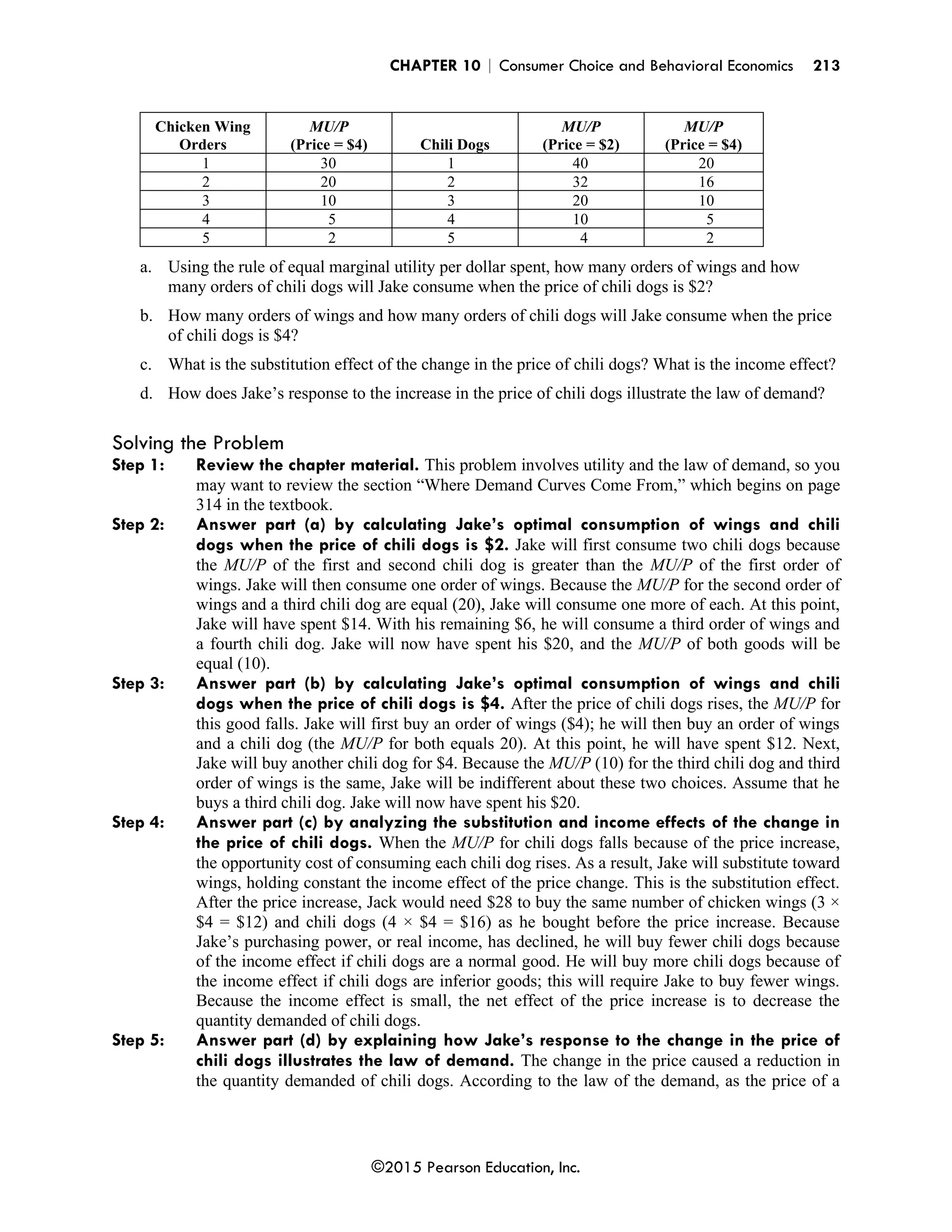
We can use the rule of equal marginal utility per dollar (MU/P) to analyze how consumers adjust their
buying decisions in response to price changes. The following table shows Jake’s utility from his two
favorite foods: chicken wings (each order contains 10 wings) and chili dogs.
Chicken Wings Chili Dogs
Orders
MU per Order of
Chicken Wings Orders
MU per Order of
Chili Dogs
1 120 1 80
2 80 2 64
3 40 3 40
4 20 4 20
5 8 5 8
Assume that Jake has $20. Assume also that the price of chicken wings is $4 per order and that the price
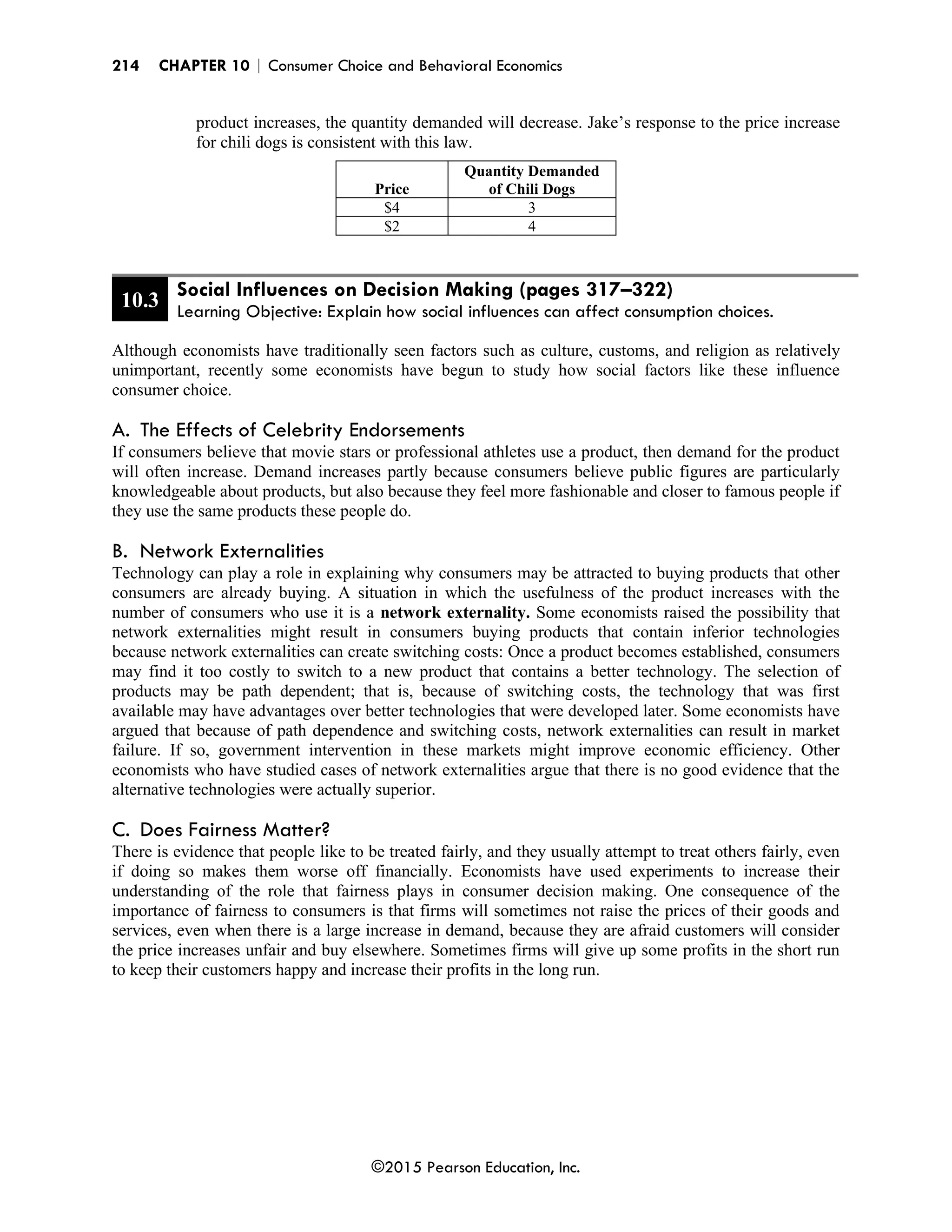
of chili dogs is initially $2. The following table shows the MU/P for wings and chili dogs at their initial
prices, as well as the MU/P of chili dogs after the price increases to $4.
CHAPTER 10 | Consumer Choice and Behavioral Economics 213
©2015 Pearson Education, Inc.
Chicken Wing
Orders
MU/P
(Price = $4) Chili Dogs
MU/P
(Price = $2)
MU/P
(Price = $4)
1 30 1 40 20
2 20 2 32 16
3 10 3 20 10
4 5 4 10 5
5 2 5 4 2
a. Using the rule of equal marginal utility per dollar spent, how many orders of wings and how
many orders of chili dogs will Jake consume when the price of chili dogs is $2?
b. How many orders of wings and how many orders of chili dogs will Jake consume when the price
of chili dogs is $4?
c. What is the substitution effect of the change in the price of chili dogs? What is the income effect?
d. How does Jake’s response to the increase in the price of chili dogs illustrate the law of demand?
Solving the Problem
Step 1: Review the chapter material. This problem involves utility and the law of demand, so you
may want to review the section “Where Demand Curves Come From,” which begins on page
314 in the textbook.
Step 2: Answer part (a) by calculating Jake’s optimal consumption of wings and chili
dogs when the price of chili dogs is $2. Jake will first consume two chili dogs because
the MU/P of the first and second chili dog is greater than the MU/P of the first order of
wings. Jake will then consume one order of wings. Because the MU/P for the second order of
wings and a third chili dog are equal (20), Jake will consume one more of each. At this point,
Jake will have spent $14. With his remaining $6, he will consume a third order of wings and
a fourth chili dog. Jake will now have spent his $20, and the MU/P of both goods will be
equal (10).
Step 3: Answer part (b) by calculating Jake’s optimal consumption of wings and chili
dogs when the price of chili dogs is $4. After the price of chili dogs rises, the MU/P for
this good falls. Jake will first buy an order of wings ($4); he will then buy an order of wings
and a chili dog (the MU/P for both equals 20). At this point, he will have spent $12. Next,
Jake will buy another chili dog for $4. Because the MU/P (10) for the third chili dog and third
order of wings is the same, Jake will be indifferent about these two choices. Assume that he
buys a third chili dog. Jake will now have spent his $20.
Step 4: Answer part (c) by analyzing the substitution and income effects of the change in
the price of chili dogs. When the MU/P for chili dogs falls because of the price increase,
the opportunity cost of consuming each chili dog rises. As a result, Jake will substitute toward
wings, holding constant the income effect of the price change. This is the substitution effect.
After the price increase, Jack would need $28 to buy the same number of chicken wings (3 ×
$4 = $12) and chili dogs (4 × $4 = $16) as he bought before the price increase. Because
Jake’s purchasing power, or real income, has declined, he will buy fewer chili dogs because
of the income effect if chili dogs are a normal good. He will buy more chili dogs because of
the income effect if chili dogs are inferior goods; this will require Jake to buy fewer wings.
Because the income effect is small, the net effect of the price increase is to decrease the
quantity demanded of chili dogs.
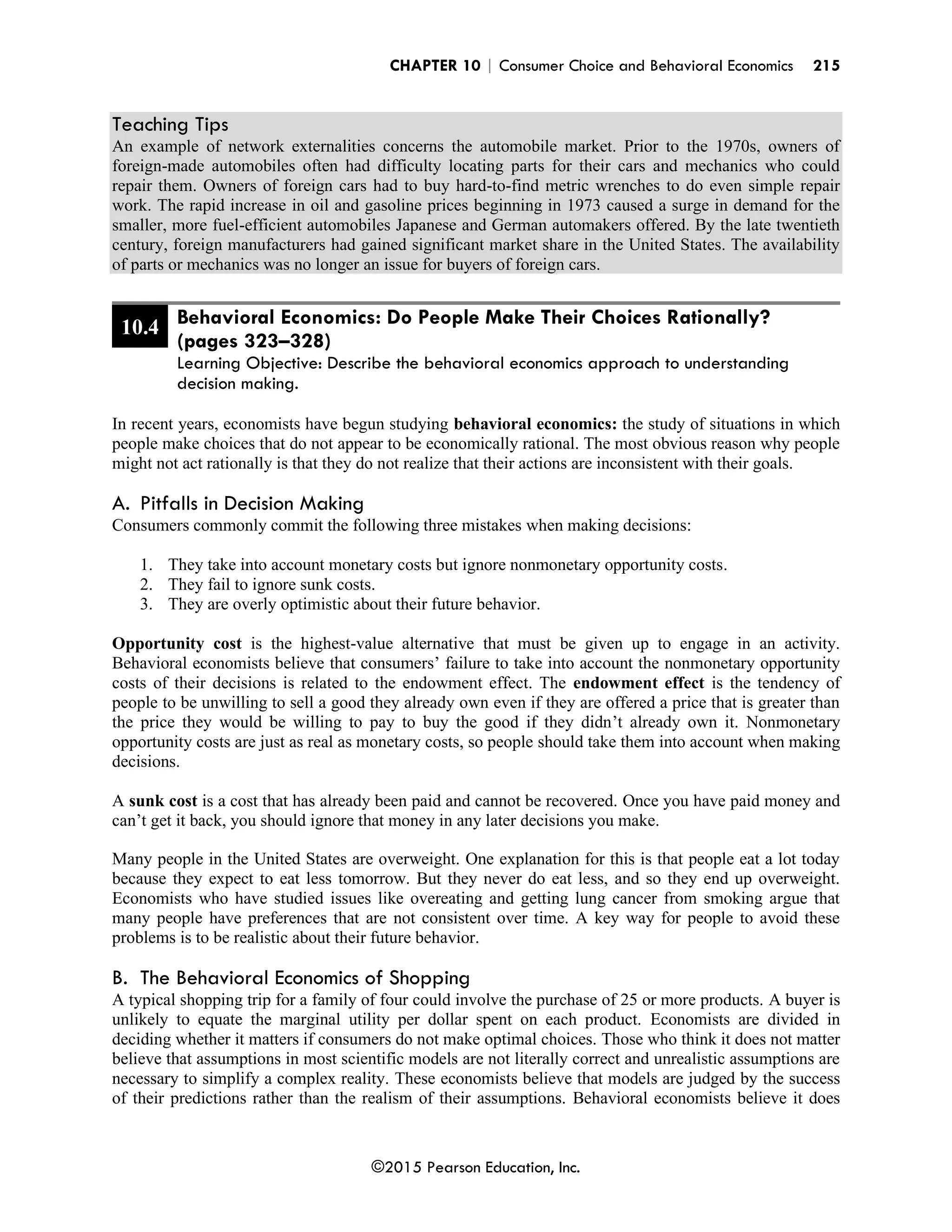
Step 5: Answer part (d) by explaining how Jake’s response to the change in the price of
chili dogs illustrates the law of demand. The change in the price caused a reduction in
the quantity demanded of chili dogs. According to the law of the demand, as the price of a
214 CHAPTER 10 | Consumer Choice and Behavioral Economics
©2015 Pearson Education, Inc.
product increases, the quantity demanded will decrease. Jake’s response to the price increase
for chili dogs is consistent with this law.
Price
Quantity Demanded
of Chili Dogs
$4 3
$2 4
10.3
Social Influences on Decision Making (pages 317–322)
Learning Objective: Explain how social influences can affect consumption choices.
Although economists have traditionally seen factors such as culture, customs, and religion as relatively
unimportant, recently some economists have begun to study how social factors like these influence
consumer choice.
A. The Effects of Celebrity Endorsements
If consumers believe that movie stars or professional athletes use a product, then demand for the product
will often increase. Demand increases partly because consumers believe public figures are particularly
knowledgeable about products, but also because they feel more fashionable and closer to famous people if
they use the same products these people do.
B. Network Externalities
Technology can play a role in explaining why consumers may be attracted to buying products that other
consumers are already buying. A situation in which the usefulness of the product increases with the
number of consumers who use it is a network externality. Some economists raised the possibility that
network externalities might result in consumers buying products that contain inferior technologies
because network externalities can create switching costs: Once a product becomes established, consumers
may find it too costly to switch to a new product that contains a better technology. The selection of
products may be path dependent; that is, because of switching costs, the technology that was first
available may have advantages over better technologies that were developed later. Some economists have
argued that because of path dependence and switching costs, network externalities can result in market
failure. If so, government intervention in these markets might improve economic efficiency. Other
economists who have studied cases of network externalities argue that there is no good evidence that the
alternative technologies were actually superior.
C. Does Fairness Matter?
There is evidence that people like to be treated fairly, and they usually attempt to treat others fairly, even
if doing so makes them worse off financially. Economists have used experiments to increase their
understanding of the role that fairness plays in consumer decision making. One consequence of the
importance of fairness to consumers is that firms will sometimes not raise the prices of their goods and
services, even when there is a large increase in demand, because they are afraid customers will consider
the price increases unfair and buy elsewhere. Sometimes firms will give up some profits in the short run
to keep their customers happy and increase their profits in the long run.
CHAPTER 10 | Consumer Choice and Behavioral Economics 215
©2015 Pearson Education, Inc.
Teaching Tips
An example of network externalities concerns the automobile market. Prior to the 1970s, owners of
foreign-made automobiles often had difficulty locating parts for their cars and mechanics who could
repair them. Owners of foreign cars had to buy hard-to-find metric wrenches to do even simple repair
work. The rapid increase in oil and gasoline prices beginning in 1973 caused a surge in demand for the
smaller, more fuel-efficient automobiles Japanese and German automakers offered. By the late twentieth
century, foreign manufacturers had gained significant market share in the United States. The availability
of parts or mechanics was no longer an issue for buyers of foreign cars.
10.4 Behavioral Economics: Do People Make Their Choices Rationally?
(pages 323–328)
Learning Objective: Describe the behavioral economics approach to understanding
decision making.
In recent years, economists have begun studying behavioral economics: the study of situations in which
people make choices that do not appear to be economically rational. The most obvious reason why people
might not act rationally is that they do not realize that their actions are inconsistent with their goals.
A. Pitfalls in Decision Making
Consumers commonly commit the following three mistakes when making decisions:
1. They take into account monetary costs but ignore nonmonetary opportunity costs.
2. They fail to ignore sunk costs.
3. They are overly optimistic about their future behavior.
Opportunity cost is the highest-value alternative that must be given up to engage in an activity.
Behavioral economists believe that consumers’ failure to take into account the nonmonetary opportunity
costs of their decisions is related to the endowment effect. The endowment effect is the tendency of
people to be unwilling to sell a good they already own even if they are offered a price that is greater than
the price they would be willing to pay to buy the good if they didn’t already own it. Nonmonetary
opportunity costs are just as real as monetary costs, so people should take them into account when making
decisions.
A sunk cost is a cost that has already been paid and cannot be recovered. Once you have paid money and
can’t get it back, you should ignore that money in any later decisions you make.
Many people in the United States are overweight. One explanation for this is that people eat a lot today
because they expect to eat less tomorrow. But they never do eat less, and so they end up overweight.
Economists who have studied issues like overeating and getting lung cancer from smoking argue that
many people have preferences that are not consistent over time. A key way for people to avoid these
problems is to be realistic about their future behavior.
B. The Behavioral Economics of Shopping
A typical shopping trip for a family of four could involve the purchase of 25 or more products. A buyer is
unlikely to equate the marginal utility per dollar spent on each product. Economists are divided in
deciding whether it matters if consumers do not make optimal choices. Those who think it does not matter
believe that assumptions in most scientific models are not literally correct and unrealistic assumptions are
necessary to simplify a complex reality. These economists believe that models are judged by the success
of their predictions rather than the realism of their assumptions. Behavioral economists believe it does
216 CHAPTER 10 | Consumer Choice and Behavioral Economics
©2015 Pearson Education, Inc.
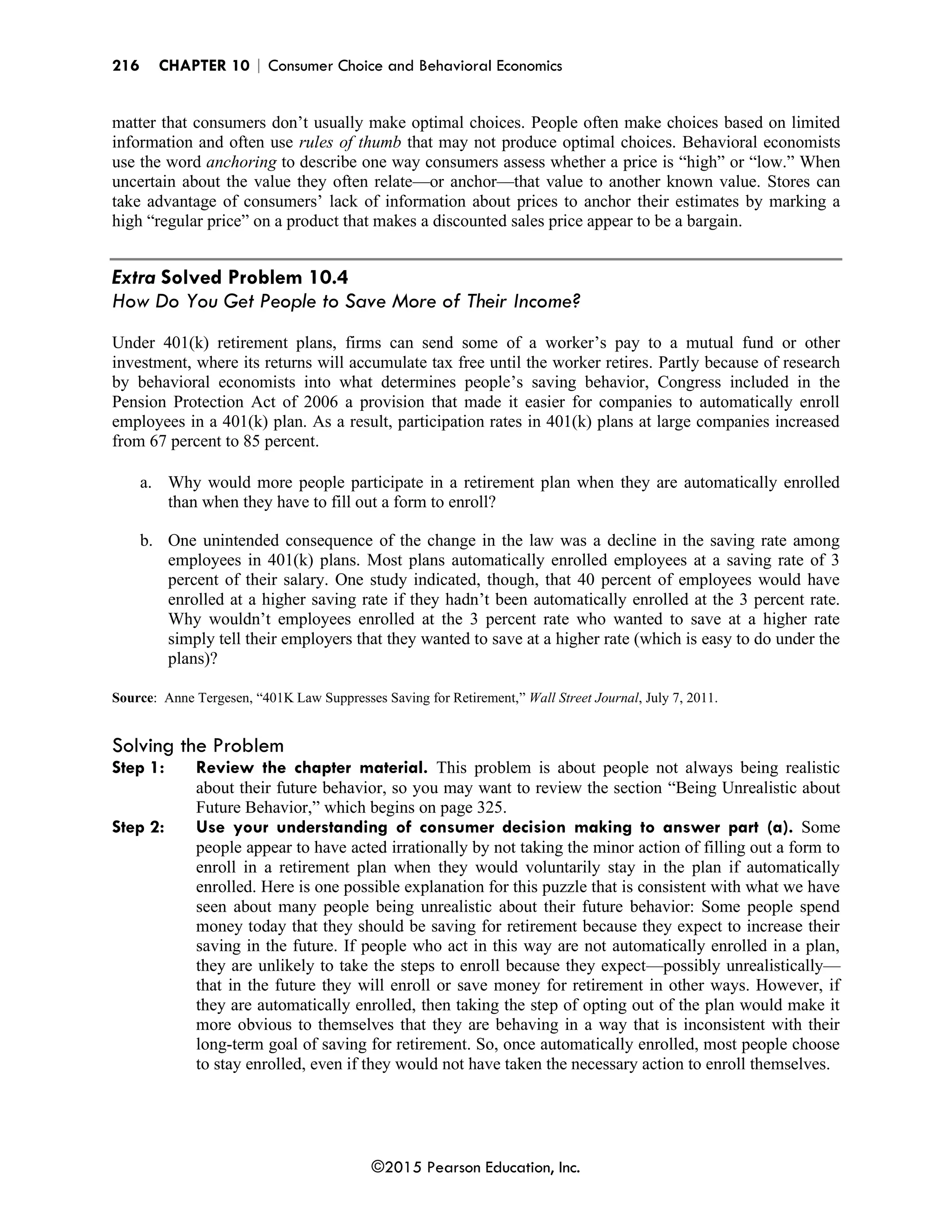
matter that consumers don’t usually make optimal choices. People often make choices based on limited
information and often use rules of thumb that may not produce optimal choices. Behavioral economists
use the word anchoring to describe one way consumers assess whether a price is “high” or “low.” When
uncertain about the value they often relate—or anchor—that value to another known value. Stores can
take advantage of consumers’ lack of information about prices to anchor their estimates by marking a
high “regular price” on a product that makes a discounted sales price appear to be a bargain.
Extra Solved Problem 10.4
How Do You Get People to Save More of Their Income?
Under 401(k) retirement plans, firms can send some of a worker’s pay to a mutual fund or other
investment, where its returns will accumulate tax free until the worker retires. Partly because of research
by behavioral economists into what determines people’s saving behavior, Congress included in the
Pension Protection Act of 2006 a provision that made it easier for companies to automatically enroll
employees in a 401(k) plan. As a result, participation rates in 401(k) plans at large companies increased
from 67 percent to 85 percent.
a. Why would more people participate in a retirement plan when they are automatically enrolled
than when they have to fill out a form to enroll?
b. One unintended consequence of the change in the law was a decline in the saving rate among
employees in 401(k) plans. Most plans automatically enrolled employees at a saving rate of 3
percent of their salary. One study indicated, though, that 40 percent of employees would have
enrolled at a higher saving rate if they hadn’t been automatically enrolled at the 3 percent rate.
Why wouldn’t employees enrolled at the 3 percent rate who wanted to save at a higher rate
simply tell their employers that they wanted to save at a higher rate (which is easy to do under the
plans)?
Source: Anne Tergesen, “401K Law Suppresses Saving for Retirement,” Wall Street Journal, July 7, 2011.
Solving the Problem
Step 1: Review the chapter material. This problem is about people not always being realistic
about their future behavior, so you may want to review the section “Being Unrealistic about
Future Behavior,” which begins on page 325.
Step 2: Use your understanding of consumer decision making to answer part (a). Some
people appear to have acted irrationally by not taking the minor action of filling out a form to
enroll in a retirement plan when they would voluntarily stay in the plan if automatically
enrolled. Here is one possible explanation for this puzzle that is consistent with what we have
seen about many people being unrealistic about their future behavior: Some people spend
money today that they should be saving for retirement because they expect to increase their
saving in the future. If people who act in this way are not automatically enrolled in a plan,
they are unlikely to take the steps to enroll because they expect—possibly unrealistically—
that in the future they will enroll or save money for retirement in other ways. However, if
they are automatically enrolled, then taking the step of opting out of the plan would make it
more obvious to themselves that they are behaving in a way that is inconsistent with their
long-term goal of saving for retirement. So, once automatically enrolled, most people choose
to stay enrolled, even if they would not have taken the necessary action to enroll themselves.
CHAPTER 10 | Consumer Choice and Behavioral Economics 217
©2015 Pearson Education, Inc.
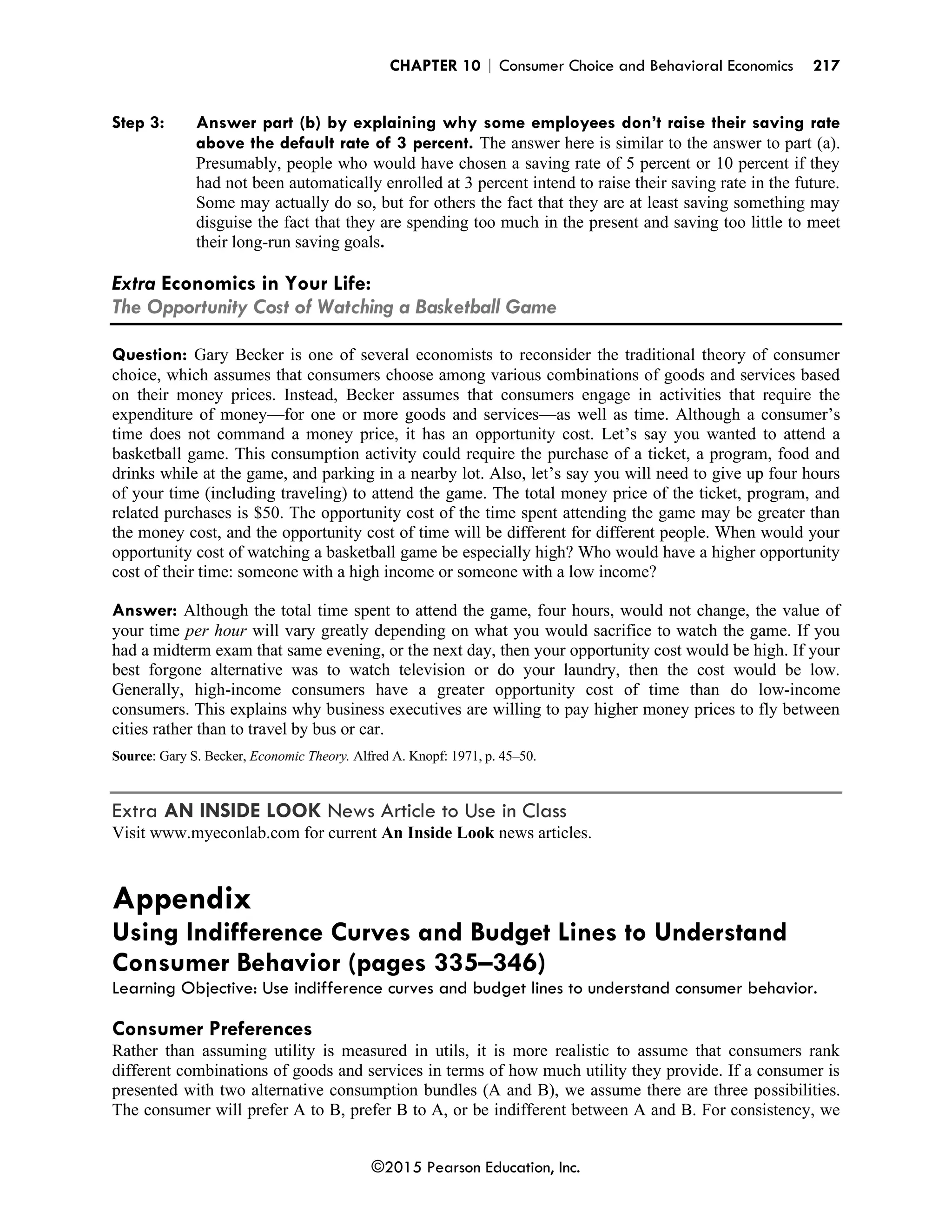
Step 3: Answer part (b) by explaining why some employees don’t raise their saving rate
above the default rate of 3 percent. The answer here is similar to the answer to part (a).
Presumably, people who would have chosen a saving rate of 5 percent or 10 percent if they
had not been automatically enrolled at 3 percent intend to raise their saving rate in the future.
Some may actually do so, but for others the fact that they are at least saving something may
disguise the fact that they are spending too much in the present and saving too little to meet
their long-run saving goals.
Extra Economics in Your Life:
The Opportunity Cost of Watching a Basketball Game
Question: Gary Becker is one of several economists to reconsider the traditional theory of consumer
choice, which assumes that consumers choose among various combinations of goods and services based
on their money prices. Instead, Becker assumes that consumers engage in activities that require the
expenditure of money—for one or more goods and services—as well as time. Although a consumer’s
time does not command a money price, it has an opportunity cost. Let’s say you wanted to attend a
basketball game. This consumption activity could require the purchase of a ticket, a program, food and
drinks while at the game, and parking in a nearby lot. Also, let’s say you will need to give up four hours
of your time (including traveling) to attend the game. The total money price of the ticket, program, and
related purchases is $50. The opportunity cost of the time spent attending the game may be greater than
the money cost, and the opportunity cost of time will be different for different people. When would your
opportunity cost of watching a basketball game be especially high? Who would have a higher opportunity
cost of their time: someone with a high income or someone with a low income?
Answer: Although the total time spent to attend the game, four hours, would not change, the value of
your time per hour will vary greatly depending on what you would sacrifice to watch the game. If you
had a midterm exam that same evening, or the next day, then your opportunity cost would be high. If your
best forgone alternative was to watch television or do your laundry, then the cost would be low.
Generally, high-income consumers have a greater opportunity cost of time than do low-income
consumers. This explains why business executives are willing to pay higher money prices to fly between
cities rather than to travel by bus or car.
Source: Gary S. Becker, Economic Theory. Alfred A. Knopf: 1971, p. 45–50.
Extra AN INSIDE LOOK News Article to Use in Class
Visit www.myeconlab.com for current An Inside Look news articles.
Appendix
Using Indifference Curves and Budget Lines to Understand
Consumer Behavior (pages 335–346)
Learning Objective: Use indifference curves and budget lines to understand consumer behavior.
Consumer Preferences
Rather than assuming utility is measured in utils, it is more realistic to assume that consumers rank
different combinations of goods and services in terms of how much utility they provide. If a consumer is
presented with two alternative consumption bundles (A and B), we assume there are three possibilities.
The consumer will prefer A to B, prefer B to A, or be indifferent between A and B. For consistency, we
218 CHAPTER 10 | Consumer Choice and Behavioral Economics
©2015 Pearson Education, Inc.
also assume the consumer’s preferences are transitive. This means that if she prefers A to B and B to C,
then she must prefer A to C.
A. Indifference Curves
An indifference curve shows the combinations of consumption bundles that give the consumer the same
utility. An indifference curve assumes that consumption bundles consist of various amounts of only two
goods. Each possible combination of two goods (for example, cans of Coca-Cola and slices of pizza) has
an indifference curve passing through it. A consumer is indifferent among all the consumption bundles
that are on the same indifference curve. In a graph of indifference curves, the further to the right a curve
is, the greater the utility it represents.
B. The Slope of an Indifference Curve
The marginal rate of substitution (MRS) is the rate at which a consumer would be willing to trade off
one good for another. The MRS decreases as an indifference curve becomes less steep as one moves down
the curve; indifference curves are bowed in or convex.
C. Can Indifference Curves Ever Cross?
Indifference curves do not cross. If two curves did cross, it would violate the assumption that consumer
preferences are transitive.
The Budget Constraint
A consumer’s budget constraint is the amount of income she has available to spend on goods and
services. In an indifference curve graph, the budget constraint is represented by a straight downward-
sloping line. Any consumption bundle on or inside the line is affordable. Any bundle that lies outside the
line is unaffordable. The slope of the budget constraint is constant because the budget constraint is a
straight line. The slope of the budget constraint is equal to the ratio of the price of the good on the
horizontal axis divided by the price of the good on the vertical axis multiplied by −1.
Choosing the Optimal Consumption of Pizza and Coke
To maximize utility, a consumer needs to be on the highest indifference curve, given his budget
constraint. Utility maximization occurs at the point of tangency between the consumer’s budget line and
an indifference curve.
A. Deriving the Demand Curve
The change in a consumer’s optimal consumption as the price of a good changes explains why demand
curves slope downward. A fall in the price of a good will rotate the budget constraint outward and make it
possible for a consumer to reach higher indifference curves. As a result, the consumer will increase the
quantity of the good demanded. An increase in price will rotate the budget line inward and force the
consumer to a lower indifference curve. As a result, the consumer will decrease the quantity of the good
demanded.
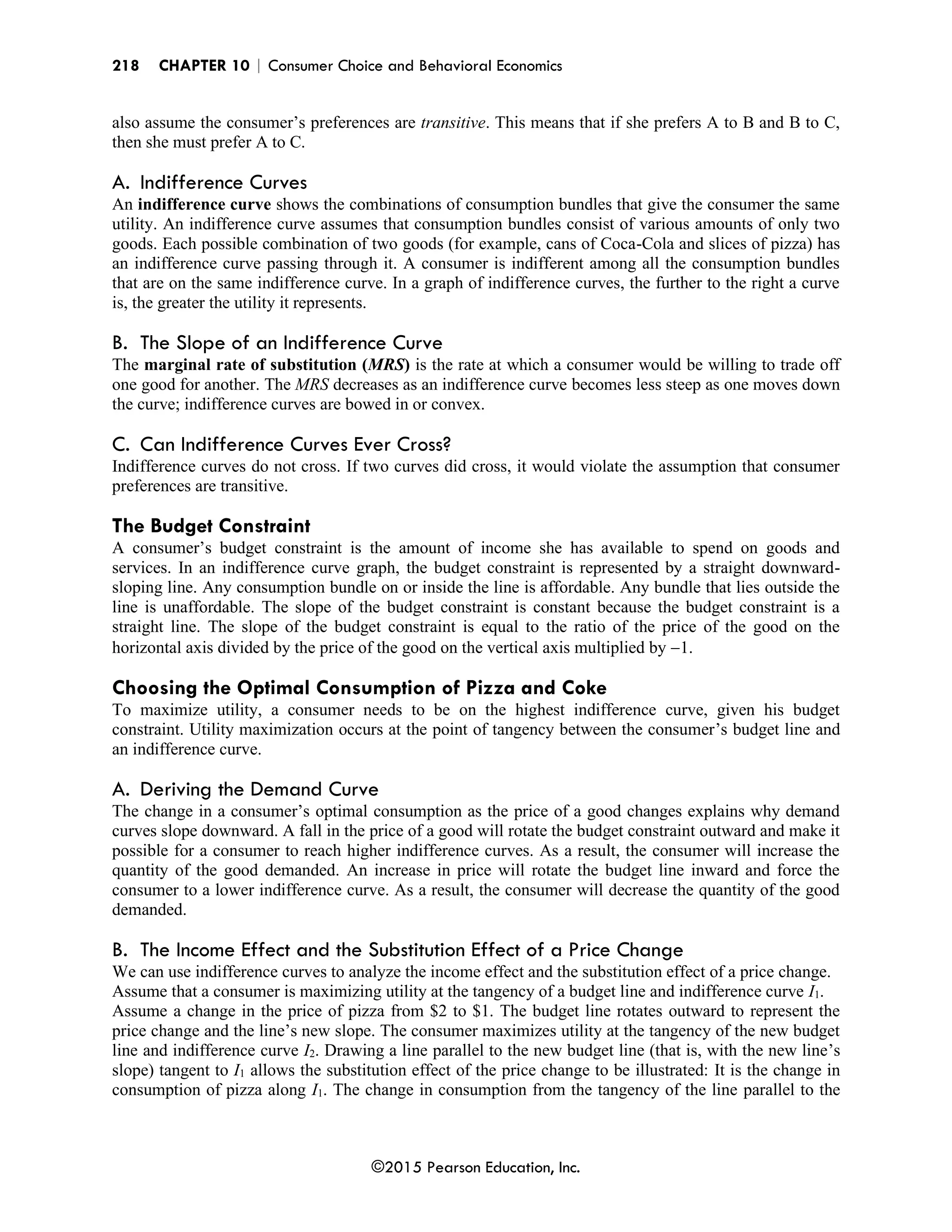
B. The Income Effect and the Substitution Effect of a Price Change
We can use indifference curves to analyze the income effect and the substitution effect of a price change.
Assume that a consumer is maximizing utility at the tangency of a budget line and indifference curve I1.
Assume a change in the price of pizza from $2 to $1. The budget line rotates outward to represent the
price change and the line’s new slope. The consumer maximizes utility at the tangency of the new budget
line and indifference curve I2. Drawing a line parallel to the new budget line (that is, with the new line’s
slope) tangent to I1 allows the substitution effect of the price change to be illustrated: It is the change in
consumption of pizza along I1. The change in consumption from the tangency of the line parallel to the
CHAPTER 10 | Consumer Choice and Behavioral Economics 219
©2015 Pearson Education, Inc.
new budget line and I1 to the tangency of the new budget line and I2 illustrates the income effect of the
change in price.
C. How a Change in Income Affects Optimal Consumption
An increase in income allows the consumer to buy more of both goods; for example, Coke and pizza. This
is shown through a parallel shift of the budget line outward. The new budget line is tangent to a higher
indifference curve.
The Slope of the Indifference Curve, the Slope of the Budget Line, and the Rule
of Equal Marginal Utility per Dollar Spent
At the point of optimal consumption, the MRS is equal to the ratio of the price of the product on the
horizontal axis to the price of the product on the vertical axis. The slope of the indifference curve tells us
the rate at which a consumer is willing to trade off one good for the other. The slope of the budget
constraint tells us the rate at which the consumer is able to trade off one good for the other. Only at the
point of optimal consumption is the rate at which a consumer is willing to trade off one good for the other
equal to the rate at which he can trade off one good for the other. This condition is equivalent to stating
that consumers maximize utility when they consume each good up to the point where the marginal utility
per dollar spent is the same for every good.
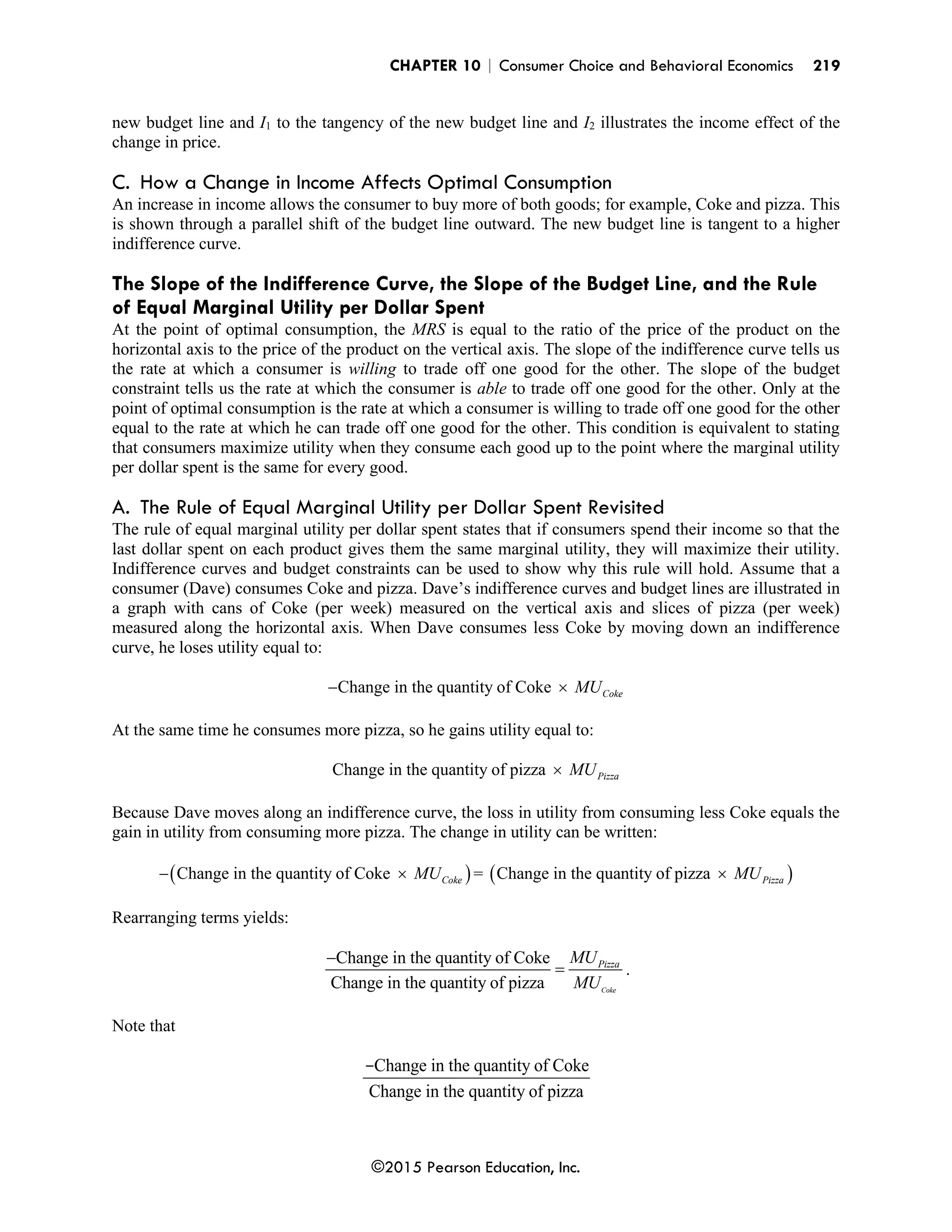
A. The Rule of Equal Marginal Utility per Dollar Spent Revisited
The rule of equal marginal utility per dollar spent states that if consumers spend their income so that the
last dollar spent on each product gives them the same marginal utility, they will maximize their utility.
Indifference curves and budget constraints can be used to show why this rule will hold. Assume that a
consumer (Dave) consumes Coke and pizza. Dave’s indifference curves and budget lines are illustrated in
a graph with cans of Coke (per week) measured on the vertical axis and slices of pizza (per week)
measured along the horizontal axis. When Dave consumes less Coke by moving down an indifference
curve, he loses utility equal to:
Change in the quantity of Coke Coke
MU
− 
At the same time he consumes more pizza, so he gains utility equal to:
Change in the quantity of pizza Pizza
MU

Because Dave moves along an indifference curve, the loss in utility from consuming less Coke equals the
gain in utility from consuming more pizza. The change in utility can be written:
( )
Change in the quantity of Coke Coke
MU
−  = ( )
Change in the quantity of pizza Pizza
MU

Rearranging terms yields:
Change in the quantity of Coke
Change in the quantity of pizza Coke
Pizza
MU
MU
−
= .
Note that
Change in the quantity of Coke
Change in the quantity of pizza
-
220 CHAPTER 10 | Consumer Choice and Behavioral Economics
©2015 Pearson Education, Inc.
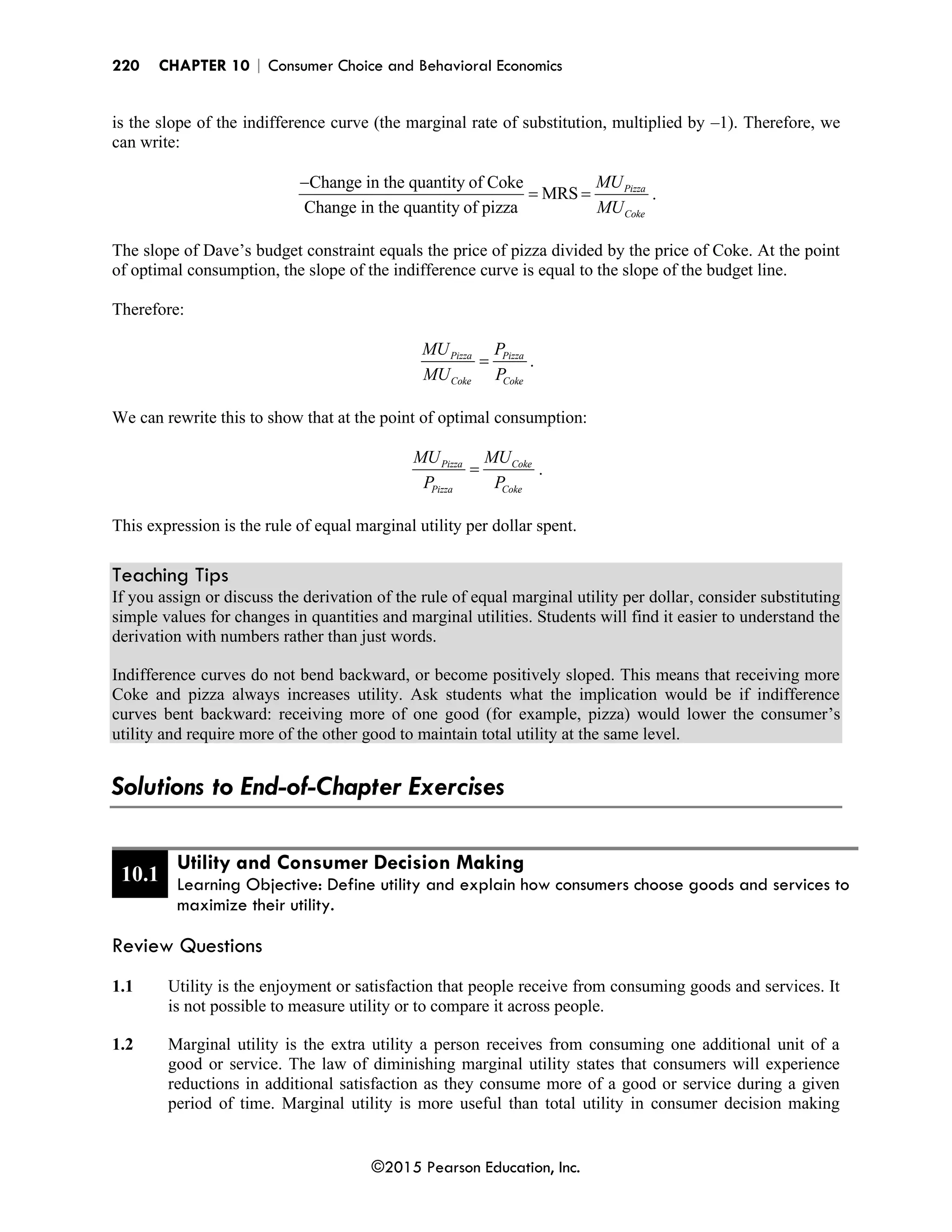
is the slope of the indifference curve (the marginal rate of substitution, multiplied by –1). Therefore, we
can write:
Change in the quantity of Coke
MRS
Change in the quantity of pizza
Pizza
Coke
MU
MU
−
= = .
The slope of Dave’s budget constraint equals the price of pizza divided by the price of Coke. At the point
of optimal consumption, the slope of the indifference curve is equal to the slope of the budget line.
Therefore:
Pizza Pizza
Coke Coke
MU P
MU P
= .
We can rewrite this to show that at the point of optimal consumption:
Pizza Coke
Pizza Coke
MU MU
P P
= .
This expression is the rule of equal marginal utility per dollar spent.
Teaching Tips
If you assign or discuss the derivation of the rule of equal marginal utility per dollar, consider substituting
simple values for changes in quantities and marginal utilities. Students will find it easier to understand the
derivation with numbers rather than just words.
Indifference curves do not bend backward, or become positively sloped. This means that receiving more
Coke and pizza always increases utility. Ask students what the implication would be if indifference
curves bent backward: receiving more of one good (for example, pizza) would lower the consumer’s
utility and require more of the other good to maintain total utility at the same level.
Solutions to End-of-Chapter Exercises
10.1
Utility and Consumer Decision Making
Learning Objective: Define utility and explain how consumers choose goods and services to
maximize their utility.
Review Questions
1.1 Utility is the enjoyment or satisfaction that people receive from consuming goods and services. It
is not possible to measure utility or to compare it across people.
1.2 Marginal utility is the extra utility a person receives from consuming one additional unit of a
good or service. The law of diminishing marginal utility states that consumers will experience
reductions in additional satisfaction as they consume more of a good or service during a given
period of time. Marginal utility is more useful than total utility in consumer decision making
CHAPTER 10 | Consumer Choice and Behavioral Economics 221
©2015 Pearson Education, Inc.
because consumption decisions are usually made at the margin, involving the decision of whether
to consume a little bit more or a little bit less of a product.
1.3 The budget constraint is the limited amount of income available for a consumer to spend on
goods and services. The rule of equal marginal utility per dollar spent states that a consumer will
make the optimal decision by allocating his or her budget so that the marginal utility per dollar
spent is the same for all goods and services being consumed.
1.4 There is a change in the quantity demanded of the product due to the effect of the change in price
on consumer purchasing power (the income effect) and due to the change in price making the
good more or less expensive relative to other goods (the substitution effect).
Problems and Applications
1.5 The law of diminishing marginal utility might not hold true in every case and might not hold over
certain ranges of consumption. One example would be increasing from less than a full dose of a
medicine to a full dose.
1.6 The last dollar saved should give consumers the same additional utility, in terms of expected
future consumption, as the last dollar spent on goods and services.
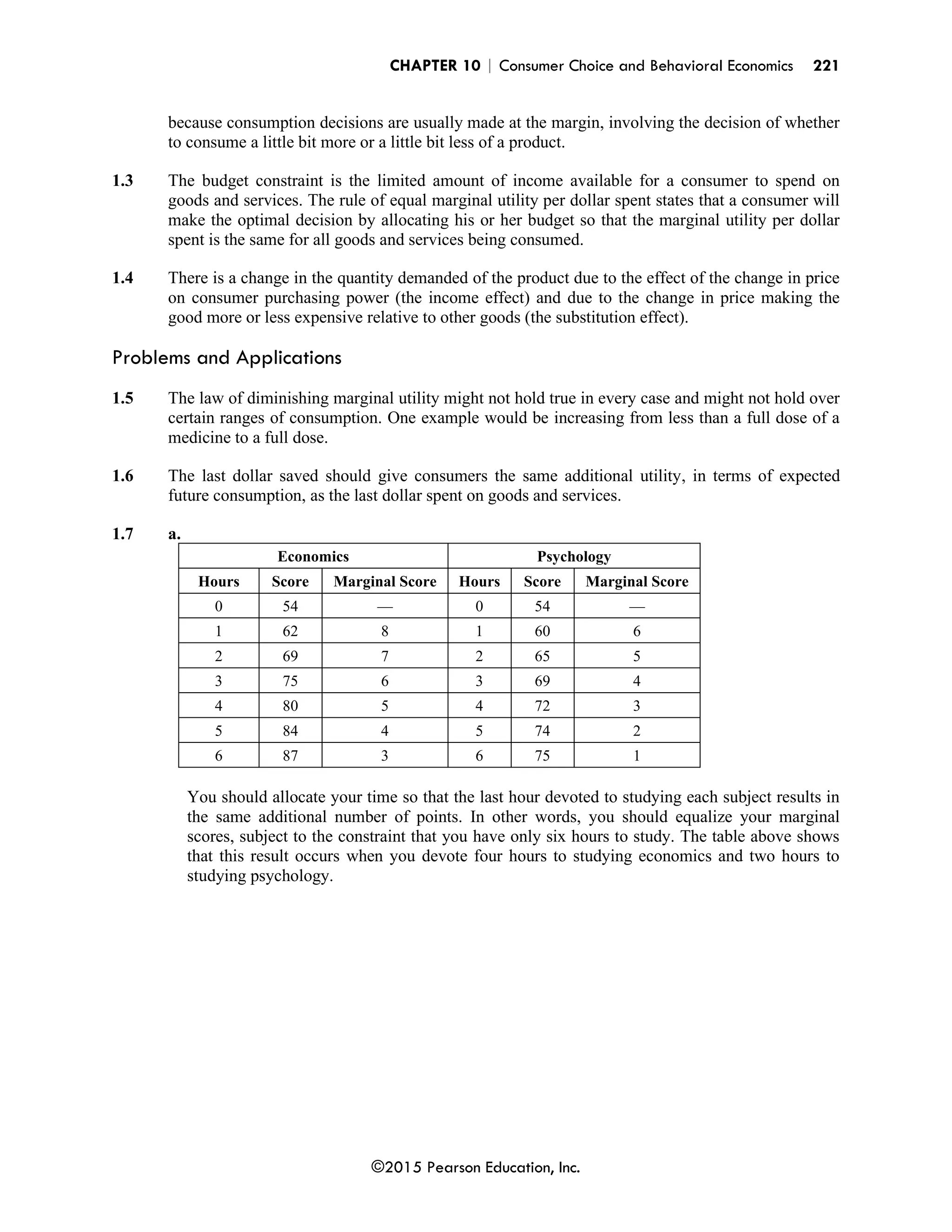
1.7 a.
Economics Psychology
Hours Score Marginal Score Hours Score Marginal Score
0 54 — 0 54 —
1 62 8 1 60 6
2 69 7 2 65 5
3 75 6 3 69 4
4 80 5 4 72 3
5 84 4 5 74 2
6 87 3 6 75 1
You should allocate your time so that the last hour devoted to studying each subject results in
the same additional number of points. In other words, you should equalize your marginal
scores, subject to the constraint that you have only six hours to study. The table above shows
that this result occurs when you devote four hours to studying economics and two hours to
studying psychology.
222 CHAPTER 10 | Consumer Choice and Behavioral Economics
©2015 Pearson Education, Inc.
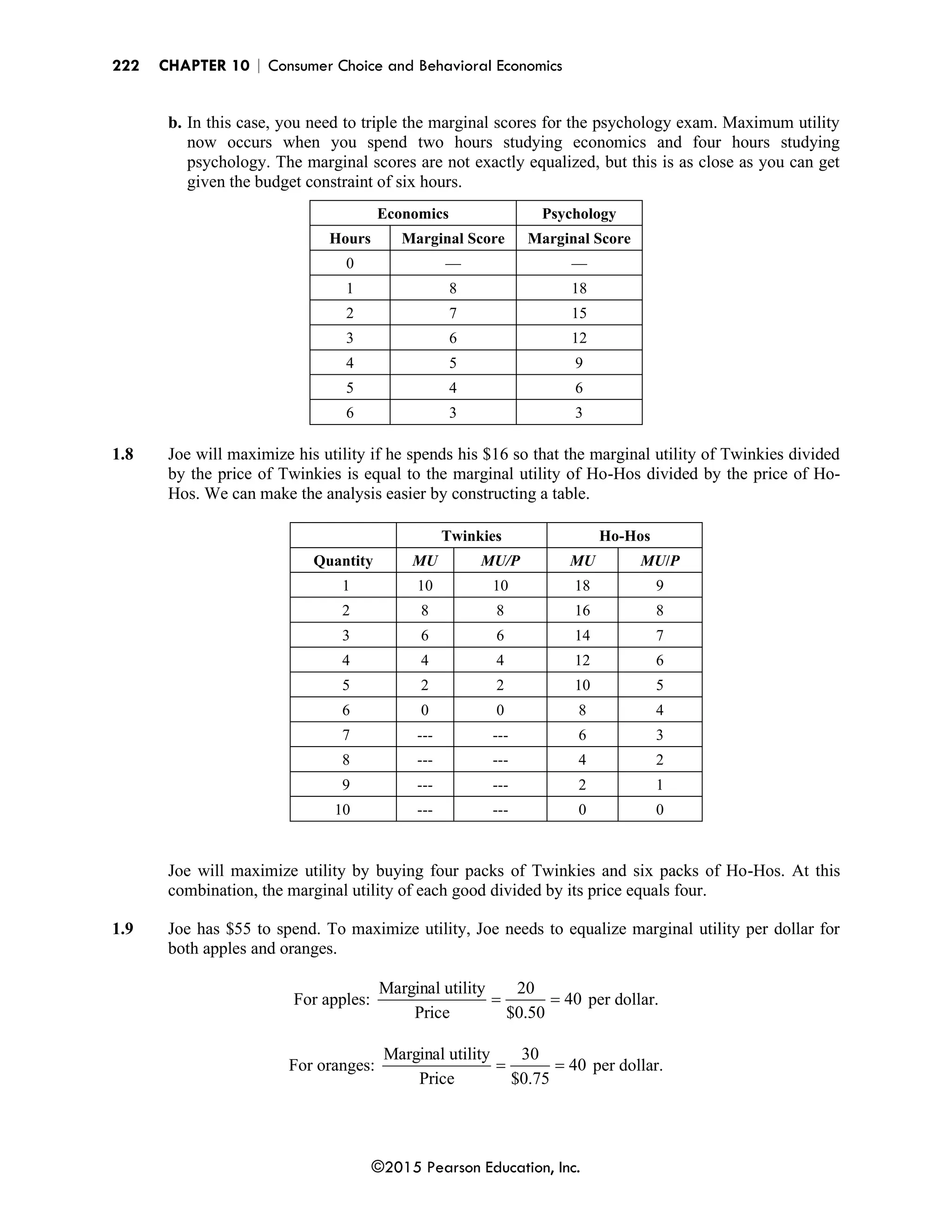
b. In this case, you need to triple the marginal scores for the psychology exam. Maximum utility
now occurs when you spend two hours studying economics and four hours studying
psychology. The marginal scores are not exactly equalized, but this is as close as you can get
given the budget constraint of six hours.
Economics Psychology
Hours Marginal Score Marginal Score
0 — —
1 8 18
2 7 15
3 6 12
4 5 9
5 4 6
6 3 3
1.8 Joe will maximize his utility if he spends his $16 so that the marginal utility of Twinkies divided
by the price of Twinkies is equal to the marginal utility of Ho-Hos divided by the price of Ho-
Hos. We can make the analysis easier by constructing a table.
Twinkies Ho-Hos
Quantity MU MU/P MU MU/P
1 10 10 18 9
2 8 8 16 8
3 6 6 14 7
4 4 4 12 6
5 2 2 10 5
6 0 0 8 4
7 --- --- 6 3
8 --- --- 4 2
9 --- --- 2 1
10 --- --- 0 0
Joe will maximize utility by buying four packs of Twinkies and six packs of Ho-Hos. At this
combination, the marginal utility of each good divided by its price equals four.
1.9 Joe has $55 to spend. To maximize utility, Joe needs to equalize marginal utility per dollar for
both apples and oranges.
For apples: 40
50
.
0
$
20
Price
utility
Marginal
=
= per dollar.
For oranges: 40
75
.
0
$
30
Price
utility
Marginal
=
= per dollar.
CHAPTER 10 | Consumer Choice and Behavioral Economics 223
©2015 Pearson Education, Inc.
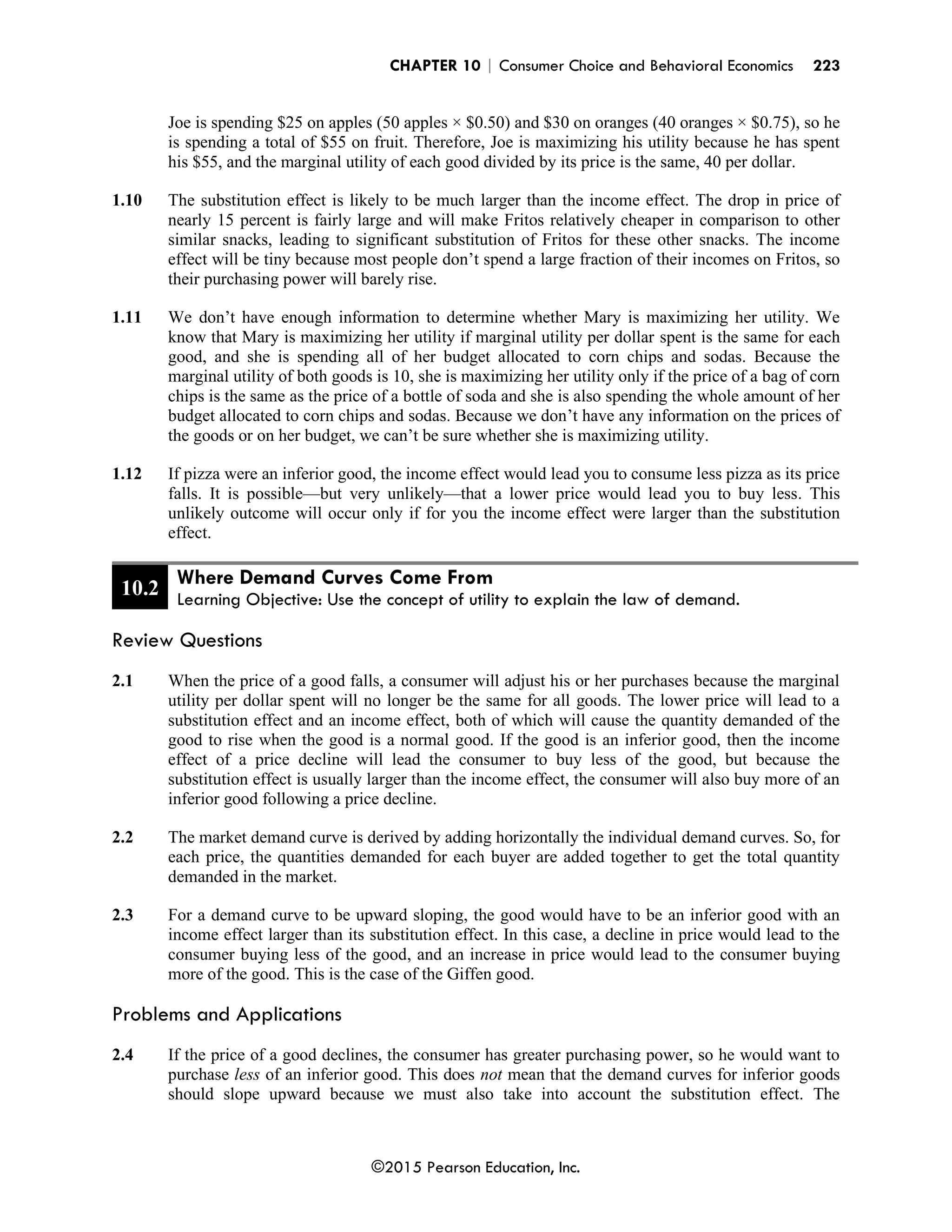
Joe is spending $25 on apples (50 apples × $0.50) and $30 on oranges (40 oranges × $0.75), so he
is spending a total of $55 on fruit. Therefore, Joe is maximizing his utility because he has spent
his $55, and the marginal utility of each good divided by its price is the same, 40 per dollar.
1.10 The substitution effect is likely to be much larger than the income effect. The drop in price of
nearly 15 percent is fairly large and will make Fritos relatively cheaper in comparison to other
similar snacks, leading to significant substitution of Fritos for these other snacks. The income
effect will be tiny because most people don’t spend a large fraction of their incomes on Fritos, so
their purchasing power will barely rise.
1.11 We don’t have enough information to determine whether Mary is maximizing her utility. We
know that Mary is maximizing her utility if marginal utility per dollar spent is the same for each
good, and she is spending all of her budget allocated to corn chips and sodas. Because the
marginal utility of both goods is 10, she is maximizing her utility only if the price of a bag of corn
chips is the same as the price of a bottle of soda and she is also spending the whole amount of her
budget allocated to corn chips and sodas. Because we don’t have any information on the prices of
the goods or on her budget, we can’t be sure whether she is maximizing utility.
1.12 If pizza were an inferior good, the income effect would lead you to consume less pizza as its price
falls. It is possible—but very unlikely—that a lower price would lead you to buy less. This
unlikely outcome will occur only if for you the income effect were larger than the substitution
effect.
10.2
Where Demand Curves Come From
Learning Objective: Use the concept of utility to explain the law of demand.
Review Questions
2.1 When the price of a good falls, a consumer will adjust his or her purchases because the marginal
utility per dollar spent will no longer be the same for all goods. The lower price will lead to a
substitution effect and an income effect, both of which will cause the quantity demanded of the
good to rise when the good is a normal good. If the good is an inferior good, then the income
effect of a price decline will lead the consumer to buy less of the good, but because the
substitution effect is usually larger than the income effect, the consumer will also buy more of an
inferior good following a price decline.
2.2 The market demand curve is derived by adding horizontally the individual demand curves. So, for
each price, the quantities demanded for each buyer are added together to get the total quantity
demanded in the market.
2.3 For a demand curve to be upward sloping, the good would have to be an inferior good with an
income effect larger than its substitution effect. In this case, a decline in price would lead to the
consumer buying less of the good, and an increase in price would lead to the consumer buying
more of the good. This is the case of the Giffen good.
Problems and Applications
2.4 If the price of a good declines, the consumer has greater purchasing power, so he would want to
purchase less of an inferior good. This does not mean that the demand curves for inferior goods
should slope upward because we must also take into account the substitution effect. The
Random documents with unrelated
content Scribd suggests to you:
longing for all that being mistress of Stanier meant to her. Then came
Colin’s return from Italy, and the whisper of her heart grew louder. She
could not help contrasting her lover with her friend, and in that new light
Raymond’s attentions to her, his caresses, his air—she must confess—of
proprietorship grew odious and insufferable. And then, just as Colin had
said, came the earthquake. In that disruption, all that from the worldly point
of view seemed so precious, turned to dross.
At that point she hesitated a moment, and Philip had found himself
recording how like she was to Colin. With just that triumphant glow of
happiness with which he had said: “Raymond has got Stanier, father, Violet
and I have got each other,” so Violet now, after her momentary hesitation,
spoke to him.
“Stanier, for which I longed, Uncle Philip, doesn’t exist for me any
more. How could I weigh it against Colin?”
Colin’s happiness ... nothing could dim that sunshine for his father, and
the sunshine was not only of to-day, it was the sunshine that had shone on
him and Rosina more than twenty years ago. His heart melted with the love
that through Colin reacted on her. Surely she must rejoice at the boy’s
happiness to-day! Raymond, to be sure, was the fruit of her body also, but it
was through Colin that she lived, he was the memory and the gracious
image of her beauty.
Raymond entered, snapping the golden thread.
“You wanted to see me, father,” he said.
Philip had been attempting to drill himself into a sympathetic bearing
towards his son, but Raymond’s actual presence here in succession to Colin
and Violet, brought sheer helplessness. For the brightness and beam of the
others there was this solid self-sufficiency. It seemed as if a crime had been
averted in the transference of the girl to another bridegroom. What
unnatural union would have been made by this mating of her! His heart
sang; it were vain to try to throttle it into silence.
“Yes, Raymond; sit down,” said he, indicating a place on the sofa where
he sat.
“Oh, thanks, it doesn’t matter. I’ll stand,” said Raymond.
“I’ve got bad news for you,” said Philip. “You must brace yourself to it.”
“Let’s have it,” said Raymond.
Philip felt his sympathy slipping from him. He wanted chiefly to get it
over; there was no use in attempting to lead up to it.
“It concerns you and Violet,” he said.
A savage look as of a hungry dog from whom his dinner is being
snatched, came across Raymond’s face.
“Well?” he said.
“She wished me to tell you that she can’t marry you,” said his father.
“She asks you to set her free from her engagement.”
The savagery of that sullen face grew blacker. “I don’t accept that from
you,” he said. “If it’s true, Violet will have to tell me herself.”
Philip made a great effort with himself. “It is true,” he said, “and I want
at once to tell you that I’m very sorry for you. But it would have been very
painful for her to tell you, and it was I who suggested that I should break
her decision to you. I hope you won’t insist on having it from her.”
“She has got to tell me,” said Raymond. “And is that all, father? If so,
I’ll go to her at once.”
“No, there’s more,” said he.
Raymond’s face went suddenly white; his mouth twitched, he presented
a mask of hatred.
“And so it’s Colin who has got to tell me the rest,” he said. “Is that it?”
“She is going to marry Colin.”
For a moment Raymond stood perfectly still; just his hands were
moving; knitted together they made the action of squeezing something.
Once it seemed that he tried to speak, but no word came; only the teeth
shewed in his mouth.
“Colin has got to tell me then,” he said. “I will see Colin first.”
Philip got up and laid a hand of authority on Raymond’s shoulder. The
boy, for all his quietness, seemed beside himself with some pent-up fury all
the more dangerous for its suppression.
“You must not see either of them in the state you are in now,” he said.
“That’s my affair,” said Raymond.
“It’s mine, too. You’re my son and so is Colin. You must wait till you’ve
got more used to what has happened. And you must remember this, that a
few weeks ago Colin was in the same case as you are now. He loved Violet,
and it was I then, out in Capri, who told him that Violet was going to marry
you. And he took it like a man, like the generous fellow he is. His first
words were: ‘By Jove, Raymond will be happy!’ I shall never forget that,
and you mustn’t either, Raymond.”
Raymond gave a dry snap of a laugh.
“I won’t,” he said. “That’s just what Colin would say. Perfect character,
isn’t he? Only last night I found him talking to Violet in her bedroom. I
wasn’t pleased, and he begged me not to be vexed, as I had got everything.
He had taken Violet from me when he said that, or if not, he came back
when Violet was in bed, and got engaged to her then. Engaged!”
“Now stop that, Raymond,” said his father.
“Very good. He was already engaged to her when he told me I had got
everything. You don’t understand Colin. He hates more than he loves. He
has hated me all my life. ‘By Jove, Raymond will be happy!’ I’ll be even
with Colin some day. Now I’m going to see him. Or shall I say: ‘By Jove,
Colin will be happy?’ Then you’ll consider me a generous fellow.”
Once again Philip tried to put himself in Raymond’s place, and made
allowance for his bitter blackness. His hand went on to the boy’s shoulder
again, with less of authority and more of attempted affection.
“Raymond, you must do better than this,” he said. “You would be very
unwise to see Colin and Violet just now, but if you insist on doing so, you
shall see them in my presence. I can’t trust you, in the mood you’re in, not
to be violent, not to say or do something which you would bitterly repent,
and which they would find it hard to forgive. And if, which I deny, Colin
has always hated you, what about yourself?”
Both of them now were on bed-rock. By implication, by admission, by
denial even, they had got down to the hatred that, like a vein of murderous
gold, ran through the very foundation of the brothers’ existence. Who knew
what struggle might have taken place, what prenatal wrestling in the very
womb of life, of which the present antagonism was but a sequel, logical and
inevitable!
Even as Philip spoke, he half-realised the futility of bringing argument to
bear on Raymond’s nature, for this hatred sprang from some ineradicable
instinct, an iron law on which intelligence and reason could but perch like a
settling fly. He could deny that Colin hated his brother, he could urge
Raymond to show himself as generous as he believed Colin to have been,
but nothing that he could say, no persuasion, no authority could mitigate
this fraternal hostility. And even while he denied Colin’s animosity, with the
evidence he had already brought forward to back it, he found himself
wondering if at heart Colin could feel the generosity he had expressed, or
whether it was not a mere superficial good-nature, mingled with contempt
perhaps, that had given voice to it.
Raymond had ceased from the clutching and squeezing of his hands.
“You don’t know what Colin is,” he said, “and I know it is no use trying
to convince you. I shan’t try. You judge by what you see of him and me, and
you put me down for a black-hearted, sullen fellow, and he’s your heart’s
darling.”
“You’ve got no right to say that,” said Philip.
“But can I help knowing it, father?” asked he.
Philip felt that his very will-power was in abeyance; he could not even
want to readjust the places which his two sons held in his heart, or, rather, to
find place in his heart for the son who had never been installed there yet.
And there would be no use in “wanting,” even if he could accomplish that.
Colin held every door of his heart, and with a grudging sense of justice
towards Raymond, he was aware that Colin would grant no admittance to
his brother. Or was that conviction only the echo of his own instinct that he
wanted no one but Colin there? He had no love to spare for Raymond. Such
spring of it as bubbled in him must fall into Colin’s cup, the cup that never
could be filled.
How could he but contrast the two? Here was Raymond, sullen in his
defeat, attempting (and with unwelcome success) to put his father in the
wrong, jealous of the joy that had come to Colin, insisting, Shylock-like, on
such revenge as was in his power, the pound of flesh which would be his, in
making a scene with the girl who had chosen as her heart bade her, and the
boy who was her choice. On the other side was Colin, who, when faced
with an identical situation, had accepted his ill-luck with a wave of
welcome for the more fortunate. And Raymond would have it that that
splendid banner was but a false flag, under cover of whose whiteness a
treacherous attack might be made.
“I don’t know that we need pursue that,” said Philip. “Your feelings are
outside my control, but what is in my control is to be just to you in spite of
them. I have tried to tell you with all possible sympathy of——”
“Of Violet’s jilting me,” interrupted Raymond. “And you have clearly
shewn me, father, your sympathy with Colin’s happiness.”
Philip felt every nerve jarring. “I am not responsible for your
interpretations of myself,” he said, “nor do I accept them. If your design is
to be intolerably offensive to me, you must work out your design
somewhere else. I am not going to have you stop here in order to amuse
yourself with being rude to me, and spoiling the happiness of others——”
“Ah! Just so!” said Raymond. “Colin.”
Philip was exasperated beyond endurance.
“Quite right,” he said. “I am not going to have you spoiling Colin’s
happiness. And Violet’s. I should have suggested you leaving Stanier for the
present for your own sake, if you had allowed me to show sympathy for
you. As you do not, I suggest that you should do so for Colin’s sake. You
may go to St. James’s Square if you like, and if you can manage to behave
decently, you may stop on there when we come up next week. But that
depends on yourself. Now if you want to see Violet and your brother you
may, but you will see them here in my presence. I will send for them now, if
that is your wish. When you have seen them you shall go. Well?”
Suddenly the idea of leaving Colin and Violet here became insupportable
to Raymond. He had to see them as lovers, and hate them for it: his hate
must be fed with the sight of them.
“Must I go, father?” he said.
“Yes; you have forced me to be harsh with you. It was not my intention.
Now do you want to see them?”
Raymond hesitated: if Colin could be cunning, he could be cunning too.
“I should like to see them both,” he said.
Philip rang the bell, and in the pause before they came, Raymond went
across to the window-seat, and sat there with face averted, making no sign,
and in the silence Philip reviewed what he had done. He had no wish, as he
had said, to be harsh to Raymond, but what possible gain to any one was his
remaining here? He would be a misery to himself, and no entertainment to
others; and yet the boy wanted to stop, thinking perhaps that thus he would
be sooner able to accept the position. It was impossible to grudge him any
feasible alleviation of the blow that, so far from stunning him, had
awakened all that was worst in him. Much must depend on his behaviour
now to Colin and Violet.
They entered together. Colin looked first at his father; then, without
pause, seeing the huddled figure in the window-seat, went straight to
Raymond. All else, Violet even, was forgotten.
He laid his hand on Raymond’s shoulder. “Oh, Raymond,” he said,
“we’re brutes. I know that.”
Philip thought he had never seen anything so exquisite as that instinct of
Colin’s to go straight to his brother. Could Raymond recognise the beauty
of that?... And was it indeed Raymond who now drew Colin on to the
window-seat beside him?
“That’s all right, Colin,” he said. “You couldn’t help it. No one can help
it when it comes. I couldn’t.”
He stood up. “Father’s told me about it all,” he said, “and I just wanted
to see you and Violet for a moment in order to realise it. I’ve got it now.
Good-bye, Colin; good-bye, Violet.”
He went across to his father with hand outstretched. “Thanks ever so
much for letting me go to St. James’s Square,” he said. “And I’m sorry,
father, for behaving as I did. I know it’s no use just saying that; I’ve got to
prove it. But that’s all I can do for the present.”
He went straight out of the room without once looking back.
“Is Raymond going away?” asked Colin.
“Yes. It’s better so.”
Colin heard this with a chill of disappointment, for among his
pleasurable anticipations had been that of seeing Raymond wince and
writhe at the recasting of their parts. Raymond would have hourly before
his eyes his own rôle played by another, and with what infinitely greater
grace. The part of heroine would be filled by its “creator,” but, in this
remodelled piece, what sparkle and life she would put into her scenes.
Where she had been wooden and impassive, she would be eager and
responsive, that icy toleration would melt into a bubbling liquor of joy.
Then there would be the part now to be filled by Raymond; would he fill
that with Colin’s tact and sweetness? Of minor characters there would be
his father and grandmother, and with what convincing sincerity now would
they fill their places.... But Raymond’s absence would take all the sting and
fire out of the play.
“Oh, father, does he feel like that?” asked Colin. “Did he feel he couldn’t
bear to stop? I’m sorry.”
“No, it was I who told him to go,” said Philip. “He behaved outrageously
just now with me.”
“But he’s sorry,” said Colin. “He wants to do better. Mayn’t he stop?
He’ll be wretched all alone up in London.”
A sudden thought struck him, a touch of genius. “But it concerns Vi
most,” he said. “What do you vote, darling?”
“By all means let him stop,” said she. Nothing but Colin’s wish, here
clearly indicated, could have any weight with her.
“Then may he, father?” he asked. “That is good of you. Come and tell
him, Vi.”
Raymond was in the hall. He had just ordered his car, and was now
about to telephone to the housekeeper in town to say he was coming, when
Colin and Violet came out of the library. Philip followed them to complete
the welcome, and saw Colin go up to his brother.
“Raymond, don’t go,” he said. “We all want you to stop. Vi does, father
does, I do.”
Raymond saw his father in the doorway. “May I stop, then, father?” he
said.
“By all means. We all wish it,” said he.
Raymond looked back again at his brother. Colin was standing just
below the portrait of his ancestor, the very image and incarnation of him.
“I’ve got you to thank, I expect, Colin,” he said.
Their eyes met; Colin’s glittered like a sword unsheathed in the sunlight
of his hatred and triumph; Raymond’s smouldered in the blackness of his
hatred and defeat.
“I wish there was anything I could do for you, Ray,” said Colin gently.
The entertainment which Colin had anticipated from these alterations in
the cast of this domestic drama did not fall short of his expectations. He
held Raymond in the hollow of his hand, for Raymond’s devotion to Violet,
gross and animal though it had been, gave Colin a thousand opportunities of
making him writhe with the shrewd stings of jealousy, and with gay
deliberation he planted those darts. The coup de grâce for Raymond would
not come yet, his father’s death would give the signal for that; but at present
there was some very pretty baiting to be done. Not one of those darts, so
becomingly beribboned, failed to hit its mark: a whispered word to Violet
which made the colour spring bright and eager to her face, a saunter with
her along the terrace in the evening, and, even more than these, Colin’s
semblance of sparing Raymond’s feelings, his suggestion that he should
join them in any trivial pursuit—all these were missiles that maddingly
pierced and stung.
No less adequately did Philip and old Lady Yardley fill their minor parts;
he, with the sun of Colin’s content warming him, was genial and thoughtful
towards Raymond in a way that betrayed without possibility of mistake the
sentiment from which it sprang; while Lady Yardley, braced and invigorated
by the same emotion, was strangely rejuvenated, and her eyes, dim with
age, seemed to pierce the mists of the encompassing years and grew bright
with Colin’s youth.
As regards his own relations with Violet, Colin found he could, for the
present anyhow, manage very well; the old habits of familiarity and
intimacy appeared to supply response sufficient; for she, shuddering now, as
at some nightmare, at her abandoned engagement to Raymond and blinded
with the splendour of the dawn of her love, saw him as a god just alighted
on the gilded and rosy hills.... Colin shrugged his shoulders at her illusion;
she presented to him no such phantasmal apparition, but he could give her
liking and friendship, just what she had always had from him. Soon, so he
hoped, this vision of himself would fade from her eyes, for even as he had
found his father’s paternal devotion to him in Capri a fatiguing and boring
business, so he foresaw a much acuter gêne that would spring from a
persistence of Violet’s love. No doubt, however, she would presently
become more reasonable.
What above all fed Colin’s soul was to stroll into the smoking-room
when Violet had gone upstairs, and his father had retired to his library, and
to make Raymond drink a cup more highly spiced with gall than that which
had refreshed him in public. Raymond had usually got there first, while
Colin lingered a moment longer with Violet, and had beside him a liberally
mixed drink, and this would serve for Colin’s text:
“Hullo, Raymond! Drowning dull care?” he asked. “That’s right. I can’t
bear seeing you so down. By Jove, didn’t Violet look lovely to-night with
her hair brought low over her forehead?”
“Did she?” said Raymond. He tried to entrench himself in self-control;
he tried to force himself to get up and go, but hatred of Colin easily stormed
those defences. “Stop and listen,” said that compelling voice. “Glut yourself
with it: Love is not for you; hate is as splendid and as absorbing....”
“Did she?” echoed Colin. “As if you hadn’t been devouring her all the
evening! But we all have our turn, don’t we? Every dog has its day. Last
week I used to see you and Violet; now you see Violet and me. Tell me,
Raymond, does Violet look happy? We can talk so confidentially, can’t we,
as we have both been in the same position? What a ticklish thing it is to be a
girl’s lover. How it ages one! I feel sixty. But does she seem happy? She
used to wear a sort of haunted look last week. I suppose that was her
wonder and her misgiving at a man’s brutal adoration. It frightened her. As
if we weren’t frightened too! Did the idea of marriage terrify you as it
terrifies me? A girl’s adoration is just as brutal.”
Colin moved about the room as he spoke, dropping the sentences out like
measured doses from some phial of a potent drug. After each he paused,
waiting for a reply, and drinking glee from the silence. In that same silence
Raymond was stoking his fires which were already blazing.
“Yes, every dog has its day,” he said, replenishing his glass.
“And every dog has his drink,” said Colin. “Lord, how you’ll get your
revenge when your day comes! What sweetness in your cup that Vi and I
will never be allowed to come to Stanier again. You’ll like that, Raymond.
You’ll have married by that time. I wonder if it will be the tobacconist’s girl
who’ll have hooked you. You’ll be happier with her than Vi, you know, and
I shouldn’t wonder if Vi will be happier with me than with you....”
Still there was silence on Raymond’s part.
“You must be more cheerful, Raymond,” said Colin. “Whatever you may
do to me hereafter, you had better remember that I’m top-dog just now. I
shall have to ask father to send you away after all, if you don’t make
yourself more agreeable. It was I who made him allow you to stop here, and
I will certainly have you sent away if you’re not kinder to me. You must be
genial and jolly, though it’s a violence to your nature. You must buck up and
be pleasant. So easy, and so profitable. Nothing to say?”
There was a step outside, and their father entered. He carried an opened
letter in his hand.
“I’ve just had a note from the governor of the asylum at Repstow,” he
said. “One of their patients has escaped, a homicidal lunatic.”
“Gosh, I’ll lock my door,” said Colin. “No use for him. What else,
father?”
“It’s no joke, Colin. The keeper at the Repstow Lodge was out attending
to the pheasants’ coops this afternoon, and while he was gone a man vaulted
over the fence, frightened his wife into hysterics, and decamped with his
gun and a bag of cartridges. Then he bolted into the woods. It’s almost
certain that he is the escaped lunatic.”
Raymond, who had been listening intently, yawned.
“But they’re out after him, I suppose,” he said. “They’ll be sure to catch
him.”
Colin wondered what that yawn meant.... To any boy of twenty—to
himself anyhow—there was a spice of excitement about the news. It was
impossible not to be interested. But Raymond did not seem to be
interested.... Or did he wish it to appear that he was not interested?
Colin, with an eye on Raymond, turned to his father. Two or three more
little darts were ready for his brother, at which he would not yawn....
“Oh, father,” said he, “come and sleep in my room and we’ll take
watches. What glorious fun. You shall take the watch from midnight till, till
half-past eight in the morning, and then you’ll wake me up, and I’ll take the
watch till five in the afternoon without a wink of sleep. Then Raymond and
Vi can slumber in safety. Now I shall go upstairs and say good-night to Vi
——”
“Better not tell her about it to-night,” said Lord Yardley.
“Rather not: we shall have other things to talk about, thanks. But not a
minute before half-past eight, father. Good-night; good-night, Raymond.
Sleep well.”
Raymond, in spite of these good wishes, passed an almost sleepless
night. If he shut his eyes it was to see Colin’s mocking face floating on the
darkness of his closed lids, and to have echoing in his ears the mockery of
Colin’s jibes. As he passed Violet’s door on his way up to bed he had heard
the sound of speech and laughter from within, and his jealousy seemed to
arrest his tip-toeing steps, so that what he might overhear should give it the
bitter provender it loved. But some new-born fear of Colin made him go on
instead of lingering: Colin seemed prospered in all he did by some hellish
protection; a mysterious instinct might warn him that there was a listener,
and he would throw open the door and with a laugh call Violet to see who
was eavesdropping on the threshold.... Then after they had laughed and
pointed at him, Colin would shut the door again, locking it for fear of—of a
homicidal maniac—and the talking would go on again till it was quenched
in kisses....
He had tossed and turned as on a gridiron, with the thought of Colin and
Violet together to feed and to keep the fire alive. He did not believe that
Colin loved her; if she had not promised to marry himself, he would not
have sought her. It was from hatred of himself that he had given her a
glance and a smile and whistled her to him, so that she threw away like a
scrap of waste-paper the contract that would have installed her as mistress
of the house she adored. Colin had idly beckoned, just to gratify his hate,
and she had flamed into love for him.
What subtle arts of contrivance and intrigue were his also! He had
wanted to feast that same hatred on the sight of his brother’s defeat and
discomfiture, and a word from him had been sufficient to make his father
revoke his edict and let him remain at Stanier. Thus Colin earned fresh
laurels in the eyes of the others for his compassionate forbearance, and by
so doing accomplished his own desire of having Raymond there, like a
moth on a pin.
As the hours went on strange red fancies crossed his brain. He imagined
himself going to his father’s room and smothering him, so that next day he
would be master of Stanier, and free to turn Colin out. Not another hour
should he stay in the place. Out he should go, and Violet with him. Better
still would it be to come behind Colin with a noose in his hand, which he
would draw tight round his neck and laugh to see his face go black and his
eyes start from his head with the strangling.... That would satisfy him; he
could forgive Colin when he lay limp and lifeless at his feet, but till then he
would never know a moment’s peace or a tranquil hour.
All this week his fever of hatred had been mounting in his blood, to-
night the heat of it made to flower in his brain this garden of murderous
images. And all the time he was afraid of Colin, afraid of his barbed tongue,
his contemptuous hate, above all, of the luck that caused him to prosper and
be beloved wherever he went. Just at birth one stroke of ill-luck had
befallen him, but that was all....
Earlier in the evening, he remembered, an idea had flitted vaguely
through his head, which had suggested to him some lucky accident.... He
had purposely yawned when that notion presented itself, so that Colin
should not see that he took any interest in what was being talked about.
For the moment he could not recollect what it had been; then he
remembered how his father had come into the smoking-room and told them
that a homicidal lunatic had got hold of a gun and was at large, probably in
the park.... That was it; he had yawned then, for he had pictured to himself
Colin strolling through the leafy ways and suddenly finding himself face to
face with the man. There would be a report and Colin would lie very still
among the bracken till his body was found. Ants and insects would be
creeping about him.
That had been the faint outline of the picture; now in the dark it started
into colour. What if once again Colin’s luck failed him, and in some remote
glade he found himself alone with Raymond? He himself would have a gun
with him, and he would fire it point-blank at Colin’s face and leave him
there. It would be supposed that the escaped mad-man had encountered
him....
It was but a wild imagining, born of a sleepless night, but as he thought
of it, Raymond’s eyelids flickered and closed, and just before dawn he fell
asleep. When he was called a few hours later, that was the first image that
came into his mind, and by the light of day it wore a soberer, a more solid
aspect. What if it was no wild vision of the night, but a thing that might
actually happen?
No fresh news when they met at breakfast was to hand about the escaped
man; indeed, in answer to an inquiry sent by Lord Yardley to the asylum,
there came the reply that, though search-parties were out after him, nothing
had as yet been seen of him. Colin was engaged to play a round of golf on
the Rye links, and the chance of falling in with him seemed so remote that
soon after breakfast he went off on his motor-bicycle, promising, in order to
soothe Violet’s apprehensions, to travel at the rate of not less than forty
miles an hour. That did not please her either; in fact, there was no pleasing
her about his expedition, whether he went fast or slow; so he kissed her, and
told her to order her mourning. At the last moment, however, at his father’s
wish, he slipped a revolver into his pocket.
Raymond, as usual, refused to play golf, and preferred a wander in the
park with a gun as a defensive measure for himself, and as an offensive
measure against the plague of wood-pigeons. They were most numerous in
the woods that lay on the steep slope through which the road to Repstow
passed. That had been Colin’s road, too, and when Raymond set out a
quarter of an hour later, the dust raised by his motor-bicycle still hung in the
windless air.
Ten minutes walking brought him to the point where the road which
hitherto had lain across the open grass of the park descended into the big
belt of wood which stretched as far as the lodge-gates. On each side of it the
ground rose sharply, covered on the one side by firs and birches with
groundwork of heather, on the other by the oaks of what was known as the
Old Park. According to tradition they were of the plantings of Elizabeth’s
Colin, and for age and grandeur they might well be so, for stately and
venerable they rose from the short deer-nibbled turf, well-spaced with full
freedom for roots and branch alike. No other trees were on that slope, but
these great, leafy sentinels stood each with his ring of shade round him, like
well-tried veterans who have earned their leisure and the dignified livery of
repose. A low wall of grey stone, some four feet high, mossy and creviced
and feathered with small ferns, separated this Old Park from the road.
It was among these great oaks that the pigeons congregated, and
Raymond was soon busy with them. This way and that, startled by his
firing, they flew, often wary and slipping out of the far side of a tree and
interposing its branches between him and them so that he could get no sight
of them, but at other times coming out into the open and giving him a fair
shot. Before long the whole battalion of them were in commotion, wheeling
and flying off and returning again, and in an hour’s time he had shot some
forty of them, not reckoning half a dozen more, which, winged or otherwise
wounded, trailed off on his approach, fluttering on in front of him.
Raymond was quite willing to put any such out of their misery, if they
would only stop still and be killed like sensible birds, but on a hot morning
it was too much to expect him to go trotting after the silly things, especially
when he had killed so many. He took no pleasure in the cruelty of leaving
them to die; he was simply indifferent.
He had come almost to the end of his cartridges, and if he was to
continue his shooting, he would have to go back to the house for more
ammunition or borrow some from the keeper at the Repstow lodge. That
was nearer than the house, but before going he sat down in the shade of one
of old Colin’s oaks to cool down and have a cigarette.
For the last hour he had been completely absorbed in his sport; now with
a snap like that of a released spring his mind leaped back to that which had
occupied it as he walked here and saw the dust of his brother’s motor-
bicycle hanging in the air. He had locked up in his mind, when he began his
shooting, all connection with that, his hate, the sleepless night with its
visions that seemed so wild at the time, but which, on his waking, had taken
on so much quieter and more likely an aspect, and now, when he unlocked
his mind again, he found that they had grown like fungi in the darkness of a
congenial atmosphere. They were solid and mature: where before there had
been but a fairy-ring of imagination, where nightly elves had danced, there
were now those red, firm-fleshed, poisoned growths, glistening and corrupt.
His subconscious mind poured out its storage: it had been busy while he
was shooting, and wonderfully acute. It reminded him now that a quarter of
a mile further on, the Old Park came to an end, and one clump of
rhododendrons stood behind the wall which ran along the road. Just here the
road took a sharp turn to the right: a man walking along it (or, for that
matter, bicycling along it) would only come into sight of any one who
might happen to be by that rhododendron bush half-a-dozen yards before he
came to it himself, and anything else he might see there (a gun, for
instance) would be at point-blank range. Such a gun-barrel would rest
conveniently on the top of the wall; any one who happened to be holding
the weapon would be concealed between the wall and the bush....
These pictures seemed to be shewn Raymond rather than to be imagined
by him; it was as if some external agency held open the book which
contained them and turned over the leaves. It might prove to be himself
who would presently lie perdu there, but he had no sense of any personal
volition or share in the matter. His hatred of Colin had somehow taken
counsel (even as doctors consult over a bad case) with the necessity that
Colin should die, and this was their advice; Raymond was but the patient
who in the apathy of sickness was going to do as they told him, not caring
much what happened, only conscious that if this advice was successful in
all its aspects, he would be restored to complete health.
He hardly knew if he hated Colin any more; all that he was certain of
was that there existed—somewhere—this black dynamic enmity. He hardly
knew whether it was he who was about to shoot Colin, as presently on his
motor-bicycle he would come round that sharp bend by the rhododendron
bush. All that he was certain of was that Colin would presently lie dead on
the road with his face all shattered by the shot. The homicidal maniac, of
course, escaped from the asylum, must have been his murderer.
There was no use for more cartridges than the two which he now slipped
into his gun. If the fellow hidden behind the rhododendron bush could not
kill Colin with two shots, he could not kill him with twenty, and Raymond,
looking carefully round, began moving quietly down the slope to the corner,
keeping in the shadow of the leafage of the splendid trees. His foot was
noiseless on the cropped plush of the turf, and he passed quickly over the
patches of sun between the shadows of the oaks, pausing every now and
then to make sure there was no one passing along the road or the hillside,
who was within sight of him. But there was no one to be seen; after the
cessation of his shooting, the deer had come back to their favourite grazing-
ground, and were now cropping at the short, sweet grass, or lying with
twinkling ears alert in the shade. No one was moving up there at the top of
the Old Park, where a foot-path made a short cut to the house from the
Repstow Lodge, or the deer would not be so tranquil, while his own sharp
eye assured him that within the circle of his vision there was none astir.
His remembrance of the rhododendron bush close to the angle in the
road, was astonishingly accurate. The top of the grey wall was a most
convenient rest for his gun, and a man coming round the corner from the
direction of Repstow would suddenly find himself within six yards of the
barrels. Probably he would never see them at all; there would be just a flash
of flames close to his startled eyes, perhaps even the report of the explosion
would never reach him.
That was the only imperfect touch in these schemes which had been thus
presented to Raymond; he would like Colin to know, one-half second
before he died, whose hand had pulled the trigger and put a muzzle on his
mocking mouth and a darkness over his laughing eyes, and he determined
that when the beat of Colin’s approaching motor-bicycle sounded loud
round the corner he would stand up and show himself. It would be all too
late for Colin to swerve or duck then, and he should just see who had the
last laugh. Raymond felt that he would laugh as he fired.... Till that moment
it was best to conceal himself from the road, and he leaned against the wall,
crouching a little, with the muzzle of his gun resting on it.... It was already
after one o’clock. Colin would be here any minute now.
A quarter of an hour before, Colin had arrived at the Repstow lodge with
a puncture in his hind tyre. Luck was kind to him as usual; the puncture had
occurred only a few yards down the road, and he could leave his machine
with the lodge-keeper, and send a mechanic from the garage to repair it and
bring it back to the house. For himself, he would take the short cut through
the top of the Old Park back home; that reduced the distance by at least a
half, and on this hot morning the soft-turfed shade would be pleasant.
Then a sudden thought struck him, and he asked whether the escaped
madman had been captured; the walk home would be less exciting but
perhaps pleasanter if they had caught him. And again it appeared that
Colin’s affairs were being well looked after; the man had been found on the
other side of the park half an hour ago; cleverly taken, so the keeper said.
He must have been in the woods all night, and they came upon him as he
dozed, seizing the gun he had possessed himself of before he woke and
getting a noose round his arms.
So that was all right, and Colin, with a smile for the keeper’s wife and a
sixpenny piece for the small child who regarded him with wide, wondering
eyes, set off for the mile walk to the house. He took his revolver out of his
pocket with the intention of giving it to the keeper, and having it brought up
to the house with the bicycle; but then thought better of it, and, emptying
the cartridges out, replaced it. It made a rather weighty bulge in his coat, but
on general principles it was wise not to leave fire-arms about.
The thought of Raymond at his pigeon-shooting occurred to him as he
walked, but no sound of firing came from the direction of the Old Park,
which now lay close in front of him, and he supposed that his brother would
have gone home by this time. What a sullen, awkward fellow he was; how
he winced under Colin’s light artillery; how impotently Raymond hated
him.... Colin could not imagine hating any one like that and not devising
something deadly. But Raymond devised nothing; he just continued hating
and doing nothing.
Colin had come to the beginning of the Old Park; the path lying along
the top of it wound in and out of the great oaks; below to the right lay the
road with the low stone wall running beside it. The road had been out of
sight hitherto, forming a wider circuit, but just below him now there was a
sharp corner and it came into view.
But what was that bright line of light on the top of the wall just at that
point? Something caught the sun, vividly gleaming. For some reason he was
imperatively curious to know what gleamed there, just as if it intimately
concerned him, and half-closing his eyes to focus it and detach it from that
baffling background of dappled light and shadow, he saw. Simultaneously
and unbidden the idea of Raymond out shooting pigeons occurred to him.
But what was he doing—if it were Raymond—hidden behind that dark-
leaved rhododendron-bush with his gun resting on the wall and pointing at
the road? That was a singular way of shooting pigeons, very singular.
Colin’s face broke into one great smile, and he slipped behind one of the
oaks. Looking out he saw that another tree lower down the slope hid the
rhododendron bush from him, and keeping behind the broad trunk he
advanced down the hill in its direction. Twice again, in similar cover, he
approached, and, peering round the tree, he could now see Raymond close
at hand. Raymond’s back was towards him; he held his gun, with the end of
the barrels resting on the top of the wall, looking at the angle of the road
round which, but for that puncture in his bicycle, he himself would already
have come.
There was now but one big tree between him and his brother, and on
tiptoe, as noiselessly as a hunting tiger, he crept up to it, and, drawing his
revolver from his pocket, he came within ten paces of him. Then some faint
sound of his advance—a twig, perhaps, snapping beneath his step—or some
sense of another’s presence reached Raymond, and he turned his head
quickly in Colin’s direction. He found himself looking straight down the
barrel of his revolver.
“Raymond, if you stir except to do precisely what I tell you, I shall
shoot,” said Colin quietly. “If you take your eyes off me I shall shoot.”
Colin’s finger was on the trigger, his revolver as steady as if a man of
stone held it.
“Open the breech of your gun,” he said, “and let the barrels drop.... Now
hold it in one hand, with your arm stretched out.... That’s right. Good dog!...
Now lay the gun down and turn round with your back to me.... Stop like
that without moving.... Remember that I am covering you, and I could
hardly miss at this distance.”
Colin picked up the gun and took the two cartridges out and put them in
his pocket. Not till they clinked against the revolver cartridges that lay there
did he remember that all the time his pistol had been unloaded. He stifled a
laugh.
“Take off your cartridge-bag, Raymond,” he said, “and put it on the
ground.”
“There are no more in it,” said Raymond, speaking for the first time.
“You ill-conditioned swine, do as I tell you,” said Colin. “I shan’t give
you an order twice again.... Well, what you said seems to be true, but that’s
not the point. The point is that you’re to do as I tell you. Now have you got
any more cartridges in your pockets?”
“No.”
Colin thought he had better make sure of this for himself, and passed his
hand over Raymond’s coat-pockets.
“Now you stand just where you are,” he said, “because we’ve got to talk.
But first I’ll put some cartridges in my own revolver. It has been perfectly
empty all this time. Isn’t that damned funny, Raymond, dear? There were
you expecting every moment would be your last, and obeying me like the
sweet, obedient boy you are. Laugh, can’t you? It’s one of the funniest
things that ever happened.”
Colin lit a cigarette with shouts of laughter.
“Well, to business,” he said. “Turn round and let’s see your face. Do you
know a parlour-trick called thought-reading? I’m going to tell you what
you’ve been thinking about. You expected me to come round that corner on
my bike; and from behind the wall you were going to fire point-blank at me.
Not at all a bad idea. There was the homicidal lunatic, you thought, loose in
the woods, and my death would have been put down to him.... But you
would have been hanged for it all the same, because he was taken nearly an
hour ago without firing a shot. So I’ve saved you from the gallows. Good
idea of yours, but it had a flaw in it.”
Colin came a step nearer his brother, his eyes dancing.
“Raymond, I can’t resist it,” he said. “You’ve got to stand quite still,
while I smack your filthy face just once, hard. It’ll hurt you, I’m afraid, but
you’ve just got to bear it. If you resist in any way, I shall tell my father
exactly what has happened this morning as soon as I get in. I shall tell him
at lunch before Violet and the servants. I may settle to tell him in any case;
that depends on how our talk goes off. But if you don’t stand still like a
good boy, I shall certainly tell him. Now! Shut your eyes and see what I’ll
give you.... There! It quite stung my fingers, so I’m sure it stung your face.
Sit down; no, I think you look nicer standing. Let me think a moment.”
Colin lit another cigarette, and stared at his brother as he smoked it.
“You’ve been wise about one thing,” he said, “in not attempting to deny
the truth of my pretty thought-reading. You’re beaten, you see; you daren’t
deny it. You’re a whipped cur, who daren’t even growl. Lucky for you that
you’re such a coward.... Now, I’ve settled what to do with you. As soon as
we get in, you shall write out for me a confession. You shall say that you
intended to shoot me, and put down quite shortly and clearly what your plan
was. You shall sign, and my father and I will sign it as witnesses. He shan’t
read it; I will tell him that it is a private friendly little matter between you
and me, and we just want his signature.
“I’m devilish good to you, you know; it’s lucky that that affair about my
revolver-cartridges amused me; that, and smacking your face. Then I shall
send your confession to my bank, to be kept unopened there, except in case
of my death, in which case it is to be sent to my father. That’ll keep you in
order, you see. You won’t dare to make any other attempt on my life,
because if it were successful, it would be known that you had tried to kill
me before, and that would be a suspicious circumstance. How’s your
face?... Answer, can’t you?”
“It’s all right,” said Raymond.
“Good Lord, I don’t want to know about your face. What do you say to
my proposal? The alternative is that I tell my father and Violet all about it. I
rather fancy—correct me if I am wrong—that he will believe me. Shocking
affair, but true. Answer.”
“I accept it,” said Raymond.
“Of course you do. Now pick up your gun. Did you have good sport with
the pigeons? Answer pleasantly.”
“I got about forty,” said Raymond.
“And you hoped to get one more at that corner, didn’t you?”
“Yes.”
“Damned rude of you to call me a pigeon. I’ll pay you out for that.”
Philip was out on the terrace when the two boys came in. Colin took
Raymond’s arm affectionately when he saw him.
“Hullo, father,” he said. “We’ve had such a ripping morning. I won my
match, and Raymond downed forty pigeons, and they’ve caught the
madman. Oh, my bicycle punctured, by the way, but that was a blessing in
disguise, for I had a jolly walk through the Old Park, and found Raymond.
We’ve had a nice talk, too, and we want you to witness something for us
after lunch.”
“What’s that?” said Philip.
“Oh, just a private little arrangement that only concerns us.... Shan’t we
show it father, Ray?”
“Oh, I think not,” said he.
Colin raised his eyebrows as he met his father’s glance. “All right,” he
said. “Just as you like.”
CHAPTER VIII
Colin was lying on the beach of the men’s bathing-place at Capri after an
hour’s swim. A great wave of heat had swept over Europe, and now, though
it was late in October, the conditions of summer still prevailed. It might
have been June still, and he here with his father, quietly making the plans
that had turned out so well. On this beach it was that he lay, pondering his
reply to Violet’s letter which told him she was engaged to Raymond. He had
thought out his reply here, that congratulatory reply, saying how delightful
her news was, and as for feeling hurt.... That had been a thorn to Violet,
which had pricked and stung her, as she had confessed. She had confessed it
to him between dusk and dawn on their marriage-night.
He knew all about it; that casual kiss in the dusk of the yew-hedge the
night before he and his father left for Italy had begun it; his indifference to
her had made her ache, and his arrival back in England had made the ache
intolerable. To be mistress at Stanier had become worthless to her, and to
reward her sense of its worthlessness, had come the news that she would
not be that only....
Colin stirred his sun-stained body to get a fresh bed of hot sand and
pebbles for his back. He had absorbed the heat of those on which he had
been lying, but a little kneading movement of his elbow brought him on to
another baked patch. That was gloriously hot; it made him pant with
pleasure, as he anticipated one more cool rush into the sea. He purred and
thought of the lovely days that had passed, of the lovely day that was here,
of the lovely days that awaited him. Quite methodically, he began at the
beginning.
Violet and he had been married in the first week of October, on the very
day indeed that had been arranged for her marriage with Raymond. There
was a suave brutality about that; he had made Raymond, under some slight
hint of pressure, advocate it. Raymond (under that same hint) had become
marvellously agreeable; he had been almost sentimental and had urged
Violet to be married on that day. He himself would be best man, if Colin
would allow him, instead of being bridegroom. Her happiness, it appeared,
was of greater import to him than his own.
Little conversations with Colin in the smoking-room, before Colin went
up to say good-night to Violet, were responsible for this Scotch
sentimentality. Raymond had been quite like a noble character in a sloshy
play. He had understood and entered into the situation; he had given up
without bitterness; he had rejoiced at his brother’s happiness and had been
best man. The happy pair had left that afternoon for Italy.
The attitude which he had forced on Raymond gave Colin the most
intense satisfaction. He had been made to appear to be affectionate and
loving, high-minded and altruistic, and Colin knew what wormwood that
must be to him. It was tiresome enough, as he knew from his experience of
the last fortnight, to be supposed to love when you only liked, but how
infinitely more galling it must be to be supposed to love when you hated.
But he did Raymond justice; a mere hint at publicity for that paper which
lay at his bankers together with his mother’s letters and that confirmatory
line from Uncle Salvatore, produced wonderful results. Raymond could be
bridled now with a single silken thread.
Colin’s thought turned over that leaf of the past, and pored over the
present—this delightful, actual present. There was the sun baking his chest
and legs, and the hot sand and pebbles warm to his back, while the cool,
clear sea awaited him when the rapture of heat became no longer bearable.
Violet had not come down with him to-day. She had taken to the rather
more sophisticated bathing establishment at the Marina, where more
complete bathing-dresses were worn, and men did not dress and undress in
the full eye of day. Colin quite agreed with her that the Marina was more
suitable for her; this bay was really the men’s bathing-place and though
women could come here if they chose, they were rather apt to be
embarrassing and embarrassed. She would find the huts at the Marina more
satisfactory and still more satisfactory to him was to be rid of her for a few
hours.
There was a stern, pitiless insistency about love which bored him. He
could not be quite tranquil when, from moment to moment, he had to make
some kind of response. A glance or a smile served the purpose, but when
Welcome to our website – the perfect destination for book lovers and
knowledge seekers. We believe that every book holds a new world,
offering opportunities for learning, discovery, and personal growth.
That’s why we are dedicated to bringing you a diverse collection of
books, ranging from classic literature and specialized publications to
self-development guides and children's books.
More than just a book-buying platform, we strive to be a bridge
connecting you with timeless cultural and intellectual values. With an
elegant, user-friendly interface and a smart search system, you can
quickly find the books that best suit your interests. Additionally,
our special promotions and home delivery services help you save time
and fully enjoy the joy of reading.
Join us on a journey of knowledge exploration, passion nurturing, and
personal growth every day!
testbankfan.com

Microeconomics 5th Edition Hubbard Solutions Manual

  • 1.
    Microeconomics 5th EditionHubbard Solutions Manual download https://testbankfan.com/product/microeconomics-5th-edition- hubbard-solutions-manual/ Find test banks or solution manuals at testbankfan.com today!
  • 2.
    We have selectedsome products that you may be interested in Click the link to download now or visit testbankfan.com for more options!. Microeconomics 5th Edition Hubbard Test Bank https://testbankfan.com/product/microeconomics-5th-edition-hubbard- test-bank/ Microeconomics 3rd Edition Hubbard Solutions Manual https://testbankfan.com/product/microeconomics-3rd-edition-hubbard- solutions-manual/ Microeconomics 7th Edition Hubbard Solutions Manual https://testbankfan.com/product/microeconomics-7th-edition-hubbard- solutions-manual/ Essentials of MIS 11th Edition Laudon Test Bank https://testbankfan.com/product/essentials-of-mis-11th-edition-laudon- test-bank/
  • 3.
    Microbiology A HumanPerspective 7th Edition Nester Test Bank https://testbankfan.com/product/microbiology-a-human-perspective-7th- edition-nester-test-bank/ Managerial Statistics International Edition 9th Edition Keller Solutions Manual https://testbankfan.com/product/managerial-statistics-international- edition-9th-edition-keller-solutions-manual/ Framework for Marketing Management Global 6th Edition Kotler Solutions Manual https://testbankfan.com/product/framework-for-marketing-management- global-6th-edition-kotler-solutions-manual/ Global Business 2nd Edition Peng Solutions Manual https://testbankfan.com/product/global-business-2nd-edition-peng- solutions-manual/ Enhanced Discovering Computers 2017 1st Edition Vermaat Solutions Manual https://testbankfan.com/product/enhanced-discovering- computers-2017-1st-edition-vermaat-solutions-manual/
  • 4.
    CISSP Guide toSecurity Essentials 2nd Edition Gregory Solutions Manual https://testbankfan.com/product/cissp-guide-to-security- essentials-2nd-edition-gregory-solutions-manual/
  • 5.
    ©2015 Pearson Education,Inc. CHAPTER 10 | Consumer Choice and Behavioral Economics Brief Chapter Summary and Learning Objectives 10.1 Utility and Consumer Decision Making (pages 306–314) Define utility and explain how consumers choose goods and services to maximize their utility. ▪ To maximize utility, a consumer must equate the marginal utility per dollar spent on each good and spend all his or her income. 10.2 Where Demand Curves Come From (pages 314–317) Use the concept of utility to explain the law of demand. ▪ Total utility, marginal utility, and the budget constraint can be used to explain the law of demand. 10.3 Social Influences on Decision Making (pages 317–322) Explain how social influences can affect consumption choices. ▪ Economists have begun to study how social factors such as culture, customs, and religion influence consumer choice. ▪ Firms will sometimes give up profits in the short run to increase their profits in the long run. 10.4 Behavioral Economics: Do People Make Their Choices Rationally? (pages 323–328) Describe the behavioral economics approach to understanding decision making. ▪ Behavioral economics studies situations in which people do not appear to be making rational choices. Appendix: Using Indifference Curves and Budget Lines to Understand Consumer Behavior (pages 335–346) Use indifference curves and budget lines to understand consumer behavior. Key Terms Behavioral economics, p. 323. The study of situations in which people make choices that do not appear to be economically rational. Budget constraint, p. 307. The limited amount of income available to consumers to spend on goods and services. Endowment effect, p. 323. The tendency of people to be unwilling to sell a good they already own even if they are offered a price that is greater than the price they would be willing to pay to buy the good if they didn’t already own it.
  • 6.
    210 CHAPTER 10| Consumer Choice and Behavioral Economics ©2015 Pearson Education, Inc. Income effect, p. 313. The change in the quantity demanded of a good that results from the effect of a change in price on consumer purchasing power, holding all other factors constant. Law of diminishing marginal utility, p. 307. The principle that consumers experience diminishing additional satisfaction as they consume more of a good or service during a given period of time. Marginal utility (MU), p. 307. The change in total utility a person receives from consuming one additional unit of a good or service. Network externality, p. 318. A situation in which the usefulness of a product increases with the number of consumers who use it. Opportunity cost, p. 323. The highest-valued alternative that must be given up to engage in an activity. Substitution effect, p. 313. The change in the quantity demanded of a good that results from a change in price making the good more or less expensive relative to other goods, holding constant the effect of the price change on consumer purchasing power. Sunk cost, p. 324. A cost that has already been paid and cannot be recovered. Utility, p. 306. The enjoyment or satisfaction people receive from consuming goods and services. Key Terms—Appendix Indifference curve, p. 335. A curve that shows the combinations of consumption bundles that give the consumer the same utility. Marginal rate of substitution (MRS), p. 336. The rate at which a consumer would be willing to trade off one good for another. Chapter Outline J.C. Penney Learns That Simplifying Prices Isn’t Simple Soon after being named CEO of J.C. Penney in 2011, Ron Johnson eliminated most sales and coupons and tried a new “everyday low price” strategy. But the new strategy failed, and Johnson was fired after only 17 months after being hired. The “everyday low prices” turned out to be higher than the sales prices under the previous policy. Some consumers noticed the price differences and switched to shopping at other stores. Other customers had difficulty knowing how low Penney’s prices really were; many of these customers believe they are getting a good price if they shop during a sale or with coupons. Teaching Tips Advertising is a good subject for classroom discussion because students are familiar with celebrities who appear in print and broadcast ads. Some of your students may claim that advertising only increases the costs of marketing products, which are passed on to consumers in higher prices. But another attribute of advertising is that it provides information to consumers. Ads placed in newspapers and magazines, in particular, provide valuable information including dates and locations of special sales. Often, costs must be incurred to convey information that helps consumers make choices.
  • 7.
    CHAPTER 10 |Consumer Choice and Behavioral Economics 211 ©2015 Pearson Education, Inc. 10.1 Utility and Consumer Decision Making (pages 306–314) Learning Objective: Define utility and explain how consumers choose goods and services to maximize their utility. The economic model of consumer behavior leads to the law of demand. A. The Economic Model of Consumer Behavior in a Nutshell The economic model of consumer behavior predicts that consumers will choose to buy the combinations of goods and services that make them as well off as possible from among all the combinations of goods and services that their budgets allow them to buy. B. Utility How much satisfaction you get from consuming a particular combination of goods and services depends on your tastes or preferences. Utility is the enjoyment or satisfaction people receive from consuming goods and services. Although economists no longer use the word “util” as an objective measure of utility, the economic model of consumer behavior is easier to understand if we assume that utility, like temperature, is directly measurable. C. The Principle of Diminishing Marginal Utility Economists use the term marginal utility (MU) to refer to the change in total utility a person receives from consuming one additional unit of a good or service. The law of diminishing marginal utility is the principle that consumers experience diminishing additional satisfaction as they consume more of a good or service during a given period of time. D. The Rule of Equal Marginal Utility per Dollar Spent The limited amount of income available to consumers to spend on goods and services is a budget constraint. A key principle to remember is: optimal decisions are made at the margin. The key to making the best consumption decision is to follow the rule of equal marginal utility per dollar spent: As you decide how to spend your income, you should consume additional units of each good to the point where the last unit of each good gives you the same utility per dollar. This is the first condition necessary for you to maximize your utility. The second condition is that total spending on all goods must equal the amount available to be spent. E. What If the Rule of Equal Marginal Utility per Dollar Does Not Hold? Assume that you met your budget constraint, but the marginal utility per dollar of one good (Coke) was greater than the marginal utility of another good (pizza). You could raise your total utility by buying less pizza and more Coke. F. The Income Effect and Substitution Effect of a Price Change A change in price has two effects on the quantity demanded. The income effect is the change in the quantity demanded of a good that results from the effect of a change in price on consumer purchasing power, holding all other factors constant. The substitution effect is the change in the quantity demanded of a good that results from a change in price making the good more or less expensive relative to other goods, holding constant the effect of the price change on consumer purchasing power.
  • 8.
    212 CHAPTER 10| Consumer Choice and Behavioral Economics ©2015 Pearson Education, Inc. Teaching Tips The assumption that utility can literally be measured, as if a mechanism strapped to a consumer would register “10 utils” on a digital display after eating a hamburger is, of course, nonsensical. But it is realistic to assume a consumer prefers a certain amount of one product to an amount of another or that she is indifferent about consuming two different products. Economists do not believe in “cardinal utility”— utility measured in utils. They do believe in “ordinal utility”—that consumers can rank products, or combinations of products, based on their preferences. You can find cardinal and ordinal measurements on a newspaper’s sports page. A list of baseball teams’ won-loss records from first to last is an ordinal ranking. Baseball standings also include the number of games teams are behind the first-place team. This is a cardinal ranking because it provides information regarding how far from first place each team is. 10.2 Where Demand Curves Come From (pages 314–317) Learning Objective: Use the concept of utility to explain the law of demand. A market demand curve is constructed by adding horizontally the individual demand curves of consumers of a particular good. According to the law of demand, market demand curves always slope downward. This is true because the income and substitution effects of a fall in price cause consumers to increase the quantity of the good they demand. But there is a complicating factor. Only for normal goods will the income effect result in consumers increasing the quantity of the good they demand when the price falls. The income effect for an inferior good leads consumers to decrease the quantity of the good they demand. The substitution effect results in consumers increasing the quantity they demand of both normal and inferior goods when the price falls. When the price of an inferior good falls, the income and substitution effects work in opposite directions. The income effect for an inferior good would have to be greater than the substitution effect for a demand curve to be upward sloping. Extra Solved Problem 10.2 Jake, Wings, and Dogs We can use the rule of equal marginal utility per dollar (MU/P) to analyze how consumers adjust their buying decisions in response to price changes. The following table shows Jake’s utility from his two favorite foods: chicken wings (each order contains 10 wings) and chili dogs. Chicken Wings Chili Dogs Orders MU per Order of Chicken Wings Orders MU per Order of Chili Dogs 1 120 1 80 2 80 2 64 3 40 3 40 4 20 4 20 5 8 5 8 Assume that Jake has $20. Assume also that the price of chicken wings is $4 per order and that the price of chili dogs is initially $2. The following table shows the MU/P for wings and chili dogs at their initial prices, as well as the MU/P of chili dogs after the price increases to $4.
  • 9.
    CHAPTER 10 |Consumer Choice and Behavioral Economics 213 ©2015 Pearson Education, Inc. Chicken Wing Orders MU/P (Price = $4) Chili Dogs MU/P (Price = $2) MU/P (Price = $4) 1 30 1 40 20 2 20 2 32 16 3 10 3 20 10 4 5 4 10 5 5 2 5 4 2 a. Using the rule of equal marginal utility per dollar spent, how many orders of wings and how many orders of chili dogs will Jake consume when the price of chili dogs is $2? b. How many orders of wings and how many orders of chili dogs will Jake consume when the price of chili dogs is $4? c. What is the substitution effect of the change in the price of chili dogs? What is the income effect? d. How does Jake’s response to the increase in the price of chili dogs illustrate the law of demand? Solving the Problem Step 1: Review the chapter material. This problem involves utility and the law of demand, so you may want to review the section “Where Demand Curves Come From,” which begins on page 314 in the textbook. Step 2: Answer part (a) by calculating Jake’s optimal consumption of wings and chili dogs when the price of chili dogs is $2. Jake will first consume two chili dogs because the MU/P of the first and second chili dog is greater than the MU/P of the first order of wings. Jake will then consume one order of wings. Because the MU/P for the second order of wings and a third chili dog are equal (20), Jake will consume one more of each. At this point, Jake will have spent $14. With his remaining $6, he will consume a third order of wings and a fourth chili dog. Jake will now have spent his $20, and the MU/P of both goods will be equal (10). Step 3: Answer part (b) by calculating Jake’s optimal consumption of wings and chili dogs when the price of chili dogs is $4. After the price of chili dogs rises, the MU/P for this good falls. Jake will first buy an order of wings ($4); he will then buy an order of wings and a chili dog (the MU/P for both equals 20). At this point, he will have spent $12. Next, Jake will buy another chili dog for $4. Because the MU/P (10) for the third chili dog and third order of wings is the same, Jake will be indifferent about these two choices. Assume that he buys a third chili dog. Jake will now have spent his $20. Step 4: Answer part (c) by analyzing the substitution and income effects of the change in the price of chili dogs. When the MU/P for chili dogs falls because of the price increase, the opportunity cost of consuming each chili dog rises. As a result, Jake will substitute toward wings, holding constant the income effect of the price change. This is the substitution effect. After the price increase, Jack would need $28 to buy the same number of chicken wings (3 × $4 = $12) and chili dogs (4 × $4 = $16) as he bought before the price increase. Because Jake’s purchasing power, or real income, has declined, he will buy fewer chili dogs because of the income effect if chili dogs are a normal good. He will buy more chili dogs because of the income effect if chili dogs are inferior goods; this will require Jake to buy fewer wings. Because the income effect is small, the net effect of the price increase is to decrease the quantity demanded of chili dogs. Step 5: Answer part (d) by explaining how Jake’s response to the change in the price of chili dogs illustrates the law of demand. The change in the price caused a reduction in the quantity demanded of chili dogs. According to the law of the demand, as the price of a
  • 10.
    214 CHAPTER 10| Consumer Choice and Behavioral Economics ©2015 Pearson Education, Inc. product increases, the quantity demanded will decrease. Jake’s response to the price increase for chili dogs is consistent with this law. Price Quantity Demanded of Chili Dogs $4 3 $2 4 10.3 Social Influences on Decision Making (pages 317–322) Learning Objective: Explain how social influences can affect consumption choices. Although economists have traditionally seen factors such as culture, customs, and religion as relatively unimportant, recently some economists have begun to study how social factors like these influence consumer choice. A. The Effects of Celebrity Endorsements If consumers believe that movie stars or professional athletes use a product, then demand for the product will often increase. Demand increases partly because consumers believe public figures are particularly knowledgeable about products, but also because they feel more fashionable and closer to famous people if they use the same products these people do. B. Network Externalities Technology can play a role in explaining why consumers may be attracted to buying products that other consumers are already buying. A situation in which the usefulness of the product increases with the number of consumers who use it is a network externality. Some economists raised the possibility that network externalities might result in consumers buying products that contain inferior technologies because network externalities can create switching costs: Once a product becomes established, consumers may find it too costly to switch to a new product that contains a better technology. The selection of products may be path dependent; that is, because of switching costs, the technology that was first available may have advantages over better technologies that were developed later. Some economists have argued that because of path dependence and switching costs, network externalities can result in market failure. If so, government intervention in these markets might improve economic efficiency. Other economists who have studied cases of network externalities argue that there is no good evidence that the alternative technologies were actually superior. C. Does Fairness Matter? There is evidence that people like to be treated fairly, and they usually attempt to treat others fairly, even if doing so makes them worse off financially. Economists have used experiments to increase their understanding of the role that fairness plays in consumer decision making. One consequence of the importance of fairness to consumers is that firms will sometimes not raise the prices of their goods and services, even when there is a large increase in demand, because they are afraid customers will consider the price increases unfair and buy elsewhere. Sometimes firms will give up some profits in the short run to keep their customers happy and increase their profits in the long run.
  • 11.
    CHAPTER 10 |Consumer Choice and Behavioral Economics 215 ©2015 Pearson Education, Inc. Teaching Tips An example of network externalities concerns the automobile market. Prior to the 1970s, owners of foreign-made automobiles often had difficulty locating parts for their cars and mechanics who could repair them. Owners of foreign cars had to buy hard-to-find metric wrenches to do even simple repair work. The rapid increase in oil and gasoline prices beginning in 1973 caused a surge in demand for the smaller, more fuel-efficient automobiles Japanese and German automakers offered. By the late twentieth century, foreign manufacturers had gained significant market share in the United States. The availability of parts or mechanics was no longer an issue for buyers of foreign cars. 10.4 Behavioral Economics: Do People Make Their Choices Rationally? (pages 323–328) Learning Objective: Describe the behavioral economics approach to understanding decision making. In recent years, economists have begun studying behavioral economics: the study of situations in which people make choices that do not appear to be economically rational. The most obvious reason why people might not act rationally is that they do not realize that their actions are inconsistent with their goals. A. Pitfalls in Decision Making Consumers commonly commit the following three mistakes when making decisions: 1. They take into account monetary costs but ignore nonmonetary opportunity costs. 2. They fail to ignore sunk costs. 3. They are overly optimistic about their future behavior. Opportunity cost is the highest-value alternative that must be given up to engage in an activity. Behavioral economists believe that consumers’ failure to take into account the nonmonetary opportunity costs of their decisions is related to the endowment effect. The endowment effect is the tendency of people to be unwilling to sell a good they already own even if they are offered a price that is greater than the price they would be willing to pay to buy the good if they didn’t already own it. Nonmonetary opportunity costs are just as real as monetary costs, so people should take them into account when making decisions. A sunk cost is a cost that has already been paid and cannot be recovered. Once you have paid money and can’t get it back, you should ignore that money in any later decisions you make. Many people in the United States are overweight. One explanation for this is that people eat a lot today because they expect to eat less tomorrow. But they never do eat less, and so they end up overweight. Economists who have studied issues like overeating and getting lung cancer from smoking argue that many people have preferences that are not consistent over time. A key way for people to avoid these problems is to be realistic about their future behavior. B. The Behavioral Economics of Shopping A typical shopping trip for a family of four could involve the purchase of 25 or more products. A buyer is unlikely to equate the marginal utility per dollar spent on each product. Economists are divided in deciding whether it matters if consumers do not make optimal choices. Those who think it does not matter believe that assumptions in most scientific models are not literally correct and unrealistic assumptions are necessary to simplify a complex reality. These economists believe that models are judged by the success of their predictions rather than the realism of their assumptions. Behavioral economists believe it does
  • 12.
    216 CHAPTER 10| Consumer Choice and Behavioral Economics ©2015 Pearson Education, Inc. matter that consumers don’t usually make optimal choices. People often make choices based on limited information and often use rules of thumb that may not produce optimal choices. Behavioral economists use the word anchoring to describe one way consumers assess whether a price is “high” or “low.” When uncertain about the value they often relate—or anchor—that value to another known value. Stores can take advantage of consumers’ lack of information about prices to anchor their estimates by marking a high “regular price” on a product that makes a discounted sales price appear to be a bargain. Extra Solved Problem 10.4 How Do You Get People to Save More of Their Income? Under 401(k) retirement plans, firms can send some of a worker’s pay to a mutual fund or other investment, where its returns will accumulate tax free until the worker retires. Partly because of research by behavioral economists into what determines people’s saving behavior, Congress included in the Pension Protection Act of 2006 a provision that made it easier for companies to automatically enroll employees in a 401(k) plan. As a result, participation rates in 401(k) plans at large companies increased from 67 percent to 85 percent. a. Why would more people participate in a retirement plan when they are automatically enrolled than when they have to fill out a form to enroll? b. One unintended consequence of the change in the law was a decline in the saving rate among employees in 401(k) plans. Most plans automatically enrolled employees at a saving rate of 3 percent of their salary. One study indicated, though, that 40 percent of employees would have enrolled at a higher saving rate if they hadn’t been automatically enrolled at the 3 percent rate. Why wouldn’t employees enrolled at the 3 percent rate who wanted to save at a higher rate simply tell their employers that they wanted to save at a higher rate (which is easy to do under the plans)? Source: Anne Tergesen, “401K Law Suppresses Saving for Retirement,” Wall Street Journal, July 7, 2011. Solving the Problem Step 1: Review the chapter material. This problem is about people not always being realistic about their future behavior, so you may want to review the section “Being Unrealistic about Future Behavior,” which begins on page 325. Step 2: Use your understanding of consumer decision making to answer part (a). Some people appear to have acted irrationally by not taking the minor action of filling out a form to enroll in a retirement plan when they would voluntarily stay in the plan if automatically enrolled. Here is one possible explanation for this puzzle that is consistent with what we have seen about many people being unrealistic about their future behavior: Some people spend money today that they should be saving for retirement because they expect to increase their saving in the future. If people who act in this way are not automatically enrolled in a plan, they are unlikely to take the steps to enroll because they expect—possibly unrealistically— that in the future they will enroll or save money for retirement in other ways. However, if they are automatically enrolled, then taking the step of opting out of the plan would make it more obvious to themselves that they are behaving in a way that is inconsistent with their long-term goal of saving for retirement. So, once automatically enrolled, most people choose to stay enrolled, even if they would not have taken the necessary action to enroll themselves.
  • 13.
    CHAPTER 10 |Consumer Choice and Behavioral Economics 217 ©2015 Pearson Education, Inc. Step 3: Answer part (b) by explaining why some employees don’t raise their saving rate above the default rate of 3 percent. The answer here is similar to the answer to part (a). Presumably, people who would have chosen a saving rate of 5 percent or 10 percent if they had not been automatically enrolled at 3 percent intend to raise their saving rate in the future. Some may actually do so, but for others the fact that they are at least saving something may disguise the fact that they are spending too much in the present and saving too little to meet their long-run saving goals. Extra Economics in Your Life: The Opportunity Cost of Watching a Basketball Game Question: Gary Becker is one of several economists to reconsider the traditional theory of consumer choice, which assumes that consumers choose among various combinations of goods and services based on their money prices. Instead, Becker assumes that consumers engage in activities that require the expenditure of money—for one or more goods and services—as well as time. Although a consumer’s time does not command a money price, it has an opportunity cost. Let’s say you wanted to attend a basketball game. This consumption activity could require the purchase of a ticket, a program, food and drinks while at the game, and parking in a nearby lot. Also, let’s say you will need to give up four hours of your time (including traveling) to attend the game. The total money price of the ticket, program, and related purchases is $50. The opportunity cost of the time spent attending the game may be greater than the money cost, and the opportunity cost of time will be different for different people. When would your opportunity cost of watching a basketball game be especially high? Who would have a higher opportunity cost of their time: someone with a high income or someone with a low income? Answer: Although the total time spent to attend the game, four hours, would not change, the value of your time per hour will vary greatly depending on what you would sacrifice to watch the game. If you had a midterm exam that same evening, or the next day, then your opportunity cost would be high. If your best forgone alternative was to watch television or do your laundry, then the cost would be low. Generally, high-income consumers have a greater opportunity cost of time than do low-income consumers. This explains why business executives are willing to pay higher money prices to fly between cities rather than to travel by bus or car. Source: Gary S. Becker, Economic Theory. Alfred A. Knopf: 1971, p. 45–50. Extra AN INSIDE LOOK News Article to Use in Class Visit www.myeconlab.com for current An Inside Look news articles. Appendix Using Indifference Curves and Budget Lines to Understand Consumer Behavior (pages 335–346) Learning Objective: Use indifference curves and budget lines to understand consumer behavior. Consumer Preferences Rather than assuming utility is measured in utils, it is more realistic to assume that consumers rank different combinations of goods and services in terms of how much utility they provide. If a consumer is presented with two alternative consumption bundles (A and B), we assume there are three possibilities. The consumer will prefer A to B, prefer B to A, or be indifferent between A and B. For consistency, we
  • 14.
    218 CHAPTER 10| Consumer Choice and Behavioral Economics ©2015 Pearson Education, Inc. also assume the consumer’s preferences are transitive. This means that if she prefers A to B and B to C, then she must prefer A to C. A. Indifference Curves An indifference curve shows the combinations of consumption bundles that give the consumer the same utility. An indifference curve assumes that consumption bundles consist of various amounts of only two goods. Each possible combination of two goods (for example, cans of Coca-Cola and slices of pizza) has an indifference curve passing through it. A consumer is indifferent among all the consumption bundles that are on the same indifference curve. In a graph of indifference curves, the further to the right a curve is, the greater the utility it represents. B. The Slope of an Indifference Curve The marginal rate of substitution (MRS) is the rate at which a consumer would be willing to trade off one good for another. The MRS decreases as an indifference curve becomes less steep as one moves down the curve; indifference curves are bowed in or convex. C. Can Indifference Curves Ever Cross? Indifference curves do not cross. If two curves did cross, it would violate the assumption that consumer preferences are transitive. The Budget Constraint A consumer’s budget constraint is the amount of income she has available to spend on goods and services. In an indifference curve graph, the budget constraint is represented by a straight downward- sloping line. Any consumption bundle on or inside the line is affordable. Any bundle that lies outside the line is unaffordable. The slope of the budget constraint is constant because the budget constraint is a straight line. The slope of the budget constraint is equal to the ratio of the price of the good on the horizontal axis divided by the price of the good on the vertical axis multiplied by −1. Choosing the Optimal Consumption of Pizza and Coke To maximize utility, a consumer needs to be on the highest indifference curve, given his budget constraint. Utility maximization occurs at the point of tangency between the consumer’s budget line and an indifference curve. A. Deriving the Demand Curve The change in a consumer’s optimal consumption as the price of a good changes explains why demand curves slope downward. A fall in the price of a good will rotate the budget constraint outward and make it possible for a consumer to reach higher indifference curves. As a result, the consumer will increase the quantity of the good demanded. An increase in price will rotate the budget line inward and force the consumer to a lower indifference curve. As a result, the consumer will decrease the quantity of the good demanded. B. The Income Effect and the Substitution Effect of a Price Change We can use indifference curves to analyze the income effect and the substitution effect of a price change. Assume that a consumer is maximizing utility at the tangency of a budget line and indifference curve I1. Assume a change in the price of pizza from $2 to $1. The budget line rotates outward to represent the price change and the line’s new slope. The consumer maximizes utility at the tangency of the new budget line and indifference curve I2. Drawing a line parallel to the new budget line (that is, with the new line’s slope) tangent to I1 allows the substitution effect of the price change to be illustrated: It is the change in consumption of pizza along I1. The change in consumption from the tangency of the line parallel to the
  • 15.
    CHAPTER 10 |Consumer Choice and Behavioral Economics 219 ©2015 Pearson Education, Inc. new budget line and I1 to the tangency of the new budget line and I2 illustrates the income effect of the change in price. C. How a Change in Income Affects Optimal Consumption An increase in income allows the consumer to buy more of both goods; for example, Coke and pizza. This is shown through a parallel shift of the budget line outward. The new budget line is tangent to a higher indifference curve. The Slope of the Indifference Curve, the Slope of the Budget Line, and the Rule of Equal Marginal Utility per Dollar Spent At the point of optimal consumption, the MRS is equal to the ratio of the price of the product on the horizontal axis to the price of the product on the vertical axis. The slope of the indifference curve tells us the rate at which a consumer is willing to trade off one good for the other. The slope of the budget constraint tells us the rate at which the consumer is able to trade off one good for the other. Only at the point of optimal consumption is the rate at which a consumer is willing to trade off one good for the other equal to the rate at which he can trade off one good for the other. This condition is equivalent to stating that consumers maximize utility when they consume each good up to the point where the marginal utility per dollar spent is the same for every good. A. The Rule of Equal Marginal Utility per Dollar Spent Revisited The rule of equal marginal utility per dollar spent states that if consumers spend their income so that the last dollar spent on each product gives them the same marginal utility, they will maximize their utility. Indifference curves and budget constraints can be used to show why this rule will hold. Assume that a consumer (Dave) consumes Coke and pizza. Dave’s indifference curves and budget lines are illustrated in a graph with cans of Coke (per week) measured on the vertical axis and slices of pizza (per week) measured along the horizontal axis. When Dave consumes less Coke by moving down an indifference curve, he loses utility equal to: Change in the quantity of Coke Coke MU −  At the same time he consumes more pizza, so he gains utility equal to: Change in the quantity of pizza Pizza MU  Because Dave moves along an indifference curve, the loss in utility from consuming less Coke equals the gain in utility from consuming more pizza. The change in utility can be written: ( ) Change in the quantity of Coke Coke MU −  = ( ) Change in the quantity of pizza Pizza MU  Rearranging terms yields: Change in the quantity of Coke Change in the quantity of pizza Coke Pizza MU MU − = . Note that Change in the quantity of Coke Change in the quantity of pizza -
  • 16.
    220 CHAPTER 10| Consumer Choice and Behavioral Economics ©2015 Pearson Education, Inc. is the slope of the indifference curve (the marginal rate of substitution, multiplied by –1). Therefore, we can write: Change in the quantity of Coke MRS Change in the quantity of pizza Pizza Coke MU MU − = = . The slope of Dave’s budget constraint equals the price of pizza divided by the price of Coke. At the point of optimal consumption, the slope of the indifference curve is equal to the slope of the budget line. Therefore: Pizza Pizza Coke Coke MU P MU P = . We can rewrite this to show that at the point of optimal consumption: Pizza Coke Pizza Coke MU MU P P = . This expression is the rule of equal marginal utility per dollar spent. Teaching Tips If you assign or discuss the derivation of the rule of equal marginal utility per dollar, consider substituting simple values for changes in quantities and marginal utilities. Students will find it easier to understand the derivation with numbers rather than just words. Indifference curves do not bend backward, or become positively sloped. This means that receiving more Coke and pizza always increases utility. Ask students what the implication would be if indifference curves bent backward: receiving more of one good (for example, pizza) would lower the consumer’s utility and require more of the other good to maintain total utility at the same level. Solutions to End-of-Chapter Exercises 10.1 Utility and Consumer Decision Making Learning Objective: Define utility and explain how consumers choose goods and services to maximize their utility. Review Questions 1.1 Utility is the enjoyment or satisfaction that people receive from consuming goods and services. It is not possible to measure utility or to compare it across people. 1.2 Marginal utility is the extra utility a person receives from consuming one additional unit of a good or service. The law of diminishing marginal utility states that consumers will experience reductions in additional satisfaction as they consume more of a good or service during a given period of time. Marginal utility is more useful than total utility in consumer decision making
  • 17.
    CHAPTER 10 |Consumer Choice and Behavioral Economics 221 ©2015 Pearson Education, Inc. because consumption decisions are usually made at the margin, involving the decision of whether to consume a little bit more or a little bit less of a product. 1.3 The budget constraint is the limited amount of income available for a consumer to spend on goods and services. The rule of equal marginal utility per dollar spent states that a consumer will make the optimal decision by allocating his or her budget so that the marginal utility per dollar spent is the same for all goods and services being consumed. 1.4 There is a change in the quantity demanded of the product due to the effect of the change in price on consumer purchasing power (the income effect) and due to the change in price making the good more or less expensive relative to other goods (the substitution effect). Problems and Applications 1.5 The law of diminishing marginal utility might not hold true in every case and might not hold over certain ranges of consumption. One example would be increasing from less than a full dose of a medicine to a full dose. 1.6 The last dollar saved should give consumers the same additional utility, in terms of expected future consumption, as the last dollar spent on goods and services. 1.7 a. Economics Psychology Hours Score Marginal Score Hours Score Marginal Score 0 54 — 0 54 — 1 62 8 1 60 6 2 69 7 2 65 5 3 75 6 3 69 4 4 80 5 4 72 3 5 84 4 5 74 2 6 87 3 6 75 1 You should allocate your time so that the last hour devoted to studying each subject results in the same additional number of points. In other words, you should equalize your marginal scores, subject to the constraint that you have only six hours to study. The table above shows that this result occurs when you devote four hours to studying economics and two hours to studying psychology.
  • 18.
    222 CHAPTER 10| Consumer Choice and Behavioral Economics ©2015 Pearson Education, Inc. b. In this case, you need to triple the marginal scores for the psychology exam. Maximum utility now occurs when you spend two hours studying economics and four hours studying psychology. The marginal scores are not exactly equalized, but this is as close as you can get given the budget constraint of six hours. Economics Psychology Hours Marginal Score Marginal Score 0 — — 1 8 18 2 7 15 3 6 12 4 5 9 5 4 6 6 3 3 1.8 Joe will maximize his utility if he spends his $16 so that the marginal utility of Twinkies divided by the price of Twinkies is equal to the marginal utility of Ho-Hos divided by the price of Ho- Hos. We can make the analysis easier by constructing a table. Twinkies Ho-Hos Quantity MU MU/P MU MU/P 1 10 10 18 9 2 8 8 16 8 3 6 6 14 7 4 4 4 12 6 5 2 2 10 5 6 0 0 8 4 7 --- --- 6 3 8 --- --- 4 2 9 --- --- 2 1 10 --- --- 0 0 Joe will maximize utility by buying four packs of Twinkies and six packs of Ho-Hos. At this combination, the marginal utility of each good divided by its price equals four. 1.9 Joe has $55 to spend. To maximize utility, Joe needs to equalize marginal utility per dollar for both apples and oranges. For apples: 40 50 . 0 $ 20 Price utility Marginal = = per dollar. For oranges: 40 75 . 0 $ 30 Price utility Marginal = = per dollar.
  • 19.
    CHAPTER 10 |Consumer Choice and Behavioral Economics 223 ©2015 Pearson Education, Inc. Joe is spending $25 on apples (50 apples × $0.50) and $30 on oranges (40 oranges × $0.75), so he is spending a total of $55 on fruit. Therefore, Joe is maximizing his utility because he has spent his $55, and the marginal utility of each good divided by its price is the same, 40 per dollar. 1.10 The substitution effect is likely to be much larger than the income effect. The drop in price of nearly 15 percent is fairly large and will make Fritos relatively cheaper in comparison to other similar snacks, leading to significant substitution of Fritos for these other snacks. The income effect will be tiny because most people don’t spend a large fraction of their incomes on Fritos, so their purchasing power will barely rise. 1.11 We don’t have enough information to determine whether Mary is maximizing her utility. We know that Mary is maximizing her utility if marginal utility per dollar spent is the same for each good, and she is spending all of her budget allocated to corn chips and sodas. Because the marginal utility of both goods is 10, she is maximizing her utility only if the price of a bag of corn chips is the same as the price of a bottle of soda and she is also spending the whole amount of her budget allocated to corn chips and sodas. Because we don’t have any information on the prices of the goods or on her budget, we can’t be sure whether she is maximizing utility. 1.12 If pizza were an inferior good, the income effect would lead you to consume less pizza as its price falls. It is possible—but very unlikely—that a lower price would lead you to buy less. This unlikely outcome will occur only if for you the income effect were larger than the substitution effect. 10.2 Where Demand Curves Come From Learning Objective: Use the concept of utility to explain the law of demand. Review Questions 2.1 When the price of a good falls, a consumer will adjust his or her purchases because the marginal utility per dollar spent will no longer be the same for all goods. The lower price will lead to a substitution effect and an income effect, both of which will cause the quantity demanded of the good to rise when the good is a normal good. If the good is an inferior good, then the income effect of a price decline will lead the consumer to buy less of the good, but because the substitution effect is usually larger than the income effect, the consumer will also buy more of an inferior good following a price decline. 2.2 The market demand curve is derived by adding horizontally the individual demand curves. So, for each price, the quantities demanded for each buyer are added together to get the total quantity demanded in the market. 2.3 For a demand curve to be upward sloping, the good would have to be an inferior good with an income effect larger than its substitution effect. In this case, a decline in price would lead to the consumer buying less of the good, and an increase in price would lead to the consumer buying more of the good. This is the case of the Giffen good. Problems and Applications 2.4 If the price of a good declines, the consumer has greater purchasing power, so he would want to purchase less of an inferior good. This does not mean that the demand curves for inferior goods should slope upward because we must also take into account the substitution effect. The
  • 20.
    Random documents withunrelated content Scribd suggests to you:
  • 21.
    longing for allthat being mistress of Stanier meant to her. Then came Colin’s return from Italy, and the whisper of her heart grew louder. She could not help contrasting her lover with her friend, and in that new light Raymond’s attentions to her, his caresses, his air—she must confess—of proprietorship grew odious and insufferable. And then, just as Colin had said, came the earthquake. In that disruption, all that from the worldly point of view seemed so precious, turned to dross. At that point she hesitated a moment, and Philip had found himself recording how like she was to Colin. With just that triumphant glow of happiness with which he had said: “Raymond has got Stanier, father, Violet and I have got each other,” so Violet now, after her momentary hesitation, spoke to him. “Stanier, for which I longed, Uncle Philip, doesn’t exist for me any more. How could I weigh it against Colin?” Colin’s happiness ... nothing could dim that sunshine for his father, and the sunshine was not only of to-day, it was the sunshine that had shone on him and Rosina more than twenty years ago. His heart melted with the love that through Colin reacted on her. Surely she must rejoice at the boy’s happiness to-day! Raymond, to be sure, was the fruit of her body also, but it was through Colin that she lived, he was the memory and the gracious image of her beauty. Raymond entered, snapping the golden thread. “You wanted to see me, father,” he said. Philip had been attempting to drill himself into a sympathetic bearing towards his son, but Raymond’s actual presence here in succession to Colin and Violet, brought sheer helplessness. For the brightness and beam of the others there was this solid self-sufficiency. It seemed as if a crime had been averted in the transference of the girl to another bridegroom. What unnatural union would have been made by this mating of her! His heart sang; it were vain to try to throttle it into silence. “Yes, Raymond; sit down,” said he, indicating a place on the sofa where he sat. “Oh, thanks, it doesn’t matter. I’ll stand,” said Raymond. “I’ve got bad news for you,” said Philip. “You must brace yourself to it.” “Let’s have it,” said Raymond.
  • 22.
    Philip felt hissympathy slipping from him. He wanted chiefly to get it over; there was no use in attempting to lead up to it. “It concerns you and Violet,” he said. A savage look as of a hungry dog from whom his dinner is being snatched, came across Raymond’s face. “Well?” he said. “She wished me to tell you that she can’t marry you,” said his father. “She asks you to set her free from her engagement.” The savagery of that sullen face grew blacker. “I don’t accept that from you,” he said. “If it’s true, Violet will have to tell me herself.” Philip made a great effort with himself. “It is true,” he said, “and I want at once to tell you that I’m very sorry for you. But it would have been very painful for her to tell you, and it was I who suggested that I should break her decision to you. I hope you won’t insist on having it from her.” “She has got to tell me,” said Raymond. “And is that all, father? If so, I’ll go to her at once.” “No, there’s more,” said he. Raymond’s face went suddenly white; his mouth twitched, he presented a mask of hatred. “And so it’s Colin who has got to tell me the rest,” he said. “Is that it?” “She is going to marry Colin.” For a moment Raymond stood perfectly still; just his hands were moving; knitted together they made the action of squeezing something. Once it seemed that he tried to speak, but no word came; only the teeth shewed in his mouth. “Colin has got to tell me then,” he said. “I will see Colin first.” Philip got up and laid a hand of authority on Raymond’s shoulder. The boy, for all his quietness, seemed beside himself with some pent-up fury all the more dangerous for its suppression. “You must not see either of them in the state you are in now,” he said. “That’s my affair,” said Raymond. “It’s mine, too. You’re my son and so is Colin. You must wait till you’ve got more used to what has happened. And you must remember this, that a few weeks ago Colin was in the same case as you are now. He loved Violet,
  • 23.
    and it wasI then, out in Capri, who told him that Violet was going to marry you. And he took it like a man, like the generous fellow he is. His first words were: ‘By Jove, Raymond will be happy!’ I shall never forget that, and you mustn’t either, Raymond.” Raymond gave a dry snap of a laugh. “I won’t,” he said. “That’s just what Colin would say. Perfect character, isn’t he? Only last night I found him talking to Violet in her bedroom. I wasn’t pleased, and he begged me not to be vexed, as I had got everything. He had taken Violet from me when he said that, or if not, he came back when Violet was in bed, and got engaged to her then. Engaged!” “Now stop that, Raymond,” said his father. “Very good. He was already engaged to her when he told me I had got everything. You don’t understand Colin. He hates more than he loves. He has hated me all my life. ‘By Jove, Raymond will be happy!’ I’ll be even with Colin some day. Now I’m going to see him. Or shall I say: ‘By Jove, Colin will be happy?’ Then you’ll consider me a generous fellow.” Once again Philip tried to put himself in Raymond’s place, and made allowance for his bitter blackness. His hand went on to the boy’s shoulder again, with less of authority and more of attempted affection. “Raymond, you must do better than this,” he said. “You would be very unwise to see Colin and Violet just now, but if you insist on doing so, you shall see them in my presence. I can’t trust you, in the mood you’re in, not to be violent, not to say or do something which you would bitterly repent, and which they would find it hard to forgive. And if, which I deny, Colin has always hated you, what about yourself?” Both of them now were on bed-rock. By implication, by admission, by denial even, they had got down to the hatred that, like a vein of murderous gold, ran through the very foundation of the brothers’ existence. Who knew what struggle might have taken place, what prenatal wrestling in the very womb of life, of which the present antagonism was but a sequel, logical and inevitable! Even as Philip spoke, he half-realised the futility of bringing argument to bear on Raymond’s nature, for this hatred sprang from some ineradicable instinct, an iron law on which intelligence and reason could but perch like a settling fly. He could deny that Colin hated his brother, he could urge Raymond to show himself as generous as he believed Colin to have been,
  • 24.
    but nothing thathe could say, no persuasion, no authority could mitigate this fraternal hostility. And even while he denied Colin’s animosity, with the evidence he had already brought forward to back it, he found himself wondering if at heart Colin could feel the generosity he had expressed, or whether it was not a mere superficial good-nature, mingled with contempt perhaps, that had given voice to it. Raymond had ceased from the clutching and squeezing of his hands. “You don’t know what Colin is,” he said, “and I know it is no use trying to convince you. I shan’t try. You judge by what you see of him and me, and you put me down for a black-hearted, sullen fellow, and he’s your heart’s darling.” “You’ve got no right to say that,” said Philip. “But can I help knowing it, father?” asked he. Philip felt that his very will-power was in abeyance; he could not even want to readjust the places which his two sons held in his heart, or, rather, to find place in his heart for the son who had never been installed there yet. And there would be no use in “wanting,” even if he could accomplish that. Colin held every door of his heart, and with a grudging sense of justice towards Raymond, he was aware that Colin would grant no admittance to his brother. Or was that conviction only the echo of his own instinct that he wanted no one but Colin there? He had no love to spare for Raymond. Such spring of it as bubbled in him must fall into Colin’s cup, the cup that never could be filled. How could he but contrast the two? Here was Raymond, sullen in his defeat, attempting (and with unwelcome success) to put his father in the wrong, jealous of the joy that had come to Colin, insisting, Shylock-like, on such revenge as was in his power, the pound of flesh which would be his, in making a scene with the girl who had chosen as her heart bade her, and the boy who was her choice. On the other side was Colin, who, when faced with an identical situation, had accepted his ill-luck with a wave of welcome for the more fortunate. And Raymond would have it that that splendid banner was but a false flag, under cover of whose whiteness a treacherous attack might be made. “I don’t know that we need pursue that,” said Philip. “Your feelings are outside my control, but what is in my control is to be just to you in spite of them. I have tried to tell you with all possible sympathy of——”
  • 25.
    “Of Violet’s jiltingme,” interrupted Raymond. “And you have clearly shewn me, father, your sympathy with Colin’s happiness.” Philip felt every nerve jarring. “I am not responsible for your interpretations of myself,” he said, “nor do I accept them. If your design is to be intolerably offensive to me, you must work out your design somewhere else. I am not going to have you stop here in order to amuse yourself with being rude to me, and spoiling the happiness of others——” “Ah! Just so!” said Raymond. “Colin.” Philip was exasperated beyond endurance. “Quite right,” he said. “I am not going to have you spoiling Colin’s happiness. And Violet’s. I should have suggested you leaving Stanier for the present for your own sake, if you had allowed me to show sympathy for you. As you do not, I suggest that you should do so for Colin’s sake. You may go to St. James’s Square if you like, and if you can manage to behave decently, you may stop on there when we come up next week. But that depends on yourself. Now if you want to see Violet and your brother you may, but you will see them here in my presence. I will send for them now, if that is your wish. When you have seen them you shall go. Well?” Suddenly the idea of leaving Colin and Violet here became insupportable to Raymond. He had to see them as lovers, and hate them for it: his hate must be fed with the sight of them. “Must I go, father?” he said. “Yes; you have forced me to be harsh with you. It was not my intention. Now do you want to see them?” Raymond hesitated: if Colin could be cunning, he could be cunning too. “I should like to see them both,” he said. Philip rang the bell, and in the pause before they came, Raymond went across to the window-seat, and sat there with face averted, making no sign, and in the silence Philip reviewed what he had done. He had no wish, as he had said, to be harsh to Raymond, but what possible gain to any one was his remaining here? He would be a misery to himself, and no entertainment to others; and yet the boy wanted to stop, thinking perhaps that thus he would be sooner able to accept the position. It was impossible to grudge him any feasible alleviation of the blow that, so far from stunning him, had awakened all that was worst in him. Much must depend on his behaviour now to Colin and Violet.
  • 26.
    They entered together.Colin looked first at his father; then, without pause, seeing the huddled figure in the window-seat, went straight to Raymond. All else, Violet even, was forgotten. He laid his hand on Raymond’s shoulder. “Oh, Raymond,” he said, “we’re brutes. I know that.” Philip thought he had never seen anything so exquisite as that instinct of Colin’s to go straight to his brother. Could Raymond recognise the beauty of that?... And was it indeed Raymond who now drew Colin on to the window-seat beside him? “That’s all right, Colin,” he said. “You couldn’t help it. No one can help it when it comes. I couldn’t.” He stood up. “Father’s told me about it all,” he said, “and I just wanted to see you and Violet for a moment in order to realise it. I’ve got it now. Good-bye, Colin; good-bye, Violet.” He went across to his father with hand outstretched. “Thanks ever so much for letting me go to St. James’s Square,” he said. “And I’m sorry, father, for behaving as I did. I know it’s no use just saying that; I’ve got to prove it. But that’s all I can do for the present.” He went straight out of the room without once looking back. “Is Raymond going away?” asked Colin. “Yes. It’s better so.” Colin heard this with a chill of disappointment, for among his pleasurable anticipations had been that of seeing Raymond wince and writhe at the recasting of their parts. Raymond would have hourly before his eyes his own rôle played by another, and with what infinitely greater grace. The part of heroine would be filled by its “creator,” but, in this remodelled piece, what sparkle and life she would put into her scenes. Where she had been wooden and impassive, she would be eager and responsive, that icy toleration would melt into a bubbling liquor of joy. Then there would be the part now to be filled by Raymond; would he fill that with Colin’s tact and sweetness? Of minor characters there would be his father and grandmother, and with what convincing sincerity now would they fill their places.... But Raymond’s absence would take all the sting and fire out of the play.
  • 27.
    “Oh, father, doeshe feel like that?” asked Colin. “Did he feel he couldn’t bear to stop? I’m sorry.” “No, it was I who told him to go,” said Philip. “He behaved outrageously just now with me.” “But he’s sorry,” said Colin. “He wants to do better. Mayn’t he stop? He’ll be wretched all alone up in London.” A sudden thought struck him, a touch of genius. “But it concerns Vi most,” he said. “What do you vote, darling?” “By all means let him stop,” said she. Nothing but Colin’s wish, here clearly indicated, could have any weight with her. “Then may he, father?” he asked. “That is good of you. Come and tell him, Vi.” Raymond was in the hall. He had just ordered his car, and was now about to telephone to the housekeeper in town to say he was coming, when Colin and Violet came out of the library. Philip followed them to complete the welcome, and saw Colin go up to his brother. “Raymond, don’t go,” he said. “We all want you to stop. Vi does, father does, I do.” Raymond saw his father in the doorway. “May I stop, then, father?” he said. “By all means. We all wish it,” said he. Raymond looked back again at his brother. Colin was standing just below the portrait of his ancestor, the very image and incarnation of him. “I’ve got you to thank, I expect, Colin,” he said. Their eyes met; Colin’s glittered like a sword unsheathed in the sunlight of his hatred and triumph; Raymond’s smouldered in the blackness of his hatred and defeat. “I wish there was anything I could do for you, Ray,” said Colin gently. The entertainment which Colin had anticipated from these alterations in the cast of this domestic drama did not fall short of his expectations. He held Raymond in the hollow of his hand, for Raymond’s devotion to Violet, gross and animal though it had been, gave Colin a thousand opportunities of making him writhe with the shrewd stings of jealousy, and with gay
  • 28.
    deliberation he plantedthose darts. The coup de grâce for Raymond would not come yet, his father’s death would give the signal for that; but at present there was some very pretty baiting to be done. Not one of those darts, so becomingly beribboned, failed to hit its mark: a whispered word to Violet which made the colour spring bright and eager to her face, a saunter with her along the terrace in the evening, and, even more than these, Colin’s semblance of sparing Raymond’s feelings, his suggestion that he should join them in any trivial pursuit—all these were missiles that maddingly pierced and stung. No less adequately did Philip and old Lady Yardley fill their minor parts; he, with the sun of Colin’s content warming him, was genial and thoughtful towards Raymond in a way that betrayed without possibility of mistake the sentiment from which it sprang; while Lady Yardley, braced and invigorated by the same emotion, was strangely rejuvenated, and her eyes, dim with age, seemed to pierce the mists of the encompassing years and grew bright with Colin’s youth. As regards his own relations with Violet, Colin found he could, for the present anyhow, manage very well; the old habits of familiarity and intimacy appeared to supply response sufficient; for she, shuddering now, as at some nightmare, at her abandoned engagement to Raymond and blinded with the splendour of the dawn of her love, saw him as a god just alighted on the gilded and rosy hills.... Colin shrugged his shoulders at her illusion; she presented to him no such phantasmal apparition, but he could give her liking and friendship, just what she had always had from him. Soon, so he hoped, this vision of himself would fade from her eyes, for even as he had found his father’s paternal devotion to him in Capri a fatiguing and boring business, so he foresaw a much acuter gêne that would spring from a persistence of Violet’s love. No doubt, however, she would presently become more reasonable. What above all fed Colin’s soul was to stroll into the smoking-room when Violet had gone upstairs, and his father had retired to his library, and to make Raymond drink a cup more highly spiced with gall than that which had refreshed him in public. Raymond had usually got there first, while Colin lingered a moment longer with Violet, and had beside him a liberally mixed drink, and this would serve for Colin’s text:
  • 29.
    “Hullo, Raymond! Drowningdull care?” he asked. “That’s right. I can’t bear seeing you so down. By Jove, didn’t Violet look lovely to-night with her hair brought low over her forehead?” “Did she?” said Raymond. He tried to entrench himself in self-control; he tried to force himself to get up and go, but hatred of Colin easily stormed those defences. “Stop and listen,” said that compelling voice. “Glut yourself with it: Love is not for you; hate is as splendid and as absorbing....” “Did she?” echoed Colin. “As if you hadn’t been devouring her all the evening! But we all have our turn, don’t we? Every dog has its day. Last week I used to see you and Violet; now you see Violet and me. Tell me, Raymond, does Violet look happy? We can talk so confidentially, can’t we, as we have both been in the same position? What a ticklish thing it is to be a girl’s lover. How it ages one! I feel sixty. But does she seem happy? She used to wear a sort of haunted look last week. I suppose that was her wonder and her misgiving at a man’s brutal adoration. It frightened her. As if we weren’t frightened too! Did the idea of marriage terrify you as it terrifies me? A girl’s adoration is just as brutal.” Colin moved about the room as he spoke, dropping the sentences out like measured doses from some phial of a potent drug. After each he paused, waiting for a reply, and drinking glee from the silence. In that same silence Raymond was stoking his fires which were already blazing. “Yes, every dog has its day,” he said, replenishing his glass. “And every dog has his drink,” said Colin. “Lord, how you’ll get your revenge when your day comes! What sweetness in your cup that Vi and I will never be allowed to come to Stanier again. You’ll like that, Raymond. You’ll have married by that time. I wonder if it will be the tobacconist’s girl who’ll have hooked you. You’ll be happier with her than Vi, you know, and I shouldn’t wonder if Vi will be happier with me than with you....” Still there was silence on Raymond’s part. “You must be more cheerful, Raymond,” said Colin. “Whatever you may do to me hereafter, you had better remember that I’m top-dog just now. I shall have to ask father to send you away after all, if you don’t make yourself more agreeable. It was I who made him allow you to stop here, and I will certainly have you sent away if you’re not kinder to me. You must be genial and jolly, though it’s a violence to your nature. You must buck up and be pleasant. So easy, and so profitable. Nothing to say?”
  • 30.
    There was astep outside, and their father entered. He carried an opened letter in his hand. “I’ve just had a note from the governor of the asylum at Repstow,” he said. “One of their patients has escaped, a homicidal lunatic.” “Gosh, I’ll lock my door,” said Colin. “No use for him. What else, father?” “It’s no joke, Colin. The keeper at the Repstow Lodge was out attending to the pheasants’ coops this afternoon, and while he was gone a man vaulted over the fence, frightened his wife into hysterics, and decamped with his gun and a bag of cartridges. Then he bolted into the woods. It’s almost certain that he is the escaped lunatic.” Raymond, who had been listening intently, yawned. “But they’re out after him, I suppose,” he said. “They’ll be sure to catch him.” Colin wondered what that yawn meant.... To any boy of twenty—to himself anyhow—there was a spice of excitement about the news. It was impossible not to be interested. But Raymond did not seem to be interested.... Or did he wish it to appear that he was not interested? Colin, with an eye on Raymond, turned to his father. Two or three more little darts were ready for his brother, at which he would not yawn.... “Oh, father,” said he, “come and sleep in my room and we’ll take watches. What glorious fun. You shall take the watch from midnight till, till half-past eight in the morning, and then you’ll wake me up, and I’ll take the watch till five in the afternoon without a wink of sleep. Then Raymond and Vi can slumber in safety. Now I shall go upstairs and say good-night to Vi ——” “Better not tell her about it to-night,” said Lord Yardley. “Rather not: we shall have other things to talk about, thanks. But not a minute before half-past eight, father. Good-night; good-night, Raymond. Sleep well.” Raymond, in spite of these good wishes, passed an almost sleepless night. If he shut his eyes it was to see Colin’s mocking face floating on the darkness of his closed lids, and to have echoing in his ears the mockery of Colin’s jibes. As he passed Violet’s door on his way up to bed he had heard the sound of speech and laughter from within, and his jealousy seemed to
  • 31.
    arrest his tip-toeingsteps, so that what he might overhear should give it the bitter provender it loved. But some new-born fear of Colin made him go on instead of lingering: Colin seemed prospered in all he did by some hellish protection; a mysterious instinct might warn him that there was a listener, and he would throw open the door and with a laugh call Violet to see who was eavesdropping on the threshold.... Then after they had laughed and pointed at him, Colin would shut the door again, locking it for fear of—of a homicidal maniac—and the talking would go on again till it was quenched in kisses.... He had tossed and turned as on a gridiron, with the thought of Colin and Violet together to feed and to keep the fire alive. He did not believe that Colin loved her; if she had not promised to marry himself, he would not have sought her. It was from hatred of himself that he had given her a glance and a smile and whistled her to him, so that she threw away like a scrap of waste-paper the contract that would have installed her as mistress of the house she adored. Colin had idly beckoned, just to gratify his hate, and she had flamed into love for him. What subtle arts of contrivance and intrigue were his also! He had wanted to feast that same hatred on the sight of his brother’s defeat and discomfiture, and a word from him had been sufficient to make his father revoke his edict and let him remain at Stanier. Thus Colin earned fresh laurels in the eyes of the others for his compassionate forbearance, and by so doing accomplished his own desire of having Raymond there, like a moth on a pin. As the hours went on strange red fancies crossed his brain. He imagined himself going to his father’s room and smothering him, so that next day he would be master of Stanier, and free to turn Colin out. Not another hour should he stay in the place. Out he should go, and Violet with him. Better still would it be to come behind Colin with a noose in his hand, which he would draw tight round his neck and laugh to see his face go black and his eyes start from his head with the strangling.... That would satisfy him; he could forgive Colin when he lay limp and lifeless at his feet, but till then he would never know a moment’s peace or a tranquil hour. All this week his fever of hatred had been mounting in his blood, to- night the heat of it made to flower in his brain this garden of murderous images. And all the time he was afraid of Colin, afraid of his barbed tongue,
  • 32.
    his contemptuous hate,above all, of the luck that caused him to prosper and be beloved wherever he went. Just at birth one stroke of ill-luck had befallen him, but that was all.... Earlier in the evening, he remembered, an idea had flitted vaguely through his head, which had suggested to him some lucky accident.... He had purposely yawned when that notion presented itself, so that Colin should not see that he took any interest in what was being talked about. For the moment he could not recollect what it had been; then he remembered how his father had come into the smoking-room and told them that a homicidal lunatic had got hold of a gun and was at large, probably in the park.... That was it; he had yawned then, for he had pictured to himself Colin strolling through the leafy ways and suddenly finding himself face to face with the man. There would be a report and Colin would lie very still among the bracken till his body was found. Ants and insects would be creeping about him.
  • 33.
    That had beenthe faint outline of the picture; now in the dark it started into colour. What if once again Colin’s luck failed him, and in some remote glade he found himself alone with Raymond? He himself would have a gun with him, and he would fire it point-blank at Colin’s face and leave him there. It would be supposed that the escaped mad-man had encountered him.... It was but a wild imagining, born of a sleepless night, but as he thought of it, Raymond’s eyelids flickered and closed, and just before dawn he fell asleep. When he was called a few hours later, that was the first image that came into his mind, and by the light of day it wore a soberer, a more solid aspect. What if it was no wild vision of the night, but a thing that might actually happen? No fresh news when they met at breakfast was to hand about the escaped man; indeed, in answer to an inquiry sent by Lord Yardley to the asylum, there came the reply that, though search-parties were out after him, nothing had as yet been seen of him. Colin was engaged to play a round of golf on the Rye links, and the chance of falling in with him seemed so remote that soon after breakfast he went off on his motor-bicycle, promising, in order to soothe Violet’s apprehensions, to travel at the rate of not less than forty miles an hour. That did not please her either; in fact, there was no pleasing her about his expedition, whether he went fast or slow; so he kissed her, and told her to order her mourning. At the last moment, however, at his father’s wish, he slipped a revolver into his pocket. Raymond, as usual, refused to play golf, and preferred a wander in the park with a gun as a defensive measure for himself, and as an offensive measure against the plague of wood-pigeons. They were most numerous in the woods that lay on the steep slope through which the road to Repstow passed. That had been Colin’s road, too, and when Raymond set out a quarter of an hour later, the dust raised by his motor-bicycle still hung in the windless air. Ten minutes walking brought him to the point where the road which hitherto had lain across the open grass of the park descended into the big belt of wood which stretched as far as the lodge-gates. On each side of it the ground rose sharply, covered on the one side by firs and birches with groundwork of heather, on the other by the oaks of what was known as the
  • 34.
    Old Park. Accordingto tradition they were of the plantings of Elizabeth’s Colin, and for age and grandeur they might well be so, for stately and venerable they rose from the short deer-nibbled turf, well-spaced with full freedom for roots and branch alike. No other trees were on that slope, but these great, leafy sentinels stood each with his ring of shade round him, like well-tried veterans who have earned their leisure and the dignified livery of repose. A low wall of grey stone, some four feet high, mossy and creviced and feathered with small ferns, separated this Old Park from the road. It was among these great oaks that the pigeons congregated, and Raymond was soon busy with them. This way and that, startled by his firing, they flew, often wary and slipping out of the far side of a tree and interposing its branches between him and them so that he could get no sight of them, but at other times coming out into the open and giving him a fair shot. Before long the whole battalion of them were in commotion, wheeling and flying off and returning again, and in an hour’s time he had shot some forty of them, not reckoning half a dozen more, which, winged or otherwise wounded, trailed off on his approach, fluttering on in front of him. Raymond was quite willing to put any such out of their misery, if they would only stop still and be killed like sensible birds, but on a hot morning it was too much to expect him to go trotting after the silly things, especially when he had killed so many. He took no pleasure in the cruelty of leaving them to die; he was simply indifferent. He had come almost to the end of his cartridges, and if he was to continue his shooting, he would have to go back to the house for more ammunition or borrow some from the keeper at the Repstow lodge. That was nearer than the house, but before going he sat down in the shade of one of old Colin’s oaks to cool down and have a cigarette. For the last hour he had been completely absorbed in his sport; now with a snap like that of a released spring his mind leaped back to that which had occupied it as he walked here and saw the dust of his brother’s motor- bicycle hanging in the air. He had locked up in his mind, when he began his shooting, all connection with that, his hate, the sleepless night with its visions that seemed so wild at the time, but which, on his waking, had taken on so much quieter and more likely an aspect, and now, when he unlocked his mind again, he found that they had grown like fungi in the darkness of a congenial atmosphere. They were solid and mature: where before there had
  • 35.
    been but afairy-ring of imagination, where nightly elves had danced, there were now those red, firm-fleshed, poisoned growths, glistening and corrupt. His subconscious mind poured out its storage: it had been busy while he was shooting, and wonderfully acute. It reminded him now that a quarter of a mile further on, the Old Park came to an end, and one clump of rhododendrons stood behind the wall which ran along the road. Just here the road took a sharp turn to the right: a man walking along it (or, for that matter, bicycling along it) would only come into sight of any one who might happen to be by that rhododendron bush half-a-dozen yards before he came to it himself, and anything else he might see there (a gun, for instance) would be at point-blank range. Such a gun-barrel would rest conveniently on the top of the wall; any one who happened to be holding the weapon would be concealed between the wall and the bush.... These pictures seemed to be shewn Raymond rather than to be imagined by him; it was as if some external agency held open the book which contained them and turned over the leaves. It might prove to be himself who would presently lie perdu there, but he had no sense of any personal volition or share in the matter. His hatred of Colin had somehow taken counsel (even as doctors consult over a bad case) with the necessity that Colin should die, and this was their advice; Raymond was but the patient who in the apathy of sickness was going to do as they told him, not caring much what happened, only conscious that if this advice was successful in all its aspects, he would be restored to complete health. He hardly knew if he hated Colin any more; all that he was certain of was that there existed—somewhere—this black dynamic enmity. He hardly knew whether it was he who was about to shoot Colin, as presently on his motor-bicycle he would come round that sharp bend by the rhododendron bush. All that he was certain of was that Colin would presently lie dead on the road with his face all shattered by the shot. The homicidal maniac, of course, escaped from the asylum, must have been his murderer. There was no use for more cartridges than the two which he now slipped into his gun. If the fellow hidden behind the rhododendron bush could not kill Colin with two shots, he could not kill him with twenty, and Raymond, looking carefully round, began moving quietly down the slope to the corner, keeping in the shadow of the leafage of the splendid trees. His foot was noiseless on the cropped plush of the turf, and he passed quickly over the
  • 36.
    patches of sunbetween the shadows of the oaks, pausing every now and then to make sure there was no one passing along the road or the hillside, who was within sight of him. But there was no one to be seen; after the cessation of his shooting, the deer had come back to their favourite grazing- ground, and were now cropping at the short, sweet grass, or lying with twinkling ears alert in the shade. No one was moving up there at the top of the Old Park, where a foot-path made a short cut to the house from the Repstow Lodge, or the deer would not be so tranquil, while his own sharp eye assured him that within the circle of his vision there was none astir. His remembrance of the rhododendron bush close to the angle in the road, was astonishingly accurate. The top of the grey wall was a most convenient rest for his gun, and a man coming round the corner from the direction of Repstow would suddenly find himself within six yards of the barrels. Probably he would never see them at all; there would be just a flash of flames close to his startled eyes, perhaps even the report of the explosion would never reach him. That was the only imperfect touch in these schemes which had been thus presented to Raymond; he would like Colin to know, one-half second before he died, whose hand had pulled the trigger and put a muzzle on his mocking mouth and a darkness over his laughing eyes, and he determined that when the beat of Colin’s approaching motor-bicycle sounded loud round the corner he would stand up and show himself. It would be all too late for Colin to swerve or duck then, and he should just see who had the last laugh. Raymond felt that he would laugh as he fired.... Till that moment it was best to conceal himself from the road, and he leaned against the wall, crouching a little, with the muzzle of his gun resting on it.... It was already after one o’clock. Colin would be here any minute now. A quarter of an hour before, Colin had arrived at the Repstow lodge with a puncture in his hind tyre. Luck was kind to him as usual; the puncture had occurred only a few yards down the road, and he could leave his machine with the lodge-keeper, and send a mechanic from the garage to repair it and bring it back to the house. For himself, he would take the short cut through the top of the Old Park back home; that reduced the distance by at least a half, and on this hot morning the soft-turfed shade would be pleasant.
  • 37.
    Then a suddenthought struck him, and he asked whether the escaped madman had been captured; the walk home would be less exciting but perhaps pleasanter if they had caught him. And again it appeared that Colin’s affairs were being well looked after; the man had been found on the other side of the park half an hour ago; cleverly taken, so the keeper said. He must have been in the woods all night, and they came upon him as he dozed, seizing the gun he had possessed himself of before he woke and getting a noose round his arms. So that was all right, and Colin, with a smile for the keeper’s wife and a sixpenny piece for the small child who regarded him with wide, wondering eyes, set off for the mile walk to the house. He took his revolver out of his pocket with the intention of giving it to the keeper, and having it brought up to the house with the bicycle; but then thought better of it, and, emptying the cartridges out, replaced it. It made a rather weighty bulge in his coat, but on general principles it was wise not to leave fire-arms about. The thought of Raymond at his pigeon-shooting occurred to him as he walked, but no sound of firing came from the direction of the Old Park, which now lay close in front of him, and he supposed that his brother would have gone home by this time. What a sullen, awkward fellow he was; how he winced under Colin’s light artillery; how impotently Raymond hated him.... Colin could not imagine hating any one like that and not devising something deadly. But Raymond devised nothing; he just continued hating and doing nothing. Colin had come to the beginning of the Old Park; the path lying along the top of it wound in and out of the great oaks; below to the right lay the road with the low stone wall running beside it. The road had been out of sight hitherto, forming a wider circuit, but just below him now there was a sharp corner and it came into view. But what was that bright line of light on the top of the wall just at that point? Something caught the sun, vividly gleaming. For some reason he was imperatively curious to know what gleamed there, just as if it intimately concerned him, and half-closing his eyes to focus it and detach it from that baffling background of dappled light and shadow, he saw. Simultaneously and unbidden the idea of Raymond out shooting pigeons occurred to him. But what was he doing—if it were Raymond—hidden behind that dark-
  • 38.
    leaved rhododendron-bush withhis gun resting on the wall and pointing at the road? That was a singular way of shooting pigeons, very singular. Colin’s face broke into one great smile, and he slipped behind one of the oaks. Looking out he saw that another tree lower down the slope hid the rhododendron bush from him, and keeping behind the broad trunk he advanced down the hill in its direction. Twice again, in similar cover, he approached, and, peering round the tree, he could now see Raymond close at hand. Raymond’s back was towards him; he held his gun, with the end of the barrels resting on the top of the wall, looking at the angle of the road round which, but for that puncture in his bicycle, he himself would already have come. There was now but one big tree between him and his brother, and on tiptoe, as noiselessly as a hunting tiger, he crept up to it, and, drawing his revolver from his pocket, he came within ten paces of him. Then some faint sound of his advance—a twig, perhaps, snapping beneath his step—or some sense of another’s presence reached Raymond, and he turned his head quickly in Colin’s direction. He found himself looking straight down the barrel of his revolver. “Raymond, if you stir except to do precisely what I tell you, I shall shoot,” said Colin quietly. “If you take your eyes off me I shall shoot.” Colin’s finger was on the trigger, his revolver as steady as if a man of stone held it. “Open the breech of your gun,” he said, “and let the barrels drop.... Now hold it in one hand, with your arm stretched out.... That’s right. Good dog!... Now lay the gun down and turn round with your back to me.... Stop like that without moving.... Remember that I am covering you, and I could hardly miss at this distance.” Colin picked up the gun and took the two cartridges out and put them in his pocket. Not till they clinked against the revolver cartridges that lay there did he remember that all the time his pistol had been unloaded. He stifled a laugh. “Take off your cartridge-bag, Raymond,” he said, “and put it on the ground.” “There are no more in it,” said Raymond, speaking for the first time. “You ill-conditioned swine, do as I tell you,” said Colin. “I shan’t give you an order twice again.... Well, what you said seems to be true, but that’s
  • 39.
    not the point.The point is that you’re to do as I tell you. Now have you got any more cartridges in your pockets?” “No.” Colin thought he had better make sure of this for himself, and passed his hand over Raymond’s coat-pockets. “Now you stand just where you are,” he said, “because we’ve got to talk. But first I’ll put some cartridges in my own revolver. It has been perfectly empty all this time. Isn’t that damned funny, Raymond, dear? There were you expecting every moment would be your last, and obeying me like the sweet, obedient boy you are. Laugh, can’t you? It’s one of the funniest things that ever happened.” Colin lit a cigarette with shouts of laughter. “Well, to business,” he said. “Turn round and let’s see your face. Do you know a parlour-trick called thought-reading? I’m going to tell you what you’ve been thinking about. You expected me to come round that corner on my bike; and from behind the wall you were going to fire point-blank at me. Not at all a bad idea. There was the homicidal lunatic, you thought, loose in the woods, and my death would have been put down to him.... But you would have been hanged for it all the same, because he was taken nearly an hour ago without firing a shot. So I’ve saved you from the gallows. Good idea of yours, but it had a flaw in it.” Colin came a step nearer his brother, his eyes dancing. “Raymond, I can’t resist it,” he said. “You’ve got to stand quite still, while I smack your filthy face just once, hard. It’ll hurt you, I’m afraid, but you’ve just got to bear it. If you resist in any way, I shall tell my father exactly what has happened this morning as soon as I get in. I shall tell him at lunch before Violet and the servants. I may settle to tell him in any case; that depends on how our talk goes off. But if you don’t stand still like a good boy, I shall certainly tell him. Now! Shut your eyes and see what I’ll give you.... There! It quite stung my fingers, so I’m sure it stung your face. Sit down; no, I think you look nicer standing. Let me think a moment.” Colin lit another cigarette, and stared at his brother as he smoked it. “You’ve been wise about one thing,” he said, “in not attempting to deny the truth of my pretty thought-reading. You’re beaten, you see; you daren’t deny it. You’re a whipped cur, who daren’t even growl. Lucky for you that you’re such a coward.... Now, I’ve settled what to do with you. As soon as
  • 40.
    we get in,you shall write out for me a confession. You shall say that you intended to shoot me, and put down quite shortly and clearly what your plan was. You shall sign, and my father and I will sign it as witnesses. He shan’t read it; I will tell him that it is a private friendly little matter between you and me, and we just want his signature. “I’m devilish good to you, you know; it’s lucky that that affair about my revolver-cartridges amused me; that, and smacking your face. Then I shall send your confession to my bank, to be kept unopened there, except in case of my death, in which case it is to be sent to my father. That’ll keep you in order, you see. You won’t dare to make any other attempt on my life, because if it were successful, it would be known that you had tried to kill me before, and that would be a suspicious circumstance. How’s your face?... Answer, can’t you?” “It’s all right,” said Raymond. “Good Lord, I don’t want to know about your face. What do you say to my proposal? The alternative is that I tell my father and Violet all about it. I rather fancy—correct me if I am wrong—that he will believe me. Shocking affair, but true. Answer.” “I accept it,” said Raymond. “Of course you do. Now pick up your gun. Did you have good sport with the pigeons? Answer pleasantly.” “I got about forty,” said Raymond. “And you hoped to get one more at that corner, didn’t you?” “Yes.” “Damned rude of you to call me a pigeon. I’ll pay you out for that.” Philip was out on the terrace when the two boys came in. Colin took Raymond’s arm affectionately when he saw him. “Hullo, father,” he said. “We’ve had such a ripping morning. I won my match, and Raymond downed forty pigeons, and they’ve caught the madman. Oh, my bicycle punctured, by the way, but that was a blessing in disguise, for I had a jolly walk through the Old Park, and found Raymond. We’ve had a nice talk, too, and we want you to witness something for us after lunch.” “What’s that?” said Philip.
  • 41.
    “Oh, just aprivate little arrangement that only concerns us.... Shan’t we show it father, Ray?” “Oh, I think not,” said he. Colin raised his eyebrows as he met his father’s glance. “All right,” he said. “Just as you like.” CHAPTER VIII Colin was lying on the beach of the men’s bathing-place at Capri after an hour’s swim. A great wave of heat had swept over Europe, and now, though it was late in October, the conditions of summer still prevailed. It might have been June still, and he here with his father, quietly making the plans that had turned out so well. On this beach it was that he lay, pondering his reply to Violet’s letter which told him she was engaged to Raymond. He had thought out his reply here, that congratulatory reply, saying how delightful her news was, and as for feeling hurt.... That had been a thorn to Violet, which had pricked and stung her, as she had confessed. She had confessed it to him between dusk and dawn on their marriage-night. He knew all about it; that casual kiss in the dusk of the yew-hedge the night before he and his father left for Italy had begun it; his indifference to her had made her ache, and his arrival back in England had made the ache intolerable. To be mistress at Stanier had become worthless to her, and to reward her sense of its worthlessness, had come the news that she would not be that only.... Colin stirred his sun-stained body to get a fresh bed of hot sand and pebbles for his back. He had absorbed the heat of those on which he had been lying, but a little kneading movement of his elbow brought him on to another baked patch. That was gloriously hot; it made him pant with pleasure, as he anticipated one more cool rush into the sea. He purred and thought of the lovely days that had passed, of the lovely day that was here, of the lovely days that awaited him. Quite methodically, he began at the beginning. Violet and he had been married in the first week of October, on the very day indeed that had been arranged for her marriage with Raymond. There was a suave brutality about that; he had made Raymond, under some slight hint of pressure, advocate it. Raymond (under that same hint) had become
  • 42.
    marvellously agreeable; hehad been almost sentimental and had urged Violet to be married on that day. He himself would be best man, if Colin would allow him, instead of being bridegroom. Her happiness, it appeared, was of greater import to him than his own. Little conversations with Colin in the smoking-room, before Colin went up to say good-night to Violet, were responsible for this Scotch sentimentality. Raymond had been quite like a noble character in a sloshy play. He had understood and entered into the situation; he had given up without bitterness; he had rejoiced at his brother’s happiness and had been best man. The happy pair had left that afternoon for Italy. The attitude which he had forced on Raymond gave Colin the most intense satisfaction. He had been made to appear to be affectionate and loving, high-minded and altruistic, and Colin knew what wormwood that must be to him. It was tiresome enough, as he knew from his experience of the last fortnight, to be supposed to love when you only liked, but how infinitely more galling it must be to be supposed to love when you hated. But he did Raymond justice; a mere hint at publicity for that paper which lay at his bankers together with his mother’s letters and that confirmatory line from Uncle Salvatore, produced wonderful results. Raymond could be bridled now with a single silken thread. Colin’s thought turned over that leaf of the past, and pored over the present—this delightful, actual present. There was the sun baking his chest and legs, and the hot sand and pebbles warm to his back, while the cool, clear sea awaited him when the rapture of heat became no longer bearable. Violet had not come down with him to-day. She had taken to the rather more sophisticated bathing establishment at the Marina, where more complete bathing-dresses were worn, and men did not dress and undress in the full eye of day. Colin quite agreed with her that the Marina was more suitable for her; this bay was really the men’s bathing-place and though women could come here if they chose, they were rather apt to be embarrassing and embarrassed. She would find the huts at the Marina more satisfactory and still more satisfactory to him was to be rid of her for a few hours. There was a stern, pitiless insistency about love which bored him. He could not be quite tranquil when, from moment to moment, he had to make some kind of response. A glance or a smile served the purpose, but when
  • 43.
    Welcome to ourwebsite – the perfect destination for book lovers and knowledge seekers. We believe that every book holds a new world, offering opportunities for learning, discovery, and personal growth. That’s why we are dedicated to bringing you a diverse collection of books, ranging from classic literature and specialized publications to self-development guides and children's books. More than just a book-buying platform, we strive to be a bridge connecting you with timeless cultural and intellectual values. With an elegant, user-friendly interface and a smart search system, you can quickly find the books that best suit your interests. Additionally, our special promotions and home delivery services help you save time and fully enjoy the joy of reading. Join us on a journey of knowledge exploration, passion nurturing, and personal growth every day! testbankfan.com