Copyright © 2016 Pearson Education Ltd. 4-1
Chapter
Chapter
3
3
Analyzing
Consumer
Markets
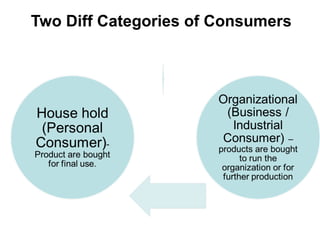
Two Diff Categories of Consumers
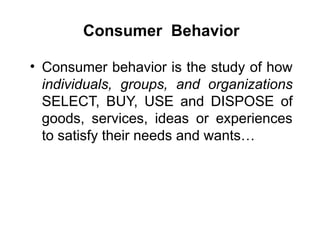
Consumer Behavior
• Consumer behavior is the study of how
individuals, groups, and organizations
SELECT, BUY, USE and DISPOSE of
goods, services, ideas or experiences
to satisfy their needs and wants…
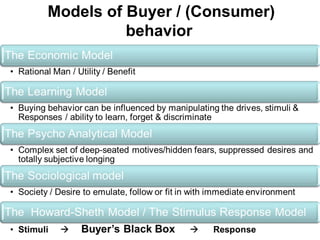
Models of Buyer / (Consumer)
behavior
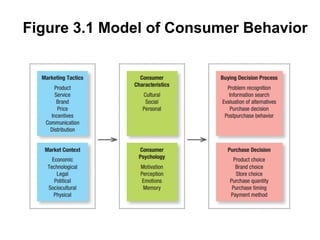
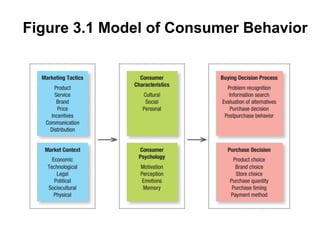
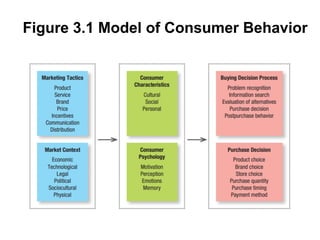
Figure 3.1 Model of Consumer Behavior
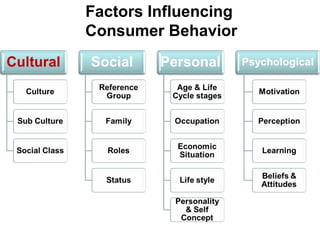
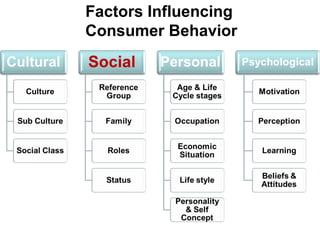
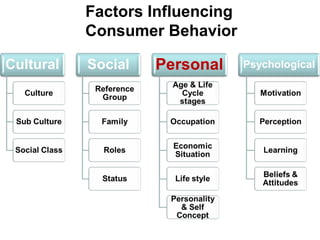
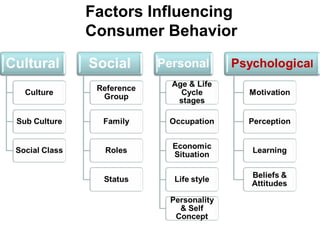
Factors Influencing
Consumer Behavior
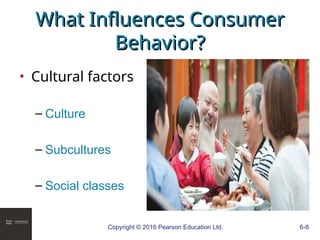
Copyright © 2016 Pearson Education Ltd. 6-8
What Influences Consumer
Behavior?
Behavior?
• Cultural factors
– Culture
– Subcultures
– Social classes
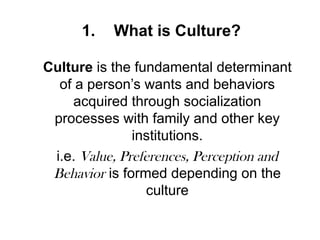
1. What is Culture?
Culture is the fundamental determinant
of a person’s wants and behaviors
acquired through socialization
processes with family and other key
institutions.
i.e. Value, Preferences, Perception and
Behavior is formed depending on the
culture
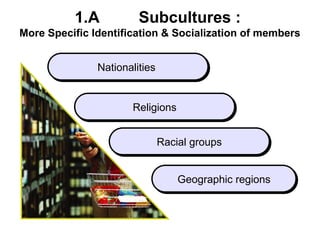
1.A Subcultures :
More Specific Identification & Socialization of members
Nationalities
Religions
Racial groups
Geographic regions
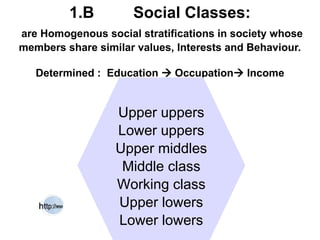
1.B Social Classes:
are Homogenous social stratifications in society whose
members share similar values, Interests and Behaviour.
Determined : Education  Occupation Income
Upper uppers
Lower uppers
Upper middles
Middle class
Working class
Upper lowers
Lower lowers
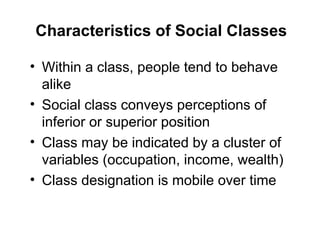
Characteristics of Social Classes
• Within a class, people tend to behave
alike
• Social class conveys perceptions of
inferior or superior position
• Class may be indicated by a cluster of
variables (occupation, income, wealth)
• Class designation is mobile over time
Factors Influencing
Consumer Behavior
Copyright © 2016 Pearson Education Ltd. 6-14
What Influences Consumer
Behavior?
Behavior?
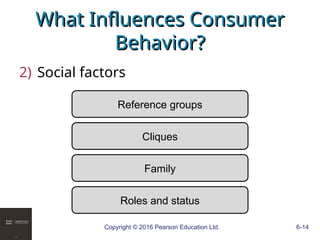
2) Social factors
Reference groups
Cliques
Family
Roles and status
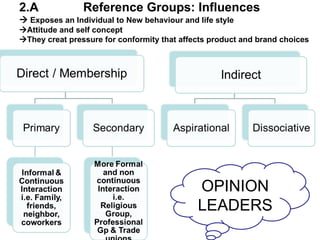
2.A Reference Groups: Influences
 Exposes an Individual to New behaviour and life style
Attitude and self concept
They creat pressure for conformity that affects product and brand choices
OPINION
LEADERS
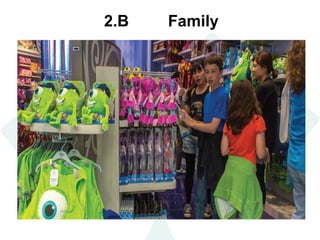
2.B Family
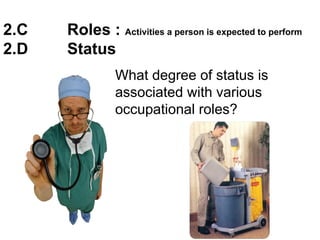
2.C Roles : Activities a person is expected to perform
2.D Status
What degree of status is
associated with various
occupational roles?
Factors Influencing
Consumer Behavior
Copyright © 2016 Pearson Education Ltd. 6-22
What Influences Consumer
Behavior?
Behavior?
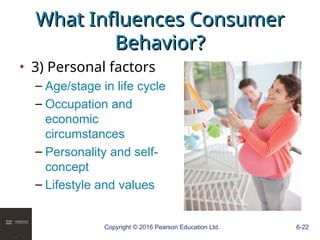
• 3) Personal factors
– Age/stage in life cycle
– Occupation and
economic
circumstances
– Personality and self-
concept
– Lifestyle and values
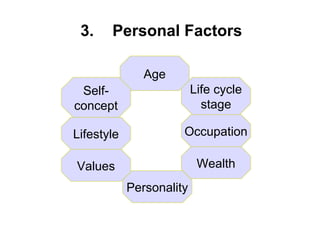
3. Personal Factors
Age
Values
Life cycle
stage
Occupation
Personality
Self-
concept
Wealth
Lifestyle
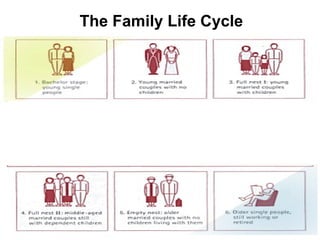
The Family Life Cycle
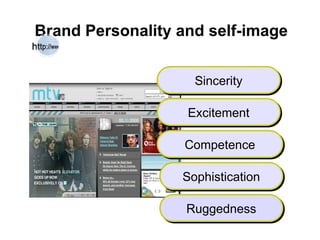
Brand Personality and self-image
Sincerity
Excitement
Competence
Sophistication
Ruggedness
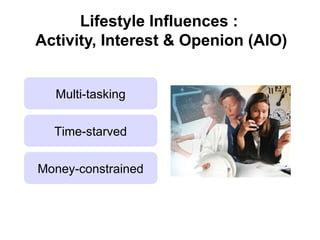
Lifestyle Influences :
Activity, Interest & Openion (AIO)
Multi-tasking
Time-starved
Money-constrained
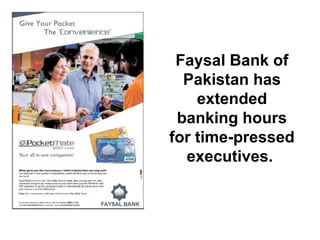
Faysal Bank of
Pakistan has
extended
banking hours
for time-pressed
executives.
Factors Influencing
Consumer Behavior
Figure 3.1 Model of Consumer Behavior
Copyright © 2016 Pearson Education Ltd. 6-31
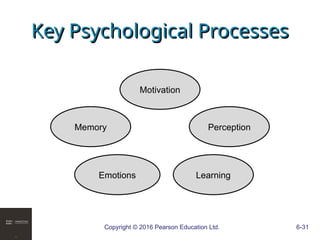
Key Psychological Processes
Motivation
Perception
Learning
Emotions
Memory
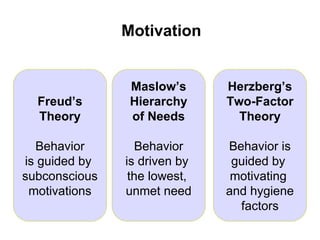
Motivation
Freud’s
Theory
Behavior
is guided by
subconscious
motivations
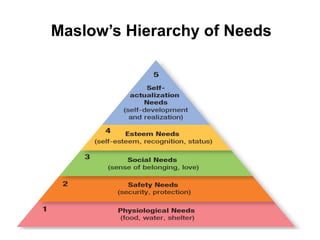
Maslow’s
Hierarchy
of Needs
Behavior
is driven by
the lowest,
unmet need
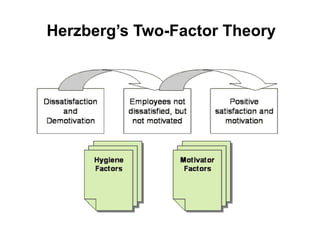
Herzberg’s
Two-Factor
Theory
Behavior is
guided by
motivating
and hygiene
factors
Maslow’s Hierarchy of Needs
Herzberg’s Two-Factor Theory
Copyright © 2016 Pearson Education Ltd. 6-35
Key Psychological Processes
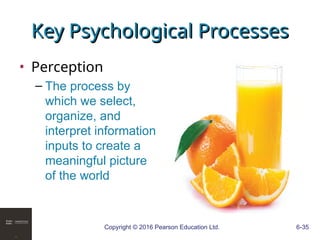
• Perception
– The process by
which we select,
organize, and
interpret information
inputs to create a
meaningful picture
of the world
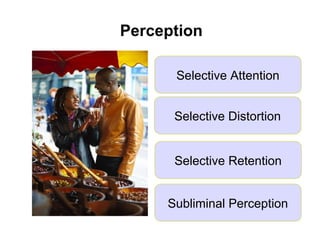
Perception
Selective Attention
Subliminal Perception
Selective Retention
Selective Distortion
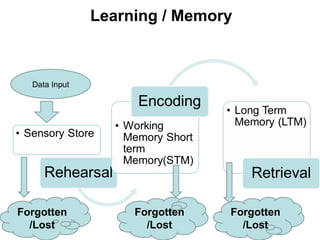
Learning / Memory
Data Input
Forgotten
/Lost
Forgotten
/Lost
Forgotten
/Lost
Copyright © 2022, 2016, 2012 Pearson Education, Inc. All Rights Reserved
Memory (1 of 3)
• Memory models
– Short-term memory—a temporary and limited
repository of information
– Long-term memory—a more permanent, essentially
unlimited repository
▪ Episodic memory
▪ Semantic memory
▪ Procedural memory
Associative Network Memory /
(ANM) model
• Nodes : - are stored information ..
connected by
• Links are the connecting strings that
vary in strength
• Brand Association consists of all brand
related thoughts, feelings, perception,
images, experience, belief, attitude and so
on that become linked to the brand node
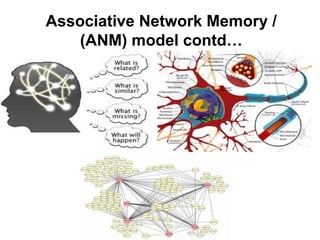
Associative Network Memory /
(ANM) model contd…
Buying Decision Making Process
Marketer have to undergo the various
influences on buyers and develop an
understanding of how consumers actually
make their decision…
Marketer must identify:
1.Who makes the decision
2.Involvement level in the buying decision
3.Steps in the Buying Process
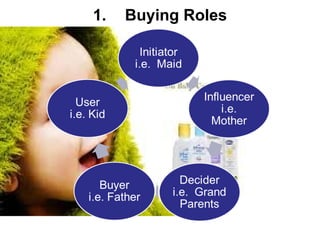
1. Buying Roles
Figure 3.1 Model of Consumer Behavior
Copyright © 2016 Pearson Education Ltd. 6-52
The Buying
The Buying
Decision Process
Decision Process
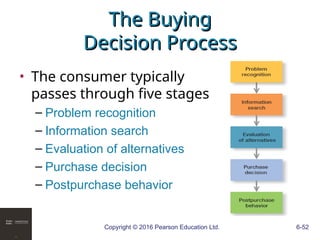
• The consumer typically
passes through five stages
– Problem recognition
– Information search
– Evaluation of alternatives
– Purchase decision
– Postpurchase behavior
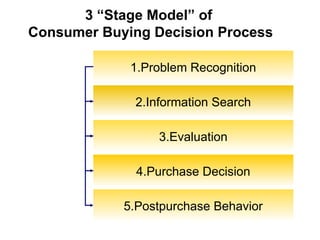
3 “Stage Model” of
Consumer Buying Decision Process
1.Problem Recognition
2.Information Search
3.Evaluation
4.Purchase Decision
5.Postpurchase Behavior
3.1 Problem Recognition
• Buying process starts when the buyer
recognizes a problem or need.
Internal Stimuli
External Stimuli:-
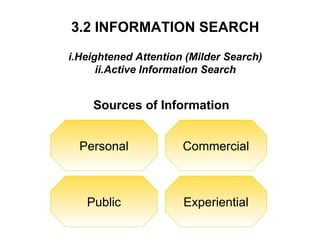
Sources of Information
Personal
Experiential
Public
Commercial
3.2 INFORMATION SEARCH
i.Heightened Attention (Milder Search)
ii.Active Information Search
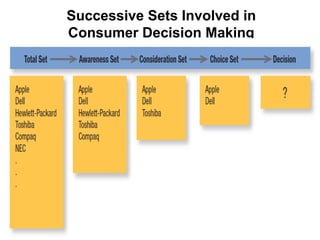
Successive Sets Involved in
Consumer Decision Making
Evaluation of Alternatives
Basic concept of Consumer Evaluation Process :
1.Consumer is trying to satisfy the need
2.Consumer is looking for certain benefits from
product solution
3.Consumer see the product as a bundle of
attributes with varying abilities for delivering
the benefits sought to satisfy the need
Evaluation contd..
• Belief:- is a descriptive thought that a
person holds about something
• Attitude:- are person’s enduring
favorable or unfavorable evaluations,
emotional feeling and action tendencies
toward some object or idea
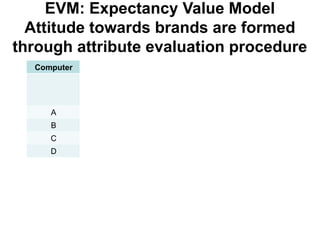
EVM: Expectancy Value Model
Attitude towards brands are formed
through attribute evaluation procedure
Computer ATTRIBUTES
Memory
(40%)
Graphics
(30%)
Size &
Weight
(20%)
Price (10%)
A 8 9 6 9
B 7 7 7 7
C 10 4 3 2
D 5 3 8 5
Computer A : 0.4x8 + 0.3x9 + 0.2x6 + 0.1x9 = 8
Computer B :------------------------------------------ =7
Computer C :------------------------------------------ =6
Computer D :------------------------------------------ =5
Copyright © 2016 Pearson Education Ltd. 6-61
Moderating Effects on Consumer
Decision Making
Decision Making
• Elaboration Likelihood Model-ELM
–Involvement & Consumer Decision
Making
• Central Route of persuasion -HI
• Peripheral route of Persuasion-LI
• Variety-Seeking Buying Behavior
Heuristics
Heuristics :- Are Mental Short cuts / Thumb Rule
Conjunctive : Customer Sets Min Acceptable cut off level for each
attribute and choose the first alternative that meets the min standard
Lexicographic :Choose the best brand on the basis of its
perceived most important attribute
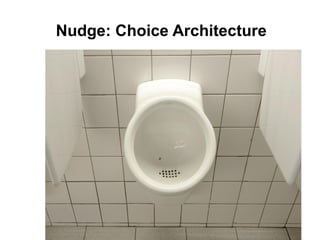
Nudge: Choice Architecture
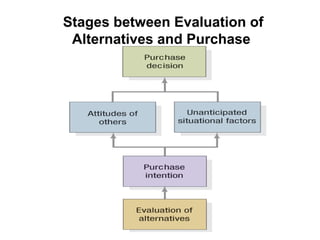
Stages between Evaluation of
Alternatives and Purchase
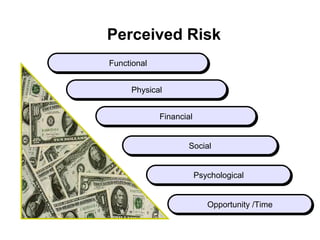
Perceived Risk
Functional
Physical
Financial
Social
Psychological
Opportunity /Time
Copyright © 2016 Pearson Education Ltd. 6-67
The Buying Decision Process
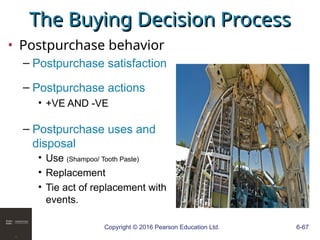
• Postpurchase behavior
– Postpurchase satisfaction
– Postpurchase actions
• +VE AND -VE
– Postpurchase uses and
disposal
• Use (Shampoo/ Tooth Paste)
• Replacement
• Tie act of replacement with
events.
Copyright © 2016 Pearson Education Ltd. 6-68
THE BUYER DECISION PROCESS
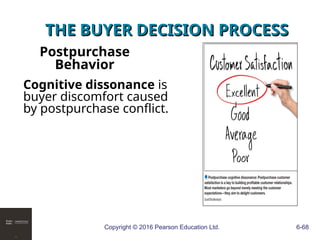
Postpurchase
Behavior
Cognitive dissonance is
buyer discomfort caused
by postpurchase conflict.
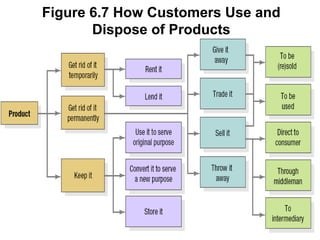
Figure 6.7 How Customers Use and
Dispose of Products
Copyright © 2016 Pearson Education Ltd. 6-70
Behavioral Economics
• Decision Heuristics
–Availability heuristic
• Consumers base their predictions on the quickness and
ease with which a particular example of an outcome comes
to mind. For example, a recent product failure may lead
consumers to inflate the likelihood of a future product failure
and make them more inclined to purchase a product
warranty.
–Representativeness heuristic:
• One reason package appearances may be so similar for different brands
in the same product category is that marketers want their products to be
seen as representative of the category as a whole.
Copyright © 2016 Pearson Education Ltd. 6-71
Behavioral Economics
• Decision Heuristics
–Conjuction Fallacy:
• People’s false belief that the probability of two events occurring
jointly is greater than the probability of either event occurring
independently
–Anchoring and adjustment heuristic:
• Consumers arrive at an initial judgment and then adjust it—
sometimes only reluctantly—based on additional information. For
services marketers, a strong first impression is critical to
establishing a favorable anchor so subsequent experiences will be
interpreted in a more favorable light.
Copyright © 2016 Pearson Education Ltd. 6-72
Behavioral Economics:
Framing
Framing
Comparative Advertisement
• Twice the cleaning Power
Breaking the bigger amount into
smaller
• Per month
• Per day
Showing bigger benefits
• Warranty for 24 months v/s 2 years
Copyright © 2016 Pearson Education Ltd. 6-73
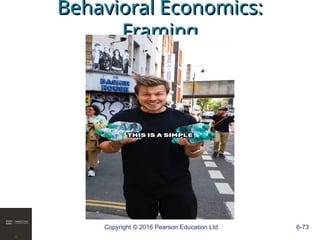
Behavioral Economics:
Framing
Framing
Copyright © 2016 Pearson Education Ltd. 6-74
Behavioral Economics
• Framing
– Mental accounting
• 1. Consumers tend to segregate gains. : Listing multiple benefits of a large
industrial product, for example, can make the sum of the parts seem greater
than the whole.
• 2. Consumers tend to integrate losses. Marketers have a distinct
advantage in selling something if its cost can be added to another large
purchase. House buyers are more inclined to view additional expenditures
favorably given the already high price of buying a house.
• 3. Consumers tend to integrate smaller losses with larger gains. The
“cancellation” principle might explain why withholding taxes from monthly
paychecks is less painful than making large, lump-sum tax payments—the
smaller withholdings are more likely to be overshadowed by the larger pay
amount.
• 4. Consumers tend to segregate small gains from large losses. The
“silver lining” principle might explain the popularity of rebates on big-ticket
purchases such as cars.
Copyright © 2016 Pearson Education Ltd. 6-75

3. analyzing consumer markexsxsxts 24.pdf

  • 1.
    Copyright © 2016Pearson Education Ltd. 4-1 Chapter Chapter 3 3 Analyzing Consumer Markets
  • 2.
    Two Diff Categoriesof Consumers
  • 3.
    Consumer Behavior • Consumerbehavior is the study of how individuals, groups, and organizations SELECT, BUY, USE and DISPOSE of goods, services, ideas or experiences to satisfy their needs and wants…
  • 4.
    Models of Buyer/ (Consumer) behavior
  • 5.
    Figure 3.1 Modelof Consumer Behavior
  • 6.
  • 7.
    Copyright © 2016Pearson Education Ltd. 6-8 What Influences Consumer What Influences Consumer Behavior? Behavior? • Cultural factors – Culture – Subcultures – Social classes
  • 8.
    1. What isCulture? Culture is the fundamental determinant of a person’s wants and behaviors acquired through socialization processes with family and other key institutions. i.e. Value, Preferences, Perception and Behavior is formed depending on the culture
  • 9.
    1.A Subcultures : MoreSpecific Identification & Socialization of members Nationalities Religions Racial groups Geographic regions
  • 10.
    1.B Social Classes: areHomogenous social stratifications in society whose members share similar values, Interests and Behaviour. Determined : Education  Occupation Income Upper uppers Lower uppers Upper middles Middle class Working class Upper lowers Lower lowers
  • 11.
    Characteristics of SocialClasses • Within a class, people tend to behave alike • Social class conveys perceptions of inferior or superior position • Class may be indicated by a cluster of variables (occupation, income, wealth) • Class designation is mobile over time
  • 12.
  • 13.
    Copyright © 2016Pearson Education Ltd. 6-14 What Influences Consumer What Influences Consumer Behavior? Behavior? 2) Social factors Reference groups Cliques Family Roles and status
  • 14.
    2.A Reference Groups:Influences  Exposes an Individual to New behaviour and life style Attitude and self concept They creat pressure for conformity that affects product and brand choices OPINION LEADERS
  • 15.
  • 16.
    2.C Roles :Activities a person is expected to perform 2.D Status What degree of status is associated with various occupational roles?
  • 17.
  • 18.
    Copyright © 2016Pearson Education Ltd. 6-22 What Influences Consumer What Influences Consumer Behavior? Behavior? • 3) Personal factors – Age/stage in life cycle – Occupation and economic circumstances – Personality and self- concept – Lifestyle and values
  • 19.
    3. Personal Factors Age Values Lifecycle stage Occupation Personality Self- concept Wealth Lifestyle
  • 20.
  • 21.
    Brand Personality andself-image Sincerity Excitement Competence Sophistication Ruggedness
  • 22.
    Lifestyle Influences : Activity,Interest & Openion (AIO) Multi-tasking Time-starved Money-constrained
  • 23.
    Faysal Bank of Pakistanhas extended banking hours for time-pressed executives.
  • 24.
  • 25.
    Figure 3.1 Modelof Consumer Behavior
  • 26.
    Copyright © 2016Pearson Education Ltd. 6-31 Key Psychological Processes Key Psychological Processes Motivation Perception Learning Emotions Memory
  • 27.
    Motivation Freud’s Theory Behavior is guided by subconscious motivations Maslow’s Hierarchy ofNeeds Behavior is driven by the lowest, unmet need Herzberg’s Two-Factor Theory Behavior is guided by motivating and hygiene factors
  • 28.
  • 29.
  • 30.
    Copyright © 2016Pearson Education Ltd. 6-35 Key Psychological Processes Key Psychological Processes • Perception – The process by which we select, organize, and interpret information inputs to create a meaningful picture of the world
  • 31.
  • 32.
    Learning / Memory DataInput Forgotten /Lost Forgotten /Lost Forgotten /Lost
  • 33.
    Copyright © 2022,2016, 2012 Pearson Education, Inc. All Rights Reserved Memory (1 of 3) • Memory models – Short-term memory—a temporary and limited repository of information – Long-term memory—a more permanent, essentially unlimited repository ▪ Episodic memory ▪ Semantic memory ▪ Procedural memory
  • 34.
    Associative Network Memory/ (ANM) model • Nodes : - are stored information .. connected by • Links are the connecting strings that vary in strength • Brand Association consists of all brand related thoughts, feelings, perception, images, experience, belief, attitude and so on that become linked to the brand node
  • 35.
    Associative Network Memory/ (ANM) model contd…
  • 36.
    Buying Decision MakingProcess Marketer have to undergo the various influences on buyers and develop an understanding of how consumers actually make their decision… Marketer must identify: 1.Who makes the decision 2.Involvement level in the buying decision 3.Steps in the Buying Process
  • 37.
  • 38.
    Figure 3.1 Modelof Consumer Behavior
  • 39.
    Copyright © 2016Pearson Education Ltd. 6-52 The Buying The Buying Decision Process Decision Process • The consumer typically passes through five stages – Problem recognition – Information search – Evaluation of alternatives – Purchase decision – Postpurchase behavior
  • 40.
    3 “Stage Model”of Consumer Buying Decision Process 1.Problem Recognition 2.Information Search 3.Evaluation 4.Purchase Decision 5.Postpurchase Behavior
  • 41.
    3.1 Problem Recognition •Buying process starts when the buyer recognizes a problem or need. Internal Stimuli External Stimuli:-
  • 42.
    Sources of Information Personal Experiential Public Commercial 3.2INFORMATION SEARCH i.Heightened Attention (Milder Search) ii.Active Information Search
  • 43.
    Successive Sets Involvedin Consumer Decision Making
  • 44.
    Evaluation of Alternatives Basicconcept of Consumer Evaluation Process : 1.Consumer is trying to satisfy the need 2.Consumer is looking for certain benefits from product solution 3.Consumer see the product as a bundle of attributes with varying abilities for delivering the benefits sought to satisfy the need
  • 45.
    Evaluation contd.. • Belief:-is a descriptive thought that a person holds about something • Attitude:- are person’s enduring favorable or unfavorable evaluations, emotional feeling and action tendencies toward some object or idea
  • 46.
    EVM: Expectancy ValueModel Attitude towards brands are formed through attribute evaluation procedure Computer ATTRIBUTES Memory (40%) Graphics (30%) Size & Weight (20%) Price (10%) A 8 9 6 9 B 7 7 7 7 C 10 4 3 2 D 5 3 8 5 Computer A : 0.4x8 + 0.3x9 + 0.2x6 + 0.1x9 = 8 Computer B :------------------------------------------ =7 Computer C :------------------------------------------ =6 Computer D :------------------------------------------ =5
  • 47.
    Copyright © 2016Pearson Education Ltd. 6-61 Moderating Effects on Consumer Moderating Effects on Consumer Decision Making Decision Making • Elaboration Likelihood Model-ELM –Involvement & Consumer Decision Making • Central Route of persuasion -HI • Peripheral route of Persuasion-LI • Variety-Seeking Buying Behavior
  • 48.
    Heuristics Heuristics :- AreMental Short cuts / Thumb Rule Conjunctive : Customer Sets Min Acceptable cut off level for each attribute and choose the first alternative that meets the min standard Lexicographic :Choose the best brand on the basis of its perceived most important attribute
  • 49.
  • 50.
  • 51.
    Stages between Evaluationof Alternatives and Purchase
  • 52.
  • 53.
    Copyright © 2016Pearson Education Ltd. 6-67 The Buying Decision Process The Buying Decision Process • Postpurchase behavior – Postpurchase satisfaction – Postpurchase actions • +VE AND -VE – Postpurchase uses and disposal • Use (Shampoo/ Tooth Paste) • Replacement • Tie act of replacement with events.
  • 54.
    Copyright © 2016Pearson Education Ltd. 6-68 THE BUYER DECISION PROCESS THE BUYER DECISION PROCESS Postpurchase Behavior Cognitive dissonance is buyer discomfort caused by postpurchase conflict.
  • 55.
    Figure 6.7 HowCustomers Use and Dispose of Products
  • 56.
    Copyright © 2016Pearson Education Ltd. 6-70 Behavioral Economics Behavioral Economics • Decision Heuristics –Availability heuristic • Consumers base their predictions on the quickness and ease with which a particular example of an outcome comes to mind. For example, a recent product failure may lead consumers to inflate the likelihood of a future product failure and make them more inclined to purchase a product warranty. –Representativeness heuristic: • One reason package appearances may be so similar for different brands in the same product category is that marketers want their products to be seen as representative of the category as a whole.
  • 57.
    Copyright © 2016Pearson Education Ltd. 6-71 Behavioral Economics Behavioral Economics • Decision Heuristics –Conjuction Fallacy: • People’s false belief that the probability of two events occurring jointly is greater than the probability of either event occurring independently –Anchoring and adjustment heuristic: • Consumers arrive at an initial judgment and then adjust it— sometimes only reluctantly—based on additional information. For services marketers, a strong first impression is critical to establishing a favorable anchor so subsequent experiences will be interpreted in a more favorable light.
  • 58.
    Copyright © 2016Pearson Education Ltd. 6-72 Behavioral Economics: Behavioral Economics: Framing Framing Comparative Advertisement • Twice the cleaning Power Breaking the bigger amount into smaller • Per month • Per day Showing bigger benefits • Warranty for 24 months v/s 2 years
  • 59.
    Copyright © 2016Pearson Education Ltd. 6-73 Behavioral Economics: Behavioral Economics: Framing Framing
  • 60.
    Copyright © 2016Pearson Education Ltd. 6-74 Behavioral Economics Behavioral Economics • Framing – Mental accounting • 1. Consumers tend to segregate gains. : Listing multiple benefits of a large industrial product, for example, can make the sum of the parts seem greater than the whole. • 2. Consumers tend to integrate losses. Marketers have a distinct advantage in selling something if its cost can be added to another large purchase. House buyers are more inclined to view additional expenditures favorably given the already high price of buying a house. • 3. Consumers tend to integrate smaller losses with larger gains. The “cancellation” principle might explain why withholding taxes from monthly paychecks is less painful than making large, lump-sum tax payments—the smaller withholdings are more likely to be overshadowed by the larger pay amount. • 4. Consumers tend to segregate small gains from large losses. The “silver lining” principle might explain the popularity of rebates on big-ticket purchases such as cars.
  • 61.
    Copyright © 2016Pearson Education Ltd. 6-75