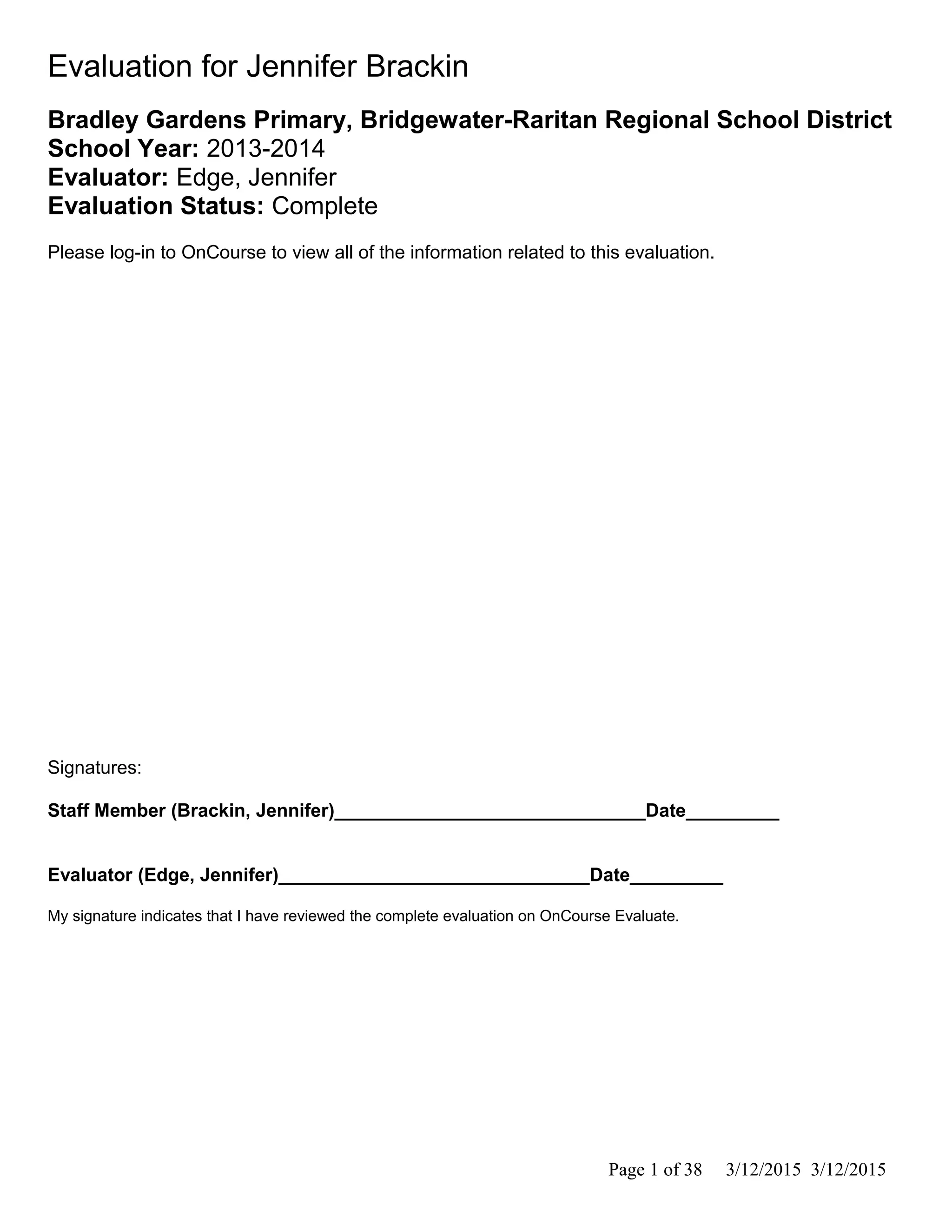
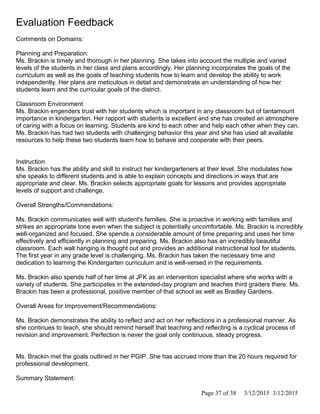
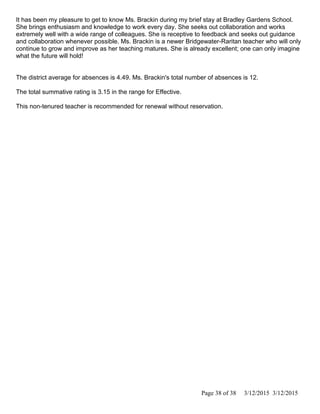
Evaluation for Jennifer Brackin
Bradley Gardens Primary, Bridgewater-Raritan Regional School District
School Year: 2013-2014
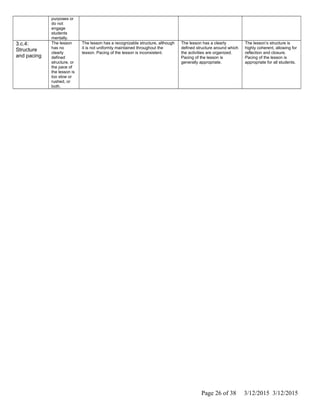
Evaluator: Edge, Jennifer
Evaluation Status: Complete
Please log-in to OnCourse to view all of the information related to this evaluation.
Signatures:
Staff Member (Brackin, Jennifer)______________________________Date_________
Evaluator (Edge, Jennifer)______________________________Date_________
My signature indicates that I have reviewed the complete evaluation on OnCourse Evaluate.
Page 1 of 38 3/12/2015 3/12/2015
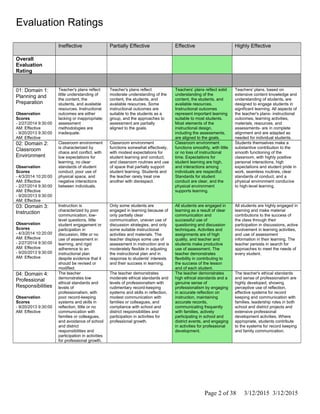
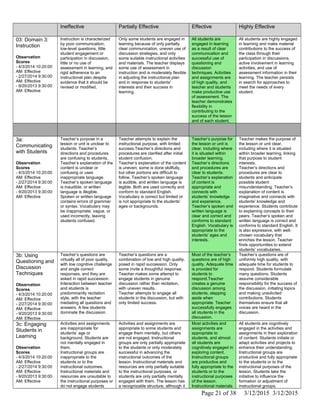
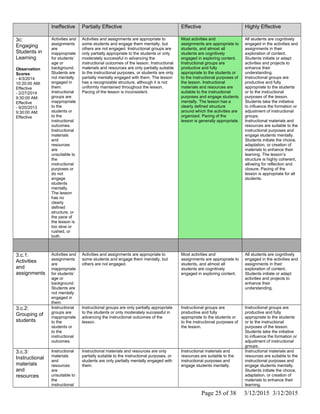
Evaluation Ratings
Ineffective Partially Effective Effective Highly Effective
Overall
Evaluation
Rating
01: Domain 1:
Planning and
Preparation
Observation
Scores
- 2/27/2014 9:30:00
AM: Effective
- 9/20/2013 9:30:00
AM: Effective
Teacher's plans reflect
little understanding of
the content, the
students, and available
resources. Instructional
outcomes are either
lacking or inappropriate;
assessment
methodologies are
inadequate.
Teacher's plans reflect
moderate understanding of the
content, the students, and
available resources. Some
instructional outcomes are
suitable to the students as a
group, and the approaches to
assessment are partially
aligned to the goals.
Teachers' plans reflect solid
understanding of the
content, the students, and
available resources.
Instructional outcomes
represent important learning
suitable to most students.
Most elements of the
instructional design,
including the assessments,
are aligned to the goals.
Teachers' plans, based on
extensive content knowledge and
understanding of students, are
designed to engage students in
significant learning. All aspects of
the teacher's plans- instructional
outcomes, learning activities,
materials, resources, and
assessments- are in complete
alignment and are adapted as
needed for individual students.
02: Domain 2:
Classroom
Environment
Observation
Scores
- 4/3/2014 10:20:00
AM: Effective
- 2/27/2014 9:30:00
AM: Effective
- 9/20/2013 9:30:00
AM: Effective
Classroom environment
is characterized by
chaos and conflict, with
low expectations for
learning, no clear
standards of student
conduct, poor use of
physical space, and
negative interactions
between individuals.
Classroom environment
functions somewhat effectively,
with modest expectations for
student learning and conduct,
and classroom routines and use
of space that partially support
student learning. Students and
the teacher rarely treat one
another with disrespect.
Classroom environment
functions smoothly, with little
or no loss of instructional
time. Expectations for
student learning are high,
and interactions among
individuals are respectful.
Standards for student
conduct are clear, and the
physical environment
supports learning.
Students themselves make a
substantive contribution to the
smooth functioning of the
classroom, with highly positive
personal interactions, high
expectations and student pride in
work, seamless routines, clear
standards of conduct, and a
physical environment conducive
to high-level learning.
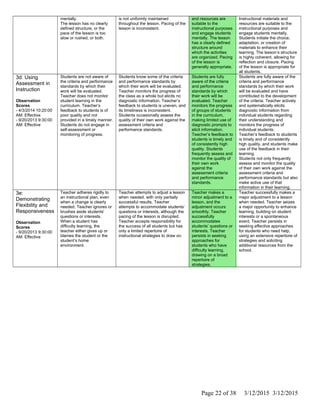
03: Domain 3:
Instruction
Observation
Scores
- 4/3/2014 10:20:00
AM: Effective
- 2/27/2014 9:30:00
AM: Effective
- 9/20/2013 9:30:00
AM: Effective
Instruction is
characterized by poor
communication, low-
level questions, little
student engagement or
participation in
discussion, little or no
use of assessment in
learning, and rigid
adherence to an
instructional plan
despite evidence that it
should be revised or
modified.
Only some students are
engaged in learning because of
only partially clear
communication, uneven use of
discussion strategies, and only
some suitable instructional
activities and materials. The
teacher displays some use of
assessment in instruction and is
moderately flexible in adjusting
the instructional plan and in
response to students' interests
and their success in learning.
All students are engaged in
learning as a result of clear
communication and
successful use of
questioning and discussion
techniques. Activities and
assignments are of high
quality, and teacher and
students make productive
use of assessment. The
teacher demonstrates
flexibility in contributing to
the success of the lesson
and of each student.
All students are highly engaged in
learning and make material
contributions to the success of
the class through their
participation in discussions, active
involvement in learning activities,
and use of assessment
information in their learning. The
teacher persists in search for
approaches to meet the needs of
every student.
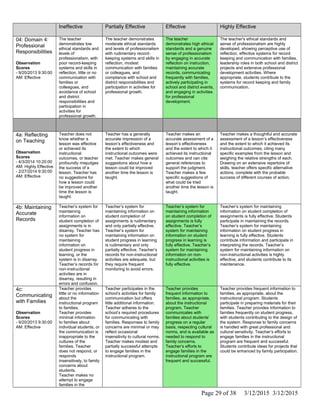
04: Domain 4:
Professional
Responsibilities
Observation
Scores
- 9/20/2013 9:30:00
AM: Effective
The teacher
demonstrates low
ethical standards and
levels of
professionalism, with
poor record-keeping
systems and skills in
reflection, little or no
communication with
families or colleagues,
and avoidance of school
and district
responsibilities and
participation in activities
for professional growth.
The teacher demonstrates
moderate ethical standards and
levels of professionalism with
rudimentary record-keeping
systems and skills in reflection,
modest communication with
families or colleagues, and
compliance with school and
district responsibilities and
participation in activities for
professional growth.
The teacher demonstrates
high ethical standards and a
genuine sense of
professionalism by engaging
in accurate reflection on
instruction, maintaining
accurate records,
communicating frequently
with families, actively
participating in school and
district events, and engaging
in activities for professional
development.
The teacher's ethical standards
and sense of professionalism are
highly developed, showing
perceptive use of reflection,
effective systems for record
keeping and communication with
families, leadership roles in both
school and district projects and
extensive professional
development activities. Where
appropriate, students contribute
to the systems for record keeping
and family communication.
Page 2 of 38 3/12/2015 3/12/2015
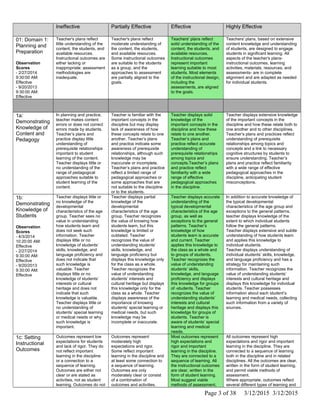
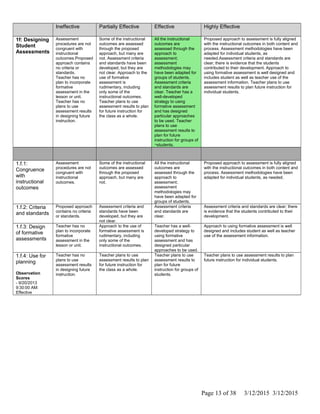
Ineffective Partially Effective Effective Highly Effective
01: Domain 1:
Planning and
Preparation
Observation
Scores
- 2/27/2014
9:30:00 AM:
Effective
- 9/20/2013
9:30:00 AM:
Effective
Teacher's plans reflect
little understanding of the
content, the students, and
available resources.
Instructional outcomes are
either lacking or
inappropriate; assessment
methodologies are
inadequate.
Teacher's plans reflect
moderate understanding of
the content, the students,
and available resources.
Some instructional outcomes
are suitable to the students
as a group, and the
approaches to assessment
are partially aligned to the
goals.
Teachers' plans reflect
solid understanding of the
content, the students, and
available resources.
Instructional outcomes
represent important
learning suitable to most
students. Most elements
of the instructional design,
including the
assessments, are aligned
to the goals.
Teachers' plans, based on extensive
content knowledge and understanding
of students, are designed to engage
students in significant learning. All
aspects of the teacher's plans-
instructional outcomes, learning
activities, materials, resources, and
assessments- are in complete
alignment and are adapted as needed
for individual students.
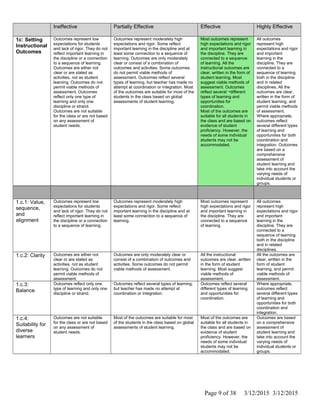
1a:
Demonstrating
Knowledge of
Content and
Pedagogy
In planning and practice,
teacher makes content
errors or does not correct
errors made by students.
Teacher’s plans and
practice display little
understanding of
prerequisite relationships
important to student
learning of the content.
Teacher displays little or
no understanding of the
range of pedagogical
approaches suitable to
student learning of the
content.
Teacher is familiar with the
important concepts in the
discipline but may display
lack of awareness of how
these concepts relate to one
another. Teacher’s plans
and practice indicate some
awareness of prerequisite
relationships, although such
knowledge may be
inaccurate or incomplete.
Teacher’s plans and practice
reflect a limited range of
pedagogical approaches or
some approaches that are
not suitable to the discipline
or to the students.
Teacher displays solid
knowledge of the
important concepts in the
discipline and how these
relate to one another.
Teacher’s plans and
practice reflect accurate
understanding of
prerequisite relationships
among topics and
concepts.Teacher’s plans
and practice reflect
familiarity with a wide
range of effective
pedagogical approaches
in the discipline.
Teacher displays extensive knowledge
of the important concepts in the
discipline and how these relate both to
one another and to other disciplines.
Teacher’s plans and practices reflect
understanding of prerequisite
relationships among topics and
concepts and a link to necessary
cognitive structures by students to
ensure understanding. Teacher’s
plans and practice reflect familiarity
with a wide range of effective
pedagogical approaches in the
discipline, anticipating student
misconceptions.
1b:
Demonstrating
Knowledge of
Students
Observation
Scores
- 4/3/2014
10:20:00 AM:
Effective
- 2/27/2014
9:30:00 AM:
Effective
- 9/20/2013
9:30:00 AM:
Effective
Teacher displays little or
no knowledge of the
developmental
characteristics of the age
group. Teacher sees no
value in understanding
how students learn and
does not seek such
information. Teacher
displays little or no
knowledge of students’
skills, knowledge, and
language proficiency and
does not indicate that
such knowledge is
valuable. Teacher
displays little or no
knowledge of students’
interests or cultural
heritage and does not
indicate that such
knowledge is valuable.
Teacher displays little or
no understanding of
students’ special learning
or medical needs or why
such knowledge is
important.
Teacher displays partial
knowledge of the
developmental
characteristics of the age
group. Teacher recognizes
the value of knowing how
students learn, but this
knowledge is limited or
outdated. Teacher
recognizes the value of
understanding students’
skills, knowledge, and
language proficiency but
displays this knowledge only
for the class as a whole.
Teacher recognizes the
value of understanding
students’ interests and
cultural heritage but displays
this knowledge only for the
class as a whole. Teacher
displays awareness of the
importance of knowing
students’ special learning or
medical needs, but such
knowledge may be
incomplete or inaccurate.
Teacher displays accurate
understanding of the
typical developmental
characteristics of the age
group, as well as
exceptions to the general
patterns. Teacher’s
knowledge of how
students learn is accurate
and current. Teacher
applies this knowledge to
the class as a whole and
to groups of students.
Teacher recognizes the
value of understanding
students’ skills,
knowledge, and language
proficiency and displays
this knowledge for groups
of -students. Teacher
recognizes the value of
understanding students’
interests and cultural
heritage and displays this
knowledge for groups of
students. Teacher is
aware of students’ special
learning and medical
needs.
In addition to accurate knowledge of
the typical developmental
characteristics of the age group and
exceptions to the general patterns,
teacher displays knowledge of the
extent to which individual students
follow the general patterns.
Teacher displays extensive and subtle
understanding of how students learn
and applies this knowledge to
individual students.
Teacher displays understanding of
individual students’ skills, knowledge,
and language proficiency and has a
strategy for maintaining such
information. Teacher recognizes the
value of understanding students’
interests and cultural heritage and
displays this knowledge for individual
students. Teacher possesses
information about each student’s
learning and medical needs, collecting
such information from a variety of
sources.
1c: Setting
Instructional
Outcomes
Outcomes represent low
expectations for students
and lack of rigor. They do
not reflect important
learning in the discipline
or a connection to a
sequence of learning.
Outcomes are either not
clear or are stated as
activities, not as student
learning. Outcomes do not
Outcomes represent
moderately high
expectations and rigor.
Some reflect important
learning in the discipline and
at least some connection to
a sequence of learning.
Outcomes are only
moderately clear or consist
of a combination of
outcomes and activities.
Most outcomes represent
high expectations and
rigor and important
learning in the discipline.
They are connected to a
sequence of learning. All
the instructional outcomes
are clear, written in the
form of student learning.
Most suggest viable
methods of assessment.
All outcomes represent high
expectations and rigor and important
learning in the discipline. They are
connected to a sequence of learning
both in the discipline and in related
disciplines. All the outcomes are clear,
written in the form of student learning,
and permit viable methods of
assessment.
Where appropriate, outcomes reflect
several different types of learning and
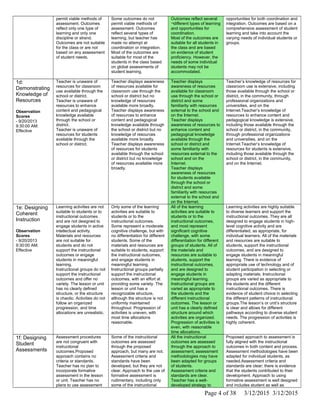
Page 3 of 38 3/12/2015 3/12/2015
permit viable methods of
assessment. Outcomes
reflect only one type of
learning and only one
discipline or strand.
Outcomes are not suitable
for the class or are not
based on any assessment
of student needs.
Some outcomes do not
permit viable methods of
assessment. Outcomes
reflect several types of
learning, but teacher has
made no attempt at
coordination or integration.
Most of the outcomes are
suitable for most of the
students in the class based
on global assessments of
student learning.
Outcomes reflect several
¬different types of learning
and opportunities for
coordination.
Most of the outcomes are
suitable for all students in
the class and are based
on evidence of student
proficiency. However, the
needs of some individual
students may not be
accommodated.
opportunities for both coordination and
integration. Outcomes are based on a
comprehensive assessment of student
learning and take into account the
varying needs of individual students or
groups.
1d:
Demonstrating
Knowledge of
Resources
Observation
Scores
- 9/20/2013
9:30:00 AM:
Effective
Teacher is unaware of
resources for classroom
use available through the
school or district.
Teacher is unaware of
resources to enhance
content and pedagogical
knowledge available
through the school or
district.
Teacher is unaware of
resources for students
available through the
school or district.
Teacher displays awareness
of resources available for
classroom use through the
school or district but no
knowledge of resources
available more broadly.
Teacher displays awareness
of resources to enhance
content and pedagogical
knowledge available through
the school or district but no
knowledge of resources
available more broadly.
Teacher displays awareness
of resources for students
available through the school
or district but no knowledge
of resources available more
broadly.
Teacher displays
awareness of resources
available for classroom
use through the school or
district and some
familiarity with resources
external to the school and
on the Internet.
Teacher displays
awareness of resources to
enhance content and
pedagogical knowledge
available through the
school or district and
some familiarity with
resources external to the
school and on the
Internet.
Teacher displays
awareness of resources
for students available
through the school or
district and some
familiarity with resources
external to the school and
on the Internet.
Teacher’s knowledge of resources for
classroom use is extensive, including
those available through the school or
district, in the community, through
professional organizations and
universities, and on the
Internet.Teacher’s knowledge of
resources to enhance content and
pedagogical knowledge is extensive,
including those available through the
school or district, in the community,
through professional organizations
and universities, and on the
Internet.Teacher’s knowledge of
resources for students is extensive,
including those available through the
school or district, in the community,
and on the Internet.
1e: Designing
Coherent
Instruction
Observation
Scores
- 9/20/2013
9:30:00 AM:
Effective
Learning activities are not
suitable to students or to
instructional outcomes
and are not designed to
engage students in active
intellectual activity.
Materials and resources
are not suitable for
students and do not
support the instructional
outcomes or engage
students in meaningful
learning.
Instructional groups do not
support the instructional
outcomes and offer no
variety. The lesson or unit
has no clearly defined
structure, or the structure
is chaotic. Activities do not
follow an organized
progression, and time
allocations are unrealistic.
Only some of the learning
activities are suitable to
students or to the
instructional outcomes.
Some represent a moderate
cognitive challenge, but with
no differentiation for different
students. Some of the
materials and resources are
suitable to students, support
the instructional outcomes,
and engage students in
meaningful learning.
Instructional groups partially
support the instructional
outcomes, with an effort at
providing some variety. The
lesson or unit has a
recognizable structure,
although the structure is not
uniformly maintained
throughout. Progression of
activities is uneven, with
most time allocations
reasonable.
All of the learning
activities are suitable to
students or to the
instructional outcomes,
and most represent
significant cognitive
challenge, with some
differentiation for different
groups of students. All of
the materials and
resources are suitable to
students, support the
instructional outcomes,
and are designed to
engage students in
meaningful learning.
Instructional groups are
varied as appropriate to
the students and the
different instructional
outcomes. The lesson or
unit has a clearly defined
structure around which
activities are organized.
Progression of activities is
even, with reasonable
time allocations.
Learning activities are highly suitable
to diverse learners and support the
instructional outcomes. They are all
designed to engage students in high-
level cognitive activity and are
differentiated, as appropriate, for
individual learners. All of the materials
and resources are suitable to
students, support the instructional
outcomes, and are designed to
engage students in meaningful
learning. There is evidence of
appropriate use of technology and of
student participation in selecting or
adapting materials. Instructional
groups are varied as appropriate to
the students and the different
instructional outcomes. There is
evidence of student choice in selecting
the different patterns of instructional
groups.The lesson’s or unit’s structure
is clear and allows for different
pathways according to diverse student
needs. The progression of activities is
highly coherent.
1f: Designing
Student
Assessments
Assessment procedures
are not congruent with
instructional
outcomes.Proposed
approach contains no
criteria or standards.
Teacher has no plan to
incorporate formative
assessment in the lesson
or unit. Teacher has no
plans to use assessment
Some of the instructional
outcomes are assessed
through the proposed
approach, but many are not.
Assessment criteria and
standards have been
developed, but they are not
clear. Approach to the use of
formative assessment is
rudimentary, including only
some of the instructional
All the instructional
outcomes are assessed
through the approach to
assessment; assessment
methodologies may have
been adapted for groups
of students.
Assessment criteria and
standards are clear.
Teacher has a well-
developed strategy to
Proposed approach to assessment is
fully aligned with the instructional
outcomes in both content and process.
Assessment methodologies have been
adapted for individual students, as
needed.Assessment criteria and
standards are clear; there is evidence
that the students contributed to their
development. Approach to using
formative assessment is well designed
and includes student as well as
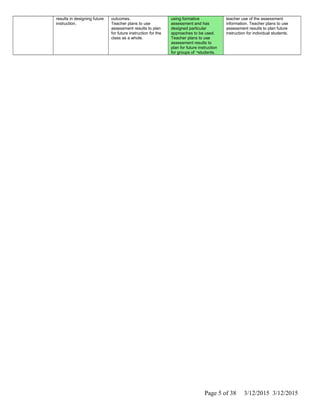
Page 4 of 38 3/12/2015 3/12/2015
results in designing future
instruction.
outcomes.
Teacher plans to use
assessment results to plan
for future instruction for the
class as a whole.
using formative
assessment and has
designed particular
approaches to be used.
Teacher plans to use
assessment results to
plan for future instruction
for groups of ¬students.
teacher use of the assessment
information. Teacher plans to use
assessment results to plan future
instruction for individual students.
Page 5 of 38 3/12/2015 3/12/2015
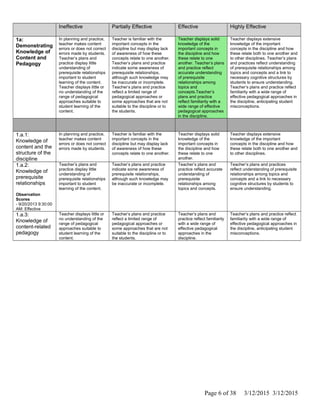
Ineffective Partially Effective Effective Highly Effective
1a:
Demonstrating
Knowledge of
Content and
Pedagogy
In planning and practice,
teacher makes content
errors or does not correct
errors made by students.
Teacher’s plans and
practice display little
understanding of
prerequisite relationships
important to student
learning of the content.
Teacher displays little or
no understanding of the
range of pedagogical
approaches suitable to
student learning of the
content.
Teacher is familiar with the
important concepts in the
discipline but may display lack
of awareness of how these
concepts relate to one another.
Teacher’s plans and practice
indicate some awareness of
prerequisite relationships,
although such knowledge may
be inaccurate or incomplete.
Teacher’s plans and practice
reflect a limited range of
pedagogical approaches or
some approaches that are not
suitable to the discipline or to
the students.
Teacher displays solid
knowledge of the
important concepts in
the discipline and how
these relate to one
another. Teacher’s plans
and practice reflect
accurate understanding
of prerequisite
relationships among
topics and
concepts.Teacher’s
plans and practice
reflect familiarity with a
wide range of effective
pedagogical approaches
in the discipline.
Teacher displays extensive
knowledge of the important
concepts in the discipline and how
these relate both to one another and
to other disciplines. Teacher’s plans
and practices reflect understanding
of prerequisite relationships among
topics and concepts and a link to
necessary cognitive structures by
students to ensure understanding.
Teacher’s plans and practice reflect
familiarity with a wide range of
effective pedagogical approaches in
the discipline, anticipating student
misconceptions.
1.a.1:
Knowledge of
content and the
structure of the
discipline
In planning and practice,
teacher makes content
errors or does not correct
errors made by students.
Teacher is familiar with the
important concepts in the
discipline but may display lack
of awareness of how these
concepts relate to one another.
Teacher displays solid
knowledge of the
important concepts in
the discipline and how
these relate to one
another.
Teacher displays extensive
knowledge of the important
concepts in the discipline and how
these relate both to one another and
to other disciplines.
1.a.2:
Knowledge of
prerequisite
relationships
Observation
Scores
- 9/20/2013 9:30:00
AM: Effective
Teacher’s plans and
practice display little
understanding of
prerequisite relationships
important to student
learning of the content.
Teacher’s plans and practice
indicate some awareness of
prerequisite relationships,
although such knowledge may
be inaccurate or incomplete.
Teacher’s plans and
practice reflect accurate
understanding of
prerequisite
relationships among
topics and concepts.
Teacher’s plans and practices
reflect understanding of prerequisite
relationships among topics and
concepts and a link to necessary
cognitive structures by students to
ensure understanding.
1.a.3:
Knowledge of
content-related
pedagogy
Teacher displays little or
no understanding of the
range of pedagogical
approaches suitable to
student learning of the
content.
Teacher’s plans and practice
reflect a limited range of
pedagogical approaches or
some approaches that are not
suitable to the discipline or to
the students.
Teacher’s plans and
practice reflect familiarity
with a wide range of
effective pedagogical
approaches in the
discipline.
Teacher’s plans and practice reflect
familiarity with a wide range of
effective pedagogical approaches in
the discipline, anticipating student
misconceptions.
Page 6 of 38 3/12/2015 3/12/2015
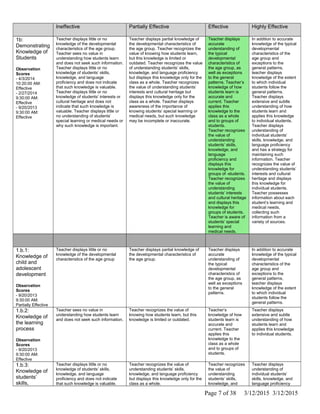
Ineffective Partially Effective Effective Highly Effective
1b:
Demonstrating
Knowledge of
Students
Observation
Scores
- 4/3/2014
10:20:00 AM:
Effective
- 2/27/2014
9:30:00 AM:
Effective
- 9/20/2013
9:30:00 AM:
Effective
Teacher displays little or no
knowledge of the developmental
characteristics of the age group.
Teacher sees no value in
understanding how students learn
and does not seek such information.
Teacher displays little or no
knowledge of students’ skills,
knowledge, and language
proficiency and does not indicate
that such knowledge is valuable.
Teacher displays little or no
knowledge of students’ interests or
cultural heritage and does not
indicate that such knowledge is
valuable. Teacher displays little or
no understanding of students’
special learning or medical needs or
why such knowledge is important.
Teacher displays partial knowledge of
the developmental characteristics of
the age group. Teacher recognizes the
value of knowing how students learn,
but this knowledge is limited or
outdated. Teacher recognizes the value
of understanding students’ skills,
knowledge, and language proficiency
but displays this knowledge only for the
class as a whole. Teacher recognizes
the value of understanding students’
interests and cultural heritage but
displays this knowledge only for the
class as a whole. Teacher displays
awareness of the importance of
knowing students’ special learning or
medical needs, but such knowledge
may be incomplete or inaccurate.
Teacher displays
accurate
understanding of
the typical
developmental
characteristics of
the age group, as
well as exceptions
to the general
patterns. Teacher’s
knowledge of how
students learn is
accurate and
current. Teacher
applies this
knowledge to the
class as a whole
and to groups of
students.
Teacher recognizes
the value of
understanding
students’ skills,
knowledge, and
language
proficiency and
displays this
knowledge for
groups of -students.
Teacher recognizes
the value of
understanding
students’ interests
and cultural heritage
and displays this
knowledge for
groups of students.
Teacher is aware of
students’ special
learning and
medical needs.
In addition to accurate
knowledge of the typical
developmental
characteristics of the
age group and
exceptions to the
general patterns,
teacher displays
knowledge of the extent
to which individual
students follow the
general patterns.
Teacher displays
extensive and subtle
understanding of how
students learn and
applies this knowledge
to individual students.
Teacher displays
understanding of
individual students’
skills, knowledge, and
language proficiency
and has a strategy for
maintaining such
information. Teacher
recognizes the value of
understanding students’
interests and cultural
heritage and displays
this knowledge for
individual students.
Teacher possesses
information about each
student’s learning and
medical needs,
collecting such
information from a
variety of sources.
1.b.1:
Knowledge of
child and
adolescent
development
Observation
Scores
- 9/20/2013
9:30:00 AM:
Partially Effective
Teacher displays little or no
knowledge of the developmental
characteristics of the age group
Teacher displays partial knowledge of
the developmental characteristics of
the age group.
Teacher displays
accurate
understanding of
the typical
developmental
characteristics of
the age group, as
well as exceptions
to the general
patterns.
In addition to accurate
knowledge of the typical
developmental
characteristics of the
age group and
exceptions to the
general patterns,
teacher displays
knowledge of the extent
to which individual
students follow the
general patterns.
1.b.2:
Knowledge of
the learning
process
Observation
Scores
- 9/20/2013
9:30:00 AM:
Effective
Teacher sees no value in
understanding how students learn
and does not seek such information.
Teacher recognizes the value of
knowing how students learn, but this
knowledge is limited or outdated.
Teacher’s
knowledge of how
students learn is
accurate and
current. Teacher
applies this
knowledge to the
class as a whole
and to groups of
students.
Teacher displays
extensive and subtle
understanding of how
students learn and
applies this knowledge
to individual students.
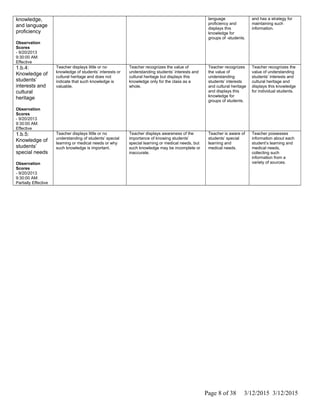
1.b.3:
Knowledge of
students’
skills,
Teacher displays little or no
knowledge of students’ skills,
knowledge, and language
proficiency and does not indicate
that such knowledge is valuable.
Teacher recognizes the value of
understanding students’ skills,
knowledge, and language proficiency
but displays this knowledge only for the
class as a whole.
Teacher recognizes
the value of
understanding
students’ skills,
knowledge, and
Teacher displays
understanding of
individual students’
skills, knowledge, and
language proficiency
Page 7 of 38 3/12/2015 3/12/2015
knowledge,
and language
proficiency
Observation
Scores
- 9/20/2013
9:30:00 AM:
Effective
language
proficiency and
displays this
knowledge for
groups of -students.
and has a strategy for
maintaining such
information.
1.b.4:
Knowledge of
students’
interests and
cultural
heritage
Observation
Scores
- 9/20/2013
9:30:00 AM:
Effective
Teacher displays little or no
knowledge of students’ interests or
cultural heritage and does not
indicate that such knowledge is
valuable.
Teacher recognizes the value of
understanding students’ interests and
cultural heritage but displays this
knowledge only for the class as a
whole.
Teacher recognizes
the value of
understanding
students’ interests
and cultural heritage
and displays this
knowledge for
groups of students.
Teacher recognizes the
value of understanding
students’ interests and
cultural heritage and
displays this knowledge
for individual students.
1.b.5:
Knowledge of
students’
special needs
Observation
Scores
- 9/20/2013
9:30:00 AM:
Partially Effective
Teacher displays little or no
understanding of students’ special
learning or medical needs or why
such knowledge is important.
Teacher displays awareness of the
importance of knowing students’
special learning or medical needs, but
such knowledge may be incomplete or
inaccurate.
Teacher is aware of
students’ special
learning and
medical needs.
Teacher possesses
information about each
student’s learning and
medical needs,
collecting such
information from a
variety of sources.
Page 8 of 38 3/12/2015 3/12/2015
Ineffective Partially Effective Effective Highly Effective
1c: Setting
Instructional
Outcomes
Outcomes represent low
expectations for students
and lack of rigor. They do not
reflect important learning in
the discipline or a connection
to a sequence of learning.
Outcomes are either not
clear or are stated as
activities, not as student
learning. Outcomes do not
permit viable methods of
assessment. Outcomes
reflect only one type of
learning and only one
discipline or strand.
Outcomes are not suitable
for the class or are not based
on any assessment of
student needs.
Outcomes represent moderately high
expectations and rigor. Some reflect
important learning in the discipline and at
least some connection to a sequence of
learning. Outcomes are only moderately
clear or consist of a combination of
outcomes and activities. Some outcomes
do not permit viable methods of
assessment. Outcomes reflect several
types of learning, but teacher has made no
attempt at coordination or integration. Most
of the outcomes are suitable for most of the
students in the class based on global
assessments of student learning.
Most outcomes represent
high expectations and rigor
and important learning in
the discipline. They are
connected to a sequence
of learning. All the
instructional outcomes are
clear, written in the form of
student learning. Most
suggest viable methods of
assessment. Outcomes
reflect several ¬different
types of learning and
opportunities for
coordination.
Most of the outcomes are
suitable for all students in
the class and are based on
evidence of student
proficiency. However, the
needs of some individual
students may not be
accommodated.
All outcomes
represent high
expectations and rigor
and important
learning in the
discipline. They are
connected to a
sequence of learning
both in the discipline
and in related
disciplines. All the
outcomes are clear,
written in the form of
student learning, and
permit viable methods
of assessment.
Where appropriate,
outcomes reflect
several different types
of learning and
opportunities for both
coordination and
integration. Outcomes
are based on a
comprehensive
assessment of
student learning and
take into account the
varying needs of
individual students or
groups.
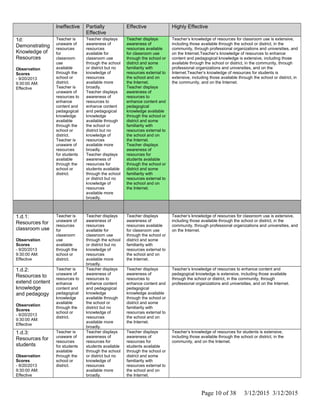
1.c.1: Value,
sequence,
and
alignment
Outcomes represent low
expectations for students
and lack of rigor. They do not
reflect important learning in
the discipline or a connection
to a sequence of learning.
Outcomes represent moderately high
expectations and rigor. Some reflect
important learning in the discipline and at
least some connection to a sequence of
learning.
Most outcomes represent
high expectations and rigor
and important learning in
the discipline. They are
connected to a sequence
of learning.
All outcomes
represent high
expectations and rigor
and important
learning in the
discipline. They are
connected to a
sequence of learning
both in the discipline
and in related
disciplines.
1.c.2: Clarity Outcomes are either not
clear or are stated as
activities, not as student
learning. Outcomes do not
permit viable methods of
assessment.
Outcomes are only moderately clear or
consist of a combination of outcomes and
activities. Some outcomes do not permit
viable methods of assessment.
All the instructional
outcomes are clear, written
in the form of student
learning. Most suggest
viable methods of
assessment.
All the outcomes are
clear, written in the
form of student
learning, and permit
viable methods of
assessment.
1.c.3:
Balance
Outcomes reflect only one
type of learning and only one
discipline or strand.
Outcomes reflect several types of learning,
but teacher has made no attempt at
coordination or integration.
Outcomes reflect several
different types of learning
and opportunities for
coordination.
Where appropriate,
outcomes reflect
several different types
of learning and
opportunities for both
coordination and
integration.
1.c.4:
Suitability for
diverse
learners
Outcomes are not suitable
for the class or are not based
on any assessment of
student needs.
Most of the outcomes are suitable for most
of the students in the class based on global
assessments of student learning.
Most of the outcomes are
suitable for all students in
the class and are based on
evidence of student
proficiency. However, the
needs of some individual
students may not be
accommodated.
Outcomes are based
on a comprehensive
assessment of
student learning and
take into account the
varying needs of
individual students or
groups.
Page 9 of 38 3/12/2015 3/12/2015
Ineffective Partially
Effective
Effective Highly Effective
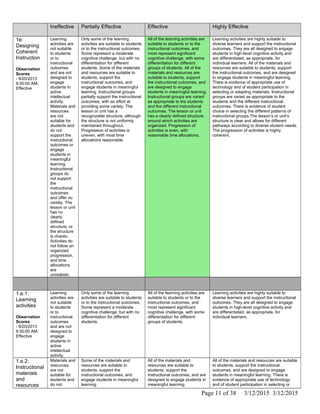
1d:
Demonstrating
Knowledge of
Resources
Observation
Scores
- 9/20/2013
9:30:00 AM:
Effective
Teacher is
unaware of
resources
for
classroom
use
available
through the
school or
district.
Teacher is
unaware of
resources to
enhance
content and
pedagogical
knowledge
available
through the
school or
district.
Teacher is
unaware of
resources
for students
available
through the
school or
district.
Teacher displays
awareness of
resources
available for
classroom use
through the school
or district but no
knowledge of
resources
available more
broadly.
Teacher displays
awareness of
resources to
enhance content
and pedagogical
knowledge
available through
the school or
district but no
knowledge of
resources
available more
broadly.
Teacher displays
awareness of
resources for
students available
through the school
or district but no
knowledge of
resources
available more
broadly.
Teacher displays
awareness of
resources available
for classroom use
through the school or
district and some
familiarity with
resources external to
the school and on
the Internet.
Teacher displays
awareness of
resources to
enhance content and
pedagogical
knowledge available
through the school or
district and some
familiarity with
resources external to
the school and on
the Internet.
Teacher displays
awareness of
resources for
students available
through the school or
district and some
familiarity with
resources external to
the school and on
the Internet.
Teacher’s knowledge of resources for classroom use is extensive,
including those available through the school or district, in the
community, through professional organizations and universities, and
on the Internet.Teacher’s knowledge of resources to enhance
content and pedagogical knowledge is extensive, including those
available through the school or district, in the community, through
professional organizations and universities, and on the
Internet.Teacher’s knowledge of resources for students is
extensive, including those available through the school or district, in
the community, and on the Internet.
1.d.1:
Resources for
classroom use
Observation
Scores
- 9/20/2013
9:30:00 AM:
Effective
Teacher is
unaware of
resources
for
classroom
use
available
through the
school or
district.
Teacher displays
awareness of
resources
available for
classroom use
through the school
or district but no
knowledge of
resources
available more
broadly.
Teacher displays
awareness of
resources available
for classroom use
through the school or
district and some
familiarity with
resources external to
the school and on
the Internet.
Teacher’s knowledge of resources for classroom use is extensive,
including those available through the school or district, in the
community, through professional organizations and universities, and
on the Internet.
1.d.2:
Resources to
extend content
knowledge
and pedagogy
Observation
Scores
- 9/20/2013
9:30:00 AM:
Effective
Teacher is
unaware of
resources to
enhance
content and
pedagogical
knowledge
available
through the
school or
district.
Teacher displays
awareness of
resources to
enhance content
and pedagogical
knowledge
available through
the school or
district but no
knowledge of
resources
available more
broadly.
Teacher displays
awareness of
resources to
enhance content and
pedagogical
knowledge available
through the school or
district and some
familiarity with
resources external to
the school and on
the Internet.
Teacher’s knowledge of resources to enhance content and
pedagogical knowledge is extensive, including those available
through the school or district, in the community, through
professional organizations and universities, and on the Internet.
1.d.3:
Resources for
students
Observation
Scores
- 9/20/2013
9:30:00 AM:
Effective
Teacher is
unaware of
resources
for students
available
through the
school or
district.
Teacher displays
awareness of
resources for
students available
through the school
or district but no
knowledge of
resources
available more
broadly.
Teacher displays
awareness of
resources for
students available
through the school or
district and some
familiarity with
resources external to
the school and on
the Internet.
Teacher’s knowledge of resources for students is extensive,
including those available through the school or district, in the
community, and on the Internet.
Page 10 of 38 3/12/2015 3/12/2015
Ineffective Partially Effective Effective Highly Effective
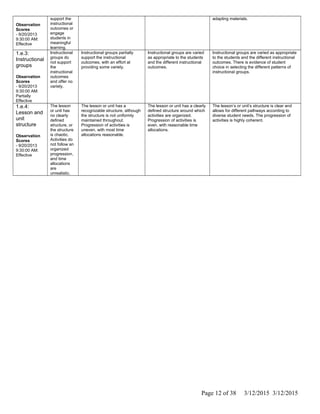
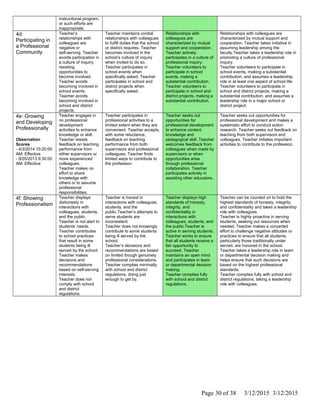
1e:
Designing
Coherent
Instruction
Observation
Scores
- 9/20/2013
9:30:00 AM:
Effective
Learning
activities are
not suitable
to students
or to
instructional
outcomes
and are not
designed to
engage
students in
active
intellectual
activity.
Materials and
resources
are not
suitable for
students and
do not
support the
instructional
outcomes or
engage
students in
meaningful
learning.
Instructional
groups do
not support
the
instructional
outcomes
and offer no
variety. The
lesson or unit
has no
clearly
defined
structure, or
the structure
is chaotic.
Activities do
not follow an
organized
progression,
and time
allocations
are
unrealistic.
Only some of the learning
activities are suitable to students
or to the instructional outcomes.
Some represent a moderate
cognitive challenge, but with no
differentiation for different
students. Some of the materials
and resources are suitable to
students, support the
instructional outcomes, and
engage students in meaningful
learning. Instructional groups
partially support the instructional
outcomes, with an effort at
providing some variety. The
lesson or unit has a
recognizable structure, although
the structure is not uniformly
maintained throughout.
Progression of activities is
uneven, with most time
allocations reasonable.
All of the learning activities are
suitable to students or to the
instructional outcomes, and
most represent significant
cognitive challenge, with some
differentiation for different
groups of students. All of the
materials and resources are
suitable to students, support
the instructional outcomes, and
are designed to engage
students in meaningful learning.
Instructional groups are varied
as appropriate to the students
and the different instructional
outcomes. The lesson or unit
has a clearly defined structure
around which activities are
organized. Progression of
activities is even, with
reasonable time allocations.
Learning activities are highly suitable to
diverse learners and support the instructional
outcomes. They are all designed to engage
students in high-level cognitive activity and
are differentiated, as appropriate, for
individual learners. All of the materials and
resources are suitable to students, support
the instructional outcomes, and are designed
to engage students in meaningful learning.
There is evidence of appropriate use of
technology and of student participation in
selecting or adapting materials. Instructional
groups are varied as appropriate to the
students and the different instructional
outcomes. There is evidence of student
choice in selecting the different patterns of
instructional groups.The lesson’s or unit’s
structure is clear and allows for different
pathways according to diverse student needs.
The progression of activities is highly
coherent.
1.e.1:
Learning
activities
Observation
Scores
- 9/20/2013
9:30:00 AM:
Effective
Learning
activities are
not suitable
to students
or to
instructional
outcomes
and are not
designed to
engage
students in
active
intellectual
activity.
Only some of the learning
activities are suitable to students
or to the instructional outcomes.
Some represent a moderate
cognitive challenge, but with no
differentiation for different
students.
All of the learning activities are
suitable to students or to the
instructional outcomes, and
most represent significant
cognitive challenge, with some
differentiation for different
groups of students.
Learning activities are highly suitable to
diverse learners and support the instructional
outcomes. They are all designed to engage
students in high-level cognitive activity and
are differentiated, as appropriate, for
individual learners.
1.e.2:
Instructional
materials
and
resources
Materials and
resources
are not
suitable for
students and
do not
Some of the materials and
resources are suitable to
students, support the
instructional outcomes, and
engage students in meaningful
learning.
All of the materials and
resources are suitable to
students, support the
instructional outcomes, and are
designed to engage students in
meaningful learning.
All of the materials and resources are suitable
to students, support the instructional
outcomes, and are designed to engage
students in meaningful learning. There is
evidence of appropriate use of technology
and of student participation in selecting or
Page 11 of 38 3/12/2015 3/12/2015
Observation
Scores
- 9/20/2013
9:30:00 AM:
Effective
support the
instructional
outcomes or
engage
students in
meaningful
learning.
adapting materials.
1.e.3:
Instructional
groups
Observation
Scores
- 9/20/2013
9:30:00 AM:
Partially
Effective
Instructional
groups do
not support
the
instructional
outcomes
and offer no
variety.
Instructional groups partially
support the instructional
outcomes, with an effort at
providing some variety.
Instructional groups are varied
as appropriate to the students
and the different instructional
outcomes.
Instructional groups are varied as appropriate
to the students and the different instructional
outcomes. There is evidence of student
choice in selecting the different patterns of
instructional groups.
1.e.4:
Lesson and
unit
structure
Observation
Scores
- 9/20/2013
9:30:00 AM:
Effective
The lesson
or unit has
no clearly
defined
structure, or
the structure
is chaotic.
Activities do
not follow an
organized
progression,
and time
allocations
are
unrealistic.
The lesson or unit has a
recognizable structure, although
the structure is not uniformly
maintained throughout.
Progression of activities is
uneven, with most time
allocations reasonable.
The lesson or unit has a clearly
defined structure around which
activities are organized.
Progression of activities is
even, with reasonable time
allocations.
The lesson’s or unit’s structure is clear and
allows for different pathways according to
diverse student needs. The progression of
activities is highly coherent.
Page 12 of 38 3/12/2015 3/12/2015
Ineffective Partially Effective Effective Highly Effective
1f: Designing
Student
Assessments
Assessment
procedures are not
congruent with
instructional
outcomes.Proposed
approach contains
no criteria or
standards.
Teacher has no
plan to incorporate
formative
assessment in the
lesson or unit.
Teacher has no
plans to use
assessment results
in designing future
instruction.
Some of the instructional
outcomes are assessed
through the proposed
approach, but many are
not. Assessment criteria
and standards have been
developed, but they are
not clear. Approach to the
use of formative
assessment is
rudimentary, including
only some of the
instructional outcomes.
Teacher plans to use
assessment results to plan
for future instruction for
the class as a whole.
All the instructional
outcomes are
assessed through the
approach to
assessment;
assessment
methodologies may
have been adapted for
groups of students.
Assessment criteria
and standards are
clear. Teacher has a
well-developed
strategy to using
formative assessment
and has designed
particular approaches
to be used. Teacher
plans to use
assessment results to
plan for future
instruction for groups of
¬students.
Proposed approach to assessment is fully aligned
with the instructional outcomes in both content and
process. Assessment methodologies have been
adapted for individual students, as
needed.Assessment criteria and standards are
clear; there is evidence that the students
contributed to their development. Approach to
using formative assessment is well designed and
includes student as well as teacher use of the
assessment information. Teacher plans to use
assessment results to plan future instruction for
individual students.
1.f.1:
Congruence
with
instructional
outcomes
Assessment
procedures are not
congruent with
instructional
outcomes.
Some of the instructional
outcomes are assessed
through the proposed
approach, but many are
not.
All the instructional
outcomes are
assessed through the
approach to
assessment;
assessment
methodologies may
have been adapted for
groups of students.
Proposed approach to assessment is fully aligned
with the instructional outcomes in both content and
process. Assessment methodologies have been
adapted for individual students, as needed.
1.f.2: Criteria
and standards
Proposed approach
contains no criteria
or standards.
Assessment criteria and
standards have been
developed, but they are
not clear.
Assessment criteria
and standards are
clear.
Assessment criteria and standards are clear; there
is evidence that the students contributed to their
development.
1.f.3: Design
of formative
assessments
Teacher has no
plan to incorporate
formative
assessment in the
lesson or unit.
Approach to the use of
formative assessment is
rudimentary, including
only some of the
instructional outcomes.
Teacher has a well-
developed strategy to
using formative
assessment and has
designed particular
approaches to be used.
Approach to using formative assessment is well
designed and includes student as well as teacher
use of the assessment information.
1.f.4: Use for
planning
Observation
Scores
- 9/20/2013
9:30:00 AM:
Effective
Teacher has no
plans to use
assessment results
in designing future
instruction.
Teacher plans to use
assessment results to plan
for future instruction for
the class as a whole.
Teacher plans to use
assessment results to
plan for future
instruction for groups of
students.
Teacher plans to use assessment results to plan
future instruction for individual students.
Page 13 of 38 3/12/2015 3/12/2015
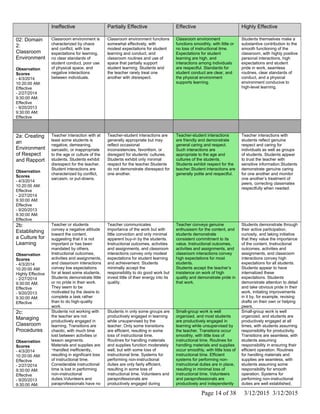
Ineffective Partially Effective Effective Highly Effective
02: Domain
2:
Classroom
Environment
Observation
Scores
- 4/3/2014
10:20:00 AM:
Effective
- 2/27/2014
9:30:00 AM:
Effective
- 9/20/2013
9:30:00 AM:
Effective
Classroom environment is
characterized by chaos
and conflict, with low
expectations for learning,
no clear standards of
student conduct, poor use
of physical space, and
negative interactions
between individuals.
Classroom environment functions
somewhat effectively, with
modest expectations for student
learning and conduct, and
classroom routines and use of
space that partially support
student learning. Students and
the teacher rarely treat one
another with disrespect.
Classroom environment
functions smoothly, with little or
no loss of instructional time.
Expectations for student
learning are high, and
interactions among individuals
are respectful. Standards for
student conduct are clear, and
the physical environment
supports learning.
Students themselves make a
substantive contribution to the
smooth functioning of the
classroom, with highly positive
personal interactions, high
expectations and student
pride in work, seamless
routines, clear standards of
conduct, and a physical
environment conducive to
high-level learning.
2a: Creating
an
Environment
of Respect
and Rapport
Observation
Scores
- 4/3/2014
10:20:00 AM:
Effective
- 2/27/2014
9:30:00 AM:
Effective
- 9/20/2013
9:30:00 AM:
Effective
Teacher interaction with at
least some students is
negative, demeaning,
sarcastic, or inappropriate
to the age or culture of the
students. Students exhibit
disrespect for the teacher.
Student interactions are
characterized by conflict,
sarcasm, or put-downs.
Teacher-student interactions are
generally appropriate but may
reflect occasional
inconsistencies, favoritism, or
disregard for students’ cultures.
Students exhibit only minimal
respect for the teacher.Students
do not demonstrate disrespect for
one another.
Teacher-student interactions
are friendly and demonstrate
general caring and respect.
Such interactions are
appropriate to the age and
cultures of the students.
Students exhibit respect for the
teacher.Student interactions are
generally polite and respectful.
Teacher interactions with
students reflect genuine
respect and caring for
individuals as well as groups
of students. Students appear
to trust the teacher with
sensitive information.Students
demonstrate genuine caring
for one another and monitor
one another’s treatment of
peers, correcting classmates
respectfully when needed.
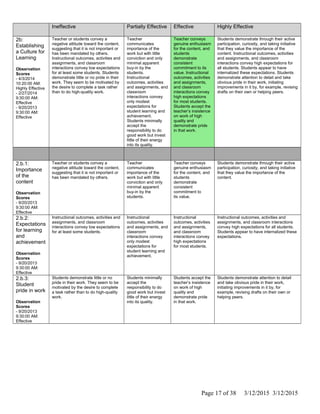
2b:
Establishing
a Culture for
Learning
Observation
Scores
- 4/3/2014
10:20:00 AM:
Highly Effective
- 2/27/2014
9:30:00 AM:
Effective
- 9/20/2013
9:30:00 AM:
Effective
Teacher or students
convey a negative attitude
toward the content,
suggesting that it is not
important or has been
mandated by others.
Instructional outcomes,
activities and assignments,
and classroom interactions
convey low expectations
for at least some students.
Students demonstrate little
or no pride in their work.
They seem to be
motivated by the desire to
complete a task rather
than to do high-quality
work.
Teacher communicates
importance of the work but with
little conviction and only minimal
apparent buy-in by the students.
Instructional outcomes, activities
and assignments, and classroom
interactions convey only modest
expectations for student learning
and achievement. Students
minimally accept the
responsibility to do good work but
invest little of their energy into its
quality.
Teacher conveys genuine
enthusiasm for the content, and
students demonstrate
consistent commitment to its
value. Instructional outcomes,
activities and assignments, and
classroom interactions convey
high expectations for most
students.
Students accept the teacher’s
insistence on work of high
quality and demonstrate pride in
that work.
Students demonstrate through
their active participation,
curiosity, and taking initiative
that they value the importance
of the content. Instructional
outcomes, activities and
assignments, and classroom
interactions convey high
expectations for all students.
Students appear to have
internalized these
expectations. Students
demonstrate attention to detail
and take obvious pride in their
work, initiating improvements
in it by, for example, revising
drafts on their own or helping
peers.
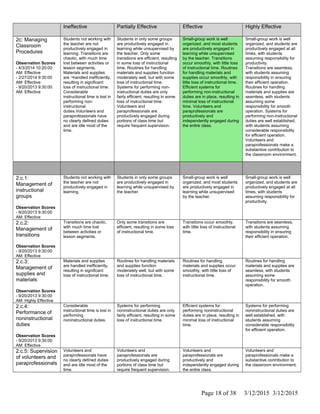
2c:
Managing
Classroom
Procedures
Observation
Scores
- 4/3/2014
10:20:00 AM:
Effective
- 2/27/2014
9:30:00 AM:
Effective
- 9/20/2013
9:30:00 AM:
Students not working with
the teacher are not
productively engaged in
learning. Transitions are
chaotic, with much time
lost between activities or
lesson segments.
Materials and supplies are
¬handled inefficiently,
resulting in significant loss
of instructional time.
Considerable instructional
time is lost in performing
non-instructional
duties.Volunteers and
paraprofessionals have no
Students in only some groups are
productively engaged in learning
while unsupervised by the
teacher. Only some transitions
are efficient, resulting in some
loss of instructional time.
Routines for handling materials
and supplies function moderately
well, but with some loss of
instructional time. Systems for
performing non-instructional
duties are only fairly efficient,
resulting in some loss of
instructional time. Volunteers and
paraprofessionals are
productively engaged during
Small-group work is well
organized, and most students
are productively engaged in
learning while unsupervised by
the teacher. Transitions occur
smoothly, with little loss of
instructional time. Routines for
handling materials and supplies
occur smoothly, with little loss of
instructional time. Efficient
systems for performing non-
instructional duties are in place,
resulting in minimal loss of
instructional time. Volunteers
and paraprofessionals are
productively and independently
Small-group work is well
organized, and students are
productively engaged at all
times, with students assuming
responsibility for productivity.
Transitions are seamless, with
students assuming
responsibility in ensuring their
efficient operation. Routines
for handling materials and
supplies are seamless, with
students assuming some
responsibility for smooth
operation. Systems for
performing non-instructional
duties are well established,
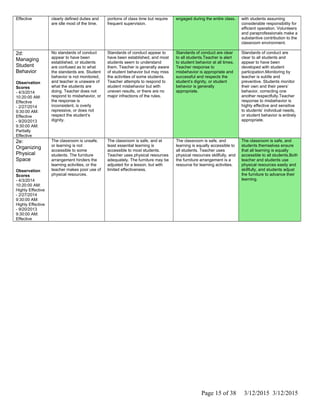
Page 14 of 38 3/12/2015 3/12/2015
Effective clearly defined duties and
are idle most of the time.
portions of class time but require
frequent supervision.
engaged during the entire class. with students assuming
considerable responsibility for
efficient operation. Volunteers
and paraprofessionals make a
substantive contribution to the
classroom environment.
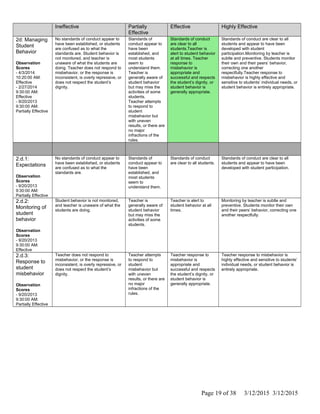
2d:
Managing
Student
Behavior
Observation
Scores
- 4/3/2014
10:20:00 AM:
Effective
- 2/27/2014
9:30:00 AM:
Effective
- 9/20/2013
9:30:00 AM:
Partially
Effective
No standards of conduct
appear to have been
established, or students
are confused as to what
the standards are. Student
behavior is not monitored,
and teacher is unaware of
what the students are
doing. Teacher does not
respond to misbehavior, or
the response is
inconsistent, is overly
repressive, or does not
respect the student’s
dignity.
Standards of conduct appear to
have been established, and most
students seem to understand
them. Teacher is generally aware
of student behavior but may miss
the activities of some students.
Teacher attempts to respond to
student misbehavior but with
uneven results, or there are no
major infractions of the rules.
Standards of conduct are clear
to all students.Teacher is alert
to student behavior at all times.
Teacher response to
misbehavior is appropriate and
successful and respects the
student’s dignity, or student
behavior is generally
appropriate.
Standards of conduct are
clear to all students and
appear to have been
developed with student
participation.Monitoring by
teacher is subtle and
preventive. Students monitor
their own and their peers’
behavior, correcting one
another respectfully.Teacher
response to misbehavior is
highly effective and sensitive
to students’ individual needs,
or student behavior is entirely
appropriate.
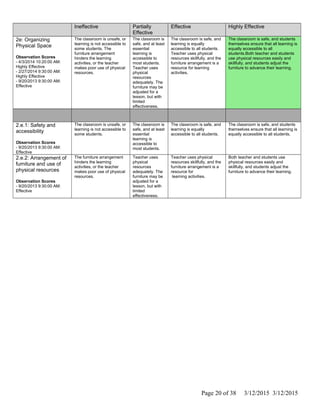
2e:
Organizing
Physical
Space
Observation
Scores
- 4/3/2014
10:20:00 AM:
Highly Effective
- 2/27/2014
9:30:00 AM:
Highly Effective
- 9/20/2013
9:30:00 AM:
Effective
The classroom is unsafe,
or learning is not
accessible to some
students. The furniture
arrangement hinders the
learning activities, or the
teacher makes poor use of
physical resources.
The classroom is safe, and at
least essential learning is
accessible to most students.
Teacher uses physical resources
adequately. The furniture may be
adjusted for a lesson, but with
limited effectiveness.
The classroom is safe, and
learning is equally accessible to
all students. Teacher uses
physical resources skillfully, and
the furniture arrangement is a
resource for learning activities.
The classroom is safe, and
students themselves ensure
that all learning is equally
accessible to all students.Both
teacher and students use
physical resources easily and
skillfully, and students adjust
the furniture to advance their
learning.
Page 15 of 38 3/12/2015 3/12/2015
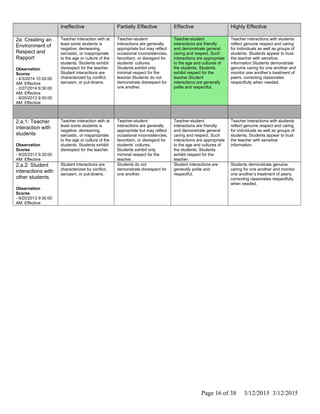
Ineffective Partially Effective Effective Highly Effective
2a: Creating an
Environment of
Respect and
Rapport
Observation
Scores
- 4/3/2014 10:20:00
AM: Effective
- 2/27/2014 9:30:00
AM: Effective
- 9/20/2013 9:30:00
AM: Effective
Teacher interaction with at
least some students is
negative, demeaning,
sarcastic, or inappropriate
to the age or culture of the
students. Students exhibit
disrespect for the teacher.
Student interactions are
characterized by conflict,
sarcasm, or put-downs.
Teacher-student
interactions are generally
appropriate but may reflect
occasional inconsistencies,
favoritism, or disregard for
students’ cultures.
Students exhibit only
minimal respect for the
teacher.Students do not
demonstrate disrespect for
one another.
Teacher-student
interactions are friendly
and demonstrate general
caring and respect. Such
interactions are appropriate
to the age and cultures of
the students. Students
exhibit respect for the
teacher.Student
interactions are generally
polite and respectful.
Teacher interactions with students
reflect genuine respect and caring
for individuals as well as groups of
students. Students appear to trust
the teacher with sensitive
information.Students demonstrate
genuine caring for one another and
monitor one another’s treatment of
peers, correcting classmates
respectfully when needed.
2.a.1: Teacher
interaction with
students
Observation
Scores
- 9/20/2013 9:30:00
AM: Effective
Teacher interaction with at
least some students is
negative, demeaning,
sarcastic, or inappropriate
to the age or culture of the
students. Students exhibit
disrespect for the teacher.
Teacher-student
interactions are generally
appropriate but may reflect
occasional inconsistencies,
favoritism, or disregard for
students’ cultures.
Students exhibit only
minimal respect for the
teacher.
Teacher-student
interactions are friendly
and demonstrate general
caring and respect. Such
interactions are appropriate
to the age and cultures of
the students. Students
exhibit respect for the
teacher.
Teacher interactions with students
reflect genuine respect and caring
for individuals as well as groups of
students. Students appear to trust
the teacher with sensitive
information.
2.a.2: Student
interactions with
other students
Observation
Scores
- 9/20/2013 9:30:00
AM: Effective
Student interactions are
characterized by conflict,
sarcasm, or put-downs.
Students do not
demonstrate disrespect for
one another.
Student interactions are
generally polite and
respectful.
Students demonstrate genuine
caring for one another and monitor
one another’s treatment of peers,
correcting classmates respectfully
when needed.
Page 16 of 38 3/12/2015 3/12/2015
Ineffective Partially Effective Effective Highly Effective
2b:
Establishing
a Culture for
Learning
Observation
Scores
- 4/3/2014
10:20:00 AM:
Highly Effective
- 2/27/2014
9:30:00 AM:
Effective
- 9/20/2013
9:30:00 AM:
Effective
Teacher or students convey a
negative attitude toward the content,
suggesting that it is not important or
has been mandated by others.
Instructional outcomes, activities and
assignments, and classroom
interactions convey low expectations
for at least some students. Students
demonstrate little or no pride in their
work. They seem to be motivated by
the desire to complete a task rather
than to do high-quality work.
Teacher
communicates
importance of the
work but with little
conviction and only
minimal apparent
buy-in by the
students.
Instructional
outcomes, activities
and assignments, and
classroom
interactions convey
only modest
expectations for
student learning and
achievement.
Students minimally
accept the
responsibility to do
good work but invest
little of their energy
into its quality.
Teacher conveys
genuine enthusiasm
for the content, and
students
demonstrate
consistent
commitment to its
value. Instructional
outcomes, activities
and assignments,
and classroom
interactions convey
high expectations
for most students.
Students accept the
teacher’s insistence
on work of high
quality and
demonstrate pride
in that work.
Students demonstrate through their active
participation, curiosity, and taking initiative
that they value the importance of the
content. Instructional outcomes, activities
and assignments, and classroom
interactions convey high expectations for
all students. Students appear to have
internalized these expectations. Students
demonstrate attention to detail and take
obvious pride in their work, initiating
improvements in it by, for example, revising
drafts on their own or helping peers.
2.b.1:
Importance
of the
content
Observation
Scores
- 9/20/2013
9:30:00 AM:
Effective
Teacher or students convey a
negative attitude toward the content,
suggesting that it is not important or
has been mandated by others.
Teacher
communicates
importance of the
work but with little
conviction and only
minimal apparent
buy-in by the
students.
Teacher conveys
genuine enthusiasm
for the content, and
students
demonstrate
consistent
commitment to
its value.
Students demonstrate through their active
participation, curiosity, and taking initiative
that they value the importance of the
content.
2.b.2:
Expectations
for learning
and
achievement
Observation
Scores
- 9/20/2013
9:30:00 AM:
Effective
Instructional outcomes, activities and
assignments, and classroom
interactions convey low expectations
for at least some students.
Instructional
outcomes, activities
and assignments, and
classroom
interactions convey
only modest
expectations for
student learning and
achievement.
Instructional
outcomes, activities
and assignments,
and classroom
interactions convey
high expectations
for most students.
Instructional outcomes, activities and
assignments, and classroom interactions
convey high expectations for all students.
Students appear to have internalized these
expectations.
2.b.3:
Student
pride in work
Observation
Scores
- 9/20/2013
9:30:00 AM:
Effective
Students demonstrate little or no
pride in their work. They seem to be
motivated by the desire to complete
a task rather than to do high-quality
work.
Students minimally
accept the
responsibility to do
good work but invest
little of their energy
into its quality.
Students accept the
teacher’s insistence
on work of high
quality and
demonstrate pride
in that work.
Students demonstrate attention to detail
and take obvious pride in their work,
initiating improvements in it by, for
example, revising drafts on their own or
helping peers.
Page 17 of 38 3/12/2015 3/12/2015
Ineffective Partially Effective Effective Highly Effective
2c: Managing
Classroom
Procedures
Observation Scores
- 4/3/2014 10:20:00
AM: Effective
- 2/27/2014 9:30:00
AM: Effective
- 9/20/2013 9:30:00
AM: Effective
Students not working with
the teacher are not
productively engaged in
learning. Transitions are
chaotic, with much time
lost between activities or
lesson segments.
Materials and supplies
are ¬handled inefficiently,
resulting in significant
loss of instructional time.
Considerable
instructional time is lost in
performing non-
instructional
duties.Volunteers and
paraprofessionals have
no clearly defined duties
and are idle most of the
time.
Students in only some groups
are productively engaged in
learning while unsupervised by
the teacher. Only some
transitions are efficient, resulting
in some loss of instructional
time. Routines for handling
materials and supplies function
moderately well, but with some
loss of instructional time.
Systems for performing non-
instructional duties are only
fairly efficient, resulting in some
loss of instructional time.
Volunteers and
paraprofessionals are
productively engaged during
portions of class time but
require frequent supervision.
Small-group work is well
organized, and most students
are productively engaged in
learning while unsupervised
by the teacher. Transitions
occur smoothly, with little loss
of instructional time. Routines
for handling materials and
supplies occur smoothly, with
little loss of instructional time.
Efficient systems for
performing non-instructional
duties are in place, resulting in
minimal loss of instructional
time. Volunteers and
paraprofessionals are
productively and
independently engaged during
the entire class.
Small-group work is well
organized, and students are
productively engaged at all
times, with students
assuming responsibility for
productivity.
Transitions are seamless,
with students assuming
responsibility in ensuring
their efficient operation.
Routines for handling
materials and supplies are
seamless, with students
assuming some
responsibility for smooth
operation. Systems for
performing non-instructional
duties are well established,
with students assuming
considerable responsibility
for efficient operation.
Volunteers and
paraprofessionals make a
substantive contribution to
the classroom environment.
2.c.1:
Management of
instructional
groups
Observation Scores
- 9/20/2013 9:30:00
AM: Effective
Students not working with
the teacher are not
productively engaged in
learning.
Students in only some groups
are productively engaged in
learning while unsupervised by
the teacher.
Small-group work is well
organized, and most students
are productively engaged in
learning while unsupervised
by the teacher.
Small-group work is well
organized, and students are
productively engaged at all
times, with students
assuming responsibility for
productivity.
2.c.2:
Management of
transitions
Observation Scores
- 9/20/2013 9:30:00
AM: Effective
Transitions are chaotic,
with much time lost
between activities or
lesson segments.
Only some transitions are
efficient, resulting in some loss
of instructional time.
Transitions occur smoothly,
with little loss of instructional
time.
Transitions are seamless,
with students assuming
responsibility in ensuring
their efficient operation.
2.c.3:
Management of
supplies and
materials
Observation Scores
- 9/20/2013 9:30:00
AM: Highly Effective
Materials and supplies
are handled inefficiently,
resulting in significant
loss of instructional time.
Routines for handling materials
and supplies function
moderately well, but with some
loss of instructional time.
Routines for handling
materials and supplies occur
smoothly, with little loss of
instructional time.
Routines for handling
materials and supplies are
seamless, with students
assuming some
responsibility for smooth
operation.
2.c.4:
Performance of
noninstructional
duties
Observation Scores
- 9/20/2013 9:30:00
AM: Effective
Considerable
instructional time is lost in
performing
noninstructional duties.
Systems for performing
noninstructional duties are only
fairly efficient, resulting in some
loss of instructional time.
Efficient systems for
performing noninstructional
duties are in place, resulting in
minimal loss of instructional
time.
Systems for performing
noninstructional duties are
well established, with
students assuming
considerable responsibility
for efficient operation.
2.c.5: Supervision
of volunteers and
paraprofessionals
Volunteers and
paraprofessionals have
no clearly defined duties
and are idle most of the
time.
Volunteers and
paraprofessionals are
productively engaged during
portions of class time but
require frequent supervision.
Volunteers and
paraprofessionals are
productively and
independently engaged during
the entire class.
Volunteers and
paraprofessionals make a
substantive contribution to
the classroom environment.
Page 18 of 38 3/12/2015 3/12/2015
Ineffective Partially
Effective
Effective Highly Effective
2d: Managing
Student
Behavior
Observation
Scores
- 4/3/2014
10:20:00 AM:
Effective
- 2/27/2014
9:30:00 AM:
Effective
- 9/20/2013
9:30:00 AM:
Partially Effective
No standards of conduct appear to
have been established, or students
are confused as to what the
standards are. Student behavior is
not monitored, and teacher is
unaware of what the students are
doing. Teacher does not respond to
misbehavior, or the response is
inconsistent, is overly repressive, or
does not respect the student’s
dignity.
Standards of
conduct appear to
have been
established, and
most students
seem to
understand them.
Teacher is
generally aware of
student behavior
but may miss the
activities of some
students.
Teacher attempts
to respond to
student
misbehavior but
with uneven
results, or there are
no major
infractions of the
rules.
Standards of conduct
are clear to all
students.Teacher is
alert to student behavior
at all times. Teacher
response to
misbehavior is
appropriate and
successful and respects
the student’s dignity, or
student behavior is
generally appropriate.
Standards of conduct are clear to all
students and appear to have been
developed with student
participation.Monitoring by teacher is
subtle and preventive. Students monitor
their own and their peers’ behavior,
correcting one another
respectfully.Teacher response to
misbehavior is highly effective and
sensitive to students’ individual needs, or
student behavior is entirely appropriate.
2.d.1:
Expectations
Observation
Scores
- 9/20/2013
9:30:00 AM:
Partially Effective
No standards of conduct appear to
have been established, or students
are confused as to what the
standards are.
Standards of
conduct appear to
have been
established, and
most students
seem to
understand them.
Standards of conduct
are clear to all students.
Standards of conduct are clear to all
students and appear to have been
developed with student participation.
2.d.2:
Monitoring of
student
behavior
Observation
Scores
- 9/20/2013
9:30:00 AM:
Effective
Student behavior is not monitored,
and teacher is unaware of what the
students are doing.
Teacher is
generally aware of
student behavior
but may miss the
activities of some
students.
Teacher is alert to
student behavior at all
times.
Monitoring by teacher is subtle and
preventive. Students monitor their own
and their peers’ behavior, correcting one
another respectfully.
2.d.3:
Response to
student
misbehavior
Observation
Scores
- 9/20/2013
9:30:00 AM:
Partially Effective
Teacher does not respond to
misbehavior, or the response is
inconsistent, is overly repressive, or
does not respect the student’s
dignity.
Teacher attempts
to respond to
student
misbehavior but
with uneven
results, or there are
no major
infractions of the
rules.
Teacher response to
misbehavior is
appropriate and
successful and respects
the student’s dignity, or
student behavior is
generally appropriate.
Teacher response to misbehavior is
highly effective and sensitive to students’
individual needs, or student behavior is
entirely appropriate.
Page 19 of 38 3/12/2015 3/12/2015
Ineffective Partially
Effective
Effective Highly Effective
2e: Organizing
Physical Space
Observation Scores
- 4/3/2014 10:20:00 AM:
Highly Effective
- 2/27/2014 9:30:00 AM:
Highly Effective
- 9/20/2013 9:30:00 AM:
Effective
The classroom is unsafe, or
learning is not accessible to
some students. The
furniture arrangement
hinders the learning
activities, or the teacher
makes poor use of physical
resources.
The classroom is
safe, and at least
essential
learning is
accessible to
most students.
Teacher uses
physical
resources
adequately. The
furniture may be
adjusted for a
lesson, but with
limited
effectiveness.
The classroom is safe, and
learning is equally
accessible to all students.
Teacher uses physical
resources skillfully, and the
furniture arrangement is a
resource for learning
activities.
The classroom is safe, and students
themselves ensure that all learning is
equally accessible to all
students.Both teacher and students
use physical resources easily and
skillfully, and students adjust the
furniture to advance their learning.
2.e.1: Safety and
accessibility
Observation Scores
- 9/20/2013 9:30:00 AM:
Effective
The classroom is unsafe, or
learning is not accessible to
some students.
The classroom is
safe, and at least
essential
learning is
accessible to
most students.
The classroom is safe, and
learning is equally
accessible to all students.
The classroom is safe, and students
themselves ensure that all learning is
equally accessible to all students.
2.e.2: Arrangement of
furniture and use of
physical resources
Observation Scores
- 9/20/2013 9:30:00 AM:
Effective
The furniture arrangement
hinders the learning
activities, or the teacher
makes poor use of physical
resources.
Teacher uses
physical
resources
adequately. The
furniture may be
adjusted for a
lesson, but with
limited
effectiveness.
Teacher uses physical
resources skillfully, and the
furniture arrangement is a
resource for
learning activities.
Both teacher and students use
physical resources easily and
skillfully, and students adjust the
furniture to advance their learning.
Page 20 of 38 3/12/2015 3/12/2015
Ineffective Partially Effective Effective Highly Effective
03: Domain 3:
Instruction
Observation
Scores
- 4/3/2014 10:20:00
AM: Effective
- 2/27/2014 9:30:00
AM: Effective
- 9/20/2013 9:30:00
AM: Effective
Instruction is characterized
by poor communication,
low-level questions, little
student engagement or
participation in discussion,
little or no use of
assessment in learning, and
rigid adherence to an
instructional plan despite
evidence that it should be
revised or modified.
Only some students are engaged in
learning because of only partially
clear communication, uneven use of
discussion strategies, and only
some suitable instructional activities
and materials. The teacher displays
some use of assessment in
instruction and is moderately flexible
in adjusting the instructional plan
and in response to students'
interests and their success in
learning.
All students are
engaged in learning
as a result of clear
communication and
successful use of
questioning and
discussion
techniques. Activities
and assignments are
of high quality, and
teacher and students
make productive use
of assessment. The
teacher demonstrates
flexibility in
contributing to the
success of the lesson
and of each student.
All students are highly engaged
in learning and make material
contributions to the success of
the class through their
participation in discussions,
active involvement in learning
activities, and use of
assessment information in their
learning. The teacher persists
in search for approaches to
meet the needs of every
student.
3a:
Communicating
with Students
Observation
Scores
- 4/3/2014 10:20:00
AM: Effective
- 2/27/2014 9:30:00
AM: Effective
- 9/20/2013 9:30:00
AM: Effective
Teacher’s purpose in a
lesson or unit is unclear to
students. Teacher’s
directions and procedures
are confusing to students.
Teacher’s explanation of the
content is unclear or
confusing or uses
inappropriate language.
Teacher’s spoken language
is inaudible, or written
language is illegible.
Spoken or written language
contains errors of grammar
or syntax. Vocabulary may
be inappropriate, vague, or
used incorrectly, leaving
students confused.
Teacher attempts to explain the
instructional purpose, with limited
success.Teacher’s directions and
procedures are clarified after initial
student confusion.
Teacher’s explanation of the content
is uneven; some is done skillfully,
but other portions are difficult to
follow. Teacher’s spoken language
is audible, and written language is
legible. Both are used correctly and
conform to standard English.
Vocabulary is correct but limited or
is not appropriate to the students’
ages or backgrounds.
Teacher’s purpose for
the lesson or unit is
clear, including where
it is situated within
broader learning.
Teacher’s directions
and procedures are
clear to students.
Teacher’s explanation
of content is
appropriate and
connects with
students’ knowledge
and experience.
Teacher’s spoken and
written language is
clear and correct and
conforms to standard
English. Vocabulary is
appropriate to the
students’ ages and
interests.
Teacher makes the purpose of
the lesson or unit clear,
including where it is situated
within broader learning, linking
that purpose to student
interests.
Teacher’s directions and
procedures are clear to
students and anticipate
possible student
misunderstanding. Teacher’s
explanation of content is
imaginative and connects with
students’ knowledge and
experience. Students contribute
to explaining concepts to their
peers. Teacher’s spoken and
written language is correct and
conforms to standard English. It
is also expressive, with well-
chosen vocabulary that
enriches the lesson. Teacher
finds opportunities to extend
students’ vocabularies.
3b: Using
Questioning and
Discussion
Techniques
Observation
Scores
- 4/3/2014 10:20:00
AM: Effective
- 2/27/2014 9:30:00
AM: Effective
- 9/20/2013 9:30:00
AM: Effective
Teacher’s questions are
virtually all of poor quality,
with low cognitive challenge
and single correct
responses, and they are
asked in rapid succession.
Interaction between teacher
and students is
predominantly recitation
style, with the teacher
mediating all questions and
answers. A few students
dominate the discussion.
Teacher’s questions are a
combination of low and high quality,
posed in rapid succession. Only
some invite a thoughtful response.
Teacher makes some attempt to
engage students in genuine
discussion rather than recitation,
with uneven results.
Teacher attempts to engage all
students in the discussion, but with
only limited success.
Most of the teacher’s
questions are of high
quality. Adequate time
is provided for
students to
respond.Teacher
creates a genuine
discussion among
students, stepping
aside when
appropriate. Teacher
successfully engages
all students in the
discussion.
Teacher’s questions are of
uniformly high quality, with
adequate time for students to
respond. Students formulate
many questions. Students
assume considerable
responsibility for the success of
the discussion, initiating topics
and making unsolicited
contributions. Students
themselves ensure that all
voices are heard in the
discussion.
3c: Engaging
Students in
Learning
Observation
Scores
- 4/3/2014 10:20:00
AM: Effective
- 2/27/2014 9:30:00
AM: Effective
- 9/20/2013 9:30:00
AM: Effective
Activities and assignments
are inappropriate for
students’ age or
background. Students are
not mentally engaged in
them.
Instructional groups are
inappropriate to the
students or to the
instructional outcomes.
Instructional materials and
resources are unsuitable to
the instructional purposes or
do not engage students
Activities and assignments are
appropriate to some students and
engage them mentally, but others
are not engaged. Instructional
groups are only partially appropriate
to the students or only moderately
successful in advancing the
instructional outcomes of the
lesson. Instructional materials and
resources are only partially suitable
to the instructional purposes, or
students are only partially mentally
engaged with them. The lesson has
a recognizable structure, although it
Most activities and
assignments are
appropriate to
students, and almost
all students are
cognitively engaged in
exploring content.
Instructional groups
are productive and
fully appropriate to the
students or to the
instructional purposes
of the lesson.
Instructional materials
All students are cognitively
engaged in the activities and
assignments in their exploration
of content. Students initiate or
adapt activities and projects to
enhance their understanding.
Instructional groups are
productive and fully appropriate
to the students or to the
instructional purposes of the
lesson. Students take the
initiative to influence the
formation or adjustment of
instructional groups.
Page 21 of 38 3/12/2015 3/12/2015
mentally.
The lesson has no clearly
defined structure, or the
pace of the lesson is too
slow or rushed, or both.
is not uniformly maintained
throughout the lesson. Pacing of the
lesson is inconsistent.
and resources are
suitable to the
instructional purposes
and engage students
mentally. The lesson
has a clearly defined
structure around
which the activities
are organized. Pacing
of the lesson is
generally appropriate.
Instructional materials and
resources are suitable to the
instructional purposes and
engage students mentally.
Students initiate the choice,
adaptation, or creation of
materials to enhance their
learning. The lesson’s structure
is highly coherent, allowing for
reflection and closure. Pacing
of the lesson is appropriate for
all students.
3d: Using
Assessment in
Instruction
Observation
Scores
- 4/3/2014 10:20:00
AM: Effective
- 9/20/2013 9:30:00
AM: Effective
Students are not aware of
the criteria and performance
standards by which their
work will be evaluated.
Teacher does not monitor
student learning in the
curriculum. Teacher’s
feedback to students is of
poor quality and not
provided in a timely manner.
Students do not engage in
self-assessment or
monitoring of progress.
Students know some of the criteria
and performance standards by
which their work will be evaluated.
Teacher monitors the progress of
the class as a whole but elicits no
diagnostic information. Teacher’s
feedback to students is uneven, and
its timeliness is inconsistent.
Students occasionally assess the
quality of their own work against the
assessment criteria and
performance standards.
Students are fully
aware of the criteria
and performance
standards by which
their work will be
evaluated. Teacher
monitors the progress
of groups of students
in the curriculum,
making limited use of
diagnostic prompts to
elicit information.
Teacher’s feedback to
students is timely and
of consistently high
quality. Students
frequently assess and
monitor the quality of
their own work
against the
assessment criteria
and performance
standards.
Students are fully aware of the
criteria and performance
standards by which their work
will be evaluated and have
contributed to the development
of the criteria. Teacher actively
and systematically elicits
diagnostic information from
individual students regarding
their understanding and
monitors the progress of
individual students.
Teacher’s feedback to students
is timely and of consistently
high quality, and students make
use of the feedback in their
learning.
Students not only frequently
assess and monitor the quality
of their own work against the
assessment criteria and
performance standards but also
make active use of that
information in their learning.
3e:
Demonstrating
Flexibility and
Responsiveness
Observation
Scores
- 9/20/2013 9:30:00
AM: Effective
Teacher adheres rigidly to
an instructional plan, even
when a change is clearly
needed. Teacher ignores or
brushes aside students’
questions or interests.
When a student has
difficulty learning, the
teacher either gives up or
blames the student or the
student’s home
environment.
Teacher attempts to adjust a lesson
when needed, with only partially
successful results. Teacher
attempts to accommodate students’
questions or interests, although the
pacing of the lesson is disrupted.
Teacher accepts responsibility for
the success of all students but has
only a limited repertoire of
instructional strategies to draw on.
Teacher makes a
minor adjustment to a
lesson, and the
adjustment occurs
smoothly. Teacher
successfully
accommodates
students’ questions or
interests. Teacher
persists in seeking
approaches for
students who have
difficulty learning,
drawing on a broad
repertoire of
strategies.
Teacher successfully makes a
major adjustment to a lesson
when needed. Teacher seizes
a major opportunity to enhance
learning, building on student
interests or a spontaneous
event. Teacher persists in
seeking effective approaches
for students who need help,
using an extensive repertoire of
strategies and soliciting
additional resources from the
school.
Page 22 of 38 3/12/2015 3/12/2015
Ineffective Partially Effective Effective Highly Effective
3a:
Communicating
with Students
Observation
Scores
- 4/3/2014 10:20:00
AM: Effective
- 2/27/2014 9:30:00
AM: Effective
- 9/20/2013 9:30:00
AM: Effective
Teacher’s purpose in a lesson or
unit is unclear to students.
Teacher’s directions and
procedures are confusing to
students. Teacher’s explanation of
the content is unclear or confusing
or uses inappropriate language.
Teacher’s spoken language is
inaudible, or written language is
illegible. Spoken or written
language contains errors of
grammar or syntax. Vocabulary
may be inappropriate, vague, or
used incorrectly, leaving students
confused.
Teacher attempts to
explain the instructional
purpose, with limited
success.Teacher’s
directions and
procedures are clarified
after initial student
confusion.
Teacher’s explanation of
the content is uneven;
some is done skillfully,
but other portions are
difficult to follow.
Teacher’s spoken
language is audible, and
written language is
legible. Both are used
correctly and conform to
standard English.
Vocabulary is correct but
limited or is not
appropriate to the
students’ ages or
backgrounds.
Teacher’s purpose
for the lesson or
unit is clear,
including where it
is situated within
broader learning.
Teacher’s
directions and
procedures are
clear to students.
Teacher’s
explanation of
content is
appropriate and
connects with
students’
knowledge and
experience.
Teacher’s spoken
and written
language is clear
and correct and
conforms to
standard English.
Vocabulary is
appropriate to the
students’ ages and
interests.
Teacher makes the purpose of the
lesson or unit clear, including where it
is situated within broader learning,
linking that purpose to student
interests.
Teacher’s directions and procedures
are clear to students and anticipate
possible student misunderstanding.
Teacher’s explanation of content is
imaginative and connects with
students’ knowledge and experience.
Students contribute to explaining
concepts to their peers. Teacher’s
spoken and written language is correct
and conforms to standard English. It is
also expressive, with well-chosen
vocabulary that enriches the lesson.
Teacher finds opportunities to extend
students’ vocabularies.
3.a.1:
Expectations
for learning
Observation
Scores
- 9/20/2013 9:30:00
AM: Effective
Teacher’s purpose in a lesson or
unit is unclear to students.
Teacher attempts to
explain the instructional
purpose, with limited
success.
Teacher’s purpose
for the lesson or
unit is clear,
including where it
is situated within
broader learning.
Teacher makes the purpose of the
lesson or unit clear, including where it
is situated within broader learning,
linking that purpose to student
interests.
3.a.2:
Directions and
procedures
Observation
Scores
- 9/20/2013 9:30:00
AM: Partially
Effective
Teacher’s directions and
procedures are confusing to
students.
Teacher’s directions and
procedures are clarified
after initial student
confusion.
Teacher’s
directions and
procedures are
clear to students.
Teacher’s directions and procedures
are clear to students and anticipate
possible student misunderstanding.
3.a.3:
Explanations of
content
Observation
Scores
- 9/20/2013 9:30:00
AM: Effective
Teacher’s explanation of the
content is unclear or confusing or
uses inappropriate language.
Teacher’s explanation of
the content is uneven;
some is done skillfully,
but other portions are
difficult to follow.
Teacher’s
explanation of
content is
appropriate and
connects with
students’
knowledge and
experience.
Teacher’s explanation of content is
imaginative and connects with
students’ knowledge and experience.
Students contribute to explaining
concepts to their peers.
3.a.4: Use of
oral and written
language
Observation
Scores
- 9/20/2013 9:30:00
AM: Effective
Teacher’s spoken language is
inaudible, or written language is
illegible. Spoken or written
language contains errors of
grammar or syntax. Vocabulary
may be inappropriate, vague, or
used incorrectly, leaving students
confused.
Teacher’s spoken
language is audible, and
written language is
legible. Both are used
correctly and conform to
standard English.
Vocabulary is correct but
limited or is not
appropriate to the
students’ ages or
backgrounds.
Teacher’s spoken
and written
language is clear
and correct and
conforms to
standard English.
Vocabulary is
appropriate to the
students’ ages and
interests.
Teacher’s spoken and written language
is correct and conforms to standard
English. It is also expressive, with well-
chosen vocabulary that enriches the
lesson. Teacher finds opportunities to
extend students’ vocabularies.
Page 23 of 38 3/12/2015 3/12/2015
Ineffective Partially Effective Effective Highly Effective
3b: Using
Questioning and
Discussion
Techniques
Observation Scores
- 4/3/2014 10:20:00
AM: Effective
- 2/27/2014 9:30:00
AM: Effective
- 9/20/2013 9:30:00
AM: Effective
Teacher’s
questions are
virtually all of poor
quality, with low
cognitive
challenge and
single correct
responses, and
they are asked in
rapid succession.
Interaction
between teacher
and students is
predominantly
recitation style,
with the teacher
mediating all
questions and
answers. A few
students dominate
the discussion.
Teacher’s questions are a
combination of low and high
quality, posed in rapid
succession. Only some
invite a thoughtful response.
Teacher makes some
attempt to engage students
in genuine discussion rather
than recitation, with uneven
results.
Teacher attempts to engage
all students in the
discussion, but with only
limited success.
Most of the teacher’s
questions are of high quality.
Adequate time is provided for
students to respond.Teacher
creates a genuine discussion
among students, stepping
aside when appropriate.
Teacher successfully
engages all students in the
discussion.
Teacher’s questions are of uniformly
high quality, with adequate time for
students to respond. Students formulate
many questions. Students assume
considerable responsibility for the
success of the discussion, initiating
topics and making unsolicited
contributions. Students themselves
ensure that all voices are heard in the
discussion.
3.b.1: Quality of
questions
Observation Scores
- 9/20/2013 9:30:00
AM: Effective
Teacher’s
questions are
virtually all of poor
quality, with low
cognitive
challenge and
single correct
responses, and
they are asked in
rapid succession.
Teacher’s questions are a
combination of low and high
quality, posed in rapid
succession. Only some
invite a thoughtful response.
Most of the teacher’s
questions are of high quality.
Adequate time is provided for
students to respond.
Teacher’s questions are of uniformly
high quality, with adequate time for
students to respond. Students formulate
many questions.
3.b.2: Discussion
techniques
Observation Scores
- 9/20/2013 9:30:00
AM: Effective
Interaction
between teacher
and students is
predominantly
recitation style,
with the teacher
mediating all
questions and
answers.
Teacher makes some
attempt to engage students
in genuine discussion rather
than recitation, with uneven
results.
Teacher creates a genuine
discussion among students,
stepping aside when
appropriate.
Students assume considerable
responsibility for the success of the
discussion, initiating topics and making
unsolicited contributions.
3.b.3: Student
participation
Observation Scores
- 9/20/2013 9:30:00
AM: Partially Effective
A few students
dominate the
discussion.
Teacher attempts to engage
all students in the
discussion, but with only
limited success.
Teacher successfully
engages all students in the
discussion.
Students themselves ensure that all
voices are heard in the discussion.
Page 24 of 38 3/12/2015 3/12/2015
Ineffective Partially Effective Effective Highly Effective
3c:
Engaging
Students in
Learning
Observation
Scores
- 4/3/2014
10:20:00 AM:
Effective
- 2/27/2014
9:30:00 AM:
Effective
- 9/20/2013
9:30:00 AM:
Effective
Activities and
assignments
are
inappropriate
for students’
age or
background.
Students are
not mentally
engaged in
them.
Instructional
groups are
inappropriate
to the
students or
to the
instructional
outcomes.
Instructional
materials
and
resources
are
unsuitable to
the
instructional
purposes or
do not
engage
students
mentally.
The lesson
has no
clearly
defined
structure, or
the pace of
the lesson is
too slow or
rushed, or
both.
Activities and assignments are appropriate to
some students and engage them mentally, but
others are not engaged. Instructional groups are
only partially appropriate to the students or only
moderately successful in advancing the
instructional outcomes of the lesson. Instructional
materials and resources are only partially suitable
to the instructional purposes, or students are only
partially mentally engaged with them. The lesson
has a recognizable structure, although it is not
uniformly maintained throughout the lesson.
Pacing of the lesson is inconsistent.
Most activities and
assignments are appropriate to
students, and almost all
students are cognitively
engaged in exploring content.
Instructional groups are
productive and fully
appropriate to the students or
to the instructional purposes of
the lesson. Instructional
materials and resources are
suitable to the instructional
purposes and engage students
mentally. The lesson has a
clearly defined structure
around which the activities are
organized. Pacing of the
lesson is generally appropriate.
All students are cognitively
engaged in the activities and
assignments in their
exploration of content.
Students initiate or adapt
activities and projects to
enhance their
understanding.
Instructional groups are
productive and fully
appropriate to the students
or to the instructional
purposes of the lesson.
Students take the initiative
to influence the formation or
adjustment of instructional
groups.
Instructional materials and
resources are suitable to the
instructional purposes and
engage students mentally.
Students initiate the choice,
adaptation, or creation of
materials to enhance their
learning. The lesson’s
structure is highly coherent,
allowing for reflection and
closure. Pacing of the
lesson is appropriate for all
students.
3.c.1:
Activities
and
assignments
Activities and
assignments
are
inappropriate
for students’
age or
background.
Students are
not mentally
engaged in
them.
Activities and assignments are appropriate to
some students and engage them mentally, but
others are not engaged.
Most activities and
assignments are appropriate to
students, and almost all
students are cognitively
engaged in exploring content.
All students are cognitively
engaged in the activities and
assignments in their
exploration of content.
Students initiate or adapt
activities and projects to
enhance their
understanding.
3.c.2:
Grouping of
students
Instructional
groups are
inappropriate
to the
students or
to the
instructional
outcomes.
Instructional groups are only partially appropriate
to the students or only moderately successful in
advancing the instructional outcomes of the
lesson.
Instructional groups are
productive and fully
appropriate to the students or
to the instructional purposes of
the lesson.
Instructional groups are
productive and fully
appropriate to the students
or to the instructional
purposes of the lesson.
Students take the initiative
to influence the formation or
adjustment of instructional
groups.
3.c.3:
Instructional
materials
and
resources
Instructional
materials
and
resources
are
unsuitable to
the
instructional
Instructional materials and resources are only
partially suitable to the instructional purposes, or
students are only partially mentally engaged with
them.
Instructional materials and
resources are suitable to the
instructional purposes and
engage students mentally.
Instructional materials and
resources are suitable to the
instructional purposes and
engage students mentally.
Students initiate the choice,
adaptation, or creation of
materials to enhance their
learning.
Page 25 of 38 3/12/2015 3/12/2015
purposes or
do not
engage
students
mentally.
3.c.4:
Structure
and pacing
The lesson
has no
clearly
defined
structure, or
the pace of
the lesson is
too slow or
rushed, or
both.
The lesson has a recognizable structure, although
it is not uniformly maintained throughout the
lesson. Pacing of the lesson is inconsistent.
The lesson has a clearly
defined structure around which
the activities are organized.
Pacing of the lesson is
generally appropriate.
The lesson’s structure is
highly coherent, allowing for
reflection and closure.
Pacing of the lesson is
appropriate for all students.
Page 26 of 38 3/12/2015 3/12/2015
Ineffective Partially Effective Effective Highly Effective
3d: Using
Assessment
in
Instruction
Observation
Scores
- 4/3/2014
10:20:00 AM:
Effective
- 9/20/2013
9:30:00 AM:
Effective
Students are not aware
of the criteria and
performance standards
by which their work will
be evaluated. Teacher
does not monitor student
learning in the
curriculum. Teacher’s
feedback to students is
of poor quality and not
provided in a timely
manner.
Students do not engage
in self-assessment or
monitoring of progress.
Students know some of the criteria and
performance standards by which their
work will be evaluated. Teacher
monitors the progress of the class as a
whole but elicits no diagnostic
information. Teacher’s feedback to
students is uneven, and its timeliness is
inconsistent. Students occasionally
assess the quality of their own work
against the assessment criteria and
performance standards.
Students are fully
aware of the criteria
and performance
standards by which
their work will be
evaluated. Teacher
monitors the progress
of groups of students in
the curriculum, making
limited use of
diagnostic prompts to
elicit information.
Teacher’s feedback to
students is timely and
of consistently high
quality. Students
frequently assess and
monitor the quality of
their own work against
the assessment criteria
and performance
standards.
Students are fully aware of the
criteria and performance
standards by which their work will
be evaluated and have
contributed to the development of
the criteria. Teacher actively and
systematically elicits diagnostic
information from individual
students regarding their
understanding and monitors the
progress of individual students.
Teacher’s feedback to students is
timely and of consistently high
quality, and students make use of
the feedback in their learning.
Students not only frequently
assess and monitor the quality of
their own work against the
assessment criteria and
performance standards but also
make active use of that
information in their learning.
3.d.1:
Assessment
criteria
Students are not aware
of the criteria and
performance standards
by which their work will
be evaluated.
Students know some of the criteria and
performance standards by which their
work will be evaluated.
Students are fully
aware of the criteria
and performance
standards by which
their work will be
evaluated.
Students are fully aware of the
criteria and performance
standards by which their work will
be evaluated and have
contributed to the development of
the criteria.
3.d.2:
Monitoring
of student
learning
Teacher does not
monitor student learning
in the curriculum.
Teacher monitors the progress of the
class as a whole but elicits no diagnostic
information.
Teacher monitors the
progress of groups of
students in the
curriculum, making
limited use of
diagnostic prompts to
elicit information.
Teacher actively and
systematically elicits diagnostic
information from individual
students regarding their
understanding and monitors the
progress of individual students.
3.d.3:
Feedback to
students
Teacher’s feedback to
students is of poor
quality and not provided
in a timely manner.
Teacher’s feedback to students is
uneven, and its timeliness is
inconsistent.
Teacher’s feedback to
students is timely and
of consistently high
quality.
Teacher’s feedback to students is
timely and of consistently high
quality, and students make use of
the feedback in their learning.
3.d.4:
Student
self-
assessment
and
monitoring
of progress
Students do not engage
in self-assessment or
monitoring of progress.
Students occasionally assess the quality
of their own work against the
assessment criteria and performance
standards.
Students frequently
assess and monitor the
quality of their own
work against the
assessment criteria and
performance standards.
Students not only frequently
assess and monitor the quality of
their own work against the
assessment criteria and
performance standards but also
make active use of that
information in their learning.
Page 27 of 38 3/12/2015 3/12/2015
Ineffective Partially Effective Effective Highly Effective
3e:
Demonstrating
Flexibility and
Responsiveness
Observation
Scores
- 9/20/2013 9:30:00
AM: Effective
Teacher
adheres rigidly
to an
instructional
plan, even
when a
change is
clearly
needed.
Teacher
ignores or
brushes aside
students’
questions or
interests.
When a
student has
difficulty
learning, the
teacher either
gives up or
blames the
student or the
student’s
home
environment.
Teacher attempts to adjust a
lesson when needed, with only
partially successful results.
Teacher attempts to accommodate
students’ questions or interests,
although the pacing of the lesson is
disrupted. Teacher accepts
responsibility for the success of all
students but has only a limited
repertoire of instructional strategies
to draw on.
Teacher makes a minor
adjustment to a lesson, and
the adjustment occurs
smoothly. Teacher
successfully accommodates
students’ questions or
interests. Teacher persists in
seeking approaches for
students who have difficulty
learning, drawing on a broad
repertoire of strategies.
Teacher successfully makes a major
adjustment to a lesson when needed.
Teacher seizes a major opportunity to
enhance learning, building on student
interests or a spontaneous event.
Teacher persists in seeking effective
approaches for students who need
help, using an extensive repertoire of
strategies and soliciting additional
resources from the school.
3.e.1: Lesson
adjustment
Teacher
adheres rigidly
to an
instructional
plan, even
when a
change is
clearly
needed.
Teacher attempts to adjust a
lesson when needed, with only
partially successful results.
Teacher makes a minor
adjustment to a lesson, and
the adjustment occurs
smoothly.
Teacher successfully makes a major
adjustment to a lesson when needed.
3.e.2: Response
to students
Teacher
ignores or
brushes aside
students’
questions or
interests.
Teacher attempts to accommodate
students’ questions or interests,
although the pacing of the lesson is
disrupted.
Teacher successfully
accommodates students’
questions or interests.
Teacher seizes a major opportunity to
enhance learning, building on student
interests or a spontaneous event.
3.e.3:
Persistence
When a
student has
difficulty
learning, the
teacher either
gives up or
blames the
student or the
student’s
home
environment.
Teacher accepts responsibility for
the success of all students but has
only a limited repertoire of
instructional strategies to draw on.
Teacher persists in seeking
approaches for students who
have difficulty learning,
drawing on a broad repertoire
of strategies.
Teacher persists in seeking effective
approaches for students who need
help, using an extensive repertoire of
strategies and soliciting additional
resources from the school.
Page 28 of 38 3/12/2015 3/12/2015
Ineffective Partially Effective Effective Highly Effective
04: Domain 4:
Professional
Responsibilities
Observation
Scores
- 9/20/2013 9:30:00
AM: Effective
The teacher
demonstrates low
ethical standards and
levels of
professionalism, with
poor record-keeping
systems and skills in
reflection, little or no
communication with
families or
colleagues, and
avoidance of school
and district
responsibilities and
participation in
activities for
professional growth.
The teacher demonstrates
moderate ethical standards
and levels of professionalism
with rudimentary record-
keeping systems and skills in
reflection, modest
communication with families
or colleagues, and
compliance with school and
district responsibilities and
participation in activities for
professional growth.
The teacher
demonstrates high ethical
standards and a genuine
sense of professionalism
by engaging in accurate
reflection on instruction,
maintaining accurate
records, communicating
frequently with families,
actively participating in
school and district events,
and engaging in activities
for professional
development.
The teacher's ethical standards and
sense of professionalism are highly
developed, showing perceptive use of
reflection, effective systems for record
keeping and communication with families,
leadership roles in both school and district
projects and extensive professional
development activities. Where
appropriate, students contribute to the
systems for record keeping and family
communication.
4a: Reflecting
on Teaching
Observation
Scores
- 4/3/2014 10:20:00
AM: Highly Effective
- 2/27/2014 9:30:00
AM: Effective
Teacher does not
know whether a
lesson was effective
or achieved its
instructional
outcomes, or teacher
profoundly misjudges
the success of a
lesson. Teacher has
no suggestions for
how a lesson could
be improved another
time the lesson is
taught.
Teacher has a generally
accurate impression of a
lesson’s effectiveness and
the extent to which
instructional outcomes were
met. Teacher makes general
suggestions about how a
lesson could be improved
another time the lesson is
taught.
Teacher makes an
accurate assessment of a
lesson’s effectiveness
and the extent to which it
achieved its instructional
outcomes and can cite
general references to
support the judgment.
Teacher makes a few
specific suggestions of
what could be tried
another time the lesson is
taught.
Teacher makes a thoughtful and accurate
assessment of a lesson’s effectiveness
and the extent to which it achieved its
instructional outcomes, citing many
specific examples from the lesson and
weighing the relative strengths of each.
Drawing on an extensive repertoire of
skills, teacher offers specific alternative
actions, complete with the probable
success of different courses of action.
4b: Maintaining
Accurate
Records
Teacher’s system for
maintaining
information on
student completion of
assignments is in
disarray. Teacher has
no system for
maintaining
information on
student progress in
learning, or the
system is in disarray.
Teacher’s records for
non-instructional
activities are in
disarray, resulting in
errors and confusion.
Teacher’s system for
maintaining information on
student completion of
assignments is rudimentary
and only partially effective.
Teacher’s system for
maintaining information on
student progress in learning
is rudimentary and only
partially effective. Teacher’s
records for non-instructional
activities are adequate, but
they require frequent
monitoring to avoid errors.
Teacher’s system for
maintaining information
on student completion of
assignments is fully
effective. Teacher’s
system for maintaining
information on student
progress in learning is
fully effective. Teacher’s
system for maintaining
information on non-
instructional activities is
fully effective.
Teacher’s system for maintaining
information on student completion of
assignments is fully effective. Students
participate in maintaining the records.
Teacher’s system for maintaining
information on student progress in
learning is fully effective. Students
contribute information and participate in
interpreting the records. Teacher’s
system for maintaining information on
non-instructional activities is highly
effective, and students contribute to its
maintenance.
4c:
Communicating
with Families
Observation
Scores
- 9/20/2013 9:30:00
AM: Effective
Teacher provides
little or no information
about the
instructional program
to families.
Teacher provides
minimal information
to families about
individual students, or
the communication is
inappropriate to the
cultures of the
families. Teacher
does not respond, or
responds
insensitively, to family
concerns about
students.
Teacher makes no
attempt to engage
families in the
Teacher participates in the
school’s activities for family
communication but offers
little additional information.
Teacher adheres to the
school’s required procedures
for communicating with
families. Responses to family
concerns are minimal or may
reflect occasional
insensitivity to cultural norms.
Teacher makes modest and
partially successful attempts
to engage families in the
instructional program.
Teacher provides
frequent information to
families, as appropriate,
about the instructional
program. Teacher
communicates with
families about students’
progress on a regular
basis, respecting cultural
norms, and is available as
needed to respond to
family concerns.
Teacher’s efforts to
engage families in the
instructional program are
frequent and successful.
Teacher provides frequent information to
families, as appropriate, about the
instructional program. Students
participate in preparing materials for their
families. Teacher provides information to
families frequently on student progress,
with students contributing to the design of
the system. Response to family concerns
is handled with great professional and
cultural sensitivity. Teacher’s efforts to
engage families in the instructional
program are frequent and successful.
Students contribute ideas for projects that
could be enhanced by family participation.
Page 29 of 38 3/12/2015 3/12/2015
instructional program,
or such efforts are
inappropriate.
4d:
Participating in
a Professional
Community
Teacher’s
relationships with
colleagues are
negative or
self-serving. Teacher
avoids participation in
a culture of inquiry,
resisting
opportunities to
become involved.
Teacher avoids
becoming involved in
school events.
Teacher avoids
becoming involved in
school and district
projects.
Teacher maintains cordial
relationships with colleagues
to fulfill duties that the school
or district requires. Teacher
becomes involved in the
school’s culture of inquiry
when invited to do so.
Teacher participates in
school events when
specifically asked. Teacher
participates in school and
district projects when
specifically asked.
Relationships with
colleagues are
characterized by mutual
support and cooperation.
Teacher actively
participates in a culture of
professional inquiry.
Teacher volunteers to
participate in school
events, making a
substantial contribution.
Teacher volunteers to
participate in school and
district projects, making a
substantial contribution.
Relationships with colleagues are
characterized by mutual support and
cooperation. Teacher takes initiative in
assuming leadership among the
faculty.Teacher takes a leadership role in
promoting a culture of professional
inquiry.
Teacher volunteers to participate in
school events, making a substantial
contribution, and assumes a leadership
role in at least one aspect of school life.
Teacher volunteers to participate in
school and district projects, making a
substantial contribution, and assumes a
leadership role in a major school or
district project.
4e: Growing
and Developing
Professionally
Observation
Scores
- 4/3/2014 10:20:00
AM: Effective
- 9/20/2013 9:30:00
AM: Effective
Teacher engages in
no professional
development
activities to enhance
knowledge or skill.
Teacher resists
feedback on teaching
performance from
either supervisors or
more experienced
colleagues.
Teacher makes no
effort to share
knowledge with
others or to assume
professional
responsibilities.
Teacher participates in
professional activities to a
limited extent when they are
convenient. Teacher accepts,
with some reluctance,
feedback on teaching
performance from both
supervisors and professional
colleagues. Teacher finds
limited ways to contribute to
the profession.
Teacher seeks out
opportunities for
professional development
to enhance content
knowledge and
pedagogical skill. Teacher
welcomes feedback from
colleagues when made by
supervisors or when
opportunities arise
through professional
collaboration. Teacher
participates actively in
assisting other educators.
Teacher seeks out opportunities for
professional development and makes a
systematic effort to conduct action
research. Teacher seeks out feedback on
teaching from both supervisors and
colleagues. Teacher initiates important
activities to contribute to the profession.
4f: Showing
Professionalism
Teacher displays
dishonesty in
interactions with
colleagues, students,
and the public.
Teacher is not alert to
students’ needs.
Teacher contributes
to school practices
that result in some
students being ill
served by the school.
Teacher makes
decisions and
recommendations
based on self-serving
interests.
Teacher does not
comply with school
and district
regulations.
Teacher is honest in
interactions with colleagues,
students, and the
public.Teacher’s attempts to
serve students are
inconsistent.
Teacher does not knowingly
contribute to some students
being ill served by the
school.
Teacher’s decisions and
recommendations are based
on limited though genuinely
professional considerations.
Teacher complies minimally
with school and district
regulations, doing just
enough to get by.
Teacher displays high
standards of honesty,
integrity, and
confidentiality in
interactions with
colleagues, students, and
the public.Teacher is
active in serving students.
Teacher works to ensure
that all students receive a
fair opportunity to
succeed. Teacher
maintains an open mind
and participates in team
or departmental decision
making.
Teacher complies fully
with school and district
regulations.
Teacher can be counted on to hold the
highest standards of honesty, integrity,
and confidentiality and takes a leadership
role with colleagues.
Teacher is highly proactive in serving
students, seeking out resources when
needed. Teacher makes a concerted
effort to challenge negative attitudes or
practices to ensure that all students,
particularly those traditionally under
served, are honored in the school.
Teacher takes a leadership role in team
or departmental decision making and
helps ensure that such decisions are
based on the highest professional
standards.
Teacher complies fully with school and
district regulations, taking a leadership
role with colleagues.
Page 30 of 38 3/12/2015 3/12/2015
Ineffective Partially Effective Effective Highly Effective
4a:
Reflecting
on
Teaching
Observation
Scores
- 4/3/2014
10:20:00 AM:
Highly
Effective
- 2/27/2014
9:30:00 AM:
Effective
Teacher does not know
whether a lesson was
effective or achieved its
instructional outcomes, or
teacher profoundly
misjudges the success of
a lesson. Teacher has no
suggestions for how a
lesson could be improved
another time the lesson is
taught.
Teacher has a generally
accurate impression of a
lesson’s effectiveness
and the extent to which
instructional outcomes
were met. Teacher
makes general
suggestions about how a
lesson could be improved
another time the lesson
is taught.
Teacher makes an accurate
assessment of a lesson’s
effectiveness and the extent to
which it achieved its
instructional outcomes and
can cite general references to
support the judgment. Teacher
makes a few specific
suggestions of what could be
tried another time the lesson is
taught.
Teacher makes a thoughtful and accurate
assessment of a lesson’s effectiveness
and the extent to which it achieved its
instructional outcomes, citing many
specific examples from the lesson and
weighing the relative strengths of each.
Drawing on an extensive repertoire of
skills, teacher offers specific alternative
actions, complete with the probable
success of different courses of action.
4.a.1:
Accuracy
Observation
Scores
- 2/27/2014
9:30:00 AM:
Highly
Effective
Teacher does not know
whether a lesson was
effective or achieved its
instructional outcomes, or
teacher profoundly
misjudges the success of
a lesson.
Teacher has a generally
accurate impression of a
lesson’s effectiveness
and the extent to which
instructional outcomes
were met.
Teacher makes an accurate
assessment of a lesson’s
effectiveness and the extent to
which it achieved its
instructional outcomes and
can cite general references to
support the judgment.
Teacher makes a thoughtful and accurate
assessment of a lesson’s effectiveness
and the extent to which it achieved its
instructional outcomes, citing many
specific examples from the lesson and
weighing the relative strengths of each.
4.a.2: Use
in future
teaching
Observation
Scores
- 2/27/2014
9:30:00 AM:
Effective
Teacher has no
suggestions for how a
lesson could be improved
another time the lesson is
taught.
Teacher makes general
suggestions about how a
lesson could be improved
another time the lesson
is taught.
Teacher makes a few specific
suggestions of what could be
tried another time the lesson is
taught.
Drawing on an extensive repertoire of
skills, teacher offers specific alternative
actions, complete with the probable
success of different courses of action.
Page 31 of 38 3/12/2015 3/12/2015
Ineffective Partially Effective Effective Highly Effective
4b:
Maintaining
Accurate
Records
Teacher’s system
for maintaining
information on
student
completion of
assignments is in
disarray. Teacher
has no system for
maintaining
information on
student progress
in learning, or the
system is in
disarray.
Teacher’s records
for non-
instructional
activities are in
disarray, resulting
in errors and
confusion.
Teacher’s system for maintaining
information on student
completion of assignments is
rudimentary and only partially
effective. Teacher’s system for
maintaining information on
student progress in learning is
rudimentary and only partially
effective. Teacher’s records for
non-instructional activities are
adequate, but they require
frequent monitoring to avoid
errors.
Teacher’s system for
maintaining information
on student completion of
assignments is fully
effective. Teacher’s
system for maintaining
information on student
progress in learning is
fully effective. Teacher’s
system for maintaining
information on non-
instructional activities is
fully effective.
Teacher’s system for maintaining
information on student completion of
assignments is fully effective. Students
participate in maintaining the records.
Teacher’s system for maintaining
information on student progress in
learning is fully effective. Students
contribute information and participate in
interpreting the records. Teacher’s system
for maintaining information on non-
instructional activities is highly effective,
and students contribute to its
maintenance.
4.b.1: Student
completion of
assignments
Teacher’s system
for maintaining
information on
student
completion of
assignments is in
disarray.
Teacher’s system for maintaining
information on student
completion of assignments is
rudimentary and only partially
effective.
Teacher’s system for
maintaining information
on student completion of
assignments is fully
effective.
Teacher’s system for maintaining
information on student completion of
assignments is fully effective. Students
participate in maintaining the records.
4.b.2: Student
progress in
learning
Teacher has no
system for
maintaining
information on
student progress
in learning, or the
system is in
disarray.
Teacher’s system for maintaining
information on student progress
in learning is rudimentary and
only partially effective.
Teacher’s system for
maintaining information
on student progress in
learning is fully effective.
Teacher’s system for maintaining
information on student progress in
learning is fully effective. Students
contribute information and participate in
interpreting the records.
4.b.3:
Noninstructional
records
Teacher’s records
for non-
instructional
activities are in
disarray, resulting
in errors and
confusion.
Teacher’s records for non-
instructional activities are
adequate, but they require
frequent monitoring to avoid
errors.
Teacher’s system for
maintaining information
on noninstructional
activities is fully effective.
Teacher’s system for maintaining
information on noninstructional activities is
highly effective, and students contribute to
its maintenance.
Page 32 of 38 3/12/2015 3/12/2015
Ineffective Partially Effective Effective Highly Effective
4c:
Communicating
with Families
Observation
Scores
- 9/20/2013 9:30:00
AM: Effective
Teacher
provides little or
no information
about the
instructional
program to
families.
Teacher
provides minimal
information to
families about
individual
students, or the
communication
is inappropriate
to the cultures of
the families.
Teacher does
not respond, or
responds
insensitively, to
family concerns
about students.
Teacher makes
no attempt to
engage families
in the
instructional
program, or
such efforts are
inappropriate.
Teacher participates in the
school’s activities for family
communication but offers little
additional information. Teacher
adheres to the school’s
required procedures for
communicating with families.
Responses to family concerns
are minimal or may reflect
occasional insensitivity to
cultural norms. Teacher makes
modest and partially
successful attempts to engage
families in the instructional
program.
Teacher provides frequent
information to families, as
appropriate, about the
instructional program.
Teacher communicates
with families about
students’ progress on a
regular basis, respecting
cultural norms, and is
available as needed to
respond to family concerns.
Teacher’s efforts to engage
families in the instructional
program are frequent and
successful.
Teacher provides frequent information to
families, as appropriate, about the
instructional program. Students participate
in preparing materials for their families.
Teacher provides information to families
frequently on student progress, with
students contributing to the design of the
system. Response to family concerns is
handled with great professional and cultural
sensitivity. Teacher’s efforts to engage
families in the instructional program are
frequent and successful. Students
contribute ideas for projects that could be
enhanced by family participation.
4.c.1:
Information
about the
instructional
program
Teacher
provides little or
no information
about the
instructional
program to
families.
Teacher participates in the
school’s activities for family
communication but offers little
additional information.
Teacher provides frequent
information to families, as
appropriate, about the
instructional program.
Teacher provides frequent information to
families, as appropriate, about the
instructional program. Students participate
in preparing materials for their families.
4.c.2:
Information
about individual
students
Observation
Scores
- 2/27/2014 9:30:00
AM: Highly
Effective
Teacher
provides minimal
information to
families about
individual
students, or the
communication
is inappropriate
to the cultures of
the families.
Teacher does
not respond, or
responds
insensitively, to
family concerns
about students.
Teacher adheres to the
school’s required procedures
for communicating with
families. Responses to family
concerns are minimal or may
reflect occasional insensitivity
to cultural norms.
Teacher communicates
with families about
students’ progress on a
regular basis, respecting
cultural norms, and is
available as needed to
respond to family concerns.
Teacher provides information to families
frequently on student progress, with
students contributing to the design of the
system. Response to family concerns is
handled with great professional and cultural
sensitivity.
4.c.3:
Engagement of
families in the
instructional
program
Teacher makes
no attempt to
engage families
in the
instructional
program, or
such efforts are
inappropriate.
Teacher makes modest and
partially successful attempts to
engage families in the
instructional program.
Teacher’s efforts to engage
families in the instructional
program are frequent and
successful.
Teacher’s efforts to engage families in the
instructional program are frequent and
successful. Students contribute ideas for
projects that could be enhanced by family
participation.
Page 33 of 38 3/12/2015 3/12/2015
Ineffective Partially Effective Effective Highly Effective
4d:
Participating
in a
Professional
Community
Teacher’s relationships
with colleagues are
negative or
self-serving. Teacher
avoids participation in a
culture of inquiry,
resisting opportunities
to become involved.
Teacher avoids
becoming involved in
school events. Teacher
avoids becoming
involved in school and
district projects.
Teacher maintains cordial
relationships with colleagues to
fulfill duties that the school or district
requires. Teacher becomes
involved in the school’s culture of
inquiry when invited to do so.
Teacher participates in school
events when specifically asked.
Teacher participates in school and
district projects when specifically
asked.
Relationships with colleagues are
characterized by mutual support and
cooperation. Teacher actively
participates in a culture of
professional inquiry. Teacher
volunteers to participate in school
events, making a substantial
contribution. Teacher volunteers to
participate in school and district
projects, making a substantial
contribution.
Relationships with
colleagues are
characterized by mutual
support and
cooperation. Teacher
takes initiative in
assuming leadership
among the
faculty.Teacher takes a
leadership role in
promoting a culture of
professional inquiry.
Teacher volunteers to
participate in school
events, making a
substantial contribution,
and assumes a
leadership role in at
least one aspect of
school life.
Teacher volunteers to
participate in school and
district projects, making
a substantial
contribution, and
assumes a leadership
role in a major school or
district project.
4.d.1:
Relationships
with
colleagues
Teacher’s relationships
with colleagues are
negative or
self-serving.
Teacher maintains cordial
relationships with colleagues to
fulfill duties that the school or district
requires.
Relationships with colleagues are
characterized by mutual support and
cooperation.
Relationships with
colleagues are
characterized by mutual
support and
cooperation. Teacher
takes initiative
in assuming leadership
among
the faculty.
4.d.2:
Involvement
in a culture of
professional
inquiry
Teacher avoids
participation in a culture
of inquiry, resisting
opportunities to become
involved.
Teacher becomes involved in the
school’s culture of inquiry when
invited to do so.
Teacher actively participates in a
culture of professional inquiry.
Teacher takes a
leadership role in
promoting a culture of
professional inquiry.
4.d.3: Service
to the school
Teacher avoids
becoming involved in
school events.
Teacher participates in school
events when specifically asked.
Teacher volunteers to participate in
school events, making a substantial
contribution.
Teacher volunteers to
participate in school
events, making a
substantial contribution,
and assumes a
leadership role in at
least one aspect of
school life.
4.d.4:
Participation
in school and
district
projects
Teacher avoids
becoming involved in
school and district
projects.
Teacher participates in school and
district projects when specifically
asked.
Teacher volunteers to participate in
school and district projects, making a
substantial contribution.
Teacher volunteers to
participate in school and
district projects, making
a substantial
contribution, and
assumes a leadership
role in a major school or
district project.
Page 34 of 38 3/12/2015 3/12/2015
Ineffective Partially Effective Effective Highly Effective
4e: Growing
and
Developing
Professionally
Observation
Scores
- 4/3/2014
10:20:00 AM:
Effective
- 9/20/2013
9:30:00 AM:
Effective
Teacher engages in
no professional
development activities
to enhance
knowledge or skill.
Teacher resists
feedback on teaching
performance from
either supervisors or
more experienced
colleagues.
Teacher makes no
effort to share
knowledge with others
or to assume
professional
responsibilities.
Teacher participates in
professional activities to a
limited extent when they are
convenient. Teacher accepts,
with some reluctance, feedback
on teaching performance from
both supervisors and
professional colleagues.
Teacher finds limited ways to
contribute to the profession.
Teacher seeks out opportunities for
professional development to
enhance content knowledge and
pedagogical skill. Teacher
welcomes feedback from colleagues
when made by supervisors or when
opportunities arise through
professional collaboration. Teacher
participates actively in assisting
other educators.
Teacher seeks out
opportunities for professional
development and makes a
systematic effort to conduct
action research. Teacher
seeks out feedback on
teaching from both supervisors
and colleagues. Teacher
initiates important activities to
contribute to the profession.
4.e.1:
Enhancement
of content
knowledge
and
pedagogical
skill
Teacher engages in
no professional
development activities
to enhance
knowledge or skill.
Teacher participates in
professional activities to a
limited extent when they are
convenient.
Teacher seeks out opportunities for
professional development to
enhance content knowledge and
pedagogical skill.
Teacher seeks out
opportunities for professional
development and makes a
systematic effort to conduct
action research.
4.e.2:
Receptivity to
feedback
from
colleagues
Teacher resists
feedback on teaching
performance from
either supervisors or
more experienced
colleagues.
Teacher accepts, with some
reluctance, feedback on
teaching performance from both
supervisors and professional
colleagues.
Teacher welcomes feedback from
colleagues when made by
supervisors or when opportunities
arise through professional
collaboration.
Teacher seeks out feedback
on teaching from both
supervisors and colleagues.
4.e.3: Service
to the
profession
Teacher makes no
effort to share
knowledge with others
or to assume
professional
responsibilities.
Teacher finds limited ways to
contribute to the profession.
Teacher participates actively in
assisting other educators.
Teacher initiates important
activities to contribute to the
profession.
Page 35 of 38 3/12/2015 3/12/2015
Ineffective Partially
Effective
Effective Highly Effective
4f: Showing
Professionalism
Teacher displays dishonesty
in interactions with
colleagues, students, and the
public. Teacher is not alert to
students’ needs. Teacher
contributes to school
practices that result in some
students being ill served by
the school. Teacher makes
decisions and
recommendations based on
self-serving interests.
Teacher does not comply with
school and district
regulations.
Teacher is honest
in interactions
with colleagues,
students, and the
public.Teacher’s
attempts to serve
students are
inconsistent.
Teacher does not
knowingly
contribute to
some students
being ill served by
the school.
Teacher’s
decisions and
recommendations
are based on
limited though
genuinely
professional
considerations.
Teacher complies
minimally with
school and district
regulations, doing
just enough to get
by.
Teacher displays high
standards of honesty,
integrity, and confidentiality in
interactions with colleagues,
students, and the
public.Teacher is active in
serving students. Teacher
works to ensure that all
students receive a fair
opportunity to succeed.
Teacher maintains an open
mind and participates in team
or departmental decision
making.
Teacher complies fully with
school and district regulations.
Teacher can be counted on to hold the
highest standards of honesty, integrity,
and confidentiality and takes a
leadership role with colleagues.
Teacher is highly proactive in serving
students, seeking out resources when
needed. Teacher makes a concerted
effort to challenge negative attitudes or
practices to ensure that all students,
particularly those traditionally under
served, are honored in the school.
Teacher takes a leadership role in
team or departmental decision making
and helps ensure that such decisions
are based on the highest professional
standards.
Teacher complies fully with school and
district regulations, taking a leadership
role with colleagues.
4.f.1: Integrity
and ethical
conduct
Teacher displays dishonesty
in interactions with
colleagues, students, and the
public.
Teacher is honest
in interactions
with colleagues,
students, and the
public.
Teacher displays high
standards of honesty,
integrity, and confidentiality in
interactions with colleagues,
students, and the public.
Teacher can be counted on to hold the
highest standards of honesty, integrity,
and confidentiality and takes a
leadership role with colleagues.
4.f.2: Service to
students
Teacher is not alert to
students’ needs.
Teacher’s
attempts to serve
students are
inconsistent.
Teacher is active in serving
students.
Teacher is highly proactive in serving
students, seeking out resources when
needed.
4.f.3: Advocacy Teacher contributes to school
practices that result in some
students being ill served by
the school.
Teacher does not
knowingly
contribute to
some students
being ill served by
the school.
Teacher works to ensure that
all students receive a fair
opportunity to succeed.
Teacher makes a concerted effort to
challenge negative attitudes or
practices to ensure that all students,
particularly those traditionally
underserved, are honored in the
school.
4.f.4: Decision
making
Teacher makes decisions and
recommendations based on
self-serving interests.
Teacher’s
decisions and
recommendations
are based on
limited though
genuinely
professional
considerations.
Teacher maintains an open
mind and participates in team
or departmental decision
making.
Teacher takes a leadership role in
team or departmental decision making
and helps ensure that such decisions
are based on the highest professional
standards.
4.f.5: Compliance
with school and
district
regulations
Teacher does not comply with
school and district
regulations.
Teacher complies
minimally with
school and district
regulations, doing
just enough to get
by.
Teacher complies fully with
school and district regulations.
Teacher complies fully with school and
district regulations, taking a leadership
role with colleagues.
Page 36 of 38 3/12/2015 3/12/2015
Evaluation Feedback
Comments on Domains:
Planning and Preparation:
Ms. Brackin is timely and thorough in her planning. She takes into account the multiple and varied
levels of the students in her class and plans accordingly. Her planning incorporates the goals of the
curriculum as well as the goals of teaching students how to learn and develop the ability to work
independently. Her plans are meticulous in detail and demonstrate an understanding of how her
students learn and the curricular goals of the district.
Classroom Environment
Ms. Brackin engenders trust with her students which is important in any classroom but of tantamount
importance in kindergarten. Her rapport with students is excellent and she has created an atmosphere
of caring with a focus on learning. Students are kind to each other and help each other when they can.
Ms. Brackin has had two students with challenging behavior this year and she has used all available
resources to help these two students learn how to behave and cooperate with their peers.
Instruction
Ms. Brackin has the ability and skill to instruct her kindergarteners at their level. She modulates how
she speaks to different students and is able to explain concepts and directions in ways that are
appropriate and clear. Ms. Brackin selects appropriate goals for lessons and provides appropriate
levels of support and challenge.
Overall Strengths/Commendations:
Ms. Brackin communicates well with student's families. She is proactive in working with families and
strikes an appropriate tone even when the subject is potentially uncomfortable. Ms. Brackin is incredibly
well-organized and focused. She spends a considerable amount of time preparing and uses her time
effectively and efficiently in planning and preparing. Ms. Brackin also has an incredibly beautiful
classroom. Each wall hanging is thought out and provides an additional instructional tool for students.
The first year in any grade level is challenging. Ms. Brackin has taken the necessary time and
dedication to learning the Kindergarten curriculum and is well-versed in the requirements.
Ms. Brackin also spends half of her time at JFK as an intervention specialist where she works with a
variety of students. She participates in the extended-day program and teaches third graders there. Ms.
Brackin has been a professional, positive member of that school as well as Bradley Gardens.
Overall Areas for Improvement/Recommendations:
Ms. Brackin demonstrates the ability to reflect and act on her reflections in a professional manner. As
she continues to teach, she should remind herself that teaching and reflecting is a cyclical process of
revision and improvement. Perfection is never the goal only continuous, steady progress.
Ms. Brackin met the goals outlined in her PGIP. She has accrued more than the 20 hours required for
professional development.
Summary Statement:
Page 37 of 38 3/12/2015 3/12/2015
It has been my pleasure to get to know Ms. Brackin during my brief stay at Bradley Gardens School.
She brings enthusiasm and knowledge to work every day. She seeks out collaboration and works
extremely well with a wide range of colleagues. She is receptive to feedback and seeks out guidance
and collaboration whenever possible. Ms. Brackin is a newer Bridgewater-Raritan teacher who will only
continue to grow and improve as her teaching matures. She is already excellent; one can only imagine
what the future will hold!
The district average for absences is 4.49. Ms. Brackin's total number of absences is 12.
The total summative rating is 3.15 in the range for Effective.
This non-tenured teacher is recommended for renewal without reservation.
Page 38 of 38 3/12/2015 3/12/2015

Evaluation

  • 1.
    Evaluation for JenniferBrackin Bradley Gardens Primary, Bridgewater-Raritan Regional School District School Year: 2013-2014 Evaluator: Edge, Jennifer Evaluation Status: Complete Please log-in to OnCourse to view all of the information related to this evaluation. Signatures: Staff Member (Brackin, Jennifer)______________________________Date_________ Evaluator (Edge, Jennifer)______________________________Date_________ My signature indicates that I have reviewed the complete evaluation on OnCourse Evaluate. Page 1 of 38 3/12/2015 3/12/2015
  • 2.
    Evaluation Ratings Ineffective PartiallyEffective Effective Highly Effective Overall Evaluation Rating 01: Domain 1: Planning and Preparation Observation Scores - 2/27/2014 9:30:00 AM: Effective - 9/20/2013 9:30:00 AM: Effective Teacher's plans reflect little understanding of the content, the students, and available resources. Instructional outcomes are either lacking or inappropriate; assessment methodologies are inadequate. Teacher's plans reflect moderate understanding of the content, the students, and available resources. Some instructional outcomes are suitable to the students as a group, and the approaches to assessment are partially aligned to the goals. Teachers' plans reflect solid understanding of the content, the students, and available resources. Instructional outcomes represent important learning suitable to most students. Most elements of the instructional design, including the assessments, are aligned to the goals. Teachers' plans, based on extensive content knowledge and understanding of students, are designed to engage students in significant learning. All aspects of the teacher's plans- instructional outcomes, learning activities, materials, resources, and assessments- are in complete alignment and are adapted as needed for individual students. 02: Domain 2: Classroom Environment Observation Scores - 4/3/2014 10:20:00 AM: Effective - 2/27/2014 9:30:00 AM: Effective - 9/20/2013 9:30:00 AM: Effective Classroom environment is characterized by chaos and conflict, with low expectations for learning, no clear standards of student conduct, poor use of physical space, and negative interactions between individuals. Classroom environment functions somewhat effectively, with modest expectations for student learning and conduct, and classroom routines and use of space that partially support student learning. Students and the teacher rarely treat one another with disrespect. Classroom environment functions smoothly, with little or no loss of instructional time. Expectations for student learning are high, and interactions among individuals are respectful. Standards for student conduct are clear, and the physical environment supports learning. Students themselves make a substantive contribution to the smooth functioning of the classroom, with highly positive personal interactions, high expectations and student pride in work, seamless routines, clear standards of conduct, and a physical environment conducive to high-level learning. 03: Domain 3: Instruction Observation Scores - 4/3/2014 10:20:00 AM: Effective - 2/27/2014 9:30:00 AM: Effective - 9/20/2013 9:30:00 AM: Effective Instruction is characterized by poor communication, low- level questions, little student engagement or participation in discussion, little or no use of assessment in learning, and rigid adherence to an instructional plan despite evidence that it should be revised or modified. Only some students are engaged in learning because of only partially clear communication, uneven use of discussion strategies, and only some suitable instructional activities and materials. The teacher displays some use of assessment in instruction and is moderately flexible in adjusting the instructional plan and in response to students' interests and their success in learning. All students are engaged in learning as a result of clear communication and successful use of questioning and discussion techniques. Activities and assignments are of high quality, and teacher and students make productive use of assessment. The teacher demonstrates flexibility in contributing to the success of the lesson and of each student. All students are highly engaged in learning and make material contributions to the success of the class through their participation in discussions, active involvement in learning activities, and use of assessment information in their learning. The teacher persists in search for approaches to meet the needs of every student. 04: Domain 4: Professional Responsibilities Observation Scores - 9/20/2013 9:30:00 AM: Effective The teacher demonstrates low ethical standards and levels of professionalism, with poor record-keeping systems and skills in reflection, little or no communication with families or colleagues, and avoidance of school and district responsibilities and participation in activities for professional growth. The teacher demonstrates moderate ethical standards and levels of professionalism with rudimentary record-keeping systems and skills in reflection, modest communication with families or colleagues, and compliance with school and district responsibilities and participation in activities for professional growth. The teacher demonstrates high ethical standards and a genuine sense of professionalism by engaging in accurate reflection on instruction, maintaining accurate records, communicating frequently with families, actively participating in school and district events, and engaging in activities for professional development. The teacher's ethical standards and sense of professionalism are highly developed, showing perceptive use of reflection, effective systems for record keeping and communication with families, leadership roles in both school and district projects and extensive professional development activities. Where appropriate, students contribute to the systems for record keeping and family communication. Page 2 of 38 3/12/2015 3/12/2015
  • 3.
    Ineffective Partially EffectiveEffective Highly Effective 01: Domain 1: Planning and Preparation Observation Scores - 2/27/2014 9:30:00 AM: Effective - 9/20/2013 9:30:00 AM: Effective Teacher's plans reflect little understanding of the content, the students, and available resources. Instructional outcomes are either lacking or inappropriate; assessment methodologies are inadequate. Teacher's plans reflect moderate understanding of the content, the students, and available resources. Some instructional outcomes are suitable to the students as a group, and the approaches to assessment are partially aligned to the goals. Teachers' plans reflect solid understanding of the content, the students, and available resources. Instructional outcomes represent important learning suitable to most students. Most elements of the instructional design, including the assessments, are aligned to the goals. Teachers' plans, based on extensive content knowledge and understanding of students, are designed to engage students in significant learning. All aspects of the teacher's plans- instructional outcomes, learning activities, materials, resources, and assessments- are in complete alignment and are adapted as needed for individual students. 1a: Demonstrating Knowledge of Content and Pedagogy In planning and practice, teacher makes content errors or does not correct errors made by students. Teacher’s plans and practice display little understanding of prerequisite relationships important to student learning of the content. Teacher displays little or no understanding of the range of pedagogical approaches suitable to student learning of the content. Teacher is familiar with the important concepts in the discipline but may display lack of awareness of how these concepts relate to one another. Teacher’s plans and practice indicate some awareness of prerequisite relationships, although such knowledge may be inaccurate or incomplete. Teacher’s plans and practice reflect a limited range of pedagogical approaches or some approaches that are not suitable to the discipline or to the students. Teacher displays solid knowledge of the important concepts in the discipline and how these relate to one another. Teacher’s plans and practice reflect accurate understanding of prerequisite relationships among topics and concepts.Teacher’s plans and practice reflect familiarity with a wide range of effective pedagogical approaches in the discipline. Teacher displays extensive knowledge of the important concepts in the discipline and how these relate both to one another and to other disciplines. Teacher’s plans and practices reflect understanding of prerequisite relationships among topics and concepts and a link to necessary cognitive structures by students to ensure understanding. Teacher’s plans and practice reflect familiarity with a wide range of effective pedagogical approaches in the discipline, anticipating student misconceptions. 1b: Demonstrating Knowledge of Students Observation Scores - 4/3/2014 10:20:00 AM: Effective - 2/27/2014 9:30:00 AM: Effective - 9/20/2013 9:30:00 AM: Effective Teacher displays little or no knowledge of the developmental characteristics of the age group. Teacher sees no value in understanding how students learn and does not seek such information. Teacher displays little or no knowledge of students’ skills, knowledge, and language proficiency and does not indicate that such knowledge is valuable. Teacher displays little or no knowledge of students’ interests or cultural heritage and does not indicate that such knowledge is valuable. Teacher displays little or no understanding of students’ special learning or medical needs or why such knowledge is important. Teacher displays partial knowledge of the developmental characteristics of the age group. Teacher recognizes the value of knowing how students learn, but this knowledge is limited or outdated. Teacher recognizes the value of understanding students’ skills, knowledge, and language proficiency but displays this knowledge only for the class as a whole. Teacher recognizes the value of understanding students’ interests and cultural heritage but displays this knowledge only for the class as a whole. Teacher displays awareness of the importance of knowing students’ special learning or medical needs, but such knowledge may be incomplete or inaccurate. Teacher displays accurate understanding of the typical developmental characteristics of the age group, as well as exceptions to the general patterns. Teacher’s knowledge of how students learn is accurate and current. Teacher applies this knowledge to the class as a whole and to groups of students. Teacher recognizes the value of understanding students’ skills, knowledge, and language proficiency and displays this knowledge for groups of -students. Teacher recognizes the value of understanding students’ interests and cultural heritage and displays this knowledge for groups of students. Teacher is aware of students’ special learning and medical needs. In addition to accurate knowledge of the typical developmental characteristics of the age group and exceptions to the general patterns, teacher displays knowledge of the extent to which individual students follow the general patterns. Teacher displays extensive and subtle understanding of how students learn and applies this knowledge to individual students. Teacher displays understanding of individual students’ skills, knowledge, and language proficiency and has a strategy for maintaining such information. Teacher recognizes the value of understanding students’ interests and cultural heritage and displays this knowledge for individual students. Teacher possesses information about each student’s learning and medical needs, collecting such information from a variety of sources. 1c: Setting Instructional Outcomes Outcomes represent low expectations for students and lack of rigor. They do not reflect important learning in the discipline or a connection to a sequence of learning. Outcomes are either not clear or are stated as activities, not as student learning. Outcomes do not Outcomes represent moderately high expectations and rigor. Some reflect important learning in the discipline and at least some connection to a sequence of learning. Outcomes are only moderately clear or consist of a combination of outcomes and activities. Most outcomes represent high expectations and rigor and important learning in the discipline. They are connected to a sequence of learning. All the instructional outcomes are clear, written in the form of student learning. Most suggest viable methods of assessment. All outcomes represent high expectations and rigor and important learning in the discipline. They are connected to a sequence of learning both in the discipline and in related disciplines. All the outcomes are clear, written in the form of student learning, and permit viable methods of assessment. Where appropriate, outcomes reflect several different types of learning and Page 3 of 38 3/12/2015 3/12/2015
  • 4.
    permit viable methodsof assessment. Outcomes reflect only one type of learning and only one discipline or strand. Outcomes are not suitable for the class or are not based on any assessment of student needs. Some outcomes do not permit viable methods of assessment. Outcomes reflect several types of learning, but teacher has made no attempt at coordination or integration. Most of the outcomes are suitable for most of the students in the class based on global assessments of student learning. Outcomes reflect several ¬different types of learning and opportunities for coordination. Most of the outcomes are suitable for all students in the class and are based on evidence of student proficiency. However, the needs of some individual students may not be accommodated. opportunities for both coordination and integration. Outcomes are based on a comprehensive assessment of student learning and take into account the varying needs of individual students or groups. 1d: Demonstrating Knowledge of Resources Observation Scores - 9/20/2013 9:30:00 AM: Effective Teacher is unaware of resources for classroom use available through the school or district. Teacher is unaware of resources to enhance content and pedagogical knowledge available through the school or district. Teacher is unaware of resources for students available through the school or district. Teacher displays awareness of resources available for classroom use through the school or district but no knowledge of resources available more broadly. Teacher displays awareness of resources to enhance content and pedagogical knowledge available through the school or district but no knowledge of resources available more broadly. Teacher displays awareness of resources for students available through the school or district but no knowledge of resources available more broadly. Teacher displays awareness of resources available for classroom use through the school or district and some familiarity with resources external to the school and on the Internet. Teacher displays awareness of resources to enhance content and pedagogical knowledge available through the school or district and some familiarity with resources external to the school and on the Internet. Teacher displays awareness of resources for students available through the school or district and some familiarity with resources external to the school and on the Internet. Teacher’s knowledge of resources for classroom use is extensive, including those available through the school or district, in the community, through professional organizations and universities, and on the Internet.Teacher’s knowledge of resources to enhance content and pedagogical knowledge is extensive, including those available through the school or district, in the community, through professional organizations and universities, and on the Internet.Teacher’s knowledge of resources for students is extensive, including those available through the school or district, in the community, and on the Internet. 1e: Designing Coherent Instruction Observation Scores - 9/20/2013 9:30:00 AM: Effective Learning activities are not suitable to students or to instructional outcomes and are not designed to engage students in active intellectual activity. Materials and resources are not suitable for students and do not support the instructional outcomes or engage students in meaningful learning. Instructional groups do not support the instructional outcomes and offer no variety. The lesson or unit has no clearly defined structure, or the structure is chaotic. Activities do not follow an organized progression, and time allocations are unrealistic. Only some of the learning activities are suitable to students or to the instructional outcomes. Some represent a moderate cognitive challenge, but with no differentiation for different students. Some of the materials and resources are suitable to students, support the instructional outcomes, and engage students in meaningful learning. Instructional groups partially support the instructional outcomes, with an effort at providing some variety. The lesson or unit has a recognizable structure, although the structure is not uniformly maintained throughout. Progression of activities is uneven, with most time allocations reasonable. All of the learning activities are suitable to students or to the instructional outcomes, and most represent significant cognitive challenge, with some differentiation for different groups of students. All of the materials and resources are suitable to students, support the instructional outcomes, and are designed to engage students in meaningful learning. Instructional groups are varied as appropriate to the students and the different instructional outcomes. The lesson or unit has a clearly defined structure around which activities are organized. Progression of activities is even, with reasonable time allocations. Learning activities are highly suitable to diverse learners and support the instructional outcomes. They are all designed to engage students in high- level cognitive activity and are differentiated, as appropriate, for individual learners. All of the materials and resources are suitable to students, support the instructional outcomes, and are designed to engage students in meaningful learning. There is evidence of appropriate use of technology and of student participation in selecting or adapting materials. Instructional groups are varied as appropriate to the students and the different instructional outcomes. There is evidence of student choice in selecting the different patterns of instructional groups.The lesson’s or unit’s structure is clear and allows for different pathways according to diverse student needs. The progression of activities is highly coherent. 1f: Designing Student Assessments Assessment procedures are not congruent with instructional outcomes.Proposed approach contains no criteria or standards. Teacher has no plan to incorporate formative assessment in the lesson or unit. Teacher has no plans to use assessment Some of the instructional outcomes are assessed through the proposed approach, but many are not. Assessment criteria and standards have been developed, but they are not clear. Approach to the use of formative assessment is rudimentary, including only some of the instructional All the instructional outcomes are assessed through the approach to assessment; assessment methodologies may have been adapted for groups of students. Assessment criteria and standards are clear. Teacher has a well- developed strategy to Proposed approach to assessment is fully aligned with the instructional outcomes in both content and process. Assessment methodologies have been adapted for individual students, as needed.Assessment criteria and standards are clear; there is evidence that the students contributed to their development. Approach to using formative assessment is well designed and includes student as well as Page 4 of 38 3/12/2015 3/12/2015
  • 5.
    results in designingfuture instruction. outcomes. Teacher plans to use assessment results to plan for future instruction for the class as a whole. using formative assessment and has designed particular approaches to be used. Teacher plans to use assessment results to plan for future instruction for groups of ¬students. teacher use of the assessment information. Teacher plans to use assessment results to plan future instruction for individual students. Page 5 of 38 3/12/2015 3/12/2015
  • 6.
    Ineffective Partially EffectiveEffective Highly Effective 1a: Demonstrating Knowledge of Content and Pedagogy In planning and practice, teacher makes content errors or does not correct errors made by students. Teacher’s plans and practice display little understanding of prerequisite relationships important to student learning of the content. Teacher displays little or no understanding of the range of pedagogical approaches suitable to student learning of the content. Teacher is familiar with the important concepts in the discipline but may display lack of awareness of how these concepts relate to one another. Teacher’s plans and practice indicate some awareness of prerequisite relationships, although such knowledge may be inaccurate or incomplete. Teacher’s plans and practice reflect a limited range of pedagogical approaches or some approaches that are not suitable to the discipline or to the students. Teacher displays solid knowledge of the important concepts in the discipline and how these relate to one another. Teacher’s plans and practice reflect accurate understanding of prerequisite relationships among topics and concepts.Teacher’s plans and practice reflect familiarity with a wide range of effective pedagogical approaches in the discipline. Teacher displays extensive knowledge of the important concepts in the discipline and how these relate both to one another and to other disciplines. Teacher’s plans and practices reflect understanding of prerequisite relationships among topics and concepts and a link to necessary cognitive structures by students to ensure understanding. Teacher’s plans and practice reflect familiarity with a wide range of effective pedagogical approaches in the discipline, anticipating student misconceptions. 1.a.1: Knowledge of content and the structure of the discipline In planning and practice, teacher makes content errors or does not correct errors made by students. Teacher is familiar with the important concepts in the discipline but may display lack of awareness of how these concepts relate to one another. Teacher displays solid knowledge of the important concepts in the discipline and how these relate to one another. Teacher displays extensive knowledge of the important concepts in the discipline and how these relate both to one another and to other disciplines. 1.a.2: Knowledge of prerequisite relationships Observation Scores - 9/20/2013 9:30:00 AM: Effective Teacher’s plans and practice display little understanding of prerequisite relationships important to student learning of the content. Teacher’s plans and practice indicate some awareness of prerequisite relationships, although such knowledge may be inaccurate or incomplete. Teacher’s plans and practice reflect accurate understanding of prerequisite relationships among topics and concepts. Teacher’s plans and practices reflect understanding of prerequisite relationships among topics and concepts and a link to necessary cognitive structures by students to ensure understanding. 1.a.3: Knowledge of content-related pedagogy Teacher displays little or no understanding of the range of pedagogical approaches suitable to student learning of the content. Teacher’s plans and practice reflect a limited range of pedagogical approaches or some approaches that are not suitable to the discipline or to the students. Teacher’s plans and practice reflect familiarity with a wide range of effective pedagogical approaches in the discipline. Teacher’s plans and practice reflect familiarity with a wide range of effective pedagogical approaches in the discipline, anticipating student misconceptions. Page 6 of 38 3/12/2015 3/12/2015
  • 7.
    Ineffective Partially EffectiveEffective Highly Effective 1b: Demonstrating Knowledge of Students Observation Scores - 4/3/2014 10:20:00 AM: Effective - 2/27/2014 9:30:00 AM: Effective - 9/20/2013 9:30:00 AM: Effective Teacher displays little or no knowledge of the developmental characteristics of the age group. Teacher sees no value in understanding how students learn and does not seek such information. Teacher displays little or no knowledge of students’ skills, knowledge, and language proficiency and does not indicate that such knowledge is valuable. Teacher displays little or no knowledge of students’ interests or cultural heritage and does not indicate that such knowledge is valuable. Teacher displays little or no understanding of students’ special learning or medical needs or why such knowledge is important. Teacher displays partial knowledge of the developmental characteristics of the age group. Teacher recognizes the value of knowing how students learn, but this knowledge is limited or outdated. Teacher recognizes the value of understanding students’ skills, knowledge, and language proficiency but displays this knowledge only for the class as a whole. Teacher recognizes the value of understanding students’ interests and cultural heritage but displays this knowledge only for the class as a whole. Teacher displays awareness of the importance of knowing students’ special learning or medical needs, but such knowledge may be incomplete or inaccurate. Teacher displays accurate understanding of the typical developmental characteristics of the age group, as well as exceptions to the general patterns. Teacher’s knowledge of how students learn is accurate and current. Teacher applies this knowledge to the class as a whole and to groups of students. Teacher recognizes the value of understanding students’ skills, knowledge, and language proficiency and displays this knowledge for groups of -students. Teacher recognizes the value of understanding students’ interests and cultural heritage and displays this knowledge for groups of students. Teacher is aware of students’ special learning and medical needs. In addition to accurate knowledge of the typical developmental characteristics of the age group and exceptions to the general patterns, teacher displays knowledge of the extent to which individual students follow the general patterns. Teacher displays extensive and subtle understanding of how students learn and applies this knowledge to individual students. Teacher displays understanding of individual students’ skills, knowledge, and language proficiency and has a strategy for maintaining such information. Teacher recognizes the value of understanding students’ interests and cultural heritage and displays this knowledge for individual students. Teacher possesses information about each student’s learning and medical needs, collecting such information from a variety of sources. 1.b.1: Knowledge of child and adolescent development Observation Scores - 9/20/2013 9:30:00 AM: Partially Effective Teacher displays little or no knowledge of the developmental characteristics of the age group Teacher displays partial knowledge of the developmental characteristics of the age group. Teacher displays accurate understanding of the typical developmental characteristics of the age group, as well as exceptions to the general patterns. In addition to accurate knowledge of the typical developmental characteristics of the age group and exceptions to the general patterns, teacher displays knowledge of the extent to which individual students follow the general patterns. 1.b.2: Knowledge of the learning process Observation Scores - 9/20/2013 9:30:00 AM: Effective Teacher sees no value in understanding how students learn and does not seek such information. Teacher recognizes the value of knowing how students learn, but this knowledge is limited or outdated. Teacher’s knowledge of how students learn is accurate and current. Teacher applies this knowledge to the class as a whole and to groups of students. Teacher displays extensive and subtle understanding of how students learn and applies this knowledge to individual students. 1.b.3: Knowledge of students’ skills, Teacher displays little or no knowledge of students’ skills, knowledge, and language proficiency and does not indicate that such knowledge is valuable. Teacher recognizes the value of understanding students’ skills, knowledge, and language proficiency but displays this knowledge only for the class as a whole. Teacher recognizes the value of understanding students’ skills, knowledge, and Teacher displays understanding of individual students’ skills, knowledge, and language proficiency Page 7 of 38 3/12/2015 3/12/2015
  • 8.
    knowledge, and language proficiency Observation Scores - 9/20/2013 9:30:00AM: Effective language proficiency and displays this knowledge for groups of -students. and has a strategy for maintaining such information. 1.b.4: Knowledge of students’ interests and cultural heritage Observation Scores - 9/20/2013 9:30:00 AM: Effective Teacher displays little or no knowledge of students’ interests or cultural heritage and does not indicate that such knowledge is valuable. Teacher recognizes the value of understanding students’ interests and cultural heritage but displays this knowledge only for the class as a whole. Teacher recognizes the value of understanding students’ interests and cultural heritage and displays this knowledge for groups of students. Teacher recognizes the value of understanding students’ interests and cultural heritage and displays this knowledge for individual students. 1.b.5: Knowledge of students’ special needs Observation Scores - 9/20/2013 9:30:00 AM: Partially Effective Teacher displays little or no understanding of students’ special learning or medical needs or why such knowledge is important. Teacher displays awareness of the importance of knowing students’ special learning or medical needs, but such knowledge may be incomplete or inaccurate. Teacher is aware of students’ special learning and medical needs. Teacher possesses information about each student’s learning and medical needs, collecting such information from a variety of sources. Page 8 of 38 3/12/2015 3/12/2015
  • 9.
    Ineffective Partially EffectiveEffective Highly Effective 1c: Setting Instructional Outcomes Outcomes represent low expectations for students and lack of rigor. They do not reflect important learning in the discipline or a connection to a sequence of learning. Outcomes are either not clear or are stated as activities, not as student learning. Outcomes do not permit viable methods of assessment. Outcomes reflect only one type of learning and only one discipline or strand. Outcomes are not suitable for the class or are not based on any assessment of student needs. Outcomes represent moderately high expectations and rigor. Some reflect important learning in the discipline and at least some connection to a sequence of learning. Outcomes are only moderately clear or consist of a combination of outcomes and activities. Some outcomes do not permit viable methods of assessment. Outcomes reflect several types of learning, but teacher has made no attempt at coordination or integration. Most of the outcomes are suitable for most of the students in the class based on global assessments of student learning. Most outcomes represent high expectations and rigor and important learning in the discipline. They are connected to a sequence of learning. All the instructional outcomes are clear, written in the form of student learning. Most suggest viable methods of assessment. Outcomes reflect several ¬different types of learning and opportunities for coordination. Most of the outcomes are suitable for all students in the class and are based on evidence of student proficiency. However, the needs of some individual students may not be accommodated. All outcomes represent high expectations and rigor and important learning in the discipline. They are connected to a sequence of learning both in the discipline and in related disciplines. All the outcomes are clear, written in the form of student learning, and permit viable methods of assessment. Where appropriate, outcomes reflect several different types of learning and opportunities for both coordination and integration. Outcomes are based on a comprehensive assessment of student learning and take into account the varying needs of individual students or groups. 1.c.1: Value, sequence, and alignment Outcomes represent low expectations for students and lack of rigor. They do not reflect important learning in the discipline or a connection to a sequence of learning. Outcomes represent moderately high expectations and rigor. Some reflect important learning in the discipline and at least some connection to a sequence of learning. Most outcomes represent high expectations and rigor and important learning in the discipline. They are connected to a sequence of learning. All outcomes represent high expectations and rigor and important learning in the discipline. They are connected to a sequence of learning both in the discipline and in related disciplines. 1.c.2: Clarity Outcomes are either not clear or are stated as activities, not as student learning. Outcomes do not permit viable methods of assessment. Outcomes are only moderately clear or consist of a combination of outcomes and activities. Some outcomes do not permit viable methods of assessment. All the instructional outcomes are clear, written in the form of student learning. Most suggest viable methods of assessment. All the outcomes are clear, written in the form of student learning, and permit viable methods of assessment. 1.c.3: Balance Outcomes reflect only one type of learning and only one discipline or strand. Outcomes reflect several types of learning, but teacher has made no attempt at coordination or integration. Outcomes reflect several different types of learning and opportunities for coordination. Where appropriate, outcomes reflect several different types of learning and opportunities for both coordination and integration. 1.c.4: Suitability for diverse learners Outcomes are not suitable for the class or are not based on any assessment of student needs. Most of the outcomes are suitable for most of the students in the class based on global assessments of student learning. Most of the outcomes are suitable for all students in the class and are based on evidence of student proficiency. However, the needs of some individual students may not be accommodated. Outcomes are based on a comprehensive assessment of student learning and take into account the varying needs of individual students or groups. Page 9 of 38 3/12/2015 3/12/2015
  • 10.
    Ineffective Partially Effective Effective HighlyEffective 1d: Demonstrating Knowledge of Resources Observation Scores - 9/20/2013 9:30:00 AM: Effective Teacher is unaware of resources for classroom use available through the school or district. Teacher is unaware of resources to enhance content and pedagogical knowledge available through the school or district. Teacher is unaware of resources for students available through the school or district. Teacher displays awareness of resources available for classroom use through the school or district but no knowledge of resources available more broadly. Teacher displays awareness of resources to enhance content and pedagogical knowledge available through the school or district but no knowledge of resources available more broadly. Teacher displays awareness of resources for students available through the school or district but no knowledge of resources available more broadly. Teacher displays awareness of resources available for classroom use through the school or district and some familiarity with resources external to the school and on the Internet. Teacher displays awareness of resources to enhance content and pedagogical knowledge available through the school or district and some familiarity with resources external to the school and on the Internet. Teacher displays awareness of resources for students available through the school or district and some familiarity with resources external to the school and on the Internet. Teacher’s knowledge of resources for classroom use is extensive, including those available through the school or district, in the community, through professional organizations and universities, and on the Internet.Teacher’s knowledge of resources to enhance content and pedagogical knowledge is extensive, including those available through the school or district, in the community, through professional organizations and universities, and on the Internet.Teacher’s knowledge of resources for students is extensive, including those available through the school or district, in the community, and on the Internet. 1.d.1: Resources for classroom use Observation Scores - 9/20/2013 9:30:00 AM: Effective Teacher is unaware of resources for classroom use available through the school or district. Teacher displays awareness of resources available for classroom use through the school or district but no knowledge of resources available more broadly. Teacher displays awareness of resources available for classroom use through the school or district and some familiarity with resources external to the school and on the Internet. Teacher’s knowledge of resources for classroom use is extensive, including those available through the school or district, in the community, through professional organizations and universities, and on the Internet. 1.d.2: Resources to extend content knowledge and pedagogy Observation Scores - 9/20/2013 9:30:00 AM: Effective Teacher is unaware of resources to enhance content and pedagogical knowledge available through the school or district. Teacher displays awareness of resources to enhance content and pedagogical knowledge available through the school or district but no knowledge of resources available more broadly. Teacher displays awareness of resources to enhance content and pedagogical knowledge available through the school or district and some familiarity with resources external to the school and on the Internet. Teacher’s knowledge of resources to enhance content and pedagogical knowledge is extensive, including those available through the school or district, in the community, through professional organizations and universities, and on the Internet. 1.d.3: Resources for students Observation Scores - 9/20/2013 9:30:00 AM: Effective Teacher is unaware of resources for students available through the school or district. Teacher displays awareness of resources for students available through the school or district but no knowledge of resources available more broadly. Teacher displays awareness of resources for students available through the school or district and some familiarity with resources external to the school and on the Internet. Teacher’s knowledge of resources for students is extensive, including those available through the school or district, in the community, and on the Internet. Page 10 of 38 3/12/2015 3/12/2015
  • 11.
    Ineffective Partially EffectiveEffective Highly Effective 1e: Designing Coherent Instruction Observation Scores - 9/20/2013 9:30:00 AM: Effective Learning activities are not suitable to students or to instructional outcomes and are not designed to engage students in active intellectual activity. Materials and resources are not suitable for students and do not support the instructional outcomes or engage students in meaningful learning. Instructional groups do not support the instructional outcomes and offer no variety. The lesson or unit has no clearly defined structure, or the structure is chaotic. Activities do not follow an organized progression, and time allocations are unrealistic. Only some of the learning activities are suitable to students or to the instructional outcomes. Some represent a moderate cognitive challenge, but with no differentiation for different students. Some of the materials and resources are suitable to students, support the instructional outcomes, and engage students in meaningful learning. Instructional groups partially support the instructional outcomes, with an effort at providing some variety. The lesson or unit has a recognizable structure, although the structure is not uniformly maintained throughout. Progression of activities is uneven, with most time allocations reasonable. All of the learning activities are suitable to students or to the instructional outcomes, and most represent significant cognitive challenge, with some differentiation for different groups of students. All of the materials and resources are suitable to students, support the instructional outcomes, and are designed to engage students in meaningful learning. Instructional groups are varied as appropriate to the students and the different instructional outcomes. The lesson or unit has a clearly defined structure around which activities are organized. Progression of activities is even, with reasonable time allocations. Learning activities are highly suitable to diverse learners and support the instructional outcomes. They are all designed to engage students in high-level cognitive activity and are differentiated, as appropriate, for individual learners. All of the materials and resources are suitable to students, support the instructional outcomes, and are designed to engage students in meaningful learning. There is evidence of appropriate use of technology and of student participation in selecting or adapting materials. Instructional groups are varied as appropriate to the students and the different instructional outcomes. There is evidence of student choice in selecting the different patterns of instructional groups.The lesson’s or unit’s structure is clear and allows for different pathways according to diverse student needs. The progression of activities is highly coherent. 1.e.1: Learning activities Observation Scores - 9/20/2013 9:30:00 AM: Effective Learning activities are not suitable to students or to instructional outcomes and are not designed to engage students in active intellectual activity. Only some of the learning activities are suitable to students or to the instructional outcomes. Some represent a moderate cognitive challenge, but with no differentiation for different students. All of the learning activities are suitable to students or to the instructional outcomes, and most represent significant cognitive challenge, with some differentiation for different groups of students. Learning activities are highly suitable to diverse learners and support the instructional outcomes. They are all designed to engage students in high-level cognitive activity and are differentiated, as appropriate, for individual learners. 1.e.2: Instructional materials and resources Materials and resources are not suitable for students and do not Some of the materials and resources are suitable to students, support the instructional outcomes, and engage students in meaningful learning. All of the materials and resources are suitable to students, support the instructional outcomes, and are designed to engage students in meaningful learning. All of the materials and resources are suitable to students, support the instructional outcomes, and are designed to engage students in meaningful learning. There is evidence of appropriate use of technology and of student participation in selecting or Page 11 of 38 3/12/2015 3/12/2015
  • 12.
    Observation Scores - 9/20/2013 9:30:00 AM: Effective supportthe instructional outcomes or engage students in meaningful learning. adapting materials. 1.e.3: Instructional groups Observation Scores - 9/20/2013 9:30:00 AM: Partially Effective Instructional groups do not support the instructional outcomes and offer no variety. Instructional groups partially support the instructional outcomes, with an effort at providing some variety. Instructional groups are varied as appropriate to the students and the different instructional outcomes. Instructional groups are varied as appropriate to the students and the different instructional outcomes. There is evidence of student choice in selecting the different patterns of instructional groups. 1.e.4: Lesson and unit structure Observation Scores - 9/20/2013 9:30:00 AM: Effective The lesson or unit has no clearly defined structure, or the structure is chaotic. Activities do not follow an organized progression, and time allocations are unrealistic. The lesson or unit has a recognizable structure, although the structure is not uniformly maintained throughout. Progression of activities is uneven, with most time allocations reasonable. The lesson or unit has a clearly defined structure around which activities are organized. Progression of activities is even, with reasonable time allocations. The lesson’s or unit’s structure is clear and allows for different pathways according to diverse student needs. The progression of activities is highly coherent. Page 12 of 38 3/12/2015 3/12/2015
  • 13.
    Ineffective Partially EffectiveEffective Highly Effective 1f: Designing Student Assessments Assessment procedures are not congruent with instructional outcomes.Proposed approach contains no criteria or standards. Teacher has no plan to incorporate formative assessment in the lesson or unit. Teacher has no plans to use assessment results in designing future instruction. Some of the instructional outcomes are assessed through the proposed approach, but many are not. Assessment criteria and standards have been developed, but they are not clear. Approach to the use of formative assessment is rudimentary, including only some of the instructional outcomes. Teacher plans to use assessment results to plan for future instruction for the class as a whole. All the instructional outcomes are assessed through the approach to assessment; assessment methodologies may have been adapted for groups of students. Assessment criteria and standards are clear. Teacher has a well-developed strategy to using formative assessment and has designed particular approaches to be used. Teacher plans to use assessment results to plan for future instruction for groups of ¬students. Proposed approach to assessment is fully aligned with the instructional outcomes in both content and process. Assessment methodologies have been adapted for individual students, as needed.Assessment criteria and standards are clear; there is evidence that the students contributed to their development. Approach to using formative assessment is well designed and includes student as well as teacher use of the assessment information. Teacher plans to use assessment results to plan future instruction for individual students. 1.f.1: Congruence with instructional outcomes Assessment procedures are not congruent with instructional outcomes. Some of the instructional outcomes are assessed through the proposed approach, but many are not. All the instructional outcomes are assessed through the approach to assessment; assessment methodologies may have been adapted for groups of students. Proposed approach to assessment is fully aligned with the instructional outcomes in both content and process. Assessment methodologies have been adapted for individual students, as needed. 1.f.2: Criteria and standards Proposed approach contains no criteria or standards. Assessment criteria and standards have been developed, but they are not clear. Assessment criteria and standards are clear. Assessment criteria and standards are clear; there is evidence that the students contributed to their development. 1.f.3: Design of formative assessments Teacher has no plan to incorporate formative assessment in the lesson or unit. Approach to the use of formative assessment is rudimentary, including only some of the instructional outcomes. Teacher has a well- developed strategy to using formative assessment and has designed particular approaches to be used. Approach to using formative assessment is well designed and includes student as well as teacher use of the assessment information. 1.f.4: Use for planning Observation Scores - 9/20/2013 9:30:00 AM: Effective Teacher has no plans to use assessment results in designing future instruction. Teacher plans to use assessment results to plan for future instruction for the class as a whole. Teacher plans to use assessment results to plan for future instruction for groups of students. Teacher plans to use assessment results to plan future instruction for individual students. Page 13 of 38 3/12/2015 3/12/2015
  • 14.
    Ineffective Partially EffectiveEffective Highly Effective 02: Domain 2: Classroom Environment Observation Scores - 4/3/2014 10:20:00 AM: Effective - 2/27/2014 9:30:00 AM: Effective - 9/20/2013 9:30:00 AM: Effective Classroom environment is characterized by chaos and conflict, with low expectations for learning, no clear standards of student conduct, poor use of physical space, and negative interactions between individuals. Classroom environment functions somewhat effectively, with modest expectations for student learning and conduct, and classroom routines and use of space that partially support student learning. Students and the teacher rarely treat one another with disrespect. Classroom environment functions smoothly, with little or no loss of instructional time. Expectations for student learning are high, and interactions among individuals are respectful. Standards for student conduct are clear, and the physical environment supports learning. Students themselves make a substantive contribution to the smooth functioning of the classroom, with highly positive personal interactions, high expectations and student pride in work, seamless routines, clear standards of conduct, and a physical environment conducive to high-level learning. 2a: Creating an Environment of Respect and Rapport Observation Scores - 4/3/2014 10:20:00 AM: Effective - 2/27/2014 9:30:00 AM: Effective - 9/20/2013 9:30:00 AM: Effective Teacher interaction with at least some students is negative, demeaning, sarcastic, or inappropriate to the age or culture of the students. Students exhibit disrespect for the teacher. Student interactions are characterized by conflict, sarcasm, or put-downs. Teacher-student interactions are generally appropriate but may reflect occasional inconsistencies, favoritism, or disregard for students’ cultures. Students exhibit only minimal respect for the teacher.Students do not demonstrate disrespect for one another. Teacher-student interactions are friendly and demonstrate general caring and respect. Such interactions are appropriate to the age and cultures of the students. Students exhibit respect for the teacher.Student interactions are generally polite and respectful. Teacher interactions with students reflect genuine respect and caring for individuals as well as groups of students. Students appear to trust the teacher with sensitive information.Students demonstrate genuine caring for one another and monitor one another’s treatment of peers, correcting classmates respectfully when needed. 2b: Establishing a Culture for Learning Observation Scores - 4/3/2014 10:20:00 AM: Highly Effective - 2/27/2014 9:30:00 AM: Effective - 9/20/2013 9:30:00 AM: Effective Teacher or students convey a negative attitude toward the content, suggesting that it is not important or has been mandated by others. Instructional outcomes, activities and assignments, and classroom interactions convey low expectations for at least some students. Students demonstrate little or no pride in their work. They seem to be motivated by the desire to complete a task rather than to do high-quality work. Teacher communicates importance of the work but with little conviction and only minimal apparent buy-in by the students. Instructional outcomes, activities and assignments, and classroom interactions convey only modest expectations for student learning and achievement. Students minimally accept the responsibility to do good work but invest little of their energy into its quality. Teacher conveys genuine enthusiasm for the content, and students demonstrate consistent commitment to its value. Instructional outcomes, activities and assignments, and classroom interactions convey high expectations for most students. Students accept the teacher’s insistence on work of high quality and demonstrate pride in that work. Students demonstrate through their active participation, curiosity, and taking initiative that they value the importance of the content. Instructional outcomes, activities and assignments, and classroom interactions convey high expectations for all students. Students appear to have internalized these expectations. Students demonstrate attention to detail and take obvious pride in their work, initiating improvements in it by, for example, revising drafts on their own or helping peers. 2c: Managing Classroom Procedures Observation Scores - 4/3/2014 10:20:00 AM: Effective - 2/27/2014 9:30:00 AM: Effective - 9/20/2013 9:30:00 AM: Students not working with the teacher are not productively engaged in learning. Transitions are chaotic, with much time lost between activities or lesson segments. Materials and supplies are ¬handled inefficiently, resulting in significant loss of instructional time. Considerable instructional time is lost in performing non-instructional duties.Volunteers and paraprofessionals have no Students in only some groups are productively engaged in learning while unsupervised by the teacher. Only some transitions are efficient, resulting in some loss of instructional time. Routines for handling materials and supplies function moderately well, but with some loss of instructional time. Systems for performing non-instructional duties are only fairly efficient, resulting in some loss of instructional time. Volunteers and paraprofessionals are productively engaged during Small-group work is well organized, and most students are productively engaged in learning while unsupervised by the teacher. Transitions occur smoothly, with little loss of instructional time. Routines for handling materials and supplies occur smoothly, with little loss of instructional time. Efficient systems for performing non- instructional duties are in place, resulting in minimal loss of instructional time. Volunteers and paraprofessionals are productively and independently Small-group work is well organized, and students are productively engaged at all times, with students assuming responsibility for productivity. Transitions are seamless, with students assuming responsibility in ensuring their efficient operation. Routines for handling materials and supplies are seamless, with students assuming some responsibility for smooth operation. Systems for performing non-instructional duties are well established, Page 14 of 38 3/12/2015 3/12/2015
  • 15.
    Effective clearly definedduties and are idle most of the time. portions of class time but require frequent supervision. engaged during the entire class. with students assuming considerable responsibility for efficient operation. Volunteers and paraprofessionals make a substantive contribution to the classroom environment. 2d: Managing Student Behavior Observation Scores - 4/3/2014 10:20:00 AM: Effective - 2/27/2014 9:30:00 AM: Effective - 9/20/2013 9:30:00 AM: Partially Effective No standards of conduct appear to have been established, or students are confused as to what the standards are. Student behavior is not monitored, and teacher is unaware of what the students are doing. Teacher does not respond to misbehavior, or the response is inconsistent, is overly repressive, or does not respect the student’s dignity. Standards of conduct appear to have been established, and most students seem to understand them. Teacher is generally aware of student behavior but may miss the activities of some students. Teacher attempts to respond to student misbehavior but with uneven results, or there are no major infractions of the rules. Standards of conduct are clear to all students.Teacher is alert to student behavior at all times. Teacher response to misbehavior is appropriate and successful and respects the student’s dignity, or student behavior is generally appropriate. Standards of conduct are clear to all students and appear to have been developed with student participation.Monitoring by teacher is subtle and preventive. Students monitor their own and their peers’ behavior, correcting one another respectfully.Teacher response to misbehavior is highly effective and sensitive to students’ individual needs, or student behavior is entirely appropriate. 2e: Organizing Physical Space Observation Scores - 4/3/2014 10:20:00 AM: Highly Effective - 2/27/2014 9:30:00 AM: Highly Effective - 9/20/2013 9:30:00 AM: Effective The classroom is unsafe, or learning is not accessible to some students. The furniture arrangement hinders the learning activities, or the teacher makes poor use of physical resources. The classroom is safe, and at least essential learning is accessible to most students. Teacher uses physical resources adequately. The furniture may be adjusted for a lesson, but with limited effectiveness. The classroom is safe, and learning is equally accessible to all students. Teacher uses physical resources skillfully, and the furniture arrangement is a resource for learning activities. The classroom is safe, and students themselves ensure that all learning is equally accessible to all students.Both teacher and students use physical resources easily and skillfully, and students adjust the furniture to advance their learning. Page 15 of 38 3/12/2015 3/12/2015
  • 16.
    Ineffective Partially EffectiveEffective Highly Effective 2a: Creating an Environment of Respect and Rapport Observation Scores - 4/3/2014 10:20:00 AM: Effective - 2/27/2014 9:30:00 AM: Effective - 9/20/2013 9:30:00 AM: Effective Teacher interaction with at least some students is negative, demeaning, sarcastic, or inappropriate to the age or culture of the students. Students exhibit disrespect for the teacher. Student interactions are characterized by conflict, sarcasm, or put-downs. Teacher-student interactions are generally appropriate but may reflect occasional inconsistencies, favoritism, or disregard for students’ cultures. Students exhibit only minimal respect for the teacher.Students do not demonstrate disrespect for one another. Teacher-student interactions are friendly and demonstrate general caring and respect. Such interactions are appropriate to the age and cultures of the students. Students exhibit respect for the teacher.Student interactions are generally polite and respectful. Teacher interactions with students reflect genuine respect and caring for individuals as well as groups of students. Students appear to trust the teacher with sensitive information.Students demonstrate genuine caring for one another and monitor one another’s treatment of peers, correcting classmates respectfully when needed. 2.a.1: Teacher interaction with students Observation Scores - 9/20/2013 9:30:00 AM: Effective Teacher interaction with at least some students is negative, demeaning, sarcastic, or inappropriate to the age or culture of the students. Students exhibit disrespect for the teacher. Teacher-student interactions are generally appropriate but may reflect occasional inconsistencies, favoritism, or disregard for students’ cultures. Students exhibit only minimal respect for the teacher. Teacher-student interactions are friendly and demonstrate general caring and respect. Such interactions are appropriate to the age and cultures of the students. Students exhibit respect for the teacher. Teacher interactions with students reflect genuine respect and caring for individuals as well as groups of students. Students appear to trust the teacher with sensitive information. 2.a.2: Student interactions with other students Observation Scores - 9/20/2013 9:30:00 AM: Effective Student interactions are characterized by conflict, sarcasm, or put-downs. Students do not demonstrate disrespect for one another. Student interactions are generally polite and respectful. Students demonstrate genuine caring for one another and monitor one another’s treatment of peers, correcting classmates respectfully when needed. Page 16 of 38 3/12/2015 3/12/2015
  • 17.
    Ineffective Partially EffectiveEffective Highly Effective 2b: Establishing a Culture for Learning Observation Scores - 4/3/2014 10:20:00 AM: Highly Effective - 2/27/2014 9:30:00 AM: Effective - 9/20/2013 9:30:00 AM: Effective Teacher or students convey a negative attitude toward the content, suggesting that it is not important or has been mandated by others. Instructional outcomes, activities and assignments, and classroom interactions convey low expectations for at least some students. Students demonstrate little or no pride in their work. They seem to be motivated by the desire to complete a task rather than to do high-quality work. Teacher communicates importance of the work but with little conviction and only minimal apparent buy-in by the students. Instructional outcomes, activities and assignments, and classroom interactions convey only modest expectations for student learning and achievement. Students minimally accept the responsibility to do good work but invest little of their energy into its quality. Teacher conveys genuine enthusiasm for the content, and students demonstrate consistent commitment to its value. Instructional outcomes, activities and assignments, and classroom interactions convey high expectations for most students. Students accept the teacher’s insistence on work of high quality and demonstrate pride in that work. Students demonstrate through their active participation, curiosity, and taking initiative that they value the importance of the content. Instructional outcomes, activities and assignments, and classroom interactions convey high expectations for all students. Students appear to have internalized these expectations. Students demonstrate attention to detail and take obvious pride in their work, initiating improvements in it by, for example, revising drafts on their own or helping peers. 2.b.1: Importance of the content Observation Scores - 9/20/2013 9:30:00 AM: Effective Teacher or students convey a negative attitude toward the content, suggesting that it is not important or has been mandated by others. Teacher communicates importance of the work but with little conviction and only minimal apparent buy-in by the students. Teacher conveys genuine enthusiasm for the content, and students demonstrate consistent commitment to its value. Students demonstrate through their active participation, curiosity, and taking initiative that they value the importance of the content. 2.b.2: Expectations for learning and achievement Observation Scores - 9/20/2013 9:30:00 AM: Effective Instructional outcomes, activities and assignments, and classroom interactions convey low expectations for at least some students. Instructional outcomes, activities and assignments, and classroom interactions convey only modest expectations for student learning and achievement. Instructional outcomes, activities and assignments, and classroom interactions convey high expectations for most students. Instructional outcomes, activities and assignments, and classroom interactions convey high expectations for all students. Students appear to have internalized these expectations. 2.b.3: Student pride in work Observation Scores - 9/20/2013 9:30:00 AM: Effective Students demonstrate little or no pride in their work. They seem to be motivated by the desire to complete a task rather than to do high-quality work. Students minimally accept the responsibility to do good work but invest little of their energy into its quality. Students accept the teacher’s insistence on work of high quality and demonstrate pride in that work. Students demonstrate attention to detail and take obvious pride in their work, initiating improvements in it by, for example, revising drafts on their own or helping peers. Page 17 of 38 3/12/2015 3/12/2015
  • 18.
    Ineffective Partially EffectiveEffective Highly Effective 2c: Managing Classroom Procedures Observation Scores - 4/3/2014 10:20:00 AM: Effective - 2/27/2014 9:30:00 AM: Effective - 9/20/2013 9:30:00 AM: Effective Students not working with the teacher are not productively engaged in learning. Transitions are chaotic, with much time lost between activities or lesson segments. Materials and supplies are ¬handled inefficiently, resulting in significant loss of instructional time. Considerable instructional time is lost in performing non- instructional duties.Volunteers and paraprofessionals have no clearly defined duties and are idle most of the time. Students in only some groups are productively engaged in learning while unsupervised by the teacher. Only some transitions are efficient, resulting in some loss of instructional time. Routines for handling materials and supplies function moderately well, but with some loss of instructional time. Systems for performing non- instructional duties are only fairly efficient, resulting in some loss of instructional time. Volunteers and paraprofessionals are productively engaged during portions of class time but require frequent supervision. Small-group work is well organized, and most students are productively engaged in learning while unsupervised by the teacher. Transitions occur smoothly, with little loss of instructional time. Routines for handling materials and supplies occur smoothly, with little loss of instructional time. Efficient systems for performing non-instructional duties are in place, resulting in minimal loss of instructional time. Volunteers and paraprofessionals are productively and independently engaged during the entire class. Small-group work is well organized, and students are productively engaged at all times, with students assuming responsibility for productivity. Transitions are seamless, with students assuming responsibility in ensuring their efficient operation. Routines for handling materials and supplies are seamless, with students assuming some responsibility for smooth operation. Systems for performing non-instructional duties are well established, with students assuming considerable responsibility for efficient operation. Volunteers and paraprofessionals make a substantive contribution to the classroom environment. 2.c.1: Management of instructional groups Observation Scores - 9/20/2013 9:30:00 AM: Effective Students not working with the teacher are not productively engaged in learning. Students in only some groups are productively engaged in learning while unsupervised by the teacher. Small-group work is well organized, and most students are productively engaged in learning while unsupervised by the teacher. Small-group work is well organized, and students are productively engaged at all times, with students assuming responsibility for productivity. 2.c.2: Management of transitions Observation Scores - 9/20/2013 9:30:00 AM: Effective Transitions are chaotic, with much time lost between activities or lesson segments. Only some transitions are efficient, resulting in some loss of instructional time. Transitions occur smoothly, with little loss of instructional time. Transitions are seamless, with students assuming responsibility in ensuring their efficient operation. 2.c.3: Management of supplies and materials Observation Scores - 9/20/2013 9:30:00 AM: Highly Effective Materials and supplies are handled inefficiently, resulting in significant loss of instructional time. Routines for handling materials and supplies function moderately well, but with some loss of instructional time. Routines for handling materials and supplies occur smoothly, with little loss of instructional time. Routines for handling materials and supplies are seamless, with students assuming some responsibility for smooth operation. 2.c.4: Performance of noninstructional duties Observation Scores - 9/20/2013 9:30:00 AM: Effective Considerable instructional time is lost in performing noninstructional duties. Systems for performing noninstructional duties are only fairly efficient, resulting in some loss of instructional time. Efficient systems for performing noninstructional duties are in place, resulting in minimal loss of instructional time. Systems for performing noninstructional duties are well established, with students assuming considerable responsibility for efficient operation. 2.c.5: Supervision of volunteers and paraprofessionals Volunteers and paraprofessionals have no clearly defined duties and are idle most of the time. Volunteers and paraprofessionals are productively engaged during portions of class time but require frequent supervision. Volunteers and paraprofessionals are productively and independently engaged during the entire class. Volunteers and paraprofessionals make a substantive contribution to the classroom environment. Page 18 of 38 3/12/2015 3/12/2015
  • 19.
    Ineffective Partially Effective Effective HighlyEffective 2d: Managing Student Behavior Observation Scores - 4/3/2014 10:20:00 AM: Effective - 2/27/2014 9:30:00 AM: Effective - 9/20/2013 9:30:00 AM: Partially Effective No standards of conduct appear to have been established, or students are confused as to what the standards are. Student behavior is not monitored, and teacher is unaware of what the students are doing. Teacher does not respond to misbehavior, or the response is inconsistent, is overly repressive, or does not respect the student’s dignity. Standards of conduct appear to have been established, and most students seem to understand them. Teacher is generally aware of student behavior but may miss the activities of some students. Teacher attempts to respond to student misbehavior but with uneven results, or there are no major infractions of the rules. Standards of conduct are clear to all students.Teacher is alert to student behavior at all times. Teacher response to misbehavior is appropriate and successful and respects the student’s dignity, or student behavior is generally appropriate. Standards of conduct are clear to all students and appear to have been developed with student participation.Monitoring by teacher is subtle and preventive. Students monitor their own and their peers’ behavior, correcting one another respectfully.Teacher response to misbehavior is highly effective and sensitive to students’ individual needs, or student behavior is entirely appropriate. 2.d.1: Expectations Observation Scores - 9/20/2013 9:30:00 AM: Partially Effective No standards of conduct appear to have been established, or students are confused as to what the standards are. Standards of conduct appear to have been established, and most students seem to understand them. Standards of conduct are clear to all students. Standards of conduct are clear to all students and appear to have been developed with student participation. 2.d.2: Monitoring of student behavior Observation Scores - 9/20/2013 9:30:00 AM: Effective Student behavior is not monitored, and teacher is unaware of what the students are doing. Teacher is generally aware of student behavior but may miss the activities of some students. Teacher is alert to student behavior at all times. Monitoring by teacher is subtle and preventive. Students monitor their own and their peers’ behavior, correcting one another respectfully. 2.d.3: Response to student misbehavior Observation Scores - 9/20/2013 9:30:00 AM: Partially Effective Teacher does not respond to misbehavior, or the response is inconsistent, is overly repressive, or does not respect the student’s dignity. Teacher attempts to respond to student misbehavior but with uneven results, or there are no major infractions of the rules. Teacher response to misbehavior is appropriate and successful and respects the student’s dignity, or student behavior is generally appropriate. Teacher response to misbehavior is highly effective and sensitive to students’ individual needs, or student behavior is entirely appropriate. Page 19 of 38 3/12/2015 3/12/2015
  • 20.
    Ineffective Partially Effective Effective HighlyEffective 2e: Organizing Physical Space Observation Scores - 4/3/2014 10:20:00 AM: Highly Effective - 2/27/2014 9:30:00 AM: Highly Effective - 9/20/2013 9:30:00 AM: Effective The classroom is unsafe, or learning is not accessible to some students. The furniture arrangement hinders the learning activities, or the teacher makes poor use of physical resources. The classroom is safe, and at least essential learning is accessible to most students. Teacher uses physical resources adequately. The furniture may be adjusted for a lesson, but with limited effectiveness. The classroom is safe, and learning is equally accessible to all students. Teacher uses physical resources skillfully, and the furniture arrangement is a resource for learning activities. The classroom is safe, and students themselves ensure that all learning is equally accessible to all students.Both teacher and students use physical resources easily and skillfully, and students adjust the furniture to advance their learning. 2.e.1: Safety and accessibility Observation Scores - 9/20/2013 9:30:00 AM: Effective The classroom is unsafe, or learning is not accessible to some students. The classroom is safe, and at least essential learning is accessible to most students. The classroom is safe, and learning is equally accessible to all students. The classroom is safe, and students themselves ensure that all learning is equally accessible to all students. 2.e.2: Arrangement of furniture and use of physical resources Observation Scores - 9/20/2013 9:30:00 AM: Effective The furniture arrangement hinders the learning activities, or the teacher makes poor use of physical resources. Teacher uses physical resources adequately. The furniture may be adjusted for a lesson, but with limited effectiveness. Teacher uses physical resources skillfully, and the furniture arrangement is a resource for learning activities. Both teacher and students use physical resources easily and skillfully, and students adjust the furniture to advance their learning. Page 20 of 38 3/12/2015 3/12/2015
  • 21.
    Ineffective Partially EffectiveEffective Highly Effective 03: Domain 3: Instruction Observation Scores - 4/3/2014 10:20:00 AM: Effective - 2/27/2014 9:30:00 AM: Effective - 9/20/2013 9:30:00 AM: Effective Instruction is characterized by poor communication, low-level questions, little student engagement or participation in discussion, little or no use of assessment in learning, and rigid adherence to an instructional plan despite evidence that it should be revised or modified. Only some students are engaged in learning because of only partially clear communication, uneven use of discussion strategies, and only some suitable instructional activities and materials. The teacher displays some use of assessment in instruction and is moderately flexible in adjusting the instructional plan and in response to students' interests and their success in learning. All students are engaged in learning as a result of clear communication and successful use of questioning and discussion techniques. Activities and assignments are of high quality, and teacher and students make productive use of assessment. The teacher demonstrates flexibility in contributing to the success of the lesson and of each student. All students are highly engaged in learning and make material contributions to the success of the class through their participation in discussions, active involvement in learning activities, and use of assessment information in their learning. The teacher persists in search for approaches to meet the needs of every student. 3a: Communicating with Students Observation Scores - 4/3/2014 10:20:00 AM: Effective - 2/27/2014 9:30:00 AM: Effective - 9/20/2013 9:30:00 AM: Effective Teacher’s purpose in a lesson or unit is unclear to students. Teacher’s directions and procedures are confusing to students. Teacher’s explanation of the content is unclear or confusing or uses inappropriate language. Teacher’s spoken language is inaudible, or written language is illegible. Spoken or written language contains errors of grammar or syntax. Vocabulary may be inappropriate, vague, or used incorrectly, leaving students confused. Teacher attempts to explain the instructional purpose, with limited success.Teacher’s directions and procedures are clarified after initial student confusion. Teacher’s explanation of the content is uneven; some is done skillfully, but other portions are difficult to follow. Teacher’s spoken language is audible, and written language is legible. Both are used correctly and conform to standard English. Vocabulary is correct but limited or is not appropriate to the students’ ages or backgrounds. Teacher’s purpose for the lesson or unit is clear, including where it is situated within broader learning. Teacher’s directions and procedures are clear to students. Teacher’s explanation of content is appropriate and connects with students’ knowledge and experience. Teacher’s spoken and written language is clear and correct and conforms to standard English. Vocabulary is appropriate to the students’ ages and interests. Teacher makes the purpose of the lesson or unit clear, including where it is situated within broader learning, linking that purpose to student interests. Teacher’s directions and procedures are clear to students and anticipate possible student misunderstanding. Teacher’s explanation of content is imaginative and connects with students’ knowledge and experience. Students contribute to explaining concepts to their peers. Teacher’s spoken and written language is correct and conforms to standard English. It is also expressive, with well- chosen vocabulary that enriches the lesson. Teacher finds opportunities to extend students’ vocabularies. 3b: Using Questioning and Discussion Techniques Observation Scores - 4/3/2014 10:20:00 AM: Effective - 2/27/2014 9:30:00 AM: Effective - 9/20/2013 9:30:00 AM: Effective Teacher’s questions are virtually all of poor quality, with low cognitive challenge and single correct responses, and they are asked in rapid succession. Interaction between teacher and students is predominantly recitation style, with the teacher mediating all questions and answers. A few students dominate the discussion. Teacher’s questions are a combination of low and high quality, posed in rapid succession. Only some invite a thoughtful response. Teacher makes some attempt to engage students in genuine discussion rather than recitation, with uneven results. Teacher attempts to engage all students in the discussion, but with only limited success. Most of the teacher’s questions are of high quality. Adequate time is provided for students to respond.Teacher creates a genuine discussion among students, stepping aside when appropriate. Teacher successfully engages all students in the discussion. Teacher’s questions are of uniformly high quality, with adequate time for students to respond. Students formulate many questions. Students assume considerable responsibility for the success of the discussion, initiating topics and making unsolicited contributions. Students themselves ensure that all voices are heard in the discussion. 3c: Engaging Students in Learning Observation Scores - 4/3/2014 10:20:00 AM: Effective - 2/27/2014 9:30:00 AM: Effective - 9/20/2013 9:30:00 AM: Effective Activities and assignments are inappropriate for students’ age or background. Students are not mentally engaged in them. Instructional groups are inappropriate to the students or to the instructional outcomes. Instructional materials and resources are unsuitable to the instructional purposes or do not engage students Activities and assignments are appropriate to some students and engage them mentally, but others are not engaged. Instructional groups are only partially appropriate to the students or only moderately successful in advancing the instructional outcomes of the lesson. Instructional materials and resources are only partially suitable to the instructional purposes, or students are only partially mentally engaged with them. The lesson has a recognizable structure, although it Most activities and assignments are appropriate to students, and almost all students are cognitively engaged in exploring content. Instructional groups are productive and fully appropriate to the students or to the instructional purposes of the lesson. Instructional materials All students are cognitively engaged in the activities and assignments in their exploration of content. Students initiate or adapt activities and projects to enhance their understanding. Instructional groups are productive and fully appropriate to the students or to the instructional purposes of the lesson. Students take the initiative to influence the formation or adjustment of instructional groups. Page 21 of 38 3/12/2015 3/12/2015
  • 22.
    mentally. The lesson hasno clearly defined structure, or the pace of the lesson is too slow or rushed, or both. is not uniformly maintained throughout the lesson. Pacing of the lesson is inconsistent. and resources are suitable to the instructional purposes and engage students mentally. The lesson has a clearly defined structure around which the activities are organized. Pacing of the lesson is generally appropriate. Instructional materials and resources are suitable to the instructional purposes and engage students mentally. Students initiate the choice, adaptation, or creation of materials to enhance their learning. The lesson’s structure is highly coherent, allowing for reflection and closure. Pacing of the lesson is appropriate for all students. 3d: Using Assessment in Instruction Observation Scores - 4/3/2014 10:20:00 AM: Effective - 9/20/2013 9:30:00 AM: Effective Students are not aware of the criteria and performance standards by which their work will be evaluated. Teacher does not monitor student learning in the curriculum. Teacher’s feedback to students is of poor quality and not provided in a timely manner. Students do not engage in self-assessment or monitoring of progress. Students know some of the criteria and performance standards by which their work will be evaluated. Teacher monitors the progress of the class as a whole but elicits no diagnostic information. Teacher’s feedback to students is uneven, and its timeliness is inconsistent. Students occasionally assess the quality of their own work against the assessment criteria and performance standards. Students are fully aware of the criteria and performance standards by which their work will be evaluated. Teacher monitors the progress of groups of students in the curriculum, making limited use of diagnostic prompts to elicit information. Teacher’s feedback to students is timely and of consistently high quality. Students frequently assess and monitor the quality of their own work against the assessment criteria and performance standards. Students are fully aware of the criteria and performance standards by which their work will be evaluated and have contributed to the development of the criteria. Teacher actively and systematically elicits diagnostic information from individual students regarding their understanding and monitors the progress of individual students. Teacher’s feedback to students is timely and of consistently high quality, and students make use of the feedback in their learning. Students not only frequently assess and monitor the quality of their own work against the assessment criteria and performance standards but also make active use of that information in their learning. 3e: Demonstrating Flexibility and Responsiveness Observation Scores - 9/20/2013 9:30:00 AM: Effective Teacher adheres rigidly to an instructional plan, even when a change is clearly needed. Teacher ignores or brushes aside students’ questions or interests. When a student has difficulty learning, the teacher either gives up or blames the student or the student’s home environment. Teacher attempts to adjust a lesson when needed, with only partially successful results. Teacher attempts to accommodate students’ questions or interests, although the pacing of the lesson is disrupted. Teacher accepts responsibility for the success of all students but has only a limited repertoire of instructional strategies to draw on. Teacher makes a minor adjustment to a lesson, and the adjustment occurs smoothly. Teacher successfully accommodates students’ questions or interests. Teacher persists in seeking approaches for students who have difficulty learning, drawing on a broad repertoire of strategies. Teacher successfully makes a major adjustment to a lesson when needed. Teacher seizes a major opportunity to enhance learning, building on student interests or a spontaneous event. Teacher persists in seeking effective approaches for students who need help, using an extensive repertoire of strategies and soliciting additional resources from the school. Page 22 of 38 3/12/2015 3/12/2015
  • 23.
    Ineffective Partially EffectiveEffective Highly Effective 3a: Communicating with Students Observation Scores - 4/3/2014 10:20:00 AM: Effective - 2/27/2014 9:30:00 AM: Effective - 9/20/2013 9:30:00 AM: Effective Teacher’s purpose in a lesson or unit is unclear to students. Teacher’s directions and procedures are confusing to students. Teacher’s explanation of the content is unclear or confusing or uses inappropriate language. Teacher’s spoken language is inaudible, or written language is illegible. Spoken or written language contains errors of grammar or syntax. Vocabulary may be inappropriate, vague, or used incorrectly, leaving students confused. Teacher attempts to explain the instructional purpose, with limited success.Teacher’s directions and procedures are clarified after initial student confusion. Teacher’s explanation of the content is uneven; some is done skillfully, but other portions are difficult to follow. Teacher’s spoken language is audible, and written language is legible. Both are used correctly and conform to standard English. Vocabulary is correct but limited or is not appropriate to the students’ ages or backgrounds. Teacher’s purpose for the lesson or unit is clear, including where it is situated within broader learning. Teacher’s directions and procedures are clear to students. Teacher’s explanation of content is appropriate and connects with students’ knowledge and experience. Teacher’s spoken and written language is clear and correct and conforms to standard English. Vocabulary is appropriate to the students’ ages and interests. Teacher makes the purpose of the lesson or unit clear, including where it is situated within broader learning, linking that purpose to student interests. Teacher’s directions and procedures are clear to students and anticipate possible student misunderstanding. Teacher’s explanation of content is imaginative and connects with students’ knowledge and experience. Students contribute to explaining concepts to their peers. Teacher’s spoken and written language is correct and conforms to standard English. It is also expressive, with well-chosen vocabulary that enriches the lesson. Teacher finds opportunities to extend students’ vocabularies. 3.a.1: Expectations for learning Observation Scores - 9/20/2013 9:30:00 AM: Effective Teacher’s purpose in a lesson or unit is unclear to students. Teacher attempts to explain the instructional purpose, with limited success. Teacher’s purpose for the lesson or unit is clear, including where it is situated within broader learning. Teacher makes the purpose of the lesson or unit clear, including where it is situated within broader learning, linking that purpose to student interests. 3.a.2: Directions and procedures Observation Scores - 9/20/2013 9:30:00 AM: Partially Effective Teacher’s directions and procedures are confusing to students. Teacher’s directions and procedures are clarified after initial student confusion. Teacher’s directions and procedures are clear to students. Teacher’s directions and procedures are clear to students and anticipate possible student misunderstanding. 3.a.3: Explanations of content Observation Scores - 9/20/2013 9:30:00 AM: Effective Teacher’s explanation of the content is unclear or confusing or uses inappropriate language. Teacher’s explanation of the content is uneven; some is done skillfully, but other portions are difficult to follow. Teacher’s explanation of content is appropriate and connects with students’ knowledge and experience. Teacher’s explanation of content is imaginative and connects with students’ knowledge and experience. Students contribute to explaining concepts to their peers. 3.a.4: Use of oral and written language Observation Scores - 9/20/2013 9:30:00 AM: Effective Teacher’s spoken language is inaudible, or written language is illegible. Spoken or written language contains errors of grammar or syntax. Vocabulary may be inappropriate, vague, or used incorrectly, leaving students confused. Teacher’s spoken language is audible, and written language is legible. Both are used correctly and conform to standard English. Vocabulary is correct but limited or is not appropriate to the students’ ages or backgrounds. Teacher’s spoken and written language is clear and correct and conforms to standard English. Vocabulary is appropriate to the students’ ages and interests. Teacher’s spoken and written language is correct and conforms to standard English. It is also expressive, with well- chosen vocabulary that enriches the lesson. Teacher finds opportunities to extend students’ vocabularies. Page 23 of 38 3/12/2015 3/12/2015
  • 24.
    Ineffective Partially EffectiveEffective Highly Effective 3b: Using Questioning and Discussion Techniques Observation Scores - 4/3/2014 10:20:00 AM: Effective - 2/27/2014 9:30:00 AM: Effective - 9/20/2013 9:30:00 AM: Effective Teacher’s questions are virtually all of poor quality, with low cognitive challenge and single correct responses, and they are asked in rapid succession. Interaction between teacher and students is predominantly recitation style, with the teacher mediating all questions and answers. A few students dominate the discussion. Teacher’s questions are a combination of low and high quality, posed in rapid succession. Only some invite a thoughtful response. Teacher makes some attempt to engage students in genuine discussion rather than recitation, with uneven results. Teacher attempts to engage all students in the discussion, but with only limited success. Most of the teacher’s questions are of high quality. Adequate time is provided for students to respond.Teacher creates a genuine discussion among students, stepping aside when appropriate. Teacher successfully engages all students in the discussion. Teacher’s questions are of uniformly high quality, with adequate time for students to respond. Students formulate many questions. Students assume considerable responsibility for the success of the discussion, initiating topics and making unsolicited contributions. Students themselves ensure that all voices are heard in the discussion. 3.b.1: Quality of questions Observation Scores - 9/20/2013 9:30:00 AM: Effective Teacher’s questions are virtually all of poor quality, with low cognitive challenge and single correct responses, and they are asked in rapid succession. Teacher’s questions are a combination of low and high quality, posed in rapid succession. Only some invite a thoughtful response. Most of the teacher’s questions are of high quality. Adequate time is provided for students to respond. Teacher’s questions are of uniformly high quality, with adequate time for students to respond. Students formulate many questions. 3.b.2: Discussion techniques Observation Scores - 9/20/2013 9:30:00 AM: Effective Interaction between teacher and students is predominantly recitation style, with the teacher mediating all questions and answers. Teacher makes some attempt to engage students in genuine discussion rather than recitation, with uneven results. Teacher creates a genuine discussion among students, stepping aside when appropriate. Students assume considerable responsibility for the success of the discussion, initiating topics and making unsolicited contributions. 3.b.3: Student participation Observation Scores - 9/20/2013 9:30:00 AM: Partially Effective A few students dominate the discussion. Teacher attempts to engage all students in the discussion, but with only limited success. Teacher successfully engages all students in the discussion. Students themselves ensure that all voices are heard in the discussion. Page 24 of 38 3/12/2015 3/12/2015
  • 25.
    Ineffective Partially EffectiveEffective Highly Effective 3c: Engaging Students in Learning Observation Scores - 4/3/2014 10:20:00 AM: Effective - 2/27/2014 9:30:00 AM: Effective - 9/20/2013 9:30:00 AM: Effective Activities and assignments are inappropriate for students’ age or background. Students are not mentally engaged in them. Instructional groups are inappropriate to the students or to the instructional outcomes. Instructional materials and resources are unsuitable to the instructional purposes or do not engage students mentally. The lesson has no clearly defined structure, or the pace of the lesson is too slow or rushed, or both. Activities and assignments are appropriate to some students and engage them mentally, but others are not engaged. Instructional groups are only partially appropriate to the students or only moderately successful in advancing the instructional outcomes of the lesson. Instructional materials and resources are only partially suitable to the instructional purposes, or students are only partially mentally engaged with them. The lesson has a recognizable structure, although it is not uniformly maintained throughout the lesson. Pacing of the lesson is inconsistent. Most activities and assignments are appropriate to students, and almost all students are cognitively engaged in exploring content. Instructional groups are productive and fully appropriate to the students or to the instructional purposes of the lesson. Instructional materials and resources are suitable to the instructional purposes and engage students mentally. The lesson has a clearly defined structure around which the activities are organized. Pacing of the lesson is generally appropriate. All students are cognitively engaged in the activities and assignments in their exploration of content. Students initiate or adapt activities and projects to enhance their understanding. Instructional groups are productive and fully appropriate to the students or to the instructional purposes of the lesson. Students take the initiative to influence the formation or adjustment of instructional groups. Instructional materials and resources are suitable to the instructional purposes and engage students mentally. Students initiate the choice, adaptation, or creation of materials to enhance their learning. The lesson’s structure is highly coherent, allowing for reflection and closure. Pacing of the lesson is appropriate for all students. 3.c.1: Activities and assignments Activities and assignments are inappropriate for students’ age or background. Students are not mentally engaged in them. Activities and assignments are appropriate to some students and engage them mentally, but others are not engaged. Most activities and assignments are appropriate to students, and almost all students are cognitively engaged in exploring content. All students are cognitively engaged in the activities and assignments in their exploration of content. Students initiate or adapt activities and projects to enhance their understanding. 3.c.2: Grouping of students Instructional groups are inappropriate to the students or to the instructional outcomes. Instructional groups are only partially appropriate to the students or only moderately successful in advancing the instructional outcomes of the lesson. Instructional groups are productive and fully appropriate to the students or to the instructional purposes of the lesson. Instructional groups are productive and fully appropriate to the students or to the instructional purposes of the lesson. Students take the initiative to influence the formation or adjustment of instructional groups. 3.c.3: Instructional materials and resources Instructional materials and resources are unsuitable to the instructional Instructional materials and resources are only partially suitable to the instructional purposes, or students are only partially mentally engaged with them. Instructional materials and resources are suitable to the instructional purposes and engage students mentally. Instructional materials and resources are suitable to the instructional purposes and engage students mentally. Students initiate the choice, adaptation, or creation of materials to enhance their learning. Page 25 of 38 3/12/2015 3/12/2015
  • 26.
    purposes or do not engage students mentally. 3.c.4: Structure andpacing The lesson has no clearly defined structure, or the pace of the lesson is too slow or rushed, or both. The lesson has a recognizable structure, although it is not uniformly maintained throughout the lesson. Pacing of the lesson is inconsistent. The lesson has a clearly defined structure around which the activities are organized. Pacing of the lesson is generally appropriate. The lesson’s structure is highly coherent, allowing for reflection and closure. Pacing of the lesson is appropriate for all students. Page 26 of 38 3/12/2015 3/12/2015
  • 27.
    Ineffective Partially EffectiveEffective Highly Effective 3d: Using Assessment in Instruction Observation Scores - 4/3/2014 10:20:00 AM: Effective - 9/20/2013 9:30:00 AM: Effective Students are not aware of the criteria and performance standards by which their work will be evaluated. Teacher does not monitor student learning in the curriculum. Teacher’s feedback to students is of poor quality and not provided in a timely manner. Students do not engage in self-assessment or monitoring of progress. Students know some of the criteria and performance standards by which their work will be evaluated. Teacher monitors the progress of the class as a whole but elicits no diagnostic information. Teacher’s feedback to students is uneven, and its timeliness is inconsistent. Students occasionally assess the quality of their own work against the assessment criteria and performance standards. Students are fully aware of the criteria and performance standards by which their work will be evaluated. Teacher monitors the progress of groups of students in the curriculum, making limited use of diagnostic prompts to elicit information. Teacher’s feedback to students is timely and of consistently high quality. Students frequently assess and monitor the quality of their own work against the assessment criteria and performance standards. Students are fully aware of the criteria and performance standards by which their work will be evaluated and have contributed to the development of the criteria. Teacher actively and systematically elicits diagnostic information from individual students regarding their understanding and monitors the progress of individual students. Teacher’s feedback to students is timely and of consistently high quality, and students make use of the feedback in their learning. Students not only frequently assess and monitor the quality of their own work against the assessment criteria and performance standards but also make active use of that information in their learning. 3.d.1: Assessment criteria Students are not aware of the criteria and performance standards by which their work will be evaluated. Students know some of the criteria and performance standards by which their work will be evaluated. Students are fully aware of the criteria and performance standards by which their work will be evaluated. Students are fully aware of the criteria and performance standards by which their work will be evaluated and have contributed to the development of the criteria. 3.d.2: Monitoring of student learning Teacher does not monitor student learning in the curriculum. Teacher monitors the progress of the class as a whole but elicits no diagnostic information. Teacher monitors the progress of groups of students in the curriculum, making limited use of diagnostic prompts to elicit information. Teacher actively and systematically elicits diagnostic information from individual students regarding their understanding and monitors the progress of individual students. 3.d.3: Feedback to students Teacher’s feedback to students is of poor quality and not provided in a timely manner. Teacher’s feedback to students is uneven, and its timeliness is inconsistent. Teacher’s feedback to students is timely and of consistently high quality. Teacher’s feedback to students is timely and of consistently high quality, and students make use of the feedback in their learning. 3.d.4: Student self- assessment and monitoring of progress Students do not engage in self-assessment or monitoring of progress. Students occasionally assess the quality of their own work against the assessment criteria and performance standards. Students frequently assess and monitor the quality of their own work against the assessment criteria and performance standards. Students not only frequently assess and monitor the quality of their own work against the assessment criteria and performance standards but also make active use of that information in their learning. Page 27 of 38 3/12/2015 3/12/2015
  • 28.
    Ineffective Partially EffectiveEffective Highly Effective 3e: Demonstrating Flexibility and Responsiveness Observation Scores - 9/20/2013 9:30:00 AM: Effective Teacher adheres rigidly to an instructional plan, even when a change is clearly needed. Teacher ignores or brushes aside students’ questions or interests. When a student has difficulty learning, the teacher either gives up or blames the student or the student’s home environment. Teacher attempts to adjust a lesson when needed, with only partially successful results. Teacher attempts to accommodate students’ questions or interests, although the pacing of the lesson is disrupted. Teacher accepts responsibility for the success of all students but has only a limited repertoire of instructional strategies to draw on. Teacher makes a minor adjustment to a lesson, and the adjustment occurs smoothly. Teacher successfully accommodates students’ questions or interests. Teacher persists in seeking approaches for students who have difficulty learning, drawing on a broad repertoire of strategies. Teacher successfully makes a major adjustment to a lesson when needed. Teacher seizes a major opportunity to enhance learning, building on student interests or a spontaneous event. Teacher persists in seeking effective approaches for students who need help, using an extensive repertoire of strategies and soliciting additional resources from the school. 3.e.1: Lesson adjustment Teacher adheres rigidly to an instructional plan, even when a change is clearly needed. Teacher attempts to adjust a lesson when needed, with only partially successful results. Teacher makes a minor adjustment to a lesson, and the adjustment occurs smoothly. Teacher successfully makes a major adjustment to a lesson when needed. 3.e.2: Response to students Teacher ignores or brushes aside students’ questions or interests. Teacher attempts to accommodate students’ questions or interests, although the pacing of the lesson is disrupted. Teacher successfully accommodates students’ questions or interests. Teacher seizes a major opportunity to enhance learning, building on student interests or a spontaneous event. 3.e.3: Persistence When a student has difficulty learning, the teacher either gives up or blames the student or the student’s home environment. Teacher accepts responsibility for the success of all students but has only a limited repertoire of instructional strategies to draw on. Teacher persists in seeking approaches for students who have difficulty learning, drawing on a broad repertoire of strategies. Teacher persists in seeking effective approaches for students who need help, using an extensive repertoire of strategies and soliciting additional resources from the school. Page 28 of 38 3/12/2015 3/12/2015
  • 29.
    Ineffective Partially EffectiveEffective Highly Effective 04: Domain 4: Professional Responsibilities Observation Scores - 9/20/2013 9:30:00 AM: Effective The teacher demonstrates low ethical standards and levels of professionalism, with poor record-keeping systems and skills in reflection, little or no communication with families or colleagues, and avoidance of school and district responsibilities and participation in activities for professional growth. The teacher demonstrates moderate ethical standards and levels of professionalism with rudimentary record- keeping systems and skills in reflection, modest communication with families or colleagues, and compliance with school and district responsibilities and participation in activities for professional growth. The teacher demonstrates high ethical standards and a genuine sense of professionalism by engaging in accurate reflection on instruction, maintaining accurate records, communicating frequently with families, actively participating in school and district events, and engaging in activities for professional development. The teacher's ethical standards and sense of professionalism are highly developed, showing perceptive use of reflection, effective systems for record keeping and communication with families, leadership roles in both school and district projects and extensive professional development activities. Where appropriate, students contribute to the systems for record keeping and family communication. 4a: Reflecting on Teaching Observation Scores - 4/3/2014 10:20:00 AM: Highly Effective - 2/27/2014 9:30:00 AM: Effective Teacher does not know whether a lesson was effective or achieved its instructional outcomes, or teacher profoundly misjudges the success of a lesson. Teacher has no suggestions for how a lesson could be improved another time the lesson is taught. Teacher has a generally accurate impression of a lesson’s effectiveness and the extent to which instructional outcomes were met. Teacher makes general suggestions about how a lesson could be improved another time the lesson is taught. Teacher makes an accurate assessment of a lesson’s effectiveness and the extent to which it achieved its instructional outcomes and can cite general references to support the judgment. Teacher makes a few specific suggestions of what could be tried another time the lesson is taught. Teacher makes a thoughtful and accurate assessment of a lesson’s effectiveness and the extent to which it achieved its instructional outcomes, citing many specific examples from the lesson and weighing the relative strengths of each. Drawing on an extensive repertoire of skills, teacher offers specific alternative actions, complete with the probable success of different courses of action. 4b: Maintaining Accurate Records Teacher’s system for maintaining information on student completion of assignments is in disarray. Teacher has no system for maintaining information on student progress in learning, or the system is in disarray. Teacher’s records for non-instructional activities are in disarray, resulting in errors and confusion. Teacher’s system for maintaining information on student completion of assignments is rudimentary and only partially effective. Teacher’s system for maintaining information on student progress in learning is rudimentary and only partially effective. Teacher’s records for non-instructional activities are adequate, but they require frequent monitoring to avoid errors. Teacher’s system for maintaining information on student completion of assignments is fully effective. Teacher’s system for maintaining information on student progress in learning is fully effective. Teacher’s system for maintaining information on non- instructional activities is fully effective. Teacher’s system for maintaining information on student completion of assignments is fully effective. Students participate in maintaining the records. Teacher’s system for maintaining information on student progress in learning is fully effective. Students contribute information and participate in interpreting the records. Teacher’s system for maintaining information on non-instructional activities is highly effective, and students contribute to its maintenance. 4c: Communicating with Families Observation Scores - 9/20/2013 9:30:00 AM: Effective Teacher provides little or no information about the instructional program to families. Teacher provides minimal information to families about individual students, or the communication is inappropriate to the cultures of the families. Teacher does not respond, or responds insensitively, to family concerns about students. Teacher makes no attempt to engage families in the Teacher participates in the school’s activities for family communication but offers little additional information. Teacher adheres to the school’s required procedures for communicating with families. Responses to family concerns are minimal or may reflect occasional insensitivity to cultural norms. Teacher makes modest and partially successful attempts to engage families in the instructional program. Teacher provides frequent information to families, as appropriate, about the instructional program. Teacher communicates with families about students’ progress on a regular basis, respecting cultural norms, and is available as needed to respond to family concerns. Teacher’s efforts to engage families in the instructional program are frequent and successful. Teacher provides frequent information to families, as appropriate, about the instructional program. Students participate in preparing materials for their families. Teacher provides information to families frequently on student progress, with students contributing to the design of the system. Response to family concerns is handled with great professional and cultural sensitivity. Teacher’s efforts to engage families in the instructional program are frequent and successful. Students contribute ideas for projects that could be enhanced by family participation. Page 29 of 38 3/12/2015 3/12/2015
  • 30.
    instructional program, or suchefforts are inappropriate. 4d: Participating in a Professional Community Teacher’s relationships with colleagues are negative or self-serving. Teacher avoids participation in a culture of inquiry, resisting opportunities to become involved. Teacher avoids becoming involved in school events. Teacher avoids becoming involved in school and district projects. Teacher maintains cordial relationships with colleagues to fulfill duties that the school or district requires. Teacher becomes involved in the school’s culture of inquiry when invited to do so. Teacher participates in school events when specifically asked. Teacher participates in school and district projects when specifically asked. Relationships with colleagues are characterized by mutual support and cooperation. Teacher actively participates in a culture of professional inquiry. Teacher volunteers to participate in school events, making a substantial contribution. Teacher volunteers to participate in school and district projects, making a substantial contribution. Relationships with colleagues are characterized by mutual support and cooperation. Teacher takes initiative in assuming leadership among the faculty.Teacher takes a leadership role in promoting a culture of professional inquiry. Teacher volunteers to participate in school events, making a substantial contribution, and assumes a leadership role in at least one aspect of school life. Teacher volunteers to participate in school and district projects, making a substantial contribution, and assumes a leadership role in a major school or district project. 4e: Growing and Developing Professionally Observation Scores - 4/3/2014 10:20:00 AM: Effective - 9/20/2013 9:30:00 AM: Effective Teacher engages in no professional development activities to enhance knowledge or skill. Teacher resists feedback on teaching performance from either supervisors or more experienced colleagues. Teacher makes no effort to share knowledge with others or to assume professional responsibilities. Teacher participates in professional activities to a limited extent when they are convenient. Teacher accepts, with some reluctance, feedback on teaching performance from both supervisors and professional colleagues. Teacher finds limited ways to contribute to the profession. Teacher seeks out opportunities for professional development to enhance content knowledge and pedagogical skill. Teacher welcomes feedback from colleagues when made by supervisors or when opportunities arise through professional collaboration. Teacher participates actively in assisting other educators. Teacher seeks out opportunities for professional development and makes a systematic effort to conduct action research. Teacher seeks out feedback on teaching from both supervisors and colleagues. Teacher initiates important activities to contribute to the profession. 4f: Showing Professionalism Teacher displays dishonesty in interactions with colleagues, students, and the public. Teacher is not alert to students’ needs. Teacher contributes to school practices that result in some students being ill served by the school. Teacher makes decisions and recommendations based on self-serving interests. Teacher does not comply with school and district regulations. Teacher is honest in interactions with colleagues, students, and the public.Teacher’s attempts to serve students are inconsistent. Teacher does not knowingly contribute to some students being ill served by the school. Teacher’s decisions and recommendations are based on limited though genuinely professional considerations. Teacher complies minimally with school and district regulations, doing just enough to get by. Teacher displays high standards of honesty, integrity, and confidentiality in interactions with colleagues, students, and the public.Teacher is active in serving students. Teacher works to ensure that all students receive a fair opportunity to succeed. Teacher maintains an open mind and participates in team or departmental decision making. Teacher complies fully with school and district regulations. Teacher can be counted on to hold the highest standards of honesty, integrity, and confidentiality and takes a leadership role with colleagues. Teacher is highly proactive in serving students, seeking out resources when needed. Teacher makes a concerted effort to challenge negative attitudes or practices to ensure that all students, particularly those traditionally under served, are honored in the school. Teacher takes a leadership role in team or departmental decision making and helps ensure that such decisions are based on the highest professional standards. Teacher complies fully with school and district regulations, taking a leadership role with colleagues. Page 30 of 38 3/12/2015 3/12/2015
  • 31.
    Ineffective Partially EffectiveEffective Highly Effective 4a: Reflecting on Teaching Observation Scores - 4/3/2014 10:20:00 AM: Highly Effective - 2/27/2014 9:30:00 AM: Effective Teacher does not know whether a lesson was effective or achieved its instructional outcomes, or teacher profoundly misjudges the success of a lesson. Teacher has no suggestions for how a lesson could be improved another time the lesson is taught. Teacher has a generally accurate impression of a lesson’s effectiveness and the extent to which instructional outcomes were met. Teacher makes general suggestions about how a lesson could be improved another time the lesson is taught. Teacher makes an accurate assessment of a lesson’s effectiveness and the extent to which it achieved its instructional outcomes and can cite general references to support the judgment. Teacher makes a few specific suggestions of what could be tried another time the lesson is taught. Teacher makes a thoughtful and accurate assessment of a lesson’s effectiveness and the extent to which it achieved its instructional outcomes, citing many specific examples from the lesson and weighing the relative strengths of each. Drawing on an extensive repertoire of skills, teacher offers specific alternative actions, complete with the probable success of different courses of action. 4.a.1: Accuracy Observation Scores - 2/27/2014 9:30:00 AM: Highly Effective Teacher does not know whether a lesson was effective or achieved its instructional outcomes, or teacher profoundly misjudges the success of a lesson. Teacher has a generally accurate impression of a lesson’s effectiveness and the extent to which instructional outcomes were met. Teacher makes an accurate assessment of a lesson’s effectiveness and the extent to which it achieved its instructional outcomes and can cite general references to support the judgment. Teacher makes a thoughtful and accurate assessment of a lesson’s effectiveness and the extent to which it achieved its instructional outcomes, citing many specific examples from the lesson and weighing the relative strengths of each. 4.a.2: Use in future teaching Observation Scores - 2/27/2014 9:30:00 AM: Effective Teacher has no suggestions for how a lesson could be improved another time the lesson is taught. Teacher makes general suggestions about how a lesson could be improved another time the lesson is taught. Teacher makes a few specific suggestions of what could be tried another time the lesson is taught. Drawing on an extensive repertoire of skills, teacher offers specific alternative actions, complete with the probable success of different courses of action. Page 31 of 38 3/12/2015 3/12/2015
  • 32.
    Ineffective Partially EffectiveEffective Highly Effective 4b: Maintaining Accurate Records Teacher’s system for maintaining information on student completion of assignments is in disarray. Teacher has no system for maintaining information on student progress in learning, or the system is in disarray. Teacher’s records for non- instructional activities are in disarray, resulting in errors and confusion. Teacher’s system for maintaining information on student completion of assignments is rudimentary and only partially effective. Teacher’s system for maintaining information on student progress in learning is rudimentary and only partially effective. Teacher’s records for non-instructional activities are adequate, but they require frequent monitoring to avoid errors. Teacher’s system for maintaining information on student completion of assignments is fully effective. Teacher’s system for maintaining information on student progress in learning is fully effective. Teacher’s system for maintaining information on non- instructional activities is fully effective. Teacher’s system for maintaining information on student completion of assignments is fully effective. Students participate in maintaining the records. Teacher’s system for maintaining information on student progress in learning is fully effective. Students contribute information and participate in interpreting the records. Teacher’s system for maintaining information on non- instructional activities is highly effective, and students contribute to its maintenance. 4.b.1: Student completion of assignments Teacher’s system for maintaining information on student completion of assignments is in disarray. Teacher’s system for maintaining information on student completion of assignments is rudimentary and only partially effective. Teacher’s system for maintaining information on student completion of assignments is fully effective. Teacher’s system for maintaining information on student completion of assignments is fully effective. Students participate in maintaining the records. 4.b.2: Student progress in learning Teacher has no system for maintaining information on student progress in learning, or the system is in disarray. Teacher’s system for maintaining information on student progress in learning is rudimentary and only partially effective. Teacher’s system for maintaining information on student progress in learning is fully effective. Teacher’s system for maintaining information on student progress in learning is fully effective. Students contribute information and participate in interpreting the records. 4.b.3: Noninstructional records Teacher’s records for non- instructional activities are in disarray, resulting in errors and confusion. Teacher’s records for non- instructional activities are adequate, but they require frequent monitoring to avoid errors. Teacher’s system for maintaining information on noninstructional activities is fully effective. Teacher’s system for maintaining information on noninstructional activities is highly effective, and students contribute to its maintenance. Page 32 of 38 3/12/2015 3/12/2015
  • 33.
    Ineffective Partially EffectiveEffective Highly Effective 4c: Communicating with Families Observation Scores - 9/20/2013 9:30:00 AM: Effective Teacher provides little or no information about the instructional program to families. Teacher provides minimal information to families about individual students, or the communication is inappropriate to the cultures of the families. Teacher does not respond, or responds insensitively, to family concerns about students. Teacher makes no attempt to engage families in the instructional program, or such efforts are inappropriate. Teacher participates in the school’s activities for family communication but offers little additional information. Teacher adheres to the school’s required procedures for communicating with families. Responses to family concerns are minimal or may reflect occasional insensitivity to cultural norms. Teacher makes modest and partially successful attempts to engage families in the instructional program. Teacher provides frequent information to families, as appropriate, about the instructional program. Teacher communicates with families about students’ progress on a regular basis, respecting cultural norms, and is available as needed to respond to family concerns. Teacher’s efforts to engage families in the instructional program are frequent and successful. Teacher provides frequent information to families, as appropriate, about the instructional program. Students participate in preparing materials for their families. Teacher provides information to families frequently on student progress, with students contributing to the design of the system. Response to family concerns is handled with great professional and cultural sensitivity. Teacher’s efforts to engage families in the instructional program are frequent and successful. Students contribute ideas for projects that could be enhanced by family participation. 4.c.1: Information about the instructional program Teacher provides little or no information about the instructional program to families. Teacher participates in the school’s activities for family communication but offers little additional information. Teacher provides frequent information to families, as appropriate, about the instructional program. Teacher provides frequent information to families, as appropriate, about the instructional program. Students participate in preparing materials for their families. 4.c.2: Information about individual students Observation Scores - 2/27/2014 9:30:00 AM: Highly Effective Teacher provides minimal information to families about individual students, or the communication is inappropriate to the cultures of the families. Teacher does not respond, or responds insensitively, to family concerns about students. Teacher adheres to the school’s required procedures for communicating with families. Responses to family concerns are minimal or may reflect occasional insensitivity to cultural norms. Teacher communicates with families about students’ progress on a regular basis, respecting cultural norms, and is available as needed to respond to family concerns. Teacher provides information to families frequently on student progress, with students contributing to the design of the system. Response to family concerns is handled with great professional and cultural sensitivity. 4.c.3: Engagement of families in the instructional program Teacher makes no attempt to engage families in the instructional program, or such efforts are inappropriate. Teacher makes modest and partially successful attempts to engage families in the instructional program. Teacher’s efforts to engage families in the instructional program are frequent and successful. Teacher’s efforts to engage families in the instructional program are frequent and successful. Students contribute ideas for projects that could be enhanced by family participation. Page 33 of 38 3/12/2015 3/12/2015
  • 34.
    Ineffective Partially EffectiveEffective Highly Effective 4d: Participating in a Professional Community Teacher’s relationships with colleagues are negative or self-serving. Teacher avoids participation in a culture of inquiry, resisting opportunities to become involved. Teacher avoids becoming involved in school events. Teacher avoids becoming involved in school and district projects. Teacher maintains cordial relationships with colleagues to fulfill duties that the school or district requires. Teacher becomes involved in the school’s culture of inquiry when invited to do so. Teacher participates in school events when specifically asked. Teacher participates in school and district projects when specifically asked. Relationships with colleagues are characterized by mutual support and cooperation. Teacher actively participates in a culture of professional inquiry. Teacher volunteers to participate in school events, making a substantial contribution. Teacher volunteers to participate in school and district projects, making a substantial contribution. Relationships with colleagues are characterized by mutual support and cooperation. Teacher takes initiative in assuming leadership among the faculty.Teacher takes a leadership role in promoting a culture of professional inquiry. Teacher volunteers to participate in school events, making a substantial contribution, and assumes a leadership role in at least one aspect of school life. Teacher volunteers to participate in school and district projects, making a substantial contribution, and assumes a leadership role in a major school or district project. 4.d.1: Relationships with colleagues Teacher’s relationships with colleagues are negative or self-serving. Teacher maintains cordial relationships with colleagues to fulfill duties that the school or district requires. Relationships with colleagues are characterized by mutual support and cooperation. Relationships with colleagues are characterized by mutual support and cooperation. Teacher takes initiative in assuming leadership among the faculty. 4.d.2: Involvement in a culture of professional inquiry Teacher avoids participation in a culture of inquiry, resisting opportunities to become involved. Teacher becomes involved in the school’s culture of inquiry when invited to do so. Teacher actively participates in a culture of professional inquiry. Teacher takes a leadership role in promoting a culture of professional inquiry. 4.d.3: Service to the school Teacher avoids becoming involved in school events. Teacher participates in school events when specifically asked. Teacher volunteers to participate in school events, making a substantial contribution. Teacher volunteers to participate in school events, making a substantial contribution, and assumes a leadership role in at least one aspect of school life. 4.d.4: Participation in school and district projects Teacher avoids becoming involved in school and district projects. Teacher participates in school and district projects when specifically asked. Teacher volunteers to participate in school and district projects, making a substantial contribution. Teacher volunteers to participate in school and district projects, making a substantial contribution, and assumes a leadership role in a major school or district project. Page 34 of 38 3/12/2015 3/12/2015
  • 35.
    Ineffective Partially EffectiveEffective Highly Effective 4e: Growing and Developing Professionally Observation Scores - 4/3/2014 10:20:00 AM: Effective - 9/20/2013 9:30:00 AM: Effective Teacher engages in no professional development activities to enhance knowledge or skill. Teacher resists feedback on teaching performance from either supervisors or more experienced colleagues. Teacher makes no effort to share knowledge with others or to assume professional responsibilities. Teacher participates in professional activities to a limited extent when they are convenient. Teacher accepts, with some reluctance, feedback on teaching performance from both supervisors and professional colleagues. Teacher finds limited ways to contribute to the profession. Teacher seeks out opportunities for professional development to enhance content knowledge and pedagogical skill. Teacher welcomes feedback from colleagues when made by supervisors or when opportunities arise through professional collaboration. Teacher participates actively in assisting other educators. Teacher seeks out opportunities for professional development and makes a systematic effort to conduct action research. Teacher seeks out feedback on teaching from both supervisors and colleagues. Teacher initiates important activities to contribute to the profession. 4.e.1: Enhancement of content knowledge and pedagogical skill Teacher engages in no professional development activities to enhance knowledge or skill. Teacher participates in professional activities to a limited extent when they are convenient. Teacher seeks out opportunities for professional development to enhance content knowledge and pedagogical skill. Teacher seeks out opportunities for professional development and makes a systematic effort to conduct action research. 4.e.2: Receptivity to feedback from colleagues Teacher resists feedback on teaching performance from either supervisors or more experienced colleagues. Teacher accepts, with some reluctance, feedback on teaching performance from both supervisors and professional colleagues. Teacher welcomes feedback from colleagues when made by supervisors or when opportunities arise through professional collaboration. Teacher seeks out feedback on teaching from both supervisors and colleagues. 4.e.3: Service to the profession Teacher makes no effort to share knowledge with others or to assume professional responsibilities. Teacher finds limited ways to contribute to the profession. Teacher participates actively in assisting other educators. Teacher initiates important activities to contribute to the profession. Page 35 of 38 3/12/2015 3/12/2015
  • 36.
    Ineffective Partially Effective Effective HighlyEffective 4f: Showing Professionalism Teacher displays dishonesty in interactions with colleagues, students, and the public. Teacher is not alert to students’ needs. Teacher contributes to school practices that result in some students being ill served by the school. Teacher makes decisions and recommendations based on self-serving interests. Teacher does not comply with school and district regulations. Teacher is honest in interactions with colleagues, students, and the public.Teacher’s attempts to serve students are inconsistent. Teacher does not knowingly contribute to some students being ill served by the school. Teacher’s decisions and recommendations are based on limited though genuinely professional considerations. Teacher complies minimally with school and district regulations, doing just enough to get by. Teacher displays high standards of honesty, integrity, and confidentiality in interactions with colleagues, students, and the public.Teacher is active in serving students. Teacher works to ensure that all students receive a fair opportunity to succeed. Teacher maintains an open mind and participates in team or departmental decision making. Teacher complies fully with school and district regulations. Teacher can be counted on to hold the highest standards of honesty, integrity, and confidentiality and takes a leadership role with colleagues. Teacher is highly proactive in serving students, seeking out resources when needed. Teacher makes a concerted effort to challenge negative attitudes or practices to ensure that all students, particularly those traditionally under served, are honored in the school. Teacher takes a leadership role in team or departmental decision making and helps ensure that such decisions are based on the highest professional standards. Teacher complies fully with school and district regulations, taking a leadership role with colleagues. 4.f.1: Integrity and ethical conduct Teacher displays dishonesty in interactions with colleagues, students, and the public. Teacher is honest in interactions with colleagues, students, and the public. Teacher displays high standards of honesty, integrity, and confidentiality in interactions with colleagues, students, and the public. Teacher can be counted on to hold the highest standards of honesty, integrity, and confidentiality and takes a leadership role with colleagues. 4.f.2: Service to students Teacher is not alert to students’ needs. Teacher’s attempts to serve students are inconsistent. Teacher is active in serving students. Teacher is highly proactive in serving students, seeking out resources when needed. 4.f.3: Advocacy Teacher contributes to school practices that result in some students being ill served by the school. Teacher does not knowingly contribute to some students being ill served by the school. Teacher works to ensure that all students receive a fair opportunity to succeed. Teacher makes a concerted effort to challenge negative attitudes or practices to ensure that all students, particularly those traditionally underserved, are honored in the school. 4.f.4: Decision making Teacher makes decisions and recommendations based on self-serving interests. Teacher’s decisions and recommendations are based on limited though genuinely professional considerations. Teacher maintains an open mind and participates in team or departmental decision making. Teacher takes a leadership role in team or departmental decision making and helps ensure that such decisions are based on the highest professional standards. 4.f.5: Compliance with school and district regulations Teacher does not comply with school and district regulations. Teacher complies minimally with school and district regulations, doing just enough to get by. Teacher complies fully with school and district regulations. Teacher complies fully with school and district regulations, taking a leadership role with colleagues. Page 36 of 38 3/12/2015 3/12/2015
  • 37.
    Evaluation Feedback Comments onDomains: Planning and Preparation: Ms. Brackin is timely and thorough in her planning. She takes into account the multiple and varied levels of the students in her class and plans accordingly. Her planning incorporates the goals of the curriculum as well as the goals of teaching students how to learn and develop the ability to work independently. Her plans are meticulous in detail and demonstrate an understanding of how her students learn and the curricular goals of the district. Classroom Environment Ms. Brackin engenders trust with her students which is important in any classroom but of tantamount importance in kindergarten. Her rapport with students is excellent and she has created an atmosphere of caring with a focus on learning. Students are kind to each other and help each other when they can. Ms. Brackin has had two students with challenging behavior this year and she has used all available resources to help these two students learn how to behave and cooperate with their peers. Instruction Ms. Brackin has the ability and skill to instruct her kindergarteners at their level. She modulates how she speaks to different students and is able to explain concepts and directions in ways that are appropriate and clear. Ms. Brackin selects appropriate goals for lessons and provides appropriate levels of support and challenge. Overall Strengths/Commendations: Ms. Brackin communicates well with student's families. She is proactive in working with families and strikes an appropriate tone even when the subject is potentially uncomfortable. Ms. Brackin is incredibly well-organized and focused. She spends a considerable amount of time preparing and uses her time effectively and efficiently in planning and preparing. Ms. Brackin also has an incredibly beautiful classroom. Each wall hanging is thought out and provides an additional instructional tool for students. The first year in any grade level is challenging. Ms. Brackin has taken the necessary time and dedication to learning the Kindergarten curriculum and is well-versed in the requirements. Ms. Brackin also spends half of her time at JFK as an intervention specialist where she works with a variety of students. She participates in the extended-day program and teaches third graders there. Ms. Brackin has been a professional, positive member of that school as well as Bradley Gardens. Overall Areas for Improvement/Recommendations: Ms. Brackin demonstrates the ability to reflect and act on her reflections in a professional manner. As she continues to teach, she should remind herself that teaching and reflecting is a cyclical process of revision and improvement. Perfection is never the goal only continuous, steady progress. Ms. Brackin met the goals outlined in her PGIP. She has accrued more than the 20 hours required for professional development. Summary Statement: Page 37 of 38 3/12/2015 3/12/2015
  • 38.
    It has beenmy pleasure to get to know Ms. Brackin during my brief stay at Bradley Gardens School. She brings enthusiasm and knowledge to work every day. She seeks out collaboration and works extremely well with a wide range of colleagues. She is receptive to feedback and seeks out guidance and collaboration whenever possible. Ms. Brackin is a newer Bridgewater-Raritan teacher who will only continue to grow and improve as her teaching matures. She is already excellent; one can only imagine what the future will hold! The district average for absences is 4.49. Ms. Brackin's total number of absences is 12. The total summative rating is 3.15 in the range for Effective. This non-tenured teacher is recommended for renewal without reservation. Page 38 of 38 3/12/2015 3/12/2015