World Politics Since
1945
Week 20
TERRORISM
Sebastiano Sali20 March 2014
OUTLINE
 Definitions: WHAT is terrorism and WHO is a
terrorist?
 Narratives: NEW terrorism vs OLD terrorism
(really?)
 Reactions: COUNTER or ANTI terrorism?
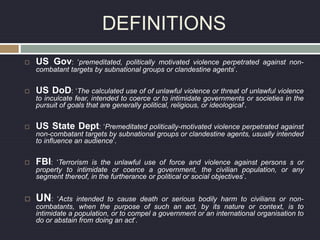
DEFINITIONS
 US Gov: ‘premeditated, politically motivated violence perpetrated against non-
combatant targets by subnational groups or clandestine agents’.
 US DoD: ‘The calculated use of of unlawful violence or threat of unlawful violence
to inculcate fear, intended to coerce or to intimidate governments or societies in the
pursuit of goals that are generally political, religious, or ideological’.
 US State Dept: ‘Premeditated politically-motivated violence perpetrated against
non-combatant targets by subnational groups or clandestine agents, usually intended
to influence an audience’.
 FBI: ‘Terrorism is the unlawful use of force and violence against persons s or
property to intimidate or coerce a government, the civilian population, or any
segment thereof, in the furtherance or political or social objectives’.
 UN: ‘Acts intended to cause death or serious bodily harm to civilians or non-
combatants, when the purpose of such an act, by its nature or context, is to
intimidate a population, or to compel a government or an international organisation to
do or abstain from doing an act’.
According to Schmid and Jongman there are
of terrorism and they
have (and this was
1988!)
A little more recently, in 2004, Weinberg, Padahzur
and Hirsch-Hoefler examined 3 major academic
journals: they found 55 articles with
of terrorism
No panic!
Let’s try to keep it simple…
 ‘The use of violence and intimidation in the pursuit of
political aim’ (The Oxford Dictionary of English)
 ‘ , frightful fact, or terrible
happening’ (Dizionario Latino Olivetti)
 THREAT =
to harm
something done
or not done (The Oxford Dictionary of English)
NARRATIVES
NEW TERRORISM OLD TERRORISM
Martyrdom
 Suicide bombers  Hashishiyyin – Tamil
Tigers
New Terrorism Old Terrorism
Religion or Politics?
 With the end of the
CW religion is the
only ideology left
 The Hindu Thugs
New Terrorism Old Terrorism
 Spread of political
Islam
 Withdrawal of
foreigners from holy
places
 Restoration of the
Caliphate
 Elimination of the
state of Israel
 Expulsion of the
non-Jewish people
from the Roman
province of Judea
(Zealots)
 Withdrawal of the
British from Ulster
(IRA) or the French
from Algeria (FLN)
 Unification of the
Cyprus island to
continental Greece
(EOKA)
State(-sponsored) Terrorism
 Syria and Hezbollah
 Yemen and Al
Qaeda
 Règime de la terreur
New Terrorism Old Terrorism
‘I want to point out, that besides
Essen, we never actually
considered any particular industrial
sites as targets. The destruction of
industrial sites always was some
sort of bonus for us. Our real
targets always were the inner
cities’.
RAF Marshall
Sir Arthur ‘Bomber’ Harris
‘It seems to me that the moment
has come when the question of
bombing German cities simply for
the sake of increasing terror,
though under other pretexts,
should be reviewed’.
Prime Minister
Winston Churchill
Network or Hierarchy?
New Terrorism
 Independent cells
 Loose global
network
Old Terrorism
 Centralised Top-
Down Structure
 Local groups
Iranian Domestic Terrorism in the 40
The Anarchist Cookbook (1960)
Assassination of the Tsar
Alexander in 1881
Assassination of the French
President in 1894
Bombing of the Greenwich
observatory in 1894
Attack to the US President
McKinsey 1904
 Al Qaeda Central is no longer the main
threat to the US, it has ceased to exist as
an organisation or as an operational entity
 The main threat comes now in the form of
the home-grown, spontaneously self-
organised groups of friends who become
terrorists.
 These are ‘radicalised bunches of guys’ that
for a scattered global network. A leaderless
Marc Sageman’s ‘Leaderless
Jihad’
Bruce Hoffman’s ‘Inside
Terrorism’
 Al Qaeda continues to exercise top-down and
bottom-up direction and guidance, planning and
operational capabilities
 High impact-impact plots
 Al Qaeda Iraq had been dispatched to ‘establish
cells in other countries’
 London’s 7/7/05 attacks and the Trans-Atlantic
jumbo in August 06 evidence of Al Qaeda Central
top-down direction
REACTIONS
 Counter-Terrorism
 Anti-Terrorism
 Doing Nothing
Counter-Terrorism
US War on Terror
Al Qaeda declares war to the US
Therefore they are US enemies
Therefore it doesn’t matter if they attack righ
now. They are a
Proactive policies that seek to eliminate terrorist
environments and groups
‘There are known knowns; there are things we know
that we know. There are known unknowns; that is to
say, there are things that we now know we don't
know. But there are also unknown unknowns – there
are things we do not know we don't know’.
US Secretary of Defence
Donald Rumsfeld
The
, which enables the strategic use of
the unsaid, to provide selected information and only
those that justify the policies adopted, as in the case
of the War on Terror (Daase and Kessler)
UNKNOWN KNOWS
Anti-Terrorism
Anti-terrorism: refers to target hardening, enhanced
security and other defensive measures seeking to
deter or prevent terrorist attacks
Policy Change: eg US Patriot Act or UK terror legislation
Passive Actions, like making likely targets more
secure
Active Actions, like engaging in political talks
with terrorist groups where possible
John Mueller’s No does, good
does
Greatest cost of terrorism is the
fear an over-reaction of
governments
Terrorist industry drives perceptions
After 9/11 in US ‘fewer people
died because of international
terrorism than have drowned in
the toilet’
Governments’ reactions are far
more deadly than the terrorism
they react against
How terrorist groups end?
Rand (2008)
Military
force
7%
Politicisati
on
43%
Policing
40%
Victory
10%
So what do we know about it?
 Different terrorist groups have shown some common
features throughout history. Eg. Suicidal acts,
religion, state-sponsored, network/hierarchy
 The ultimate goal is political and mostly in retribution
to political/military actions
 Military force works very little in crushing terrorism
 The absence of certain knowledge leaves a lot of
room for reaction
 ‘Terrorist is as terrorist does’ (Gump:1994)
THANK YOU!
Sebastiano Sali20 March 2014
Some additional readings
Schmid, A. and Jongman, A. (1988) Political Terrorism: A New Guide to Actors,
Authors, Concepts, Databases, Theories and Literature, Oxford: North Holland.
Weinberg, L., Pedahzur, A., Hirsch-Hoefler, S., (2004) The Challenges of
Conceptualizing Terrorism, Terrorism and Political Violence, 16:4.
Sageman, M., Leaderless Jihad: Terror networks in the 21st century, University of
Pennsylvania Press, 2011
Hoffman, B., Inside Terrorism, New York: Columbia University Press, 2006
Daase, C. and Kessler, O. Known and Unknowns in the War on Terror: Uncertainty
and the Political Constitution of Danger, Security Dialogue, 38:4, 2007
Mueller, J.E., Overblown: How Politicians and Terrorism Industry Inflate National
Security Threats, and Why We Believe Them, Simon and Schuster, 2006
EVALUATIONS
 Academic Year: 2013/14
 Module Title/Code: World Politics Since 1945, 4SSPP102
 Programme of Study: International Politics or Politics of the
International Economy
 Lecturer: Ami Abou-Bakr
 Seminar Tutors: Ali Hawks, Isabelle Anstey, Sebastiano
Sali
 For the scanner to read your responses please:
 Use blue or black pen
 Write clearly in BLOCK capitals
 Please keep responses INSIDE the box 
 THANK YOU! We value your comments and they will help us
improve!

Terrorism

  • 1.
    World Politics Since 1945 Week20 TERRORISM Sebastiano Sali20 March 2014
  • 2.
    OUTLINE  Definitions: WHATis terrorism and WHO is a terrorist?  Narratives: NEW terrorism vs OLD terrorism (really?)  Reactions: COUNTER or ANTI terrorism?
  • 4.
    DEFINITIONS  US Gov:‘premeditated, politically motivated violence perpetrated against non- combatant targets by subnational groups or clandestine agents’.  US DoD: ‘The calculated use of of unlawful violence or threat of unlawful violence to inculcate fear, intended to coerce or to intimidate governments or societies in the pursuit of goals that are generally political, religious, or ideological’.  US State Dept: ‘Premeditated politically-motivated violence perpetrated against non-combatant targets by subnational groups or clandestine agents, usually intended to influence an audience’.  FBI: ‘Terrorism is the unlawful use of force and violence against persons s or property to intimidate or coerce a government, the civilian population, or any segment thereof, in the furtherance or political or social objectives’.  UN: ‘Acts intended to cause death or serious bodily harm to civilians or non- combatants, when the purpose of such an act, by its nature or context, is to intimidate a population, or to compel a government or an international organisation to do or abstain from doing an act’.
  • 5.
    According to Schmidand Jongman there are of terrorism and they have (and this was 1988!) A little more recently, in 2004, Weinberg, Padahzur and Hirsch-Hoefler examined 3 major academic journals: they found 55 articles with of terrorism
  • 6.
    No panic! Let’s tryto keep it simple…
  • 7.
     ‘The useof violence and intimidation in the pursuit of political aim’ (The Oxford Dictionary of English)  ‘ , frightful fact, or terrible happening’ (Dizionario Latino Olivetti)  THREAT = to harm something done or not done (The Oxford Dictionary of English)
  • 8.
  • 9.
    Martyrdom  Suicide bombers Hashishiyyin – Tamil Tigers New Terrorism Old Terrorism
  • 10.
    Religion or Politics? With the end of the CW religion is the only ideology left  The Hindu Thugs New Terrorism Old Terrorism
  • 11.
     Spread ofpolitical Islam  Withdrawal of foreigners from holy places  Restoration of the Caliphate  Elimination of the state of Israel  Expulsion of the non-Jewish people from the Roman province of Judea (Zealots)  Withdrawal of the British from Ulster (IRA) or the French from Algeria (FLN)  Unification of the Cyprus island to continental Greece (EOKA)
  • 12.
    State(-sponsored) Terrorism  Syriaand Hezbollah  Yemen and Al Qaeda  Règime de la terreur New Terrorism Old Terrorism
  • 13.
    ‘I want topoint out, that besides Essen, we never actually considered any particular industrial sites as targets. The destruction of industrial sites always was some sort of bonus for us. Our real targets always were the inner cities’. RAF Marshall Sir Arthur ‘Bomber’ Harris
  • 14.
    ‘It seems tome that the moment has come when the question of bombing German cities simply for the sake of increasing terror, though under other pretexts, should be reviewed’. Prime Minister Winston Churchill
  • 15.
    Network or Hierarchy? NewTerrorism  Independent cells  Loose global network Old Terrorism  Centralised Top- Down Structure  Local groups
  • 16.
    Iranian Domestic Terrorismin the 40 The Anarchist Cookbook (1960) Assassination of the Tsar Alexander in 1881 Assassination of the French President in 1894 Bombing of the Greenwich observatory in 1894 Attack to the US President McKinsey 1904
  • 17.
     Al QaedaCentral is no longer the main threat to the US, it has ceased to exist as an organisation or as an operational entity  The main threat comes now in the form of the home-grown, spontaneously self- organised groups of friends who become terrorists.  These are ‘radicalised bunches of guys’ that for a scattered global network. A leaderless Marc Sageman’s ‘Leaderless Jihad’
  • 18.
    Bruce Hoffman’s ‘Inside Terrorism’ Al Qaeda continues to exercise top-down and bottom-up direction and guidance, planning and operational capabilities  High impact-impact plots  Al Qaeda Iraq had been dispatched to ‘establish cells in other countries’  London’s 7/7/05 attacks and the Trans-Atlantic jumbo in August 06 evidence of Al Qaeda Central top-down direction
  • 19.
  • 20.
    Counter-Terrorism US War onTerror Al Qaeda declares war to the US Therefore they are US enemies Therefore it doesn’t matter if they attack righ now. They are a Proactive policies that seek to eliminate terrorist environments and groups
  • 21.
    ‘There are knownknowns; there are things we know that we know. There are known unknowns; that is to say, there are things that we now know we don't know. But there are also unknown unknowns – there are things we do not know we don't know’. US Secretary of Defence Donald Rumsfeld
  • 22.
    The , which enablesthe strategic use of the unsaid, to provide selected information and only those that justify the policies adopted, as in the case of the War on Terror (Daase and Kessler) UNKNOWN KNOWS
  • 23.
    Anti-Terrorism Anti-terrorism: refers totarget hardening, enhanced security and other defensive measures seeking to deter or prevent terrorist attacks Policy Change: eg US Patriot Act or UK terror legislation Passive Actions, like making likely targets more secure Active Actions, like engaging in political talks with terrorist groups where possible
  • 24.
    John Mueller’s Nodoes, good does Greatest cost of terrorism is the fear an over-reaction of governments Terrorist industry drives perceptions After 9/11 in US ‘fewer people died because of international terrorism than have drowned in the toilet’ Governments’ reactions are far more deadly than the terrorism they react against
  • 25.
    How terrorist groupsend? Rand (2008) Military force 7% Politicisati on 43% Policing 40% Victory 10%
  • 26.
    So what dowe know about it?  Different terrorist groups have shown some common features throughout history. Eg. Suicidal acts, religion, state-sponsored, network/hierarchy  The ultimate goal is political and mostly in retribution to political/military actions  Military force works very little in crushing terrorism  The absence of certain knowledge leaves a lot of room for reaction  ‘Terrorist is as terrorist does’ (Gump:1994)
  • 27.
  • 28.
    Some additional readings Schmid,A. and Jongman, A. (1988) Political Terrorism: A New Guide to Actors, Authors, Concepts, Databases, Theories and Literature, Oxford: North Holland. Weinberg, L., Pedahzur, A., Hirsch-Hoefler, S., (2004) The Challenges of Conceptualizing Terrorism, Terrorism and Political Violence, 16:4. Sageman, M., Leaderless Jihad: Terror networks in the 21st century, University of Pennsylvania Press, 2011 Hoffman, B., Inside Terrorism, New York: Columbia University Press, 2006 Daase, C. and Kessler, O. Known and Unknowns in the War on Terror: Uncertainty and the Political Constitution of Danger, Security Dialogue, 38:4, 2007 Mueller, J.E., Overblown: How Politicians and Terrorism Industry Inflate National Security Threats, and Why We Believe Them, Simon and Schuster, 2006
  • 29.
    EVALUATIONS  Academic Year:2013/14  Module Title/Code: World Politics Since 1945, 4SSPP102  Programme of Study: International Politics or Politics of the International Economy  Lecturer: Ami Abou-Bakr  Seminar Tutors: Ali Hawks, Isabelle Anstey, Sebastiano Sali  For the scanner to read your responses please:  Use blue or black pen  Write clearly in BLOCK capitals  Please keep responses INSIDE the box   THANK YOU! We value your comments and they will help us improve!