STATEMENT: PREPARED BY
SEYDOU BAGAYOKO
TOPIC DEBATE:TERRORISM
MODULE: ENGLISH
LICEENCE-PRO ATII : PROMOTION 2015/2016
In its broadest sense, terrorism is any act
designed to cause terror In a narrower sense,
terrorism can be understood to feature a political
objective. The word terrorism is politically
loaded and emotionally charged.
A broad array of political organizations have
practised terrorism to further their objectives. It has
been practiced by both right- and left-wing political
parties, nationalist groups, religious groups,
revolutionaries, and ruling governments. The
symbolism of terrorism can exploit human fear to
help achieve these goals.
ORIGIN OF TERM TERRORISM:
See also: Terror and State terrorism
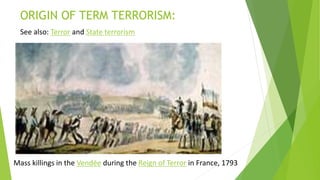
Mass killings in the Vendée during the Reign of Terror in France, 1793
"Terrorism" comes from the French word terrorisme, and
originally referred specifically to state terrorism as practiced by
the French government during the 1793–1794 Reign of terror. The
French word terrorisme in turn derives from the Latin verb terrere
(e, terreo) meaning "to frighten". The terror cimbricus was a panic
and state of emergency in Rome in response to the approach of
warriors of the Cimbri tribe in 105 BC. The Jacobins cited this
precedent when imposing a Reign of Terror during the French
Revolution. After the Jacobins lost power, the word "terrorist"
became a term of abuse.
"terrorism" originally referred to acts
committed by a government, currently it
usually refers to the killing of innocent people
for political purposes in such a way as to
create a media spectacle. This meaning can be
traced back to Sergey Nechayev, who
described himself as a "terrorist". Nechayev
founded the Russian terrorist group "People's
Retribution" (Народная расправа) in 1869.
In November 2004, a Secretary-General of the
United Nations report described terrorism as any
act "intended to cause death or serious bodily
harm to civilians or non-combatants with the
purpose of intimidating a population or
compelling a government or an international
organization to do or abstain from doing any act.
DEFINITION:
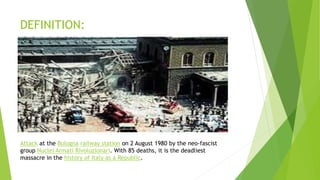
Attack at the Bologna railway station on 2 August 1980 by the neo-fascist
group Nuclei Armati Rivoluzionari. With 85 deaths, it is the deadliest
massacre in the history of Italy as a Republic.
The definition of terrorism has proved
controversial. Various legal systems and
government agencies use different definitions of
terrorism in their national legislation. Moreover,
the international community has been slow to
formulate a universally agreed, legally binding
definition of this crime. These difficulties arise
from the fact that the term "terrorism" is
politically and emotionally charged. In this
regard, Angus Martyn, briefing the Australian
Parliament, stated,
The international community has never
succeeded in developing an accepted
comprehensive definition of terrorism.
During the 1970s and 1980s, the United
Nations attempts to define the term
floundered mainly due to differences of
opinion between various members about
the use of violence in the context of
conflicts over national liberation and self-
determination.
These divergences have made it impossible
for the United Nations to conclude a
Comprehensive Convention on International
Terrorism that incorporates a single, all-
encompassing, legally binding, criminal law
definition of terrorism. The international
community has adopted a series of sectoral
conventions that define and criminalize
various types of terrorist activities.
Since 1994, the United Nations General Assembly has
repeatedly condemned terrorist acts using the following
political description of terrorism:
Criminal acts intended or calculated to provoke a state
of terror in the public, a group of persons or particular
persons for political purposes are in any circumstance
unjustifiable, whatever the considerations of a political,
philosophical, ideological, racial, ethnic, religious or
any other nature that may be invoked to justify them.
WHY THE TERRORISM ?

TERRORISM

  • 1.
    STATEMENT: PREPARED BY SEYDOUBAGAYOKO TOPIC DEBATE:TERRORISM MODULE: ENGLISH LICEENCE-PRO ATII : PROMOTION 2015/2016
  • 2.
    In its broadestsense, terrorism is any act designed to cause terror In a narrower sense, terrorism can be understood to feature a political objective. The word terrorism is politically loaded and emotionally charged.
  • 3.
    A broad arrayof political organizations have practised terrorism to further their objectives. It has been practiced by both right- and left-wing political parties, nationalist groups, religious groups, revolutionaries, and ruling governments. The symbolism of terrorism can exploit human fear to help achieve these goals.
  • 4.
    ORIGIN OF TERMTERRORISM: See also: Terror and State terrorism Mass killings in the Vendée during the Reign of Terror in France, 1793
  • 5.
    "Terrorism" comes fromthe French word terrorisme, and originally referred specifically to state terrorism as practiced by the French government during the 1793–1794 Reign of terror. The French word terrorisme in turn derives from the Latin verb terrere (e, terreo) meaning "to frighten". The terror cimbricus was a panic and state of emergency in Rome in response to the approach of warriors of the Cimbri tribe in 105 BC. The Jacobins cited this precedent when imposing a Reign of Terror during the French Revolution. After the Jacobins lost power, the word "terrorist" became a term of abuse.
  • 6.
    "terrorism" originally referredto acts committed by a government, currently it usually refers to the killing of innocent people for political purposes in such a way as to create a media spectacle. This meaning can be traced back to Sergey Nechayev, who described himself as a "terrorist". Nechayev founded the Russian terrorist group "People's Retribution" (Народная расправа) in 1869.
  • 7.
    In November 2004,a Secretary-General of the United Nations report described terrorism as any act "intended to cause death or serious bodily harm to civilians or non-combatants with the purpose of intimidating a population or compelling a government or an international organization to do or abstain from doing any act.
  • 8.
    DEFINITION: Attack at theBologna railway station on 2 August 1980 by the neo-fascist group Nuclei Armati Rivoluzionari. With 85 deaths, it is the deadliest massacre in the history of Italy as a Republic.
  • 9.
    The definition ofterrorism has proved controversial. Various legal systems and government agencies use different definitions of terrorism in their national legislation. Moreover, the international community has been slow to formulate a universally agreed, legally binding definition of this crime. These difficulties arise from the fact that the term "terrorism" is politically and emotionally charged. In this regard, Angus Martyn, briefing the Australian Parliament, stated,
  • 10.
    The international communityhas never succeeded in developing an accepted comprehensive definition of terrorism. During the 1970s and 1980s, the United Nations attempts to define the term floundered mainly due to differences of opinion between various members about the use of violence in the context of conflicts over national liberation and self- determination.
  • 11.
    These divergences havemade it impossible for the United Nations to conclude a Comprehensive Convention on International Terrorism that incorporates a single, all- encompassing, legally binding, criminal law definition of terrorism. The international community has adopted a series of sectoral conventions that define and criminalize various types of terrorist activities.
  • 12.
    Since 1994, theUnited Nations General Assembly has repeatedly condemned terrorist acts using the following political description of terrorism: Criminal acts intended or calculated to provoke a state of terror in the public, a group of persons or particular persons for political purposes are in any circumstance unjustifiable, whatever the considerations of a political, philosophical, ideological, racial, ethnic, religious or any other nature that may be invoked to justify them.
  • 13.