1
Smart Metering, Load Control
and Customer Behaviour
Dr David Crossley
Managing Director
Energy Futures Australia Pty Ltd
The Smartness of Smart Grids Workshop
Stockholm, 6 October 2010
2
Presentation Topics
● Changing customer behaviour
● Smart metering and behaviour change
● Load control technology and behaviour change
● Conclusions
● Information resources
3
Changing Customer Behaviour
4
Why Behaviour Change?
● A challenge facing developed countries is to
achieve changes in the quantities of energy we use
and the timing of when we use it
● We need to significantly increase the efficiency with
which we use energy to combat climate change
● We need to change the time at which we use
energy to reduce the massive expenditure required
to expand electricity networks to handle peak loads
● Achieving both these goals requires significant
behaviour change in the ways in which we
currently use energy
5
Role of Technology
● Technology is a (relatively) new factor that can
greatly assist in achieving changes in energy-using
behaviour
● Two types of technology have the potential to
achieve behaviour change:
► smart metering; and
► load control technology
6
Smart Metering and
Behaviour Change
7
Types of Metering
● Accumulation meters simply record energy
consumption progressively over time
● Interval meters record the quantities of energy
consumed over set, frequent time intervals
● Typically, the minimum time interval set for
recording energy consumption is every 15 minutes
and the maximum interval is every hour
● Smart meters are interval meters with one-way or
two-way communications between the energy
supplier and the meter
8
Capabilities of Smart Metering
● Interval meters enable implementation of time-
varying energy pricing in which the energy price
varies during the day, eg high prices can be set
during peak periods when the energy system may
be constrained
● Seasonal variation in prices is also possible
● Time-varying tariffs send price signals to customers
that reflect the underlying costs of generating,
transporting and supplying electricity, enabling
resources to be allocated more efficiently
Customer Response to Time-Varying Prices
● Price-based demand response programs are
implemented to reduce or shape customer demand,
particularly to reduce loads at peak times
● The effectiveness of these programs depends on
customers changing their behaviour in response to
price signals
● Customers may change their behaviour for a period of
time (months?) after time-varying prices are introduced
● However, this response usually decays over time as
customers find that their financial savings are minimal
and the effort required to respond to price changes is
large
9
10
Load Control Technology and
Behaviour Change
11
What is Load Control?
● Load control comprises a system or program that
enables end-use loads to be changed in response
to particular events, eg high electricity prices or
problems on the electricity network
● The operator of the load control system may be:
► an electricity supplier or network operator
► a market or system operator
► a demand side response service provider; or
► the end-user themselves
12
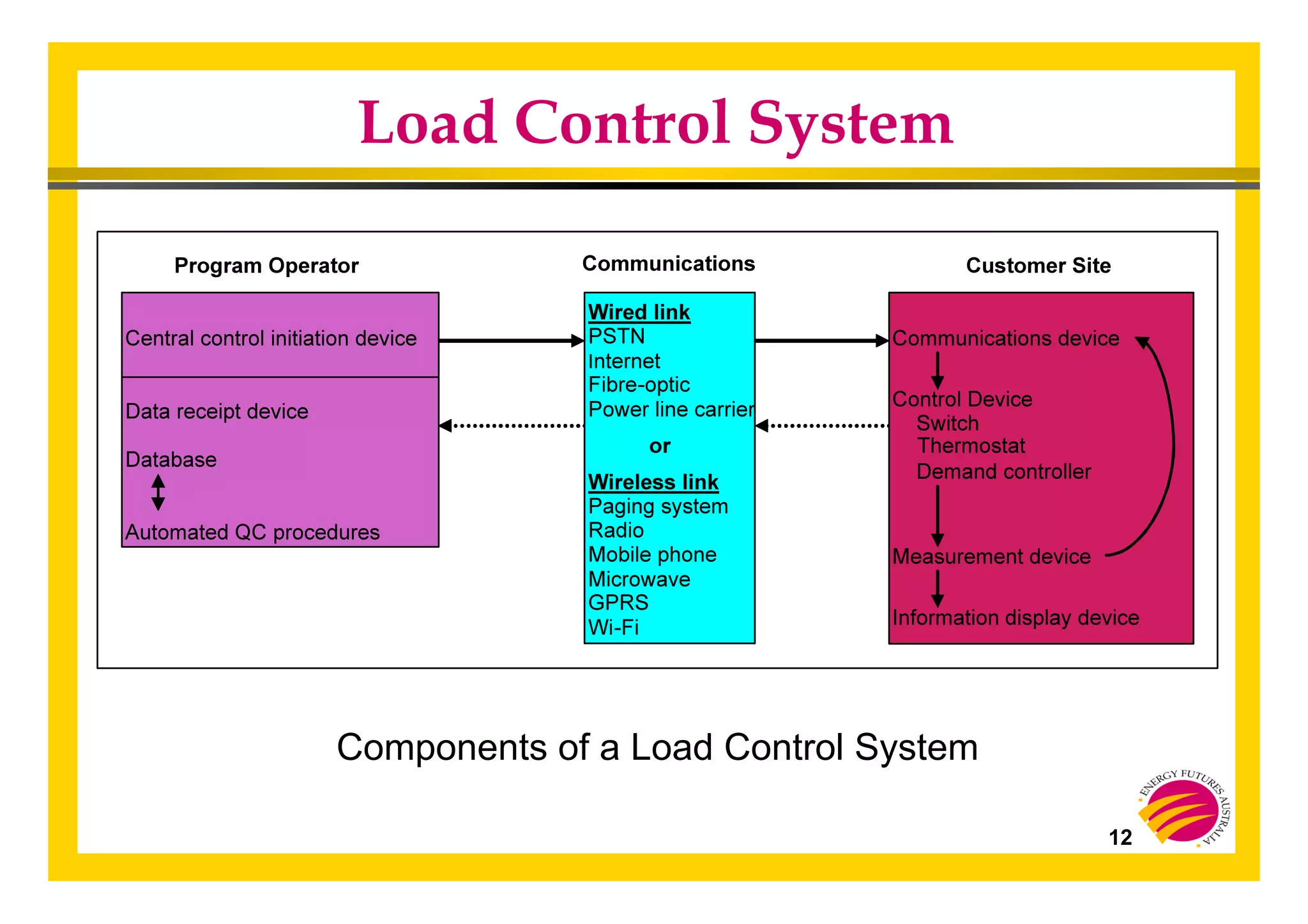
Load Control System
Components of a Load Control System
13
Capabilities of Load Control Technology (1)
● Load control technology now exists that enables
switching of end-use loads to be carried out:
► automatically, in response to a signal linked to a
particular event, eg high energy prices or network
constraints
► manually, also in response to an event (the initiator
of the switching requires information about the
event)
● Switching may be carried out locally by the end-user, or
remotely by a signal sent by a load control program
operator
Capabilities of Load Control Technology (2)
● Switching of loads may involve:
► cycling loads on and off according to pre-set
timing schedules
► reducing loads to pre-set levels; or
► switching off loads completely
● Load control technology provides energy suppliers
and network operators with flexible methods to
influence the quantity and timing of energy use
● Smart meters are not necessary to carry out load
control; switching signals do not necessarily have
to pass through the meter
14
Customer Response to Load Control Programs
● Load control technology enables a single “set and
forget” decision by facility operators and householders
in relation to energy use
● Customers can set a price level above which selected
appliances or equipment will be automatically
controlled
● The effort required by customers to respond to time-
varying prices is greatly reduced and customers
generally respond by changing their behavour with little
decay in their response over time
● The most successful load control programs enable
customers to override any automated settings, eg
for special events 15
16
Conclusions
17
Metering and Load Control (1)
● Interval metering is necessary to implement time-
varying pricing
● Interval metering is not necessary to carry out
load control functions – available technology can
remotely switch loads without requiring connection
to a meter
● One-way communication (not necessarily through
a meter) is essential to carry out remote switching
of loads
18
Metering and Load Control (2)
● Two-way communication is not essential to carry
out remote switching of loads but it can provide
valuable information to the program operator about
the results of the switching
● Metering in some form is required for settlement of
the financial transactions associated with load
control programs
19
Smart Metering and Saving Energy
●  Installing smart meters will, by itself, do nothing to save
energy
●  Energy savings will only be achieved if installing the meters
results in changing people’s behaviour so that they use less
energy in total
●  Some studies suggest that rolling out smart meters to all
electricity consumers in a country may achieve savings of
between 4% and 10% in total national electricity use
●  However, energy savings can only be achieved if the
installation of the meters is accompanied by supporting
technology and programs, such as information displays,
time-varying pricing, energy audits and particularly some
form of load control
20
Information Resources
21
Information Resources
● David Crossley: crossley@efa.com.au
● Energy Futures Australia, my company’s website:
www.efa.com.au
● In 2009, the IEA DSM Programme completed a
research project on using advanced metering and load
control to support electricity networks. Website for
information about this project: www.ieadsm.org/
ViewTask.aspx?ID=16&Task=15&Sort=0

Smart Metering, Load Control and Customer Behaviour – Task 15 - IEA DSM Programme

  • 1.
    1 Smart Metering, LoadControl and Customer Behaviour Dr David Crossley Managing Director Energy Futures Australia Pty Ltd The Smartness of Smart Grids Workshop Stockholm, 6 October 2010
  • 2.
    2 Presentation Topics ● Changing customerbehaviour ● Smart metering and behaviour change ● Load control technology and behaviour change ● Conclusions ● Information resources
  • 3.
  • 4.
    4 Why Behaviour Change? ● Achallenge facing developed countries is to achieve changes in the quantities of energy we use and the timing of when we use it ● We need to significantly increase the efficiency with which we use energy to combat climate change ● We need to change the time at which we use energy to reduce the massive expenditure required to expand electricity networks to handle peak loads ● Achieving both these goals requires significant behaviour change in the ways in which we currently use energy
  • 5.
    5 Role of Technology ● Technologyis a (relatively) new factor that can greatly assist in achieving changes in energy-using behaviour ● Two types of technology have the potential to achieve behaviour change: ► smart metering; and ► load control technology
  • 6.
  • 7.
    7 Types of Metering ● Accumulationmeters simply record energy consumption progressively over time ● Interval meters record the quantities of energy consumed over set, frequent time intervals ● Typically, the minimum time interval set for recording energy consumption is every 15 minutes and the maximum interval is every hour ● Smart meters are interval meters with one-way or two-way communications between the energy supplier and the meter
  • 8.
    8 Capabilities of SmartMetering ● Interval meters enable implementation of time- varying energy pricing in which the energy price varies during the day, eg high prices can be set during peak periods when the energy system may be constrained ● Seasonal variation in prices is also possible ● Time-varying tariffs send price signals to customers that reflect the underlying costs of generating, transporting and supplying electricity, enabling resources to be allocated more efficiently
  • 9.
    Customer Response toTime-Varying Prices ● Price-based demand response programs are implemented to reduce or shape customer demand, particularly to reduce loads at peak times ● The effectiveness of these programs depends on customers changing their behaviour in response to price signals ● Customers may change their behaviour for a period of time (months?) after time-varying prices are introduced ● However, this response usually decays over time as customers find that their financial savings are minimal and the effort required to respond to price changes is large 9
  • 10.
    10 Load Control Technologyand Behaviour Change
  • 11.
    11 What is LoadControl? ● Load control comprises a system or program that enables end-use loads to be changed in response to particular events, eg high electricity prices or problems on the electricity network ● The operator of the load control system may be: ► an electricity supplier or network operator ► a market or system operator ► a demand side response service provider; or ► the end-user themselves
  • 12.
    12 Load Control System Componentsof a Load Control System
  • 13.
    13 Capabilities of LoadControl Technology (1) ● Load control technology now exists that enables switching of end-use loads to be carried out: ► automatically, in response to a signal linked to a particular event, eg high energy prices or network constraints ► manually, also in response to an event (the initiator of the switching requires information about the event) ● Switching may be carried out locally by the end-user, or remotely by a signal sent by a load control program operator
  • 14.
    Capabilities of LoadControl Technology (2) ● Switching of loads may involve: ► cycling loads on and off according to pre-set timing schedules ► reducing loads to pre-set levels; or ► switching off loads completely ● Load control technology provides energy suppliers and network operators with flexible methods to influence the quantity and timing of energy use ● Smart meters are not necessary to carry out load control; switching signals do not necessarily have to pass through the meter 14
  • 15.
    Customer Response toLoad Control Programs ● Load control technology enables a single “set and forget” decision by facility operators and householders in relation to energy use ● Customers can set a price level above which selected appliances or equipment will be automatically controlled ● The effort required by customers to respond to time- varying prices is greatly reduced and customers generally respond by changing their behavour with little decay in their response over time ● The most successful load control programs enable customers to override any automated settings, eg for special events 15
  • 16.
  • 17.
    17 Metering and LoadControl (1) ● Interval metering is necessary to implement time- varying pricing ● Interval metering is not necessary to carry out load control functions – available technology can remotely switch loads without requiring connection to a meter ● One-way communication (not necessarily through a meter) is essential to carry out remote switching of loads
  • 18.
    18 Metering and LoadControl (2) ● Two-way communication is not essential to carry out remote switching of loads but it can provide valuable information to the program operator about the results of the switching ● Metering in some form is required for settlement of the financial transactions associated with load control programs
  • 19.
    19 Smart Metering andSaving Energy ●  Installing smart meters will, by itself, do nothing to save energy ●  Energy savings will only be achieved if installing the meters results in changing people’s behaviour so that they use less energy in total ●  Some studies suggest that rolling out smart meters to all electricity consumers in a country may achieve savings of between 4% and 10% in total national electricity use ●  However, energy savings can only be achieved if the installation of the meters is accompanied by supporting technology and programs, such as information displays, time-varying pricing, energy audits and particularly some form of load control
  • 20.
  • 21.
    21 Information Resources ● David Crossley:crossley@efa.com.au ● Energy Futures Australia, my company’s website: www.efa.com.au ● In 2009, the IEA DSM Programme completed a research project on using advanced metering and load control to support electricity networks. Website for information about this project: www.ieadsm.org/ ViewTask.aspx?ID=16&Task=15&Sort=0