Developments in Surgical 
nursing: A Global perspective 
Professor Joy Notter 
Birmingham City University
History of surgical nursing 
• Difference in surgical and 
medical nursing 
recognised from late 19th 
/ early 20th century as 
nursing role became 
established and surgical 
possibilities increased 
• At same time in USA 
parallel role -anaesthetic 
nurses spread to other 
countries – still separate
Non-ward Surgical nurses 
• This role of surgical 
nursing was in 
operating room 
• Mainly cleaning and 
preparing the room 
• Practical training not 
formal courses 
• But acceptance of 
ability to prepare 
instruments
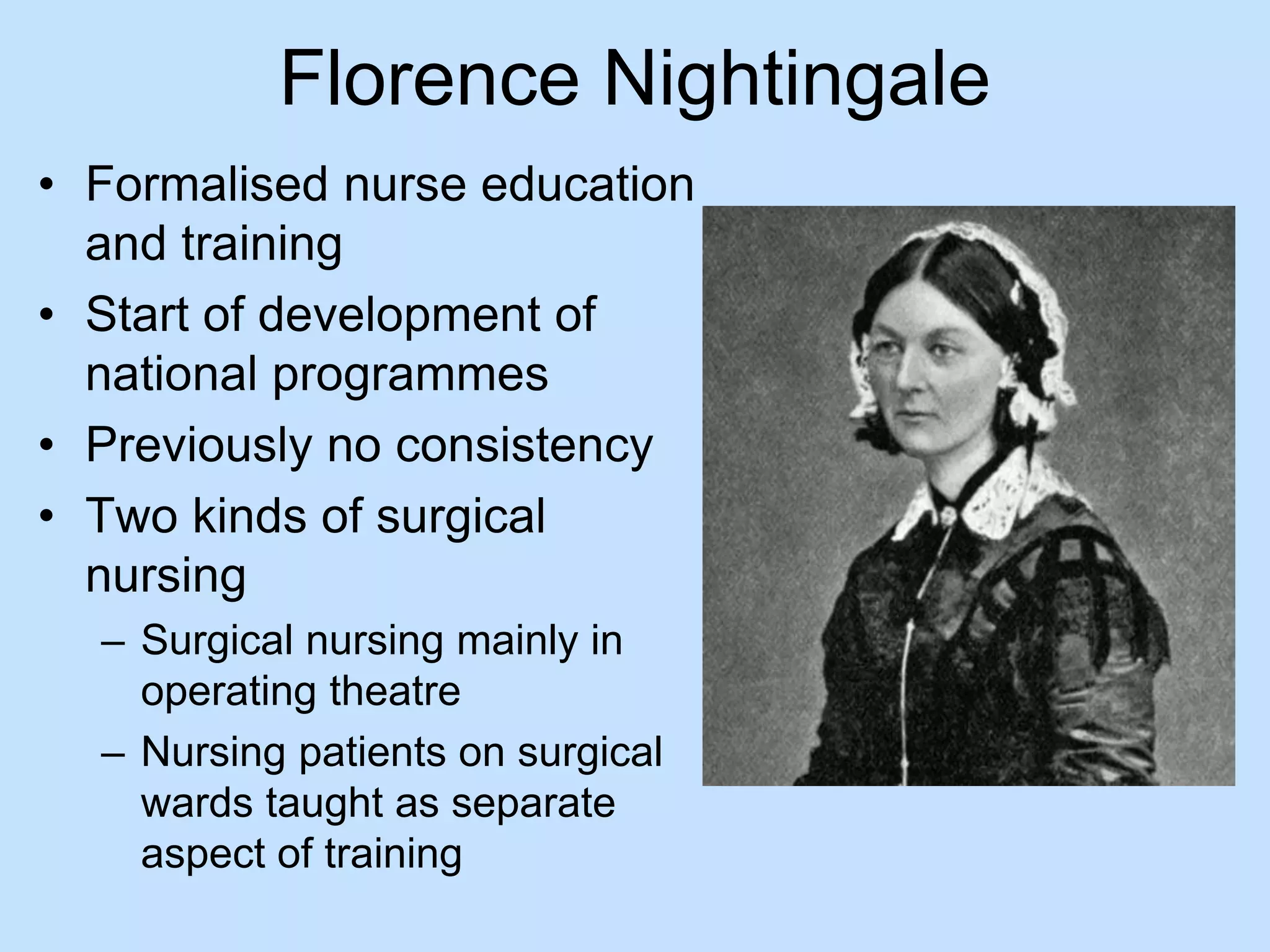
Florence Nightingale 
• Formalised nurse education 
and training 
• Start of development of 
national programmes 
• Previously no consistency 
• Two kinds of surgical 
nursing 
– Surgical nursing mainly in 
operating theatre 
– Nursing patients on surgical 
wards taught as separate 
aspect of training
Surgical nursing 
• 1930s nurses taught general programme which 
include medicine and surgery. Although wards 
increasingly separated into medicine and surgery 
• 1960s start of specialisation extending role of 
nurses in surgery 
• 1970s courses for specialist nurses 
• 1980s move towards advanced practice and 
higher degrees 
• 1990s masters level advanced practice and 
nurse consultant roles
Today in USA: Circulating Nurse 
• S/he is in charge of the operating theatre 
• Manages the care of a patient during surgery; 
• Ensures the sterile integrity of the operating 
room, equipment, and materials; 
• Enters data that records the procedures; 
• Assesses the patient’s condition 
– before, during, and immediately following surgery.
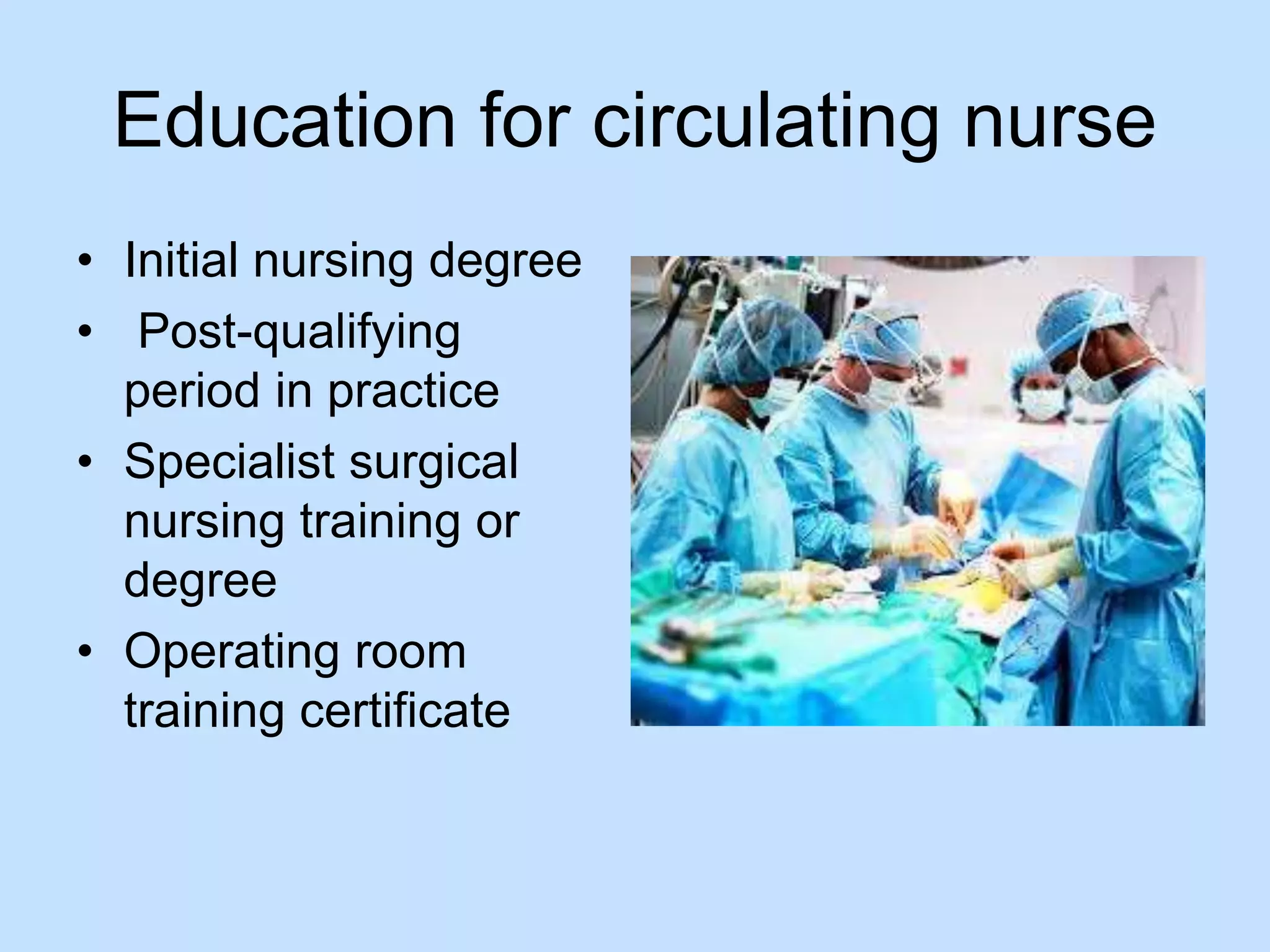
Education for circulating nurse 
• Initial nursing degree 
• Post-qualifying 
period in practice 
• Specialist surgical 
nursing training or 
degree 
• Operating room 
training certificate
Recently Change in title in some 
countries to reflect role 
Surgical nursing Perioperative nursing
What is meant by 
perioperative nursing? 
Perioperative nursing is a term 
used to describe nursing through the 
entire span of surgery, including what 
occurs before, during, and after the 
actual operation.
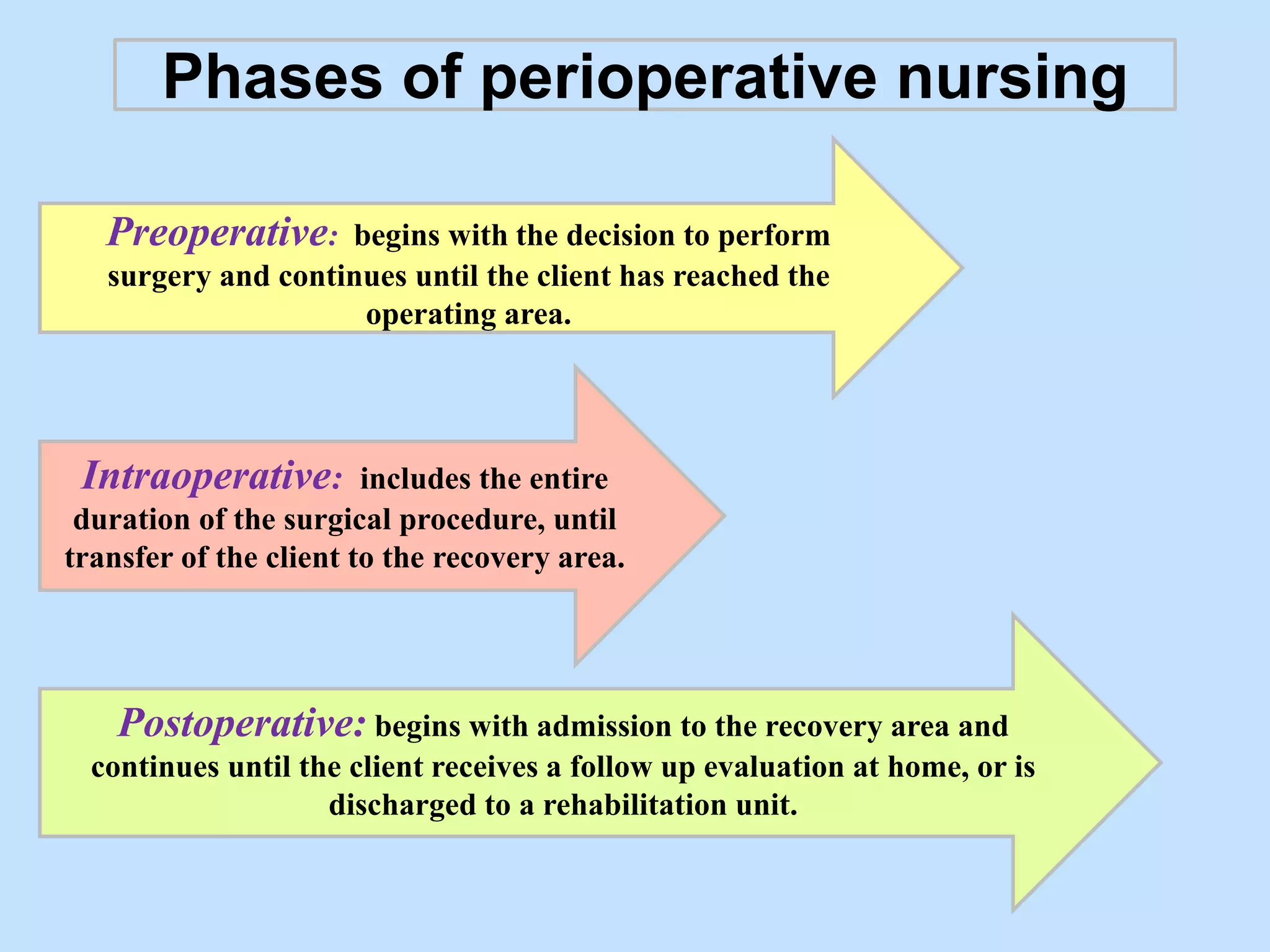
Phases of perioperative nursing 
Preoperative: begins with the decision to perform 
surgery and continues until the client has reached the 
operating area. 
Intraoperative: includes the entire 
duration of the surgical procedure, until 
transfer of the client to the recovery area. 
Postoperative: begins with admission to the recovery area and 
continues until the client receives a follow up evaluation at home, or is 
discharged to a rehabilitation unit.
: 
Preoperative 
I. Assess physical needs 
II. Review the client’s health history 
and preparation for surgery 
III. Review preoperative laboratory 
and diagnostic studies 
IV. Assess psychological needs 
V. Assess cultural needs
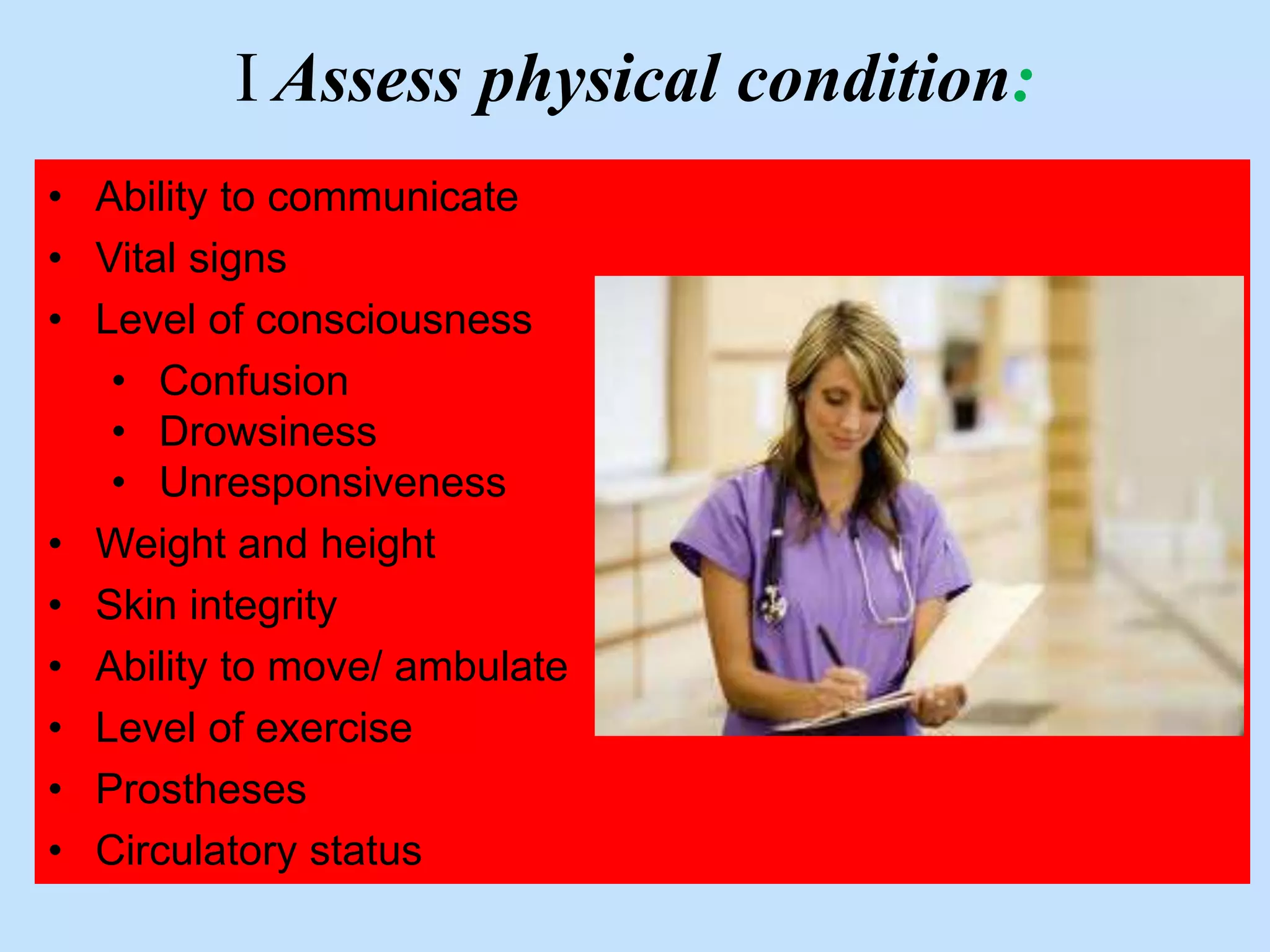
I Assess physical condition: 
• Ability to communicate 
• Vital signs 
• Level of consciousness 
• Confusion 
• Drowsiness 
• Unresponsiveness 
• Weight and height 
• Skin integrity 
• Ability to move/ ambulate 
• Level of exercise 
• Prostheses 
• Circulatory status
I. Check documentation of the client’s 
health history and preparation for surgery: 
• History of present illness and reason for surgery 
• Past medical history 
• Medical conditions (acute and chronic) 
• Previous hospitalization and surgeries 
• History of any past problem with anesthesia 
• Allergies 
• Present medications 
• Substance use: alcohol, tobacco, street drugs 
• Review of system
II. Check preoperative laboratory and 
diagnostic studies 
• Complete blood count. 
• Blood type and cross match. 
• Serum electrolytes. 
• Urinalysis. 
• Chest X-rays. 
• Electrocardiogram. 
• Other tests related to procedure or client’s medical 
condition, such as: prothrombin time, partial 
thromboplastin time, blood urea nitrogen, creatinine, and 
other radiographic studies.
IV. Assess psychological needs: 
• Emotional state 
• Level of understanding of surgical procedure, preoperative and 
postoperative instruction 
• Coping strategies 
• Support system 
• Roles and responsibilities
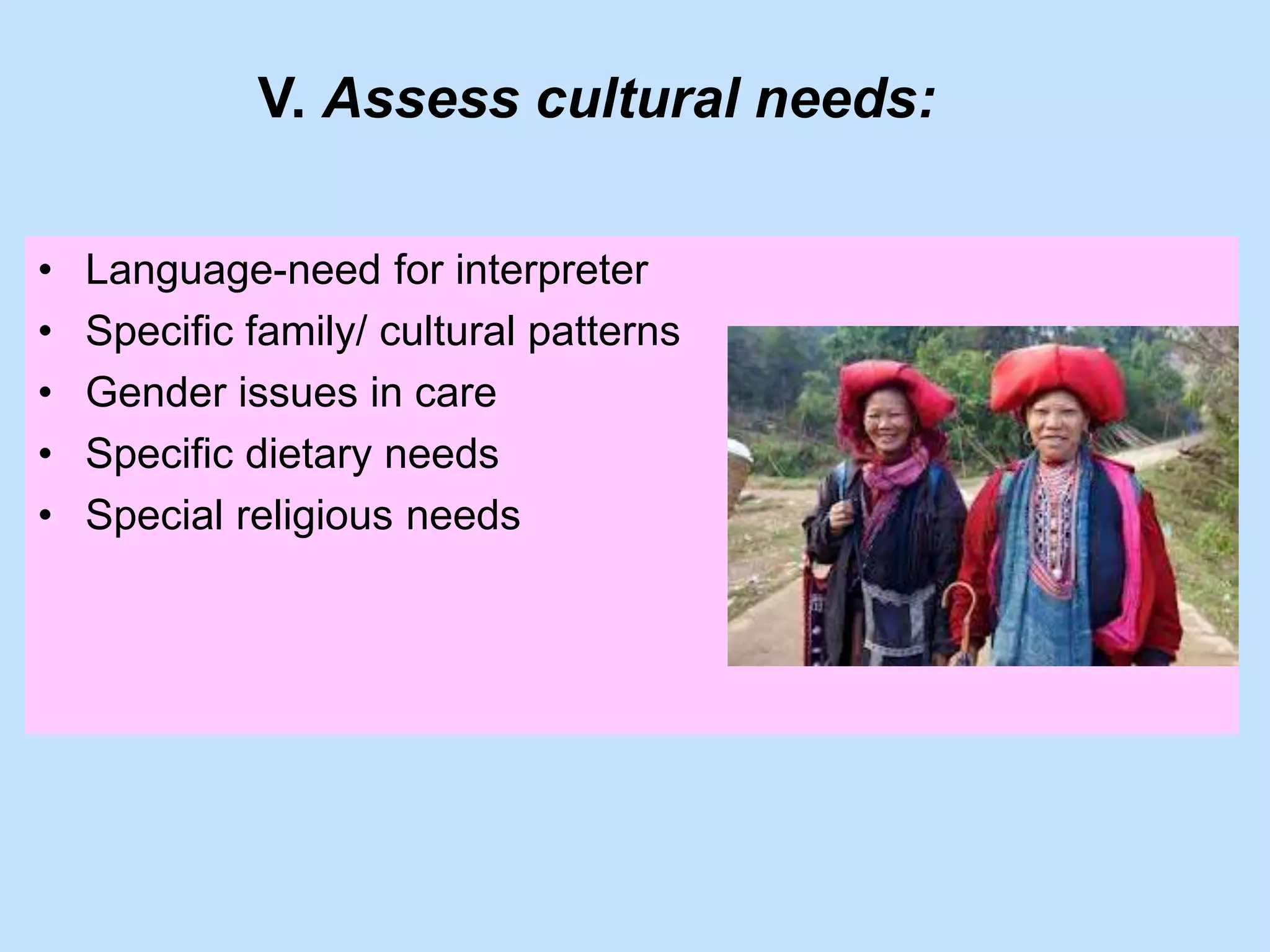
V. Assess cultural needs: 
• Language-need for interpreter 
• Specific family/ cultural patterns 
• Gender issues in care 
• Specific dietary needs 
• Special religious needs
Intraoperative 
I Type of surgery 
II. Intraoperative nursing
Type of surgery 
• Diagnostic → Removal and study of tissue to make a 
diagnosis 
• Exploratory → Most extensive means to involve exploration 
of a body cavity or use of scopes inserted though small 
incision. 
• Curative → Removal or replacement of defective tissue to 
restore function. 
• Palliative→ Relief of symptoms or enhancement of function 
without cure. 
• Cosmetic→ Correction of defects, improvement of 
appearance, or change to a physical feature.
Intraoperative nursing 
• Prepare/ check operating room 
• Prepare sterile packs 
• Set and check instruments 
• Assist surgeon or anaesthetist 
• Check biopsies and forms 
• Check /weigh removed tissues 
• Check instruments and swabs 
• Check documentation 
• Transfer patient to recovery 
• Reset operating room
Nurse’s Main Responsibilities 
in Postoperative Phase 
• Ensure a patent airway 
• Help maintain adequate circulation 
• Prevent or assist with the treatment of 
shock 
• Maintain proper position and function of 
drain tubes and IV infusion 
• Monitor for potential complications
Postoperative 
I. Immediate postoperative period 
II. Later postoperative period 
III. Preparation for transfer or 
discharge
Immediate postoperative 
period. 
• Airway patency 
• Effectiveness of respiration 
• Presence of artificial airways 
• Mechanical ventilation, or supplemental oxygen 
• Circulatory status, vital signs 
• Wound condition, including dressings and drains 
• Fluid balance, including IV fluids, output from catheters 
and drains and ability to void 
• Level of consciousness and pain
Later postoperative period 
• Respiratory function 
• General condition 
• Vital signs 
• Cardiovascular function 
• Fluid status 
• Pain level 
• Bowel and urinary elimination 
• Dressings, tubes, drains, and IV lines
Preparation for transfer or 
discharge 
• Monitor healing 
• Monitor mobility 
• Assess condition 
• Meet with family 
• Check home situation 
• Check information for community care 
• Check medication etc to take with them 
• Check transport processes for transfer/ 
discharge
Future for perioperative nursing 
• It will be faster paced and more complex. 
• It will be much more linked to technology 
• Team work and communication will be critical. 
• The culture of the Operating Room will change 
to give nurses a lead role 
• Perioperative nurses will 
monitor and lead on patient 
safety and risk 
management issues.
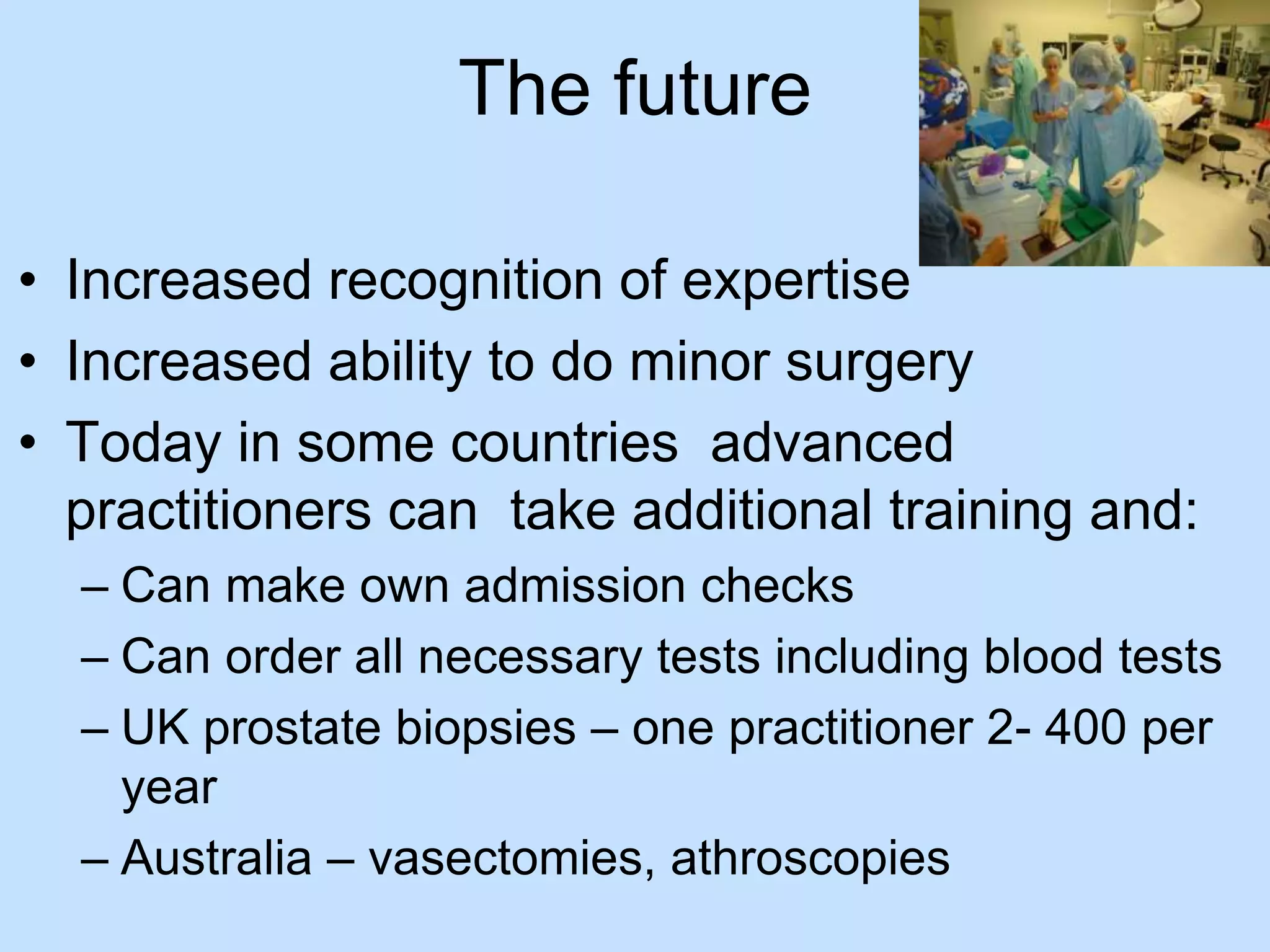
The future 
• Increased recognition of expertise 
• Increased ability to do minor surgery 
• Today in some countries advanced 
practitioners can take additional training and: 
– Can make own admission checks 
– Can order all necessary tests including blood tests 
– UK prostate biopsies – one practitioner 2- 400 per 
year 
– Australia – vasectomies, athroscopies
in Future: Different knowledge 
and skills needed 
• In addition to current knowledge and 
competencies other information and skills 
will be needed including: 
– An understanding of informatics & software 
management 
– physics 
– Radiology 
– nanotechnology 
– technology management
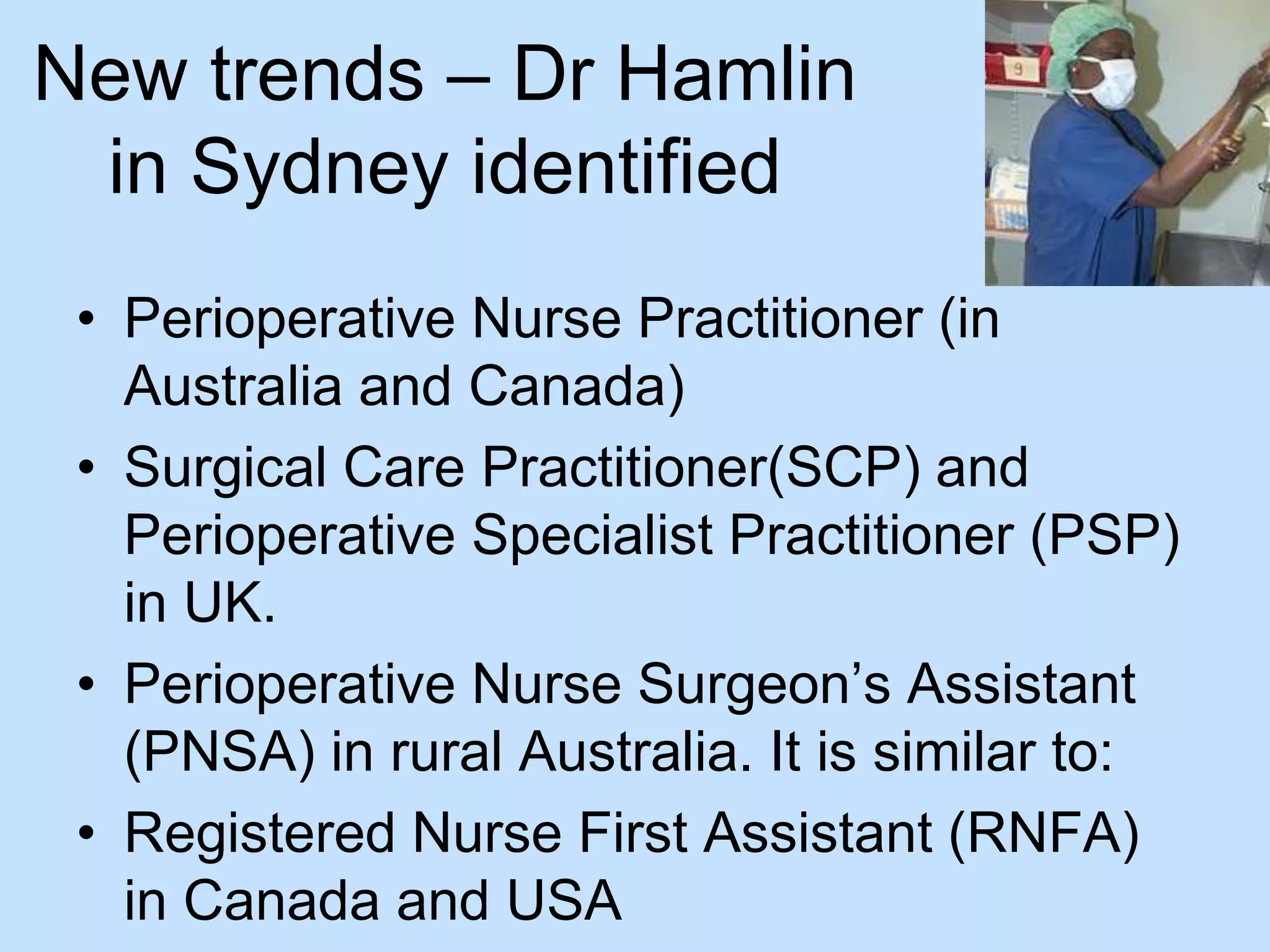
New trends – Dr Hamlin 
in Sydney identified 
• Perioperative Nurse Practitioner (in 
Australia and Canada) 
• Surgical Care Practitioner(SCP) and 
Perioperative Specialist Practitioner (PSP) 
in UK. 
• Perioperative Nurse Surgeon’s Assistant 
(PNSA) in rural Australia. It is similar to: 
• Registered Nurse First Assistant (RNFA) 
in Canada and USA
Advanced roles 
• Nurse Anesthetist (in USA) 
• Nurse sedationist (in Australia) 
• Nurse endoscopist (in UK and 
just beginning in Australia) 
• Surgical nurse liaison roles
Other evolving roles 
• Outside the operating 
room setting. The day 
surgery role is now very 
well defined. 
• advanced roles in pre-anaesthetic 
and pre-surgical 
clinics assessing, 
screening and including 
patient and family 
education
Thank you

1 phat trien cua dd ngoai khoa the gioi

  • 1.
    Developments in Surgical nursing: A Global perspective Professor Joy Notter Birmingham City University
  • 3.
    History of surgicalnursing • Difference in surgical and medical nursing recognised from late 19th / early 20th century as nursing role became established and surgical possibilities increased • At same time in USA parallel role -anaesthetic nurses spread to other countries – still separate
  • 4.
    Non-ward Surgical nurses • This role of surgical nursing was in operating room • Mainly cleaning and preparing the room • Practical training not formal courses • But acceptance of ability to prepare instruments
  • 5.
    Florence Nightingale •Formalised nurse education and training • Start of development of national programmes • Previously no consistency • Two kinds of surgical nursing – Surgical nursing mainly in operating theatre – Nursing patients on surgical wards taught as separate aspect of training
  • 6.
    Surgical nursing •1930s nurses taught general programme which include medicine and surgery. Although wards increasingly separated into medicine and surgery • 1960s start of specialisation extending role of nurses in surgery • 1970s courses for specialist nurses • 1980s move towards advanced practice and higher degrees • 1990s masters level advanced practice and nurse consultant roles
  • 7.
    Today in USA:Circulating Nurse • S/he is in charge of the operating theatre • Manages the care of a patient during surgery; • Ensures the sterile integrity of the operating room, equipment, and materials; • Enters data that records the procedures; • Assesses the patient’s condition – before, during, and immediately following surgery.
  • 8.
    Education for circulatingnurse • Initial nursing degree • Post-qualifying period in practice • Specialist surgical nursing training or degree • Operating room training certificate
  • 9.
    Recently Change intitle in some countries to reflect role Surgical nursing Perioperative nursing
  • 10.
    What is meantby perioperative nursing? Perioperative nursing is a term used to describe nursing through the entire span of surgery, including what occurs before, during, and after the actual operation.
  • 11.
    Phases of perioperativenursing Preoperative: begins with the decision to perform surgery and continues until the client has reached the operating area. Intraoperative: includes the entire duration of the surgical procedure, until transfer of the client to the recovery area. Postoperative: begins with admission to the recovery area and continues until the client receives a follow up evaluation at home, or is discharged to a rehabilitation unit.
  • 12.
    : Preoperative I.Assess physical needs II. Review the client’s health history and preparation for surgery III. Review preoperative laboratory and diagnostic studies IV. Assess psychological needs V. Assess cultural needs
  • 13.
    I Assess physicalcondition: • Ability to communicate • Vital signs • Level of consciousness • Confusion • Drowsiness • Unresponsiveness • Weight and height • Skin integrity • Ability to move/ ambulate • Level of exercise • Prostheses • Circulatory status
  • 14.
    I. Check documentationof the client’s health history and preparation for surgery: • History of present illness and reason for surgery • Past medical history • Medical conditions (acute and chronic) • Previous hospitalization and surgeries • History of any past problem with anesthesia • Allergies • Present medications • Substance use: alcohol, tobacco, street drugs • Review of system
  • 15.
    II. Check preoperativelaboratory and diagnostic studies • Complete blood count. • Blood type and cross match. • Serum electrolytes. • Urinalysis. • Chest X-rays. • Electrocardiogram. • Other tests related to procedure or client’s medical condition, such as: prothrombin time, partial thromboplastin time, blood urea nitrogen, creatinine, and other radiographic studies.
  • 16.
    IV. Assess psychologicalneeds: • Emotional state • Level of understanding of surgical procedure, preoperative and postoperative instruction • Coping strategies • Support system • Roles and responsibilities
  • 17.
    V. Assess culturalneeds: • Language-need for interpreter • Specific family/ cultural patterns • Gender issues in care • Specific dietary needs • Special religious needs
  • 18.
    Intraoperative I Typeof surgery II. Intraoperative nursing
  • 19.
    Type of surgery • Diagnostic → Removal and study of tissue to make a diagnosis • Exploratory → Most extensive means to involve exploration of a body cavity or use of scopes inserted though small incision. • Curative → Removal or replacement of defective tissue to restore function. • Palliative→ Relief of symptoms or enhancement of function without cure. • Cosmetic→ Correction of defects, improvement of appearance, or change to a physical feature.
  • 20.
    Intraoperative nursing •Prepare/ check operating room • Prepare sterile packs • Set and check instruments • Assist surgeon or anaesthetist • Check biopsies and forms • Check /weigh removed tissues • Check instruments and swabs • Check documentation • Transfer patient to recovery • Reset operating room
  • 21.
    Nurse’s Main Responsibilities in Postoperative Phase • Ensure a patent airway • Help maintain adequate circulation • Prevent or assist with the treatment of shock • Maintain proper position and function of drain tubes and IV infusion • Monitor for potential complications
  • 22.
    Postoperative I. Immediatepostoperative period II. Later postoperative period III. Preparation for transfer or discharge
  • 23.
    Immediate postoperative period. • Airway patency • Effectiveness of respiration • Presence of artificial airways • Mechanical ventilation, or supplemental oxygen • Circulatory status, vital signs • Wound condition, including dressings and drains • Fluid balance, including IV fluids, output from catheters and drains and ability to void • Level of consciousness and pain
  • 24.
    Later postoperative period • Respiratory function • General condition • Vital signs • Cardiovascular function • Fluid status • Pain level • Bowel and urinary elimination • Dressings, tubes, drains, and IV lines
  • 25.
    Preparation for transferor discharge • Monitor healing • Monitor mobility • Assess condition • Meet with family • Check home situation • Check information for community care • Check medication etc to take with them • Check transport processes for transfer/ discharge
  • 26.
    Future for perioperativenursing • It will be faster paced and more complex. • It will be much more linked to technology • Team work and communication will be critical. • The culture of the Operating Room will change to give nurses a lead role • Perioperative nurses will monitor and lead on patient safety and risk management issues.
  • 27.
    The future •Increased recognition of expertise • Increased ability to do minor surgery • Today in some countries advanced practitioners can take additional training and: – Can make own admission checks – Can order all necessary tests including blood tests – UK prostate biopsies – one practitioner 2- 400 per year – Australia – vasectomies, athroscopies
  • 28.
    in Future: Differentknowledge and skills needed • In addition to current knowledge and competencies other information and skills will be needed including: – An understanding of informatics & software management – physics – Radiology – nanotechnology – technology management
  • 29.
    New trends –Dr Hamlin in Sydney identified • Perioperative Nurse Practitioner (in Australia and Canada) • Surgical Care Practitioner(SCP) and Perioperative Specialist Practitioner (PSP) in UK. • Perioperative Nurse Surgeon’s Assistant (PNSA) in rural Australia. It is similar to: • Registered Nurse First Assistant (RNFA) in Canada and USA
  • 30.
    Advanced roles •Nurse Anesthetist (in USA) • Nurse sedationist (in Australia) • Nurse endoscopist (in UK and just beginning in Australia) • Surgical nurse liaison roles
  • 31.
    Other evolving roles • Outside the operating room setting. The day surgery role is now very well defined. • advanced roles in pre-anaesthetic and pre-surgical clinics assessing, screening and including patient and family education
  • 32.