Evolution of Advanced Practice Nursing (APN) S Spencer
Nursing History Video http://www.youtube.com/watch?v=Noaqf- JE3UI
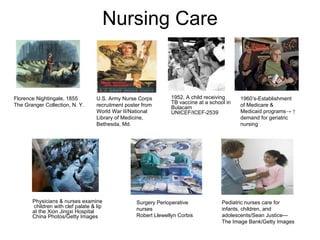
Nursing Care Florence Nightingale, 1855 The Granger Collection, N. Y. 1952, A child receiving TB vaccine at a school in Bulacam UNICEF/ICEF-2539 Surgery Perioperative nurses  Robert Llewellyn Corbis Physicians & nurses examine children with clef palate & lip at the Xion Jingxi Hospital China Photos/Getty Images 1960’s-Establishment of Medicare & Medicaid programs-> ↑ demand for geriatric nursing Pediatric nurses care for infants, children, and adolescents/Sean Justice—The Image Bank/Getty Images U.S. Army Nurse Corps recruitment poster from World War II/National Library of Medicine, Bethesda, Md.
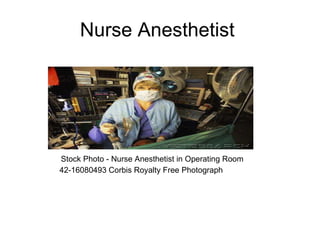
Nurse Anesthetist  Stock Photo - Nurse Anesthetist in Operating Room 42-16080493 Corbis Royalty Free Photograph
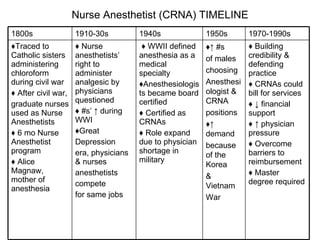
Nurse Anesthetist (CRNA) TIMELINE 1800s 1910-30s 1940s 1950s 1970-1990s ♦ Traced to Catholic sisters administering chloroform during civil war  ♦   After civil war,  graduate nurses used as Nurse Anesthetists  ♦   6 mo Nurse Anesthetist program ♦   Alice Magnaw, mother of anesthesia  ♦   Nurse anesthetists’ right to administer analgesic by physicians questioned ♦   #s’ ↑ during WWI ♦ Great  Depression era, physicians & nurses anesthetists compete for same jobs  ♦   WWII defined anesthesia as a medical specialty  ♦ Anesthesiologists became board certified ♦   Certified as CRNAs ♦   Role expand due to physician shortage in military  ♦↑   #s of males choosing Anesthesiologist & CRNA positions ♦↑  demand because of the Korea &  Vietnam War  ♦   Building credibility & defending practice  ♦   CRNAs could bill for services ♦   ↓  financial support ♦  ↑  physician pressure ♦   Overcome barriers to reimbursement ♦   Master degree required
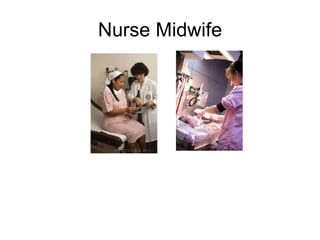
Nurse Midwife
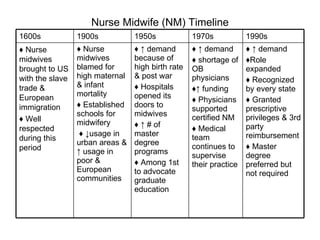
Nurse Midwife (NM) Timeline 1600s 1900s 1950s 1970s 1990s ♦   Nurse midwives  brought to US with the slave trade & European immigration ♦   Well respected during this period  ♦   Nurse midwives blamed for high maternal & infant mortality ♦   Established schools for midwifery  ♦   ↓ usage in urban areas & ↑ usage in poor & European communities ♦  ↑  demand because of high birth rate & post war ♦   Hospitals opened its doors to midwives ♦  ↑  # of  master degree programs ♦   Among 1st to advocate graduate education  ♦  ↑  demand  ♦   shortage of OB physicians ♦↑   funding ♦   Physicians supported certified NM ♦   Medical team continues to supervise their practice ♦  ↑  demand ♦ Role expanded ♦   Recognized by every state ♦   Granted prescriptive privileges & 3rd party reimbursement ♦   Master degree preferred but not required
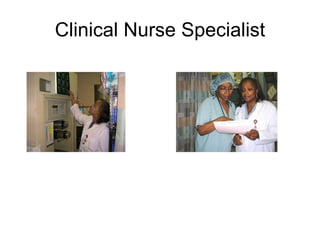
Clinical Nurse Specialist
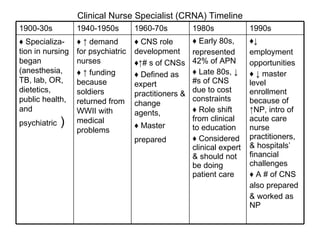
Clinical Nurse Specialist (CRNA) Timeline 1900-30s 1940-1950s 1960-70s 1980s 1990s ♦   Specializa-tion in nursing began (anesthesia, TB, lab, OR, dietetics, public health, and psychiatric  ) ♦  ↑  demand for psychiatric nurses  ♦  ↑  funding because soldiers returned from WWII with medical problems  ♦   CNS role development ♦↑ # s of CNSs ♦   Defined as expert practitioners & change agents, ♦   Master prepared   ♦   Early 80s, represented 42% of APN ♦   Late 80s,  ↓  #s of CNS due to cost constraints ♦   Role shift from clinical to education ♦   Considered clinical expert & should not be doing patient care  ♦↓ employment opportunities ♦   ↓  master level enrollment because of ↑NP, intro of acute care nurse practitioners, & hospitals’ financial challenges ♦   A # of CNS also prepared & worked as NP
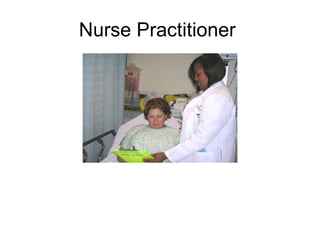
Nurse Practitioner
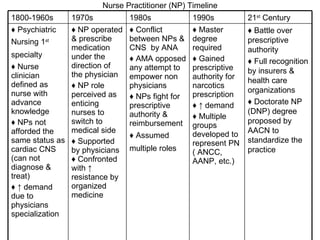
Nurse Practitioner (NP) Timeline 1800-1960s 1970s 1980s 1990s 21 st  Century ♦   Psychiatric Nursing 1 st  specialty   ♦   Nurse clinician defined as nurse with advance knowledge  ♦   NPs not afforded the same status as cardiac CNS (can not diagnose & treat) ♦  ↑  demand due to physicians specialization ♦   NP operated & prescribe medication under the direction of the physician ♦   NP role perceived as enticing  nurses to switch to medical side ♦   Supported by physicians  ♦  Confronted with ↑ resistance by organized medicine  ♦   Conflict between NPs & CNS  by ANA ♦   AMA opposed any attempt to empower non physicians ♦   NPs fight for prescriptive authority & reimbursement ♦   Assumed multiple roles   ♦   Master degree required ♦   Gained prescriptive authority for narcotics prescription ♦  ↑  demand ♦   Multiple groups developed to represent PN ( ANCC, AANP, etc.) ♦   Battle over prescriptive authority  ♦   Full recognition by insurers & health care organizations  ♦   Doctorate NP (DNP) degree proposed by AACN to standardize the practice
Physician Assistant
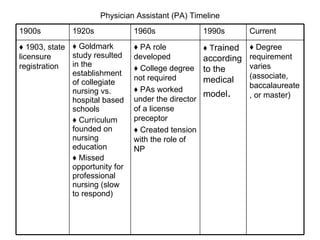
Physician Assistant (PA) Timeline 1900s 1920s 1960s 1990s Current ♦   1903, state licensure registration  ♦  Goldmark study resulted in the  establishment of collegiate nursing vs. hospital based schools ♦  Curriculum founded on  nursing education ♦  Missed opportunity for professional nursing (slow to respond)  ♦  PA role developed  ♦  C ollege degree not required ♦  PAs worked  under the director of a license preceptor ♦  Created tension with the role of NP ♦  T rained according to the medical model .  ♦  Degree requirement varies (associate, baccalaureate, or master)
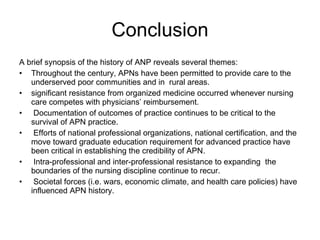
Conclusion A brief synopsis of the history of ANP reveals several themes: Throughout the century, APNs have been permitted to provide care to the underserved poor communities and in  rural areas. significant resistance from organized medicine occurred whenever nursing care competes with physicians’ reimbursement.   Documentation of outcomes of practice continues to be critical to the survival of APN practice.   Efforts of national professional organizations, national certification, and the move toward graduate education requirement for advanced practice have been critical in establishing the credibility of APN.   Intra-professional and inter-professional resistance to expanding  the boundaries of the nursing discipline continue to recur.   Societal forces (i.e. wars, economic climate, and health care policies) have influenced APN history.
Reference Brucker, M. C. & Reedy, N. J. (2000). Nurse Midwifery: Yesterday, Today, and Tomorrow.  MCN,   The American Journal of Maternal/Child Nursing . November/December 25(6), 322. Hamric, A. B., Spross, J. A. & Hanson, C. M. (Eds.),  Advanced practice nursing: An integrated approach.  (3 rd  ed.). Elsevier Saunders. St. Louis MO.  Hodson, D. M. (1998). The evolving role of the nurse practitioner in surgery. Retrieved June 5, 2005 from http://findarticles.com/p/articles/mi_m0FSL/is_n5_v67/ai_20601099/pg_2/ Kristi, H. K.   The history and evolution of the APN role:   The impact on healthcare. Retrieved July, 27, 2009 from:  http://dynamicnursingeducation.com/class.php?class_id=86&pid=18 Northouse, P. G. (2003).  Leadership theory and practice.  (3rd ed.).  Sage Publications, Thousand Oaks, CA.  Nursing. In Encyclopedia Britannica online encyclopedia. Retrieved August 2, 2009,  from http://www.britannica.com/EBchecked/topic-art/422718/11075/Stephen-Girard-lithograph-by-A-Newsam-after-a-portrait-by%20on%20August%202

Evolution of APN

  • 1.
    Evolution of AdvancedPractice Nursing (APN) S Spencer
  • 2.
    Nursing History Videohttp://www.youtube.com/watch?v=Noaqf- JE3UI
  • 3.
    Nursing Care FlorenceNightingale, 1855 The Granger Collection, N. Y. 1952, A child receiving TB vaccine at a school in Bulacam UNICEF/ICEF-2539 Surgery Perioperative nurses Robert Llewellyn Corbis Physicians & nurses examine children with clef palate & lip at the Xion Jingxi Hospital China Photos/Getty Images 1960’s-Establishment of Medicare & Medicaid programs-> ↑ demand for geriatric nursing Pediatric nurses care for infants, children, and adolescents/Sean Justice—The Image Bank/Getty Images U.S. Army Nurse Corps recruitment poster from World War II/National Library of Medicine, Bethesda, Md.
  • 4.
    Nurse Anesthetist Stock Photo - Nurse Anesthetist in Operating Room 42-16080493 Corbis Royalty Free Photograph
  • 5.
    Nurse Anesthetist (CRNA)TIMELINE 1800s 1910-30s 1940s 1950s 1970-1990s ♦ Traced to Catholic sisters administering chloroform during civil war ♦ After civil war, graduate nurses used as Nurse Anesthetists ♦ 6 mo Nurse Anesthetist program ♦ Alice Magnaw, mother of anesthesia ♦ Nurse anesthetists’ right to administer analgesic by physicians questioned ♦ #s’ ↑ during WWI ♦ Great Depression era, physicians & nurses anesthetists compete for same jobs ♦ WWII defined anesthesia as a medical specialty ♦ Anesthesiologists became board certified ♦ Certified as CRNAs ♦ Role expand due to physician shortage in military ♦↑ #s of males choosing Anesthesiologist & CRNA positions ♦↑ demand because of the Korea & Vietnam War ♦ Building credibility & defending practice ♦ CRNAs could bill for services ♦ ↓ financial support ♦ ↑ physician pressure ♦ Overcome barriers to reimbursement ♦ Master degree required
  • 6.
  • 7.
    Nurse Midwife (NM)Timeline 1600s 1900s 1950s 1970s 1990s ♦ Nurse midwives brought to US with the slave trade & European immigration ♦ Well respected during this period ♦ Nurse midwives blamed for high maternal & infant mortality ♦ Established schools for midwifery ♦ ↓ usage in urban areas & ↑ usage in poor & European communities ♦ ↑ demand because of high birth rate & post war ♦ Hospitals opened its doors to midwives ♦ ↑ # of master degree programs ♦ Among 1st to advocate graduate education ♦ ↑ demand ♦ shortage of OB physicians ♦↑ funding ♦ Physicians supported certified NM ♦ Medical team continues to supervise their practice ♦ ↑ demand ♦ Role expanded ♦ Recognized by every state ♦ Granted prescriptive privileges & 3rd party reimbursement ♦ Master degree preferred but not required
  • 8.
  • 9.
    Clinical Nurse Specialist(CRNA) Timeline 1900-30s 1940-1950s 1960-70s 1980s 1990s ♦ Specializa-tion in nursing began (anesthesia, TB, lab, OR, dietetics, public health, and psychiatric ) ♦ ↑ demand for psychiatric nurses ♦ ↑ funding because soldiers returned from WWII with medical problems ♦ CNS role development ♦↑ # s of CNSs ♦ Defined as expert practitioners & change agents, ♦ Master prepared ♦ Early 80s, represented 42% of APN ♦ Late 80s, ↓ #s of CNS due to cost constraints ♦ Role shift from clinical to education ♦ Considered clinical expert & should not be doing patient care ♦↓ employment opportunities ♦ ↓ master level enrollment because of ↑NP, intro of acute care nurse practitioners, & hospitals’ financial challenges ♦ A # of CNS also prepared & worked as NP
  • 10.
  • 11.
    Nurse Practitioner (NP)Timeline 1800-1960s 1970s 1980s 1990s 21 st Century ♦ Psychiatric Nursing 1 st specialty ♦ Nurse clinician defined as nurse with advance knowledge ♦ NPs not afforded the same status as cardiac CNS (can not diagnose & treat) ♦ ↑ demand due to physicians specialization ♦ NP operated & prescribe medication under the direction of the physician ♦ NP role perceived as enticing nurses to switch to medical side ♦ Supported by physicians ♦ Confronted with ↑ resistance by organized medicine ♦ Conflict between NPs & CNS by ANA ♦ AMA opposed any attempt to empower non physicians ♦ NPs fight for prescriptive authority & reimbursement ♦ Assumed multiple roles ♦ Master degree required ♦ Gained prescriptive authority for narcotics prescription ♦ ↑ demand ♦ Multiple groups developed to represent PN ( ANCC, AANP, etc.) ♦ Battle over prescriptive authority ♦ Full recognition by insurers & health care organizations ♦ Doctorate NP (DNP) degree proposed by AACN to standardize the practice
  • 12.
  • 13.
    Physician Assistant (PA)Timeline 1900s 1920s 1960s 1990s Current ♦ 1903, state licensure registration ♦ Goldmark study resulted in the establishment of collegiate nursing vs. hospital based schools ♦ Curriculum founded on nursing education ♦ Missed opportunity for professional nursing (slow to respond) ♦ PA role developed ♦ C ollege degree not required ♦ PAs worked under the director of a license preceptor ♦ Created tension with the role of NP ♦ T rained according to the medical model . ♦ Degree requirement varies (associate, baccalaureate, or master)
  • 14.
    Conclusion A briefsynopsis of the history of ANP reveals several themes: Throughout the century, APNs have been permitted to provide care to the underserved poor communities and in rural areas. significant resistance from organized medicine occurred whenever nursing care competes with physicians’ reimbursement.   Documentation of outcomes of practice continues to be critical to the survival of APN practice.   Efforts of national professional organizations, national certification, and the move toward graduate education requirement for advanced practice have been critical in establishing the credibility of APN.   Intra-professional and inter-professional resistance to expanding the boundaries of the nursing discipline continue to recur.   Societal forces (i.e. wars, economic climate, and health care policies) have influenced APN history.
  • 15.
    Reference Brucker, M.C. & Reedy, N. J. (2000). Nurse Midwifery: Yesterday, Today, and Tomorrow. MCN, The American Journal of Maternal/Child Nursing . November/December 25(6), 322. Hamric, A. B., Spross, J. A. & Hanson, C. M. (Eds.), Advanced practice nursing: An integrated approach. (3 rd ed.). Elsevier Saunders. St. Louis MO.  Hodson, D. M. (1998). The evolving role of the nurse practitioner in surgery. Retrieved June 5, 2005 from http://findarticles.com/p/articles/mi_m0FSL/is_n5_v67/ai_20601099/pg_2/ Kristi, H. K. The history and evolution of the APN role: The impact on healthcare. Retrieved July, 27, 2009 from: http://dynamicnursingeducation.com/class.php?class_id=86&pid=18 Northouse, P. G. (2003). Leadership theory and practice. (3rd ed.). Sage Publications, Thousand Oaks, CA. Nursing. In Encyclopedia Britannica online encyclopedia. Retrieved August 2, 2009, from http://www.britannica.com/EBchecked/topic-art/422718/11075/Stephen-Girard-lithograph-by-A-Newsam-after-a-portrait-by%20on%20August%202