1.
WHAT IS NATURAL RESOURCE ECONOMICS &
WHY IS IT IMPORTANT?
Key Terms
• Natural Resources
• Specific attributes of the environment that are valued or have
proven useful to humans [or have the potential to do so]* --G.
Johnston
• Aspects of nature that can be used by humans to satisfy human
wants--Hite & Mulkey
• key to human use: technology, time, accessibility, appli-cation,
perception; conflicts often related to culture
• Economics
• the study of the production, processing, distribution, consumption
of goods/services in an exchange system
Key Terms (cont)
• Natural Resource Economics
• application of economics to manage naturally occurring resources
for human needs/wants with efficiency as the primary goal
• efficiency may be defined in market or nonmarket terms, focused
on the short or long run, relative to current or future generations,
local or global in scope
• decision choices include maintaining the status quo, altering the
status quo, or doing nothing with focus on relevant institutions
• evaluation always includes the costs & benefits of a decision & to
whom those costs & benefits accrue
Key Terms (cont)
• Environmental Economics vs. Natural Resources Economics
(Hackett)
• Environmental Economics: economic basis for pollution problems
& policy alternatives
• Natural Resources Economics: problems of managing common-
pool* natural resources, determining optimal rates of extraction,
& understanding resource markets
• *common-pool natural resources: difficult to exclude access, but
once extracted is no longer available to others (groundwater,
rivers, fisheries, public forests)
• Scarcity, Opportunity cost, economic rationality
Why Study Natural Resource Economics?
• Natural Sciences lack commonly accepted decision process
• Economics may “assume” the problem away
• Irreversibility
• Market failure
• Joint importance of economic and ecological systems
• Physical-Natural-Economic System Links
• Improves efficient functioning of system
• Improves understanding about the world we live in
• Summary: Improved management of natural resources,
whether for private, public or natural gain
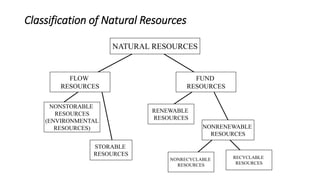
Classification of Natural Resources
NATURAL RESOURCES
FLOW
RESOURCES
FUND
RESOURCES
NONSTORABLE
RESOURCES
(ENVIRONMENTAL
RESOURCES)
STORABLE
RESOURCES
RENEWABLE
RESOURCES
NONRENEWABLE
RESOURCES
NONRECYCLABLE
RESOURCES
RECYCLABLE
RESOURCES
Classification of Resources (continued)
1. Flow Resources (nondepletable)
a. Nonstorable (sometimes called
“environmental resources”)
•Often indivisible
•Inexhaustible (in human span of time)
•Time & management relevant only to
consumption, not supply
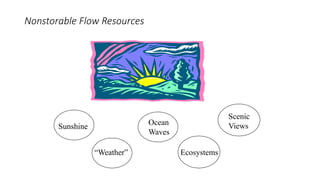
Nonstorable Flow Resources
Sunshine
“Weather”
Ocean
Waves
Ecosystems
Scenic
Views
Classification of Resources (cont)
1. Flow Resources (cont)
b. Storable (by nature, as in living matter;
by humans with technology)
• May be divisible
• Time & management relevant to both
to consumption & supply
• The services are what are significant
for humans
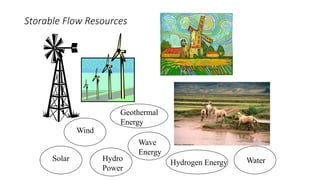
Storable Flow Resources
Solar
Wind
Wave
Energy
Geothermal
Energy
Hydrogen Energy WaterHydro
Power
Classification (cont.)
2. Fund Resources (stock or depletable
resources)
a. Exhaustible & Renewable
•Regenerative within human use time
frame
•Assumes use within minimum &
maximum thresholds
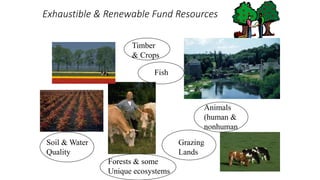
Exhaustible & Renewable Fund Resources
Timber
& Crops
Animals
(human &
nonhuman
Fish
Grazing
Lands
Soil & Water
Quality
Forests & some
Unique ecosystems
Classification (cont.)
2. Fund Resources (cont)
b. Exhaustible & Nonrenewable
• Relatively fixed stocks/fund within
human use time frame
(1) Nonrecyclable--Examples: fossil-fuel
energy resources (oil, natural gas, coal, peat,
many “renewable” resources when thresholds
violated)
(2) Recyclable--Examples: some minerals
(iron, aluminum, gold, silver)
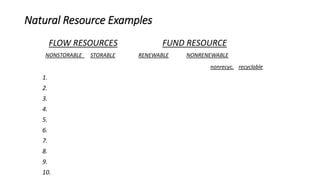
Natural Resource Examples
FLOW RESOURCES FUND RESOURCE
NONSTORABLE STORABLE RENEWABLE NONRENEWABLE
nonrecyc. recyclable
1.
2.
3.
4.
5.
6.
7.
8.
9.
10.
Framing Natural Resource Issues
• Quantity & Quality of: Land, Water, Air, Energy
• Public vs. Private Management Question
• Trend of Magnitude of Problem:
• Persistent, Chronic, Cyclical, Declining, Growing?
• Irreversibility
• Geographic scope
• Whose problem & who decides (ethics)?
• Property rights
• Time (short vs. long run; current vs. future generations)
Optimism vs. Concern for Environment & Natural
Resources
• Concerns
• Global warming & climate impacts
• Over-population & biodiversity
• Soil/water quality/Mineral/energy cost/availability
• Pollution/resource shortage impacts on social & political
institutions
• Optimism
• Legislative progress
• Toxic release rates down
• US competitiveness
References for Lesson 1
Hackett text
Hite, J.C., & W. D. Mulkey. Natural Resource Economics : An Introductory Textbook,
draft unpublished text.
Johnston, G.M., D. Freshwater & P. Favero (editors). Natural Resource and
Environmental Policy Analysis: Cases in Applied Economics, Westview Press,
Boulder, 1988.
Kahn, J.R. The Economic Approach to Environmental and Natural Resources, second
edition, 1998.
Sanders, various notes

1. natural resources and types

  • 1.
    1. WHAT IS NATURALRESOURCE ECONOMICS & WHY IS IT IMPORTANT?
  • 2.
    Key Terms • NaturalResources • Specific attributes of the environment that are valued or have proven useful to humans [or have the potential to do so]* --G. Johnston • Aspects of nature that can be used by humans to satisfy human wants--Hite & Mulkey • key to human use: technology, time, accessibility, appli-cation, perception; conflicts often related to culture • Economics • the study of the production, processing, distribution, consumption of goods/services in an exchange system
  • 3.
    Key Terms (cont) •Natural Resource Economics • application of economics to manage naturally occurring resources for human needs/wants with efficiency as the primary goal • efficiency may be defined in market or nonmarket terms, focused on the short or long run, relative to current or future generations, local or global in scope • decision choices include maintaining the status quo, altering the status quo, or doing nothing with focus on relevant institutions • evaluation always includes the costs & benefits of a decision & to whom those costs & benefits accrue
  • 4.
    Key Terms (cont) •Environmental Economics vs. Natural Resources Economics (Hackett) • Environmental Economics: economic basis for pollution problems & policy alternatives • Natural Resources Economics: problems of managing common- pool* natural resources, determining optimal rates of extraction, & understanding resource markets • *common-pool natural resources: difficult to exclude access, but once extracted is no longer available to others (groundwater, rivers, fisheries, public forests) • Scarcity, Opportunity cost, economic rationality
  • 5.
    Why Study NaturalResource Economics? • Natural Sciences lack commonly accepted decision process • Economics may “assume” the problem away • Irreversibility • Market failure • Joint importance of economic and ecological systems • Physical-Natural-Economic System Links • Improves efficient functioning of system • Improves understanding about the world we live in • Summary: Improved management of natural resources, whether for private, public or natural gain
  • 6.
    Classification of NaturalResources NATURAL RESOURCES FLOW RESOURCES FUND RESOURCES NONSTORABLE RESOURCES (ENVIRONMENTAL RESOURCES) STORABLE RESOURCES RENEWABLE RESOURCES NONRENEWABLE RESOURCES NONRECYCLABLE RESOURCES RECYCLABLE RESOURCES
  • 7.
    Classification of Resources(continued) 1. Flow Resources (nondepletable) a. Nonstorable (sometimes called “environmental resources”) •Often indivisible •Inexhaustible (in human span of time) •Time & management relevant only to consumption, not supply
  • 8.
  • 9.
    Classification of Resources(cont) 1. Flow Resources (cont) b. Storable (by nature, as in living matter; by humans with technology) • May be divisible • Time & management relevant to both to consumption & supply • The services are what are significant for humans
  • 10.
  • 11.
    Classification (cont.) 2. FundResources (stock or depletable resources) a. Exhaustible & Renewable •Regenerative within human use time frame •Assumes use within minimum & maximum thresholds
  • 12.
    Exhaustible & RenewableFund Resources Timber & Crops Animals (human & nonhuman Fish Grazing Lands Soil & Water Quality Forests & some Unique ecosystems
  • 13.
    Classification (cont.) 2. FundResources (cont) b. Exhaustible & Nonrenewable • Relatively fixed stocks/fund within human use time frame (1) Nonrecyclable--Examples: fossil-fuel energy resources (oil, natural gas, coal, peat, many “renewable” resources when thresholds violated) (2) Recyclable--Examples: some minerals (iron, aluminum, gold, silver)
  • 14.
    Natural Resource Examples FLOWRESOURCES FUND RESOURCE NONSTORABLE STORABLE RENEWABLE NONRENEWABLE nonrecyc. recyclable 1. 2. 3. 4. 5. 6. 7. 8. 9. 10.
  • 15.
    Framing Natural ResourceIssues • Quantity & Quality of: Land, Water, Air, Energy • Public vs. Private Management Question • Trend of Magnitude of Problem: • Persistent, Chronic, Cyclical, Declining, Growing? • Irreversibility • Geographic scope • Whose problem & who decides (ethics)? • Property rights • Time (short vs. long run; current vs. future generations)
  • 16.
    Optimism vs. Concernfor Environment & Natural Resources • Concerns • Global warming & climate impacts • Over-population & biodiversity • Soil/water quality/Mineral/energy cost/availability • Pollution/resource shortage impacts on social & political institutions • Optimism • Legislative progress • Toxic release rates down • US competitiveness
  • 17.
    References for Lesson1 Hackett text Hite, J.C., & W. D. Mulkey. Natural Resource Economics : An Introductory Textbook, draft unpublished text. Johnston, G.M., D. Freshwater & P. Favero (editors). Natural Resource and Environmental Policy Analysis: Cases in Applied Economics, Westview Press, Boulder, 1988. Kahn, J.R. The Economic Approach to Environmental and Natural Resources, second edition, 1998. Sanders, various notes