Hello Students!
Welcome to DELD class!
DELD (EC105) Mr. Rajvir Singh - Gp. No.23 1
• Course Name : Digital electronics & Logic Design (DELD)
• Course Code : EC-105
• Session : July-Dec 2021-22
• Batch/Semester : 2020/3rd
• Course Credits : 4
• Faculty : Mr. Rajvir Singh
DELD (EC105) Mr. Rajvir Singh - Gp. No.23 2
This course aims to teach students the fundamentals of
digital logic design.
Starting from learning the basic concepts of the different
base number systems, to basic logic elements and deriving
logical expressions to further optimize a circuit diagram,
this course teaches students everything they need to
evaluate different combinational logic designs, as well as
design their own digital circuits with different parameters.
About the Course …
DELD (EC105) Mr. Rajvir Singh - Gp. No.23 3
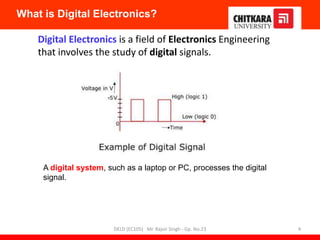
Digital Electronics is a field of Electronics Engineering
that involves the study of digital signals.
A digital system, such as a laptop or PC, processes the digital
signal.
What is Digital Electronics?
DELD (EC105) Mr. Rajvir Singh - Gp. No.23 4
Logic design is the basic organization of digital
circuit.
All digital circuits, also known as logic circuits,
are based on a two valued logic system — 1 and 0,
High and Low levels.
Logic Diagram is a graphical representation of
a logic circuit that shows the wiring and
connections of each individual logic gate,
represented by a specific graphical symbol, that
implements the logic circuit.
Logic Design and related terms
DELD (EC105) Mr. Rajvir Singh - Gp. No.23 5
 Digital Electronic circuits are relatively easy to
design.
 It has higher accuracy and capability to program.
 Transmitted digital signals are not degraded over
long distances.
 Digital Signals can be stored easily.
 Digital Electronics is comparatively more
immune to 'error' and 'noise'.
Advantages of Digital Electronics
DELD (EC105) Mr. Rajvir Singh - Gp. No.23 6
Several electronic items make use of digital
electronics. For example, laptops, TVs, remote
controls, Mobile Phones, and other entertainment
systems.
Computers are one of the most complex examples
and will make use of numerous and complex digital
circuits.
Importance of Digital Electronics
DELD (EC105) Mr. Rajvir Singh - Gp. No.23 7
Digital Electronics & Logic Design course is a
comprehensive study of the principles and
techniques of modern digital systems.
Digital logic design is the foundation of computer
and microcontroller-based systems deployed in
Electronic communication and Biomedical
equipments, automobiles, industrial control
systems, etc.
Future Scope and Applications
DELD (EC105) Mr. Rajvir Singh - Gp. No.23 8
At the completion of the course, the students should be
able to:
CO1: Understand the underlying differences between analog and digital
systems, and interconversion between the two.
CO2: Understand and apply mathematical techniques to solve digital
design problems involving Boolean logic.
CO3: Understand the underlying differences between combinational
and sequential circuits.
CO4: Understand and apply the design methods for implementing
combinational and sequential circuits.
CO5: Understand the concept of memories and Programmable Logic
Devices and their classification.
Course Outcomes
DELD (EC105) Mr. Rajvir Singh - Gp. No.23 9
SYLLABUS:
• UNIT-1: Introduction to Digital Concepts
• UNIT-2: Boolean algebra
• UNIT3:Combinationalcircuit
• UNIT-4:Sequential circuits
• UNIT-5:Digital IC families
• UNIT-6:D/A and A/D converters
• Unit-7:Semiconductor Memories and PLDs
DELD (EC105) Mr. Rajvir Singh - Gp. No.23 10
Recommended Books
B1: Anand Kumar, Fundamentals of digital circuits, 2rd Edition, PHI.
B2: Thomas L. Floyd, 10th Edition, Digital Fundamentals, Pearson
Publications.
B3: M. Morris Mano, Digital Design, 4.ed., Prentice Hall of India
Pvt. Ltd., New Delhi, Sixth impression Pearson Education
(Singapore) Pvt. Ltd., New Delhi.
B4: Donald P. Leach and Albert Paul Malvino, Digital Principles
and Applications, 5th Edition, Tata McGraw Hill Publishing
Company Limited, New Delhi, 2003.
DELD (EC105) Mr. Rajvir Singh - Gp. No.23 11
UNIT 1: Introduction to Digital Concepts
DELD (EC105) Mr. Rajvir Singh - Gp. No.23 12
UNIT 1: Introduction to Digital Concepts
• Introduction to Digital Concepts:
– Digital and Analog systems, logic levels & Pulse waveform.
• Logic Gates:
– And Gate, OR Gate, Not gate, Universal Gates, Exclusive–OR gate,
Exclusive-NOR gate
• Number systems:
– Decimal number system, Binary number system, Representation of
signed numbers, Octal number system, Hexadecimal number system.
DELD (EC105) Mr. Rajvir Singh - Gp. No.23 13
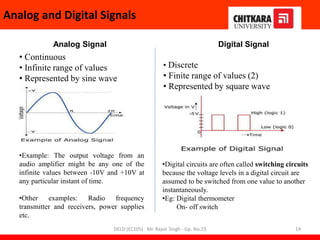
Analog and Digital Signals
Analog Signal Digital Signal
• Continuous
• Infinite range of values
• Represented by sine wave
• Discrete
• Finite range of values (2)
• Represented by square wave
DELD (EC105) Mr. Rajvir Singh - Gp. No.23 14
•Example: The output voltage from an
audio amplifier might be any one of the
infinite values between -10V and +10V at
any particular instant of time.
•Other examples: Radio frequency
transmitter and receivers, power supplies
etc.
•Digital circuits are often called switching circuits
because the voltage levels in a digital circuit are
assumed to be switched from one value to another
instantaneously.
•Eg: Digital thermometer
On- off switch
Logic Levels
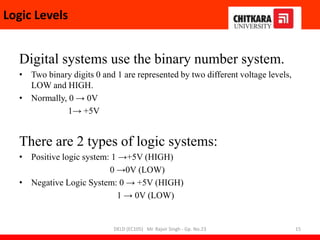
Digital systems use the binary number system.
• Two binary digits 0 and 1 are represented by two different voltage levels,
LOW and HIGH.
• Normally, 0 → 0V
1→ +5V
There are 2 types of logic systems:
• Positive logic system: 1 →+5V (HIGH)
0 →0V (LOW)
• Negative Logic System: 0 → +5V (HIGH)
1 → 0V (LOW)
DELD (EC105) Mr. Rajvir Singh - Gp. No.23 15
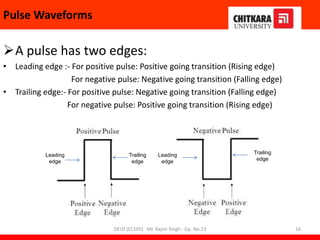
Pulse Waveforms
A pulse has two edges:
• Leading edge :- For positive pulse: Positive going transition (Rising edge)
For negative pulse: Negative going transition (Falling edge)
• Trailing edge:- For positive pulse: Negative going transition (Falling edge)
For negative pulse: Positive going transition (Rising edge)
Leading
edge
Trailing
edge
Trailing
edge
Leading
edge
DELD (EC105) Mr. Rajvir Singh - Gp. No.23 16
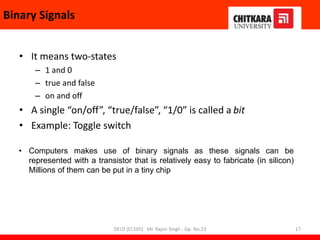
Binary Signals
• It means two-states
– 1 and 0
– true and false
– on and off
• A single “on/off”, “true/false”, “1/0” is called a bit
• Example: Toggle switch
DELD (EC105) Mr. Rajvir Singh - Gp. No.23 17
• Computers makes use of binary signals as these signals can be
represented with a transistor that is relatively easy to fabricate (in silicon)
Millions of them can be put in a tiny chip
DELD (EC105) Mr. Rajvir Singh - Gp. No.23 18
Logic Gates
Logic Gates
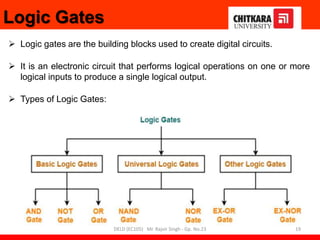
 Logic gates are the building blocks used to create digital circuits.
 It is an electronic circuit that performs logical operations on one or more
logical inputs to produce a single logical output.
 Types of Logic Gates:
.
19
DELD (EC105) Mr. Rajvir Singh - Gp. No.23
There are four different, but equally powerful, notational methods for describing the behaviour
of gates and circuits
 Definition
 Symbol
 Boolean expression
 Logic diagrams
 Truth tables
 Timing Diagram
 Boolean expression: It is a mathematical equation showing the relationship between the
input and the output variables. Eg: Y= A+B
 Logic diagram: a graphical representation of a circuit representing a particular function..
– Each type of gate is represented by a specific graphical symbol.
 Truth table: defines the function of a gate by listing all possible input combinations that
the gate could encounter, and the corresponding output.
 Timing diagram: A digital timing diagram is a representation of set of signals in the time
domain as waveforms.
Notational methods for describing the behaviour of gates
and circuits
20
DELD (EC105) Mr. Rajvir Singh - Gp. No.23
AND Gate( Multiplication function)
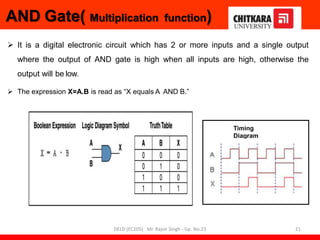
 It is a digital electronic circuit which has 2 or more inputs and a single output
where the output of AND gate is high when all inputs are high, otherwise the
output will be low.
 The expression X=A.B is read as “X equals A AND B.”
Timing
Diagram
21
DELD (EC105) Mr. Rajvir Singh - Gp. No.23
 What is the only input combination that will produce a HIGH at the output of a
five-input AND gate?
– all 5 inputs = 1
 What logic level should be applied to the second input of a two-input AND
gate if the logic signal at the first input is to be inhibited(prevented) from
reaching the output?
– A LOW input will keep the output LOW
22
DELD (EC105) Mr. Rajvir Singh - Gp. No.23
Review Questions:
OR Gate (Logical Addition Function)
 It is a digital electronic circuit which has 2 or more inputs and a single
output where the output of OR gate is Low when all inputs are low, else
output will be high.
 The expression X=A+B is read as “X equals A OR B”
Timing Diagram
23
DELD (EC105) Mr. Rajvir Singh - Gp. No.23
Review Questions:
 What is the only set of input conditions that will produce a LOW output for any
OR gate?
– all inputs LOW
 Write the Boolean expression for a six-input OR gate
– X=A+B+C+D+E+F
 If the A input in previous example is permanently kept at the 1 level, what will
the resultant output waveform be?
– constant HIGH
24
DELD (EC105) Mr. Rajvir Singh - Gp. No.23
Not Gate (Inverter)
 The inverter (NOT circuit) performs the operation called inversion or
complementation.
 The NOT operation changes one logic level to the opposite logical level. When the
input is Low, the output is high. When the input is high, the output is low.
Timing
Diagram
25
DELD (EC105) Mr. Rajvir Singh - Gp. No.23
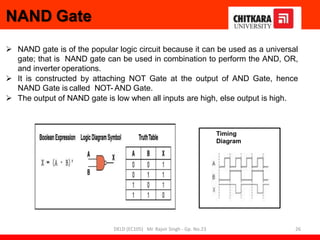
NAND Gate
 NAND gate is of the popular logic circuit because it can be used as a universal
gate; that is NAND gate can be used in combination to perform the AND, OR,
and inverter operations.
 It is constructed by attaching NOT Gate at the output of AND Gate, hence
NAND Gate is called NOT- AND Gate.
 The output of NAND gate is low when all inputs are high, else output is high.
Timing
Diagram
26
DELD (EC105) Mr. Rajvir Singh - Gp. No.23
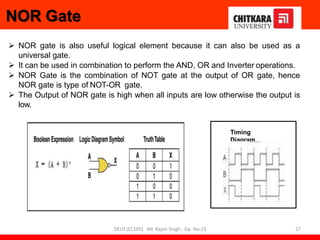
NOR Gate
 NOR gate is also useful logical element because it can also be used as a
universal gate.
 It can be used in combination to perform the AND, OR and Inverter operations.
 NOR Gate is the combination of NOT gate at the output of OR gate, hence
NOR gate is type of NOT-OR gate.
 The Output of NOR gate is high when all inputs are low otherwise the output is
low.
Timing
Diagram
27
DELD (EC105) Mr. Rajvir Singh - Gp. No.23
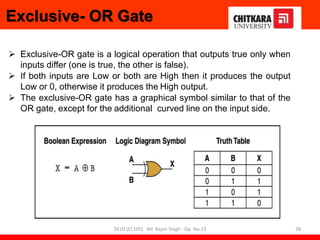
Exclusive- OR Gate
 Exclusive-OR gate is a logical operation that outputs true only when
inputs differ (one is true, the other is false).
 If both inputs are Low or both are High then it produces the output
Low or 0, otherwise it produces the High output.
 The exclusive-OR gate has a graphical symbol similar to that of the
OR gate, except for the additional curved line on the input side.
28
DELD (EC105) Mr. Rajvir Singh - Gp. No.23
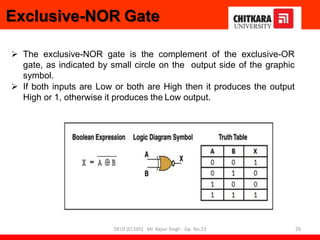
Exclusive-NOR Gate
 The exclusive-NOR gate is the complement of the exclusive-OR
gate, as indicated by small circle on the output side of the graphic
symbol.
 If both inputs are Low or both are High then it produces the output
High or 1, otherwise it produces the Low output.
29
DELD (EC105) Mr. Rajvir Singh - Gp. No.23
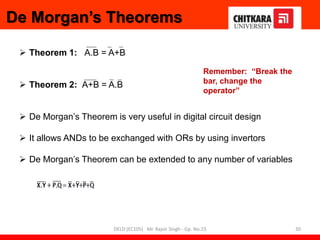
De Morgan’s Theorems
 Theorem 1: A.B = A+B
 Theorem 2: A+B = A.B
 De Morgan’s Theorem is very useful in digital circuit design
 It allows ANDs to be exchanged with ORs by using invertors
 De Morgan’s Theorem can be extended to any number of variables
Remember: “Break the
bar, change the
operator”
30
DELD (EC105) Mr. Rajvir Singh - Gp. No.23
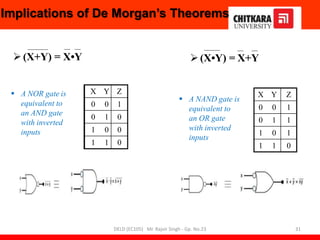
Implications of De Morgan’s Theorems
(X+Y) = X•Y
 A NOR gate is
equivalent to
an AND gate
with inverted
inputs
X Y Z
0 0 1
0 1 0
1 0 0
1 1 0
(X•Y) = X+Y
 A NAND gate is
equivalent to
an OR gate
with inverted
inputs
X Y Z
0 0 1
0 1 1
1 0 1
1 1 0
31
DELD (EC105) Mr. Rajvir Singh - Gp. No.23
DELD (EC105) Mr. Rajvir Singh - Gp. No.23 32
Universal Gates
NAND Gate
as
Universal Gate
33
DELD (EC105) Mr. Rajvir Singh - Gp. No.23
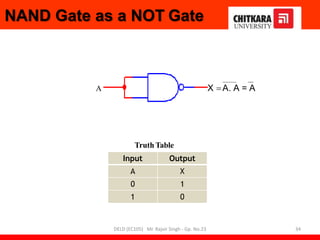
NAND Gate as a NOT Gate
A X A. A = A
Input Output
A X
0 1
1 0
Truth Table
34
DELD (EC105) Mr. Rajvir Singh - Gp. No.23
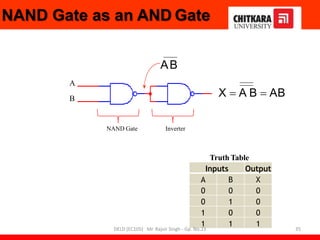
NAND Gate as an AND Gate
A
B
X  A B  AB
NAND Gate Inverter
AB
Inputs Output
A B X
0 0 0
0 1 0
1 0 0
1 1 1
Truth Table
35
DELD (EC105) Mr. Rajvir Singh - Gp. No.23
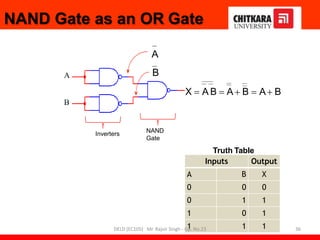
NAND Gate as an OR Gate
A
B
X  A B  A  B  A B
NAND
Gate
Inverters
B
A
Inputs Output
A B X
0 0 0
0 1 1
1 0 1
1 1 1
Truth Table
36
DELD (EC105) Mr. Rajvir Singh - Gp. No.23
NOR Gate
As
Universal Gate
37
DELD (EC105) Mr. Rajvir Singh - Gp. No.23
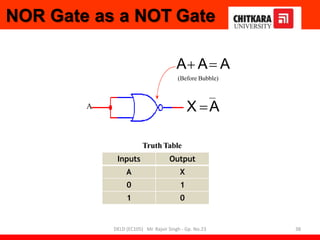
NOR Gate as a NOT Gate
A X A
A A A
(Before Bubble)
Truth Table
Inputs Output
A X
0 1
1 0
38
DELD (EC105) Mr. Rajvir Singh - Gp. No.23
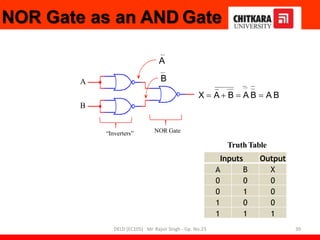
NOR Gate as an AND Gate
A
B
X  A  B  A B  A B
NOR Gate
“Inverters”
B
A
Truth Table
Inputs Output
A B X
0 0 0
0 1 0
1 0 0
1 1 1
39
DELD (EC105) Mr. Rajvir Singh - Gp. No.23
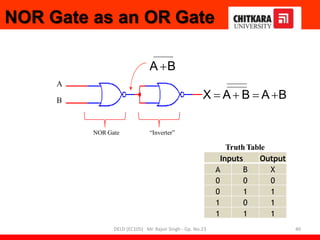
NOR Gate as an OR Gate
A
B
X  A B  AB
NOR Gate “Inverter”
A B
Truth Table
Inputs Output
A B X
0 0 0
0 1 1
1 0 1
1 1 1
40
DELD (EC105) Mr. Rajvir Singh - Gp. No.23
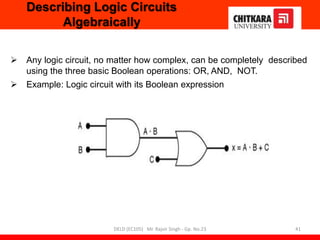
 Any logic circuit, no matter how complex, can be completely described
using the three basic Boolean operations: OR, AND, NOT.
 Example: Logic circuit with its Boolean expression
Describing Logic Circuits
Algebraically
41
DELD (EC105) Mr. Rajvir Singh - Gp. No.23
Example:
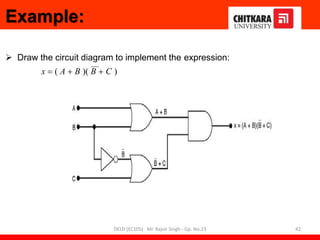
 Draw the circuit diagram to implement the expression:
x  ( A  B )( B  C )
42
DELD (EC105) Mr. Rajvir Singh - Gp. No.23
Activity 1:
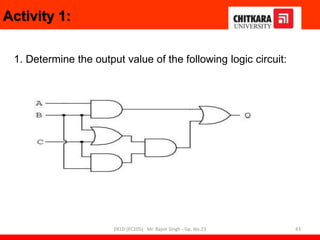
1. Determine the output value of the following logic circuit:
43
DELD (EC105) Mr. Rajvir Singh - Gp. No.23
44
1. Draw the circuit diagram to implement the expression:
X = (A.B)+C
Activity 2:
DELD (EC105) Mr. Rajvir Singh - Gp. No.23
Applications of Logic Gates
 NAND Gates are used in Burglar alarms and buzzers.
 They are basically used in circuits involving computation and
processing.
 They are also used in push button switches. E.g. Door Bell.
 They are used in the functioning of street lights.
 AND Gates are used to enable/inhibit the data transfer function.
45
DELD (EC105) Mr. Rajvir Singh - Gp. No.23
DELD (EC105) Mr. Rajvir Singh - Gp. No.23 46
Number systems
Number systems
System of numbers!
• Decimal Number System
• Binary number Systems
• Octal
• Hexadecimal
• Number conversion
DELD (EC105) Mr. Rajvir Singh - Gp. No.23 47
Number systems
DELD (EC105) Mr. Rajvir Singh - Gp. No.23 48
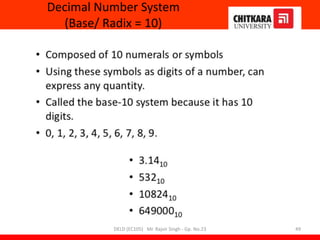
Decimal Number System
(Base/ Radix = 10)
DELD (EC105) Mr. Rajvir Singh - Gp. No.23 49
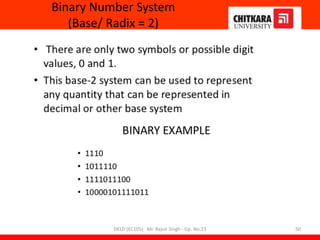
Binary Number System
(Base/ Radix = 2)
DELD (EC105) Mr. Rajvir Singh - Gp. No.23 50
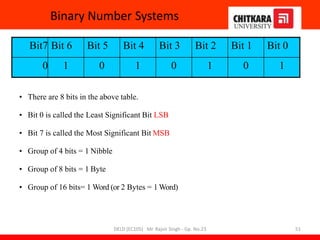
Binary Number Systems
Bit7 Bit 6 Bit 5 Bit 4 Bit 3 Bit 2 Bit 1 Bit 0
0 1 0 1 0 1 0 1
• There are 8 bits in the above table.
• Bit 0 is called the Least Significant Bit LSB
• Bit 7 is called the Most Significant Bit MSB
• Group of 4 bits = 1 Nibble
• Group of 8 bits = 1 Byte
• Group of 16 bits= 1 Word (or 2 Bytes = 1 Word)
DELD (EC105) Mr. Rajvir Singh - Gp. No.23 51
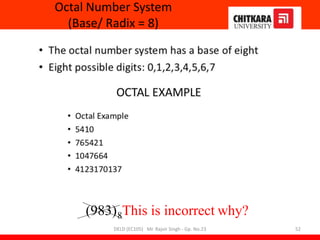
Octal Number System
(Base/ Radix = 8)
(983)8This is incorrect why?
DELD (EC105) Mr. Rajvir Singh - Gp. No.23 52
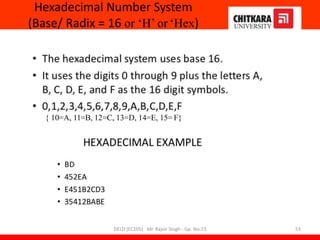
Hexadecimal Number System
(Base/ Radix = 16 or ‘H’ or ‘Hex)
DELD (EC105) Mr. Rajvir Singh - Gp. No.23 53
{ 10=A, 11=B, 12=C, 13=D, 14=E, 15= F}
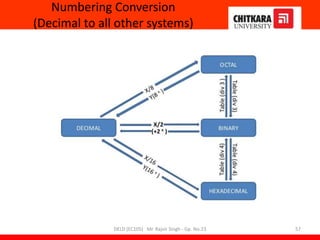
Numbering Conversion
DELD (EC105) Mr. Rajvir Singh - Gp. No.23 54
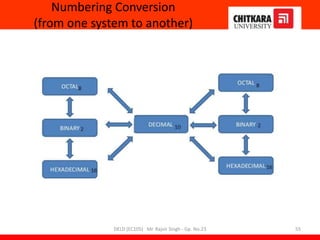
Numbering Conversion
(from one system to another)
DELD (EC105) Mr. Rajvir Singh - Gp. No.23 55
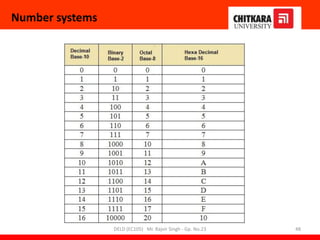
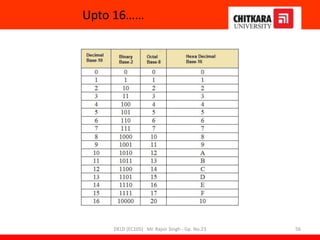
Upto 16……
DELD (EC105) Mr. Rajvir Singh - Gp. No.23 56
Numbering Conversion
(Decimal to all other systems)
DELD (EC105) Mr. Rajvir Singh - Gp. No.23 57
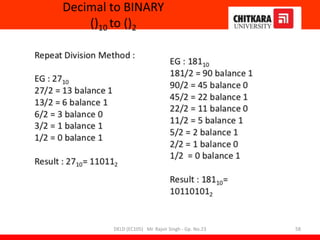
Decimal to BINARY
()10 to ()2
DELD (EC105) Mr. Rajvir Singh - Gp. No.23 58
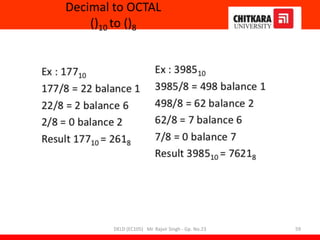
Decimal to OCTAL
()10 to ()8
DELD (EC105) Mr. Rajvir Singh - Gp. No.23 59
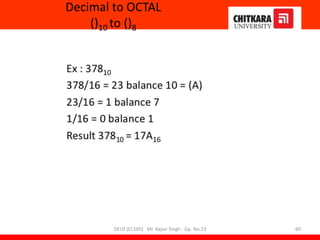
Decimal to OCTAL
()10 to ()8
DELD (EC105) Mr. Rajvir Singh - Gp. No.23 60
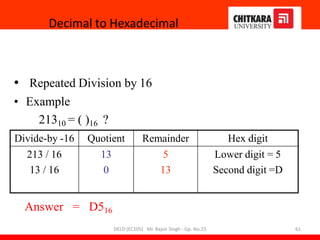
• Repeated Division by 16
• Example
21310 = ( )16 ?
Divide-by -16 Quotient Remainder Hex digit
213 / 16
13 / 16
13
0
5
13
Lower digit = 5
Second digit =D
Answer = D516
Decimal to Hexadecimal
DELD (EC105) Mr. Rajvir Singh - Gp. No.23 61
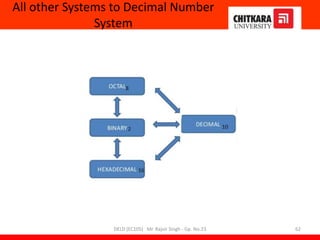
All other Systems to Decimal Number
System
DELD (EC105) Mr. Rajvir Singh - Gp. No.23 62
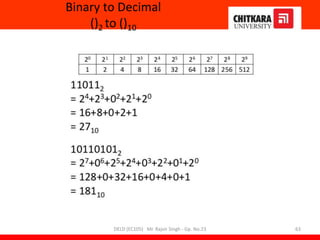
Binary to Decimal
()2 to ()10
DELD (EC105) Mr. Rajvir Singh - Gp. No.23 63
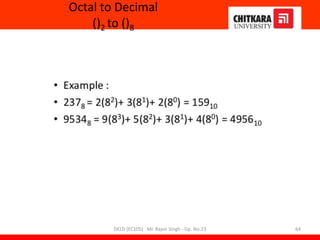
Octal to Decimal
()2 to ()8
DELD (EC105) Mr. Rajvir Singh - Gp. No.23 64
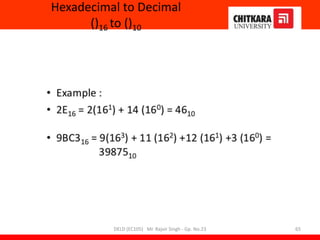
Hexadecimal to Decimal
()16 to ()10
DELD (EC105) Mr. Rajvir Singh - Gp. No.23 65
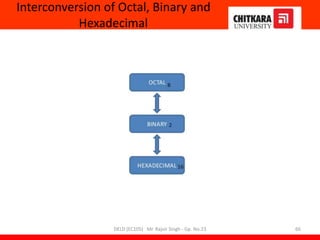
Interconversion of Octal, Binary and
Hexadecimal
DELD (EC105) Mr. Rajvir Singh - Gp. No.23 66
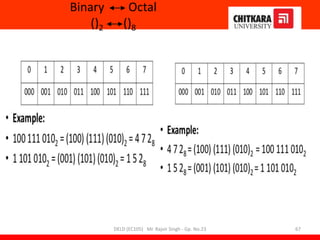
Binary Octal
()2 ()8
DELD (EC105) Mr. Rajvir Singh - Gp. No.23 67
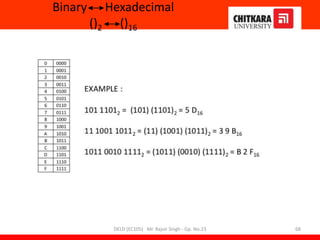
Binary Hexadecimal
()2 ()16
DELD (EC105) Mr. Rajvir Singh - Gp. No.23 68
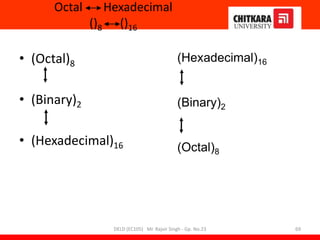
Octal Hexadecimal
()8 ()16
• (Octal)8
• (Binary)2
• (Hexadecimal)16
(Hexadecimal)16
(Binary)2
(Octal)8
DELD (EC105) Mr. Rajvir Singh - Gp. No.23 69
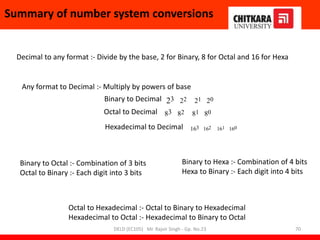
Decimal to any format :- Divide by the base, 2 for Binary, 8 for Octal and 16 for Hexa
Any format to Decimal :- Multiply by powers of base
Binary to Decimal 23 22 21 20
Octal to Decimal 83 82 81 80
Hexadecimal to Decimal 163 162 161 160
Binary to Octal :- Combination of 3 bits
Octal to Binary :- Each digit into 3 bits
Binary to Hexa :- Combination of 4 bits
Hexa to Binary :- Each digit into 4 bits
Octal to Hexadecimal :- Octal to Binary to Hexadecimal
Hexadecimal to Octal :- Hexadecimal to Binary to Octal
Summary of number system conversions
DELD (EC105) Mr. Rajvir Singh - Gp. No.23 70
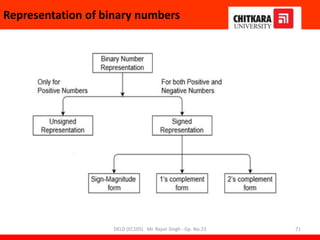
Representation of binary numbers
DELD (EC105) Mr. Rajvir Singh - Gp. No.23 71
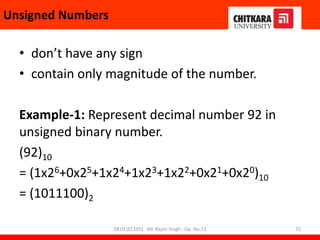
Unsigned Numbers
• don’t have any sign
• contain only magnitude of the number.
Example-1: Represent decimal number 92 in
unsigned binary number.
(92)10
= (1x26+0x25+1x24+1x23+1x22+0x21+0x20)10
= (1011100)2
DELD (EC105) Mr. Rajvir Singh - Gp. No.23 72
Unsigned Numbers
Example-2: Find range of 6 bit unsigned binary
numbers. Also, find minimum and maximum value in
this range.
Sol: Since, range of unsigned binary number is from 0
to (2n-1). Therefore, range of 6 bit unsigned binary
number is from 0 to (26-1) which is equal from
minimum value 0 (i.e., 000000) to maximum value 63
(i.e., 111111).
DELD (EC105) Mr. Rajvir Singh - Gp. No.23 73
Signed Numbers
• Unsigned representation can be used for positive
integers
• How about negative integers?
– Everything must be represented in binary numbers
– Computers cannot use – or + signs
DELD (EC105) Mr. Rajvir Singh - Gp. No.23 74
• contain sign flag
• contains both sign bit and magnitude of a
number
• this representation distinguish positive and
negative numbers
• For negative numbers the sign bit is always 1,
and for positive numbers it is 0 in these three
systems
Signed Numbers
DELD (EC105) Mr. Rajvir Singh - Gp. No.23 75
Representation of signed numbers
There are two ways of representing negative binary numbers:
1. Sign Magnitude form
2. Complement Method
- 1’s Complement form
- 2’s Complement form
• Advantage of using complement method for subtraction is
reduction in hardware.
• Instead of having separate circuits for addition and
subtraction, only addition circuits are needed.
DELD (EC105) Mr. Rajvir Singh - Gp. No.23 76
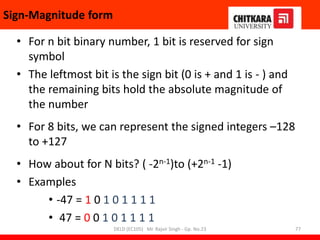
Sign-Magnitude form
• For n bit binary number, 1 bit is reserved for sign
symbol
• The leftmost bit is the sign bit (0 is + and 1 is - ) and
the remaining bits hold the absolute magnitude of
the number
• For 8 bits, we can represent the signed integers –128
to +127
• How about for N bits? ( -2n-1)to (+2n-1 -1)
• Examples
• -47 = 1 0 1 0 1 1 1 1
• 47 = 0 0 1 0 1 1 1 1
DELD (EC105) Mr. Rajvir Singh - Gp. No.23 77
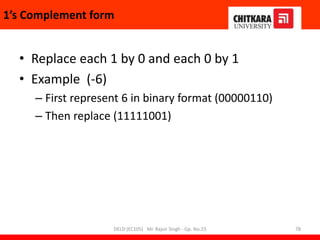
1’s Complement form
• Replace each 1 by 0 and each 0 by 1
• Example (-6)
– First represent 6 in binary format (00000110)
– Then replace (11111001)
DELD (EC105) Mr. Rajvir Singh - Gp. No.23 78
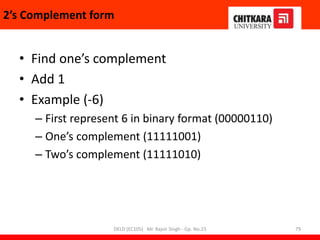
2’s Complement form
• Find one’s complement
• Add 1
• Example (-6)
– First represent 6 in binary format (00000110)
– One’s complement (11111001)
– Two’s complement (11111010)
DELD (EC105) Mr. Rajvir Singh - Gp. No.23 79
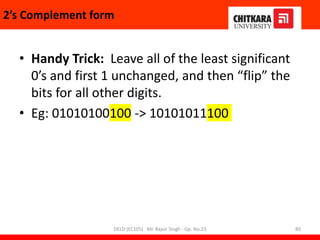
• Handy Trick: Leave all of the least significant
0’s and first 1 unchanged, and then “flip” the
bits for all other digits.
• Eg: 01010100100 -> 10101011100
2’s Complement form
DELD (EC105) Mr. Rajvir Singh - Gp. No.23 80
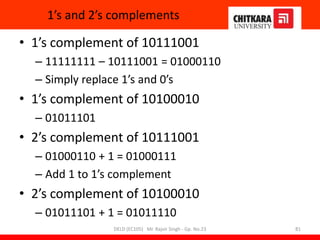
1’s and 2’s complements
• 1’s complement of 10111001
– 11111111 – 10111001 = 01000110
– Simply replace 1’s and 0’s
• 1’s complement of 10100010
– 01011101
• 2’s complement of 10111001
– 01000110 + 1 = 01000111
– Add 1 to 1’s complement
• 2’s complement of 10100010
– 01011101 + 1 = 01011110
DELD (EC105) Mr. Rajvir Singh - Gp. No.23 81
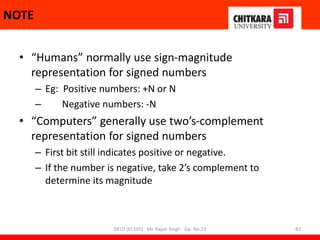
NOTE
• “Humans” normally use sign-magnitude
representation for signed numbers
– Eg: Positive numbers: +N or N
– Negative numbers: -N
• “Computers” generally use two’s-complement
representation for signed numbers
– First bit still indicates positive or negative.
– If the number is negative, take 2’s complement to
determine its magnitude
DELD (EC105) Mr. Rajvir Singh - Gp. No.23 82
Thank You
DELD (EC105) Mr. Rajvir Singh - Gp. No.23 83

1. Introduction to Digital Concepts.pptx

  • 1.
    Hello Students! Welcome toDELD class! DELD (EC105) Mr. Rajvir Singh - Gp. No.23 1
  • 2.
    • Course Name: Digital electronics & Logic Design (DELD) • Course Code : EC-105 • Session : July-Dec 2021-22 • Batch/Semester : 2020/3rd • Course Credits : 4 • Faculty : Mr. Rajvir Singh DELD (EC105) Mr. Rajvir Singh - Gp. No.23 2
  • 3.
    This course aimsto teach students the fundamentals of digital logic design. Starting from learning the basic concepts of the different base number systems, to basic logic elements and deriving logical expressions to further optimize a circuit diagram, this course teaches students everything they need to evaluate different combinational logic designs, as well as design their own digital circuits with different parameters. About the Course … DELD (EC105) Mr. Rajvir Singh - Gp. No.23 3
  • 4.
    Digital Electronics isa field of Electronics Engineering that involves the study of digital signals. A digital system, such as a laptop or PC, processes the digital signal. What is Digital Electronics? DELD (EC105) Mr. Rajvir Singh - Gp. No.23 4
  • 5.
    Logic design isthe basic organization of digital circuit. All digital circuits, also known as logic circuits, are based on a two valued logic system — 1 and 0, High and Low levels. Logic Diagram is a graphical representation of a logic circuit that shows the wiring and connections of each individual logic gate, represented by a specific graphical symbol, that implements the logic circuit. Logic Design and related terms DELD (EC105) Mr. Rajvir Singh - Gp. No.23 5
  • 6.
     Digital Electroniccircuits are relatively easy to design.  It has higher accuracy and capability to program.  Transmitted digital signals are not degraded over long distances.  Digital Signals can be stored easily.  Digital Electronics is comparatively more immune to 'error' and 'noise'. Advantages of Digital Electronics DELD (EC105) Mr. Rajvir Singh - Gp. No.23 6
  • 7.
    Several electronic itemsmake use of digital electronics. For example, laptops, TVs, remote controls, Mobile Phones, and other entertainment systems. Computers are one of the most complex examples and will make use of numerous and complex digital circuits. Importance of Digital Electronics DELD (EC105) Mr. Rajvir Singh - Gp. No.23 7
  • 8.
    Digital Electronics &Logic Design course is a comprehensive study of the principles and techniques of modern digital systems. Digital logic design is the foundation of computer and microcontroller-based systems deployed in Electronic communication and Biomedical equipments, automobiles, industrial control systems, etc. Future Scope and Applications DELD (EC105) Mr. Rajvir Singh - Gp. No.23 8
  • 9.
    At the completionof the course, the students should be able to: CO1: Understand the underlying differences between analog and digital systems, and interconversion between the two. CO2: Understand and apply mathematical techniques to solve digital design problems involving Boolean logic. CO3: Understand the underlying differences between combinational and sequential circuits. CO4: Understand and apply the design methods for implementing combinational and sequential circuits. CO5: Understand the concept of memories and Programmable Logic Devices and their classification. Course Outcomes DELD (EC105) Mr. Rajvir Singh - Gp. No.23 9
  • 10.
    SYLLABUS: • UNIT-1: Introductionto Digital Concepts • UNIT-2: Boolean algebra • UNIT3:Combinationalcircuit • UNIT-4:Sequential circuits • UNIT-5:Digital IC families • UNIT-6:D/A and A/D converters • Unit-7:Semiconductor Memories and PLDs DELD (EC105) Mr. Rajvir Singh - Gp. No.23 10
  • 11.
    Recommended Books B1: AnandKumar, Fundamentals of digital circuits, 2rd Edition, PHI. B2: Thomas L. Floyd, 10th Edition, Digital Fundamentals, Pearson Publications. B3: M. Morris Mano, Digital Design, 4.ed., Prentice Hall of India Pvt. Ltd., New Delhi, Sixth impression Pearson Education (Singapore) Pvt. Ltd., New Delhi. B4: Donald P. Leach and Albert Paul Malvino, Digital Principles and Applications, 5th Edition, Tata McGraw Hill Publishing Company Limited, New Delhi, 2003. DELD (EC105) Mr. Rajvir Singh - Gp. No.23 11
  • 12.
    UNIT 1: Introductionto Digital Concepts DELD (EC105) Mr. Rajvir Singh - Gp. No.23 12
  • 13.
    UNIT 1: Introductionto Digital Concepts • Introduction to Digital Concepts: – Digital and Analog systems, logic levels & Pulse waveform. • Logic Gates: – And Gate, OR Gate, Not gate, Universal Gates, Exclusive–OR gate, Exclusive-NOR gate • Number systems: – Decimal number system, Binary number system, Representation of signed numbers, Octal number system, Hexadecimal number system. DELD (EC105) Mr. Rajvir Singh - Gp. No.23 13
  • 14.
    Analog and DigitalSignals Analog Signal Digital Signal • Continuous • Infinite range of values • Represented by sine wave • Discrete • Finite range of values (2) • Represented by square wave DELD (EC105) Mr. Rajvir Singh - Gp. No.23 14 •Example: The output voltage from an audio amplifier might be any one of the infinite values between -10V and +10V at any particular instant of time. •Other examples: Radio frequency transmitter and receivers, power supplies etc. •Digital circuits are often called switching circuits because the voltage levels in a digital circuit are assumed to be switched from one value to another instantaneously. •Eg: Digital thermometer On- off switch
  • 15.
    Logic Levels Digital systemsuse the binary number system. • Two binary digits 0 and 1 are represented by two different voltage levels, LOW and HIGH. • Normally, 0 → 0V 1→ +5V There are 2 types of logic systems: • Positive logic system: 1 →+5V (HIGH) 0 →0V (LOW) • Negative Logic System: 0 → +5V (HIGH) 1 → 0V (LOW) DELD (EC105) Mr. Rajvir Singh - Gp. No.23 15
  • 16.
    Pulse Waveforms A pulsehas two edges: • Leading edge :- For positive pulse: Positive going transition (Rising edge) For negative pulse: Negative going transition (Falling edge) • Trailing edge:- For positive pulse: Negative going transition (Falling edge) For negative pulse: Positive going transition (Rising edge) Leading edge Trailing edge Trailing edge Leading edge DELD (EC105) Mr. Rajvir Singh - Gp. No.23 16
  • 17.
    Binary Signals • Itmeans two-states – 1 and 0 – true and false – on and off • A single “on/off”, “true/false”, “1/0” is called a bit • Example: Toggle switch DELD (EC105) Mr. Rajvir Singh - Gp. No.23 17 • Computers makes use of binary signals as these signals can be represented with a transistor that is relatively easy to fabricate (in silicon) Millions of them can be put in a tiny chip
  • 18.
    DELD (EC105) Mr.Rajvir Singh - Gp. No.23 18 Logic Gates
  • 19.
    Logic Gates  Logicgates are the building blocks used to create digital circuits.  It is an electronic circuit that performs logical operations on one or more logical inputs to produce a single logical output.  Types of Logic Gates: . 19 DELD (EC105) Mr. Rajvir Singh - Gp. No.23
  • 20.
    There are fourdifferent, but equally powerful, notational methods for describing the behaviour of gates and circuits  Definition  Symbol  Boolean expression  Logic diagrams  Truth tables  Timing Diagram  Boolean expression: It is a mathematical equation showing the relationship between the input and the output variables. Eg: Y= A+B  Logic diagram: a graphical representation of a circuit representing a particular function.. – Each type of gate is represented by a specific graphical symbol.  Truth table: defines the function of a gate by listing all possible input combinations that the gate could encounter, and the corresponding output.  Timing diagram: A digital timing diagram is a representation of set of signals in the time domain as waveforms. Notational methods for describing the behaviour of gates and circuits 20 DELD (EC105) Mr. Rajvir Singh - Gp. No.23
  • 21.
    AND Gate( Multiplicationfunction)  It is a digital electronic circuit which has 2 or more inputs and a single output where the output of AND gate is high when all inputs are high, otherwise the output will be low.  The expression X=A.B is read as “X equals A AND B.” Timing Diagram 21 DELD (EC105) Mr. Rajvir Singh - Gp. No.23
  • 22.
     What isthe only input combination that will produce a HIGH at the output of a five-input AND gate? – all 5 inputs = 1  What logic level should be applied to the second input of a two-input AND gate if the logic signal at the first input is to be inhibited(prevented) from reaching the output? – A LOW input will keep the output LOW 22 DELD (EC105) Mr. Rajvir Singh - Gp. No.23 Review Questions:
  • 23.
    OR Gate (LogicalAddition Function)  It is a digital electronic circuit which has 2 or more inputs and a single output where the output of OR gate is Low when all inputs are low, else output will be high.  The expression X=A+B is read as “X equals A OR B” Timing Diagram 23 DELD (EC105) Mr. Rajvir Singh - Gp. No.23
  • 24.
    Review Questions:  Whatis the only set of input conditions that will produce a LOW output for any OR gate? – all inputs LOW  Write the Boolean expression for a six-input OR gate – X=A+B+C+D+E+F  If the A input in previous example is permanently kept at the 1 level, what will the resultant output waveform be? – constant HIGH 24 DELD (EC105) Mr. Rajvir Singh - Gp. No.23
  • 25.
    Not Gate (Inverter) The inverter (NOT circuit) performs the operation called inversion or complementation.  The NOT operation changes one logic level to the opposite logical level. When the input is Low, the output is high. When the input is high, the output is low. Timing Diagram 25 DELD (EC105) Mr. Rajvir Singh - Gp. No.23
  • 26.
    NAND Gate  NANDgate is of the popular logic circuit because it can be used as a universal gate; that is NAND gate can be used in combination to perform the AND, OR, and inverter operations.  It is constructed by attaching NOT Gate at the output of AND Gate, hence NAND Gate is called NOT- AND Gate.  The output of NAND gate is low when all inputs are high, else output is high. Timing Diagram 26 DELD (EC105) Mr. Rajvir Singh - Gp. No.23
  • 27.
    NOR Gate  NORgate is also useful logical element because it can also be used as a universal gate.  It can be used in combination to perform the AND, OR and Inverter operations.  NOR Gate is the combination of NOT gate at the output of OR gate, hence NOR gate is type of NOT-OR gate.  The Output of NOR gate is high when all inputs are low otherwise the output is low. Timing Diagram 27 DELD (EC105) Mr. Rajvir Singh - Gp. No.23
  • 28.
    Exclusive- OR Gate Exclusive-OR gate is a logical operation that outputs true only when inputs differ (one is true, the other is false).  If both inputs are Low or both are High then it produces the output Low or 0, otherwise it produces the High output.  The exclusive-OR gate has a graphical symbol similar to that of the OR gate, except for the additional curved line on the input side. 28 DELD (EC105) Mr. Rajvir Singh - Gp. No.23
  • 29.
    Exclusive-NOR Gate  Theexclusive-NOR gate is the complement of the exclusive-OR gate, as indicated by small circle on the output side of the graphic symbol.  If both inputs are Low or both are High then it produces the output High or 1, otherwise it produces the Low output. 29 DELD (EC105) Mr. Rajvir Singh - Gp. No.23
  • 30.
    De Morgan’s Theorems Theorem 1: A.B = A+B  Theorem 2: A+B = A.B  De Morgan’s Theorem is very useful in digital circuit design  It allows ANDs to be exchanged with ORs by using invertors  De Morgan’s Theorem can be extended to any number of variables Remember: “Break the bar, change the operator” 30 DELD (EC105) Mr. Rajvir Singh - Gp. No.23
  • 31.
    Implications of DeMorgan’s Theorems (X+Y) = X•Y  A NOR gate is equivalent to an AND gate with inverted inputs X Y Z 0 0 1 0 1 0 1 0 0 1 1 0 (X•Y) = X+Y  A NAND gate is equivalent to an OR gate with inverted inputs X Y Z 0 0 1 0 1 1 1 0 1 1 1 0 31 DELD (EC105) Mr. Rajvir Singh - Gp. No.23
  • 32.
    DELD (EC105) Mr.Rajvir Singh - Gp. No.23 32 Universal Gates
  • 33.
    NAND Gate as Universal Gate 33 DELD(EC105) Mr. Rajvir Singh - Gp. No.23
  • 34.
    NAND Gate asa NOT Gate A X A. A = A Input Output A X 0 1 1 0 Truth Table 34 DELD (EC105) Mr. Rajvir Singh - Gp. No.23
  • 35.
    NAND Gate asan AND Gate A B X  A B  AB NAND Gate Inverter AB Inputs Output A B X 0 0 0 0 1 0 1 0 0 1 1 1 Truth Table 35 DELD (EC105) Mr. Rajvir Singh - Gp. No.23
  • 36.
    NAND Gate asan OR Gate A B X  A B  A  B  A B NAND Gate Inverters B A Inputs Output A B X 0 0 0 0 1 1 1 0 1 1 1 1 Truth Table 36 DELD (EC105) Mr. Rajvir Singh - Gp. No.23
  • 37.
    NOR Gate As Universal Gate 37 DELD(EC105) Mr. Rajvir Singh - Gp. No.23
  • 38.
    NOR Gate asa NOT Gate A X A A A A (Before Bubble) Truth Table Inputs Output A X 0 1 1 0 38 DELD (EC105) Mr. Rajvir Singh - Gp. No.23
  • 39.
    NOR Gate asan AND Gate A B X  A  B  A B  A B NOR Gate “Inverters” B A Truth Table Inputs Output A B X 0 0 0 0 1 0 1 0 0 1 1 1 39 DELD (EC105) Mr. Rajvir Singh - Gp. No.23
  • 40.
    NOR Gate asan OR Gate A B X  A B  AB NOR Gate “Inverter” A B Truth Table Inputs Output A B X 0 0 0 0 1 1 1 0 1 1 1 1 40 DELD (EC105) Mr. Rajvir Singh - Gp. No.23
  • 41.
     Any logiccircuit, no matter how complex, can be completely described using the three basic Boolean operations: OR, AND, NOT.  Example: Logic circuit with its Boolean expression Describing Logic Circuits Algebraically 41 DELD (EC105) Mr. Rajvir Singh - Gp. No.23
  • 42.
    Example:  Draw thecircuit diagram to implement the expression: x  ( A  B )( B  C ) 42 DELD (EC105) Mr. Rajvir Singh - Gp. No.23
  • 43.
    Activity 1: 1. Determinethe output value of the following logic circuit: 43 DELD (EC105) Mr. Rajvir Singh - Gp. No.23
  • 44.
    44 1. Draw thecircuit diagram to implement the expression: X = (A.B)+C Activity 2: DELD (EC105) Mr. Rajvir Singh - Gp. No.23
  • 45.
    Applications of LogicGates  NAND Gates are used in Burglar alarms and buzzers.  They are basically used in circuits involving computation and processing.  They are also used in push button switches. E.g. Door Bell.  They are used in the functioning of street lights.  AND Gates are used to enable/inhibit the data transfer function. 45 DELD (EC105) Mr. Rajvir Singh - Gp. No.23
  • 46.
    DELD (EC105) Mr.Rajvir Singh - Gp. No.23 46 Number systems
  • 47.
    Number systems System ofnumbers! • Decimal Number System • Binary number Systems • Octal • Hexadecimal • Number conversion DELD (EC105) Mr. Rajvir Singh - Gp. No.23 47
  • 48.
    Number systems DELD (EC105)Mr. Rajvir Singh - Gp. No.23 48
  • 49.
    Decimal Number System (Base/Radix = 10) DELD (EC105) Mr. Rajvir Singh - Gp. No.23 49
  • 50.
    Binary Number System (Base/Radix = 2) DELD (EC105) Mr. Rajvir Singh - Gp. No.23 50
  • 51.
    Binary Number Systems Bit7Bit 6 Bit 5 Bit 4 Bit 3 Bit 2 Bit 1 Bit 0 0 1 0 1 0 1 0 1 • There are 8 bits in the above table. • Bit 0 is called the Least Significant Bit LSB • Bit 7 is called the Most Significant Bit MSB • Group of 4 bits = 1 Nibble • Group of 8 bits = 1 Byte • Group of 16 bits= 1 Word (or 2 Bytes = 1 Word) DELD (EC105) Mr. Rajvir Singh - Gp. No.23 51
  • 52.
    Octal Number System (Base/Radix = 8) (983)8This is incorrect why? DELD (EC105) Mr. Rajvir Singh - Gp. No.23 52
  • 53.
    Hexadecimal Number System (Base/Radix = 16 or ‘H’ or ‘Hex) DELD (EC105) Mr. Rajvir Singh - Gp. No.23 53 { 10=A, 11=B, 12=C, 13=D, 14=E, 15= F}
  • 54.
    Numbering Conversion DELD (EC105)Mr. Rajvir Singh - Gp. No.23 54
  • 55.
    Numbering Conversion (from onesystem to another) DELD (EC105) Mr. Rajvir Singh - Gp. No.23 55
  • 56.
    Upto 16…… DELD (EC105)Mr. Rajvir Singh - Gp. No.23 56
  • 57.
    Numbering Conversion (Decimal toall other systems) DELD (EC105) Mr. Rajvir Singh - Gp. No.23 57
  • 58.
    Decimal to BINARY ()10to ()2 DELD (EC105) Mr. Rajvir Singh - Gp. No.23 58
  • 59.
    Decimal to OCTAL ()10to ()8 DELD (EC105) Mr. Rajvir Singh - Gp. No.23 59
  • 60.
    Decimal to OCTAL ()10to ()8 DELD (EC105) Mr. Rajvir Singh - Gp. No.23 60
  • 61.
    • Repeated Divisionby 16 • Example 21310 = ( )16 ? Divide-by -16 Quotient Remainder Hex digit 213 / 16 13 / 16 13 0 5 13 Lower digit = 5 Second digit =D Answer = D516 Decimal to Hexadecimal DELD (EC105) Mr. Rajvir Singh - Gp. No.23 61
  • 62.
    All other Systemsto Decimal Number System DELD (EC105) Mr. Rajvir Singh - Gp. No.23 62
  • 63.
    Binary to Decimal ()2to ()10 DELD (EC105) Mr. Rajvir Singh - Gp. No.23 63
  • 64.
    Octal to Decimal ()2to ()8 DELD (EC105) Mr. Rajvir Singh - Gp. No.23 64
  • 65.
    Hexadecimal to Decimal ()16to ()10 DELD (EC105) Mr. Rajvir Singh - Gp. No.23 65
  • 66.
    Interconversion of Octal,Binary and Hexadecimal DELD (EC105) Mr. Rajvir Singh - Gp. No.23 66
  • 67.
    Binary Octal ()2 ()8 DELD(EC105) Mr. Rajvir Singh - Gp. No.23 67
  • 68.
    Binary Hexadecimal ()2 ()16 DELD(EC105) Mr. Rajvir Singh - Gp. No.23 68
  • 69.
    Octal Hexadecimal ()8 ()16 •(Octal)8 • (Binary)2 • (Hexadecimal)16 (Hexadecimal)16 (Binary)2 (Octal)8 DELD (EC105) Mr. Rajvir Singh - Gp. No.23 69
  • 70.
    Decimal to anyformat :- Divide by the base, 2 for Binary, 8 for Octal and 16 for Hexa Any format to Decimal :- Multiply by powers of base Binary to Decimal 23 22 21 20 Octal to Decimal 83 82 81 80 Hexadecimal to Decimal 163 162 161 160 Binary to Octal :- Combination of 3 bits Octal to Binary :- Each digit into 3 bits Binary to Hexa :- Combination of 4 bits Hexa to Binary :- Each digit into 4 bits Octal to Hexadecimal :- Octal to Binary to Hexadecimal Hexadecimal to Octal :- Hexadecimal to Binary to Octal Summary of number system conversions DELD (EC105) Mr. Rajvir Singh - Gp. No.23 70
  • 71.
    Representation of binarynumbers DELD (EC105) Mr. Rajvir Singh - Gp. No.23 71
  • 72.
    Unsigned Numbers • don’thave any sign • contain only magnitude of the number. Example-1: Represent decimal number 92 in unsigned binary number. (92)10 = (1x26+0x25+1x24+1x23+1x22+0x21+0x20)10 = (1011100)2 DELD (EC105) Mr. Rajvir Singh - Gp. No.23 72
  • 73.
    Unsigned Numbers Example-2: Findrange of 6 bit unsigned binary numbers. Also, find minimum and maximum value in this range. Sol: Since, range of unsigned binary number is from 0 to (2n-1). Therefore, range of 6 bit unsigned binary number is from 0 to (26-1) which is equal from minimum value 0 (i.e., 000000) to maximum value 63 (i.e., 111111). DELD (EC105) Mr. Rajvir Singh - Gp. No.23 73
  • 74.
    Signed Numbers • Unsignedrepresentation can be used for positive integers • How about negative integers? – Everything must be represented in binary numbers – Computers cannot use – or + signs DELD (EC105) Mr. Rajvir Singh - Gp. No.23 74
  • 75.
    • contain signflag • contains both sign bit and magnitude of a number • this representation distinguish positive and negative numbers • For negative numbers the sign bit is always 1, and for positive numbers it is 0 in these three systems Signed Numbers DELD (EC105) Mr. Rajvir Singh - Gp. No.23 75
  • 76.
    Representation of signednumbers There are two ways of representing negative binary numbers: 1. Sign Magnitude form 2. Complement Method - 1’s Complement form - 2’s Complement form • Advantage of using complement method for subtraction is reduction in hardware. • Instead of having separate circuits for addition and subtraction, only addition circuits are needed. DELD (EC105) Mr. Rajvir Singh - Gp. No.23 76
  • 77.
    Sign-Magnitude form • Forn bit binary number, 1 bit is reserved for sign symbol • The leftmost bit is the sign bit (0 is + and 1 is - ) and the remaining bits hold the absolute magnitude of the number • For 8 bits, we can represent the signed integers –128 to +127 • How about for N bits? ( -2n-1)to (+2n-1 -1) • Examples • -47 = 1 0 1 0 1 1 1 1 • 47 = 0 0 1 0 1 1 1 1 DELD (EC105) Mr. Rajvir Singh - Gp. No.23 77
  • 78.
    1’s Complement form •Replace each 1 by 0 and each 0 by 1 • Example (-6) – First represent 6 in binary format (00000110) – Then replace (11111001) DELD (EC105) Mr. Rajvir Singh - Gp. No.23 78
  • 79.
    2’s Complement form •Find one’s complement • Add 1 • Example (-6) – First represent 6 in binary format (00000110) – One’s complement (11111001) – Two’s complement (11111010) DELD (EC105) Mr. Rajvir Singh - Gp. No.23 79
  • 80.
    • Handy Trick:Leave all of the least significant 0’s and first 1 unchanged, and then “flip” the bits for all other digits. • Eg: 01010100100 -> 10101011100 2’s Complement form DELD (EC105) Mr. Rajvir Singh - Gp. No.23 80
  • 81.
    1’s and 2’scomplements • 1’s complement of 10111001 – 11111111 – 10111001 = 01000110 – Simply replace 1’s and 0’s • 1’s complement of 10100010 – 01011101 • 2’s complement of 10111001 – 01000110 + 1 = 01000111 – Add 1 to 1’s complement • 2’s complement of 10100010 – 01011101 + 1 = 01011110 DELD (EC105) Mr. Rajvir Singh - Gp. No.23 81
  • 82.
    NOTE • “Humans” normallyuse sign-magnitude representation for signed numbers – Eg: Positive numbers: +N or N – Negative numbers: -N • “Computers” generally use two’s-complement representation for signed numbers – First bit still indicates positive or negative. – If the number is negative, take 2’s complement to determine its magnitude DELD (EC105) Mr. Rajvir Singh - Gp. No.23 82
  • 83.
    Thank You DELD (EC105)Mr. Rajvir Singh - Gp. No.23 83