MATHEMATICS ASSIGNMENT
BY,
ARAVINDA A KUMAR
RVCE22MCA057
ABHISHEK G
RVCE22MCA110
TOPIC
DIGITALELECTRONICS
Introduction to Digital Electronics
Digital electronics is a branch of electronics which deals with digital format of data and codes.
Digital stand for digit, digital electronics basically has two conditions which are possible, 0 (low logic) and 1 (high logic).
Digital electronic systems use a digital signal that are composed of mathematical features to work.
"1" as true and "0" as false are called bit and the group of bits are named byte.
Digital electronic circuits are usually made from large assemblies of logic gates.
Digital describes electronic technology that generates, stores, and processes data in terms of two states: 1 and number 0.
A modem is used to convert the digital information in your computer to analog signals for your device and to convert analog
signals to digital information for your computer.
3
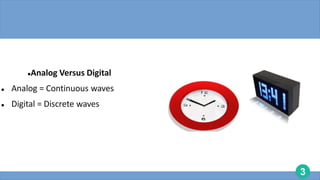
Analog Versus Digital
 Analog = Continuous waves
 Digital = Discrete waves
4
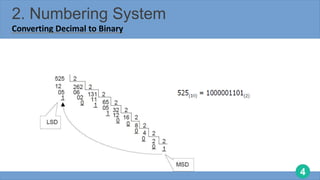
2. Numbering System
Converting Decimal to Binary
5
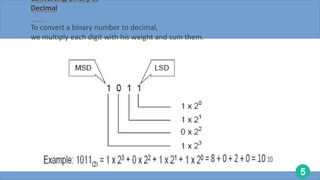
Converting Binary to
Decimal
To convert a binary number to decimal,
we multiply each digit with his weight and sum them.
6
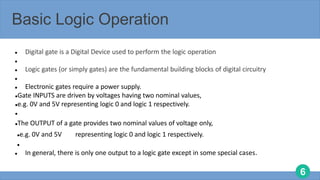
Basic Logic Operation
 Digital gate is a Digital Device used to perform the logic operation

 Logic gates (or simply gates) are the fundamental building blocks of digital circuitry

 Electronic gates require a power supply.
Gate INPUTS are driven by voltages having two nominal values,
e.g. 0V and 5V representing logic 0 and logic 1 respectively.

The OUTPUT of a gate provides two nominal values of voltage only,
e.g. 0V and 5V representing logic 0 and logic 1 respectively.

 In general, there is only one output to a logic gate except in some special cases.
7
Truth
Table
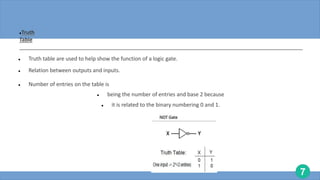
 Truth table are used to help show the function of a logic gate.
 Relation between outputs and inputs.
 Number of entries on the table is
 being the number of entries and base 2 because
 it is related to the binary numbering 0 and 1.

8
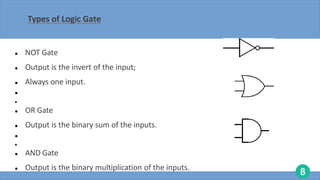
Types of Logic Gate
 NOT Gate
 Output is the invert of the input;
 Always one input.


 OR Gate
 Output is the binary sum of the inputs.


 AND Gate
 Output is the binary multiplication of the inputs.
9
OR
Gate

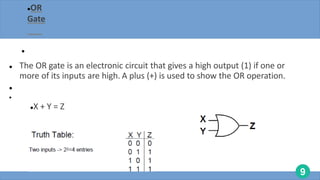
 The OR gate is an electronic circuit that gives a high output (1) if one or
more of its inputs are high. A plus (+) is used to show the OR operation.


X + Y = Z
10
AND
Gate
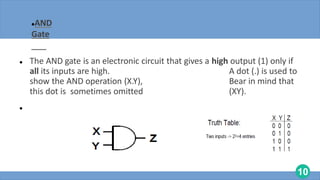
 The AND gate is an electronic circuit that gives a high output (1) only if
all its inputs are high. A dot (.) is used to
show the AND operation (X.Y), Bear in mind that
this dot is sometimes omitted (XY).

11
NOR Gate
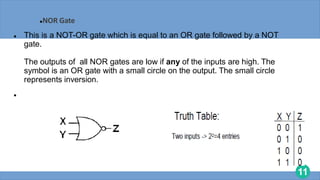
 This is a NOT-OR gate which is equal to an OR gate followed by a NOT
gate.
The outputs of all NOR gates are low if any of the inputs are high. The
symbol is an OR gate with a small circle on the output. The small circle
represents inversion.

12
NAND Gate
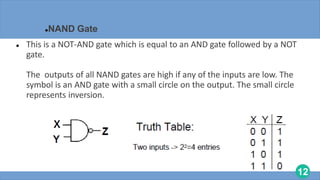
 This is a NOT-AND gate which is equal to an AND gate followed by a NOT
gate.
The outputs of all NAND gates are high if any of the inputs are low. The
symbol is an AND gate with a small circle on the output. The small circle
represents inversion.
13
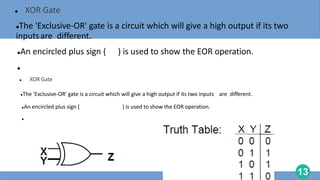
 XOR Gate
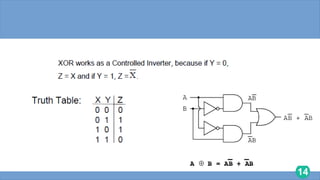
The 'Exclusive-OR' gate is a circuit which will give a high output if its two inputs are different.
An encircled plus sign ( ) is used to show the EOR operation.

 XOR Gate
The 'Exclusive-OR' gate is a circuit which will give a high output if its two
inputsare different.
An encircled plus sign ( ) is used to show the EOR operation.

14
15
16
17
Complex
Operations
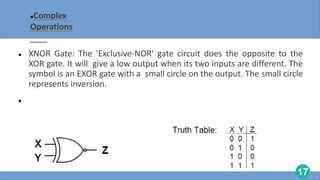
 XNOR Gate: The 'Exclusive-NOR' gate circuit does the opposite to the
XOR gate. It will give a low output when its two inputs are different. The
symbol is an EXOR gate with a small circle on the output. The small circle
represents inversion.

18
19
20

assignment_mathematics.pptx

  • 1.
    MATHEMATICS ASSIGNMENT BY, ARAVINDA AKUMAR RVCE22MCA057 ABHISHEK G RVCE22MCA110
  • 2.
    TOPIC DIGITALELECTRONICS Introduction to DigitalElectronics Digital electronics is a branch of electronics which deals with digital format of data and codes. Digital stand for digit, digital electronics basically has two conditions which are possible, 0 (low logic) and 1 (high logic). Digital electronic systems use a digital signal that are composed of mathematical features to work. "1" as true and "0" as false are called bit and the group of bits are named byte. Digital electronic circuits are usually made from large assemblies of logic gates. Digital describes electronic technology that generates, stores, and processes data in terms of two states: 1 and number 0. A modem is used to convert the digital information in your computer to analog signals for your device and to convert analog signals to digital information for your computer.
  • 3.
    3 Analog Versus Digital Analog = Continuous waves  Digital = Discrete waves
  • 4.
  • 5.
    5 Converting Binary to Decimal Toconvert a binary number to decimal, we multiply each digit with his weight and sum them.
  • 6.
    6 Basic Logic Operation Digital gate is a Digital Device used to perform the logic operation   Logic gates (or simply gates) are the fundamental building blocks of digital circuitry   Electronic gates require a power supply. Gate INPUTS are driven by voltages having two nominal values, e.g. 0V and 5V representing logic 0 and logic 1 respectively.  The OUTPUT of a gate provides two nominal values of voltage only, e.g. 0V and 5V representing logic 0 and logic 1 respectively.   In general, there is only one output to a logic gate except in some special cases.
  • 7.
    7 Truth Table  Truth tableare used to help show the function of a logic gate.  Relation between outputs and inputs.  Number of entries on the table is  being the number of entries and base 2 because  it is related to the binary numbering 0 and 1. 
  • 8.
    8 Types of LogicGate  NOT Gate  Output is the invert of the input;  Always one input.    OR Gate  Output is the binary sum of the inputs.    AND Gate  Output is the binary multiplication of the inputs.
  • 9.
    9 OR Gate   The ORgate is an electronic circuit that gives a high output (1) if one or more of its inputs are high. A plus (+) is used to show the OR operation.   X + Y = Z
  • 10.
    10 AND Gate  The ANDgate is an electronic circuit that gives a high output (1) only if all its inputs are high. A dot (.) is used to show the AND operation (X.Y), Bear in mind that this dot is sometimes omitted (XY). 
  • 11.
    11 NOR Gate  Thisis a NOT-OR gate which is equal to an OR gate followed by a NOT gate. The outputs of all NOR gates are low if any of the inputs are high. The symbol is an OR gate with a small circle on the output. The small circle represents inversion. 
  • 12.
    12 NAND Gate  Thisis a NOT-AND gate which is equal to an AND gate followed by a NOT gate. The outputs of all NAND gates are high if any of the inputs are low. The symbol is an AND gate with a small circle on the output. The small circle represents inversion.
  • 13.
    13  XOR Gate The'Exclusive-OR' gate is a circuit which will give a high output if its two inputs are different. An encircled plus sign ( ) is used to show the EOR operation.   XOR Gate The 'Exclusive-OR' gate is a circuit which will give a high output if its two inputsare different. An encircled plus sign ( ) is used to show the EOR operation. 
  • 14.
  • 15.
  • 16.
  • 17.
    17 Complex Operations  XNOR Gate:The 'Exclusive-NOR' gate circuit does the opposite to the XOR gate. It will give a low output when its two inputs are different. The symbol is an EXOR gate with a small circle on the output. The small circle represents inversion. 
  • 18.
  • 19.
  • 20.