Logistics Management
Introduction to the Course
Jing Yuan
Feb, 2012
Introduce Yourself
Let’s me know who you are.
What’s logistics management?
Supply chain management Vs. logistics
management
…
Outline
Introduce yourself
Who I am
Course introduction
– Course description
– Learning objectives
– Textbooks
– Grading policy
– Schedules
Outline
Introduce yourself
Who I am
Course introduction
– Course description
– Learning objectives
– Textbooks
– Grading policy
– Schedule
Course description
An introductory course in the analysis,
design and operation of logistics and
supply chain
Presented through lectures along with
several case studies and experiments
The lectures consist of nine parts
Learning objectives
Knowledge the strategic role of the supply
chain
An understanding of logistic systems &
their management problems
Ability to devise workable solutions in
business situations
Textbooks
Textbook
– Harrison, A. and Hoek, R. V. (2010) Logistics
Management and Strategy, third edition, 中国
人民大学出版社
References (not required)
– Christopher, M. (2006) Logistics and Supply
Chain Management: Creating Value-adding
Network, third edition, 电子工业出版社
– 张余华,现代物流管理,清华大学出版
社, 2010 年。
Lecture Organization
Lecturing
Videos
Group exercises
Case discussion
Case study presentations
Grading Policy
Grading
– Assignment and Quiz 10%
– Midterm 20%
– Final Project 70%
Midterm
– Case study
– Final presentation
Final project
– A closed examination held in the last week of term
Schedule
Lectures
– 14 weeks
Case study presentations
– 2 weeks
Experiments
– 2 weeks
Logistics and supply chain
Logistics Management
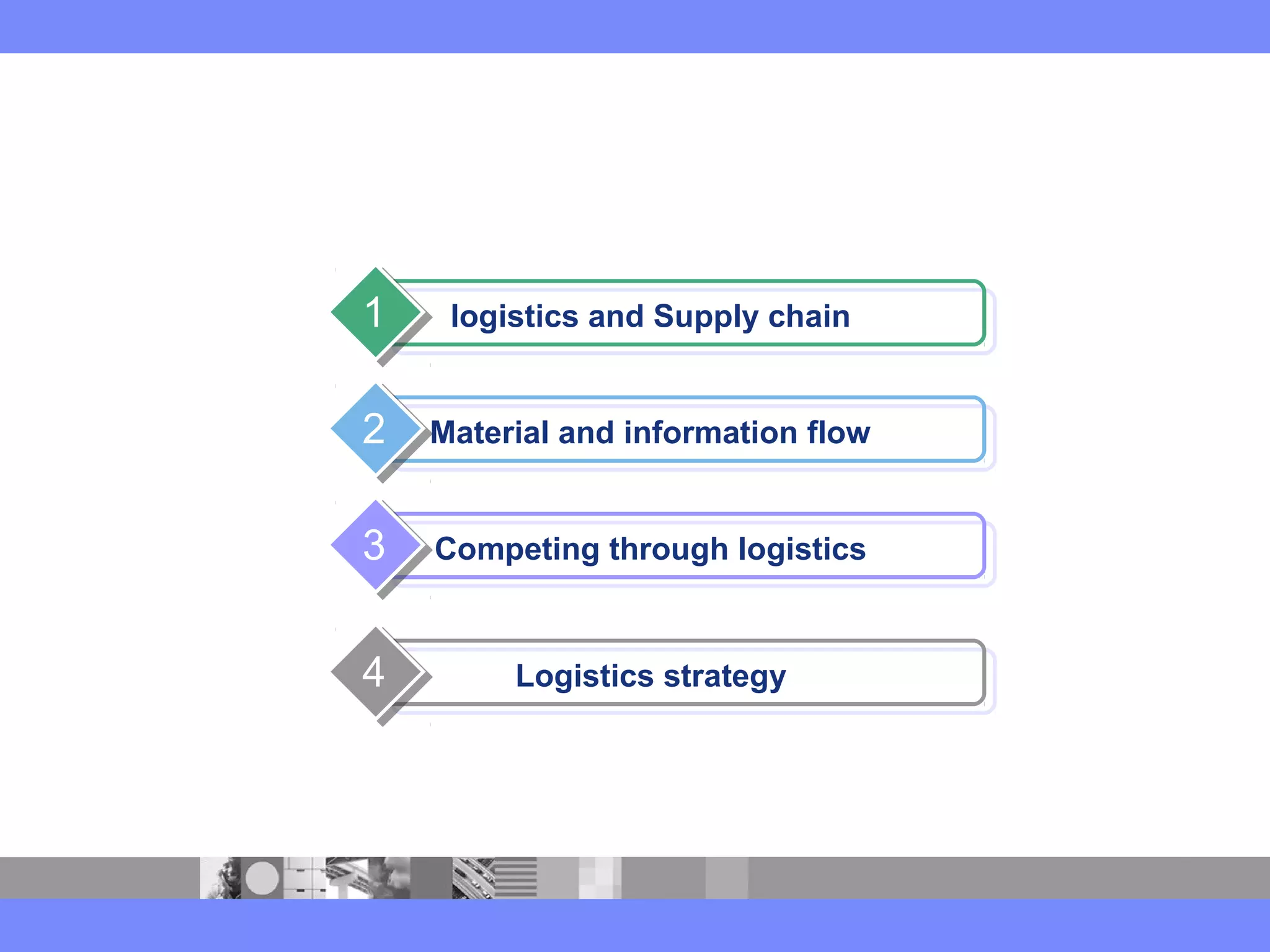
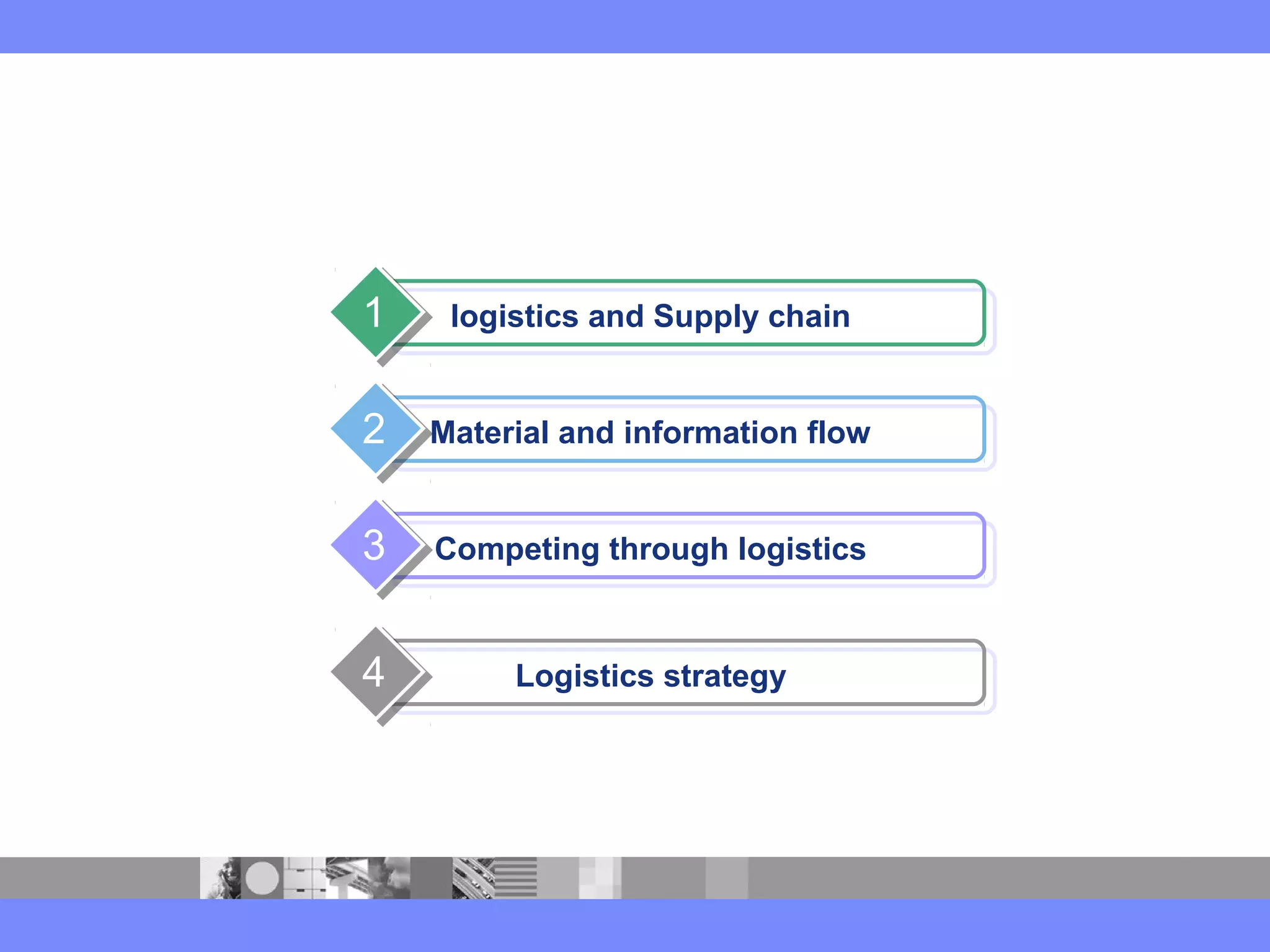
logistics and Supply chain1
Material and information flow2
Competing through logistics3
Logistics strategy4
Seven-eleven convenience store
– Describe the key logistics processes at 7-11.
– What differences between the early reform
and the regional distribution center at 7-11.
– What do you think are the main logistics
challenges in running the 7-11 operation.
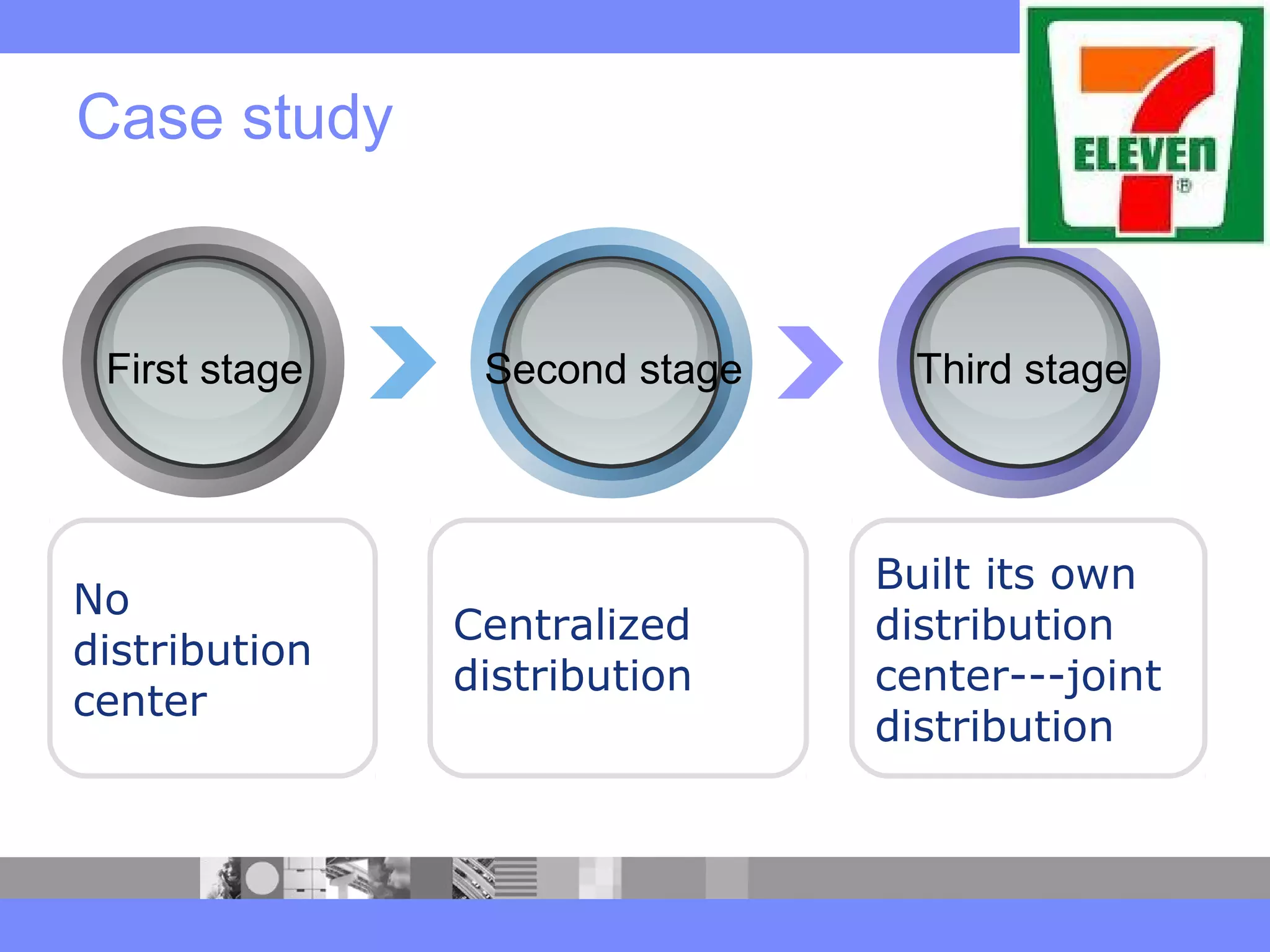
Case study
Case study
Centralized
distribution
No
distribution
center
Built its own
distribution
center---joint
distribution
First stage Second stage Third stage
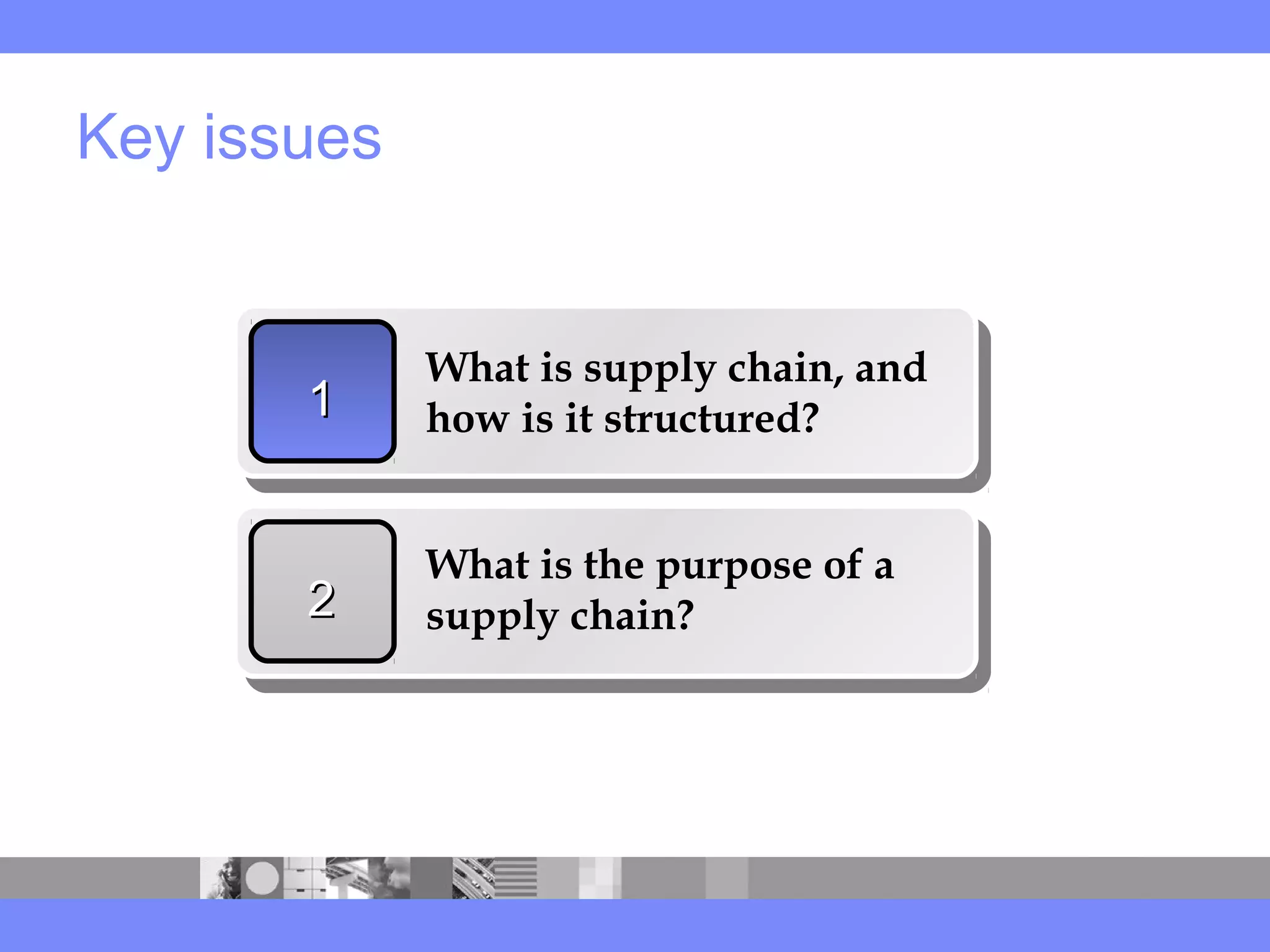
Key issues
11
What is supply chain, and
how is it structured?
22
What is the purpose of a
supply chain?
The Supply Chain Concept
Development of the Concept
– Total systems cost - remains an important
element of logistics analysis.
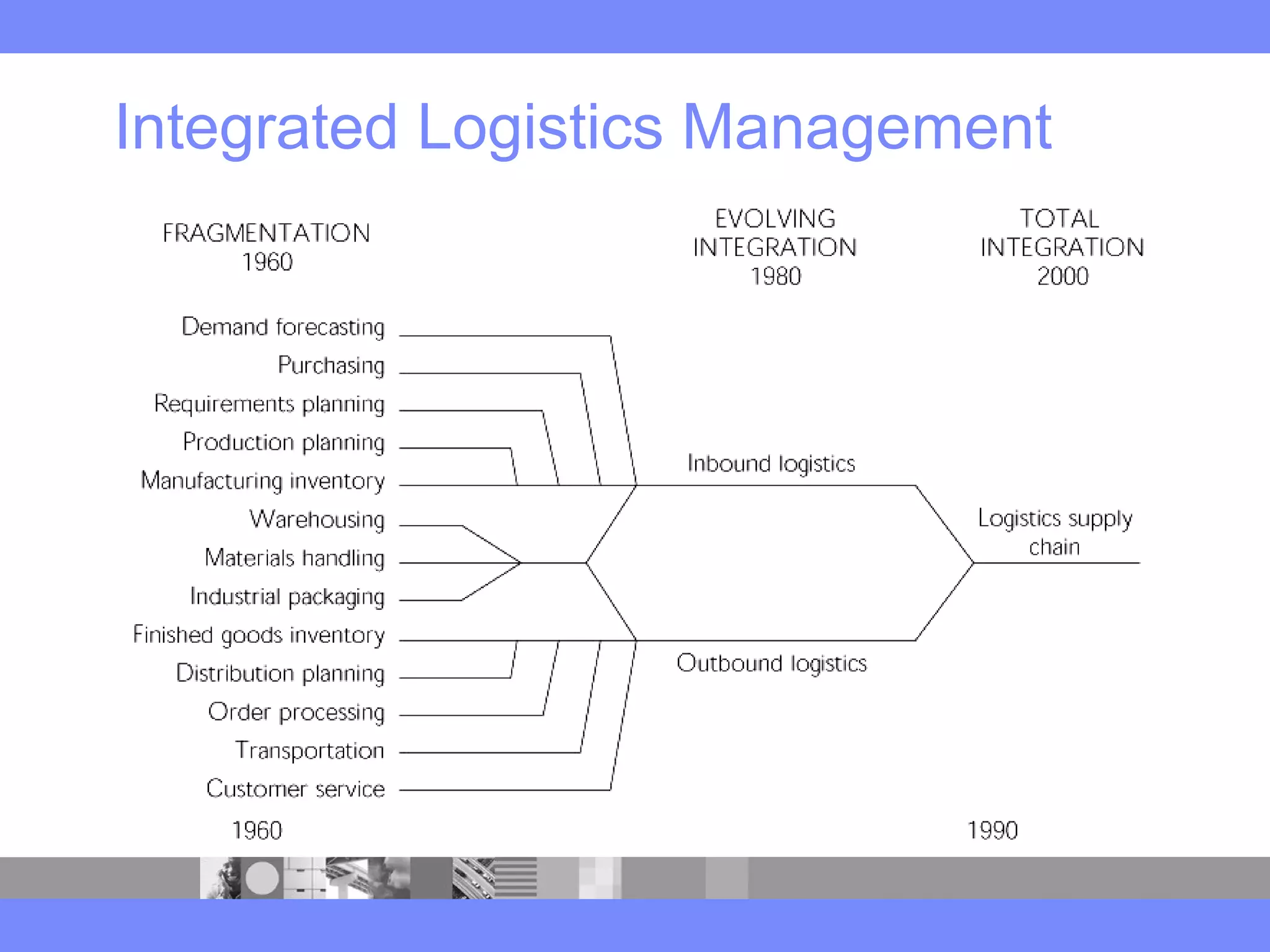
– Outbound logistics – the warehousing and
distribution of finished goods.
– Inbound logistics – the receiving and warehousing
of raw materials, and their distribution to
manufacturing as they are required.
– Value chain analysis integrated logistics activities.
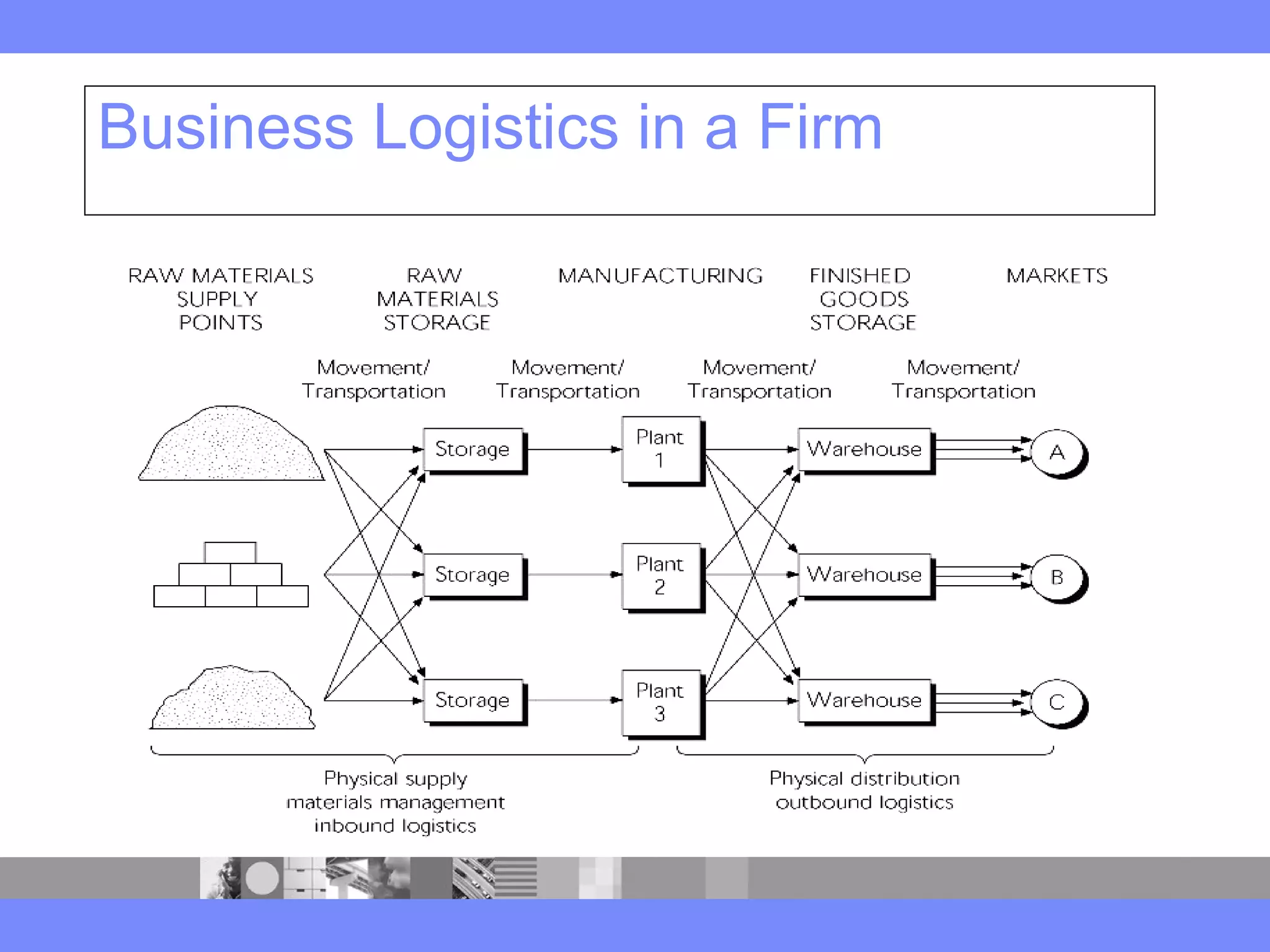
Business Logistics in a Firm
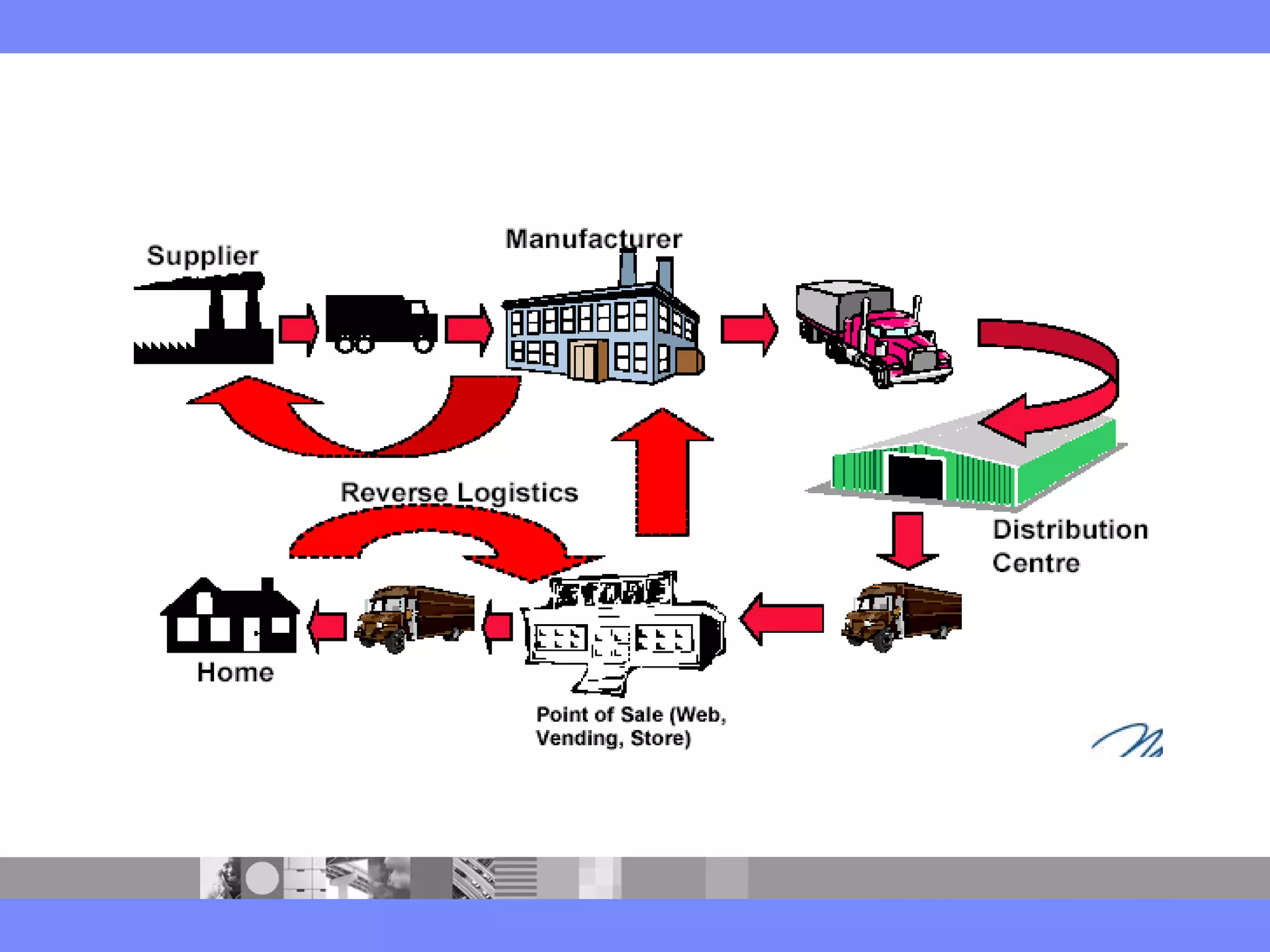
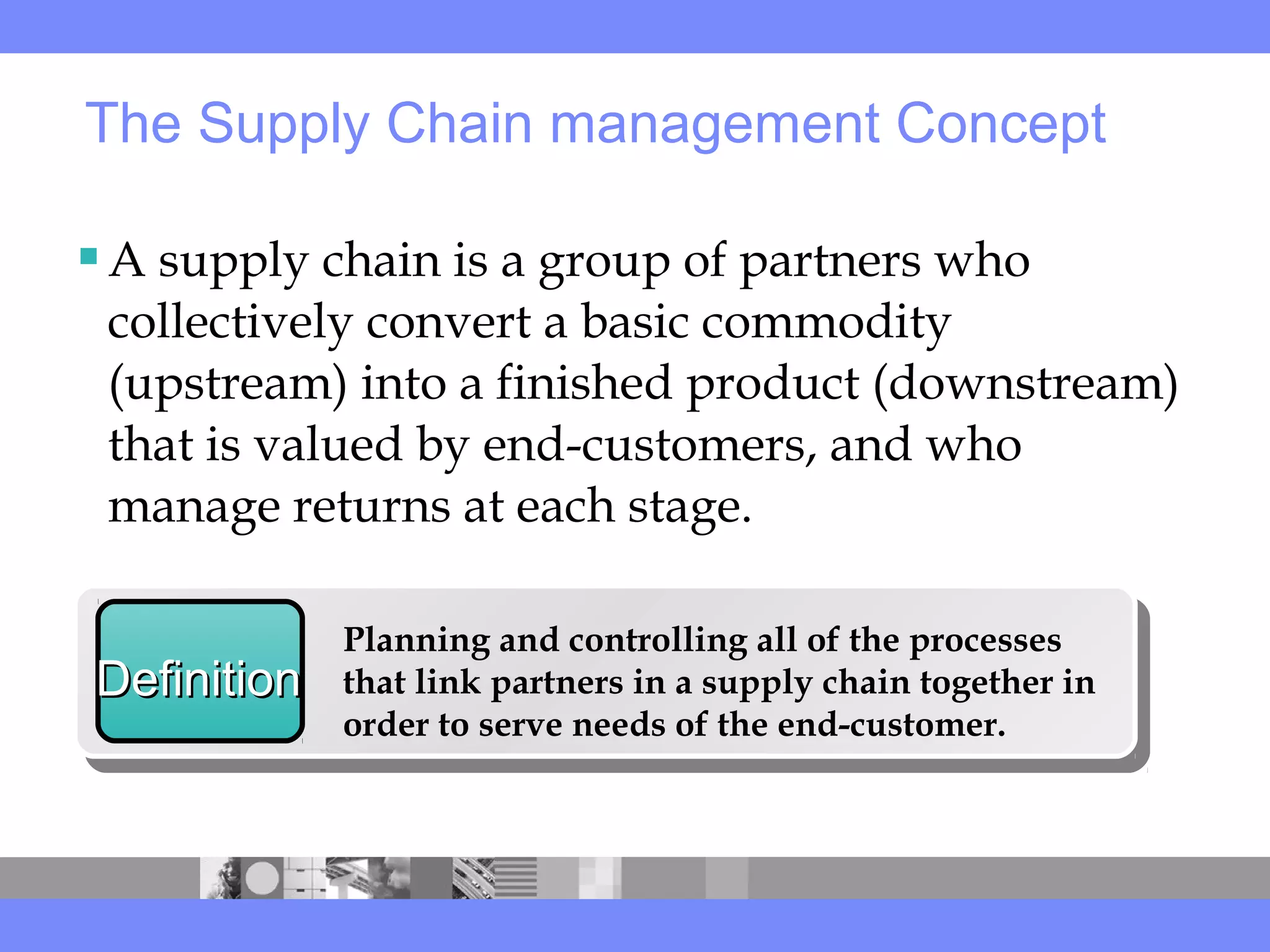
A supply chain is a group of partners who
collectively convert a basic commodity
(upstream) into a finished product (downstream)
that is valued by end-customers, and who
manage returns at each stage.
The Supply Chain management Concept
DefinitionDefinition
Planning and controlling all of the processes
that link partners in a supply chain together in
order to serve needs of the end-customer.
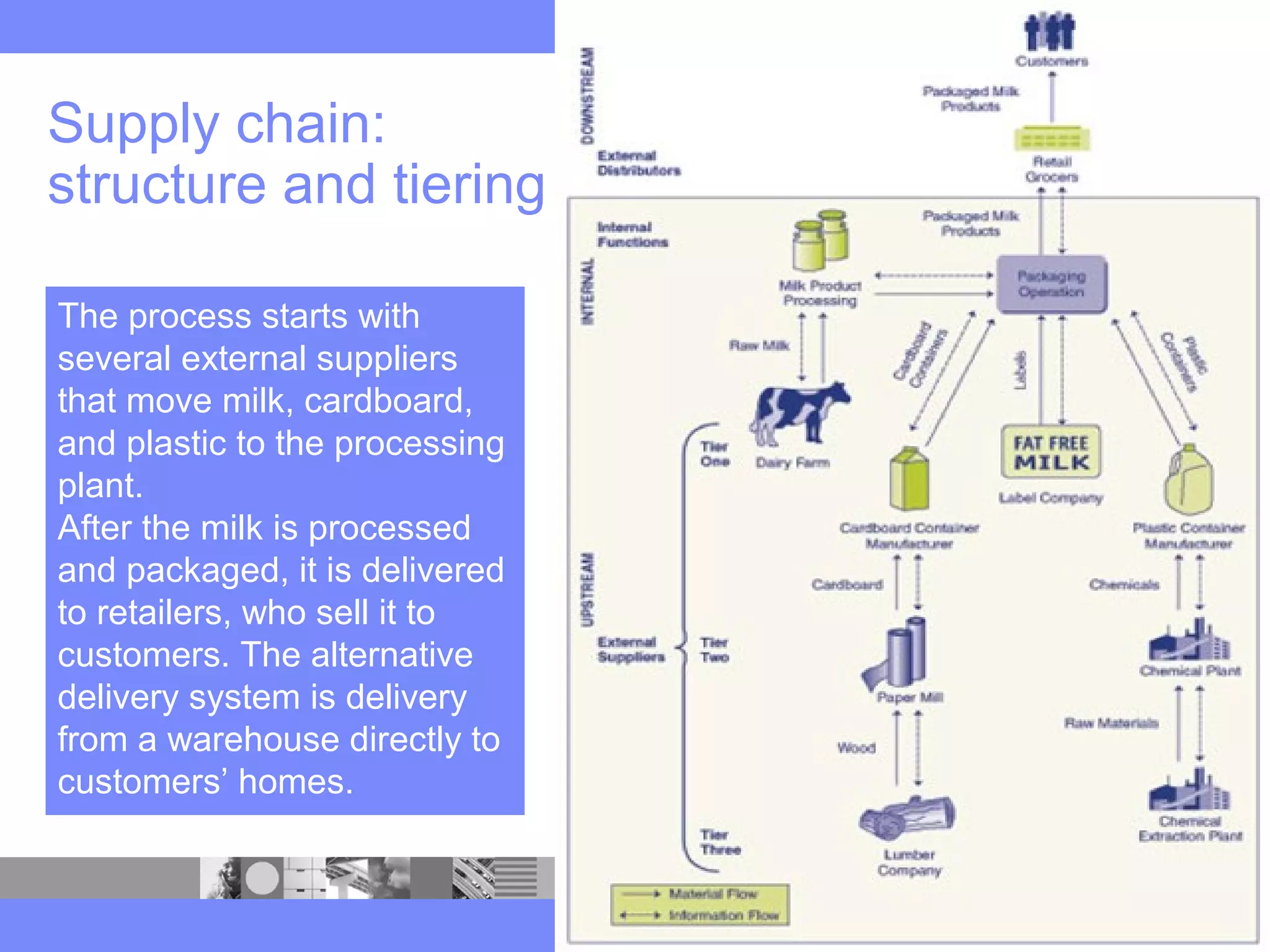
The process starts with
several external suppliers
that move milk, cardboard,
and plastic to the processing
plant.
After the milk is processed
and packaged, it is delivered
to retailers, who sell it to
customers. The alternative
delivery system is delivery
from a warehouse directly to
customers’ homes.
Supply chain:
structure and tiering
Supply chain:
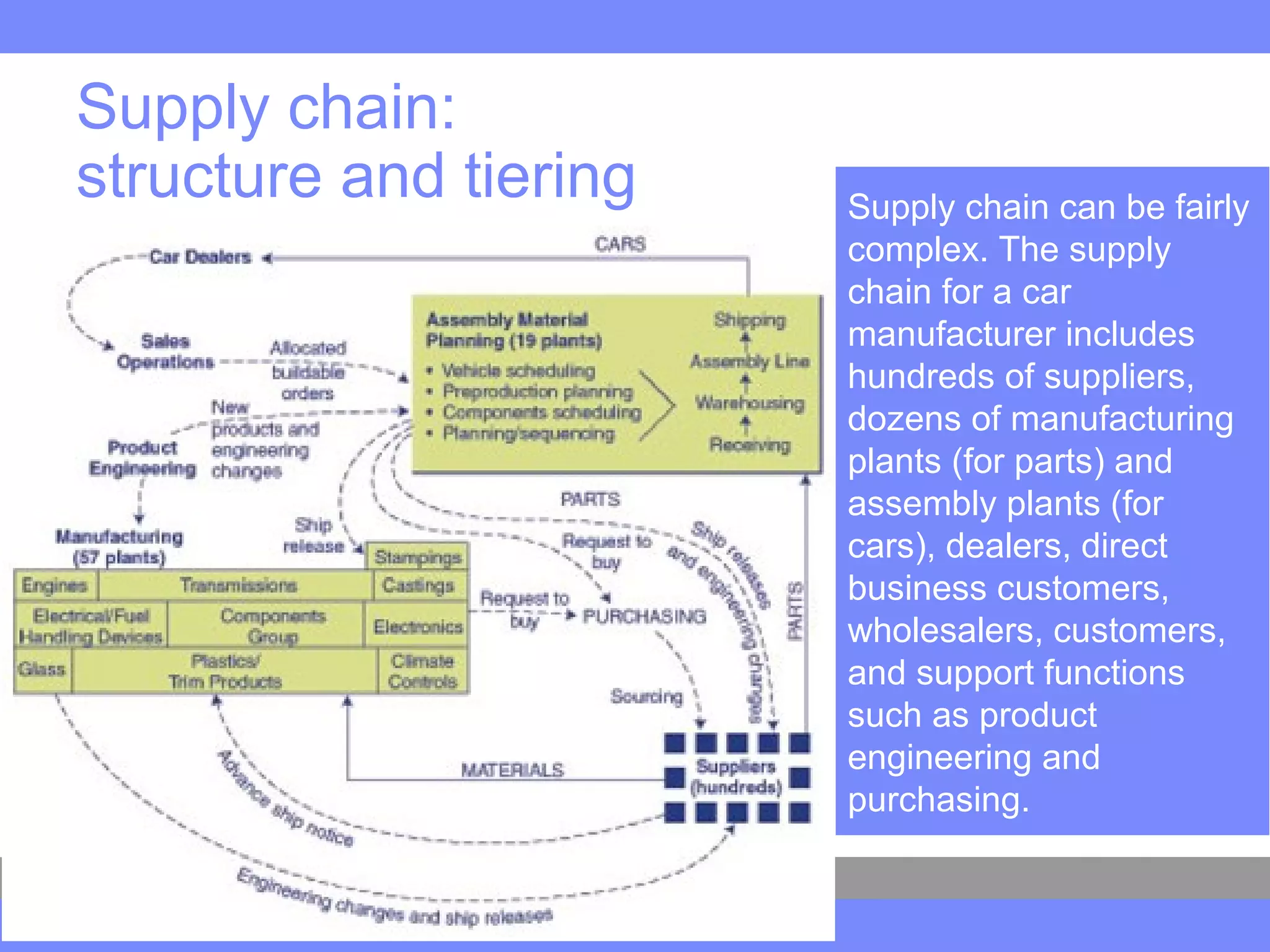
structure and tiering Supply chain can be fairly
complex. The supply
chain for a car
manufacturer includes
hundreds of suppliers,
dozens of manufacturing
plants (for parts) and
assembly plants (for
cars), dealers, direct
business customers,
wholesalers, customers,
and support functions
such as product
engineering and
purchasing.
Logistics concept
DefinitionDefinition
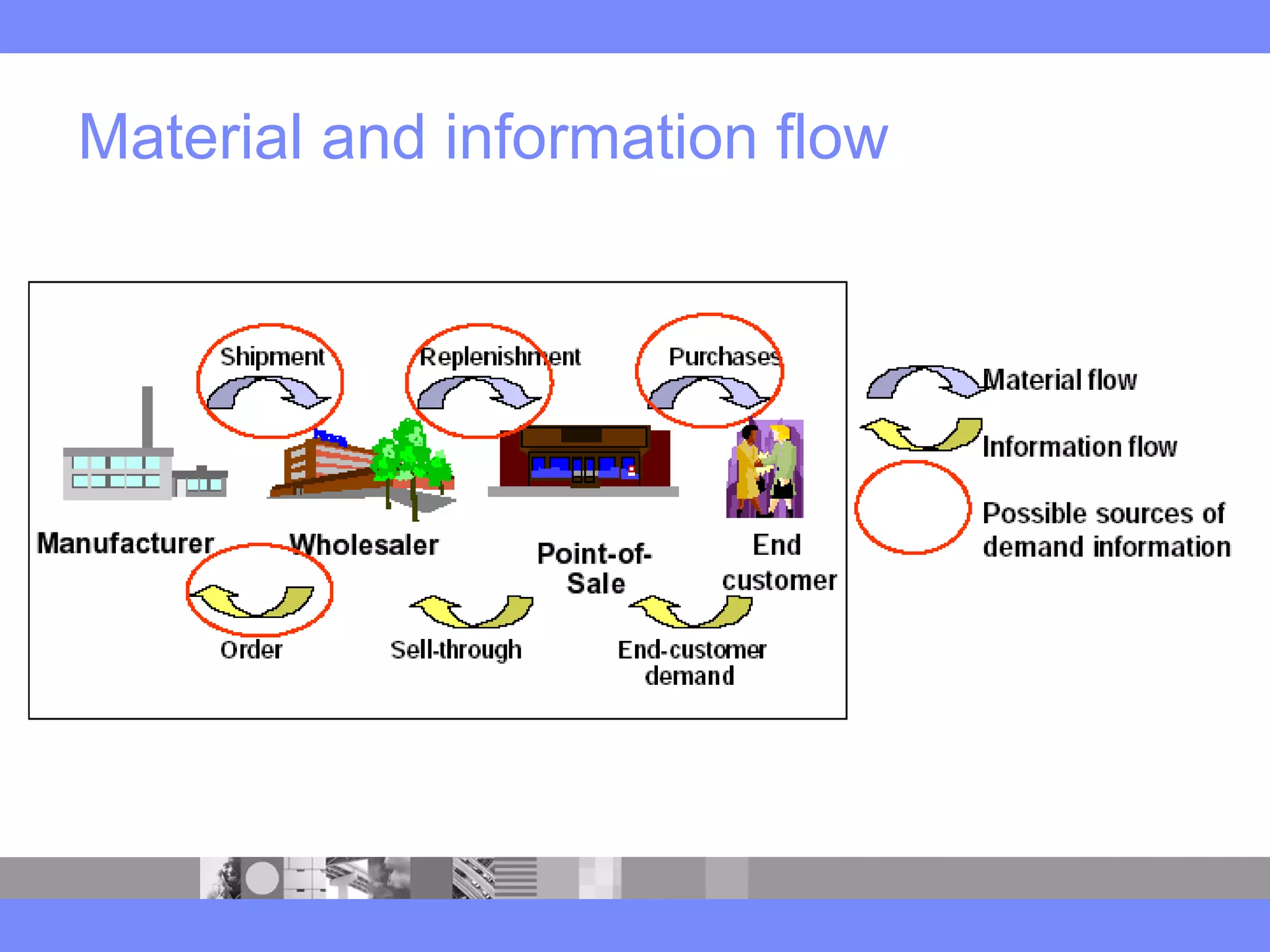
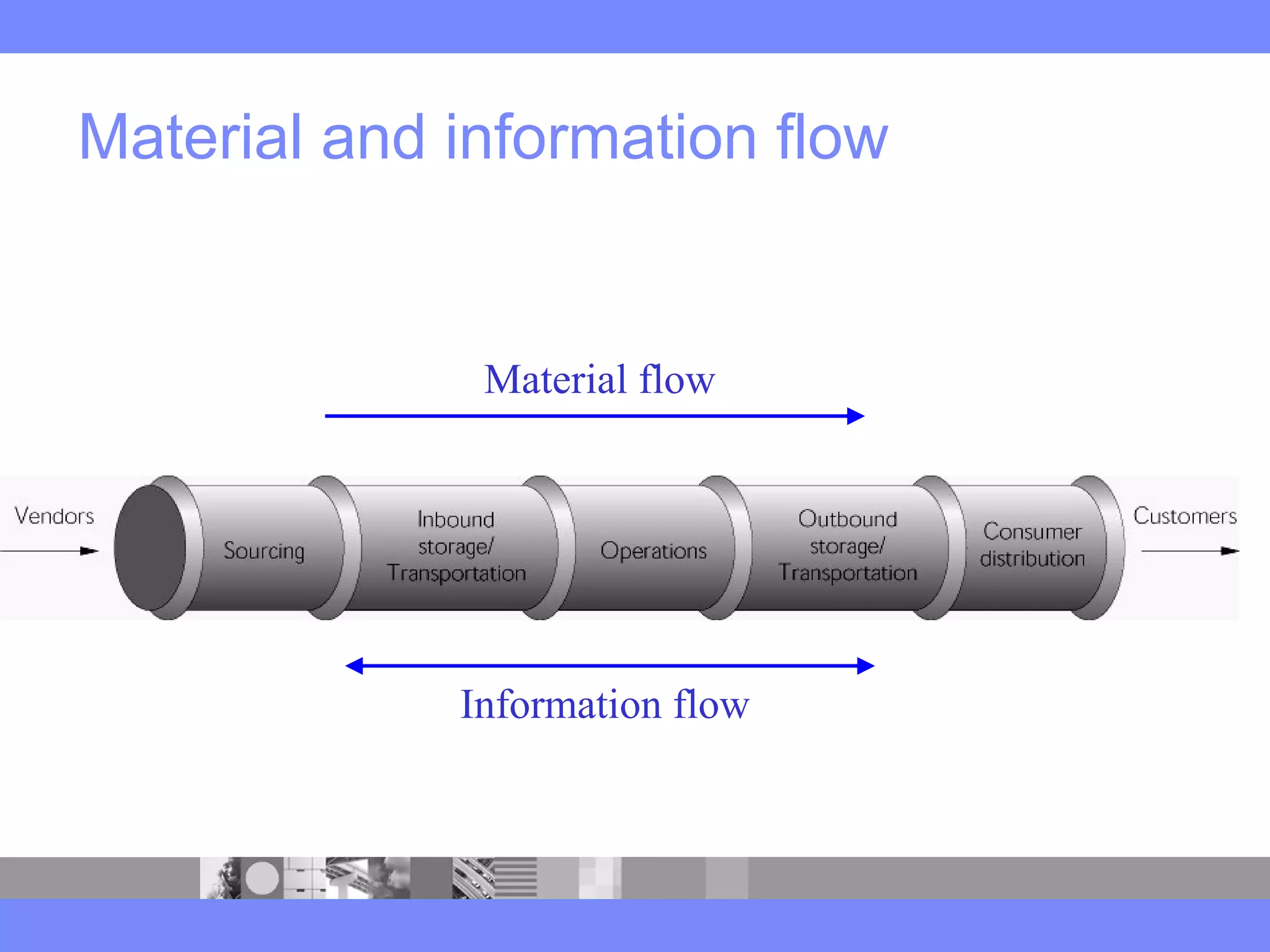
The task of coordinating material flow
and information flow across the supply
chain.
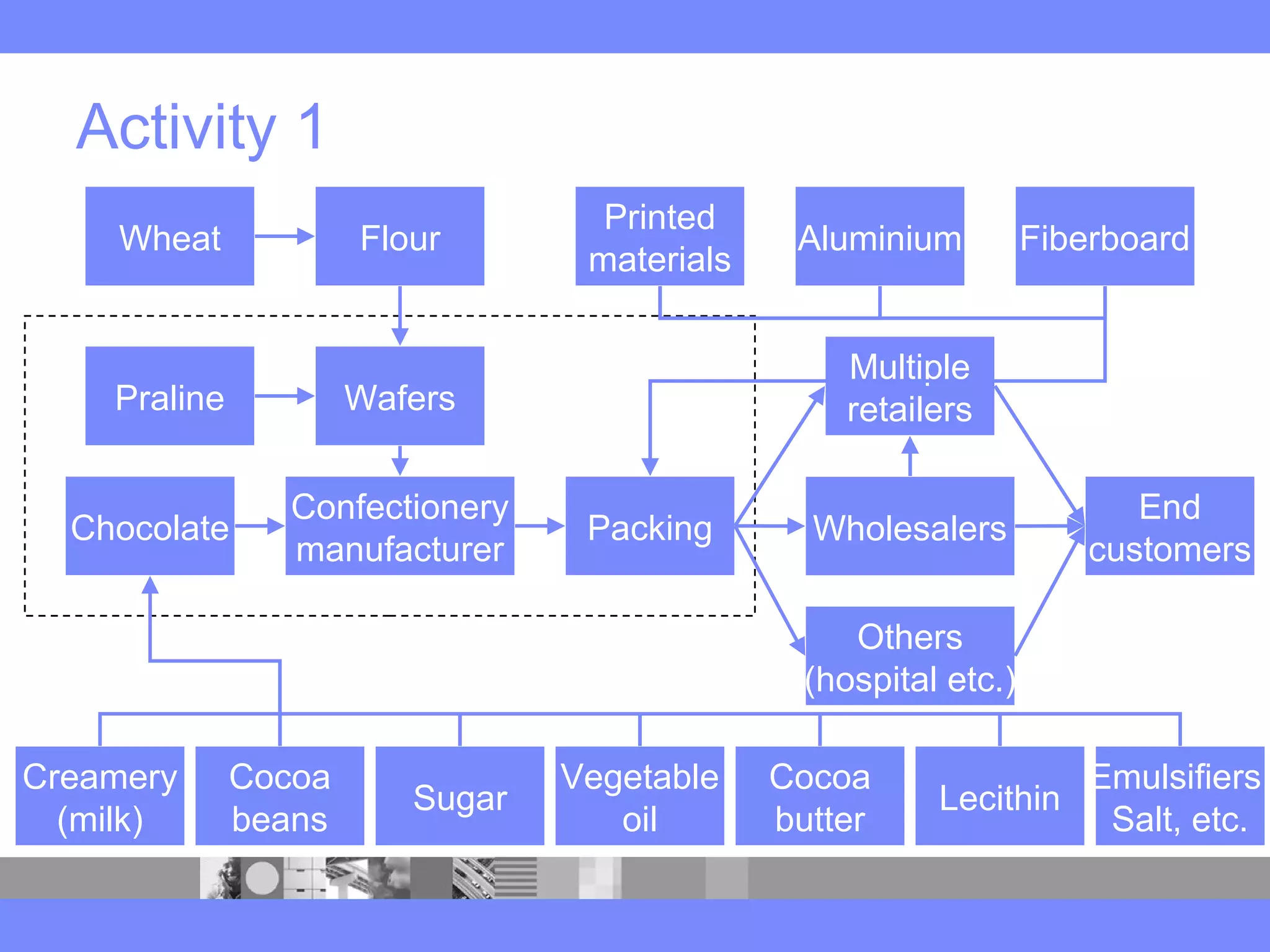
Activity 1
Wheat Flour
Praline Wafers
Chocolate
Confectionery
manufacturer
Packing
Creamery
(milk)
Cocoa
beans
Sugar
Vegetable
oil
Cocoa
butter
Lecithin
Emulsifiers,
Salt, etc.
Printed
materials
Aluminium Fiberboard
Multiple
retailers
Wholesalers
Others
(hospital etc.)
End
customers
logistics and Supply chain1
Material and information flow2
Competing through logistics3
Logistics strategy4
Key issue
11
What is the relationship between
material flow and information
flow?
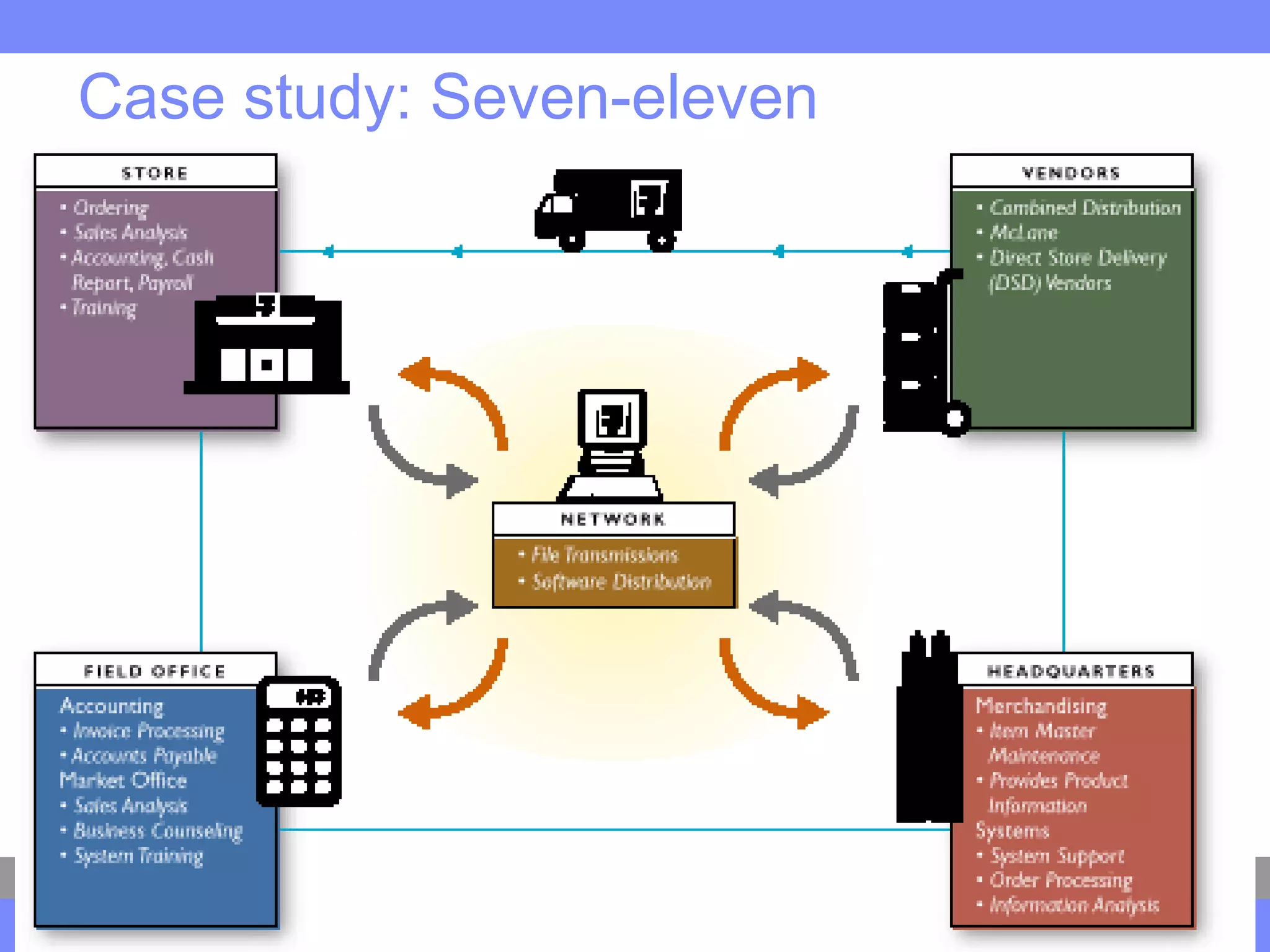
Case study: Seven-eleven
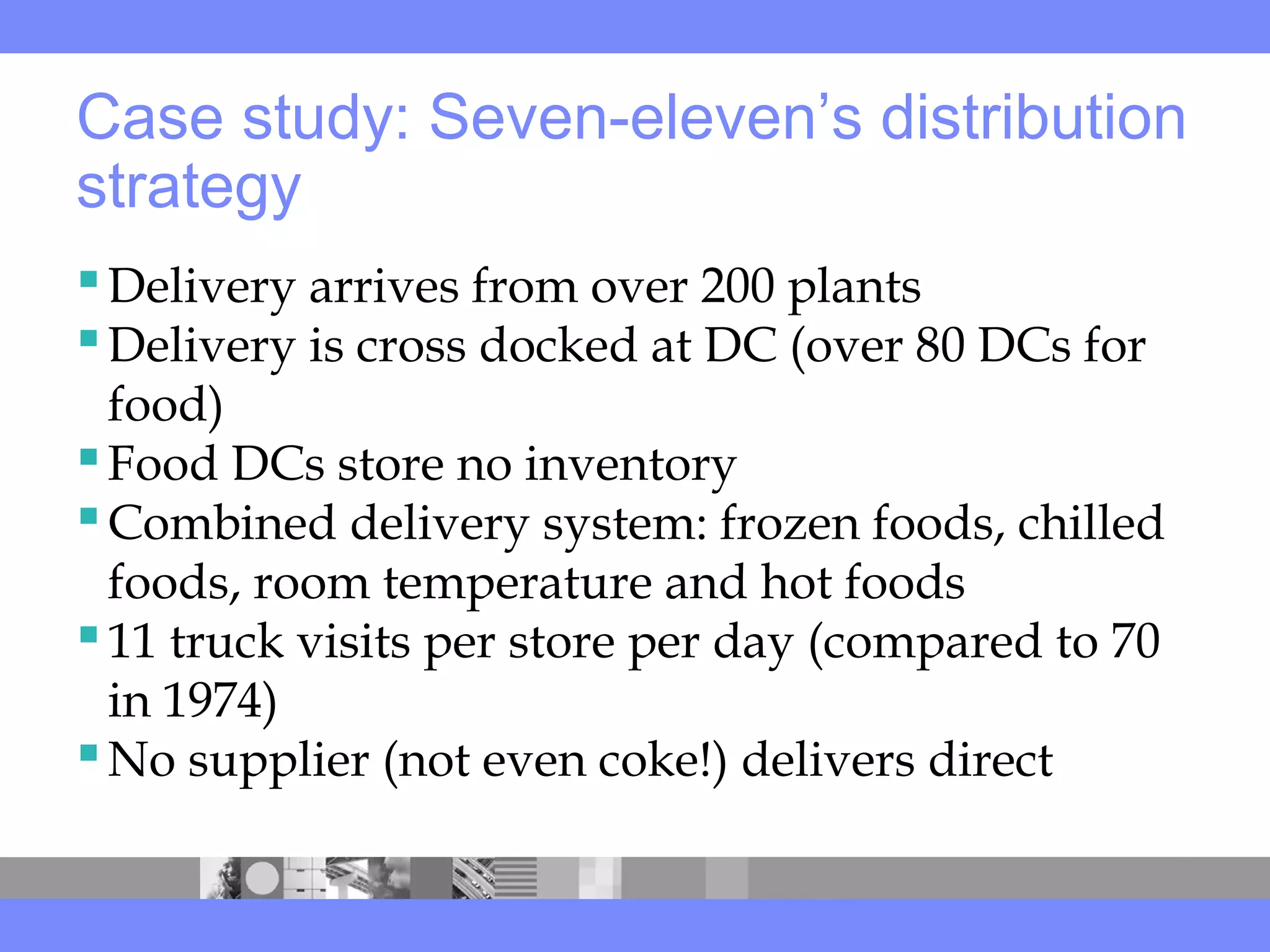
Case study: Seven-eleven’s distribution
strategy
Delivery arrives from over 200 plants
Delivery is cross docked at DC (over 80 DCs for
food)
Food DCs store no inventory
Combined delivery system: frozen foods, chilled
foods, room temperature and hot foods
11 truck visits per store per day (compared to 70
in 1974)
No supplier (not even coke!) delivers direct
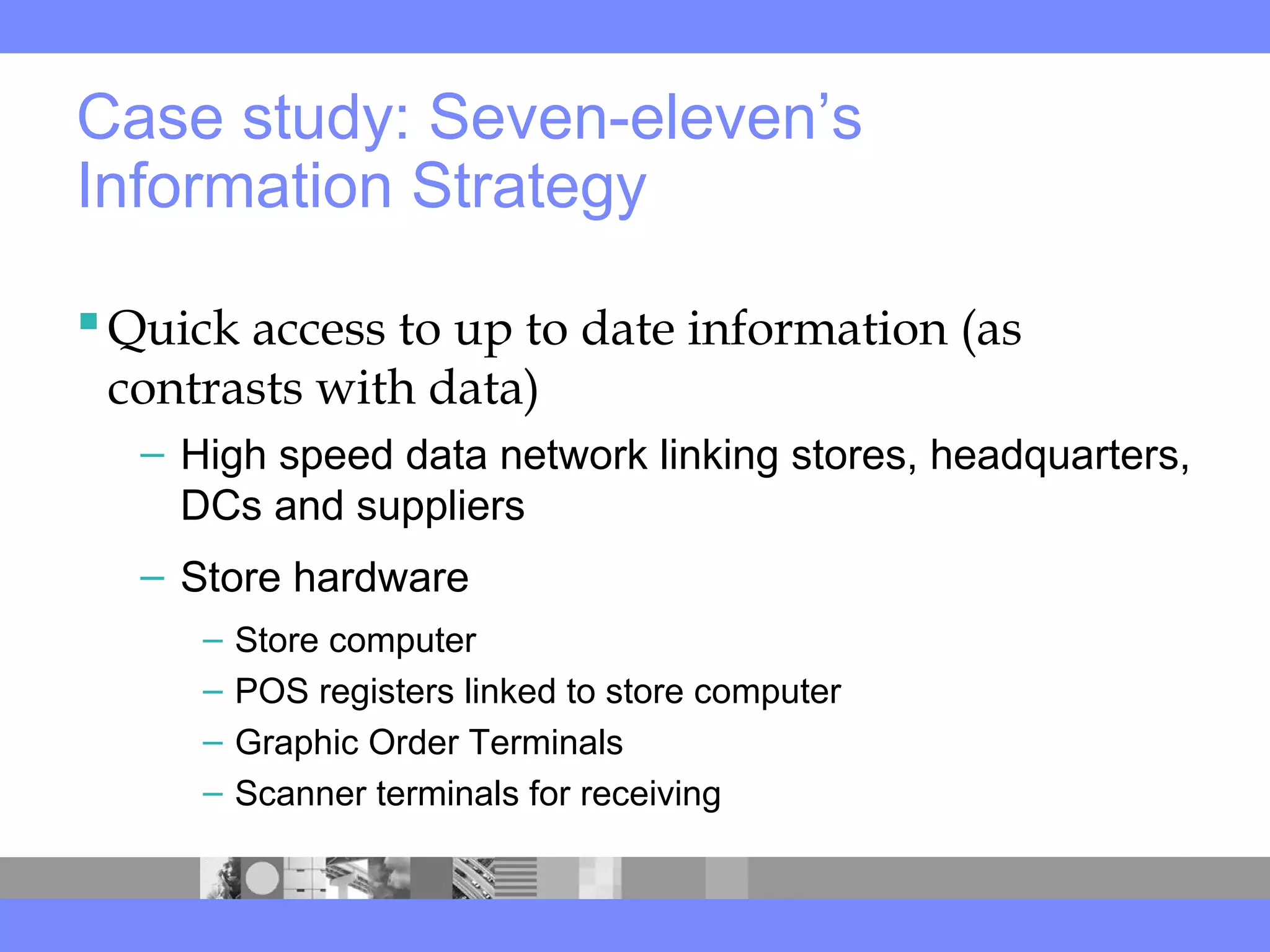
Case study: Seven-eleven’s
Information Strategy
Quick access to up to date information (as
contrasts with data)
– High speed data network linking stores, headquarters,
DCs and suppliers
– Store hardware
– Store computer
– POS registers linked to store computer
– Graphic Order Terminals
– Scanner terminals for receiving
Integrated Logistics Management
Material and information flow
Material flow
Information flow
Activity 2
Describe the material and information flow in the
supply network affecting one of the major
products in Activity 1.
logistics and Supply chain1
Material and information flow2
Competing through logistics3
Logistics strategy4
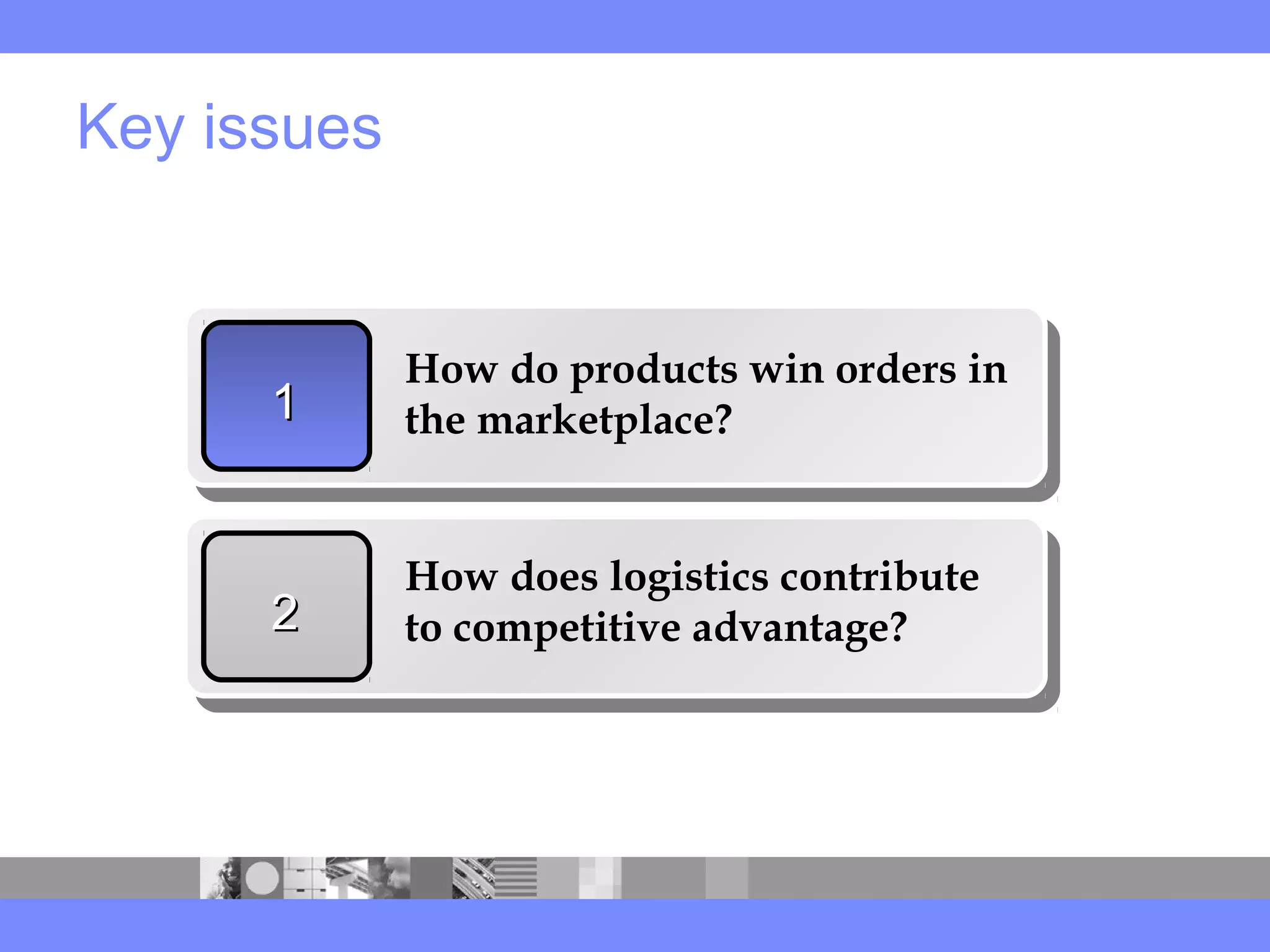
Key issues
11
How do products win orders in
the marketplace?
22
How does logistics contribute
to competitive advantage?
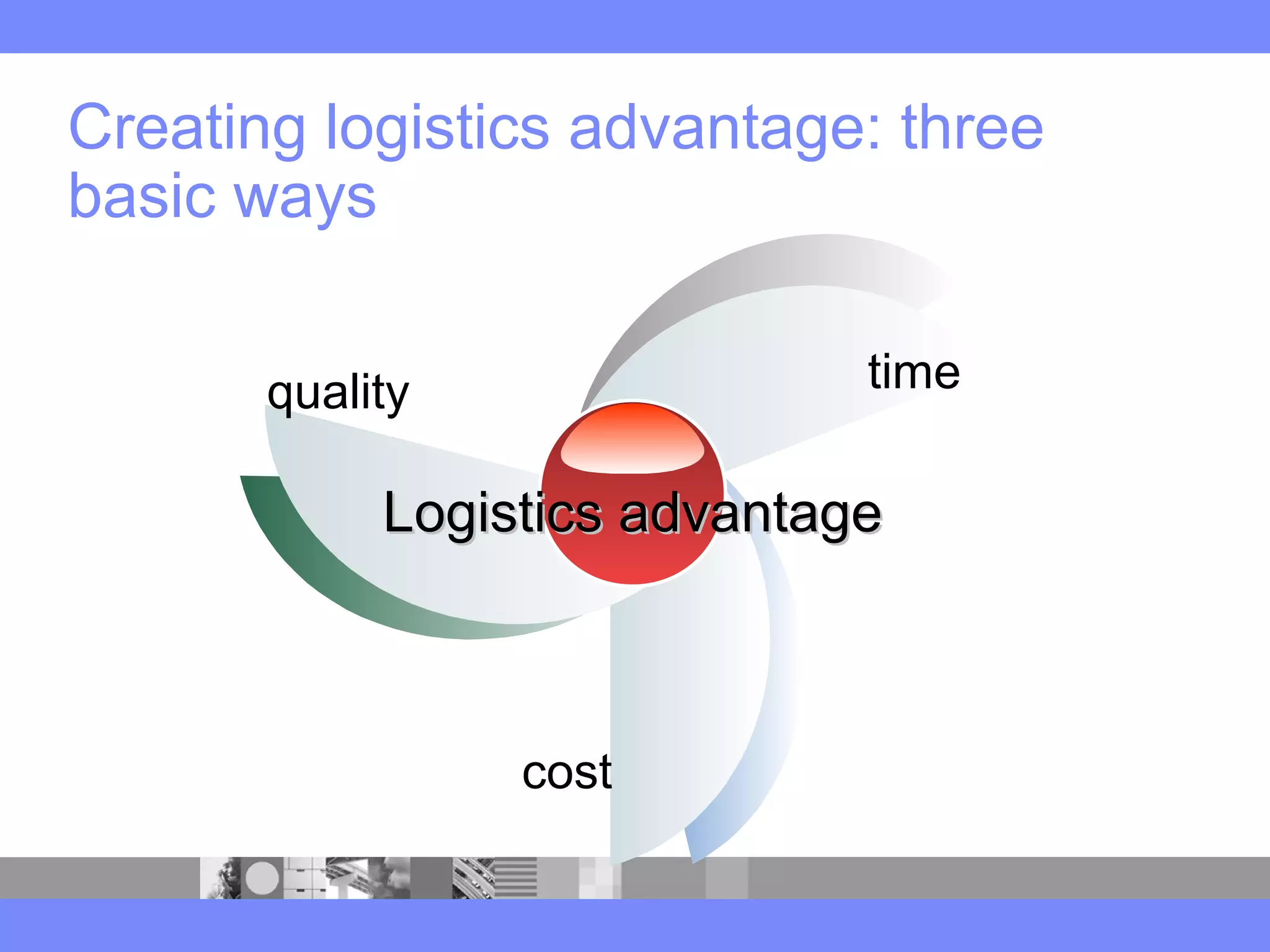
Creating logistics advantage: three
basic ways
Logistics advantageLogistics advantage
quality time
cost
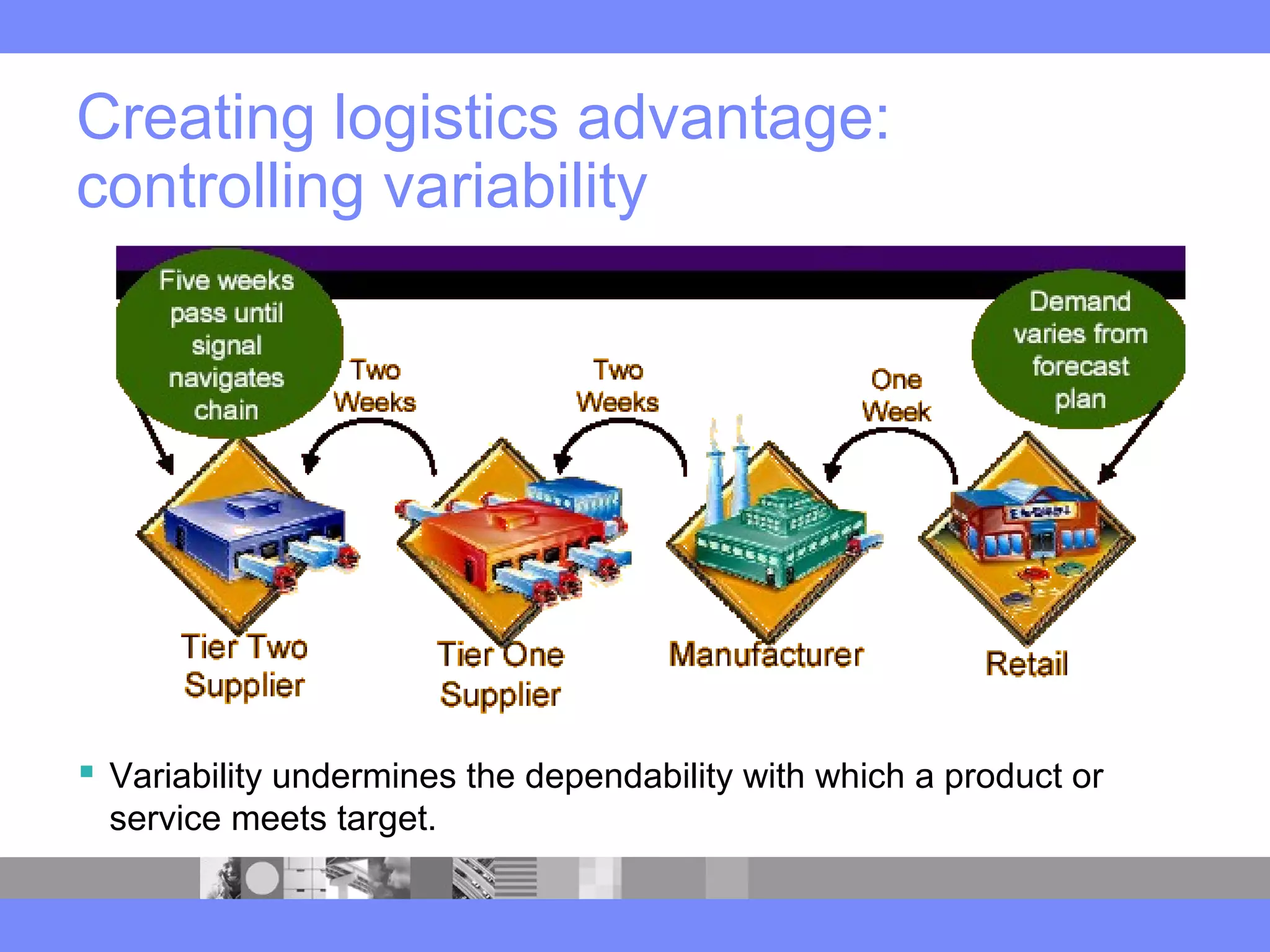
Creating logistics advantage:
controlling variability
 Variability undermines the dependability with which a product or
service meets target.
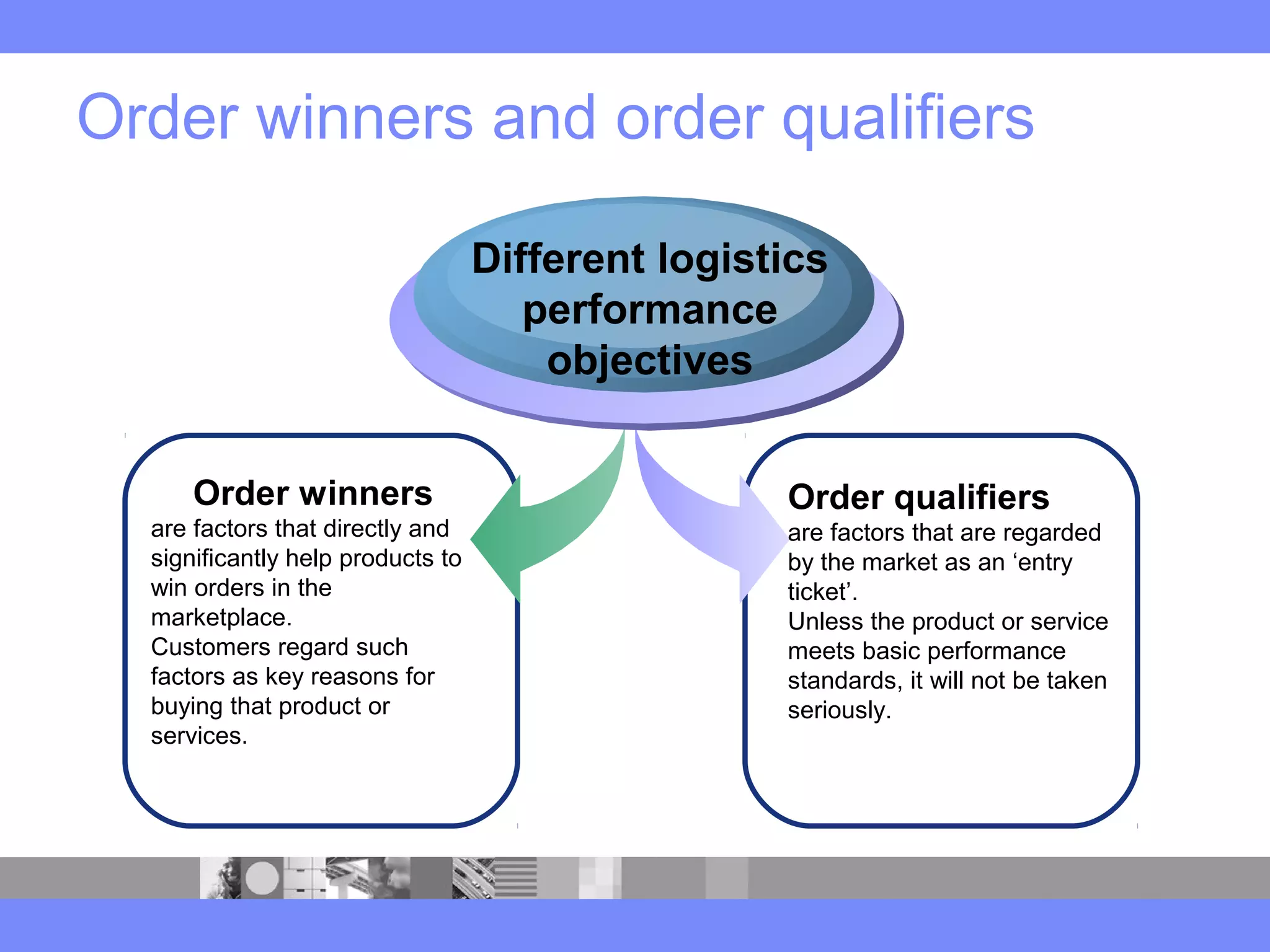
Order winners and order qualifiers
Order winners
are factors that directly and
significantly help products to
win orders in the
marketplace.
Customers regard such
factors as key reasons for
buying that product or
services.
Different logistics
performance
objectives
Order qualifiers
are factors that are regarded
by the market as an ‘entry
ticket’.
Unless the product or service
meets basic performance
standards, it will not be taken
seriously.
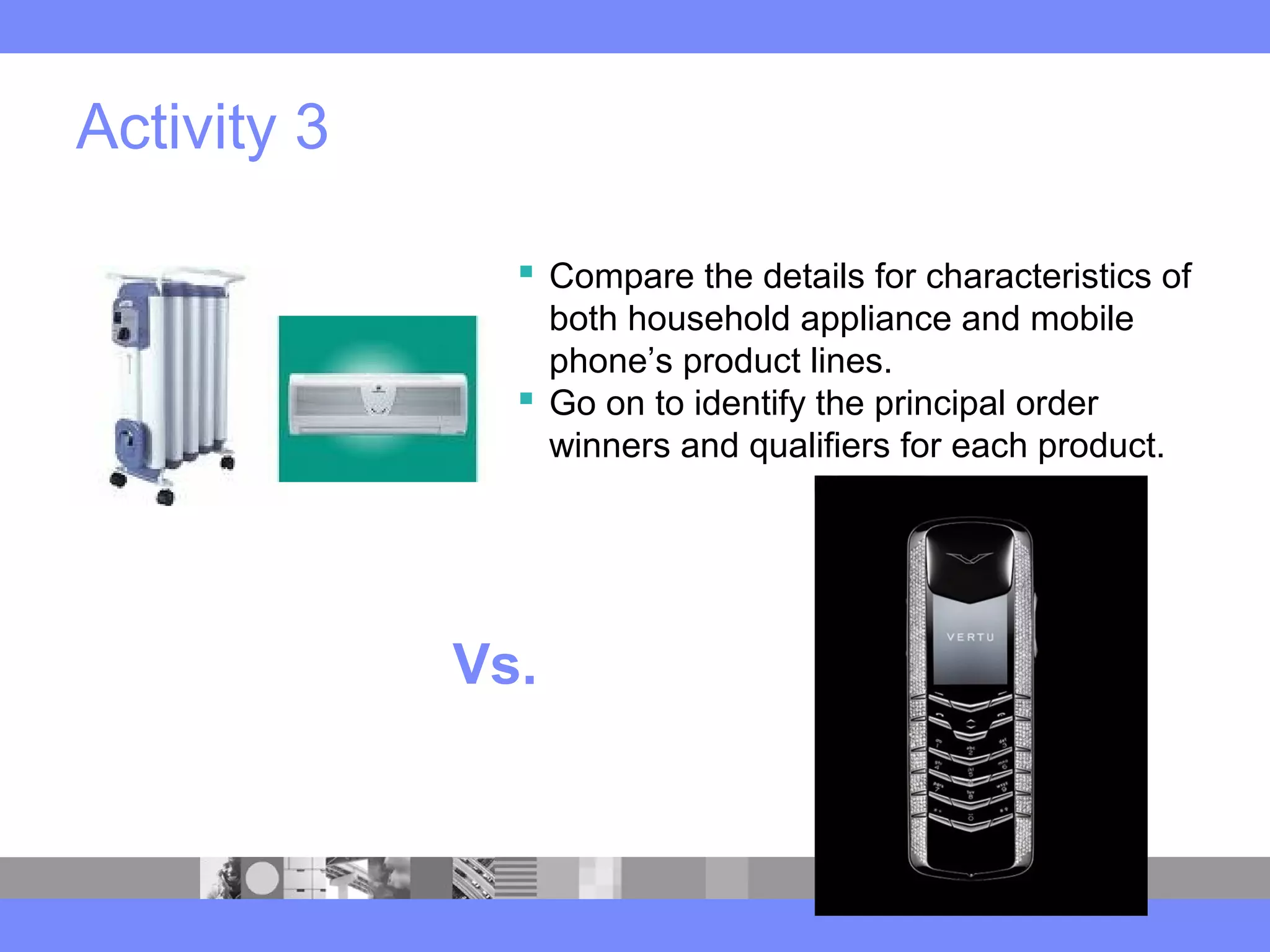
Activity 3
 Compare the details for characteristics of
both household appliance and mobile
phone’s product lines.
 Go on to identify the principal order
winners and qualifiers for each product.
Vs.
logistics and Supply chain1
Material and information flow2
Competing through logistics3
Logistics strategy4
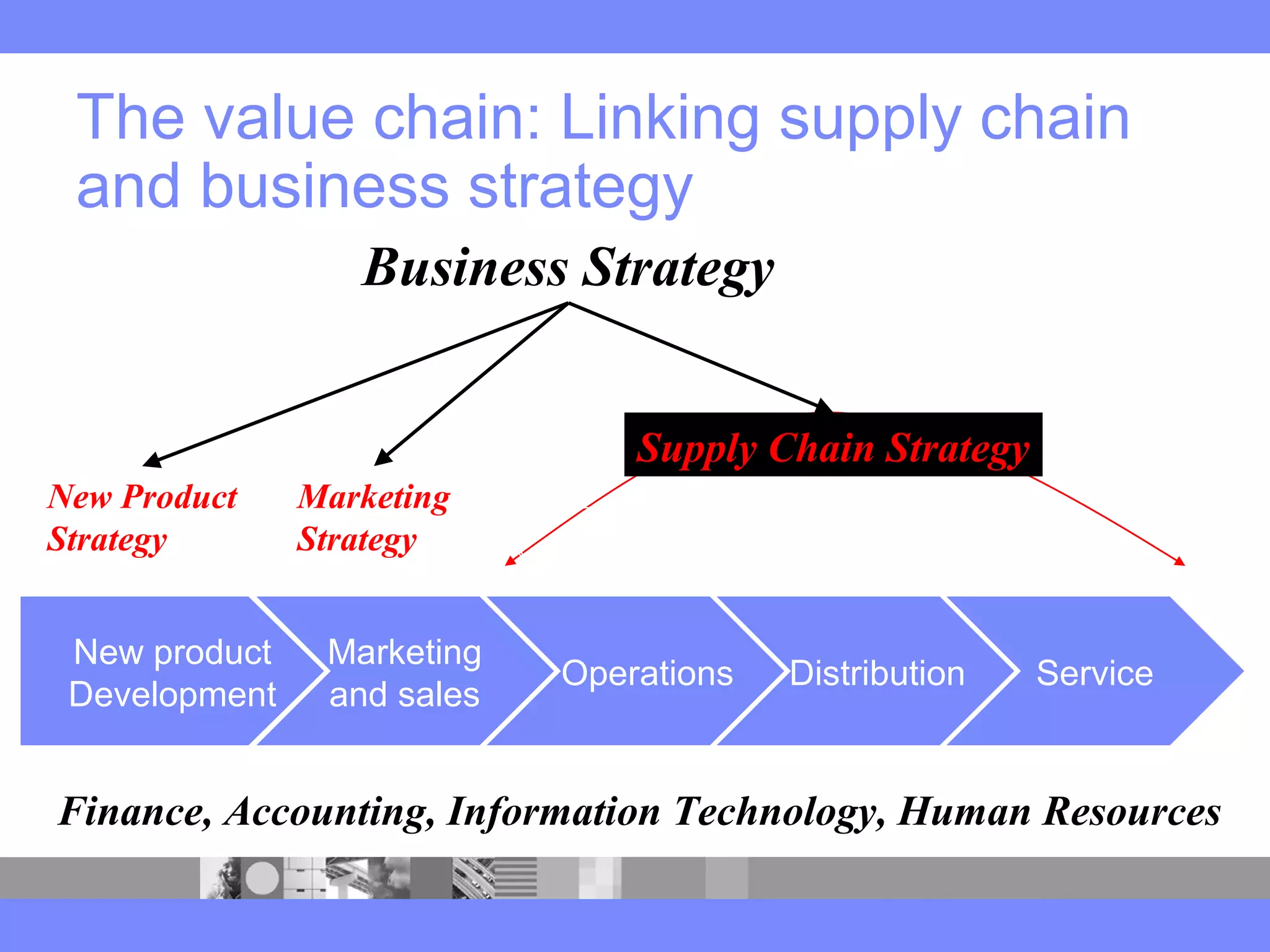
The value chain: Linking supply chain
and business strategy
New
Product
Development
Marketing
and
Sales
Operations
Business Strategy
New Product
Strategy
Marketing
Strategy
Supply Chain Strategy
New product
Development
Marketing
and sales
Operations Distribution Service
Finance, Accounting, Information Technology, Human Resources
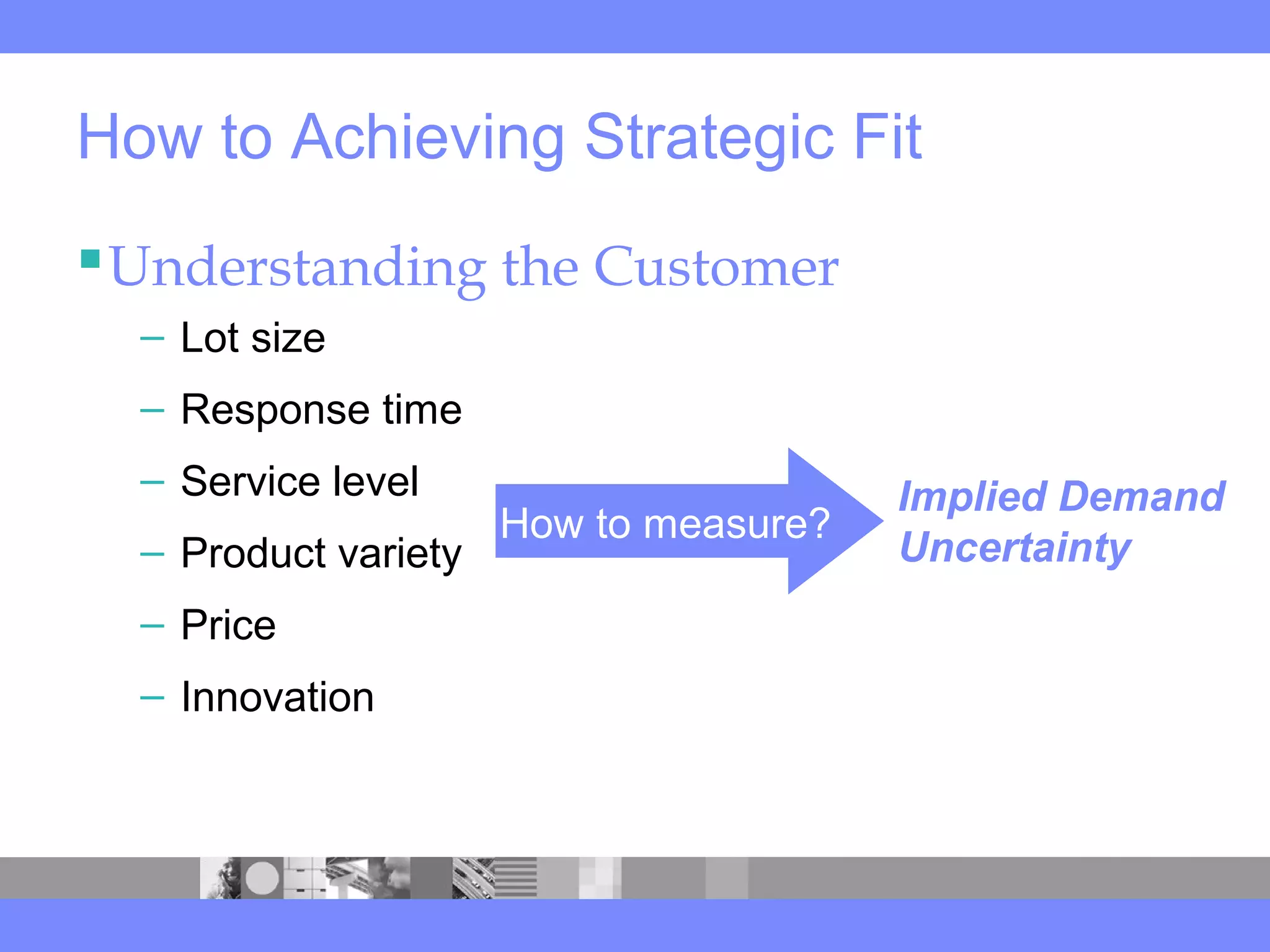
How to Achieving Strategic Fit
Understanding the Customer
– Lot size
– Response time
– Service level
– Product variety
– Price
– Innovation
How to measure?
Implied Demand
Uncertainty
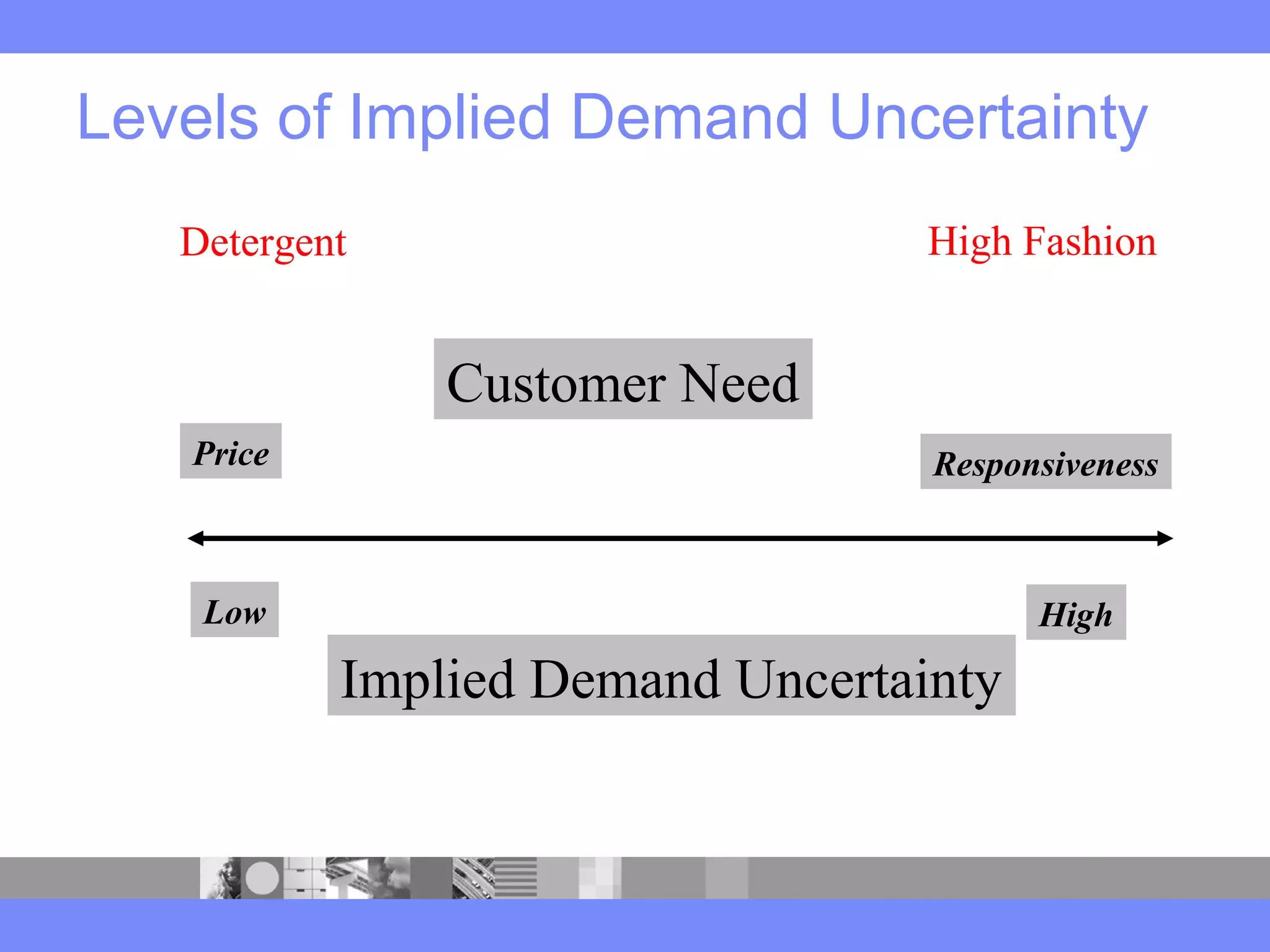
Levels of Implied Demand Uncertainty
Detergent High Fashion
Low High
Price Responsiveness
Customer Need
Implied Demand Uncertainty
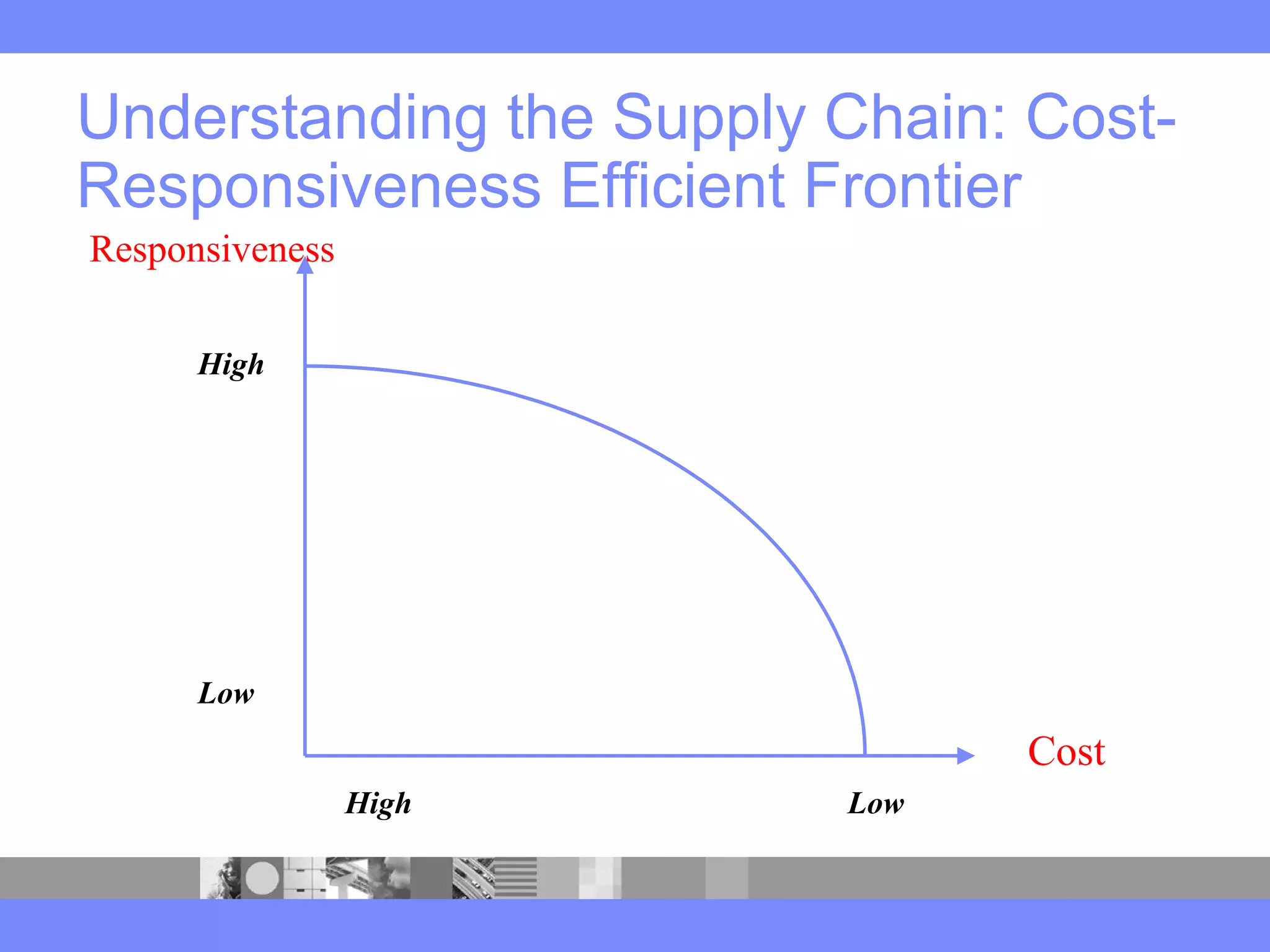
Understanding the Supply Chain: Cost-
Responsiveness Efficient Frontier
High
High
Low
Low
Cost
Responsiveness
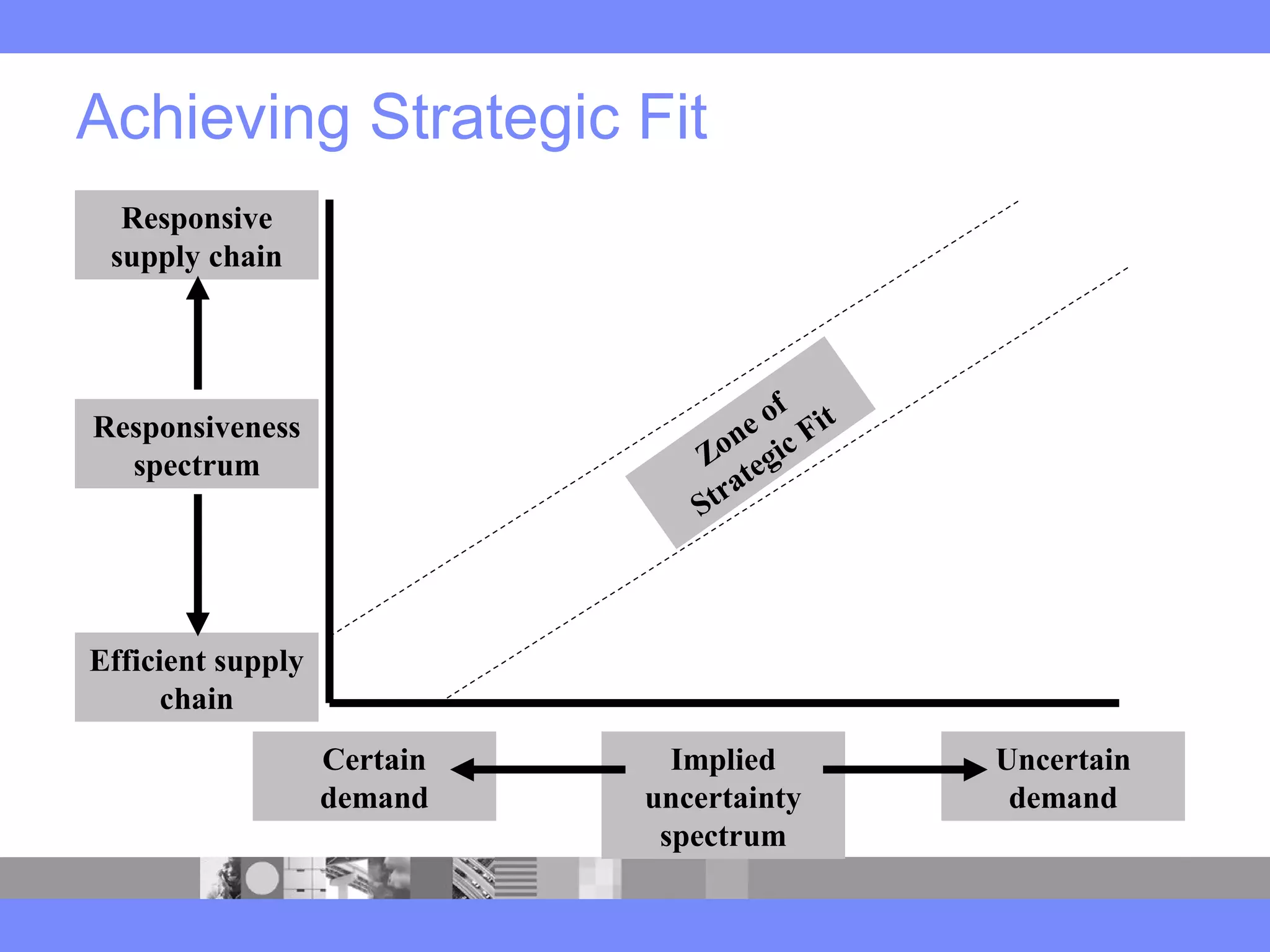
Achieving Strategic Fit
Implied
uncertainty
spectrum
Responsive
supply chain
Efficient supply
chain
Certain
demand
Uncertain
demand
Responsiveness
spectrum Zone of
Strategic Fit
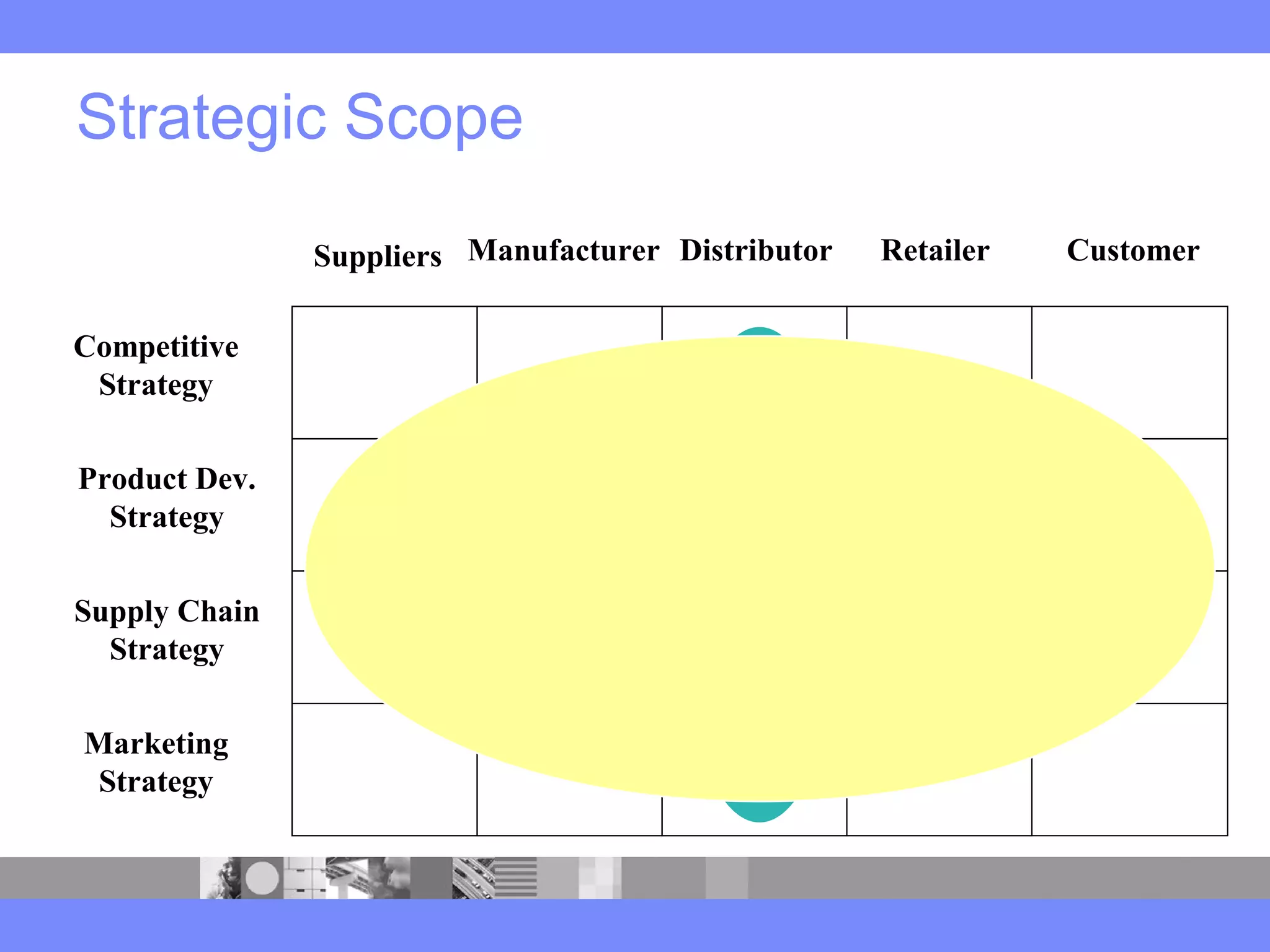
Strategic Scope
Suppliers Manufacturer Distributor Retailer Customer
Competitive
Strategy
Product Dev.
Strategy
Supply Chain
Strategy
Marketing
Strategy
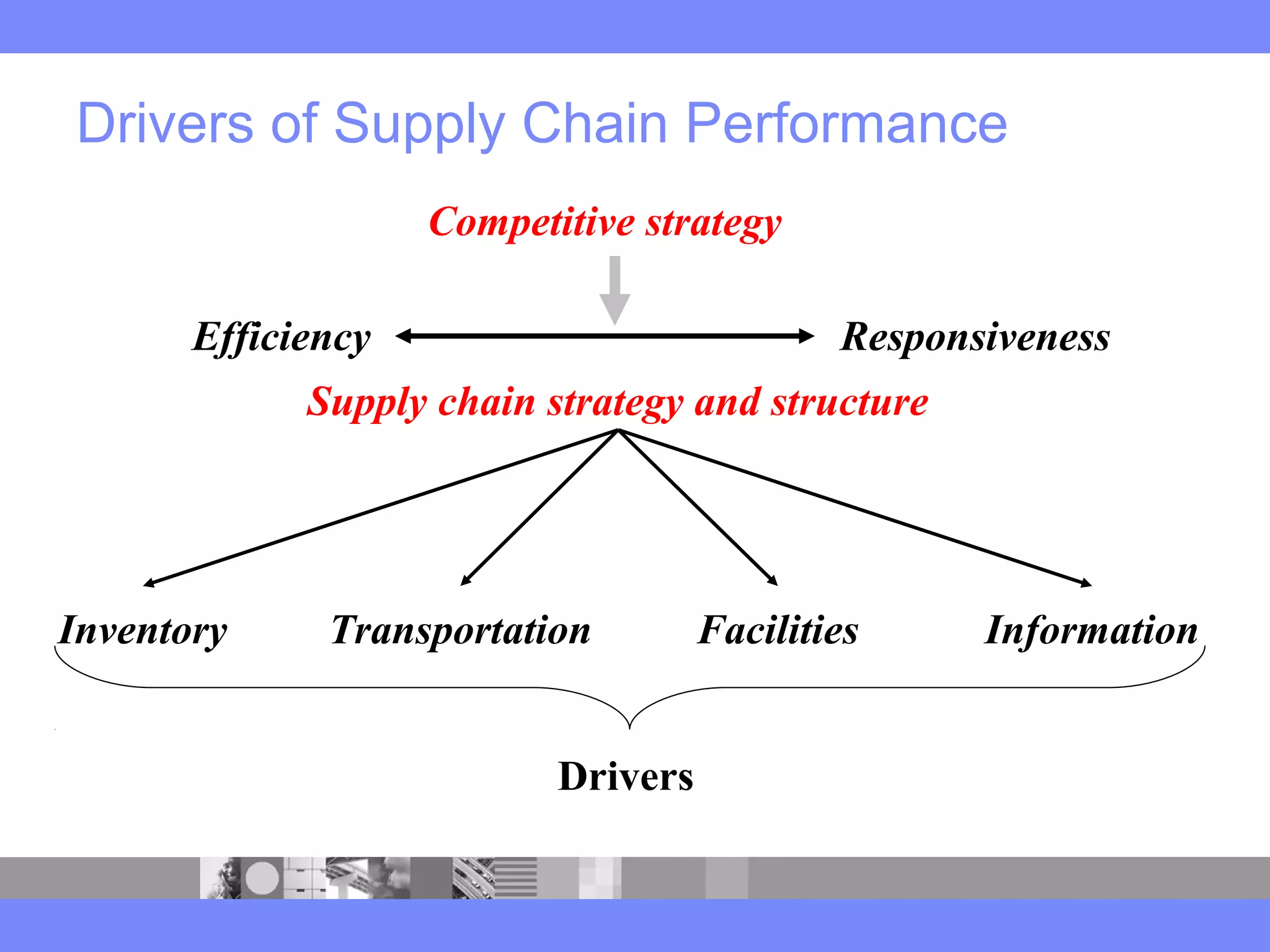
Drivers of Supply Chain Performance
Efficiency Responsiveness
Inventory Transportation Facilities Information
Supply chain strategy and structure
Drivers
Competitive strategy
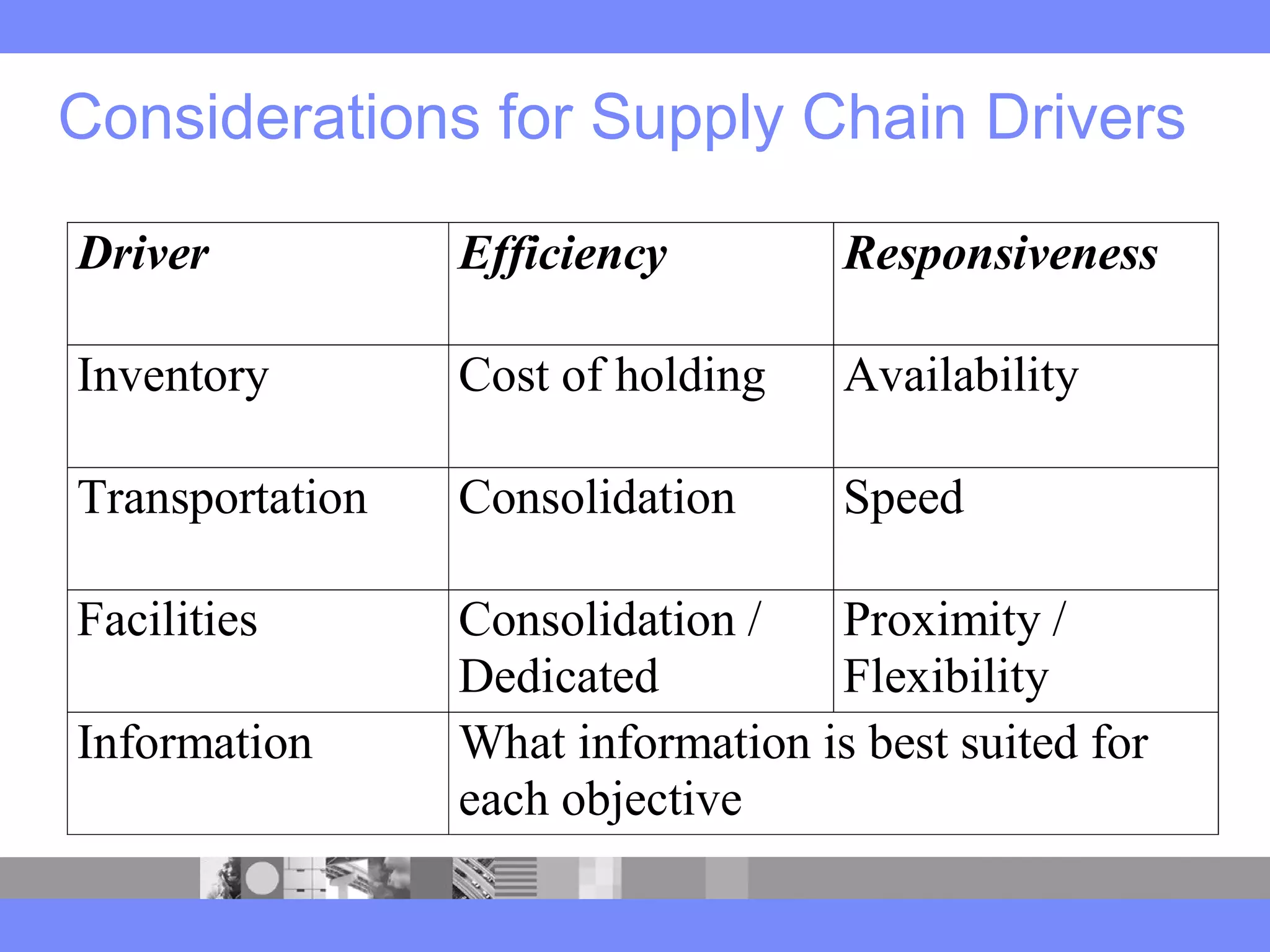
Considerations for Supply Chain Drivers
Driver Efficiency Responsiveness
Inventory Cost of holding Availability
Transportation Consolidation Speed
Facilities Consolidation /
Dedicated
Proximity /
Flexibility
Information What information is best suited for
each objective

1 introduction

  • 1.
    Logistics Management Introduction tothe Course Jing Yuan Feb, 2012
  • 2.
    Introduce Yourself Let’s meknow who you are. What’s logistics management? Supply chain management Vs. logistics management …
  • 3.
    Outline Introduce yourself Who Iam Course introduction – Course description – Learning objectives – Textbooks – Grading policy – Schedules
  • 4.
    Outline Introduce yourself Who Iam Course introduction – Course description – Learning objectives – Textbooks – Grading policy – Schedule
  • 5.
    Course description An introductorycourse in the analysis, design and operation of logistics and supply chain Presented through lectures along with several case studies and experiments The lectures consist of nine parts
  • 6.
    Learning objectives Knowledge thestrategic role of the supply chain An understanding of logistic systems & their management problems Ability to devise workable solutions in business situations
  • 7.
    Textbooks Textbook – Harrison, A.and Hoek, R. V. (2010) Logistics Management and Strategy, third edition, 中国 人民大学出版社 References (not required) – Christopher, M. (2006) Logistics and Supply Chain Management: Creating Value-adding Network, third edition, 电子工业出版社 – 张余华,现代物流管理,清华大学出版 社, 2010 年。
  • 8.
  • 9.
    Grading Policy Grading – Assignmentand Quiz 10% – Midterm 20% – Final Project 70% Midterm – Case study – Final presentation Final project – A closed examination held in the last week of term
  • 10.
    Schedule Lectures – 14 weeks Casestudy presentations – 2 weeks Experiments – 2 weeks
  • 11.
    Logistics and supplychain Logistics Management
  • 12.
    logistics and Supplychain1 Material and information flow2 Competing through logistics3 Logistics strategy4
  • 13.
    Seven-eleven convenience store –Describe the key logistics processes at 7-11. – What differences between the early reform and the regional distribution center at 7-11. – What do you think are the main logistics challenges in running the 7-11 operation. Case study
  • 14.
    Case study Centralized distribution No distribution center Built itsown distribution center---joint distribution First stage Second stage Third stage
  • 15.
    Key issues 11 What issupply chain, and how is it structured? 22 What is the purpose of a supply chain?
  • 17.
    The Supply ChainConcept Development of the Concept – Total systems cost - remains an important element of logistics analysis. – Outbound logistics – the warehousing and distribution of finished goods. – Inbound logistics – the receiving and warehousing of raw materials, and their distribution to manufacturing as they are required. – Value chain analysis integrated logistics activities.
  • 18.
  • 19.
    A supply chainis a group of partners who collectively convert a basic commodity (upstream) into a finished product (downstream) that is valued by end-customers, and who manage returns at each stage. The Supply Chain management Concept DefinitionDefinition Planning and controlling all of the processes that link partners in a supply chain together in order to serve needs of the end-customer.
  • 20.
    The process startswith several external suppliers that move milk, cardboard, and plastic to the processing plant. After the milk is processed and packaged, it is delivered to retailers, who sell it to customers. The alternative delivery system is delivery from a warehouse directly to customers’ homes. Supply chain: structure and tiering
  • 21.
    Supply chain: structure andtiering Supply chain can be fairly complex. The supply chain for a car manufacturer includes hundreds of suppliers, dozens of manufacturing plants (for parts) and assembly plants (for cars), dealers, direct business customers, wholesalers, customers, and support functions such as product engineering and purchasing.
  • 22.
    Logistics concept DefinitionDefinition The taskof coordinating material flow and information flow across the supply chain.
  • 23.
    Activity 1 Wheat Flour PralineWafers Chocolate Confectionery manufacturer Packing Creamery (milk) Cocoa beans Sugar Vegetable oil Cocoa butter Lecithin Emulsifiers, Salt, etc. Printed materials Aluminium Fiberboard Multiple retailers Wholesalers Others (hospital etc.) End customers
  • 24.
    logistics and Supplychain1 Material and information flow2 Competing through logistics3 Logistics strategy4
  • 25.
    Key issue 11 What isthe relationship between material flow and information flow?
  • 26.
  • 27.
    Case study: Seven-eleven’sdistribution strategy Delivery arrives from over 200 plants Delivery is cross docked at DC (over 80 DCs for food) Food DCs store no inventory Combined delivery system: frozen foods, chilled foods, room temperature and hot foods 11 truck visits per store per day (compared to 70 in 1974) No supplier (not even coke!) delivers direct
  • 28.
    Case study: Seven-eleven’s InformationStrategy Quick access to up to date information (as contrasts with data) – High speed data network linking stores, headquarters, DCs and suppliers – Store hardware – Store computer – POS registers linked to store computer – Graphic Order Terminals – Scanner terminals for receiving
  • 29.
  • 30.
  • 31.
    Material and informationflow Material flow Information flow
  • 32.
    Activity 2 Describe thematerial and information flow in the supply network affecting one of the major products in Activity 1.
  • 33.
    logistics and Supplychain1 Material and information flow2 Competing through logistics3 Logistics strategy4
  • 34.
    Key issues 11 How doproducts win orders in the marketplace? 22 How does logistics contribute to competitive advantage?
  • 35.
    Creating logistics advantage:three basic ways Logistics advantageLogistics advantage quality time cost
  • 36.
    Creating logistics advantage: controllingvariability  Variability undermines the dependability with which a product or service meets target.
  • 37.
    Order winners andorder qualifiers Order winners are factors that directly and significantly help products to win orders in the marketplace. Customers regard such factors as key reasons for buying that product or services. Different logistics performance objectives Order qualifiers are factors that are regarded by the market as an ‘entry ticket’. Unless the product or service meets basic performance standards, it will not be taken seriously.
  • 38.
    Activity 3  Comparethe details for characteristics of both household appliance and mobile phone’s product lines.  Go on to identify the principal order winners and qualifiers for each product. Vs.
  • 39.
    logistics and Supplychain1 Material and information flow2 Competing through logistics3 Logistics strategy4
  • 40.
    The value chain:Linking supply chain and business strategy New Product Development Marketing and Sales Operations Business Strategy New Product Strategy Marketing Strategy Supply Chain Strategy New product Development Marketing and sales Operations Distribution Service Finance, Accounting, Information Technology, Human Resources
  • 41.
    How to AchievingStrategic Fit Understanding the Customer – Lot size – Response time – Service level – Product variety – Price – Innovation How to measure? Implied Demand Uncertainty
  • 42.
    Levels of ImpliedDemand Uncertainty Detergent High Fashion Low High Price Responsiveness Customer Need Implied Demand Uncertainty
  • 43.
    Understanding the SupplyChain: Cost- Responsiveness Efficient Frontier High High Low Low Cost Responsiveness
  • 44.
    Achieving Strategic Fit Implied uncertainty spectrum Responsive supplychain Efficient supply chain Certain demand Uncertain demand Responsiveness spectrum Zone of Strategic Fit
  • 45.
    Strategic Scope Suppliers ManufacturerDistributor Retailer Customer Competitive Strategy Product Dev. Strategy Supply Chain Strategy Marketing Strategy
  • 46.
    Drivers of SupplyChain Performance Efficiency Responsiveness Inventory Transportation Facilities Information Supply chain strategy and structure Drivers Competitive strategy
  • 47.
    Considerations for SupplyChain Drivers Driver Efficiency Responsiveness Inventory Cost of holding Availability Transportation Consolidation Speed Facilities Consolidation / Dedicated Proximity / Flexibility Information What information is best suited for each objective

Editor's Notes

  • #47 How does a supply chain make the efficiency / responsiveness tradeoff and position at the appropriate point - using Inventory, Transportation, Facilities, and Information decisions.