LOGISTICS IN MANUFACTURING
MCG 5179: Manufacturing System Analysis
Section B (Friday)
Presented By
Utsav Patel (7946404 uOttawa) Ehireme Egbele (8064140 uOttawa)
Tedj Machou (100963272 Carleton)
University of Ottawa
4th December 2015
• According to (CSCMP) Council of Supply Chain Management Professionals
(2007), logistic is “a part of the supply chain process that plans, implements,
and controls the efficient, effective forward and reverse flow and storage of
goods, services, and related information between the point of origin and the
point of consumption in order to meet customers’ requirements”.
• During the construction of the pyramids (around 2700 B. C.), Egyptian
pyramid construction techniques were used to transport and assemble huge
blocks of stones at the construction sites. Giza pyramid is 146 meters high
and weighs around 6 million tons. The weight of the each limestone stone
was around 2.5 tons. Egypt engineers used a very innovative technique to
transport such huge blocks to the construction site.
• During the Second World War (1939-1945),the military of the United States
provided their services and supplies to their troops at the right time and
right place. They also tried to provide their services to their army in the
most economical manner and whenever they want. Best military logistic
techniques were developed during the World War 2.
Definition and History of logistics
2
Logistics and value
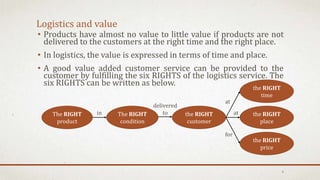
• Products have almost no value to little value if products are not
delivered to the customers at the right time and the right place.
• In logistics, the value is expressed in terms of time and place.
• A good value added customer service can be provided to the
customer by fulfilling the six RIGHTS of the logistics service. The
six RIGHTS can be written as below.
The RIGHT
product
The RIGHT
condition
the RIGHT
customer
the RIGHT
time
the RIGHT
place
the RIGHT
price
in
delivered
to
at
at
for
3
Objectives of logistics system
• Improve customer service
• Reliable and consistent service
• Life cycle support
4
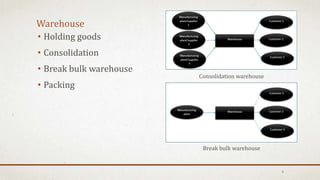
Warehouse
• Holding goods
• Consolidation
• Break bulk warehouse
• Packing
Consolidation warehouse
Break bulk warehouse
5
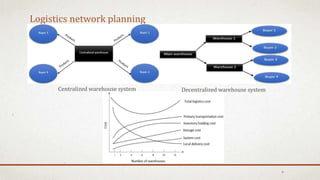
Logistics network planning
6
Centralized warehouse system Decentralized warehouse system
In-house logistics is defined simply as a manufacturing
company carrying out it’s logistics operations. In-house
logistics involves the following:
• Focusing on both the company’s core business and logistics
operations
• Investing in logistics infrastructure like warehouses, racking
systems, trucks and IT systems
• Bearing the risks associated with logistics operations like
lost goods, late deliveries, high stock discrepancies and
excessive/insufficient stock.
In-House Logistics
7
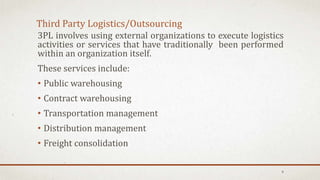
3PL involves using external organizations to execute logistics
activities or services that have traditionally been performed
within an organization itself.
These services include:
• Public warehousing
• Contract warehousing
• Transportation management
• Distribution management
• Freight consolidation
Third Party Logistics/Outsourcing
8
Advantages of using 3PL/Outsourcing:
• Flexibility
• Convenience
• Expertise
• Better transport rates
• Professionalism
Third Party Logistics/Outsourcing
9
Disadvantages of using 3PL/Outsourcing:
• Cost
• Loss of direct control
• Distance
• Potential loss of reputation
Third Party Logistics/Outsourcing
10
• A transportation management system (TMS) is a software
that facilitates interactions between an organization’s order
management system system (OMS) and its warehouse
management system (WMS) or distribution center (DC).
• A TMS software is a subset of supply chain management
concerning transportation operations and may be part of an
enterprise resource planning system.
Transportation Management System (TMS) Software
11
Functions of the TMS Software:
• Real time transportation tracking
• Transport costs and scheme simulation
• Shipment batching of orders
• Management of motor carrier, rail, air and maritime
transport
• Inbound and outbound transportation mode and
transportation provider selection
Transportation Management System (TMS) Software
12
Benefits of the TMS Software:
• Reduce freight expenses
• Track drivers in real-time
• Warehouse inventory management
• Streamlined billing process
• Increase supply chain efficiency
Transportation Management System (TMS) Software
13
Definition
• The efforts that measure and minimize environmental
impact in all activities related to logistics.
• Why should Green Logistics be chosen?
Green logistics
14
Some of the benefits:
• Reduction in CO2 footprints and emissions
• It unlocks significant amount of cost savings
• Improves optimization of supply chain
• More efficient packing
• Route optimization
Green logistics
15
Challenges that logistics management faces.
• Infrastructure Limitations
• Insufficient Planning
• Financial limitations
• Personnel resources
Challenges in logistics
16
• Logistics supply system is an important value adding
activity for the manufacturing firms.

• By a good logistics network planning, the total cost of the
logistics system can be reduced.
• If company wants to focus more on product development,
then the third party logistics is a good option.
• Green logistics should be promoted by manufacturing firm
to reduce waste and save environment.
Conclusion
17
• Rushton, Alan, Phil Croucher, and Peter Baker. The Handbook of Logistics and Distribution
Management. London: Kogan Page, 2006. Print.
• Sople, Vinod V. Logistics Management. N.p.: Pearson Education India, n.d. Print.
• Voortman, Craig. Global Logistics: Management. Lansdowne: Juta, 2004. Print.
• John Snow Inc./DELIVER, 2004. The Logistics Handbook: A Practical Guide for Supply Chain
Managers in Family Planning and Health Programs. Arlington, Va.: John Snow Inc./DELIVER,
for the U.S. Agency for International Development (USAID).
• Ballou, Ronald H. "BUSINESS LOGISTICS - IMPORTANCE AND SOME RESEARCH
OPPORTUNITIES." GESTÃO & PRODUÇÃO 4 (1997): 117-29. Web. 16 Nov. 2015.
<http://www.scielo.br/pdf/gp/v4n2/a01v4n2.pdf>.
• Dhl-discoverlogistics.com,. (2015). The changing face of logistics - DHL Logistik. Retrieved 12
November 2015, from https://www.dhl-
discoverlogistics.com/cms/en/course/origin/historical_development.jsp
References
18
Questions?
Thank You
19

Logistics in manufacturing system

  • 1.
    LOGISTICS IN MANUFACTURING MCG5179: Manufacturing System Analysis Section B (Friday) Presented By Utsav Patel (7946404 uOttawa) Ehireme Egbele (8064140 uOttawa) Tedj Machou (100963272 Carleton) University of Ottawa 4th December 2015
  • 2.
    • According to(CSCMP) Council of Supply Chain Management Professionals (2007), logistic is “a part of the supply chain process that plans, implements, and controls the efficient, effective forward and reverse flow and storage of goods, services, and related information between the point of origin and the point of consumption in order to meet customers’ requirements”. • During the construction of the pyramids (around 2700 B. C.), Egyptian pyramid construction techniques were used to transport and assemble huge blocks of stones at the construction sites. Giza pyramid is 146 meters high and weighs around 6 million tons. The weight of the each limestone stone was around 2.5 tons. Egypt engineers used a very innovative technique to transport such huge blocks to the construction site. • During the Second World War (1939-1945),the military of the United States provided their services and supplies to their troops at the right time and right place. They also tried to provide their services to their army in the most economical manner and whenever they want. Best military logistic techniques were developed during the World War 2. Definition and History of logistics 2
  • 3.
    Logistics and value •Products have almost no value to little value if products are not delivered to the customers at the right time and the right place. • In logistics, the value is expressed in terms of time and place. • A good value added customer service can be provided to the customer by fulfilling the six RIGHTS of the logistics service. The six RIGHTS can be written as below. The RIGHT product The RIGHT condition the RIGHT customer the RIGHT time the RIGHT place the RIGHT price in delivered to at at for 3
  • 4.
    Objectives of logisticssystem • Improve customer service • Reliable and consistent service • Life cycle support 4
  • 5.
    Warehouse • Holding goods •Consolidation • Break bulk warehouse • Packing Consolidation warehouse Break bulk warehouse 5
  • 6.
    Logistics network planning 6 Centralizedwarehouse system Decentralized warehouse system
  • 7.
    In-house logistics isdefined simply as a manufacturing company carrying out it’s logistics operations. In-house logistics involves the following: • Focusing on both the company’s core business and logistics operations • Investing in logistics infrastructure like warehouses, racking systems, trucks and IT systems • Bearing the risks associated with logistics operations like lost goods, late deliveries, high stock discrepancies and excessive/insufficient stock. In-House Logistics 7
  • 8.
    3PL involves usingexternal organizations to execute logistics activities or services that have traditionally been performed within an organization itself. These services include: • Public warehousing • Contract warehousing • Transportation management • Distribution management • Freight consolidation Third Party Logistics/Outsourcing 8
  • 9.
    Advantages of using3PL/Outsourcing: • Flexibility • Convenience • Expertise • Better transport rates • Professionalism Third Party Logistics/Outsourcing 9
  • 10.
    Disadvantages of using3PL/Outsourcing: • Cost • Loss of direct control • Distance • Potential loss of reputation Third Party Logistics/Outsourcing 10
  • 11.
    • A transportationmanagement system (TMS) is a software that facilitates interactions between an organization’s order management system system (OMS) and its warehouse management system (WMS) or distribution center (DC). • A TMS software is a subset of supply chain management concerning transportation operations and may be part of an enterprise resource planning system. Transportation Management System (TMS) Software 11
  • 12.
    Functions of theTMS Software: • Real time transportation tracking • Transport costs and scheme simulation • Shipment batching of orders • Management of motor carrier, rail, air and maritime transport • Inbound and outbound transportation mode and transportation provider selection Transportation Management System (TMS) Software 12
  • 13.
    Benefits of theTMS Software: • Reduce freight expenses • Track drivers in real-time • Warehouse inventory management • Streamlined billing process • Increase supply chain efficiency Transportation Management System (TMS) Software 13
  • 14.
    Definition • The effortsthat measure and minimize environmental impact in all activities related to logistics. • Why should Green Logistics be chosen? Green logistics 14
  • 15.
    Some of thebenefits: • Reduction in CO2 footprints and emissions • It unlocks significant amount of cost savings • Improves optimization of supply chain • More efficient packing • Route optimization Green logistics 15
  • 16.
    Challenges that logisticsmanagement faces. • Infrastructure Limitations • Insufficient Planning • Financial limitations • Personnel resources Challenges in logistics 16
  • 17.
    • Logistics supplysystem is an important value adding activity for the manufacturing firms. • By a good logistics network planning, the total cost of the logistics system can be reduced. • If company wants to focus more on product development, then the third party logistics is a good option. • Green logistics should be promoted by manufacturing firm to reduce waste and save environment. Conclusion 17
  • 18.
    • Rushton, Alan,Phil Croucher, and Peter Baker. The Handbook of Logistics and Distribution Management. London: Kogan Page, 2006. Print. • Sople, Vinod V. Logistics Management. N.p.: Pearson Education India, n.d. Print. • Voortman, Craig. Global Logistics: Management. Lansdowne: Juta, 2004. Print. • John Snow Inc./DELIVER, 2004. The Logistics Handbook: A Practical Guide for Supply Chain Managers in Family Planning and Health Programs. Arlington, Va.: John Snow Inc./DELIVER, for the U.S. Agency for International Development (USAID). • Ballou, Ronald H. "BUSINESS LOGISTICS - IMPORTANCE AND SOME RESEARCH OPPORTUNITIES." GESTÃO & PRODUÇÃO 4 (1997): 117-29. Web. 16 Nov. 2015. <http://www.scielo.br/pdf/gp/v4n2/a01v4n2.pdf>. • Dhl-discoverlogistics.com,. (2015). The changing face of logistics - DHL Logistik. Retrieved 12 November 2015, from https://www.dhl- discoverlogistics.com/cms/en/course/origin/historical_development.jsp References 18
  • 19.