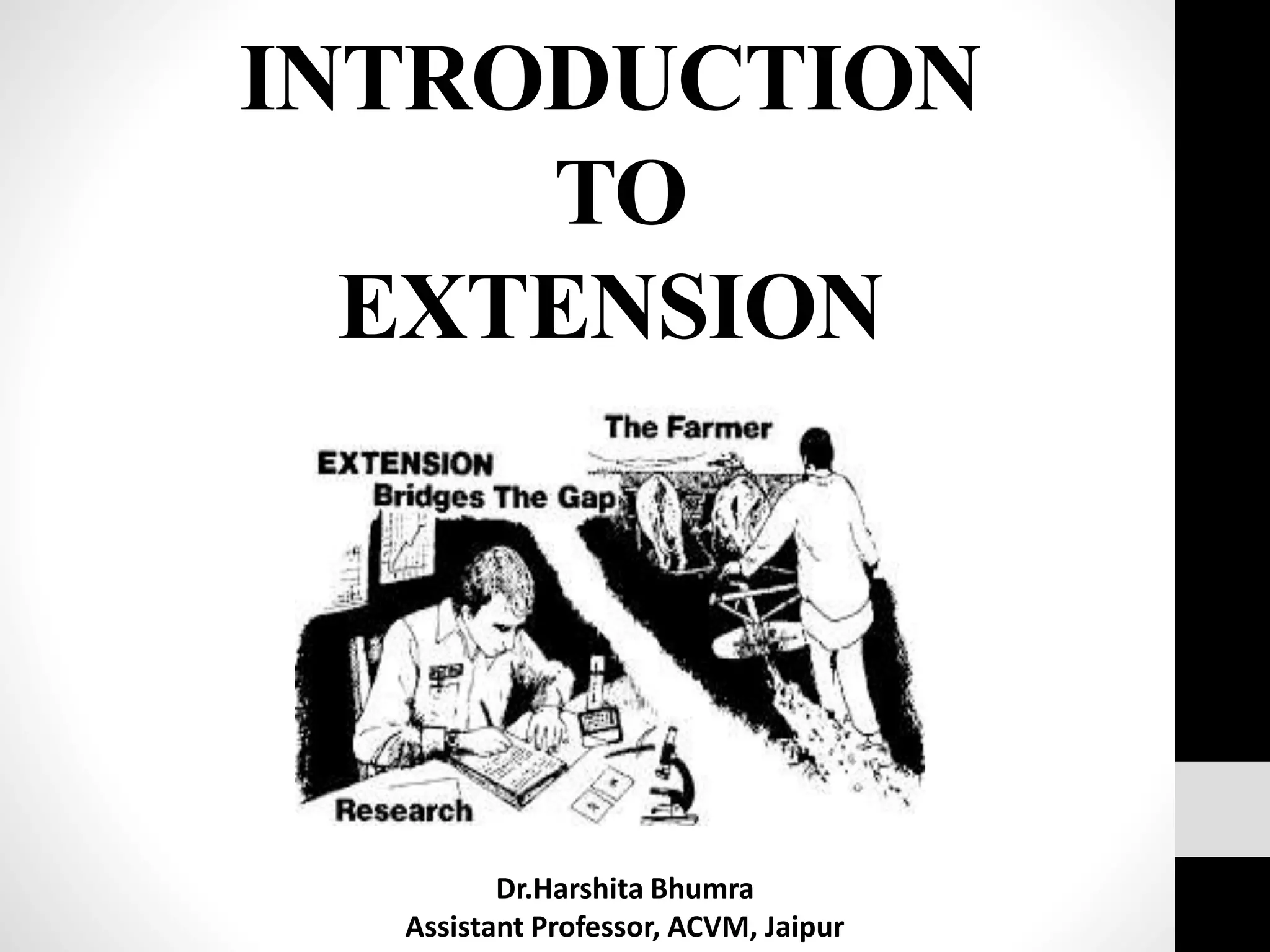

INTRODUCTION
TO
EXTENSION
Dr.Harshita Bhumra
Assistant Professor, ACVM, Jaipur
• Introduction
• The History of Extension
• The Meaning of Extension
• The Components of Extension
• The Philosophy, Objectives, Functions and
Scope of Extension
• Principles of Extension
• Process of Extension
• Extension and Development
The word Extension is derived from the Latin
roots, “tensio” meaning “stretching, and “ex”
meaning “out”.
Thus the term “Extension Education” means
the type of education which is “stretched out” into
the villages and fields beyond the limits of the schools
and colleges to which the formal type of education is
normally confined.
Extension – Non-formal Education
Education
Education is the process of bringing desirable
change into the behaviour of human beings.
The education is effective when it results in
changes in all the behavioral components.
• What an individual knows (Knowledge)
• What he can do (Physical & Mental skills)
• What he thinks (Attitudes)
• What he actually does (Action)
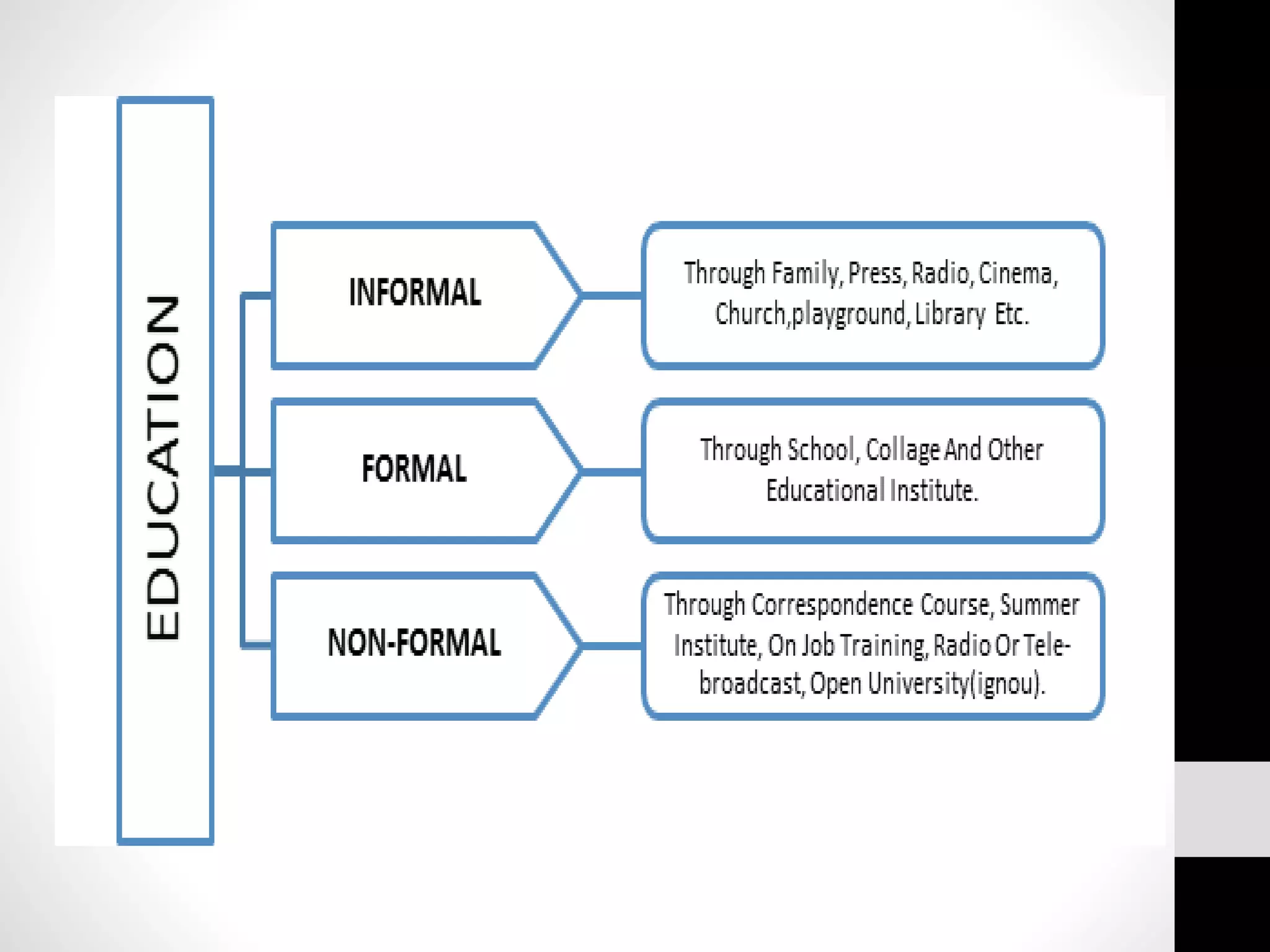
Types of Education
• Coombs & Ahmed (1974) drew a distinction
between the three types of education as follows:
A. Formal Education
B. Informal Education
C. Non- Informal Education
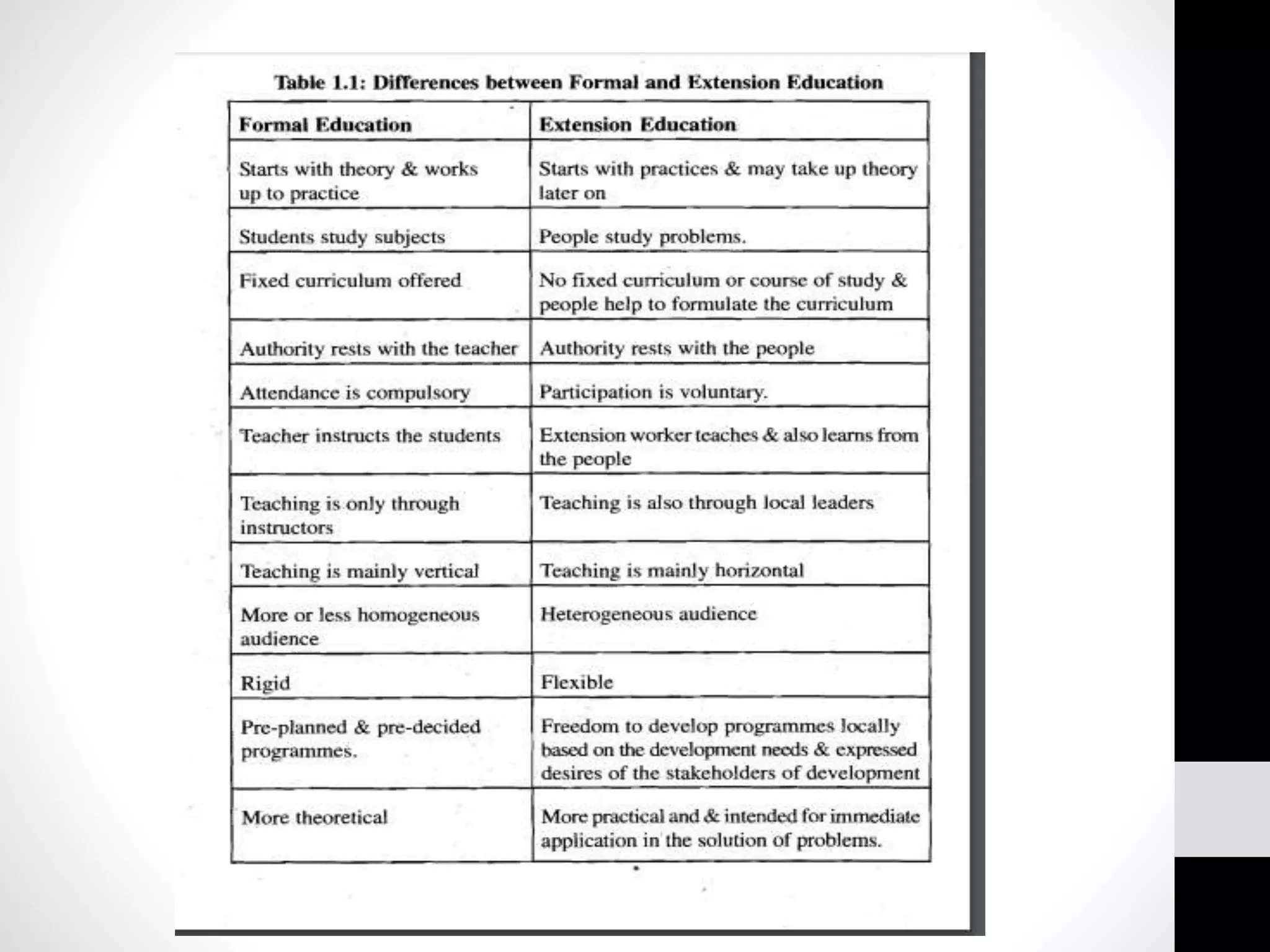
A. Formal Education:
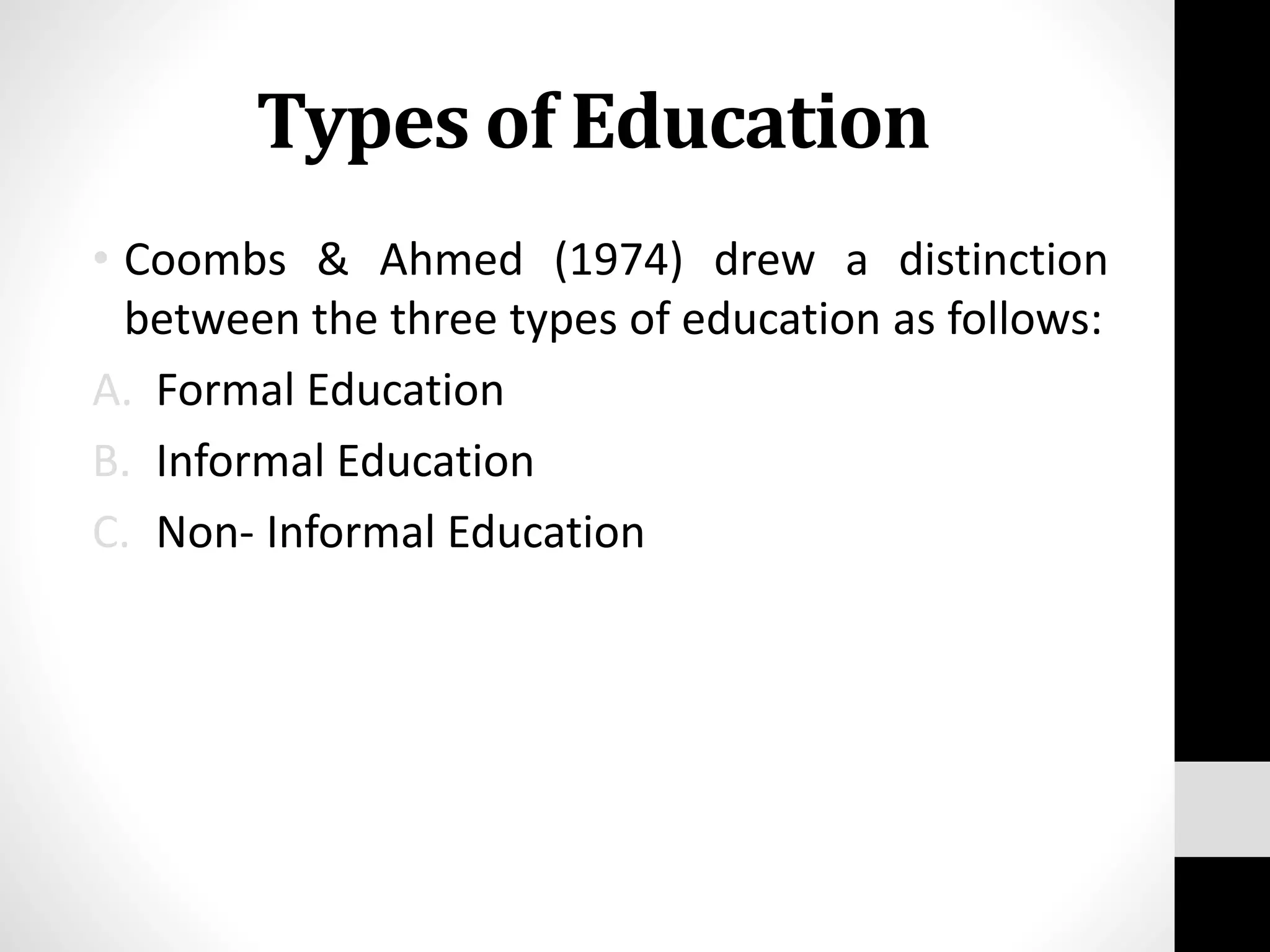
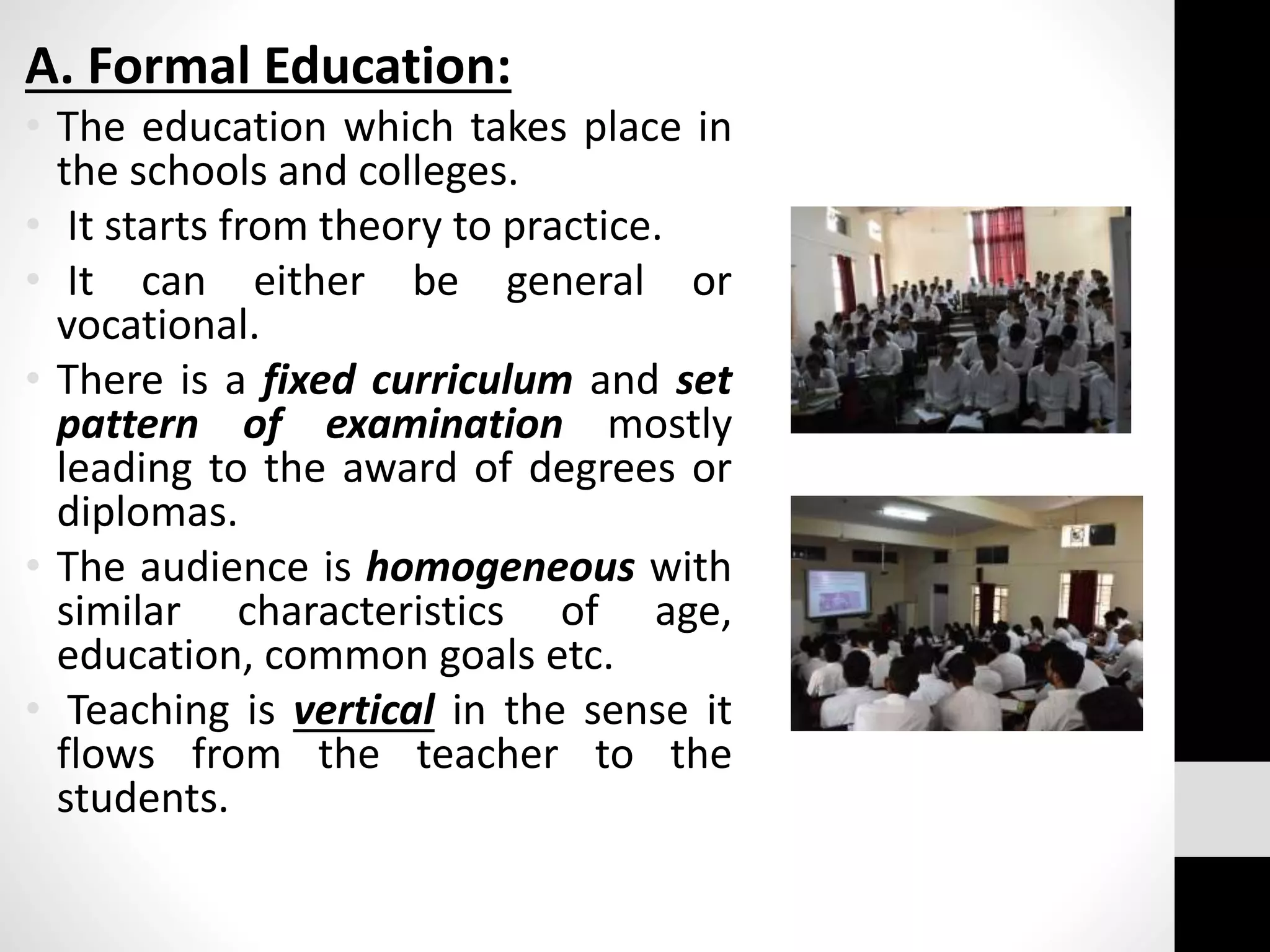
• The education which takes place in
the schools and colleges.
• It starts from theory to practice.
• It can either be general or
vocational.
• There is a fixed curriculum and set
pattern of examination mostly
leading to the award of degrees or
diplomas.
• The audience is homogeneous with
similar characteristics of age,
education, common goals etc.
• Teaching is vertical in the sense it
flows from the teacher to the
students.
B. Informal Education:
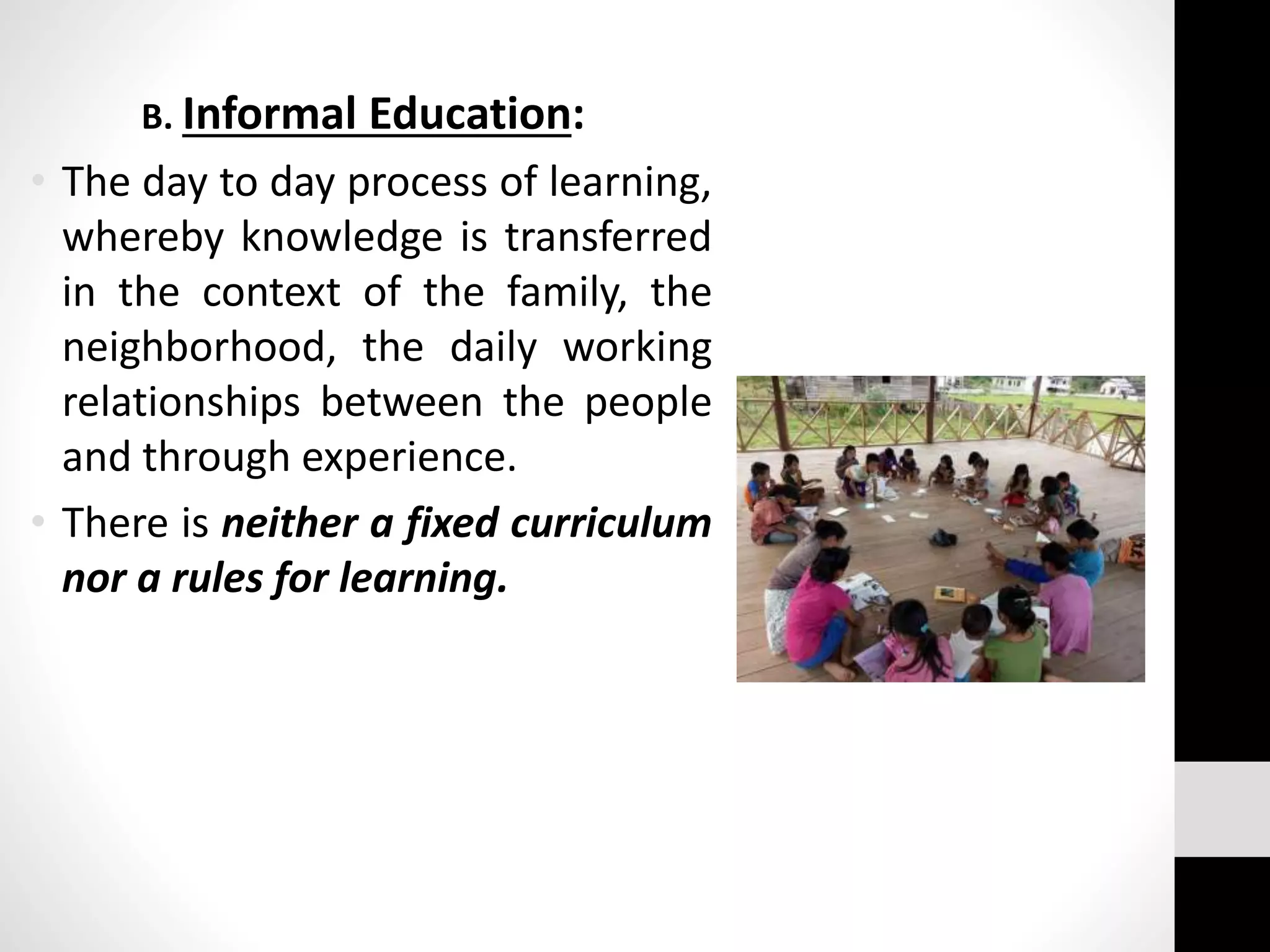
• The day to day process of learning,
whereby knowledge is transferred
in the context of the family, the
neighborhood, the daily working
relationships between the people
and through experience.
• There is neither a fixed curriculum
nor a rules for learning.
C. Non-formal Education :
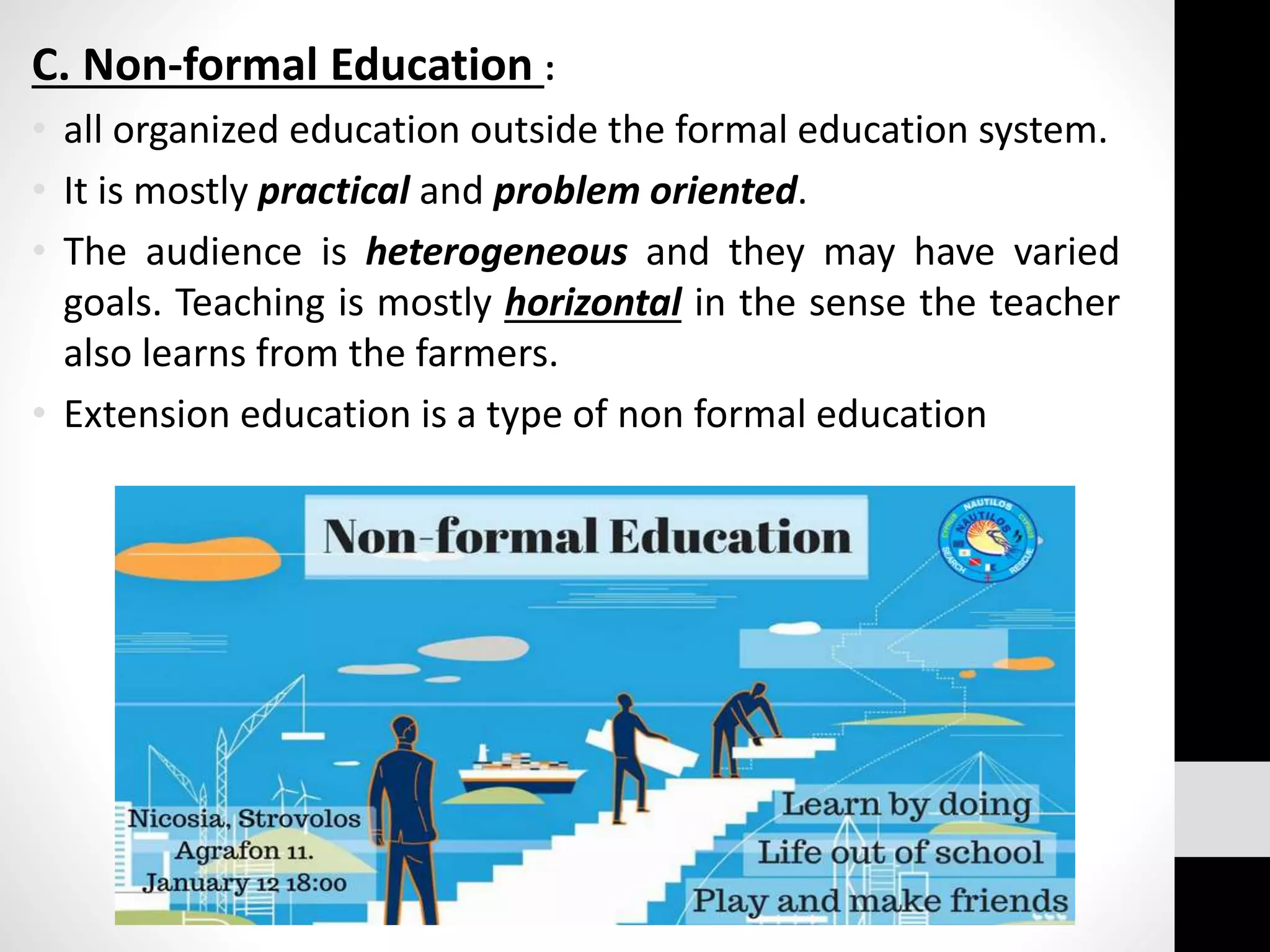
• all organized education outside the formal education system.
• It is mostly practical and problem oriented.
• The audience is heterogeneous and they may have varied
goals. Teaching is mostly horizontal in the sense the teacher
also learns from the farmers.
• Extension education is a type of non formal education
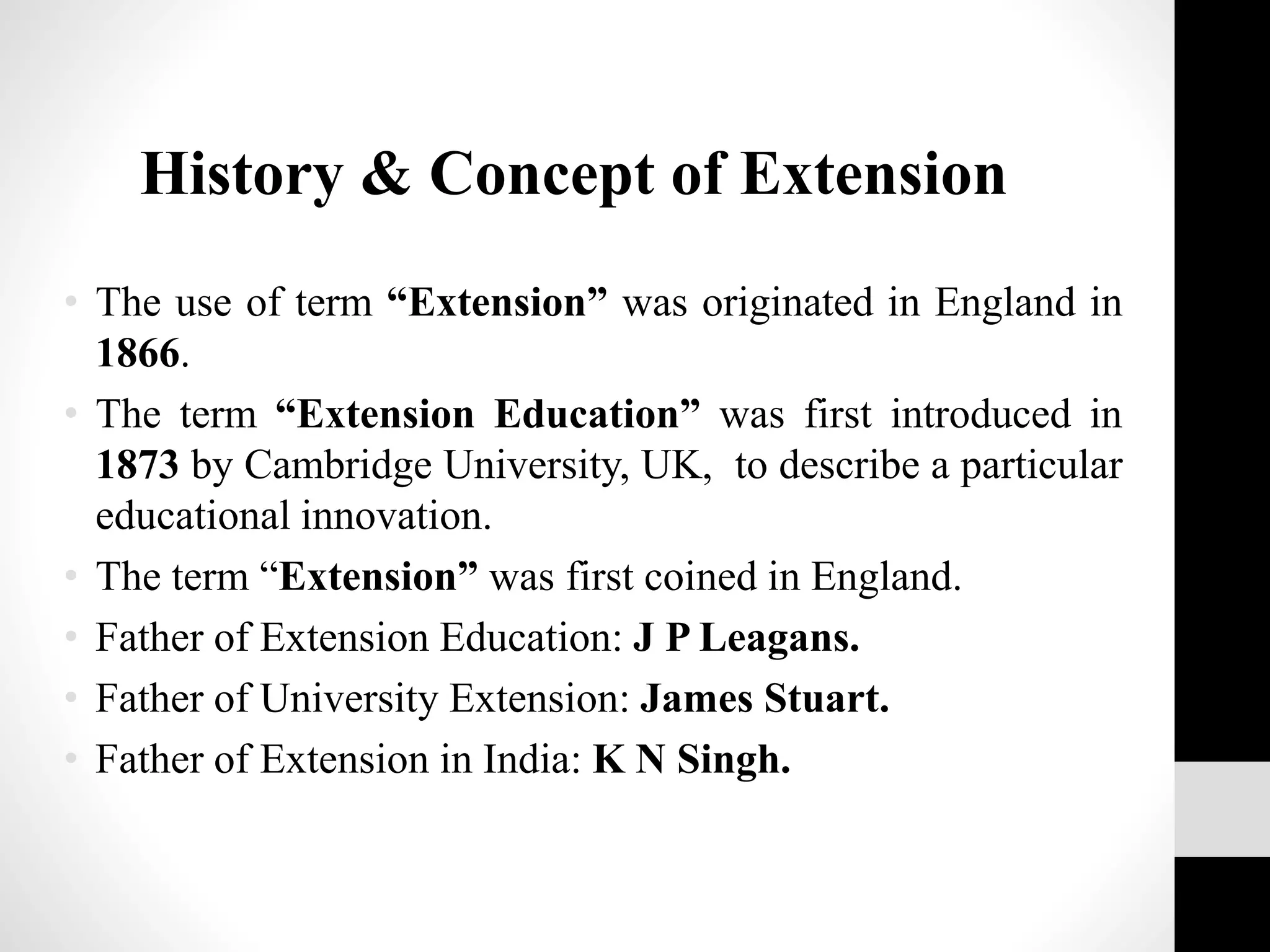
• The use of term “Extension” was originated in England in
1866.
• The term “Extension Education” was first introduced in
1873 by Cambridge University, UK, to describe a particular
educational innovation.
• The term “Extension” was first coined in England.
• Father of Extension Education: J P Leagans.
• Father of University Extension: James Stuart.
• Father of Extension in India: K N Singh.
History & Concept of Extension
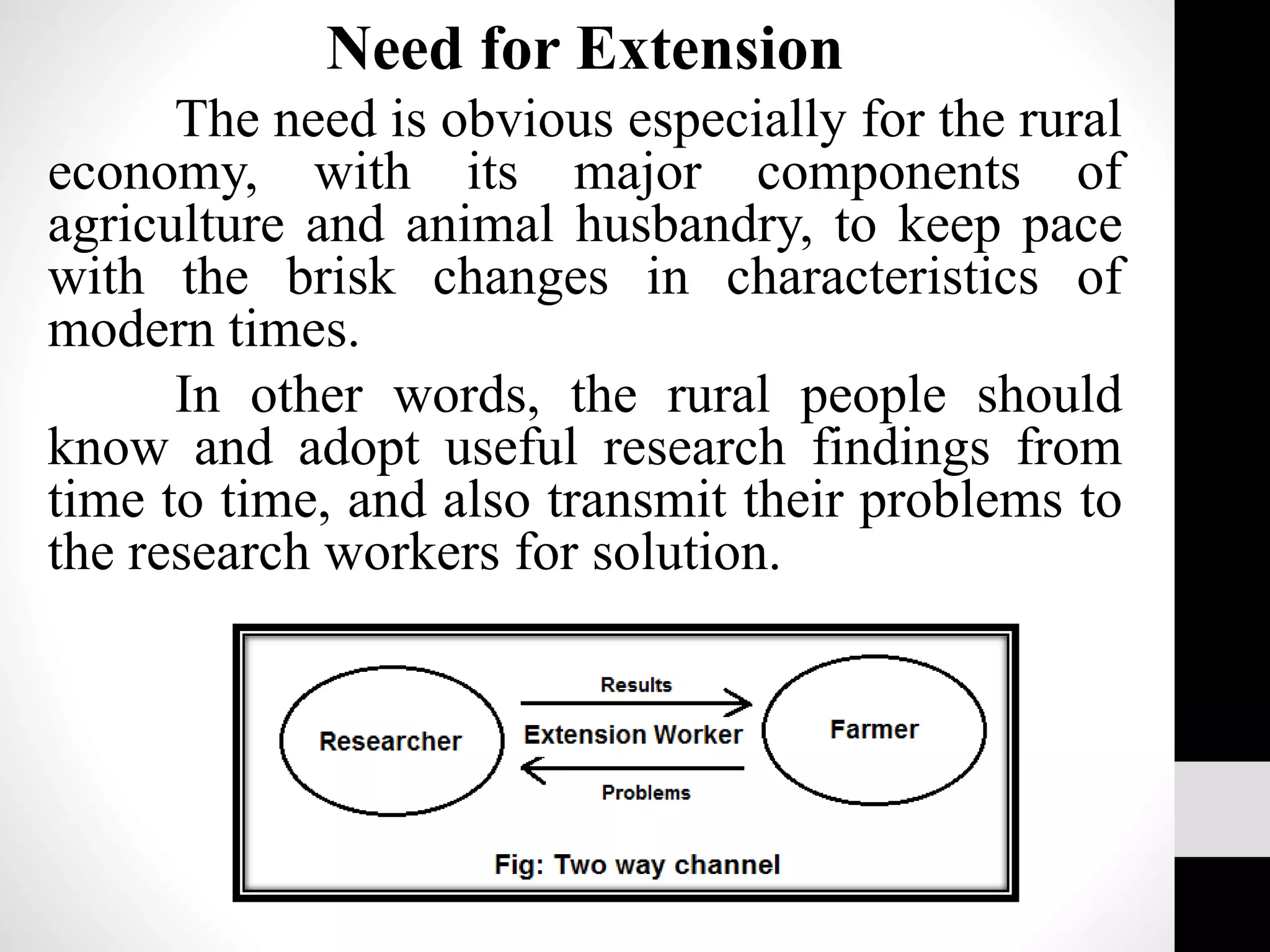
Need for Extension
The need is obvious especially for the rural
economy, with its major components of
agriculture and animal husbandry, to keep pace
with the brisk changes in characteristics of
modern times.
In other words, the rural people should
know and adopt useful research findings from
time to time, and also transmit their problems to
the research workers for solution.
Need for studying Extension
To be a successful extension worker he
should not only know what to teach, but also how to
teach people.
In other words, it is not enough that he is
equipped with technical knowledge in subject
matter fields; but also he should have the ability to
successfully communicate his ideas to the people,
taking the personal social and situational factors
into consideration.
Definition
Extension Education is an applied science consisting of
contents derived from research, accumulated field experiences and
relevant principles drawn from behavioral sciences synthesized with
useful technology into a body of philosophy, principles, contents and
methods focused on the problems of out of school education for
adults and youth. (Paul Leagans, 1961)
Animal Husbandry Extension may be defined as a special
branch of extension education which deals with the people through
educational procedures, in improving livestock farming methods and
techniques, increasing the livestock production, efficiency and
income, stepping up the level of living and elevating the educational
standards of rural life, through the development of livestock farmers.
Objectives of Extension
Objectives are expression of the ends towards which our efforts are
directed.
1. To assist people to discover and analyze their problems
and identify the felt needs.
2.To develop leadership among people and help them in
organizing groups to solve their problems.
3. To disseminate research information of economic and
practical importance in a way people would be able to
understand and use.
4. To assist people in mobilizing and utilizing the resources
which they have and which they need from outside.
5. To collect and transmit feedback information for solving
management problems.
Function of Extension
The function of extension is to bring about desirable
changes in human behaviour by means of education.
• Change in knowledge
• Change in skill
• Change in attitude
• Change in understanding
• Change in goal
• Change in action
• Change in confidence
• Change in behaviour
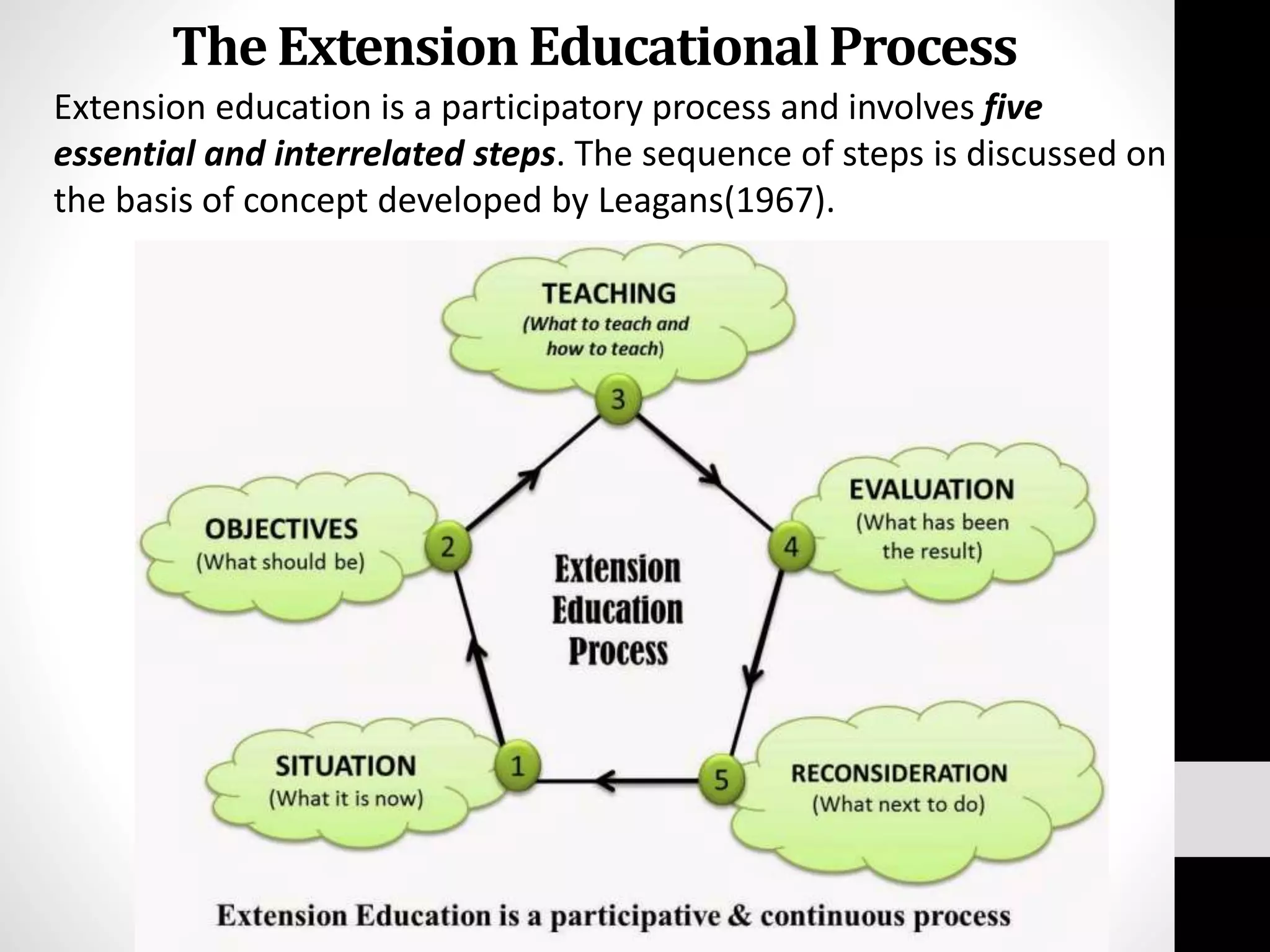
The Extension EducationalProcess
Extension education is a participatory process and involves five
essential and interrelated steps. The sequence of steps is discussed on
the basis of concept developed by Leagans(1967).
Principles of Extension
1. Principle of Cultural Difference
2. Grass Roots Principle
3. Principle of Indigenous Knowledge
4. Principle of Interests and Needs
5. Principle of Learning by Doing
6. Principle of Participation
7. Family Principle
8. Principle of Leadership
9. Principle of Adaptability
10. Principle of Satisfaction
11. Principle of Evaluation
1. Intoduction to Extension.pptx

1. Intoduction to Extension.pptx

  • 1.
  • 2.
    • Introduction • TheHistory of Extension • The Meaning of Extension • The Components of Extension • The Philosophy, Objectives, Functions and Scope of Extension • Principles of Extension • Process of Extension • Extension and Development
  • 3.
    The word Extensionis derived from the Latin roots, “tensio” meaning “stretching, and “ex” meaning “out”. Thus the term “Extension Education” means the type of education which is “stretched out” into the villages and fields beyond the limits of the schools and colleges to which the formal type of education is normally confined. Extension – Non-formal Education
  • 4.
    Education Education is theprocess of bringing desirable change into the behaviour of human beings. The education is effective when it results in changes in all the behavioral components. • What an individual knows (Knowledge) • What he can do (Physical & Mental skills) • What he thinks (Attitudes) • What he actually does (Action)
  • 5.
    Types of Education •Coombs & Ahmed (1974) drew a distinction between the three types of education as follows: A. Formal Education B. Informal Education C. Non- Informal Education
  • 6.
    A. Formal Education: •The education which takes place in the schools and colleges. • It starts from theory to practice. • It can either be general or vocational. • There is a fixed curriculum and set pattern of examination mostly leading to the award of degrees or diplomas. • The audience is homogeneous with similar characteristics of age, education, common goals etc. • Teaching is vertical in the sense it flows from the teacher to the students.
  • 7.
    B. Informal Education: •The day to day process of learning, whereby knowledge is transferred in the context of the family, the neighborhood, the daily working relationships between the people and through experience. • There is neither a fixed curriculum nor a rules for learning.
  • 8.
    C. Non-formal Education: • all organized education outside the formal education system. • It is mostly practical and problem oriented. • The audience is heterogeneous and they may have varied goals. Teaching is mostly horizontal in the sense the teacher also learns from the farmers. • Extension education is a type of non formal education
  • 11.
    • The useof term “Extension” was originated in England in 1866. • The term “Extension Education” was first introduced in 1873 by Cambridge University, UK, to describe a particular educational innovation. • The term “Extension” was first coined in England. • Father of Extension Education: J P Leagans. • Father of University Extension: James Stuart. • Father of Extension in India: K N Singh. History & Concept of Extension
  • 12.
    Need for Extension Theneed is obvious especially for the rural economy, with its major components of agriculture and animal husbandry, to keep pace with the brisk changes in characteristics of modern times. In other words, the rural people should know and adopt useful research findings from time to time, and also transmit their problems to the research workers for solution.
  • 13.
    Need for studyingExtension To be a successful extension worker he should not only know what to teach, but also how to teach people. In other words, it is not enough that he is equipped with technical knowledge in subject matter fields; but also he should have the ability to successfully communicate his ideas to the people, taking the personal social and situational factors into consideration.
  • 14.
    Definition Extension Education isan applied science consisting of contents derived from research, accumulated field experiences and relevant principles drawn from behavioral sciences synthesized with useful technology into a body of philosophy, principles, contents and methods focused on the problems of out of school education for adults and youth. (Paul Leagans, 1961) Animal Husbandry Extension may be defined as a special branch of extension education which deals with the people through educational procedures, in improving livestock farming methods and techniques, increasing the livestock production, efficiency and income, stepping up the level of living and elevating the educational standards of rural life, through the development of livestock farmers.
  • 15.
    Objectives of Extension Objectivesare expression of the ends towards which our efforts are directed. 1. To assist people to discover and analyze their problems and identify the felt needs. 2.To develop leadership among people and help them in organizing groups to solve their problems. 3. To disseminate research information of economic and practical importance in a way people would be able to understand and use. 4. To assist people in mobilizing and utilizing the resources which they have and which they need from outside. 5. To collect and transmit feedback information for solving management problems.
  • 16.
    Function of Extension Thefunction of extension is to bring about desirable changes in human behaviour by means of education. • Change in knowledge • Change in skill • Change in attitude • Change in understanding • Change in goal • Change in action • Change in confidence • Change in behaviour
  • 17.
    The Extension EducationalProcess Extensioneducation is a participatory process and involves five essential and interrelated steps. The sequence of steps is discussed on the basis of concept developed by Leagans(1967).
  • 18.
    Principles of Extension 1.Principle of Cultural Difference 2. Grass Roots Principle 3. Principle of Indigenous Knowledge 4. Principle of Interests and Needs 5. Principle of Learning by Doing 6. Principle of Participation 7. Family Principle 8. Principle of Leadership 9. Principle of Adaptability 10. Principle of Satisfaction 11. Principle of Evaluation