RVSKVV, Gwalior
K.N.K. College of Horticulture, Mandsaur (M.P.)
K.N.K.
COLLEGE
OF
HORTICULTURE,
MANDSAUR
Course Title : Fundamentals of Extension Education
(EXT311)
Credit : 2(1+1)
Topic: Extension Education
❖ Introduction
❖ Definition of Extension Education
❖ Types of Education
❖ Extension Education Principles
❖ Need of Extension Education
❖ Scope of Extension Education
❖ Future Challenges for Extension
❖ Reference
The word ‘Extension’ is derived from Latin roots: ‘ex’ means- ‘out’ and
‘tensio’ mean- ‘stretching’.
The term ‘extension’ originated in United Kingdom (U.K.) in 1866.
The system of University Extension- first taken by the Cambridge & the
Oxford Universities.
The Cambridge University first used the term ‘extension education’- in
1873.
The term ‘Education’ was derived from the Latin roots: ‘educare’ means
‘lead out’.
Introduction
Education: desirable change in human behaviour through
the process of teaching & learning.
Extension: method of non-formal education aimed at
behaviour changes in its clients through increased in their
knowledge, skills, attitudes and income.
Extension refers to the actual work done by professional
extension agents at various levels of management while extension
education- referred to the body of knowledge concerning that work
practice (Rolling, 1982).
Definitions
Extension is education and that its purpose is to change
attitudes and practices of the people with whom the work is done
(Ensminger, 1957).
Extension education is an applied science consisting of content
derived from research, accumulated field experiences and relevant
principles drawn from the behavioural sciences synthesized with
useful technology into a body of philosophy, principles, content and
methods focused on the problems of out-of-school education for
adults and youth (Leagans, 1961).
Definitions
Extension is basically an educational function. Its job may
very considerable from country to country, but without exception it
will be expected to inform, advice and educate people in a practical
manner (Watts, 1984).
Extension is to bring desirable changes in the behaviour,
knowledge, skills, attitude, understanding, goals and confidence of the
people through mutual learning (Bhatnagar and Desai).
Informal Education: lifelong process by which every person
acquires and accumulates knowledge, skills, attitudes,
understanding and insights from their daily experiences and
exposure to the environment at home, at work and at play.
Formal Education: the highly institutionalized, chronologically
graded and hierarchically structured educational system, spanning
lower primary school and the upper reaches of the university.
Types of Education
Non-Formal Education: an organized, systematic, educational
activity carried on outside the framework of the formal system to
provide selected types of learning to particular sub-groups in the
population, adults as well as children according to their needs.
Non Formal education key elements: Learner-centered, flexibility
in curriculum, build informal human relationships, educational
content & methods are directly related to learners life styles and less
bureaucratic control.
Types of Education
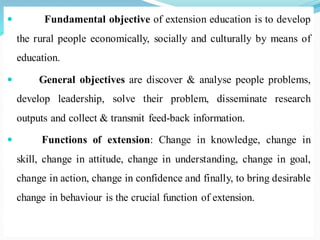
 Fundamental objective of extension education is to develop
the rural people economically, socially and culturally by means of
education.
 General objectives are discover & analyse people problems,
develop leadership, solve their problem, disseminate research
outputs and collect & transmit feed-back information.
 Functions of extension: Change in knowledge, change in
skill, change in attitude, change in understanding, change in goal,
change in action, change in confidence and finally, to bring desirable
change in behaviour is the crucial function of extension.
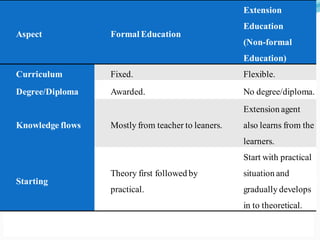
Aspect Formal Education
Extension
Education
(Non-formal
Education)
Curriculum Fixed. Flexible.
Degree/Diploma Awarded. No degree/diploma.
Knowledge flows Mostly from teacher to leaners.
Extension agent
also learns from the
learners.
Starting
Theory first followed by
practical.
Start with practical
situation and
gradually develops
in to theoretical.
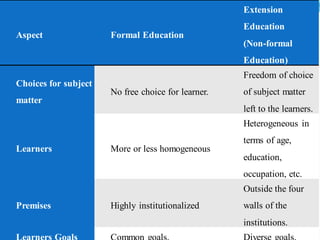
Aspect Formal Education
Extension
Education
(Non-formal
Education)
Choices for subject
matter
No free choice for learner.
Freedom of choice
of subject matter
left to the learners.
Learners More or less homogeneous
Heterogeneous in
terms of age,
education,
occupation, etc.
Premises Highly institutionalized
Outside the four
walls of the
institutions.
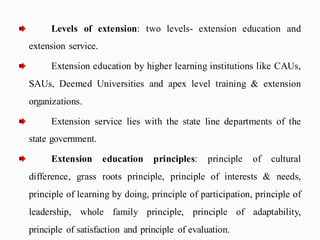
Levels of extension: two levels- extension education and
extension service.
Extension education by higher learning institutions like CAUs,
SAUs, Deemed Universities and apex level training & extension
organizations.
Extension service lies with the state line departments of the
state government.
Extension education principles: principle of cultural
difference, grass roots principle, principle of interests & needs,
principle of learning by doing, principle of participation, principle of
leadership, whole family principle, principle of adaptability,
principle of satisfaction and principle of evaluation.
People’s needs and interests are the starting points of extension
work. Identifying the real needs and interests of the people are
challenging tasks of Extension agents. The Extension agents should
not pass on their own needs and interests as those of the people.
Extension work shall be successful only when it is based on the
interests and needs of the people as they see them. To be effective,
extension work must begin with the needs and interests of people.
Principle of needs and interests
Culture simply means social heritage. There is cultural
difference between the extension agents and the farmers. The cultural
differences are also exists between the farmers groups. The differences
may be in their Habits, Customs, Values, Attitudes, beliefs, Way of life
etc. Extension work, to be successful, must be carried out in
harmony with the cultural pattern of the people. The approach and
procedures must be suited to the culture of the people. Extension is
working in harmony with the people.
Principles of Cultural Difference
Extension programmes should start with local groups, local
situations and local problems. It must fit to the local conditions.
Extension work should start with where people are and what they have.
Change should start from the existing situation
Principles of Grass root Approach
In extension work, farmers should be encouraged to learn new
things by doing and direct participation. Learning remains far from
perfect, unless people get involved in actually doing the work.
Learning by doing is most effective in changing people’s behavior.
This develops confidence as it involves maximum number of sensory
organs. People should learn what to do, why to do, how to do and with
what result.
Principle of learning by doing
Indigenous knowledge systems have developed through
generations of work experiences & problem solving in their own
specific situations. The indigenous knowledge systems encompass all
aspects of life and people consider it essential for their survival.
Therefore, the extension agent should try to understand them and their
ramifications in the life of the people, before proceeding to recommend
something new to him.
Principle of Indigenous Knowledge
Cooperation and Participation of people in extension
programme should be ensured. Most people of the village community
should willingly cooperate and participate in identifying the problems,
planning of projects for solving the problems and implementing the
projects in getting desired results. The participation of the people is of
fundamental importance for the success of an extension programme.
People must share in developing and implementing the programme and
feel that it is their own programme.
Principle of Cooperation and Participation
Family is the primary unit of society. The target for extension
work should, therefore, be developing the Family as a whole, socially
and economically. Hence, the farmers, the farm women and farm
youth are also to be involved in extension programmes. This is
because, extension programme effects all members of the family,
family members have great influence in decision making, it creates
mutual understanding, it helps in money management, it balances farm
and family needs, it educates the younger members etc.
Principle of Whole FamilyApproach
Identifying different types of leaders and working through
them is essential in extension. Leadership traits are to be developed in
the people so that they on their own shall seek change from less
desirable to more desirable situation. The leaders may be trained and
developed to act as carriers of change in the villages. Local leaders are
the custodians of local thoughts and actions. The involvement of local
leaders and legitimization by them are essential for the success of a
programme.
Principle of Leadership
Extension work and extension teaching methods must be
flexible and adaptable to suit the local conditions. This is necessary
because People, Situation, Resources & Constraints vary from place to
place and time to time. An extension programme should be flexible, so
that necessary changes can be made whenever needed to meet the
varying conditions. No single extension teaching method is effective
under all situations. Thus, the extension methods must have flexibility
to be adapted to members of a community who differ in age,
education, economic and social status.
Principle of Flexibility and Adaptability
The end product of extension work should produce satisfying
results for the people. Satisfaction of the people is very essential in
extension work. In a democratic country/ set up people cannot be run
in a mechanized way. People should derive full satisfaction from
extension work. Satisfaction is the key to success in extension work. “A
satisfied customer is the best advertisement”. Satisfying results
reinforce Learning & Motivate people to seek further improvement.
Principle of Satisfaction
Monitoring and evaluation prevents stagnation. There should
be a continuous built-in mechanism of finding out the extent to which
the results obtained are in agreement with the objectives fixed earlier.
Evaluation should indicate the gaps and steps to be taken for further
improvement.
Principle of Monitoring and Evaluation
Extension work is democratic both in philosophy and
procedure. It aims to operate through discussion and suggestion. Facts
about a situation are shared with the people. All possible alternative
solutions are placed before the participants and their merits are
highlighted through mutual discussions. Ultimately, the people are left
free to decide their line of action, the methods to be adopted in the
local situation with their own resources and available government
assistance.
Principle of democratic approach
The researchers neither have any time nor they equipped for
the job of persuading and convincing the farmers to adopt scientific
methods as well as to ascertain from their problems, similarly, it is not
possible for all the farmers to always visit the research stations to get
first-hand information for solving this problem extension system play a
important link between the research system and the farmers for
interpretation of finding of the research to farmers and providing
feedback from farmers to research station for modification of
technology.
Need of Extension Education
Scope of Extension Education
Extension appears to have unlimited scope in
situations where there is need for creating
awareness amongst the people and changing their
behaviour by informing and educating them.
Kelsey and Hearne (1967) identified nine areas of
programme emphasis, which indicate the
scope of agricultural extension.
• Efficiency in agricultural production.
• Efficiency in marketing, distribution and utilization.
Scope of Extension Education
• Conservation, development and use of natural
resources.
• Management on the farm and in the home.
• Family living.
• Youth development.
• Leadership development.
• Community development and rural area development.
• Public affairs.
Scope of Extension Education
Extension is an integral part of agricultural and rural development programmes in India.
The progress in production which has been achieved in agriculture, horticulture, animal
husbandry, veterinary, fishery, social forestry, sericulture etc., may be thought of as
proportional to the strength of extension service of the relevant government
departments.
The following statements will further amplify the scope of extension
1. Extension is fundamentally a system of out-of-school education for adults and
youths alike. Extension is education for all village people.
2. Extension is bringing about desirable changes in the knowledge, attitudes and
skills of people.
3. Extension is helping people to help themselves.
4. Extension is working with men and women, boys and girls, to answer their felt
needs and wants.
5. Extension is teaching through "learning by doing" and "seeing is believing“.
Scope of Extension Education
6. Extension is working in harmony with the culture of the
people.
7. Extension is a two-way channel; it brings scientific
information to village people and it also takes the problems
of the village people to the scientific institutes for solution.
8. Extension is working together (in groups) to expand the
welfare and happiness of the people with their own families,
their own villages, their own country and the world.
9. Extension is development of individuals in their day-to-day
living, development of their leaders, their society and their
world as a whole.
❖Demands a System of Market-led Extension
❖Management of Knowledge
Future Challenges for Extension
 Ray GL. 2005. Extension Communication and Management.
Kalyani Publ.
Reference:
lecture   for   3rd   year   notes.  pdf

lecture for 3rd year notes. pdf

  • 1.
    RVSKVV, Gwalior K.N.K. Collegeof Horticulture, Mandsaur (M.P.) K.N.K. COLLEGE OF HORTICULTURE, MANDSAUR Course Title : Fundamentals of Extension Education (EXT311) Credit : 2(1+1) Topic: Extension Education
  • 2.
    ❖ Introduction ❖ Definitionof Extension Education ❖ Types of Education ❖ Extension Education Principles ❖ Need of Extension Education ❖ Scope of Extension Education ❖ Future Challenges for Extension ❖ Reference
  • 3.
    The word ‘Extension’is derived from Latin roots: ‘ex’ means- ‘out’ and ‘tensio’ mean- ‘stretching’. The term ‘extension’ originated in United Kingdom (U.K.) in 1866. The system of University Extension- first taken by the Cambridge & the Oxford Universities. The Cambridge University first used the term ‘extension education’- in 1873. The term ‘Education’ was derived from the Latin roots: ‘educare’ means ‘lead out’. Introduction
  • 4.
    Education: desirable changein human behaviour through the process of teaching & learning. Extension: method of non-formal education aimed at behaviour changes in its clients through increased in their knowledge, skills, attitudes and income. Extension refers to the actual work done by professional extension agents at various levels of management while extension education- referred to the body of knowledge concerning that work practice (Rolling, 1982). Definitions
  • 5.
    Extension is educationand that its purpose is to change attitudes and practices of the people with whom the work is done (Ensminger, 1957). Extension education is an applied science consisting of content derived from research, accumulated field experiences and relevant principles drawn from the behavioural sciences synthesized with useful technology into a body of philosophy, principles, content and methods focused on the problems of out-of-school education for adults and youth (Leagans, 1961). Definitions
  • 6.
    Extension is basicallyan educational function. Its job may very considerable from country to country, but without exception it will be expected to inform, advice and educate people in a practical manner (Watts, 1984). Extension is to bring desirable changes in the behaviour, knowledge, skills, attitude, understanding, goals and confidence of the people through mutual learning (Bhatnagar and Desai).
  • 7.
    Informal Education: lifelongprocess by which every person acquires and accumulates knowledge, skills, attitudes, understanding and insights from their daily experiences and exposure to the environment at home, at work and at play. Formal Education: the highly institutionalized, chronologically graded and hierarchically structured educational system, spanning lower primary school and the upper reaches of the university. Types of Education
  • 8.
    Non-Formal Education: anorganized, systematic, educational activity carried on outside the framework of the formal system to provide selected types of learning to particular sub-groups in the population, adults as well as children according to their needs. Non Formal education key elements: Learner-centered, flexibility in curriculum, build informal human relationships, educational content & methods are directly related to learners life styles and less bureaucratic control. Types of Education
  • 9.
     Fundamental objectiveof extension education is to develop the rural people economically, socially and culturally by means of education.  General objectives are discover & analyse people problems, develop leadership, solve their problem, disseminate research outputs and collect & transmit feed-back information.  Functions of extension: Change in knowledge, change in skill, change in attitude, change in understanding, change in goal, change in action, change in confidence and finally, to bring desirable change in behaviour is the crucial function of extension.
  • 10.
    Aspect Formal Education Extension Education (Non-formal Education) CurriculumFixed. Flexible. Degree/Diploma Awarded. No degree/diploma. Knowledge flows Mostly from teacher to leaners. Extension agent also learns from the learners. Starting Theory first followed by practical. Start with practical situation and gradually develops in to theoretical.
  • 11.
    Aspect Formal Education Extension Education (Non-formal Education) Choicesfor subject matter No free choice for learner. Freedom of choice of subject matter left to the learners. Learners More or less homogeneous Heterogeneous in terms of age, education, occupation, etc. Premises Highly institutionalized Outside the four walls of the institutions.
  • 12.
    Levels of extension:two levels- extension education and extension service. Extension education by higher learning institutions like CAUs, SAUs, Deemed Universities and apex level training & extension organizations. Extension service lies with the state line departments of the state government. Extension education principles: principle of cultural difference, grass roots principle, principle of interests & needs, principle of learning by doing, principle of participation, principle of leadership, whole family principle, principle of adaptability, principle of satisfaction and principle of evaluation.
  • 13.
    People’s needs andinterests are the starting points of extension work. Identifying the real needs and interests of the people are challenging tasks of Extension agents. The Extension agents should not pass on their own needs and interests as those of the people. Extension work shall be successful only when it is based on the interests and needs of the people as they see them. To be effective, extension work must begin with the needs and interests of people. Principle of needs and interests
  • 14.
    Culture simply meanssocial heritage. There is cultural difference between the extension agents and the farmers. The cultural differences are also exists between the farmers groups. The differences may be in their Habits, Customs, Values, Attitudes, beliefs, Way of life etc. Extension work, to be successful, must be carried out in harmony with the cultural pattern of the people. The approach and procedures must be suited to the culture of the people. Extension is working in harmony with the people. Principles of Cultural Difference
  • 15.
    Extension programmes shouldstart with local groups, local situations and local problems. It must fit to the local conditions. Extension work should start with where people are and what they have. Change should start from the existing situation Principles of Grass root Approach
  • 16.
    In extension work,farmers should be encouraged to learn new things by doing and direct participation. Learning remains far from perfect, unless people get involved in actually doing the work. Learning by doing is most effective in changing people’s behavior. This develops confidence as it involves maximum number of sensory organs. People should learn what to do, why to do, how to do and with what result. Principle of learning by doing
  • 17.
    Indigenous knowledge systemshave developed through generations of work experiences & problem solving in their own specific situations. The indigenous knowledge systems encompass all aspects of life and people consider it essential for their survival. Therefore, the extension agent should try to understand them and their ramifications in the life of the people, before proceeding to recommend something new to him. Principle of Indigenous Knowledge
  • 18.
    Cooperation and Participationof people in extension programme should be ensured. Most people of the village community should willingly cooperate and participate in identifying the problems, planning of projects for solving the problems and implementing the projects in getting desired results. The participation of the people is of fundamental importance for the success of an extension programme. People must share in developing and implementing the programme and feel that it is their own programme. Principle of Cooperation and Participation
  • 19.
    Family is theprimary unit of society. The target for extension work should, therefore, be developing the Family as a whole, socially and economically. Hence, the farmers, the farm women and farm youth are also to be involved in extension programmes. This is because, extension programme effects all members of the family, family members have great influence in decision making, it creates mutual understanding, it helps in money management, it balances farm and family needs, it educates the younger members etc. Principle of Whole FamilyApproach
  • 20.
    Identifying different typesof leaders and working through them is essential in extension. Leadership traits are to be developed in the people so that they on their own shall seek change from less desirable to more desirable situation. The leaders may be trained and developed to act as carriers of change in the villages. Local leaders are the custodians of local thoughts and actions. The involvement of local leaders and legitimization by them are essential for the success of a programme. Principle of Leadership
  • 21.
    Extension work andextension teaching methods must be flexible and adaptable to suit the local conditions. This is necessary because People, Situation, Resources & Constraints vary from place to place and time to time. An extension programme should be flexible, so that necessary changes can be made whenever needed to meet the varying conditions. No single extension teaching method is effective under all situations. Thus, the extension methods must have flexibility to be adapted to members of a community who differ in age, education, economic and social status. Principle of Flexibility and Adaptability
  • 22.
    The end productof extension work should produce satisfying results for the people. Satisfaction of the people is very essential in extension work. In a democratic country/ set up people cannot be run in a mechanized way. People should derive full satisfaction from extension work. Satisfaction is the key to success in extension work. “A satisfied customer is the best advertisement”. Satisfying results reinforce Learning & Motivate people to seek further improvement. Principle of Satisfaction
  • 23.
    Monitoring and evaluationprevents stagnation. There should be a continuous built-in mechanism of finding out the extent to which the results obtained are in agreement with the objectives fixed earlier. Evaluation should indicate the gaps and steps to be taken for further improvement. Principle of Monitoring and Evaluation
  • 24.
    Extension work isdemocratic both in philosophy and procedure. It aims to operate through discussion and suggestion. Facts about a situation are shared with the people. All possible alternative solutions are placed before the participants and their merits are highlighted through mutual discussions. Ultimately, the people are left free to decide their line of action, the methods to be adopted in the local situation with their own resources and available government assistance. Principle of democratic approach
  • 25.
    The researchers neitherhave any time nor they equipped for the job of persuading and convincing the farmers to adopt scientific methods as well as to ascertain from their problems, similarly, it is not possible for all the farmers to always visit the research stations to get first-hand information for solving this problem extension system play a important link between the research system and the farmers for interpretation of finding of the research to farmers and providing feedback from farmers to research station for modification of technology. Need of Extension Education
  • 26.
    Scope of ExtensionEducation Extension appears to have unlimited scope in situations where there is need for creating awareness amongst the people and changing their behaviour by informing and educating them. Kelsey and Hearne (1967) identified nine areas of programme emphasis, which indicate the scope of agricultural extension. • Efficiency in agricultural production. • Efficiency in marketing, distribution and utilization.
  • 27.
    Scope of ExtensionEducation • Conservation, development and use of natural resources. • Management on the farm and in the home. • Family living. • Youth development. • Leadership development. • Community development and rural area development. • Public affairs.
  • 28.
    Scope of ExtensionEducation Extension is an integral part of agricultural and rural development programmes in India. The progress in production which has been achieved in agriculture, horticulture, animal husbandry, veterinary, fishery, social forestry, sericulture etc., may be thought of as proportional to the strength of extension service of the relevant government departments. The following statements will further amplify the scope of extension 1. Extension is fundamentally a system of out-of-school education for adults and youths alike. Extension is education for all village people. 2. Extension is bringing about desirable changes in the knowledge, attitudes and skills of people. 3. Extension is helping people to help themselves. 4. Extension is working with men and women, boys and girls, to answer their felt needs and wants. 5. Extension is teaching through "learning by doing" and "seeing is believing“.
  • 29.
    Scope of ExtensionEducation 6. Extension is working in harmony with the culture of the people. 7. Extension is a two-way channel; it brings scientific information to village people and it also takes the problems of the village people to the scientific institutes for solution. 8. Extension is working together (in groups) to expand the welfare and happiness of the people with their own families, their own villages, their own country and the world. 9. Extension is development of individuals in their day-to-day living, development of their leaders, their society and their world as a whole.
  • 30.
    ❖Demands a Systemof Market-led Extension ❖Management of Knowledge Future Challenges for Extension
  • 31.
     Ray GL.2005. Extension Communication and Management. Kalyani Publ. Reference: