Farming
&
Characteristics of
Farming
By Dr. Harshita Bhumra
Farm : A farm is an area of land that is devoted primarily to agricultural processes
with the primary objective of producing food and other crops; it is the basic facility in
food production. The name is used for specialised units such as vegetable farms, fruit
farms, dairy, pig and poultry farms.
Farming : It is growing crops or keeping animals by people for food and raw materials.
Farming is a part of agriculture.
Agriculture: It is not only growing food for people and animals, but also growing
other things like flowers and nursery plants, manure or dung, animal hides (skins
or furs), leather, animals, fungi, fibers (cotton, wool, hemp, and flax), biofuels ,
and drugs (biopharmaceuticals, marijuana, opium).
Basic Introduction
KINDS OF FARMING
Farming is an activity that involves
the use of land for cultivation of crops,
raising of animals etc. There are several
factors, which determine the type of
farming undertaken by an individual /
organization and these factors are
classified as physical, economic and
social.
Factors Determining Type of Farming
A. Physical factors
• Climate
• Soil
• Topography
B. Economic factors
• Marketing cost
• Changes in relative value of farm products
• Availability of labour and capital
• Land values
• Cycles of over and under production
• Competition between enterprises
• Miscellaneous – Seasonal availability of raw material, diseases etc.
C. Social factors
• Type of community
• Cooperative spirit
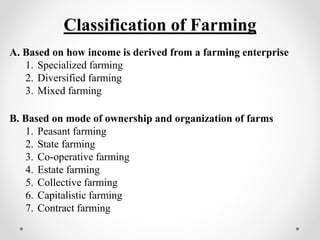
Classification of Farming
A. Based on how income is derived from a farming enterprise
1. Specialized farming
2. Diversified farming
3. Mixed farming
B. Based on mode of ownership and organization of farms
1. Peasant farming
2. State farming
3. Co-operative farming
4. Estate farming
5. Collective farming
6. Capitalistic farming
7. Contract farming
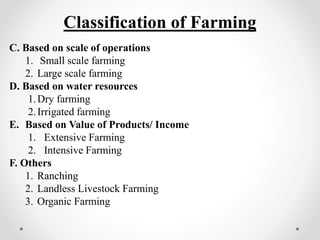
C. Based on scale of operations
1. Small scale farming
2. Large scale farming
D. Based on water resources
1.Dry farming
2.Irrigated farming
E. Based on Value of Products/ Income
1. Extensive Farming
2. Intensive Farming
F. Others
1. Ranching
2. Landless Livestock Farming
3. Organic Farming
Classification of Farming
A. Based on How Income is Derived from a Farming
Enterprise
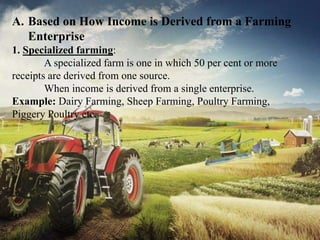
1. Specialized farming:
A specialized farm is one in which 50 per cent or more
receipts are derived from one source.
When income is derived from a single enterprise.
Example: Dairy Farming, Sheep Farming, Poultry Farming,
Piggery Poultry etc.
Advantage
1. Efficient utilisation of land, labour & equipment.
2. Work easily reduced to routine.
3. Better management & marketing.
4. Efficiency skill are increased.
5. Best suited to particular soil, climate, topography and other physical
conditions like market type
6. Costly and efficient machinery can be kept
7. Farmer can secure complete mastery over the conditions, problems
of production, processing and sale
8. Under favorable and specific conditions extremely profitable
Disadvantage
1. Greater risk
2. Fertility of soil can’t be maintained.
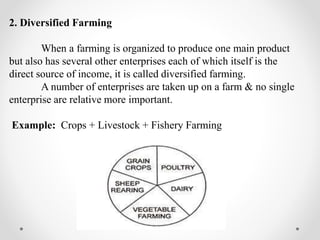
2. Diversified Farming
When a farming is organized to produce one main product
but also has several other enterprises each of which itself is the
direct source of income, it is called diversified farming.
A number of enterprises are taken up on a farm & no single
enterprise are relative more important.
Example: Crops + Livestock + Fishery Farming
Advantage
1. Better use of resources .
2. Risk is reduced.
3. Regular & quicker return are obtained
from various sources.
Disadvantage
1. Marketing is insufficient.
2. Ineffective supervision &
mismanagement.
3. Better equipping of the farm is not
possible
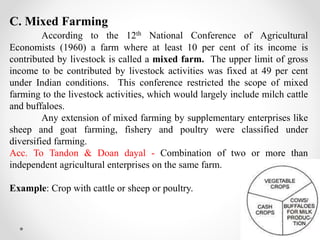
C. Mixed Farming
According to the 12th National Conference of Agricultural
Economists (1960) a farm where at least 10 per cent of its income is
contributed by livestock is called a mixed farm. The upper limit of gross
income to be contributed by livestock activities was fixed at 49 per cent
under Indian conditions. This conference restricted the scope of mixed
farming to the livestock activities, which would largely include milch cattle
and buffaloes.
Any extension of mixed farming by supplementary enterprises like
sheep and goat farming, fishery and poultry were classified under
diversified farming.
Acc. To Tandon & Doan dayal - Combination of two or more than
independent agricultural enterprises on the same farm.
Example: Crop with cattle or sheep or poultry.
Advantage
1. Efficient use of land, labour, equipment & other
resources
2. Proper use of by-product.
3. Provide employment & better income throughout the
year
Disadvantage
1. Ineffective supervision & mismanagement.
2. Better equipping of the farm is not possible.
B. Based on Mode of Ownership and Organization of Farms
1. Peasant Farming
The farmer himself is considered as the owner, manager,
organizer, worker of his farm. The farmer himself cultivates the
land. He makes decision in planning for his farm depending upon
the resources available. The advantage is he is free to take any
decision regarding the farm. But the resources of the individual are
less in comparison with the other systems.
2. State Farming
It is managed by the government. All the labours
are hired on daily / monthly basis and they have no right
to decision making. Here the resources are plenty but the
efficiency is less. Operations and management is done
by officials.
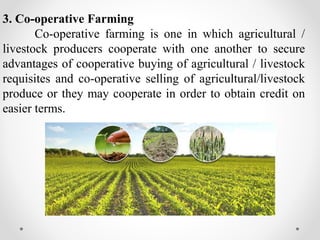
3. Co-operative Farming
Co-operative farming is one in which agricultural /
livestock producers cooperate with one another to secure
advantages of cooperative buying of agricultural / livestock
requisites and co-operative selling of agricultural/livestock
produce or they may cooperate in order to obtain credit on
easier terms.
Classification of cooperative farming societies are :
1. Co-operative better farming society: In this kind, independent
land holding members agree to follow a plan of cultivation /
operation laid down by the society
2. Co-operative tenant farming society: This differs from the above
in the fact that the society (which may hold land on freehold or
leasehold) leases out the plots to members for individual cultivation.
Otherwise, its objectives and spheres of action are the same as that
of better farming society.
3. Co-operative joint farming society: In this type, landowners pool
their lands for joint cultivation. The ownership of each member in
his holding continues and is recognized by the payment of dividend
in proportion to the value of his land.
4. Estate Farming
• Farm operation & management is done by
Government official or university.
• No limitation of resources.
• Mechanization of farm activities
• Supervision by farm manager
• Laboured hired on daily/monthly basis.
• State farming is not profitability
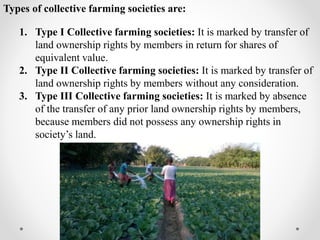
5. Collective Farming:
In collective farming societies, members do not
have an individual land ownership right in the society’s
land. The society holds land in free hold or leasehold and
undertakes joint cultivation.
Types of collective farming societies are:
1. Type I Collective farming societies: It is marked by transfer of
land ownership rights by members in return for shares of
equivalent value.
2. Type II Collective farming societies: It is marked by transfer of
land ownership rights by members without any consideration.
3. Type III Collective farming societies: It is marked by absence
of the transfer of any prior land ownership rights by members,
because members did not possess any ownership rights in
society’s land.
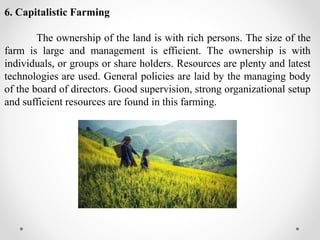
6. Capitalistic Farming
The ownership of the land is with rich persons. The size of the
farm is large and management is efficient. The ownership is with
individuals, or groups or share holders. Resources are plenty and latest
technologies are used. General policies are laid by the managing body
of the board of directors. Good supervision, strong organizational setup
and sufficient resources are found in this farming.
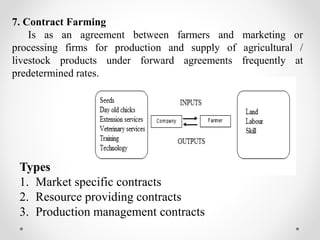
7. Contract Farming
Is as an agreement between farmers and marketing or
processing firms for production and supply of agricultural /
livestock products under forward agreements frequently at
predetermined rates.
Types
1. Market specific contracts
2. Resource providing contracts
3. Production management contracts
Advantages
Farmers
• Provision of inputs and services
• Access to credit
• Introduction of appropriate
technology
• Skill transfer
• Guaranteed and fixed pricing
structure
• Easy access to reliable market
Sponsors/Companies/Integrators
1. Timely availability of products
2. Easy access to resources
3. Shared risks
4. Quality consistency
Disadvantages
Farmers
• Lack of timely supply of resources
• Delay in payment
• Unsuitable technologies
• Domination by monopoly
• Corruption
Sponsors/Companies/Integrators
1. Land availability constraints
2. Farmers discontent
3. Input diversion
Contract Farming
C. Based on Scale of Operations
Size of herd or flock is large and it need more land, labour &
capital
Advantage
• Per unit cost of production is less
• Mechanization of farm activities
• Increased efficiency of land, labour & by product
• Easy to get finance
• Better marketing of product
Disadvantage
• Need more capital and labour and the Risk is also high(natural
calamities ,labour strike , price fluctuation)
• Difficulties in supervision
1. Large Scale Farming
2. Small Scale Farming
Size of herd or flock is small and it is easy to managed
by family labour & requires less capital.
Advantage
• Risk is low due to natural calamities, price fluctuation.
• Effective supervision.
Disadvantage
• Per unit cost of production is high.
• Mechanization of farm activities are not possible.
• Farmer don’t get employment round the year.
S.No. Aspects Large scale Small scale
1.
Division of labour
(Specialization)
Possible Limited
2. Mechanization Possible Not possible
3. Quantity of the output More Less
4. Cost of production Low High
5. Cost of management Low High
6. Marketing facilities Better Poor
7. Economy of buying and selling More Less
8.
Possibility of using improved
technology
More Less
9. Danger of over production More Less
10. Supervision Poor Better
11. Flexibility Inflexible Flexible
12. Chances of unhealthy competition More Less
Comparison between small and large scale farming
D. Based on water resources
1. Dry farming
It refers to the farming area which receives 20 inches or less
annual rainfall. The major problem here is that the crops are entirely
dependent on rain only.
Ex: Agroforestry, Sylviculture
2. Irrigated farming
It refers to the area where the rainfall is irregular,
seasonal and insufficient and the crops are raised through the
bore well and canal irrigation. It is also known as Garden
Land Farming.
Ex: Sericulture etc.
E. Based on Value of Products
1. EXTENSIVE FARMING
When more area is brought under operation to increase the output, it
is termed as extensive farming.
Extensive farming systems strongly depend on natural factors
Ex: Deep litter system of poultry farming, sheep and cattle farming
Advantages
• Mechanisation can be used more effectively .
• Less labour per unit areas is required.
• Animal welfare
• Lower requirements of inputs such as fertilizers.
• Local environment and soil are not damaged by over use of
chemicals.
EXTENSIVE FARMING
Disadvantages
• Yields much lower than
intensive farming in the
short term.
B. INTENSIVE FARMING
• More capital is used in small area.
• In other words land remains fixed in size while other factors
are increased.
Ex: Raised platform multi-tier cage system of poultry farming.
F. Others
1. Ranching/ Pastoral Farming
• Practice of grazing animal on pasture (Public land).
• Common practice in cooler region with less population density.
2. Landless Livestock Farming
Practice of grazing animals on the road side, Govt Land, forest.
3. Organic Farming
Organic farming is the form of agriculture that relies on
technique such as crop rotation green manure, compost, and
biological pest control to maintain soil productivity & to control
pest on farm.
• Economic.
• Consumer safety.
• Bacterial contamination( Meta-analysis determined that
prevalence of E. coli contamination was not significant)
• Pesticide residues(Organic produce had 30% lower risk for
contamination with any detectable pesticide residue)
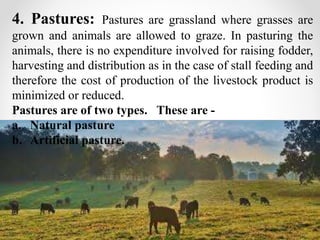
4. Pastures: Pastures are grassland where grasses are
grown and animals are allowed to graze. In pasturing the
animals, there is no expenditure involved for raising fodder,
harvesting and distribution as in the case of stall feeding and
therefore the cost of production of the livestock product is
minimized or reduced.
Pastures are of two types. These are -
a. Natural pasture
b. Artificial pasture.
Farming and its characterstics

Farming and its characterstics

  • 1.
  • 2.
    Farm : Afarm is an area of land that is devoted primarily to agricultural processes with the primary objective of producing food and other crops; it is the basic facility in food production. The name is used for specialised units such as vegetable farms, fruit farms, dairy, pig and poultry farms. Farming : It is growing crops or keeping animals by people for food and raw materials. Farming is a part of agriculture. Agriculture: It is not only growing food for people and animals, but also growing other things like flowers and nursery plants, manure or dung, animal hides (skins or furs), leather, animals, fungi, fibers (cotton, wool, hemp, and flax), biofuels , and drugs (biopharmaceuticals, marijuana, opium). Basic Introduction
  • 3.
    KINDS OF FARMING Farmingis an activity that involves the use of land for cultivation of crops, raising of animals etc. There are several factors, which determine the type of farming undertaken by an individual / organization and these factors are classified as physical, economic and social.
  • 4.
    Factors Determining Typeof Farming A. Physical factors • Climate • Soil • Topography B. Economic factors • Marketing cost • Changes in relative value of farm products • Availability of labour and capital • Land values • Cycles of over and under production • Competition between enterprises • Miscellaneous – Seasonal availability of raw material, diseases etc. C. Social factors • Type of community • Cooperative spirit
  • 5.
    Classification of Farming A.Based on how income is derived from a farming enterprise 1. Specialized farming 2. Diversified farming 3. Mixed farming B. Based on mode of ownership and organization of farms 1. Peasant farming 2. State farming 3. Co-operative farming 4. Estate farming 5. Collective farming 6. Capitalistic farming 7. Contract farming
  • 6.
    C. Based onscale of operations 1. Small scale farming 2. Large scale farming D. Based on water resources 1.Dry farming 2.Irrigated farming E. Based on Value of Products/ Income 1. Extensive Farming 2. Intensive Farming F. Others 1. Ranching 2. Landless Livestock Farming 3. Organic Farming Classification of Farming
  • 7.
    A. Based onHow Income is Derived from a Farming Enterprise 1. Specialized farming: A specialized farm is one in which 50 per cent or more receipts are derived from one source. When income is derived from a single enterprise. Example: Dairy Farming, Sheep Farming, Poultry Farming, Piggery Poultry etc.
  • 8.
    Advantage 1. Efficient utilisationof land, labour & equipment. 2. Work easily reduced to routine. 3. Better management & marketing. 4. Efficiency skill are increased. 5. Best suited to particular soil, climate, topography and other physical conditions like market type 6. Costly and efficient machinery can be kept 7. Farmer can secure complete mastery over the conditions, problems of production, processing and sale 8. Under favorable and specific conditions extremely profitable Disadvantage 1. Greater risk 2. Fertility of soil can’t be maintained.
  • 9.
    2. Diversified Farming Whena farming is organized to produce one main product but also has several other enterprises each of which itself is the direct source of income, it is called diversified farming. A number of enterprises are taken up on a farm & no single enterprise are relative more important. Example: Crops + Livestock + Fishery Farming
  • 10.
    Advantage 1. Better useof resources . 2. Risk is reduced. 3. Regular & quicker return are obtained from various sources. Disadvantage 1. Marketing is insufficient. 2. Ineffective supervision & mismanagement. 3. Better equipping of the farm is not possible
  • 11.
    C. Mixed Farming Accordingto the 12th National Conference of Agricultural Economists (1960) a farm where at least 10 per cent of its income is contributed by livestock is called a mixed farm. The upper limit of gross income to be contributed by livestock activities was fixed at 49 per cent under Indian conditions. This conference restricted the scope of mixed farming to the livestock activities, which would largely include milch cattle and buffaloes. Any extension of mixed farming by supplementary enterprises like sheep and goat farming, fishery and poultry were classified under diversified farming. Acc. To Tandon & Doan dayal - Combination of two or more than independent agricultural enterprises on the same farm. Example: Crop with cattle or sheep or poultry.
  • 12.
    Advantage 1. Efficient useof land, labour, equipment & other resources 2. Proper use of by-product. 3. Provide employment & better income throughout the year Disadvantage 1. Ineffective supervision & mismanagement. 2. Better equipping of the farm is not possible.
  • 13.
    B. Based onMode of Ownership and Organization of Farms 1. Peasant Farming The farmer himself is considered as the owner, manager, organizer, worker of his farm. The farmer himself cultivates the land. He makes decision in planning for his farm depending upon the resources available. The advantage is he is free to take any decision regarding the farm. But the resources of the individual are less in comparison with the other systems.
  • 14.
    2. State Farming Itis managed by the government. All the labours are hired on daily / monthly basis and they have no right to decision making. Here the resources are plenty but the efficiency is less. Operations and management is done by officials.
  • 15.
    3. Co-operative Farming Co-operativefarming is one in which agricultural / livestock producers cooperate with one another to secure advantages of cooperative buying of agricultural / livestock requisites and co-operative selling of agricultural/livestock produce or they may cooperate in order to obtain credit on easier terms.
  • 16.
    Classification of cooperativefarming societies are : 1. Co-operative better farming society: In this kind, independent land holding members agree to follow a plan of cultivation / operation laid down by the society 2. Co-operative tenant farming society: This differs from the above in the fact that the society (which may hold land on freehold or leasehold) leases out the plots to members for individual cultivation. Otherwise, its objectives and spheres of action are the same as that of better farming society. 3. Co-operative joint farming society: In this type, landowners pool their lands for joint cultivation. The ownership of each member in his holding continues and is recognized by the payment of dividend in proportion to the value of his land.
  • 17.
    4. Estate Farming •Farm operation & management is done by Government official or university. • No limitation of resources. • Mechanization of farm activities • Supervision by farm manager • Laboured hired on daily/monthly basis. • State farming is not profitability
  • 18.
    5. Collective Farming: Incollective farming societies, members do not have an individual land ownership right in the society’s land. The society holds land in free hold or leasehold and undertakes joint cultivation.
  • 19.
    Types of collectivefarming societies are: 1. Type I Collective farming societies: It is marked by transfer of land ownership rights by members in return for shares of equivalent value. 2. Type II Collective farming societies: It is marked by transfer of land ownership rights by members without any consideration. 3. Type III Collective farming societies: It is marked by absence of the transfer of any prior land ownership rights by members, because members did not possess any ownership rights in society’s land.
  • 20.
    6. Capitalistic Farming Theownership of the land is with rich persons. The size of the farm is large and management is efficient. The ownership is with individuals, or groups or share holders. Resources are plenty and latest technologies are used. General policies are laid by the managing body of the board of directors. Good supervision, strong organizational setup and sufficient resources are found in this farming.
  • 21.
    7. Contract Farming Isas an agreement between farmers and marketing or processing firms for production and supply of agricultural / livestock products under forward agreements frequently at predetermined rates. Types 1. Market specific contracts 2. Resource providing contracts 3. Production management contracts
  • 23.
    Advantages Farmers • Provision ofinputs and services • Access to credit • Introduction of appropriate technology • Skill transfer • Guaranteed and fixed pricing structure • Easy access to reliable market Sponsors/Companies/Integrators 1. Timely availability of products 2. Easy access to resources 3. Shared risks 4. Quality consistency Disadvantages Farmers • Lack of timely supply of resources • Delay in payment • Unsuitable technologies • Domination by monopoly • Corruption Sponsors/Companies/Integrators 1. Land availability constraints 2. Farmers discontent 3. Input diversion Contract Farming
  • 24.
    C. Based onScale of Operations Size of herd or flock is large and it need more land, labour & capital Advantage • Per unit cost of production is less • Mechanization of farm activities • Increased efficiency of land, labour & by product • Easy to get finance • Better marketing of product Disadvantage • Need more capital and labour and the Risk is also high(natural calamities ,labour strike , price fluctuation) • Difficulties in supervision 1. Large Scale Farming
  • 25.
    2. Small ScaleFarming Size of herd or flock is small and it is easy to managed by family labour & requires less capital. Advantage • Risk is low due to natural calamities, price fluctuation. • Effective supervision. Disadvantage • Per unit cost of production is high. • Mechanization of farm activities are not possible. • Farmer don’t get employment round the year.
  • 26.
    S.No. Aspects Largescale Small scale 1. Division of labour (Specialization) Possible Limited 2. Mechanization Possible Not possible 3. Quantity of the output More Less 4. Cost of production Low High 5. Cost of management Low High 6. Marketing facilities Better Poor 7. Economy of buying and selling More Less 8. Possibility of using improved technology More Less 9. Danger of over production More Less 10. Supervision Poor Better 11. Flexibility Inflexible Flexible 12. Chances of unhealthy competition More Less Comparison between small and large scale farming
  • 27.
    D. Based onwater resources 1. Dry farming It refers to the farming area which receives 20 inches or less annual rainfall. The major problem here is that the crops are entirely dependent on rain only. Ex: Agroforestry, Sylviculture
  • 28.
    2. Irrigated farming Itrefers to the area where the rainfall is irregular, seasonal and insufficient and the crops are raised through the bore well and canal irrigation. It is also known as Garden Land Farming. Ex: Sericulture etc.
  • 29.
    E. Based onValue of Products 1. EXTENSIVE FARMING When more area is brought under operation to increase the output, it is termed as extensive farming. Extensive farming systems strongly depend on natural factors Ex: Deep litter system of poultry farming, sheep and cattle farming
  • 30.
    Advantages • Mechanisation canbe used more effectively . • Less labour per unit areas is required. • Animal welfare • Lower requirements of inputs such as fertilizers. • Local environment and soil are not damaged by over use of chemicals. EXTENSIVE FARMING Disadvantages • Yields much lower than intensive farming in the short term.
  • 31.
    B. INTENSIVE FARMING •More capital is used in small area. • In other words land remains fixed in size while other factors are increased. Ex: Raised platform multi-tier cage system of poultry farming.
  • 33.
    F. Others 1. Ranching/Pastoral Farming • Practice of grazing animal on pasture (Public land). • Common practice in cooler region with less population density.
  • 34.
    2. Landless LivestockFarming Practice of grazing animals on the road side, Govt Land, forest.
  • 35.
    3. Organic Farming Organicfarming is the form of agriculture that relies on technique such as crop rotation green manure, compost, and biological pest control to maintain soil productivity & to control pest on farm. • Economic. • Consumer safety. • Bacterial contamination( Meta-analysis determined that prevalence of E. coli contamination was not significant) • Pesticide residues(Organic produce had 30% lower risk for contamination with any detectable pesticide residue)
  • 36.
    4. Pastures: Pasturesare grassland where grasses are grown and animals are allowed to graze. In pasturing the animals, there is no expenditure involved for raising fodder, harvesting and distribution as in the case of stall feeding and therefore the cost of production of the livestock product is minimized or reduced. Pastures are of two types. These are - a. Natural pasture b. Artificial pasture.