MEANING AND
PHILOSOPHY OF
EXTENSION
 Lecture 1
Introduction
In this lecture we shall focus on the basic
introduction to extension.
We shall discuss the meaning and origins of
extension, comparison between extension education
and formal education, objectives and philosophy of
extension.
Lecture Objectives
By the end of this lecture you should be able to:
 Define agricultural extension
 Explain the difference between formal and extension
education
 Discuss the philosophy underpinning agricultural
philosophy
Meaning of Agricultural Extension
◊ The term “Extension” has been derived from the Latin
word “ex” meaning out and “tenso” which means
stretching.
◊ Thus the word “extension” would imply a kind of
education which is stretched out of the people in far and
wide i.e. rural areas and beyond the four walls of
educational institutions.
◊ Applied to agriculture, agricultural extension (education)
would mean stretching out or spreading the useful and
practical knowledge about agriculture to those who are
engaged in agricultural activities and thereby motivate
and change the behavior of tradition bound farming
community so that it could adopt new methods at
farming, producing surplus for meeting the diverse needs
of the increasing human numbers.
Meaning of Agricultural Extension… Cont’d
 The equivalent expression of “extension” in German is
“beratung” which literally means “advice or counsel”.
 In extension education in a democratic system,
participation of the people in extension programmes is
voluntary.
 The people have complete freedom whether or not to
join an extension programme.
 The behavior of the people has to be changed not by
ordering or coercing, but by educating and motivating
them.
Meaning of Agricultural Extension… Cont’d
 Unless the people are convinced, unless they get
good results, unless they are satisfied, they shall
turn their faces away from extension.
 Extension education is an applied science consisting
of content derived from research, accumulated field
experiences and relevant principles drawn from the
behavioral sciences synthesized with useful
technology into a body of philosophy, principles,
content and methods, focused on the problems of
out-of-school education for adults and youth.
Meaning of Agricultural Extension… Cont’d
 The National Commission on Agriculture (India) refers to
extension as an informal out-of-school education and
services for the members of the farm family and others
directly or indirectly engaged in farm production, to enable
them to adopt improved practice in production,
management, conservation and marketing.
 The commission further stated that agricultural extension is
not only imparting knowledge and securing adoption of a
particular improved practice but also aims at changing the
outlook of the farmer to the point where he will be receptive
to and on his own initiative, continuously seek means of
improving his farm occupation, home and family life as a
whole.
Meaning of Agricultural Extension… Cont’d
 Horton emphasizes “Extension programmes revolve
around the individual, the cultivator and we have to
bring change in his attitude, knowledge, skill,
understanding, capacity and ability through
persuasion by educational means.”
 Bhatnagar defines extension to be “The activities of
the Government when providing the farmers with the
technical know-how as a guide to improved methods
in order to bring desirable changes in their behavior
with the aim of attaining higher production.”
Meaning of Agricultural Extension… Cont’d
From the above definitions, it may be deduced
that extension education basically aims at
agricultural development and improvement in
rural economy.
The concept of extension education is used in
educating people about agriculture, industry,
home science, dairy, veterinary science or public
health.
Branches of extension
• As per specialization these branches of extension
education are called:
agricultural extension
industrial extension
home science extension
dairy extension
veterinary science extension
public health extension
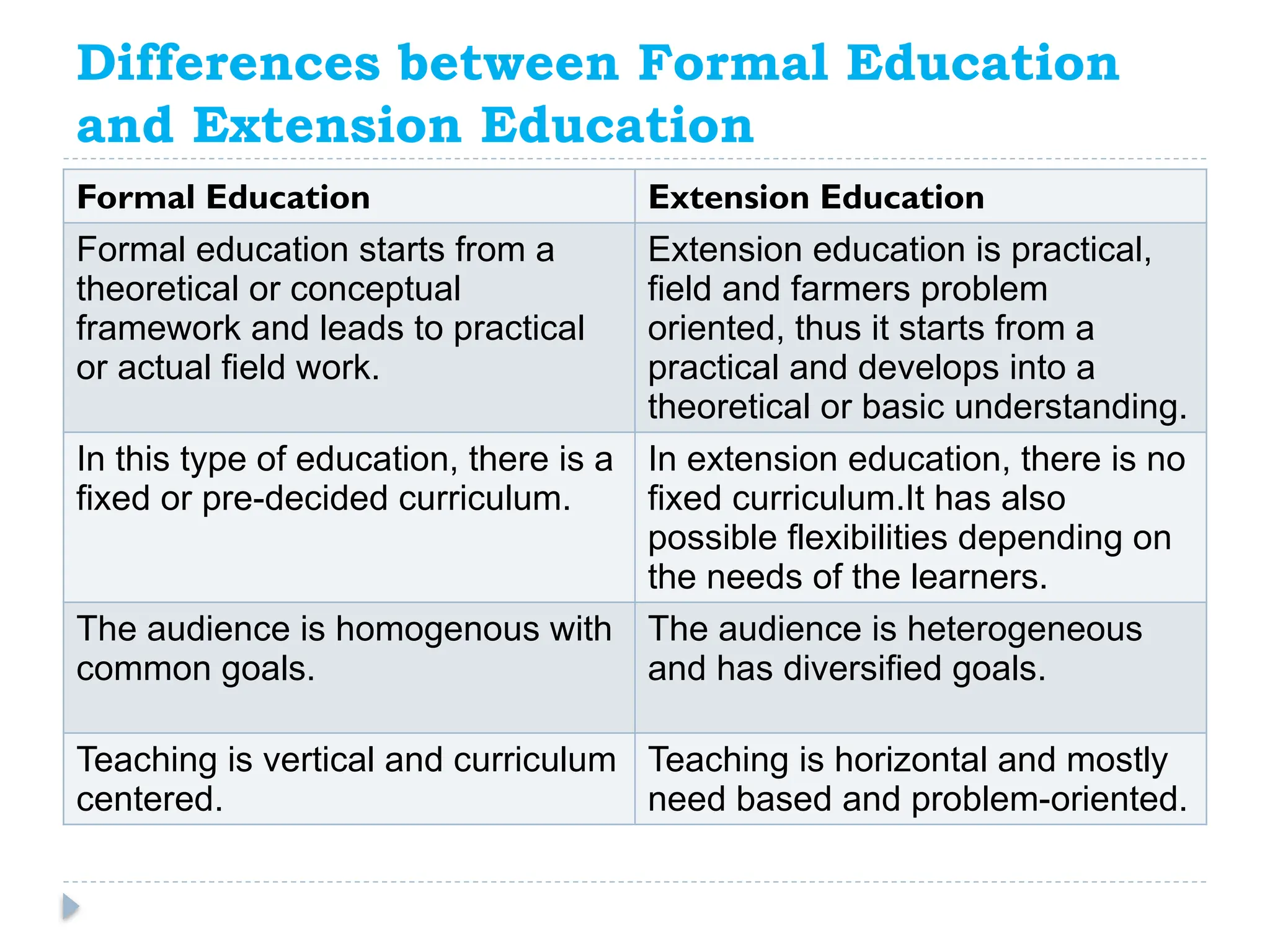
Differences between Formal Education
and Extension Education
Formal Education Extension Education
Formal education starts from a
theoretical or conceptual
framework and leads to practical
or actual field work.
Extension education is practical,
field and farmers problem
oriented, thus it starts from a
practical and develops into a
theoretical or basic understanding.
In this type of education, there is a
fixed or pre-decided curriculum.
In extension education, there is no
fixed curriculum.It has also
possible flexibilities depending on
the needs of the learners.
The audience is homogenous with
common goals.
The audience is heterogeneous
and has diversified goals.
Teaching is vertical and curriculum
centered.
Teaching is horizontal and mostly
need based and problem-oriented.
Differences between Formal Education
and Extension Education
Formal Education Extension Education
Strict adherence to
institutional norms and no
free choice for the learners.
Freedom and choice of
subject matter left to the
learners.
This education is of a
specialized nature i.e. class-
oriented, subject centered
and certificate/degree
oriented.
Informal with some elements
of formal education in class
teaching, but not
certificate/degree oriented.
Learners are taught directly
by the teachers.
Local teachers are used for
training and dissemination of
knowledge.
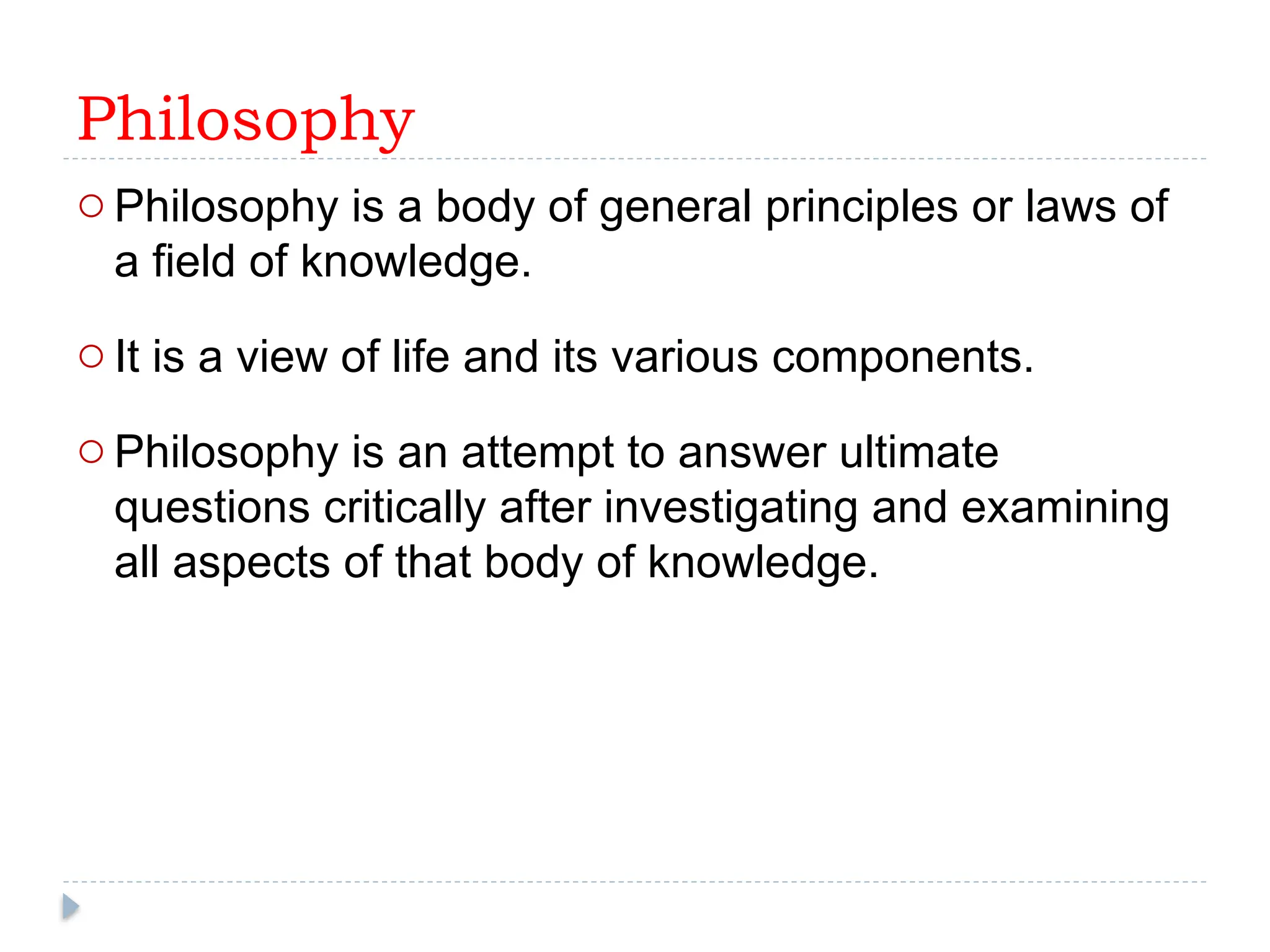
Philosophy
oPhilosophy is a body of general principles or laws of
a field of knowledge.
oIt is a view of life and its various components.
oPhilosophy is an attempt to answer ultimate
questions critically after investigating and examining
all aspects of that body of knowledge.
Philosophy of Extension Education
 The philosophy of extension education is based on the basic
premise that rural people are intelligent, are interested in
obtaining new information and at the same time have a keen
desire to utilize this information for their individual benefit.
 The basic philosophy of extension education is to teach
people how to think, and not what to think.
 Extension’s specific job is furnishing the inspiration,
supplying specific advice and technical help and counselling
to see that the people as individuals, families, groups and
communities work together as a unit in identifying their own
problems, charting their own courses and that they launch
forth to achieve their objectives.
Philosophy of Extension Education…cont’d
 Extension is an educational, cooperative,
collaborative, democratic, persuasive and never
ending process that generates harmony, leadership,
effective communication, participation and
involvement of the people in organizing self-help
activities and projects.
 It is a system of “learning by doing”, “seeing is
believing” at an individual level and “mutual
learning” at group level amongst professionals and
target beneficiaries, resulting in a high degree of
rapport and empathy.
According to Horton, there are four principles
which make the philosophy of extension:
 They include:-
1. The individual is supreme in democracy
2. The home is the fundamental unit in a civilization.
3. The family is the first training group of the human
race.
4. The foundation of any permanent civilization must
rest in the partnership of man and land.
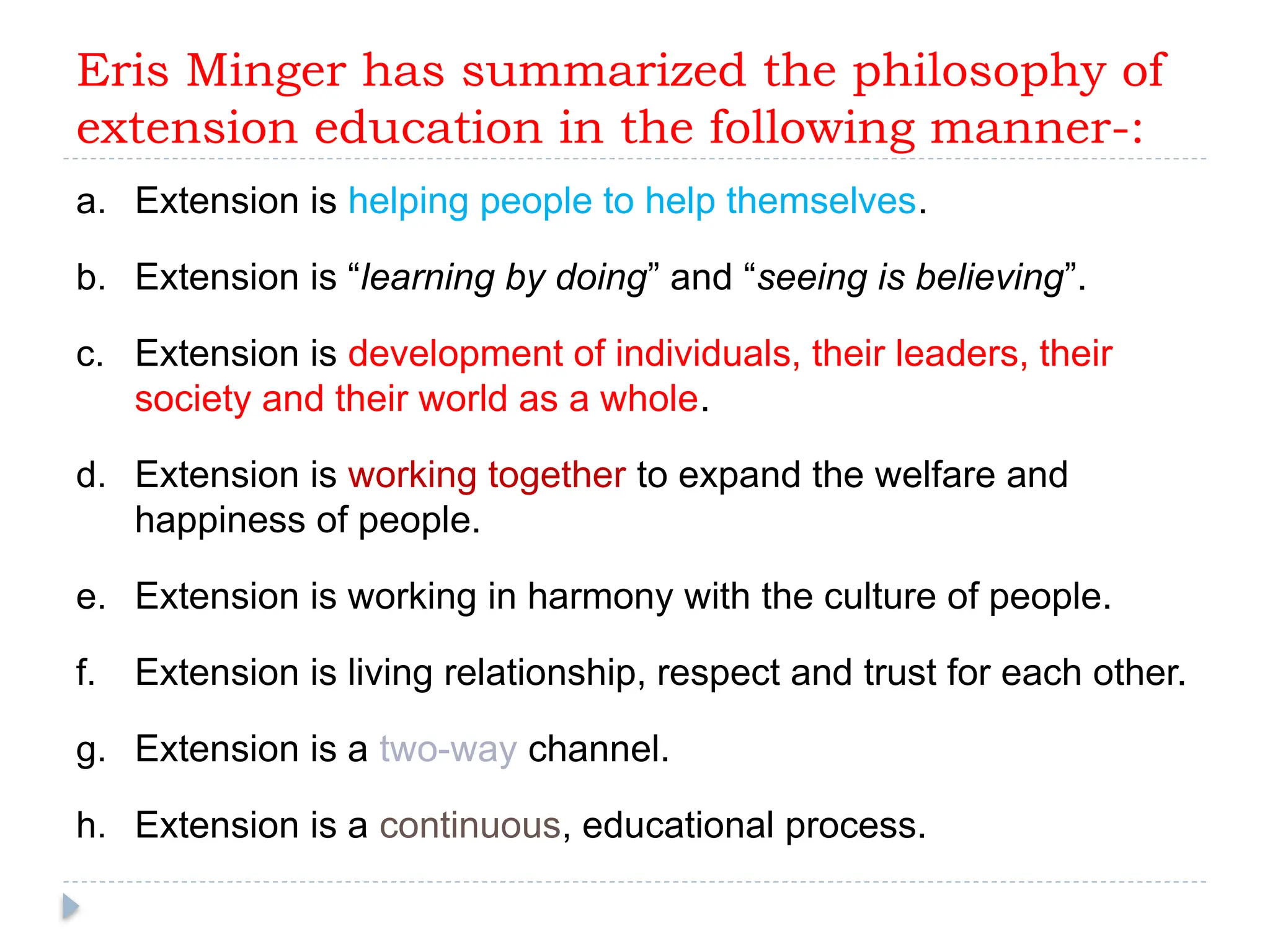
Eris Minger has summarized the philosophy of
extension education in the following manner-:
a. Extension is helping people to help themselves.
b. Extension is “learning by doing” and “seeing is believing”.
c. Extension is development of individuals, their leaders, their
society and their world as a whole.
d. Extension is working together to expand the welfare and
happiness of people.
e. Extension is working in harmony with the culture of people.
f. Extension is living relationship, respect and trust for each other.
g. Extension is a two-way channel.
h. Extension is a continuous, educational process.
The End
Feel free to ask any question

Lec 1.ppt meaning and philosophy of extension

  • 1.
  • 2.
    Introduction In this lecturewe shall focus on the basic introduction to extension. We shall discuss the meaning and origins of extension, comparison between extension education and formal education, objectives and philosophy of extension.
  • 3.
    Lecture Objectives By theend of this lecture you should be able to:  Define agricultural extension  Explain the difference between formal and extension education  Discuss the philosophy underpinning agricultural philosophy
  • 4.
    Meaning of AgriculturalExtension ◊ The term “Extension” has been derived from the Latin word “ex” meaning out and “tenso” which means stretching. ◊ Thus the word “extension” would imply a kind of education which is stretched out of the people in far and wide i.e. rural areas and beyond the four walls of educational institutions. ◊ Applied to agriculture, agricultural extension (education) would mean stretching out or spreading the useful and practical knowledge about agriculture to those who are engaged in agricultural activities and thereby motivate and change the behavior of tradition bound farming community so that it could adopt new methods at farming, producing surplus for meeting the diverse needs of the increasing human numbers.
  • 5.
    Meaning of AgriculturalExtension… Cont’d  The equivalent expression of “extension” in German is “beratung” which literally means “advice or counsel”.  In extension education in a democratic system, participation of the people in extension programmes is voluntary.  The people have complete freedom whether or not to join an extension programme.  The behavior of the people has to be changed not by ordering or coercing, but by educating and motivating them.
  • 6.
    Meaning of AgriculturalExtension… Cont’d  Unless the people are convinced, unless they get good results, unless they are satisfied, they shall turn their faces away from extension.  Extension education is an applied science consisting of content derived from research, accumulated field experiences and relevant principles drawn from the behavioral sciences synthesized with useful technology into a body of philosophy, principles, content and methods, focused on the problems of out-of-school education for adults and youth.
  • 7.
    Meaning of AgriculturalExtension… Cont’d  The National Commission on Agriculture (India) refers to extension as an informal out-of-school education and services for the members of the farm family and others directly or indirectly engaged in farm production, to enable them to adopt improved practice in production, management, conservation and marketing.  The commission further stated that agricultural extension is not only imparting knowledge and securing adoption of a particular improved practice but also aims at changing the outlook of the farmer to the point where he will be receptive to and on his own initiative, continuously seek means of improving his farm occupation, home and family life as a whole.
  • 8.
    Meaning of AgriculturalExtension… Cont’d  Horton emphasizes “Extension programmes revolve around the individual, the cultivator and we have to bring change in his attitude, knowledge, skill, understanding, capacity and ability through persuasion by educational means.”  Bhatnagar defines extension to be “The activities of the Government when providing the farmers with the technical know-how as a guide to improved methods in order to bring desirable changes in their behavior with the aim of attaining higher production.”
  • 9.
    Meaning of AgriculturalExtension… Cont’d From the above definitions, it may be deduced that extension education basically aims at agricultural development and improvement in rural economy. The concept of extension education is used in educating people about agriculture, industry, home science, dairy, veterinary science or public health.
  • 10.
    Branches of extension •As per specialization these branches of extension education are called: agricultural extension industrial extension home science extension dairy extension veterinary science extension public health extension
  • 11.
    Differences between FormalEducation and Extension Education Formal Education Extension Education Formal education starts from a theoretical or conceptual framework and leads to practical or actual field work. Extension education is practical, field and farmers problem oriented, thus it starts from a practical and develops into a theoretical or basic understanding. In this type of education, there is a fixed or pre-decided curriculum. In extension education, there is no fixed curriculum.It has also possible flexibilities depending on the needs of the learners. The audience is homogenous with common goals. The audience is heterogeneous and has diversified goals. Teaching is vertical and curriculum centered. Teaching is horizontal and mostly need based and problem-oriented.
  • 12.
    Differences between FormalEducation and Extension Education Formal Education Extension Education Strict adherence to institutional norms and no free choice for the learners. Freedom and choice of subject matter left to the learners. This education is of a specialized nature i.e. class- oriented, subject centered and certificate/degree oriented. Informal with some elements of formal education in class teaching, but not certificate/degree oriented. Learners are taught directly by the teachers. Local teachers are used for training and dissemination of knowledge.
  • 13.
    Philosophy oPhilosophy is abody of general principles or laws of a field of knowledge. oIt is a view of life and its various components. oPhilosophy is an attempt to answer ultimate questions critically after investigating and examining all aspects of that body of knowledge.
  • 14.
    Philosophy of ExtensionEducation  The philosophy of extension education is based on the basic premise that rural people are intelligent, are interested in obtaining new information and at the same time have a keen desire to utilize this information for their individual benefit.  The basic philosophy of extension education is to teach people how to think, and not what to think.  Extension’s specific job is furnishing the inspiration, supplying specific advice and technical help and counselling to see that the people as individuals, families, groups and communities work together as a unit in identifying their own problems, charting their own courses and that they launch forth to achieve their objectives.
  • 15.
    Philosophy of ExtensionEducation…cont’d  Extension is an educational, cooperative, collaborative, democratic, persuasive and never ending process that generates harmony, leadership, effective communication, participation and involvement of the people in organizing self-help activities and projects.  It is a system of “learning by doing”, “seeing is believing” at an individual level and “mutual learning” at group level amongst professionals and target beneficiaries, resulting in a high degree of rapport and empathy.
  • 16.
    According to Horton,there are four principles which make the philosophy of extension:  They include:- 1. The individual is supreme in democracy 2. The home is the fundamental unit in a civilization. 3. The family is the first training group of the human race. 4. The foundation of any permanent civilization must rest in the partnership of man and land.
  • 17.
    Eris Minger hassummarized the philosophy of extension education in the following manner-: a. Extension is helping people to help themselves. b. Extension is “learning by doing” and “seeing is believing”. c. Extension is development of individuals, their leaders, their society and their world as a whole. d. Extension is working together to expand the welfare and happiness of people. e. Extension is working in harmony with the culture of people. f. Extension is living relationship, respect and trust for each other. g. Extension is a two-way channel. h. Extension is a continuous, educational process.
  • 18.
    The End Feel freeto ask any question