BASIC ELECTRICAL ENGINEERING
Dr. P. K. Sahu
Associate Professor
SCHOOL OF ELECTRICAL ENGG
Thursday, October 21, 2021 1
INTRODUCTION
• Electrical energy scenario in India
• Power system layout
• Comparison of overhead transmission lines and underground
cables
• Classification of sources of energy
• Types of generating stations
• Electrical safety rules
• Components of LT Switch gear
• Different electric wiring technique
• Necessity of earthing and fuses
Thursday, October 21, 2021 2
ESSENCE OF ELECTRICITY
• Need for Electricity
• Why Electricity/ not other forms.
i. Possibility of bulk Production and is transportability over long distances
ii. It is silent
iii. Ease of control
iv. It is very fast
v. Convertible to other forms
vi. Possibility of storage
• The electrification of Kolkata city took place in 1879.
• Electrical Utility : CESU (Central Electricity Supply
Utility of Orissa Limited)
• Board of Trades Unit (kWhr)
Thursday, October 21, 2021 3
ELECTRICAL ENERGY SCENARIO IN INDIA
• Total installed capacity of power stations in India stood at 356
Giga watt (GW) as of May 31, 2019
• India is the world's third largest producer and fourth largest
consumer of electricity.
• Electric energy consumption in agriculture was recorded
highest (17.89%) in 2015-16 among all countries.
• The per capita electricity consumption is low compared to
many countries despite cheaper electricity tariff in India.
• Power in (MW) from Thermal: 218,330, Nuclear: 6780,
Hydro: 44,478, other renewable: 57,260.
Thursday, October 21, 2021 4
ELECTRICAL ENERGY SCENARIO IN INDIA
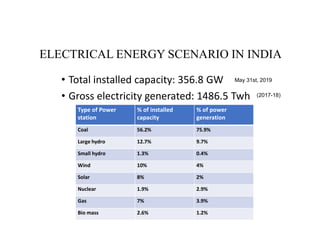
• Total installed capacity: 356.8 GW
• Gross electricity generated: 1486.5 Twh
Type of Power
station
% of installed
capacity
% of power
generation
May 31st, 2019
(2017-18)
Coal 56.2% 75.9%
Large hydro 12.7% 9.7%
Small hydro 1.3% 0.4%
Wind 10% 4%
Solar 8% 2%
Nuclear 1.9% 2.9%
Gas 7% 3.9%
Bio mass 2.6% 1.2%
POWER SYSTEM LAYOUT
POWER SYSTEM LAYOUT
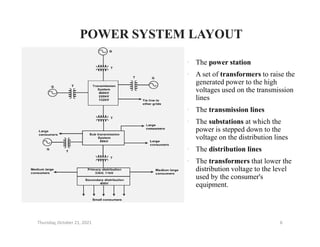
• The power station
• A set of transformers to raise the
generated power to the high
voltages used on the transmission
lines
• The transmission lines
• The substations at which the
power is stepped down to the
voltage on the distribution lines
• The distribution lines
• The transformers that lower the
distribution voltage to the level
used by the consumer's
equipment.
Thursday, October 21, 2021 6

1 chapter 1_introduction_to_bee

  • 1.
    BASIC ELECTRICAL ENGINEERING Dr.P. K. Sahu Associate Professor SCHOOL OF ELECTRICAL ENGG Thursday, October 21, 2021 1
  • 2.
    INTRODUCTION • Electrical energyscenario in India • Power system layout • Comparison of overhead transmission lines and underground cables • Classification of sources of energy • Types of generating stations • Electrical safety rules • Components of LT Switch gear • Different electric wiring technique • Necessity of earthing and fuses Thursday, October 21, 2021 2
  • 3.
    ESSENCE OF ELECTRICITY •Need for Electricity • Why Electricity/ not other forms. i. Possibility of bulk Production and is transportability over long distances ii. It is silent iii. Ease of control iv. It is very fast v. Convertible to other forms v. Convertible to other forms vi. Possibility of storage • The electrification of Kolkata city took place in 1879. • Electrical Utility : CESU (Central Electricity Supply Utility of Orissa Limited) • Board of Trades Unit (kWhr) Thursday, October 21, 2021 3
  • 4.
    ELECTRICAL ENERGY SCENARIOIN INDIA • Total installed capacity of power stations in India stood at 356 Giga watt (GW) as of May 31, 2019 • India is the world's third largest producer and fourth largest consumer of electricity. • Electric energy consumption in agriculture was recorded • Electric energy consumption in agriculture was recorded highest (17.89%) in 2015-16 among all countries. • The per capita electricity consumption is low compared to many countries despite cheaper electricity tariff in India. • Power in (MW) from Thermal: 218,330, Nuclear: 6780, Hydro: 44,478, other renewable: 57,260. Thursday, October 21, 2021 4
  • 5.
    ELECTRICAL ENERGY SCENARIOIN INDIA • Total installed capacity: 356.8 GW • Gross electricity generated: 1486.5 Twh Type of Power station % of installed capacity % of power generation May 31st, 2019 (2017-18) Coal 56.2% 75.9% Large hydro 12.7% 9.7% Small hydro 1.3% 0.4% Wind 10% 4% Solar 8% 2% Nuclear 1.9% 2.9% Gas 7% 3.9% Bio mass 2.6% 1.2%
  • 6.
    POWER SYSTEM LAYOUT POWERSYSTEM LAYOUT • The power station • A set of transformers to raise the generated power to the high voltages used on the transmission lines • The transmission lines • The substations at which the • The substations at which the power is stepped down to the voltage on the distribution lines • The distribution lines • The transformers that lower the distribution voltage to the level used by the consumer's equipment. Thursday, October 21, 2021 6