WELCOME
Coming Together Is A Beginning;
Keeping Together Is Progress;
Working Together Is Success….!
Dr. D. Y. PATIL COLLEGE OFAGRICULTURAL ENGINEERING & TECHNOLOGY, TALSANDE.
A
Presentation on
Problem Based Learning
“ EFFICIENT ELECTRICITY DISTRUBUTION SYSTEM
NEEDS AND REQUIREMENT ”
From 1st June 2021 to 31st July 2021
Presented by,
Mr. Harshwardhan Babasaheb Devkar
Mr. Rushikesh Subhash Devmore
Mr. Abhishek Malhari Dhond
Miss Samiksha Sharad Dhurgude
Mr. Soham Rajendra Gadhave
Miss Mrunali Devendra Gaikwad
Mr. Atharv Kerba Gavhane
Miss Shruti Gajanan Gedam
Miss Anuja Pandurang Ghadge
Mr. Siddhant Santosh Gharge
Dr. D. Y. Patil College of Agricultural Engineering And Technology,
Talsande, Kolhapur
(Affiliated to Mahatma Phule Krishi Vidyapeeth, Rahuri)
Dr. D. Y. PATIL COLLEGE OFAGRICULTURAL ENGINEERING & TECHNOLOGY, TALSANDE.
Objectives
 Describe and analyze distributed system such as transmission lines
and fields.
 To study reforms and restructuring in Indian power sector.
 To study knowledge about intelligent and strategic issues related to
growth and development of Indian power business.
Dr. D. Y. PATIL COLLEGE OFAGRICULTURAL ENGINEERING & TECHNOLOGY, TALSANDE.
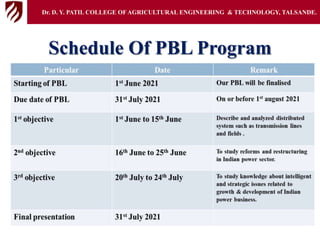
Schedule Of PBL Program
Dr. D. Y. PATIL COLLEGE OFAGRICULTURAL ENGINEERING & TECHNOLOGY, TALSANDE.
Contents
Introduction
Schedule
Objectives
History
Work Details
Outcomes
Conclusion
References
Dr. D. Y. PATIL COLLEGE OFAGRICULTURAL ENGINEERING & TECHNOLOGY, TALSANDE.
Introduction
 The primary purpose of electricity distribution system is to
meet the customers demands for energy.
 India is the world's third largest producer and third largest
consumer of electricity.
 The national electric grid in India has an installed capacity
383.37 GW as of 31 May 2021.
 In May 2018, India ranked fourth in the Asia Pacific region out
of 25 nations on an index that measured their overall power.
 Nowadays electricity is an essential part of modern life
Dr. D. Y. PATIL COLLEGE OFAGRICULTURAL ENGINEERING & TECHNOLOGY, TALSANDE.
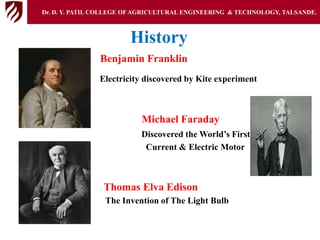
History
Benjamin Franklin
Electricity discovered by Kite experiment
Michael Faraday
Discovered the World’s First
Current & Electric Motor
Thomas Elva Edison
The Invention of The Light Bulb
Dr. D. Y. PATIL COLLEGE OFAGRICULTURAL ENGINEERING & TECHNOLOGY, TALSANDE.
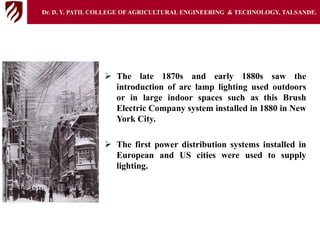
 The late 1870s and early 1880s saw the
introduction of arc lamp lighting used outdoors
or in large indoor spaces such as this Brush
Electric Company system installed in 1880 in New
York City.
 The first power distribution systems installed in
European and US cities were used to supply
lighting.
Dr. D. Y. PATIL COLLEGE OFAGRICULTURAL ENGINEERING & TECHNOLOGY, TALSANDE.
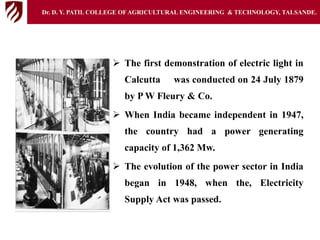
 The first demonstration of electric light in
Calcutta was conducted on 24 July 1879
by P W Fleury & Co.
 When India became independent in 1947,
the country had a power generating
capacity of 1,362 Mw.
 The evolution of the power sector in India
began in 1948, when the, Electricity
Supply Act was passed.
Dr. D. Y. PATIL COLLEGE OFAGRICULTURAL ENGINEERING & TECHNOLOGY, TALSANDE.
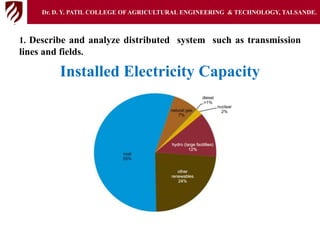
1. Describe and analyze distributed system such as transmission
lines and fields.
Installed Electricity Capacity
Dr. D. Y. PATIL COLLEGE OFAGRICULTURAL ENGINEERING & TECHNOLOGY, TALSANDE.
Sources of Electricity
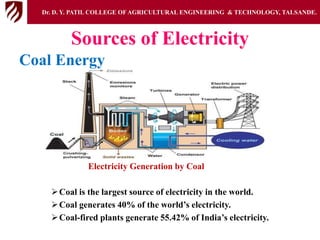
Coal Energy
Electricity Generation by Coal
Coal is the largest source of electricity in the world.
Coal generates 40% of the world’s electricity.
Coal-fired plants generate 55.42% of India’s electricity.
Dr. D. Y. PATIL COLLEGE OFAGRICULTURAL ENGINEERING & TECHNOLOGY, TALSANDE.
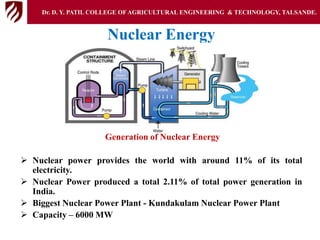
Nuclear Energy
Generation of Nuclear Energy
 Nuclear power provides the world with around 11% of its total
electricity.
 Nuclear Power produced a total 2.11% of total power generation in
India.
 Biggest Nuclear Power Plant - Kundakulam Nuclear Power Plant
 Capacity – 6000 MW
Dr. D. Y. PATIL COLLEGE OFAGRICULTURAL ENGINEERING & TECHNOLOGY, TALSANDE.
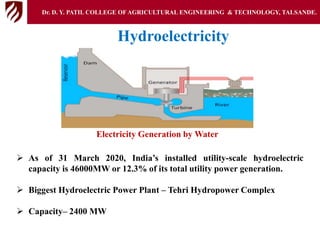
 As of 31 March 2020, India’s installed utility-scale hydroelectric
capacity is 46000MW or 12.3% of its total utility power generation.
 Biggest Hydroelectric Power Plant – Tehri Hydropower Complex
 Capacity– 2400 MW
Hydroelectricity
Dr. D. Y. PATIL COLLEGE OFAGRICULTURAL ENGINEERING & TECHNOLOGY, TALSANDE.
Electricity Generation by Water
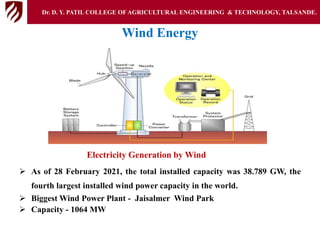
Wind Energy
Electricity Generation by Wind
 As of 28 February 2021, the total installed capacity was 38.789 GW, the
fourth largest installed wind power capacity in the world.
 Biggest Wind Power Plant - Jaisalmer Wind Park
 Capacity - 1064 MW
Dr. D. Y. PATIL COLLEGE OFAGRICULTURAL ENGINEERING & TECHNOLOGY, TALSANDE.
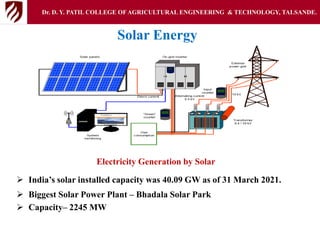
Solar Energy
Electricity Generation by Solar
 India’s solar installed capacity was 40.09 GW as of 31 March 2021.
 Biggest Solar Power Plant – Bhadala Solar Park
 Capacity– 2245 MW
Dr. D. Y. PATIL COLLEGE OFAGRICULTURAL ENGINEERING & TECHNOLOGY, TALSANDE.
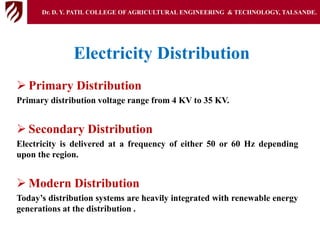
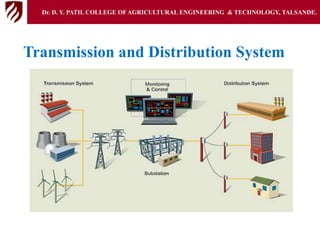
Electricity Distribution
 Primary Distribution
Primary distribution voltage range from 4 KV to 35 KV.
 Secondary Distribution
Electricity is delivered at a frequency of either 50 or 60 Hz depending
upon the region.
 Modern Distribution
Today’s distribution systems are heavily integrated with renewable energy
generations at the distribution .
Dr. D. Y. PATIL COLLEGE OFAGRICULTURAL ENGINEERING & TECHNOLOGY, TALSANDE.
Transmission and Distribution System
Dr. D. Y. PATIL COLLEGE OFAGRICULTURAL ENGINEERING & TECHNOLOGY, TALSANDE.
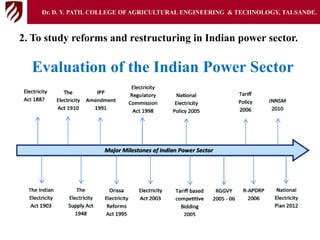
2. To study reforms and restructuring in Indian power sector.
Evaluation of the Indian Power Sector
Dr. D. Y. PATIL COLLEGE OFAGRICULTURAL ENGINEERING & TECHNOLOGY, TALSANDE.
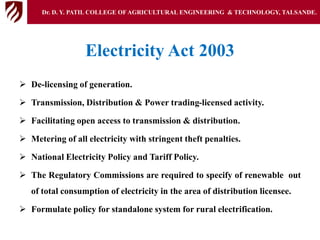
Electricity Act 2003
 De-licensing of generation.
 Transmission, Distribution & Power trading-licensed activity.
 Facilitating open access to transmission & distribution.
 Metering of all electricity with stringent theft penalties.
 National Electricity Policy and Tariff Policy.
 The Regulatory Commissions are required to specify of renewable out
of total consumption of electricity in the area of distribution licensee.
 Formulate policy for standalone system for rural electrification.
Dr. D. Y. PATIL COLLEGE OFAGRICULTURAL ENGINEERING & TECHNOLOGY, TALSANDE.
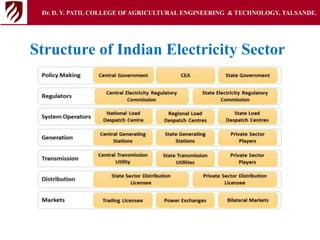
Structure of Indian Electricity Sector
Dr. D. Y. PATIL COLLEGE OFAGRICULTURAL ENGINEERING & TECHNOLOGY, TALSANDE.
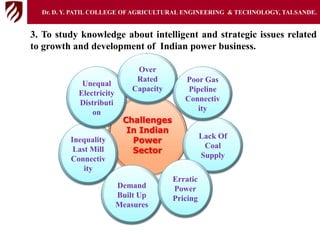
Inequality
Last Mill
Connectiv
ity
Demand
Built Up
Measures
Unequal
Electricity
Distributi
on
Over
Rated
Capacity
Lack Of
Coal
Supply
Erratic
Power
Pricing
Poor Gas
Pipeline
Connectiv
ity
Dr. D. Y. PATIL COLLEGE OFAGRICULTURAL ENGINEERING & TECHNOLOGY, TALSANDE.
3. To study knowledge about intelligent and strategic issues related
to growth and development of Indian power business.
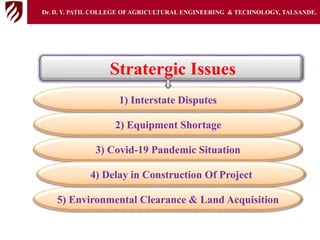
5) Environmental Clearance & Land Acquisition
3) Covid-19 Pandemic Situation
4) Delay in Construction Of Project
Stratergic Issues
2) Equipment Shortage
1) Interstate Disputes
Dr. D. Y. PATIL COLLEGE OFAGRICULTURAL ENGINEERING & TECHNOLOGY, TALSANDE.
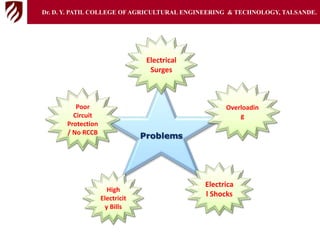
High
Electricit
y Bills
Poor
Circuit
Protection
/ No RCCB
Overloadin
g
Electrical
Surges
Electrica
l Shocks
Dr. D. Y. PATIL COLLEGE OFAGRICULTURAL ENGINEERING & TECHNOLOGY, TALSANDE.
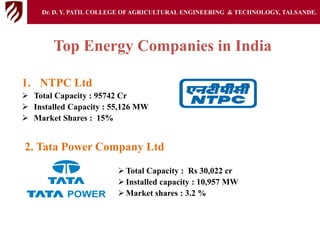
Top Energy Companies in India
1. NTPC Ltd
 Total Capacity : 95742 Cr
 Installed Capacity : 55,126 MW
 Market Shares : 15%
2. Tata Power Company Ltd
 Total Capacity : Rs 30,022 cr
 Installed capacity : 10,957 MW
 Market shares : 3.2 %
Dr. D. Y. PATIL COLLEGE OFAGRICULTURAL ENGINEERING & TECHNOLOGY, TALSANDE.
3. Adani Power Limited
 Total sales : Rs 28013 cr
 Installed capacity : 10,440 MW
 Market shares : 3%
4. JSW Energy Ltd
 Total sales : Rs 9,189 cr
 Installed capacity : 4,541 MW
 Market shares : 1.4%
Dr. D. Y. PATIL COLLEGE OFAGRICULTURAL ENGINEERING & TECHNOLOGY, TALSANDE.
Future of Power Business
 Under the Union Budget 2021-22, the government allocated RS
305,985 Crore (US$ 42 Billion) for a revamped, reforms-based and
result-linked new power distribution sector schemes over the next five
years.
 Now a days, some biggest companies like Tata, Reliance, Adani and
NTPC are invested in Renewable sources. Competition in this leading
companies are helpful to power generating capacity of Indian Power
Sector.
Dr. D. Y. PATIL COLLEGE OFAGRICULTURAL ENGINEERING & TECHNOLOGY, TALSANDE.
Outcomes of PBL
 Communication skill is improved
 Skill of information collection is improved
 Learned about working and preparation of Electricity Distribution
 Studied and observed generation and transmission of Electricity
 Skill of Team Work is improved
 Presentation and Report writing skills are improved
Dr. D. Y. PATIL COLLEGE OFAGRICULTURAL ENGINEERING & TECHNOLOGY, TALSANDE.
References
1) Article on Power Sector in India by India Brand
2) India Energy Outlook 2021
3) Central Authority, Ministry of New and Renewable Energy Media reports
and Press releases
4) Article based on Toothless reform move for Power sector
5) Electricity Act 2003, published in Gazette of India
6) Equality Foundation (IBEF)
7) http://www.cea.nic.in
8) http://www.cercind.org
Dr. D. Y. PATIL COLLEGE OFAGRICULTURAL ENGINEERING & TECHNOLOGY, TALSANDE.
Conclusion
 To make future brighter India gear up to utilize renewable sources.
 The power sector in Indian is currently in the developing stage.
 Reduce use of non-renewable and extend use of renewable sources is
need in future
 Without electricity you wouldn‘t be able to view this page or be on a
computer at this moment.
Dr. D. Y. PATIL COLLEGE OFAGRICULTURAL ENGINEERING & TECHNOLOGY, TALSANDE.

EFFICIENT ELECTRICITY DISTRIBUTION Presentation.pptx

  • 1.
    WELCOME Coming Together IsA Beginning; Keeping Together Is Progress; Working Together Is Success….! Dr. D. Y. PATIL COLLEGE OFAGRICULTURAL ENGINEERING & TECHNOLOGY, TALSANDE.
  • 2.
    A Presentation on Problem BasedLearning “ EFFICIENT ELECTRICITY DISTRUBUTION SYSTEM NEEDS AND REQUIREMENT ” From 1st June 2021 to 31st July 2021 Presented by, Mr. Harshwardhan Babasaheb Devkar Mr. Rushikesh Subhash Devmore Mr. Abhishek Malhari Dhond Miss Samiksha Sharad Dhurgude Mr. Soham Rajendra Gadhave Miss Mrunali Devendra Gaikwad Mr. Atharv Kerba Gavhane Miss Shruti Gajanan Gedam Miss Anuja Pandurang Ghadge Mr. Siddhant Santosh Gharge Dr. D. Y. Patil College of Agricultural Engineering And Technology, Talsande, Kolhapur (Affiliated to Mahatma Phule Krishi Vidyapeeth, Rahuri) Dr. D. Y. PATIL COLLEGE OFAGRICULTURAL ENGINEERING & TECHNOLOGY, TALSANDE.
  • 3.
    Objectives  Describe andanalyze distributed system such as transmission lines and fields.  To study reforms and restructuring in Indian power sector.  To study knowledge about intelligent and strategic issues related to growth and development of Indian power business. Dr. D. Y. PATIL COLLEGE OFAGRICULTURAL ENGINEERING & TECHNOLOGY, TALSANDE.
  • 4.
    Schedule Of PBLProgram Dr. D. Y. PATIL COLLEGE OFAGRICULTURAL ENGINEERING & TECHNOLOGY, TALSANDE.
  • 5.
  • 6.
    Introduction  The primarypurpose of electricity distribution system is to meet the customers demands for energy.  India is the world's third largest producer and third largest consumer of electricity.  The national electric grid in India has an installed capacity 383.37 GW as of 31 May 2021.  In May 2018, India ranked fourth in the Asia Pacific region out of 25 nations on an index that measured their overall power.  Nowadays electricity is an essential part of modern life Dr. D. Y. PATIL COLLEGE OFAGRICULTURAL ENGINEERING & TECHNOLOGY, TALSANDE.
  • 7.
    History Benjamin Franklin Electricity discoveredby Kite experiment Michael Faraday Discovered the World’s First Current & Electric Motor Thomas Elva Edison The Invention of The Light Bulb Dr. D. Y. PATIL COLLEGE OFAGRICULTURAL ENGINEERING & TECHNOLOGY, TALSANDE.
  • 8.
     The late1870s and early 1880s saw the introduction of arc lamp lighting used outdoors or in large indoor spaces such as this Brush Electric Company system installed in 1880 in New York City.  The first power distribution systems installed in European and US cities were used to supply lighting. Dr. D. Y. PATIL COLLEGE OFAGRICULTURAL ENGINEERING & TECHNOLOGY, TALSANDE.
  • 9.
     The firstdemonstration of electric light in Calcutta was conducted on 24 July 1879 by P W Fleury & Co.  When India became independent in 1947, the country had a power generating capacity of 1,362 Mw.  The evolution of the power sector in India began in 1948, when the, Electricity Supply Act was passed. Dr. D. Y. PATIL COLLEGE OFAGRICULTURAL ENGINEERING & TECHNOLOGY, TALSANDE.
  • 10.
    1. Describe andanalyze distributed system such as transmission lines and fields. Installed Electricity Capacity Dr. D. Y. PATIL COLLEGE OFAGRICULTURAL ENGINEERING & TECHNOLOGY, TALSANDE.
  • 11.
    Sources of Electricity CoalEnergy Electricity Generation by Coal Coal is the largest source of electricity in the world. Coal generates 40% of the world’s electricity. Coal-fired plants generate 55.42% of India’s electricity. Dr. D. Y. PATIL COLLEGE OFAGRICULTURAL ENGINEERING & TECHNOLOGY, TALSANDE.
  • 12.
    Nuclear Energy Generation ofNuclear Energy  Nuclear power provides the world with around 11% of its total electricity.  Nuclear Power produced a total 2.11% of total power generation in India.  Biggest Nuclear Power Plant - Kundakulam Nuclear Power Plant  Capacity – 6000 MW Dr. D. Y. PATIL COLLEGE OFAGRICULTURAL ENGINEERING & TECHNOLOGY, TALSANDE.
  • 13.
     As of31 March 2020, India’s installed utility-scale hydroelectric capacity is 46000MW or 12.3% of its total utility power generation.  Biggest Hydroelectric Power Plant – Tehri Hydropower Complex  Capacity– 2400 MW Hydroelectricity Dr. D. Y. PATIL COLLEGE OFAGRICULTURAL ENGINEERING & TECHNOLOGY, TALSANDE. Electricity Generation by Water
  • 14.
    Wind Energy Electricity Generationby Wind  As of 28 February 2021, the total installed capacity was 38.789 GW, the fourth largest installed wind power capacity in the world.  Biggest Wind Power Plant - Jaisalmer Wind Park  Capacity - 1064 MW Dr. D. Y. PATIL COLLEGE OFAGRICULTURAL ENGINEERING & TECHNOLOGY, TALSANDE.
  • 15.
    Solar Energy Electricity Generationby Solar  India’s solar installed capacity was 40.09 GW as of 31 March 2021.  Biggest Solar Power Plant – Bhadala Solar Park  Capacity– 2245 MW Dr. D. Y. PATIL COLLEGE OFAGRICULTURAL ENGINEERING & TECHNOLOGY, TALSANDE.
  • 16.
    Dr. D. Y.PATIL COLLEGE OFAGRICULTURAL ENGINEERING & TECHNOLOGY, TALSANDE.
  • 17.
    Electricity Distribution  PrimaryDistribution Primary distribution voltage range from 4 KV to 35 KV.  Secondary Distribution Electricity is delivered at a frequency of either 50 or 60 Hz depending upon the region.  Modern Distribution Today’s distribution systems are heavily integrated with renewable energy generations at the distribution . Dr. D. Y. PATIL COLLEGE OFAGRICULTURAL ENGINEERING & TECHNOLOGY, TALSANDE.
  • 18.
    Transmission and DistributionSystem Dr. D. Y. PATIL COLLEGE OFAGRICULTURAL ENGINEERING & TECHNOLOGY, TALSANDE.
  • 19.
    2. To studyreforms and restructuring in Indian power sector. Evaluation of the Indian Power Sector Dr. D. Y. PATIL COLLEGE OFAGRICULTURAL ENGINEERING & TECHNOLOGY, TALSANDE.
  • 20.
    Electricity Act 2003 De-licensing of generation.  Transmission, Distribution & Power trading-licensed activity.  Facilitating open access to transmission & distribution.  Metering of all electricity with stringent theft penalties.  National Electricity Policy and Tariff Policy.  The Regulatory Commissions are required to specify of renewable out of total consumption of electricity in the area of distribution licensee.  Formulate policy for standalone system for rural electrification. Dr. D. Y. PATIL COLLEGE OFAGRICULTURAL ENGINEERING & TECHNOLOGY, TALSANDE.
  • 21.
    Structure of IndianElectricity Sector Dr. D. Y. PATIL COLLEGE OFAGRICULTURAL ENGINEERING & TECHNOLOGY, TALSANDE.
  • 22.
    Inequality Last Mill Connectiv ity Demand Built Up Measures Unequal Electricity Distributi on Over Rated Capacity LackOf Coal Supply Erratic Power Pricing Poor Gas Pipeline Connectiv ity Dr. D. Y. PATIL COLLEGE OFAGRICULTURAL ENGINEERING & TECHNOLOGY, TALSANDE. 3. To study knowledge about intelligent and strategic issues related to growth and development of Indian power business.
  • 23.
    5) Environmental Clearance& Land Acquisition 3) Covid-19 Pandemic Situation 4) Delay in Construction Of Project Stratergic Issues 2) Equipment Shortage 1) Interstate Disputes Dr. D. Y. PATIL COLLEGE OFAGRICULTURAL ENGINEERING & TECHNOLOGY, TALSANDE.
  • 24.
    High Electricit y Bills Poor Circuit Protection / NoRCCB Overloadin g Electrical Surges Electrica l Shocks Dr. D. Y. PATIL COLLEGE OFAGRICULTURAL ENGINEERING & TECHNOLOGY, TALSANDE.
  • 25.
    Top Energy Companiesin India 1. NTPC Ltd  Total Capacity : 95742 Cr  Installed Capacity : 55,126 MW  Market Shares : 15% 2. Tata Power Company Ltd  Total Capacity : Rs 30,022 cr  Installed capacity : 10,957 MW  Market shares : 3.2 % Dr. D. Y. PATIL COLLEGE OFAGRICULTURAL ENGINEERING & TECHNOLOGY, TALSANDE.
  • 26.
    3. Adani PowerLimited  Total sales : Rs 28013 cr  Installed capacity : 10,440 MW  Market shares : 3% 4. JSW Energy Ltd  Total sales : Rs 9,189 cr  Installed capacity : 4,541 MW  Market shares : 1.4% Dr. D. Y. PATIL COLLEGE OFAGRICULTURAL ENGINEERING & TECHNOLOGY, TALSANDE.
  • 27.
    Future of PowerBusiness  Under the Union Budget 2021-22, the government allocated RS 305,985 Crore (US$ 42 Billion) for a revamped, reforms-based and result-linked new power distribution sector schemes over the next five years.  Now a days, some biggest companies like Tata, Reliance, Adani and NTPC are invested in Renewable sources. Competition in this leading companies are helpful to power generating capacity of Indian Power Sector. Dr. D. Y. PATIL COLLEGE OFAGRICULTURAL ENGINEERING & TECHNOLOGY, TALSANDE.
  • 28.
    Outcomes of PBL Communication skill is improved  Skill of information collection is improved  Learned about working and preparation of Electricity Distribution  Studied and observed generation and transmission of Electricity  Skill of Team Work is improved  Presentation and Report writing skills are improved Dr. D. Y. PATIL COLLEGE OFAGRICULTURAL ENGINEERING & TECHNOLOGY, TALSANDE.
  • 29.
    References 1) Article onPower Sector in India by India Brand 2) India Energy Outlook 2021 3) Central Authority, Ministry of New and Renewable Energy Media reports and Press releases 4) Article based on Toothless reform move for Power sector 5) Electricity Act 2003, published in Gazette of India 6) Equality Foundation (IBEF) 7) http://www.cea.nic.in 8) http://www.cercind.org Dr. D. Y. PATIL COLLEGE OFAGRICULTURAL ENGINEERING & TECHNOLOGY, TALSANDE.
  • 30.
    Conclusion  To makefuture brighter India gear up to utilize renewable sources.  The power sector in Indian is currently in the developing stage.  Reduce use of non-renewable and extend use of renewable sources is need in future  Without electricity you wouldn‘t be able to view this page or be on a computer at this moment. Dr. D. Y. PATIL COLLEGE OFAGRICULTURAL ENGINEERING & TECHNOLOGY, TALSANDE.
  • 31.
    Dr. D. Y.PATIL COLLEGE OFAGRICULTURAL ENGINEERING & TECHNOLOGY, TALSANDE.