PART 1
FUNDAMENTALS
Copyright © 2015 Thames & Hudson
Chapter 1.9
Pattern and Rhythm
PART 1
FUNDAMENTALS
Gateways to Art: Understanding the Visual Arts, Second Edition, Debra J. DeWitte, Ralph M. Larmann, and M. Kathryn Shields
Chapter 1.9 Pattern and Rhythm
Introduction
 Pattern and rhythm bring order to
space and create a dynamic
experience of time
 Patterns are created by the
recurrence of an art element
 Rhythm arises through the
repetition of pattern
PART 1
FUNDAMENTALS
Gateways to Art: Understanding the Visual Arts, Second Edition, Debra J. DeWitte, Ralph M. Larmann, and M. Kathryn Shields
Chapter 1.9 Pattern and Rhythm
Pattern
 The use of repetition in a work
usually results in pattern
 Pattern can impose order on a
work
 Alternating patterns may be used
to make a work more lively
 The area covered by pattern is
called the field
PART 1
FUNDAMENTALS
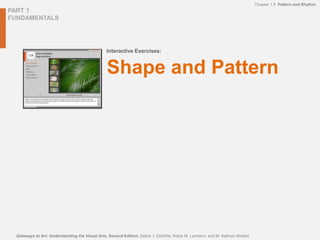
Interactive Exercises:
Chapter 1.9 Pattern and Rhythm
Gateways to Art: Understanding the Visual Arts, Second Edition, Debra J. DeWitte, Ralph M. Larmann, and M. Kathryn Shields
Shape and Pattern
PART 1
FUNDAMENTALS
Chapter 1.9 Pattern and Rhythm
Gateways to Art: Understanding the Visual Arts, Second Edition, Debra J. DeWitte, Ralph M. Larmann, and M. Kathryn Shields
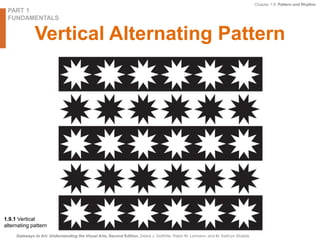
Vertical Alternating Pattern
1.9.1 Vertical
alternating pattern
PART 1
FUNDAMENTALS
Interactive Exercises:
Chapter 1.9 Pattern and Rhythm
Gateways to Art: Understanding the Visual Arts, Second Edition, Debra J. DeWitte, Ralph M. Larmann, and M. Kathryn Shields
Unity and Contrast
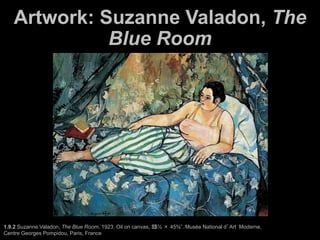
Artwork: Suzanne Valadon, The
Blue Room
1.9.2 Suzanne Valadon, The Blue Room, 1923. Oil on canvas, 35½ × 45⅝”. Musée National d’Art Moderne,
Centre Georges Pompidou, Paris, France
PART 1
FUNDAMENTALS
Chapter 1.9 Pattern and Rhythm
Gateways to Art: Understanding the Visual Arts, Second Edition, Debra J. DeWitte, Ralph M. Larmann, and M. Kathryn Shields
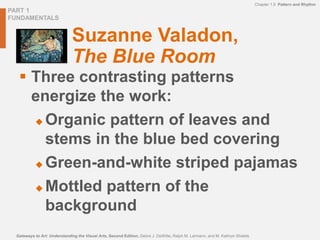
Suzanne Valadon,
The Blue Room
 Three contrasting patterns
energize the work:
 Organic pattern of leaves and
stems in the blue bed covering
 Green-and-white striped pajamas
 Mottled pattern of the
background
PART 1
FUNDAMENTALS
Gateways to Art: Understanding the Visual Arts, Second Edition, Debra J. DeWitte, Ralph M. Larmann, and M. Kathryn Shields
Chapter 1.9 Pattern and Rhythm
What is Motif?
 A design repeated as a unit in a
pattern is called a motif
 Motifs can represent ideas,
images, and themes
 A repeated motif can create a
strong unified design
PART 1
FUNDAMENTALS
Interactive Exercises:
Chapter 1.9 Pattern and Rhythm
Gateways to Art: Understanding the Visual Arts, Second Edition, Debra J. DeWitte, Ralph M. Larmann, and M. Kathryn Shields
Motif
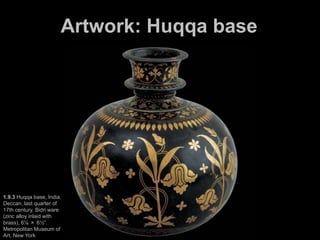
Artwork: Huqqa base
1.9.3 Huqqa base, India,
Deccan, last quarter of
17th century. Bidri ware
(zinc alloy inlaid with
brass), 6⅞ × 6½”.
Metropolitan Museum of
Art, New York
PART 1
FUNDAMENTALS
Chapter 1.9 Pattern and Rhythm
Gateways to Art: Understanding the Visual Arts, Second Edition, Debra J. DeWitte, Ralph M. Larmann, and M. Kathryn Shields
Huqqa base
 Many Islamic works use complex
interlaced motifs
 Elements, such as the flowers and
leaves of the plants, recur at
intervals
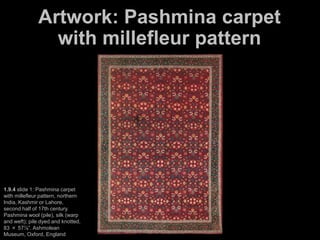
Artwork: Pashmina carpet
with millefleur pattern
1.9.4 slide 1: Pashmina carpet
with millefleur pattern, northern
India, Kashmir or Lahore,
second half of 17th century.
Pashmina wool (pile), silk (warp
and weft); pile dyed and knotted,
83 × 57⅞”. Ashmolean
Museum, Oxford, England
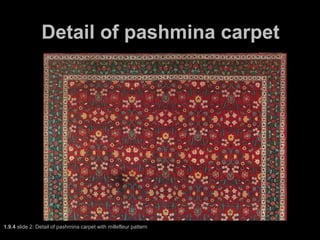
Detail of pashmina carpet
1.9.4 slide 2: Detail of pashmina carpet with millefleur pattern
PART 1
FUNDAMENTALS
Chapter 1.9 Pattern and Rhythm
Gateways to Art: Understanding the Visual Arts, Second Edition, Debra J. DeWitte, Ralph M. Larmann, and M. Kathryn Shields
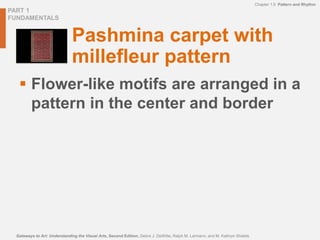
Pashmina carpet with
millefleur pattern
 Flower-like motifs are arranged in a
pattern in the center and border
Video:
PART 1
FUNDAMENTALS
Chapter 1.9 Pattern and Rhythm
Gateways to Art: Understanding the Visual Arts, Second Edition, Debra J. DeWitte, Ralph M. Larmann, and M. Kathryn Shields
“The Abode of
Paradise”:
The Taj Mahal
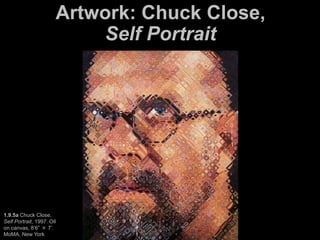
Artwork: Chuck Close,
Self Portrait
1.9.5a Chuck Close,
Self Portrait, 1997. Oil
on canvas, 8’6” × 7’.
MoMA, New York
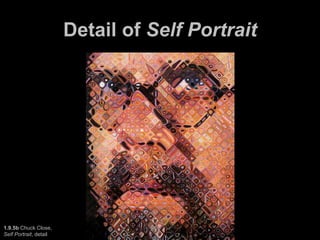
Detail of Self Portrait
1.9.5b Chuck Close,
Self Portrait, detail
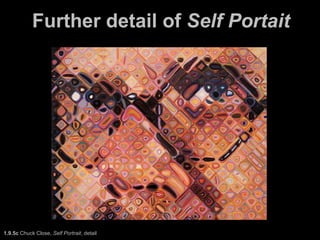
Further detail of Self Portait
1.9.5c Chuck Close, Self Portrait, detail
PART 1
FUNDAMENTALS
Chapter 1.9 Pattern and Rhythm
Gateways to Art: Understanding the Visual Arts, Second Edition, Debra J. DeWitte, Ralph M. Larmann, and M. Kathryn Shields
Chuck Close,
Self Portrait
 Close’s paintings appear as
abstract patterns when viewed
closely
 A grid that subdivides the entire
image organizes the placement of
each cell
 The repeating cell motif unifies the
work
PART 1
FUNDAMENTALS
Gateways to Art: Understanding the Visual Arts, Second Edition, Debra J. DeWitte, Ralph M. Larmann, and M. Kathryn Shields
Chapter 1.9 Pattern and Rhythm
Rhythm
 Rhythm gives structure to the
experience of looking
 Guides our eyes from one point to
another in a work of art
 Rhythm occurs when there are at
least two points of reference in an
artwork
PART 1
FUNDAMENTALS
Interactive Exercises:
Chapter 1.9 Pattern and Rhythm
Gateways to Art: Understanding the Visual Arts, Second Edition, Debra J. DeWitte, Ralph M. Larmann, and M. Kathryn Shields
Types of Rhythm
Artwork: Pieter Bruegel,
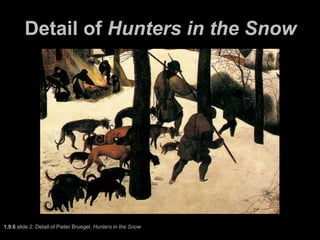
Hunters in the Snow
1.9.6 slide 1: Pieter Bruegel, Hunters in the Snow, 1565. Oil on panel, 46 × 63¾”. Kunsthistorisches Museum, Vienna, Austria
Detail of Hunters in the Snow
1.9.6 slide 2: Detail of Pieter Bruegel, Hunters in the Snow
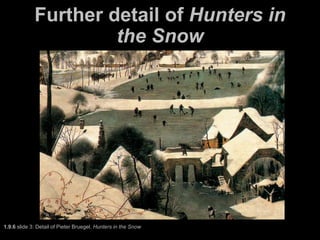
Further detail of Hunters in
the Snow
1.9.6 slide 3: Detail of Pieter Bruegel, Hunters in the Snow
PART 1
FUNDAMENTALS
Chapter 1.9 Pattern and Rhythm
Gateways to Art: Understanding the Visual Arts, Second Edition, Debra J. DeWitte, Ralph M. Larmann, and M. Kathryn Shields
Pieter Bruegel,
Hunters in the Snow
 The party of hunters on the left
side first draws our attention into
the work
 Our gaze circles through
foreground, middle ground and
background, then returns to the
original focal point
PART 1
FUNDAMENTALS
Gateways to Art: Understanding the Visual Arts, Second Edition, Debra J. DeWitte, Ralph M. Larmann, and M. Kathryn Shields
Chapter 1.9 Pattern and Rhythm
Simple Repetitive Rhythm
 Artists create repetition by using
the same shape, color, size, value,
line, or texture over and over again
 Such regularity communicates
reassurance
 It is incorporated into architectural
designs as a sign of stability and
durability
Artwork: Great Mosque of
Córdoba
1.9.7 Great Mosque of Córdoba, prayer hall of Abd al-Rahman I, 784–86, Córdoba, Spain
PART 1
FUNDAMENTALS
Chapter 1.9 Pattern and Rhythm
Gateways to Art: Understanding the Visual Arts, Second Edition, Debra J. DeWitte, Ralph M. Larmann, and M. Kathryn Shields
Great Mosque of
Córdoba
 Each of the repeating elements—
columns, arches, and voussoirs—
creates its own simple rhythm
 Enhances the function of the
space; becomes a part of the
activity of worship, like the
timelessness of prayer
PART 1
FUNDAMENTALS
Gateways to Art: Understanding the Visual Arts, Second Edition, Debra J. DeWitte, Ralph M. Larmann, and M. Kathryn Shields
Chapter 1.9 Pattern and Rhythm
Progressive Rhythm
 Repetition that regularly increases
or decreases in frequency creates
a progressive rhythm as the eye
moves faster or slower across the
surface of the work
PART 1
FUNDAMENTALS
Gateways to Art: Understanding the Visual Arts, Second Edition, Debra J. DeWitte, Ralph M. Larmann, and M. Kathryn Shields
Chapter 1.9 Pattern and Rhythm
Alternating Rhythm
 Multiple rhythms can become
complex
 The addition and alternation of
rhythms can add unpredictability
and visual excitement
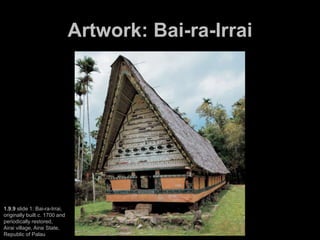
Artwork: Bai-ra-Irrai
1.9.9 slide 1: Bai-ra-Irrai,
originally built c. 1700 and
periodically restored,
Airai village, Airai State,
Republic of Palau
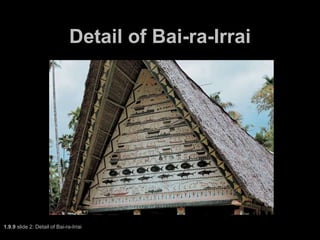
Detail of Bai-ra-Irrai
1.9.9 slide 2: Detail of Bai-ra-Irrai
PART 1
FUNDAMENTALS
Chapter 1.9 Pattern and Rhythm
Gateways to Art: Understanding the Visual Arts, Second Edition, Debra J. DeWitte, Ralph M. Larmann, and M. Kathryn Shields
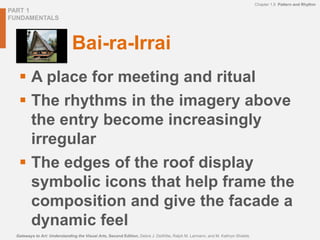
Bai-ra-Irrai
 A place for meeting and ritual
 The rhythms in the imagery above
the entry become increasingly
irregular
 The edges of the roof display
symbolic icons that help frame the
composition and give the facade a
dynamic feel
Artwork: Francisco Goya, The
Third of May, 1808
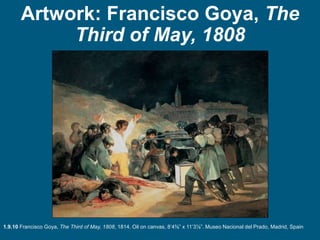
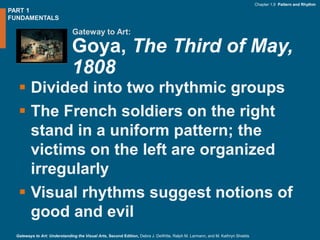
1.9.10 Francisco Goya, The Third of May, 1808, 1814. Oil on canvas, 8’4⅜” x 11’3⅞”. Museo Nacional del Prado, Madrid, Spain
PART 1
FUNDAMENTALS
Gateway to Art:
Chapter 1.9 Pattern and Rhythm
Gateways to Art: Understanding the Visual Arts, Second Edition, Debra J. DeWitte, Ralph M. Larmann, and M. Kathryn Shields
Goya, The Third of May,
1808
 Divided into two rhythmic groups
 The French soldiers on the right
stand in a uniform pattern; the
victims on the left are organized
irregularly
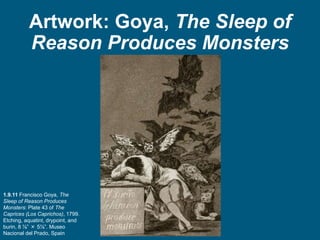
 Visual rhythms suggest notions of
good and evil
Artwork: Goya, The Sleep of
Reason Produces Monsters
1.9.11 Francisco Goya, The
Sleep of Reason Produces
Monsters: Plate 43 of The
Caprices (Los Caprichos), 1799.
Etching, aquatint, drypoint, and
burin, 8 ⅞” × 5⅞”. Museo
Nacional del Prado, Spain
PART 1
FUNDAMENTALS
Gateways to Art: Understanding the Visual Arts, Second Edition, Debra J. DeWitte, Ralph M. Larmann, and M. Kathryn Shields
Chapter 1.9 Pattern and Rhythm
Rhythmic Design Structure
 How artists divide visual space
into different sections to achieve
different kinds of effects
PART 1
FUNDAMENTALS
Interactive Exercises:
Chapter 1.9 Pattern and Rhythm
Gateways to Art: Understanding the Visual Arts, Second Edition, Debra J. DeWitte, Ralph M. Larmann, and M. Kathryn Shields
Rhythmic Structure
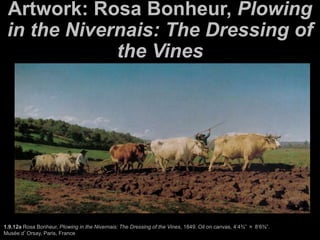
Artwork: Rosa Bonheur, Plowing
in the Nivernais: The Dressing of
the Vines
1.9.12a Rosa Bonheur, Plowing in the Nivernais: The Dressing of the Vines, 1849. Oil on canvas, 4’4¾” × 8’6⅜”.
Musée d’Orsay, Paris, France
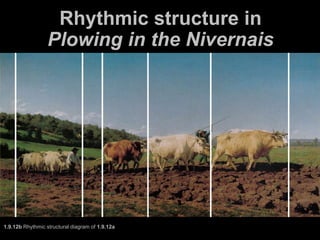
Rhythmic structure in
Plowing in the Nivernais
1.9.12b Rhythmic structural diagram of 1.9.12a
PART 1
FUNDAMENTALS
Chapter 1.9 Pattern and Rhythm
Gateways to Art: Understanding the Visual Arts, Second Edition, Debra J. DeWitte, Ralph M. Larmann, and M. Kathryn Shields
Rosa Bonheur,
Plowing in the Nivernais
 A horizontal rhythmic structure
leads our eye in sequence from
one group of shapes to the next,
from left to right
 Changing width of the gaps
suggests the slow, irregular
movement of the cattle
PART 1
FUNDAMENTALS
PowerPoints developed by CreativeMyndz Multimedia Studios
Chapter 1.9 Pattern and Rhythm
Chapter 1.9 Copyright
Information
This concludes the PowerPoint slide set for Chapter 1.9
Gateways to Art: Understanding the Visual Arts
Second Edition
By Debra J. DeWitte, Ralph M. Larmann, and M. Kathryn Shields
Copyright © 2015 Thames & Hudson
PART 1
FUNDAMENTALS
PowerPoints developed by CreativeMyndz Multimedia Studios
Chapter 1.9 Pattern and Rhythm
Picture Credits for Chapter 1.9
1.9.1 Ralph Larmann
1.9.2 Musée National d’Art Moderne, Centre Georges Pompidou, Paris
1.9.3 Metropolitan Museum of Art, Louis E. and Theresa S. Seley Purchase Fund for Islamic Art,
and Rogers Fund, 1984. Photo Metropolitan Museum of Art/Art Resource/Scala, Florence
1.9.4 Ashmolean Museum, Oxford
1.9.5a, b, c Museum of Modern Art, New York, Gift of Agnes Gund, Jo Carole and Ronald S. Lauder, Donald L.
Bryant, Jr., Leon Black, Michael and Judy Ovitz, Anna Marie and Robert F. Shapiro, Leila and Melville
Straus, Doris and Donald Fisher, and purchase, Acc. no. 215.2000. Photo Ellen Page Wilson, courtesy The
Pace Gallery © Chuck Close, The Pace Gallery
1.9.6 Kunsthistorisches Museum, Vienna
1.9.7 iStockphoto.com
1.9.8 Please note that this image is not available for digital use but can be found on p. 173 of the textbook.
1.9.9 © WaterFrame/Alamy
1.9.10, 1.9.11 Museo Nacional del Prado, Madrid
1.9.12a Musée d’Orsay, Paris
1.9.12b Ralph Larmann

1 9 gateways-to_art2e_final

  • 1.
    PART 1 FUNDAMENTALS Copyright ©2015 Thames & Hudson Chapter 1.9 Pattern and Rhythm
  • 2.
    PART 1 FUNDAMENTALS Gateways toArt: Understanding the Visual Arts, Second Edition, Debra J. DeWitte, Ralph M. Larmann, and M. Kathryn Shields Chapter 1.9 Pattern and Rhythm Introduction  Pattern and rhythm bring order to space and create a dynamic experience of time  Patterns are created by the recurrence of an art element  Rhythm arises through the repetition of pattern
  • 3.
    PART 1 FUNDAMENTALS Gateways toArt: Understanding the Visual Arts, Second Edition, Debra J. DeWitte, Ralph M. Larmann, and M. Kathryn Shields Chapter 1.9 Pattern and Rhythm Pattern  The use of repetition in a work usually results in pattern  Pattern can impose order on a work  Alternating patterns may be used to make a work more lively  The area covered by pattern is called the field
  • 4.
    PART 1 FUNDAMENTALS Interactive Exercises: Chapter1.9 Pattern and Rhythm Gateways to Art: Understanding the Visual Arts, Second Edition, Debra J. DeWitte, Ralph M. Larmann, and M. Kathryn Shields Shape and Pattern
  • 5.
    PART 1 FUNDAMENTALS Chapter 1.9Pattern and Rhythm Gateways to Art: Understanding the Visual Arts, Second Edition, Debra J. DeWitte, Ralph M. Larmann, and M. Kathryn Shields Vertical Alternating Pattern 1.9.1 Vertical alternating pattern
  • 6.
    PART 1 FUNDAMENTALS Interactive Exercises: Chapter1.9 Pattern and Rhythm Gateways to Art: Understanding the Visual Arts, Second Edition, Debra J. DeWitte, Ralph M. Larmann, and M. Kathryn Shields Unity and Contrast
  • 7.
    Artwork: Suzanne Valadon,The Blue Room 1.9.2 Suzanne Valadon, The Blue Room, 1923. Oil on canvas, 35½ × 45⅝”. Musée National d’Art Moderne, Centre Georges Pompidou, Paris, France
  • 8.
    PART 1 FUNDAMENTALS Chapter 1.9Pattern and Rhythm Gateways to Art: Understanding the Visual Arts, Second Edition, Debra J. DeWitte, Ralph M. Larmann, and M. Kathryn Shields Suzanne Valadon, The Blue Room  Three contrasting patterns energize the work:  Organic pattern of leaves and stems in the blue bed covering  Green-and-white striped pajamas  Mottled pattern of the background
  • 9.
    PART 1 FUNDAMENTALS Gateways toArt: Understanding the Visual Arts, Second Edition, Debra J. DeWitte, Ralph M. Larmann, and M. Kathryn Shields Chapter 1.9 Pattern and Rhythm What is Motif?  A design repeated as a unit in a pattern is called a motif  Motifs can represent ideas, images, and themes  A repeated motif can create a strong unified design
  • 10.
    PART 1 FUNDAMENTALS Interactive Exercises: Chapter1.9 Pattern and Rhythm Gateways to Art: Understanding the Visual Arts, Second Edition, Debra J. DeWitte, Ralph M. Larmann, and M. Kathryn Shields Motif
  • 11.
    Artwork: Huqqa base 1.9.3Huqqa base, India, Deccan, last quarter of 17th century. Bidri ware (zinc alloy inlaid with brass), 6⅞ × 6½”. Metropolitan Museum of Art, New York
  • 12.
    PART 1 FUNDAMENTALS Chapter 1.9Pattern and Rhythm Gateways to Art: Understanding the Visual Arts, Second Edition, Debra J. DeWitte, Ralph M. Larmann, and M. Kathryn Shields Huqqa base  Many Islamic works use complex interlaced motifs  Elements, such as the flowers and leaves of the plants, recur at intervals
  • 13.
    Artwork: Pashmina carpet withmillefleur pattern 1.9.4 slide 1: Pashmina carpet with millefleur pattern, northern India, Kashmir or Lahore, second half of 17th century. Pashmina wool (pile), silk (warp and weft); pile dyed and knotted, 83 × 57⅞”. Ashmolean Museum, Oxford, England
  • 14.
    Detail of pashminacarpet 1.9.4 slide 2: Detail of pashmina carpet with millefleur pattern
  • 15.
    PART 1 FUNDAMENTALS Chapter 1.9Pattern and Rhythm Gateways to Art: Understanding the Visual Arts, Second Edition, Debra J. DeWitte, Ralph M. Larmann, and M. Kathryn Shields Pashmina carpet with millefleur pattern  Flower-like motifs are arranged in a pattern in the center and border
  • 16.
    Video: PART 1 FUNDAMENTALS Chapter 1.9Pattern and Rhythm Gateways to Art: Understanding the Visual Arts, Second Edition, Debra J. DeWitte, Ralph M. Larmann, and M. Kathryn Shields “The Abode of Paradise”: The Taj Mahal
  • 17.
    Artwork: Chuck Close, SelfPortrait 1.9.5a Chuck Close, Self Portrait, 1997. Oil on canvas, 8’6” × 7’. MoMA, New York
  • 18.
    Detail of SelfPortrait 1.9.5b Chuck Close, Self Portrait, detail
  • 19.
    Further detail ofSelf Portait 1.9.5c Chuck Close, Self Portrait, detail
  • 20.
    PART 1 FUNDAMENTALS Chapter 1.9Pattern and Rhythm Gateways to Art: Understanding the Visual Arts, Second Edition, Debra J. DeWitte, Ralph M. Larmann, and M. Kathryn Shields Chuck Close, Self Portrait  Close’s paintings appear as abstract patterns when viewed closely  A grid that subdivides the entire image organizes the placement of each cell  The repeating cell motif unifies the work
  • 21.
    PART 1 FUNDAMENTALS Gateways toArt: Understanding the Visual Arts, Second Edition, Debra J. DeWitte, Ralph M. Larmann, and M. Kathryn Shields Chapter 1.9 Pattern and Rhythm Rhythm  Rhythm gives structure to the experience of looking  Guides our eyes from one point to another in a work of art  Rhythm occurs when there are at least two points of reference in an artwork
  • 22.
    PART 1 FUNDAMENTALS Interactive Exercises: Chapter1.9 Pattern and Rhythm Gateways to Art: Understanding the Visual Arts, Second Edition, Debra J. DeWitte, Ralph M. Larmann, and M. Kathryn Shields Types of Rhythm
  • 23.
    Artwork: Pieter Bruegel, Huntersin the Snow 1.9.6 slide 1: Pieter Bruegel, Hunters in the Snow, 1565. Oil on panel, 46 × 63¾”. Kunsthistorisches Museum, Vienna, Austria
  • 24.
    Detail of Huntersin the Snow 1.9.6 slide 2: Detail of Pieter Bruegel, Hunters in the Snow
  • 25.
    Further detail ofHunters in the Snow 1.9.6 slide 3: Detail of Pieter Bruegel, Hunters in the Snow
  • 26.
    PART 1 FUNDAMENTALS Chapter 1.9Pattern and Rhythm Gateways to Art: Understanding the Visual Arts, Second Edition, Debra J. DeWitte, Ralph M. Larmann, and M. Kathryn Shields Pieter Bruegel, Hunters in the Snow  The party of hunters on the left side first draws our attention into the work  Our gaze circles through foreground, middle ground and background, then returns to the original focal point
  • 27.
    PART 1 FUNDAMENTALS Gateways toArt: Understanding the Visual Arts, Second Edition, Debra J. DeWitte, Ralph M. Larmann, and M. Kathryn Shields Chapter 1.9 Pattern and Rhythm Simple Repetitive Rhythm  Artists create repetition by using the same shape, color, size, value, line, or texture over and over again  Such regularity communicates reassurance  It is incorporated into architectural designs as a sign of stability and durability
  • 28.
    Artwork: Great Mosqueof Córdoba 1.9.7 Great Mosque of Córdoba, prayer hall of Abd al-Rahman I, 784–86, Córdoba, Spain
  • 29.
    PART 1 FUNDAMENTALS Chapter 1.9Pattern and Rhythm Gateways to Art: Understanding the Visual Arts, Second Edition, Debra J. DeWitte, Ralph M. Larmann, and M. Kathryn Shields Great Mosque of Córdoba  Each of the repeating elements— columns, arches, and voussoirs— creates its own simple rhythm  Enhances the function of the space; becomes a part of the activity of worship, like the timelessness of prayer
  • 30.
    PART 1 FUNDAMENTALS Gateways toArt: Understanding the Visual Arts, Second Edition, Debra J. DeWitte, Ralph M. Larmann, and M. Kathryn Shields Chapter 1.9 Pattern and Rhythm Progressive Rhythm  Repetition that regularly increases or decreases in frequency creates a progressive rhythm as the eye moves faster or slower across the surface of the work
  • 31.
    PART 1 FUNDAMENTALS Gateways toArt: Understanding the Visual Arts, Second Edition, Debra J. DeWitte, Ralph M. Larmann, and M. Kathryn Shields Chapter 1.9 Pattern and Rhythm Alternating Rhythm  Multiple rhythms can become complex  The addition and alternation of rhythms can add unpredictability and visual excitement
  • 32.
    Artwork: Bai-ra-Irrai 1.9.9 slide1: Bai-ra-Irrai, originally built c. 1700 and periodically restored, Airai village, Airai State, Republic of Palau
  • 33.
    Detail of Bai-ra-Irrai 1.9.9slide 2: Detail of Bai-ra-Irrai
  • 34.
    PART 1 FUNDAMENTALS Chapter 1.9Pattern and Rhythm Gateways to Art: Understanding the Visual Arts, Second Edition, Debra J. DeWitte, Ralph M. Larmann, and M. Kathryn Shields Bai-ra-Irrai  A place for meeting and ritual  The rhythms in the imagery above the entry become increasingly irregular  The edges of the roof display symbolic icons that help frame the composition and give the facade a dynamic feel
  • 35.
    Artwork: Francisco Goya,The Third of May, 1808 1.9.10 Francisco Goya, The Third of May, 1808, 1814. Oil on canvas, 8’4⅜” x 11’3⅞”. Museo Nacional del Prado, Madrid, Spain
  • 36.
    PART 1 FUNDAMENTALS Gateway toArt: Chapter 1.9 Pattern and Rhythm Gateways to Art: Understanding the Visual Arts, Second Edition, Debra J. DeWitte, Ralph M. Larmann, and M. Kathryn Shields Goya, The Third of May, 1808  Divided into two rhythmic groups  The French soldiers on the right stand in a uniform pattern; the victims on the left are organized irregularly  Visual rhythms suggest notions of good and evil
  • 37.
    Artwork: Goya, TheSleep of Reason Produces Monsters 1.9.11 Francisco Goya, The Sleep of Reason Produces Monsters: Plate 43 of The Caprices (Los Caprichos), 1799. Etching, aquatint, drypoint, and burin, 8 ⅞” × 5⅞”. Museo Nacional del Prado, Spain
  • 38.
    PART 1 FUNDAMENTALS Gateways toArt: Understanding the Visual Arts, Second Edition, Debra J. DeWitte, Ralph M. Larmann, and M. Kathryn Shields Chapter 1.9 Pattern and Rhythm Rhythmic Design Structure  How artists divide visual space into different sections to achieve different kinds of effects
  • 39.
    PART 1 FUNDAMENTALS Interactive Exercises: Chapter1.9 Pattern and Rhythm Gateways to Art: Understanding the Visual Arts, Second Edition, Debra J. DeWitte, Ralph M. Larmann, and M. Kathryn Shields Rhythmic Structure
  • 40.
    Artwork: Rosa Bonheur,Plowing in the Nivernais: The Dressing of the Vines 1.9.12a Rosa Bonheur, Plowing in the Nivernais: The Dressing of the Vines, 1849. Oil on canvas, 4’4¾” × 8’6⅜”. Musée d’Orsay, Paris, France
  • 41.
    Rhythmic structure in Plowingin the Nivernais 1.9.12b Rhythmic structural diagram of 1.9.12a
  • 42.
    PART 1 FUNDAMENTALS Chapter 1.9Pattern and Rhythm Gateways to Art: Understanding the Visual Arts, Second Edition, Debra J. DeWitte, Ralph M. Larmann, and M. Kathryn Shields Rosa Bonheur, Plowing in the Nivernais  A horizontal rhythmic structure leads our eye in sequence from one group of shapes to the next, from left to right  Changing width of the gaps suggests the slow, irregular movement of the cattle
  • 43.
    PART 1 FUNDAMENTALS PowerPoints developedby CreativeMyndz Multimedia Studios Chapter 1.9 Pattern and Rhythm Chapter 1.9 Copyright Information This concludes the PowerPoint slide set for Chapter 1.9 Gateways to Art: Understanding the Visual Arts Second Edition By Debra J. DeWitte, Ralph M. Larmann, and M. Kathryn Shields Copyright © 2015 Thames & Hudson
  • 44.
    PART 1 FUNDAMENTALS PowerPoints developedby CreativeMyndz Multimedia Studios Chapter 1.9 Pattern and Rhythm Picture Credits for Chapter 1.9 1.9.1 Ralph Larmann 1.9.2 Musée National d’Art Moderne, Centre Georges Pompidou, Paris 1.9.3 Metropolitan Museum of Art, Louis E. and Theresa S. Seley Purchase Fund for Islamic Art, and Rogers Fund, 1984. Photo Metropolitan Museum of Art/Art Resource/Scala, Florence 1.9.4 Ashmolean Museum, Oxford 1.9.5a, b, c Museum of Modern Art, New York, Gift of Agnes Gund, Jo Carole and Ronald S. Lauder, Donald L. Bryant, Jr., Leon Black, Michael and Judy Ovitz, Anna Marie and Robert F. Shapiro, Leila and Melville Straus, Doris and Donald Fisher, and purchase, Acc. no. 215.2000. Photo Ellen Page Wilson, courtesy The Pace Gallery © Chuck Close, The Pace Gallery 1.9.6 Kunsthistorisches Museum, Vienna 1.9.7 iStockphoto.com 1.9.8 Please note that this image is not available for digital use but can be found on p. 173 of the textbook. 1.9.9 © WaterFrame/Alamy 1.9.10, 1.9.11 Museo Nacional del Prado, Madrid 1.9.12a Musée d’Orsay, Paris 1.9.12b Ralph Larmann

Editor's Notes

  • #3 Repetition of patterns provides a sense of unity Rhythm provides cohesiveness because it links elements together The artist can also use rhythm to add variety
  • #4 Patterns can be based on occurrences in nature, such as the regular repetition of fish scales, or the pattern created by the cracks that open as mud dries in the desert Other patterns may be derived from the repeated shapes of mass-produced objects, such as tin cans or the warp and weft of woven cloth Artists often create unity by repeatedly using a similar shape, value, or color
  • #6 This pattern shows a series of star shapes set on alternating black and white backgrounds on a rectangular field The drastic difference in value combined with the active shape causes a visual vibration
  • #9 A variety of different colors and patterns enlivens work by the French painter Suzanne Valadon (1865–1938)
  • #13 Created in seventeenth-century India A huqqa is a water pipe used for smoking
  • #16 Created in seventeenth-century India Islamic artists delight in the detail of pattern
  • #21 American artist Chuck Close (b. 1940) uses a repeated pattern of organic concentric rings set into a diamond shape as the basic building blocks for his large compositions There is a difference between a close-up view of the painting and the overall effect when we stand back from this enormous canvas
  • #22 Even the simplest works have an implicit rhythm For example, the horizontal distance from one side of the canvas to the other is one rhythm, and the vertical distance from top to bottom, another The intervals between elements provide points of reference for more complex rhythms
  • #27 Our attention follows the group’s direction, creating the first part of a rhythmic progression In the middle ground, figures appear to be ice skating The color of the sky and pond draw our attention to the horizon The recession of the ridgeline pulls the eye to the left and into the far background We then naturally inspect details in the painting and notice subsidiary rhythms, such as the receding line of trees Bruegel paints the winter activities of the townspeople of sixteenth-century Flanders (a country that is now Belgium, the Netherlands, and part of northern France)
  • #28 We want reassurance that our buildings will endure Stability was so important to the ancient Romans that architects were made to stand under archways while temporary support structures were removed If the arch failed, the architect would be crushed
  • #30 Voussoirs are the stone wedges that make up the arch The simple repetitions become like prayer beads, reciting the Shahada (profession of faith), or the five-times-a-day call to prayer
  • #35 On the island of Belau in the western Pacific, a traditional men’s long house is called a bai The imagery begins, at the bottom, with a horizontal line of fish that become irregular as they change to other kinds of shapes
  • #37 Spanish painter Francisco Goya shows an image of Napoleon’s troops executing Spanish citizens during the French occupation of Madrid in 1808 Although the number of figures in each group is the same, they are distributed differently Each soldier adopts the same stance and the machine guns repeat the uniformity On the left, the figures are not so rigid: some are on the ground, some stand, and some kneel The unarmed vulnerability and disarray of those being attacked invites the viewer to sympathize with the plight of the artist’s countrymen (the Spaniards)
  • #38 Goya also uses different visual rhythms to communicate notions of good and evil in the work The Sleep of Reason Produces Monsters The square box in the lower left stabilizes the image The straight lines symbolize reason as a guarantee of safety and goodness The evil monsters that dominate the upper portion are more haphazard and threatening
  • #43 French artist Rosa Bonheur (1822–1899) may have been sympathetic toward those who worked outside of the stuffy social order of the time, yet she did not seek to glamorize her subject Her gender may have been a disadvantage in a traditionally male profession