Basic Elements & Principles of Fibre and
Decorative Arts
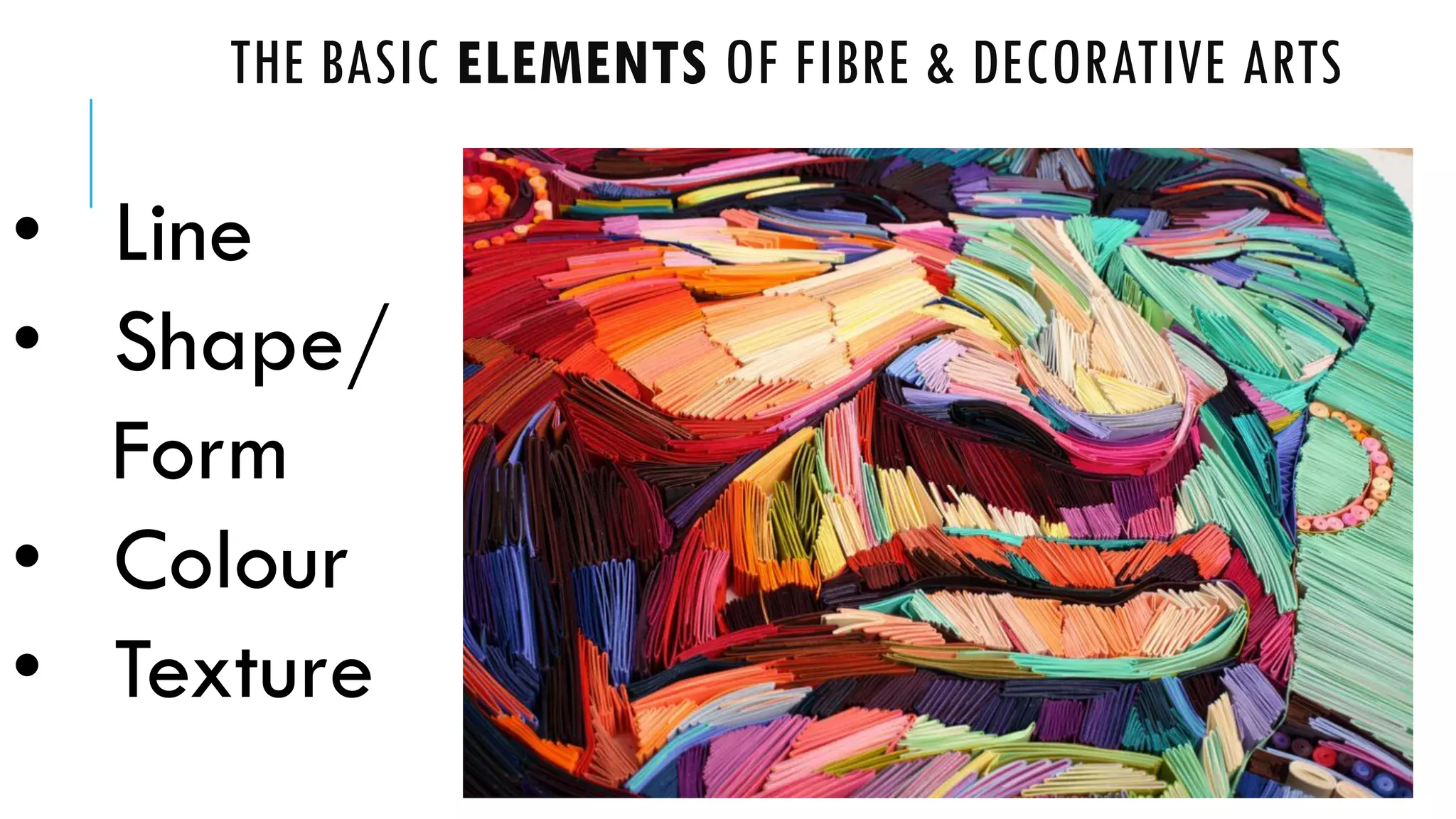
THE BASIC ELEMENTS OF FIBRE & DECORATIVE ARTS
• Line
• Shape/
Form
• Colour
• Texture
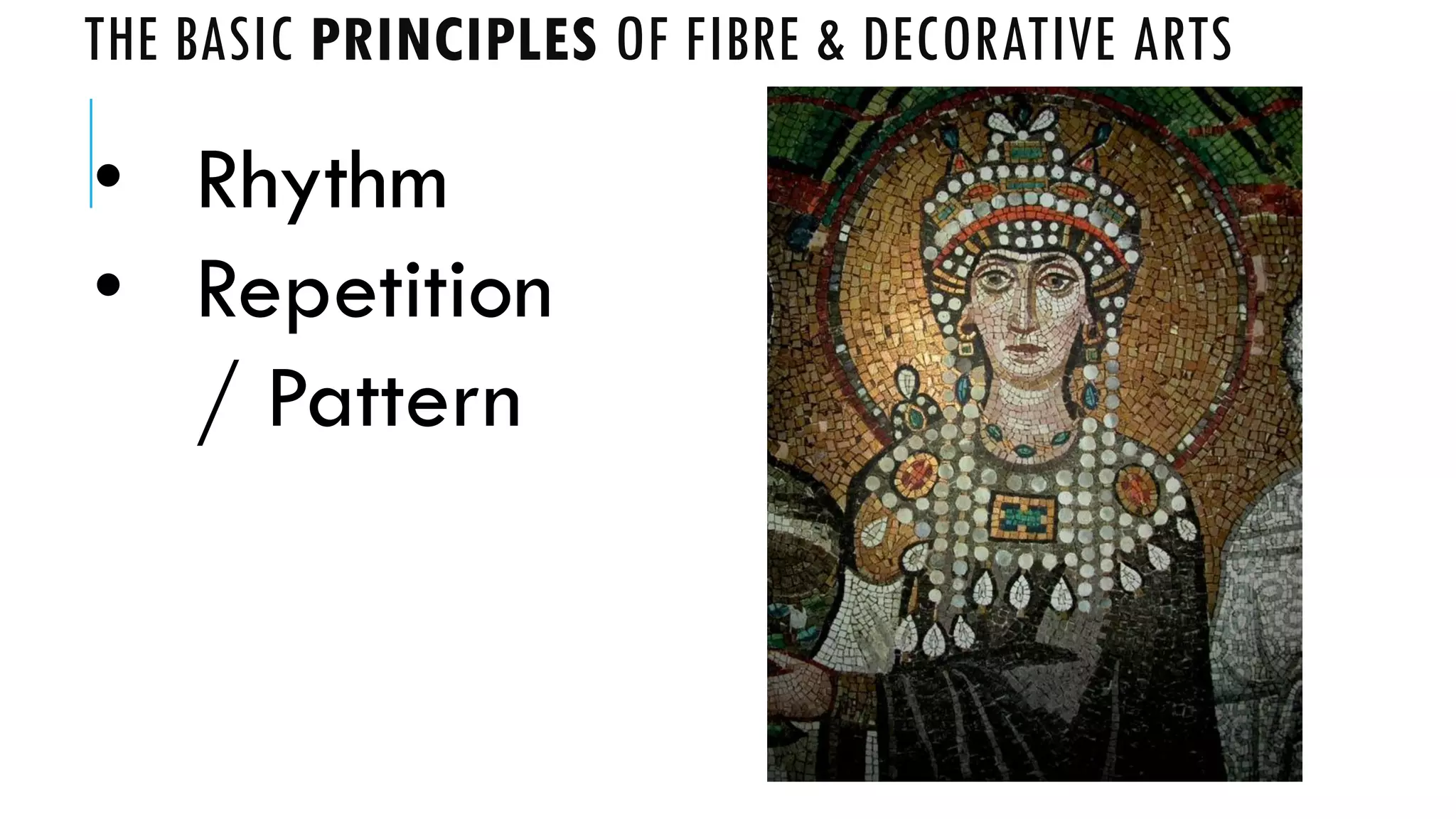
THE BASIC PRINCIPLES OF FIBRE & DECORATIVE ARTS
• Rhythm
• Repetition
/ Pattern
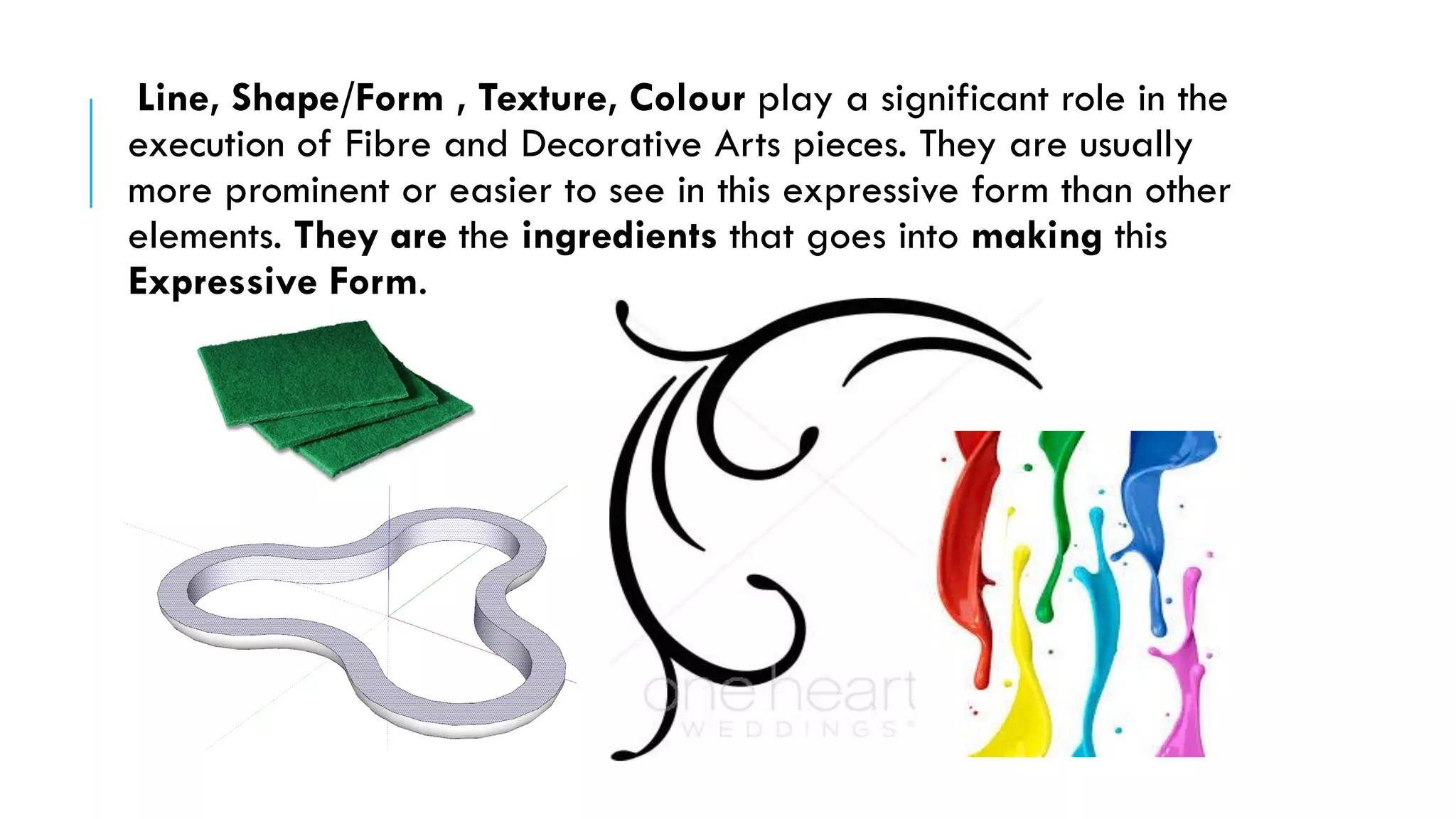
Line, Shape/Form , Texture, Colour play a significant role in the
execution of Fibre and Decorative Arts pieces. They are usually
more prominent or easier to see in this expressive form than other
elements. They are the ingredients that goes into making this
Expressive Form.
Repetition/Pattern, Rhythm and Balance are the main principles
associated with this expressive form [Fibre and Decorative Arts]. They
are like the blinding agents [water, fire, the pot and wood] that pull
the elements – ingredients together like when making soup.
End Product: A blow of Soup –
Ingredients/Elements of art:
- thyme [lines]
- out line of peas [shapes/forms]
- carrots [colour - orange]
- rough [texture of the surface of the ingredient]
Binding Agent/Principle of art:
- water [pattern]
- fire [repetition]
- wood [ rhythm] / pot [balance]
End Product – Mosaic:
Ingredients/Elements of art:
- lines
- shapes/forms
- colour
- texture
Binding Agent/Principle of art:
- pattern
- repetition
- rhythm
REPETITION/PATTERN, RHYTHM & BALANCE
Repeating art elements in regular or cyclical fashion to
create interest, movement, and or harmony, unity in a
radial, symmetrical or asymmetrical way.
MOTIF
This is like an additional element for Fibre and
Decorative Arts.
It is especially works like a building block when
applying the elements and principles of art to
create pieces of Fibre and Decorative Arts.
MOTIF …
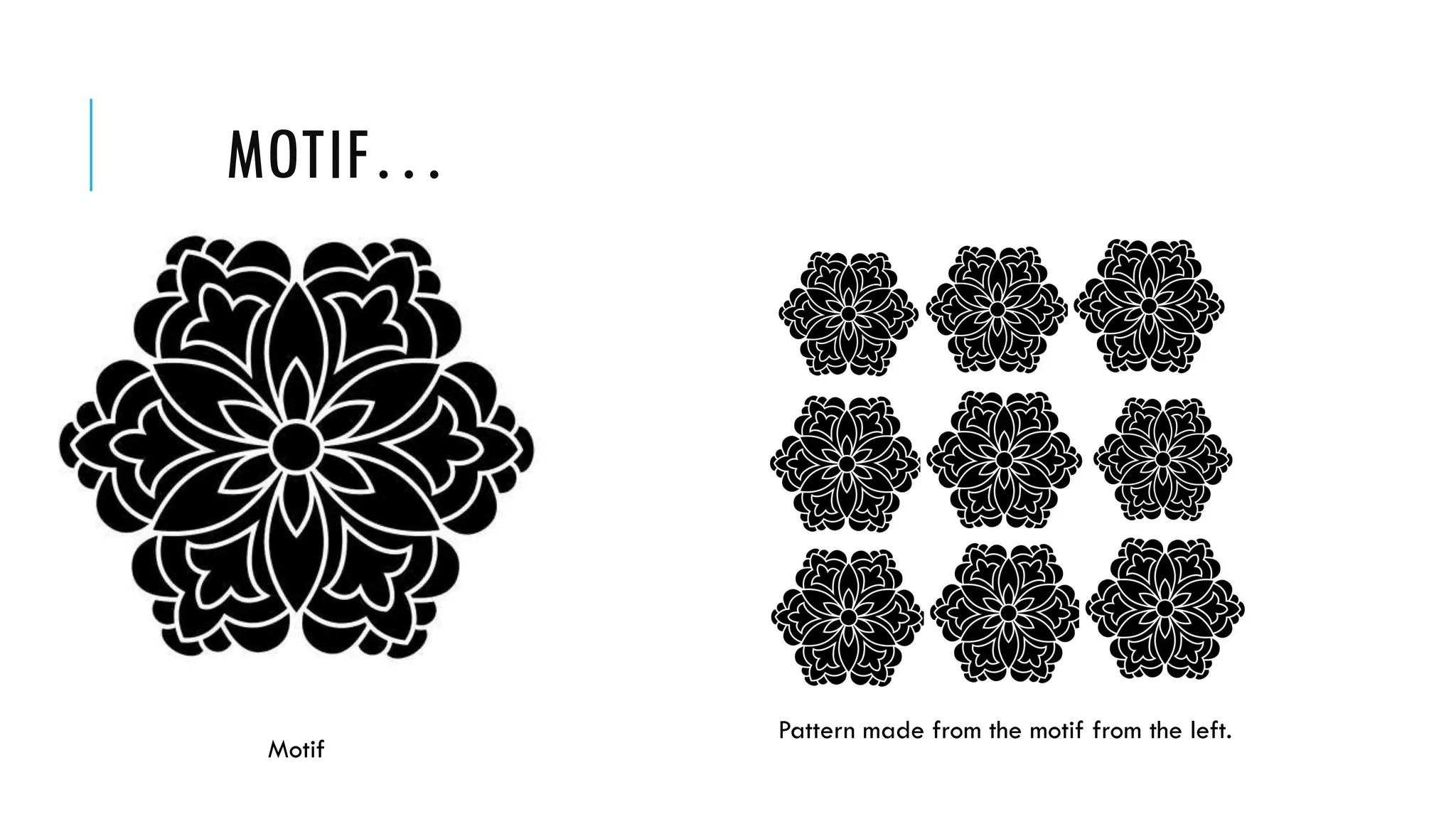
Motifs maybe seen as units of pattern in Fibre and
Decorative Arts. In the aforementioned expressive
form as well as Visual Arts in general motifs are
bounded area or volumes that contain designs or
any desired combination of art elements.
MOTIF…
Motif maybe copied and arranged in different
instances to make a desired effect or principles;
such as repetition, pattern, rhythm and balance.
MOTIF…
Motif
Pattern made from the motif from the left.
REPETITION
It is the repeating of texture, shape/form and or
other elements or deign in an art piece that can help
to unify different parts into a whole.
REPETITION …
It is important to note that the repetition might be
limited to only an instance or two: not enough to
create a pattern or rhythm, but enough to cause a
visual echo and reinforce or accent certain aspects
of the work.
BALANCE
It is the distribution of equal visual weight and or
mass in an art piece. ***
RHYTHM
When motifs or elements are repeated, alternated,
or otherwise arranged, the intervals between them
or how they overlap can create rhythm and a sense
of movement. In visual rhythm, design motifs become
the beats. ***
RHYTHM
Types of Rhythm that works together to form Repetition, Pattern, and Balance when
applying principles to create Fibre and Decorative Arts pieces maybe broadly
categorized as:
- Random
- Regular
- Alternating
- Flowing
- Progressive
RANDOM RHYTHM
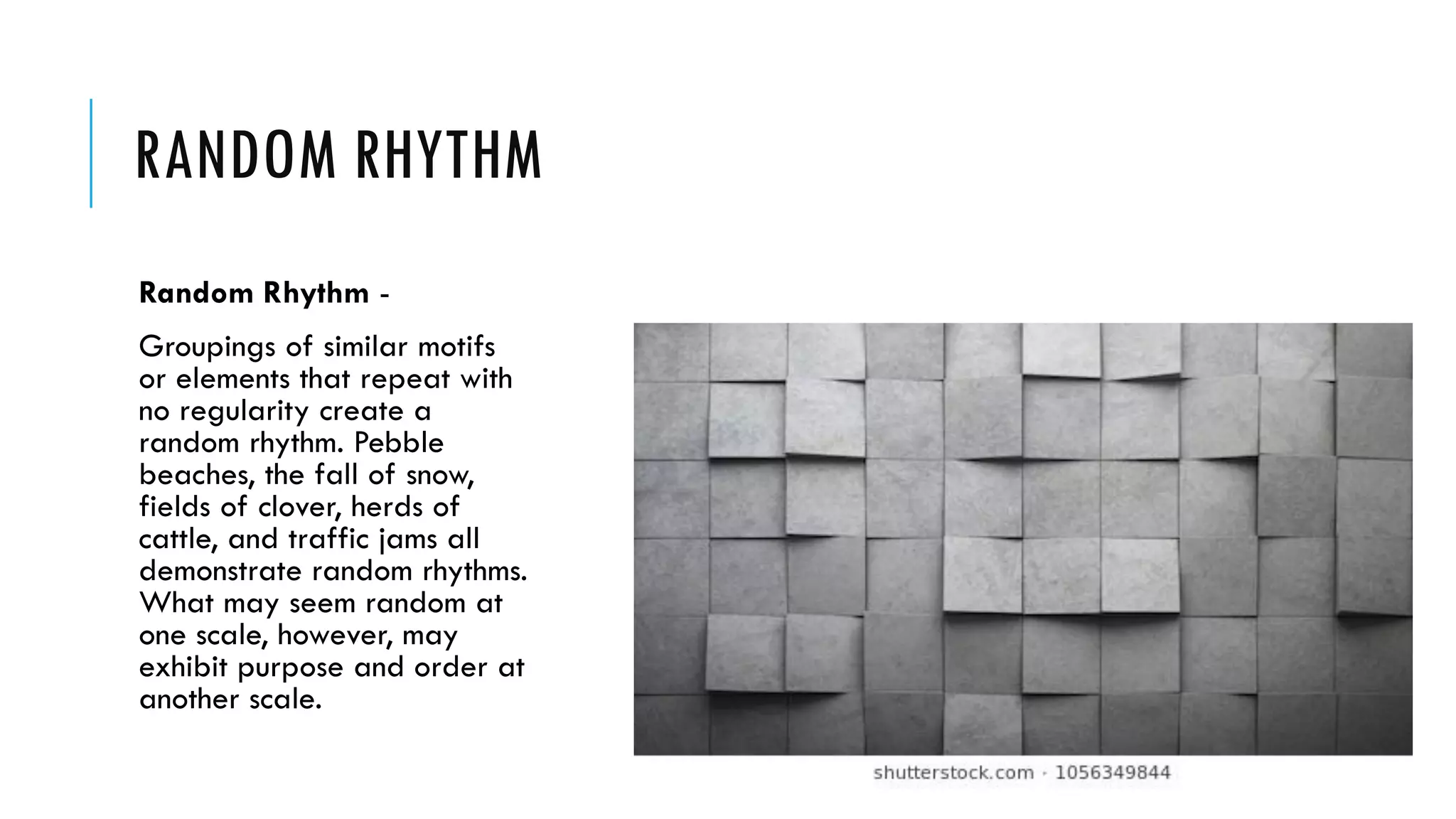
Random Rhythm -
Groupings of similar motifs
or elements that repeat with
no regularity create a
random rhythm. Pebble
beaches, the fall of snow,
fields of clover, herds of
cattle, and traffic jams all
demonstrate random rhythms.
What may seem random at
one scale, however, may
exhibit purpose and order at
another scale.
REGULAR RHYTHM
Regular Rhythm -
Like a heart or song
with a steady beat,
regular rhythm is
created by a series of
elements, often identical
or similar, that are
placed at regular or
similar intervals, such as
in grids. Simple regular
rhythms, if overused,
can be monotonous.
ALTERNATING RHYTHM
Alternating Rhythm -
Two or more different motifs may
be alternated, such as the black
and red squares in a
checkerboard; a single motif might
be flipped, mirrored or rotated
every so many iterations; or the
placement or spacing between
motifs can be alternated. This is
essentially a regular rhythm that
has more complex motifs, or meta-
motifs. The added variety can help
lessen the monotony of a regular
rhythm.
FLOWING RHYTHM
Flowing Rhythm -
Flowing rhythm is created by
undulating elements and
intervals, bending and
curving motifs and spaces.
Natural flowing rhythm can
be seen in streams and
waterways, beaches and
waves, sand dunes and
glaciers, rolling hills and
wind-blown grasses.
PROGRESSIVE RHYTHM
Progressive Rhythm -
In progressive
rhythm, each time a
motif repeats it
changes a little,
transforming and
translating in a steady
sequence - the motif
progresses from one
thing to another.
REFRENCES
For more information see:
http://flyeschool.com/content/repetition-rhythm-and-pattern
https://www.youtube.com/watch?v=ZK86XQ1iFVs&t=28s

Elements and Principles of Fibre and Decorative Arts

  • 1.
    Basic Elements &Principles of Fibre and Decorative Arts
  • 2.
    THE BASIC ELEMENTSOF FIBRE & DECORATIVE ARTS • Line • Shape/ Form • Colour • Texture
  • 3.
    THE BASIC PRINCIPLESOF FIBRE & DECORATIVE ARTS • Rhythm • Repetition / Pattern
  • 4.
    Line, Shape/Form ,Texture, Colour play a significant role in the execution of Fibre and Decorative Arts pieces. They are usually more prominent or easier to see in this expressive form than other elements. They are the ingredients that goes into making this Expressive Form.
  • 5.
    Repetition/Pattern, Rhythm andBalance are the main principles associated with this expressive form [Fibre and Decorative Arts]. They are like the blinding agents [water, fire, the pot and wood] that pull the elements – ingredients together like when making soup.
  • 6.
    End Product: Ablow of Soup – Ingredients/Elements of art: - thyme [lines] - out line of peas [shapes/forms] - carrots [colour - orange] - rough [texture of the surface of the ingredient] Binding Agent/Principle of art: - water [pattern] - fire [repetition] - wood [ rhythm] / pot [balance] End Product – Mosaic: Ingredients/Elements of art: - lines - shapes/forms - colour - texture Binding Agent/Principle of art: - pattern - repetition - rhythm
  • 7.
    REPETITION/PATTERN, RHYTHM &BALANCE Repeating art elements in regular or cyclical fashion to create interest, movement, and or harmony, unity in a radial, symmetrical or asymmetrical way.
  • 8.
    MOTIF This is likean additional element for Fibre and Decorative Arts. It is especially works like a building block when applying the elements and principles of art to create pieces of Fibre and Decorative Arts.
  • 9.
    MOTIF … Motifs maybeseen as units of pattern in Fibre and Decorative Arts. In the aforementioned expressive form as well as Visual Arts in general motifs are bounded area or volumes that contain designs or any desired combination of art elements.
  • 10.
    MOTIF… Motif maybe copiedand arranged in different instances to make a desired effect or principles; such as repetition, pattern, rhythm and balance.
  • 11.
    MOTIF… Motif Pattern made fromthe motif from the left.
  • 12.
    REPETITION It is therepeating of texture, shape/form and or other elements or deign in an art piece that can help to unify different parts into a whole.
  • 13.
    REPETITION … It isimportant to note that the repetition might be limited to only an instance or two: not enough to create a pattern or rhythm, but enough to cause a visual echo and reinforce or accent certain aspects of the work.
  • 14.
    BALANCE It is thedistribution of equal visual weight and or mass in an art piece. ***
  • 15.
    RHYTHM When motifs orelements are repeated, alternated, or otherwise arranged, the intervals between them or how they overlap can create rhythm and a sense of movement. In visual rhythm, design motifs become the beats. ***
  • 16.
    RHYTHM Types of Rhythmthat works together to form Repetition, Pattern, and Balance when applying principles to create Fibre and Decorative Arts pieces maybe broadly categorized as: - Random - Regular - Alternating - Flowing - Progressive
  • 17.
    RANDOM RHYTHM Random Rhythm- Groupings of similar motifs or elements that repeat with no regularity create a random rhythm. Pebble beaches, the fall of snow, fields of clover, herds of cattle, and traffic jams all demonstrate random rhythms. What may seem random at one scale, however, may exhibit purpose and order at another scale.
  • 18.
    REGULAR RHYTHM Regular Rhythm- Like a heart or song with a steady beat, regular rhythm is created by a series of elements, often identical or similar, that are placed at regular or similar intervals, such as in grids. Simple regular rhythms, if overused, can be monotonous.
  • 19.
    ALTERNATING RHYTHM Alternating Rhythm- Two or more different motifs may be alternated, such as the black and red squares in a checkerboard; a single motif might be flipped, mirrored or rotated every so many iterations; or the placement or spacing between motifs can be alternated. This is essentially a regular rhythm that has more complex motifs, or meta- motifs. The added variety can help lessen the monotony of a regular rhythm.
  • 20.
    FLOWING RHYTHM Flowing Rhythm- Flowing rhythm is created by undulating elements and intervals, bending and curving motifs and spaces. Natural flowing rhythm can be seen in streams and waterways, beaches and waves, sand dunes and glaciers, rolling hills and wind-blown grasses.
  • 21.
    PROGRESSIVE RHYTHM Progressive Rhythm- In progressive rhythm, each time a motif repeats it changes a little, transforming and translating in a steady sequence - the motif progresses from one thing to another.
  • 22.
    REFRENCES For more informationsee: http://flyeschool.com/content/repetition-rhythm-and-pattern https://www.youtube.com/watch?v=ZK86XQ1iFVs&t=28s