Land Art is an art movement which is used in the form
of sculpture, started in the late 1960s.
Artists used natural and organic materials such as
rocks, wood and synthetic materials to create these
sculptures which would then be left to erode under
natural causes, this meant that a lot of the time these
kind of works could only be viewed in photographs.
These sculptures would often be created in open spaces
in sight of the public eye.
Richard Shilling is a British
artist who creates sculptures
using only natural materials
gathered from where the
sculpture is actually going to
be made.
He doesn’t use anything like
glue or string to create his
pieces and a lot of the time,
most of his sculptures will
only last for a few minutes
before the weather destroys
them.
Autumn butterfly –
Dog wood, maple leaves and thorns
Norwegian Maple Autumn Fire Wheel –
Woven dogwood, Willow Wheel and Norwegian
Maple Leaves
His Artwork started a few years
ago when he moved house.
He saw a structure of rocks which
had no purpose to them.
After that he started looking at an
artist called Andy Goldsworthy.
By looking into Andy
Goldsworthy, he realised what
he could discover through
nature and started creating his
own little sculptures to reflect
what he saw.
Spore –
Woven hazel stick ball with teasel heads
Andy Goldsworthy is a British
artist who is very much inspire by
natural and organic shapes and
materials.
In all of his works, he tends to use
snow, ice, leaves, rocks etc.
When a specific sculpture has
been made, Goldsworthy tends to
record it as a photograph before it
disappears or during the
disappearing stage.
This is one of his pieces called the
Icicle Star.
Goldsworthy used human saliva
to join all the spikes together.
Leaves which have been polished with grease
and then pinned down with thorns
underneath the tree from where the leaves
fell.
A slab of frozen snow has been cut and
then each level of the circle has been
scraped/picked out with a stick to the
point where the stick almost goes
through the last layer.
That way the sun can shine through the
gap.
Goldsworthy didn’t intend to make his mark with the sculptures he made because
he knew that a lot of the time, the weather would destroy them.
Instead he decided to work with the area as it was, so that he could create a
sculpture and then capture it in a new perception.
‘’Place is found by walking,
direction determined by
weather and season.
I take the opportunity each
day offers: if it is snowing, I
work in snow, at leaf-fall it
will be leaves; a blown over
tree becomes a source of
twigs and branches. ‘’
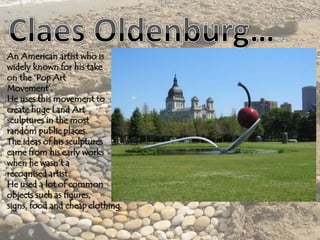
An American artist who is
widely known for his take
on the ‘Pop Art
Movement’.
He uses this movement to
create huge Land Art
sculptures in the most
random public places.
The ideas of his sculptures
came from his early works
when he wasn’t a
recognised artist.
He used a lot of common
objects such as figures,
signs, food and cheap clothing.
Before making the giant sculptures, Oldenburg saw his ideas as drawings and paintings, he
would call them the imaginary outdoor monuments.
These ideas also took the form of collages or poetic drawings, he would draw a common
object like a spoon and he would put it into a landscape.
The spoon would be huge compared to the buildings.
As he became more involved with the drawings, he started to imagine them for real and
soon after he created his first sculpture which was ‘Lipstick Ascending, on Caterpillar
Tracks.’
Installed in front of
the Beinecke Rare
Book Library at Yale
University in 1969.
Satu Maaranen uses the idea of the nature
within her garments in an artistic way.
John Rocha used the shape of Andy Goldsworthy’s
sculptures to create his own collection.
Presentation   land art

Presentation land art

  • 2.
    Land Art isan art movement which is used in the form of sculpture, started in the late 1960s. Artists used natural and organic materials such as rocks, wood and synthetic materials to create these sculptures which would then be left to erode under natural causes, this meant that a lot of the time these kind of works could only be viewed in photographs. These sculptures would often be created in open spaces in sight of the public eye.
  • 3.
    Richard Shilling isa British artist who creates sculptures using only natural materials gathered from where the sculpture is actually going to be made. He doesn’t use anything like glue or string to create his pieces and a lot of the time, most of his sculptures will only last for a few minutes before the weather destroys them. Autumn butterfly – Dog wood, maple leaves and thorns
  • 4.
    Norwegian Maple AutumnFire Wheel – Woven dogwood, Willow Wheel and Norwegian Maple Leaves His Artwork started a few years ago when he moved house. He saw a structure of rocks which had no purpose to them. After that he started looking at an artist called Andy Goldsworthy. By looking into Andy Goldsworthy, he realised what he could discover through nature and started creating his own little sculptures to reflect what he saw. Spore – Woven hazel stick ball with teasel heads
  • 5.
    Andy Goldsworthy isa British artist who is very much inspire by natural and organic shapes and materials. In all of his works, he tends to use snow, ice, leaves, rocks etc. When a specific sculpture has been made, Goldsworthy tends to record it as a photograph before it disappears or during the disappearing stage. This is one of his pieces called the Icicle Star. Goldsworthy used human saliva to join all the spikes together.
  • 6.
    Leaves which havebeen polished with grease and then pinned down with thorns underneath the tree from where the leaves fell. A slab of frozen snow has been cut and then each level of the circle has been scraped/picked out with a stick to the point where the stick almost goes through the last layer. That way the sun can shine through the gap.
  • 7.
    Goldsworthy didn’t intendto make his mark with the sculptures he made because he knew that a lot of the time, the weather would destroy them. Instead he decided to work with the area as it was, so that he could create a sculpture and then capture it in a new perception. ‘’Place is found by walking, direction determined by weather and season. I take the opportunity each day offers: if it is snowing, I work in snow, at leaf-fall it will be leaves; a blown over tree becomes a source of twigs and branches. ‘’
  • 8.
    An American artistwho is widely known for his take on the ‘Pop Art Movement’. He uses this movement to create huge Land Art sculptures in the most random public places. The ideas of his sculptures came from his early works when he wasn’t a recognised artist. He used a lot of common objects such as figures, signs, food and cheap clothing.
  • 9.
    Before making thegiant sculptures, Oldenburg saw his ideas as drawings and paintings, he would call them the imaginary outdoor monuments. These ideas also took the form of collages or poetic drawings, he would draw a common object like a spoon and he would put it into a landscape. The spoon would be huge compared to the buildings. As he became more involved with the drawings, he started to imagine them for real and soon after he created his first sculpture which was ‘Lipstick Ascending, on Caterpillar Tracks.’
  • 10.
    Installed in frontof the Beinecke Rare Book Library at Yale University in 1969.
  • 11.
    Satu Maaranen usesthe idea of the nature within her garments in an artistic way.
  • 12.
    John Rocha usedthe shape of Andy Goldsworthy’s sculptures to create his own collection.