“If it isn’t popular,
then it isn’t culture.”
Youth, Media, and Popular Culture
Carolyn Guertin, PhD
UOIT | EDUC5199G
30 June 2015
Our Home Base
http://uoit-educ5199g.weebly.com/
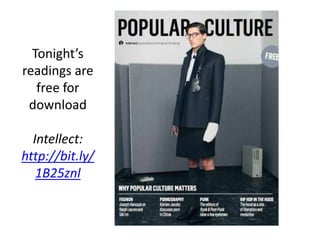
Tonight’s
readings are
free for
download
Intellect:
http://bit.ly/
1B25znl
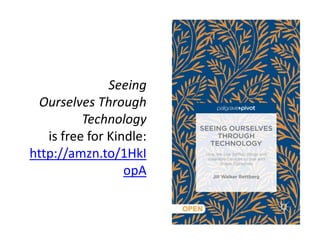
Seeing
Ourselves Through
Technology
is free for Kindle:
http://amzn.to/1HkI
opA
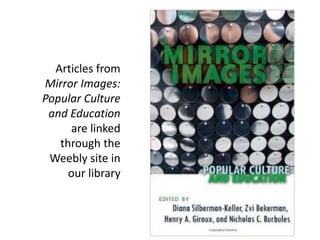
Articles from
Mirror Images:
Popular Culture
and Education
are linked
through the
Weebly site in
our library
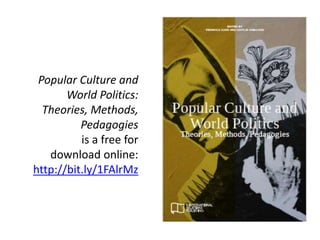
Popular Culture and
World Politics:
Theories, Methods,
Pedagogies
is a free for
download online:
http://bit.ly/1FAlrMz
The Walking Dead,
Volume 1, by
Robert Kirkman
(will be
downloadable from
Blackboard)
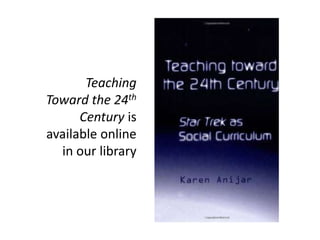
Teaching
Toward the 24th
Century is
available online
in our library
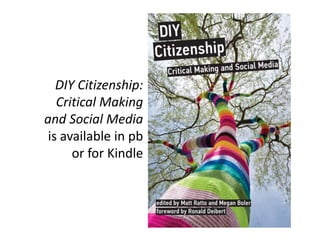
DIY Citizenship:
Critical Making
and Social Media
is available in pb
or for Kindle
Assignments
• Weekly Learning Blog or Vlog. Seven reading responses or analyses exploring
popular culture and teaching. Your entries should demonstrate deep knowledge of
different pedagogical approaches. 250 wds/wk posted to course Weebly site prior
to start of each class. Each entry should be a critical response to course materials.
(10%)
• Weekly in-class assignments, usually in groups. Attendance is mandatory. (10%)
• A 15-minute presentation with slides or a Prezi on a topic related to teaching a
class or unit in your subject area using a specific topic in popular culture. May be
performed live or pre-recorded. Should include multimedia and be liberally
illustrated and/or sonically rich with samples from your source material. This is a
research assignment and should include critical theory and full citations in APA
Style. (Due on date chosen - 30%)
• A 10 to 12 page essay on a topic related to popular culture and education. You
might discuss genre fiction, music, television, comics, film, games, remix culture,
transmedia, social practices (like participatory culture, selfies or hacking or queer
media) or social movements (like the Occupy Wall Street or maker culture). (2500
– 3000 words). (Proposal due July 21st; final paper due August 13th: 50%)
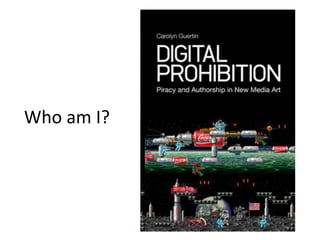
Who am I?
Why should we study
popular culture?
Why incorporate it into our
teaching?
EdTwist for notetaking and sharing
material:
https://edtwist.com/board/55908b22c154af3b0102d898
Breakout rooms: discuss your article from Why Popular Culture Matters
(http://bit.ly/1B25znl). Then find examples of your subject on the Web
(images or video clips) that you might use to enhance this topic in your
teaching. Designate a note-taker and a presenter.
• Fan Culture: pp. 4-5
– Iyanuoluwa, Vikki, Jason,
• Punk & Post-Punk: pp. 6-7
– Catherine, Ashley, Alison,
• Female DJs, pp. 8-9
– Kathryn, Kathleen, Lori,
• Humour, pp. 10-14
– Amy, Stephen, Maria, Nic
• Hip-Hop culture, pp. 18-19
– Swati, Derek, Anna,
• Pornification of pop culture, pp. 22-23
– Rahul, Sandy, Safiullah, Rodney,
• Fashion, pp. 25-29
– Cassidy, Justin, Jeanette, Kevin
“Popular culture is not only about media; it is
about identity, commodities and their connection
with education, curriculum, pedagogy and our
notions of a just, democratic society. How do
multiple interpretations of popular culture enhance our
understandings of education and how can critical
pedagogy – in the Freirean (2002) sense – be expanded
to develop a student’s critical consciousness (of issues
of race, class, gender, and sexual preference)?”
~ William M. Reynolds, p. 24
Paulo Freire’s Critical Pedagogy:
Social critique as social change
• Critical pedagogy is a teaching method that aims to help in challenging and
actively struggling against any form of social oppression and the related customs
and beliefs. It is a form of theory and practice which serves to let pupils gain a
critical awareness. Critical pedagogy is a type of pedagogy in which criticism of the
established order and social criticism are essential. Critical pedagogy wants to
question society in its understanding of the role that education has. From this
point of view, social critique is necessary if one does not want an upbringing and
education that contributes to the reproduction of inequality
An important key concept in this is emancipation. It is emancipation, liberation
from oppressive social relations, which critical pedagogy is committed to. Social
critique leads to social change. With this mode of critique we want students to
see clearly that phenomena like inequality are not necessary, but arose in a certain
historical context that has been established and produced by man-made social
processes.
According to the critical pedagogy, education is inherently political, and any kind
of pedagogy should be aware of this fact. A social and educational vision of justice
and equality should be the basis for any kind of education. The liberation from
oppression and human suffering should be an important dimension in education.
Source: http://daily-struggles.tumblr.com/post/18785753110/paulo-freire-and-the-role-of-critical-pedagogy
Freire’s Pedagogy of the Oppressed
1. Emphasis on dialogue as a foundation for respect
2. Emphasis on praxis – action that is informed (and
linked to particular values). Talk leads to informed
action on social justice issues.
3. Pedagogy of hope involves developing consciousness,
but consciousness that is understood to have the
power to transform reality (Taylor 1993: 52).
4. Education as lived experience
5. Advocates collapsing the gap between teachers and
students
Critique and discussion of these principles here:
http://infed.org/mobi/paulo-freire-dialogue-praxis-and-education/
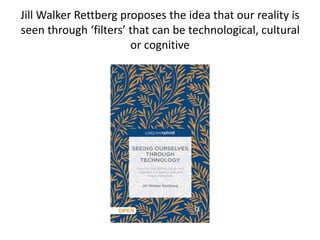
Jill Walker Rettberg proposes the idea that our reality is
seen through ‘filters’ that can be technological, cultural
or cognitive
“Facebook filters our news feed and it also filters our
behaviour. Cultural filters are as important as
technological filters. Our cultural filters, the rules and
conventions that guide us, filter out possible modes of
expression so subtly that we often are not even aware
of all the things that we do not see.”
In what ways do these filters aestheticise, anaesthetise,
and defamiliarize us from the everyday?
#365grateful:
http://365grateful.com/
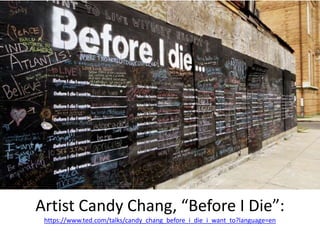
Artist Candy Chang, “Before I Die”:
https://www.ted.com/talks/candy_chang_before_i_die_i_want_to?language=en
Why is defamiliarization a key attribute of art
(according to Rettberg and Shklovsky)?
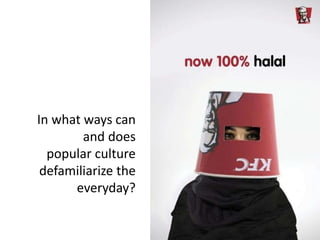
In what ways can
and does
popular culture
defamiliarize the
everyday?
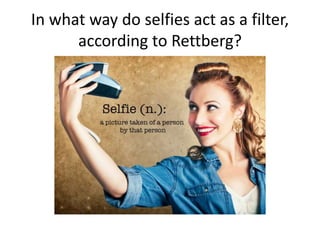
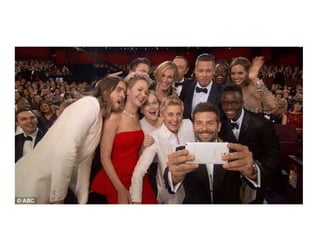
In what way do selfies act as a filter,
according to Rettberg?
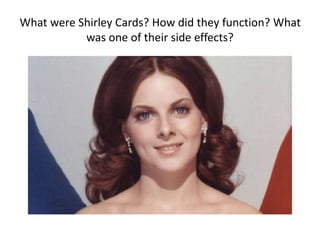
What were Shirley Cards? How did they function? What
was one of their side effects?
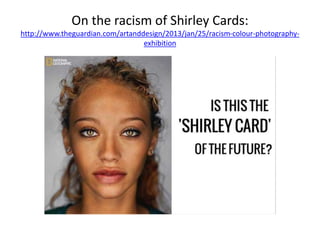
On the racism of Shirley Cards:
http://www.theguardian.com/artanddesign/2013/jan/25/racism-colour-photography-
exhibition
Popular Culture Board for
inspiration on Pinterest:
https://www.pinterest.com/carolynguertin/pop-culture/

1 5199-pop-culture-intro

  • 1.
    “If it isn’tpopular, then it isn’t culture.” Youth, Media, and Popular Culture Carolyn Guertin, PhD UOIT | EDUC5199G 30 June 2015
  • 2.
  • 3.
  • 4.
    Seeing Ourselves Through Technology is freefor Kindle: http://amzn.to/1HkI opA
  • 5.
    Articles from Mirror Images: PopularCulture and Education are linked through the Weebly site in our library
  • 6.
    Popular Culture and WorldPolitics: Theories, Methods, Pedagogies is a free for download online: http://bit.ly/1FAlrMz
  • 7.
    The Walking Dead, Volume1, by Robert Kirkman (will be downloadable from Blackboard)
  • 8.
    Teaching Toward the 24th Centuryis available online in our library
  • 9.
    DIY Citizenship: Critical Making andSocial Media is available in pb or for Kindle
  • 10.
    Assignments • Weekly LearningBlog or Vlog. Seven reading responses or analyses exploring popular culture and teaching. Your entries should demonstrate deep knowledge of different pedagogical approaches. 250 wds/wk posted to course Weebly site prior to start of each class. Each entry should be a critical response to course materials. (10%) • Weekly in-class assignments, usually in groups. Attendance is mandatory. (10%) • A 15-minute presentation with slides or a Prezi on a topic related to teaching a class or unit in your subject area using a specific topic in popular culture. May be performed live or pre-recorded. Should include multimedia and be liberally illustrated and/or sonically rich with samples from your source material. This is a research assignment and should include critical theory and full citations in APA Style. (Due on date chosen - 30%) • A 10 to 12 page essay on a topic related to popular culture and education. You might discuss genre fiction, music, television, comics, film, games, remix culture, transmedia, social practices (like participatory culture, selfies or hacking or queer media) or social movements (like the Occupy Wall Street or maker culture). (2500 – 3000 words). (Proposal due July 21st; final paper due August 13th: 50%)
  • 11.
  • 12.
    Why should westudy popular culture? Why incorporate it into our teaching?
  • 13.
    EdTwist for notetakingand sharing material: https://edtwist.com/board/55908b22c154af3b0102d898
  • 14.
    Breakout rooms: discussyour article from Why Popular Culture Matters (http://bit.ly/1B25znl). Then find examples of your subject on the Web (images or video clips) that you might use to enhance this topic in your teaching. Designate a note-taker and a presenter. • Fan Culture: pp. 4-5 – Iyanuoluwa, Vikki, Jason, • Punk & Post-Punk: pp. 6-7 – Catherine, Ashley, Alison, • Female DJs, pp. 8-9 – Kathryn, Kathleen, Lori, • Humour, pp. 10-14 – Amy, Stephen, Maria, Nic • Hip-Hop culture, pp. 18-19 – Swati, Derek, Anna, • Pornification of pop culture, pp. 22-23 – Rahul, Sandy, Safiullah, Rodney, • Fashion, pp. 25-29 – Cassidy, Justin, Jeanette, Kevin
  • 15.
    “Popular culture isnot only about media; it is about identity, commodities and their connection with education, curriculum, pedagogy and our notions of a just, democratic society. How do multiple interpretations of popular culture enhance our understandings of education and how can critical pedagogy – in the Freirean (2002) sense – be expanded to develop a student’s critical consciousness (of issues of race, class, gender, and sexual preference)?” ~ William M. Reynolds, p. 24
  • 16.
    Paulo Freire’s CriticalPedagogy: Social critique as social change • Critical pedagogy is a teaching method that aims to help in challenging and actively struggling against any form of social oppression and the related customs and beliefs. It is a form of theory and practice which serves to let pupils gain a critical awareness. Critical pedagogy is a type of pedagogy in which criticism of the established order and social criticism are essential. Critical pedagogy wants to question society in its understanding of the role that education has. From this point of view, social critique is necessary if one does not want an upbringing and education that contributes to the reproduction of inequality An important key concept in this is emancipation. It is emancipation, liberation from oppressive social relations, which critical pedagogy is committed to. Social critique leads to social change. With this mode of critique we want students to see clearly that phenomena like inequality are not necessary, but arose in a certain historical context that has been established and produced by man-made social processes. According to the critical pedagogy, education is inherently political, and any kind of pedagogy should be aware of this fact. A social and educational vision of justice and equality should be the basis for any kind of education. The liberation from oppression and human suffering should be an important dimension in education. Source: http://daily-struggles.tumblr.com/post/18785753110/paulo-freire-and-the-role-of-critical-pedagogy
  • 17.
    Freire’s Pedagogy ofthe Oppressed 1. Emphasis on dialogue as a foundation for respect 2. Emphasis on praxis – action that is informed (and linked to particular values). Talk leads to informed action on social justice issues. 3. Pedagogy of hope involves developing consciousness, but consciousness that is understood to have the power to transform reality (Taylor 1993: 52). 4. Education as lived experience 5. Advocates collapsing the gap between teachers and students Critique and discussion of these principles here: http://infed.org/mobi/paulo-freire-dialogue-praxis-and-education/
  • 18.
    Jill Walker Rettbergproposes the idea that our reality is seen through ‘filters’ that can be technological, cultural or cognitive
  • 19.
    “Facebook filters ournews feed and it also filters our behaviour. Cultural filters are as important as technological filters. Our cultural filters, the rules and conventions that guide us, filter out possible modes of expression so subtly that we often are not even aware of all the things that we do not see.” In what ways do these filters aestheticise, anaesthetise, and defamiliarize us from the everyday?
  • 20.
  • 21.
    Artist Candy Chang,“Before I Die”: https://www.ted.com/talks/candy_chang_before_i_die_i_want_to?language=en
  • 22.
    Why is defamiliarizationa key attribute of art (according to Rettberg and Shklovsky)?
  • 23.
    In what wayscan and does popular culture defamiliarize the everyday?
  • 27.
    In what waydo selfies act as a filter, according to Rettberg?
  • 29.
    What were ShirleyCards? How did they function? What was one of their side effects?
  • 30.
    On the racismof Shirley Cards: http://www.theguardian.com/artanddesign/2013/jan/25/racism-colour-photography- exhibition
  • 31.
    Popular Culture Boardfor inspiration on Pinterest: https://www.pinterest.com/carolynguertin/pop-culture/