TRANSFORMATIVE
EDUCATION FRAMEWORK
           Kurt Love, Ph.D.
  Central Connecticut State University
WHAT IS A
      TRANSFORMATIVE EDUCATION?

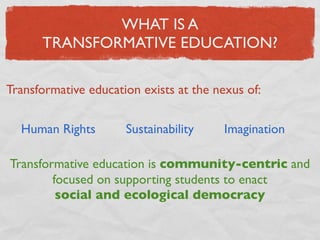
Transformative education exists at the nexus of:


  Human Rights        Sustainability     Imagination

Transformative education is community-centric and
        focused on supporting students to enact
         social and ecological democracy
WHAT IS A
      TRANSFORMATIVE EDUCATION?

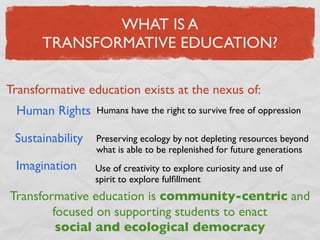
Transformative education exists at the nexus of:
 Human Rights     Humans have the right to survive free of oppression

 Sustainability   Preserving ecology by not depleting resources beyond
                  what is able to be replenished for future generations
 Imagination      Use of creativity to explore curiosity and use of
                  spirit to explore fulfillment
Transformative education is community-centric and
        focused on supporting students to enact
         social and ecological democracy
What is
     Transformative Learning?

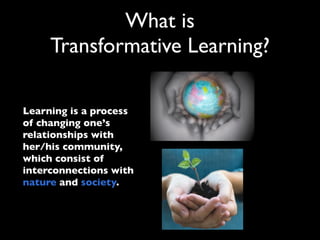
Learning is a process
of changing one’s
relationships with
her/his community,
which consist of
interconnections with
nature and society.
Zoe Weil & “Solutionaries”
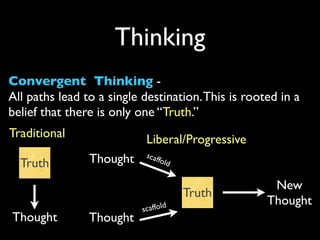
Thinking
Convergent Thinking -
All paths lead to a single destination. This is rooted in a
belief that there is only one “Truth.”
Traditional                 Liberal/Progressive
                            scaf
  Truth         Thought          fold


                                                     New
                                        Truth
                                   d                Thought
                           scaffol
Thought         Thought
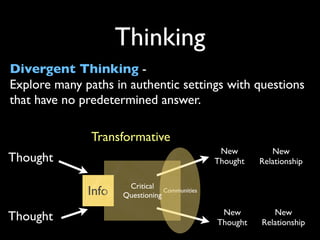
Thinking
Divergent Thinking -
Explore many paths in authentic settings with questions
that have no predetermined answer.

               Transformative
                                              New         New
Thought                                      Thought   Relationship

                      Critical Communities
              Info   Questioning

                                              New         New
Thought                                      Thought   Relationship
Divergent Thinking
Divergent Thinking &
       Transformative Learning
Divergent thinking
contextualized in
community provides
students to not only
learn “basic” skills, but
also opportunities for
democratic discourse,
participation and
contributions to the
world in which they
live.
Messages in Water
We Teach “Reality”


Are teachers allowed to teach about
     lesser known information?
What is
         Transformative Learning?
Assumptions:

 •   Information is diverse, culturally
     grounded, and a representation of
     a value system (knowledge/power
     relationship).

 •   Learners are constantly
     investigating their own locations
     (positionalities) in relationship to
     culture, ideology, power
     structures, technology, and nature.

 •   Learners are constantly
     investigating processes in
     community (via the content areas)
     that perpetuate hegemonic
     relationships
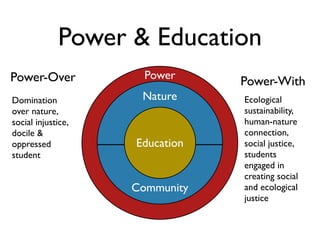
Power & Education
Power-Over            Power
                                Power-With
Domination           Nature     Ecological
over nature,                    sustainability,
social injustice,               human-nature
docile &                        connection,
oppressed           Education   social justice,
student                         students
                                engaged in
                                creating social
                    Community   and ecological
                                justice
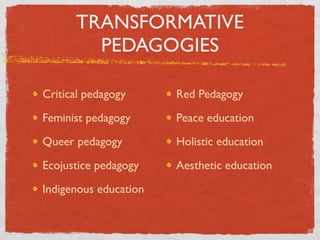
TRANSFORMATIVE
        PEDAGOGIES

Critical pedagogy      Red Pedagogy

Feminist pedagogy      Peace education

Queer pedagogy         Holistic education

Ecojustice pedagogy    Aesthetic education

Indigenous education
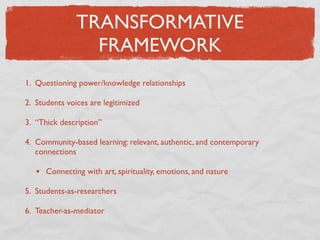
TRANSFORMATIVE
                 FRAMEWORK
1. Questioning power/knowledge relationships

2. Students voices are legitimized

3. “Thick description”

4. Community-based learning: relevant, authentic, and contemporary
   connections

   • Connecting with art, spirituality, emotions, and nature
5. Students-as-researchers

6. Teacher-as-mediator
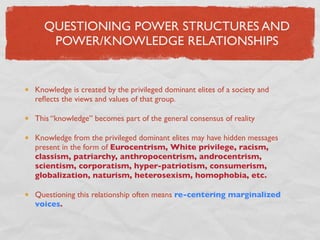
QUESTIONING POWER STRUCTURES AND
   POWER/KNOWLEDGE RELATIONSHIPS


Knowledge is created by the privileged dominant elites of a society and
reflects the views and values of that group.

This “knowledge” becomes part of the general consensus of reality

Knowledge from the privileged dominant elites may have hidden messages
present in the form of Eurocentrism, White privilege, racism,
classism, patriarchy, anthropocentrism, androcentrism,
scientism, corporatism, hyper-patriotism, consumerism,
globalization, naturism, heterosexism, homophobia, etc.

Questioning this relationship often means re-centering marginalized
voices.
3 Types of Curricula
•   Mainstream Curriculum - Curriculum that is
    explicit

•   Hidden Curriculum - Messages that are present
    but hidden (i.e. forms of oppression and
    privilege)

•   Null Curriculum - Messages that are silenced,
    omitted, or marginalized.
3 Ways to Teach About
     Columbus
•   Mainstream Curriculum - Columbus was a strong, brave
    “explorer” that opened the doors for European
    colonization of the Americas.

•   Hidden Curriculum - Europeans are more advanced and
    sophisticated than the indigenous peoples of the Americas.
    Eurocentrism, patriarchy, technology over nature.

•   Null Curriculum - Columbus violently exploited and
    dominated the indigenous peoples of the Americas, which
    was part of a larger European mindset that allowed for
    genocide, enslavement, assimilation, colonization and in
    contemporary settings, globalization (or global
    Westernization).
STUDENT VOICES ARE
            LEGITIMIZED

Students generate knowledge, which is seen as
legitimate by the teacher.

The student’s experiences, worldviews, value systems,
and identities are legitimate lenses of analysis of the
content.

This applies especially to students of color, female
students, GLBTQ students, working class or poor
students, or any students that have socially and/or
culturally oppressed identities.
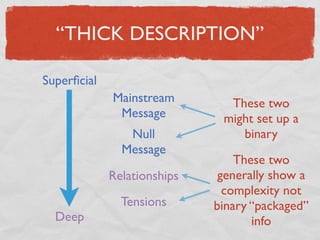
“THICK DESCRIPTION”

Superficial
             Mainstream        These two
              Message         might set up a
                Null             binary
               Message
                                 These two
             Relationships    generally show a
                               complexity not
               Tensions      binary “packaged”
  Deep                              info
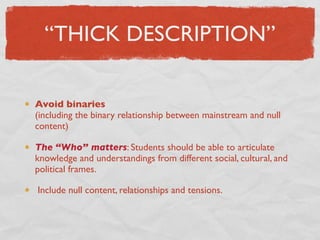
“THICK DESCRIPTION”

Avoid binaries
(including the binary relationship between mainstream and null
content)

The “Who” matters: Students should be able to articulate
knowledge and understandings from different social, cultural, and
political frames.

Include null content, relationships and tensions.
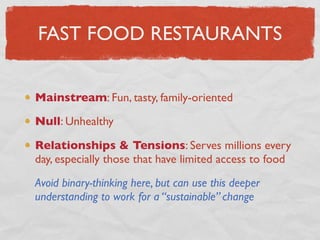
FAST FOOD RESTAURANTS


Mainstream: Fun, tasty, family-oriented

Null: Unhealthy

Relationships & Tensions: Serves millions every
day, especially those that have limited access to food

Avoid binary-thinking here, but can use this deeper
understanding to work for a “sustainable” change
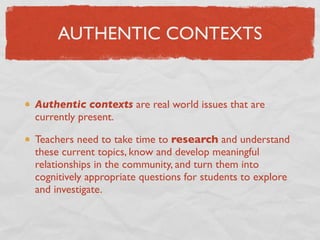
AUTHENTIC CONTEXTS


Authentic contexts are real world issues that are
currently present.

Teachers need to take time to research and understand
these current topics, know and develop meaningful
relationships in the community, and turn them into
cognitively appropriate questions for students to explore
and investigate.
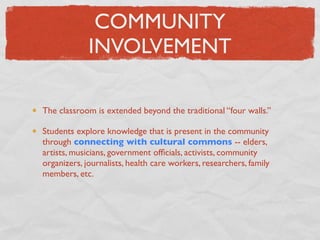
COMMUNITY
             INVOLVEMENT

The classroom is extended beyond the traditional “four walls.”

Students explore knowledge that is present in the community
through connecting with cultural commons -- elders,
artists, musicians, government officials, activists, community
organizers, journalists, health care workers, researchers, family
members, etc.
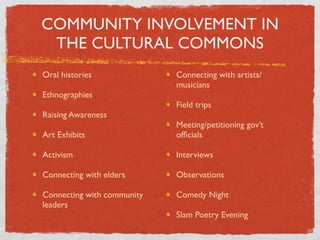
COMMUNITY INVOLVEMENT IN
 THE CULTURAL COMMONS
Oral histories              Connecting with artists/
                            musicians
Ethnographies
                            Field trips
Raising Awareness
                            Meeting/petitioning gov’t
Art Exhibits                officials

Activism                    Interviews

Connecting with elders      Observations

Connecting with community   Comedy Night
leaders
                            Slam Poetry Evening
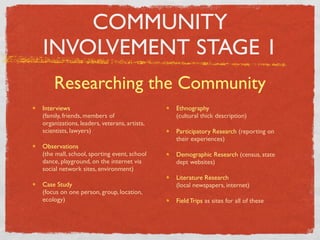
COMMUNITY
INVOLVEMENT STAGE 1
    Researching the Community
Interviews                                   Ethnography
(family, friends, members of                 (cultural thick description)
organizations, leaders, veterans, artists,
scientists, lawyers)                         Participatory Research (reporting on
                                             their experiences)
Observations
(the mall, school, sporting event, school    Demographic Research (census, state
dance, playground, on the internet via       dept websites)
social network sites, environment)
                                             Literature Research
Case Study                                   (local newspapers, internet)
(focus on one person, group, location,
ecology)                                     Field Trips as sites for all of these
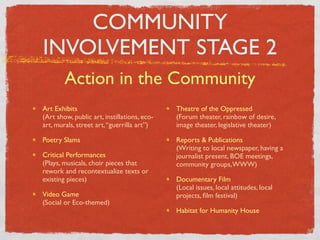
COMMUNITY
INVOLVEMENT STAGE 2
        Action in the Community
Art Exhibits                                 Theatre of the Oppressed
(Art show, public art, instillations, eco-   (Forum theater, rainbow of desire,
art, murals, street art, “guerrilla art”)    image theater, legislative theater)

Poetry Slams                                 Reports & Publications
                                             (Writing to local newspaper, having a
Critical Performances                        journalist present, BOE meetings,
(Plays, musicals, choir pieces that          community groups, WWW)
rework and recontextualize texts or
existing pieces)                             Documentary Film
                                             (Local issues, local attitudes, local
Video Game                                   projects, film festival)
(Social or Eco-themed)
                                             Habitat for Humanity House
TEACHER'S ROLE =
 TEACHER-AS-MEDIATOR

Teacher provides various sociocultural contexts for students to
explore and research.

The point here is not to stop at just the "facts" of the curriculum.

The point is to really interrogate knowledge and curriculum through
different sociocultural perspectives or frames and provide learning
experiences where students provide thick description by investigating
authentic questions.
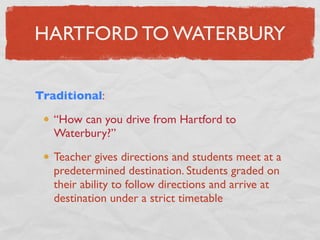
HARTFORD TO WATERBURY

Traditional:

   “How can you drive from Hartford to
   Waterbury?”

   Teacher gives directions and students meet at a
   predetermined destination. Students graded on
   their ability to follow directions and arrive at
   destination under a strict timetable
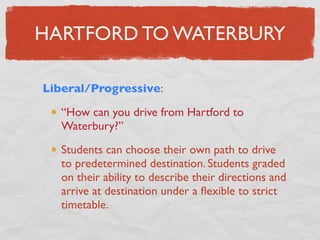
HARTFORD TO WATERBURY

Liberal/Progressive:

   “How can you drive from Hartford to
   Waterbury?”

   Students can choose their own path to drive
   to predetermined destination. Students graded
   on their ability to describe their directions and
   arrive at destination under a flexible to strict
   timetable.
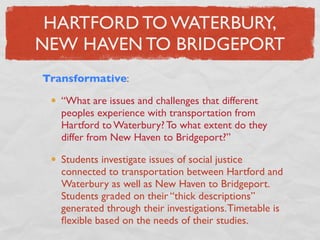
HARTFORD TO WATERBURY,
NEW HAVEN TO BRIDGEPORT
Transformative:

   “What are issues and challenges that different
   peoples experience with transportation from
   Hartford to Waterbury? To what extent do they
   differ from New Haven to Bridgeport?”

   Students investigate issues of social justice
   connected to transportation between Hartford and
   Waterbury as well as New Haven to Bridgeport.
   Students graded on their “thick descriptions”
   generated through their investigations. Timetable is
   flexible based on the needs of their studies.
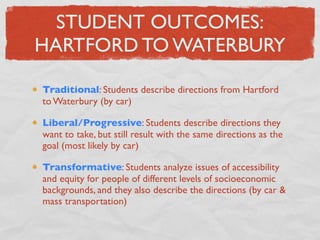
STUDENT OUTCOMES:
HARTFORD TO WATERBURY

Traditional: Students describe directions from Hartford
to Waterbury (by car)

Liberal/Progressive: Students describe directions they
want to take, but still result with the same directions as the
goal (most likely by car)

Transformative: Students analyze issues of accessibility
and equity for people of different levels of socioeconomic
backgrounds, and they also describe the directions (by car &
mass transportation)
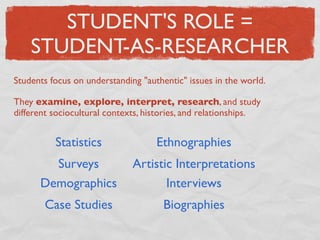
STUDENT'S ROLE =
    STUDENT-AS-RESEARCHER
Students focus on understanding "authentic" issues in the world.

They examine, explore, interpret, research, and study
different sociocultural contexts, histories, and relationships.


          Statistics                Ethnographies
        Surveys               Artistic Interpretations
      Demographics                   Interviews
       Case Studies                   Biographies
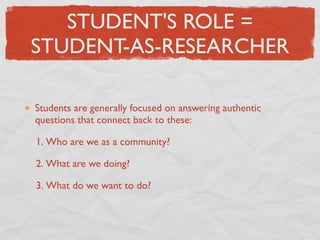
STUDENT'S ROLE =
STUDENT-AS-RESEARCHER

Students are generally focused on answering authentic
questions that connect back to these:

1. Who are we as a community?

2. What are we doing?

3. What do we want to do?
ART & AUTHENTICITY


Art brings us immediately to the facts and skills that
are in our curricula

Art locates us in the issues of community
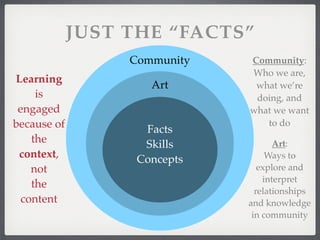
JUST THE “FACTS”
                  Community   Community:
                              Who we are,
Learning
                     Art       what we’re
    is                         doing, and
 engaged                      what we want
because of                       to do
                    Facts
   the              Skills           Art:
 context,          Concepts        Ways to
   not                           explore and
                                  interpret
   the
                                relationships
 content                      and knowledge
                               in community
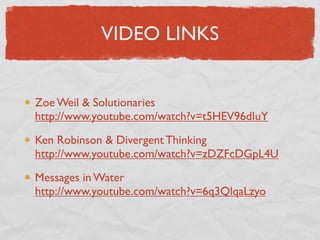
VIDEO LINKS


Zoe Weil & Solutionaries
http://www.youtube.com/watch?v=t5HEV96dIuY

Ken Robinson & Divergent Thinking
http://www.youtube.com/watch?v=zDZFcDGpL4U

Messages in Water
http://www.youtube.com/watch?v=6q3QlqaLzyo

Transformative Teaching Framework

  • 1.
    TRANSFORMATIVE EDUCATION FRAMEWORK Kurt Love, Ph.D. Central Connecticut State University
  • 2.
    WHAT IS A TRANSFORMATIVE EDUCATION? Transformative education exists at the nexus of: Human Rights Sustainability Imagination Transformative education is community-centric and focused on supporting students to enact social and ecological democracy
  • 3.
    WHAT IS A TRANSFORMATIVE EDUCATION? Transformative education exists at the nexus of: Human Rights Humans have the right to survive free of oppression Sustainability Preserving ecology by not depleting resources beyond what is able to be replenished for future generations Imagination Use of creativity to explore curiosity and use of spirit to explore fulfillment Transformative education is community-centric and focused on supporting students to enact social and ecological democracy
  • 4.
    What is Transformative Learning? Learning is a process of changing one’s relationships with her/his community, which consist of interconnections with nature and society.
  • 5.
    Zoe Weil &“Solutionaries”
  • 6.
    Thinking Convergent Thinking - Allpaths lead to a single destination. This is rooted in a belief that there is only one “Truth.” Traditional Liberal/Progressive scaf Truth Thought fold New Truth d Thought scaffol Thought Thought
  • 7.
    Thinking Divergent Thinking - Exploremany paths in authentic settings with questions that have no predetermined answer. Transformative New New Thought Thought Relationship Critical Communities Info Questioning New New Thought Thought Relationship
  • 8.
  • 9.
    Divergent Thinking & Transformative Learning Divergent thinking contextualized in community provides students to not only learn “basic” skills, but also opportunities for democratic discourse, participation and contributions to the world in which they live.
  • 10.
  • 11.
    We Teach “Reality” Areteachers allowed to teach about lesser known information?
  • 12.
    What is Transformative Learning? Assumptions: • Information is diverse, culturally grounded, and a representation of a value system (knowledge/power relationship). • Learners are constantly investigating their own locations (positionalities) in relationship to culture, ideology, power structures, technology, and nature. • Learners are constantly investigating processes in community (via the content areas) that perpetuate hegemonic relationships
  • 13.
    Power & Education Power-Over Power Power-With Domination Nature Ecological over nature, sustainability, social injustice, human-nature docile & connection, oppressed Education social justice, student students engaged in creating social Community and ecological justice
  • 14.
    TRANSFORMATIVE PEDAGOGIES Critical pedagogy Red Pedagogy Feminist pedagogy Peace education Queer pedagogy Holistic education Ecojustice pedagogy Aesthetic education Indigenous education
  • 15.
    TRANSFORMATIVE FRAMEWORK 1. Questioning power/knowledge relationships 2. Students voices are legitimized 3. “Thick description” 4. Community-based learning: relevant, authentic, and contemporary connections • Connecting with art, spirituality, emotions, and nature 5. Students-as-researchers 6. Teacher-as-mediator
  • 16.
    QUESTIONING POWER STRUCTURESAND POWER/KNOWLEDGE RELATIONSHIPS Knowledge is created by the privileged dominant elites of a society and reflects the views and values of that group. This “knowledge” becomes part of the general consensus of reality Knowledge from the privileged dominant elites may have hidden messages present in the form of Eurocentrism, White privilege, racism, classism, patriarchy, anthropocentrism, androcentrism, scientism, corporatism, hyper-patriotism, consumerism, globalization, naturism, heterosexism, homophobia, etc. Questioning this relationship often means re-centering marginalized voices.
  • 17.
    3 Types ofCurricula • Mainstream Curriculum - Curriculum that is explicit • Hidden Curriculum - Messages that are present but hidden (i.e. forms of oppression and privilege) • Null Curriculum - Messages that are silenced, omitted, or marginalized.
  • 18.
    3 Ways toTeach About Columbus • Mainstream Curriculum - Columbus was a strong, brave “explorer” that opened the doors for European colonization of the Americas. • Hidden Curriculum - Europeans are more advanced and sophisticated than the indigenous peoples of the Americas. Eurocentrism, patriarchy, technology over nature. • Null Curriculum - Columbus violently exploited and dominated the indigenous peoples of the Americas, which was part of a larger European mindset that allowed for genocide, enslavement, assimilation, colonization and in contemporary settings, globalization (or global Westernization).
  • 19.
    STUDENT VOICES ARE LEGITIMIZED Students generate knowledge, which is seen as legitimate by the teacher. The student’s experiences, worldviews, value systems, and identities are legitimate lenses of analysis of the content. This applies especially to students of color, female students, GLBTQ students, working class or poor students, or any students that have socially and/or culturally oppressed identities.
  • 20.
    “THICK DESCRIPTION” Superficial Mainstream These two Message might set up a Null binary Message These two Relationships generally show a complexity not Tensions binary “packaged” Deep info
  • 21.
    “THICK DESCRIPTION” Avoid binaries (includingthe binary relationship between mainstream and null content) The “Who” matters: Students should be able to articulate knowledge and understandings from different social, cultural, and political frames. Include null content, relationships and tensions.
  • 22.
    FAST FOOD RESTAURANTS Mainstream:Fun, tasty, family-oriented Null: Unhealthy Relationships & Tensions: Serves millions every day, especially those that have limited access to food Avoid binary-thinking here, but can use this deeper understanding to work for a “sustainable” change
  • 23.
    AUTHENTIC CONTEXTS Authentic contextsare real world issues that are currently present. Teachers need to take time to research and understand these current topics, know and develop meaningful relationships in the community, and turn them into cognitively appropriate questions for students to explore and investigate.
  • 24.
    COMMUNITY INVOLVEMENT The classroom is extended beyond the traditional “four walls.” Students explore knowledge that is present in the community through connecting with cultural commons -- elders, artists, musicians, government officials, activists, community organizers, journalists, health care workers, researchers, family members, etc.
  • 25.
    COMMUNITY INVOLVEMENT IN THE CULTURAL COMMONS Oral histories Connecting with artists/ musicians Ethnographies Field trips Raising Awareness Meeting/petitioning gov’t Art Exhibits officials Activism Interviews Connecting with elders Observations Connecting with community Comedy Night leaders Slam Poetry Evening
  • 26.
    COMMUNITY INVOLVEMENT STAGE 1 Researching the Community Interviews Ethnography (family, friends, members of (cultural thick description) organizations, leaders, veterans, artists, scientists, lawyers) Participatory Research (reporting on their experiences) Observations (the mall, school, sporting event, school Demographic Research (census, state dance, playground, on the internet via dept websites) social network sites, environment) Literature Research Case Study (local newspapers, internet) (focus on one person, group, location, ecology) Field Trips as sites for all of these
  • 27.
    COMMUNITY INVOLVEMENT STAGE 2 Action in the Community Art Exhibits Theatre of the Oppressed (Art show, public art, instillations, eco- (Forum theater, rainbow of desire, art, murals, street art, “guerrilla art”) image theater, legislative theater) Poetry Slams Reports & Publications (Writing to local newspaper, having a Critical Performances journalist present, BOE meetings, (Plays, musicals, choir pieces that community groups, WWW) rework and recontextualize texts or existing pieces) Documentary Film (Local issues, local attitudes, local Video Game projects, film festival) (Social or Eco-themed) Habitat for Humanity House
  • 28.
    TEACHER'S ROLE = TEACHER-AS-MEDIATOR Teacher provides various sociocultural contexts for students to explore and research. The point here is not to stop at just the "facts" of the curriculum. The point is to really interrogate knowledge and curriculum through different sociocultural perspectives or frames and provide learning experiences where students provide thick description by investigating authentic questions.
  • 29.
    HARTFORD TO WATERBURY Traditional: “How can you drive from Hartford to Waterbury?” Teacher gives directions and students meet at a predetermined destination. Students graded on their ability to follow directions and arrive at destination under a strict timetable
  • 30.
    HARTFORD TO WATERBURY Liberal/Progressive: “How can you drive from Hartford to Waterbury?” Students can choose their own path to drive to predetermined destination. Students graded on their ability to describe their directions and arrive at destination under a flexible to strict timetable.
  • 31.
    HARTFORD TO WATERBURY, NEWHAVEN TO BRIDGEPORT Transformative: “What are issues and challenges that different peoples experience with transportation from Hartford to Waterbury? To what extent do they differ from New Haven to Bridgeport?” Students investigate issues of social justice connected to transportation between Hartford and Waterbury as well as New Haven to Bridgeport. Students graded on their “thick descriptions” generated through their investigations. Timetable is flexible based on the needs of their studies.
  • 32.
    STUDENT OUTCOMES: HARTFORD TOWATERBURY Traditional: Students describe directions from Hartford to Waterbury (by car) Liberal/Progressive: Students describe directions they want to take, but still result with the same directions as the goal (most likely by car) Transformative: Students analyze issues of accessibility and equity for people of different levels of socioeconomic backgrounds, and they also describe the directions (by car & mass transportation)
  • 33.
    STUDENT'S ROLE = STUDENT-AS-RESEARCHER Students focus on understanding "authentic" issues in the world. They examine, explore, interpret, research, and study different sociocultural contexts, histories, and relationships. Statistics Ethnographies Surveys Artistic Interpretations Demographics Interviews Case Studies Biographies
  • 34.
    STUDENT'S ROLE = STUDENT-AS-RESEARCHER Studentsare generally focused on answering authentic questions that connect back to these: 1. Who are we as a community? 2. What are we doing? 3. What do we want to do?
  • 35.
    ART & AUTHENTICITY Artbrings us immediately to the facts and skills that are in our curricula Art locates us in the issues of community
  • 36.
    JUST THE “FACTS” Community Community: Who we are, Learning Art what we’re is doing, and engaged what we want because of to do Facts the Skills Art: context, Concepts Ways to not explore and interpret the relationships content and knowledge in community
  • 37.
    VIDEO LINKS Zoe Weil& Solutionaries http://www.youtube.com/watch?v=t5HEV96dIuY Ken Robinson & Divergent Thinking http://www.youtube.com/watch?v=zDZFcDGpL4U Messages in Water http://www.youtube.com/watch?v=6q3QlqaLzyo