Sample Footer Text
1. Explain and discuss environmental ethics
and environmental impact assessment.
2. Inspect the precision of environmental
impact assessment for a case study.
3. Outline the process of environmental impact
assessment
4. Evaluate environmental engineering
problems by applying chemical engineering
principles.
5. Influence of estimated solution on the
environment and recommendation of possible
modification, methods, alternatives, and
treatments to reduce or nullify the pollution.
1
Sample Footer Text
Environmental Ethics
Environmental ethics is ethics applied to
the environment, in other words, it is a
branch of ethics that studies the
relationship of human beings with the
natural environment and how ethics
plays a role in this relationship.
Environmental ethics excerpts influence
on a large scale of disciplines including
environmental law, environmental
sociology, ecotheology, ecological
economics, environmental geography
and ecology.
2
Sample Footer Text
Three Philosophical Approaches to
Environmental Ethics
Anthropocentrism (human-centered)
This view holds that all environmental
responsibility is derived from human
interests. Assumes that only humans are
morally significant. Assumes nature is an
instrument for human manipulation.
Biocentrism (life-centered) All life forms
have an inherent right to exist.
Ecocentrism This view maintains that
the environment deserves direct moral
consideration, not consideration
derived from human or animal interests.
3
Sample Footer Text
Environmental Impact Assessment
Environmental Impact Assessment (EIA) is a
tool used to assess the significant effects of a
project or development proposal on the
environment.
EIAs make sure that project decision makers
think about the likely effects on the
environment at the earliest possible time and
aim to avoid, reduce or offset those effects.
The EIA process helps to promote sustainable
development and protect the environment
while ensuring that development projects are
implemented responsibly and transparently.
4
Sample Footer Text
5 Tuesday, February 2, 20XX
An EIA may be defined as: a formal process to predict the environmental
consequences of human development activities and to plan appropriate measures to
eliminate or reduce adverse effects and to augment positive effects.
EIA thus has three main functions:
• to predict problems,
• to find ways to avoid them, and
• To enhance positive effects.
Stages of Environmental
Impact Assessment
Screening: This is the initial stage of EIA, where the proposed project is
evaluated to determine whether it requires a full EIA.
• Screening involves assessing the potential environmental impacts of the
project based on factors such as the size, location, and nature of the
project.
Scoping: In this stage, the scope and objectives of the EIA are defined.
• Scoping involves identifying the project’s potential environmental,
social, and economic impacts and selecting the key issues that will be
evaluated in the EIA.
Preparation of EIA Report: This stage involves the preparation of a detailed
report that describes the potential impacts of the project, evaluates the
significance of these impacts, and recommends measures to mitigate or
avoid any negative impacts.
• The EIA report is typically prepared by environmental experts based on
data collected during field investigations, stakeholder
consultations, and other sources.
5
Stages of Environmental Impact
Assessment
Making An Application And Consultation: In this stage of environmental impact
assessment, the report is submitted to the regulatory authority and the
application for project approval. The regulatory authority will then review the EIA
report and may seek additional information or clarification. T
• There is also often a public consultation process where stakeholders can
provide feedback and comments on the project proposal and the EIA report.
Decision Making: Based on the EIA report, application, and public consultation
process, the regulatory authority will decide whether to approve, reject, or
request modifications to the project proposal.
• The decision may be based on environmental, social, economic, and other
factors and compliance with relevant laws and regulations.
Post Decision: Once a decision has been made, the project can proceed with
implementation, subject to any conditions or requirements specified in the
approval.
• The regulatory authority will typically monitor the project to ensure
compliance with the approval conditions and any environmental
management plans that have been developed.
6
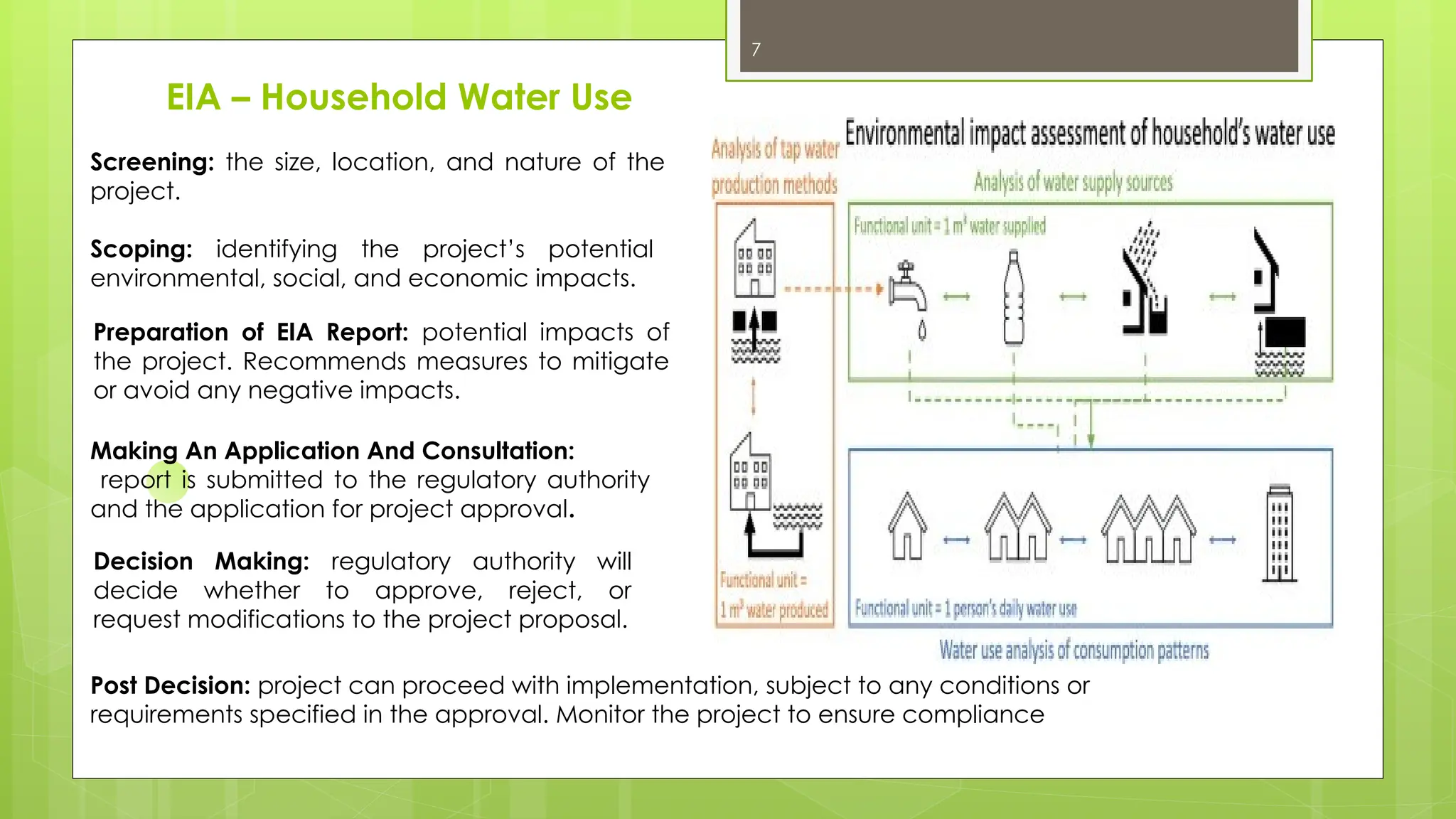
EIA – Household Water Use
Screening: the size, location, and nature of the
project.
Scoping: identifying the project’s potential
environmental, social, and economic impacts.
Preparation of EIA Report: potential impacts of
the project. Recommends measures to mitigate
or avoid any negative impacts.
Making An Application And Consultation:
report is submitted to the regulatory authority
and the application for project approval.
Decision Making: regulatory authority will
decide whether to approve, reject, or
request modifications to the project proposal.
Post Decision: project can proceed with implementation, subject to any conditions or
requirements specified in the approval. Monitor the project to ensure compliance
7
Sample Footer Text
9
Evaluate environmental engineering problems by applying chemical engineering principles
 Chemical Engineering has demonstrated to be a powerful tool to have comprehensive
solutions to a wide range of environmental problems.
 Chemical Engineering have been extensively applied to typical and emerging
environmental technologies such as wastewater treatment, anaerobic digestion,
biofiltration, etc.
 Among them, it is CE classical topics: chemical reactors design, kinetics, simulation,
control,modeling and especially,heat and mass balances.
Sample Footer Text
10
11
Pollution Impact and Alternative Treatment for Produced Water
Yusran Hedar 1,* and Budiyono2
Master Program of Environmental Science, School of Postgraduate Studies,
Diponegoro University, Semarang - Indonesia
2 Department of Chemical Engineering, Faculty of Engineering,
Diponegoro University, Semarang - Indonesia
Abstract:
• Oil and gas exploration and production are two of the activities that
potentially cause pollution and environmental damage.
• The largest waste generated from this activity is produced water.
• Produced water contains hazardous pollutants of both organic and
inorganic materials, so that the produced water of oil and gas
production cannot be discharged directly to the environment.
• Uncontrolled discharge can lead to the environmental damage, killing
the life of water and plants.
• The produced water needs to be handled and fulfill the quality
standards before being discharged to the environment.
• Several studies to reduce the contaminants in the produced water
were conducted by researchers.
• Among them were gravity based separation - flotation, separation
technique based on filtration, and biological process treatment.
• Therefore, some of these methods can be used as an alternative waste
handling of produced water.
PDO produces around one
million m3
/day of produced
treated water, 70 percent of
which is reused for reservoir
maintenance and chemical oil
recovery operations while the
remainder is equally distributed
between reed beds and for
deep disposal, according to an
October 2022 Oman Daily
Observer report.

environmental engineering course materials

  • 1.
    Sample Footer Text 1.Explain and discuss environmental ethics and environmental impact assessment. 2. Inspect the precision of environmental impact assessment for a case study. 3. Outline the process of environmental impact assessment 4. Evaluate environmental engineering problems by applying chemical engineering principles. 5. Influence of estimated solution on the environment and recommendation of possible modification, methods, alternatives, and treatments to reduce or nullify the pollution. 1
  • 2.
    Sample Footer Text EnvironmentalEthics Environmental ethics is ethics applied to the environment, in other words, it is a branch of ethics that studies the relationship of human beings with the natural environment and how ethics plays a role in this relationship. Environmental ethics excerpts influence on a large scale of disciplines including environmental law, environmental sociology, ecotheology, ecological economics, environmental geography and ecology. 2
  • 3.
    Sample Footer Text ThreePhilosophical Approaches to Environmental Ethics Anthropocentrism (human-centered) This view holds that all environmental responsibility is derived from human interests. Assumes that only humans are morally significant. Assumes nature is an instrument for human manipulation. Biocentrism (life-centered) All life forms have an inherent right to exist. Ecocentrism This view maintains that the environment deserves direct moral consideration, not consideration derived from human or animal interests. 3
  • 4.
    Sample Footer Text EnvironmentalImpact Assessment Environmental Impact Assessment (EIA) is a tool used to assess the significant effects of a project or development proposal on the environment. EIAs make sure that project decision makers think about the likely effects on the environment at the earliest possible time and aim to avoid, reduce or offset those effects. The EIA process helps to promote sustainable development and protect the environment while ensuring that development projects are implemented responsibly and transparently. 4
  • 5.
    Sample Footer Text 5Tuesday, February 2, 20XX An EIA may be defined as: a formal process to predict the environmental consequences of human development activities and to plan appropriate measures to eliminate or reduce adverse effects and to augment positive effects. EIA thus has three main functions: • to predict problems, • to find ways to avoid them, and • To enhance positive effects.
  • 6.
    Stages of Environmental ImpactAssessment Screening: This is the initial stage of EIA, where the proposed project is evaluated to determine whether it requires a full EIA. • Screening involves assessing the potential environmental impacts of the project based on factors such as the size, location, and nature of the project. Scoping: In this stage, the scope and objectives of the EIA are defined. • Scoping involves identifying the project’s potential environmental, social, and economic impacts and selecting the key issues that will be evaluated in the EIA. Preparation of EIA Report: This stage involves the preparation of a detailed report that describes the potential impacts of the project, evaluates the significance of these impacts, and recommends measures to mitigate or avoid any negative impacts. • The EIA report is typically prepared by environmental experts based on data collected during field investigations, stakeholder consultations, and other sources. 5
  • 7.
    Stages of EnvironmentalImpact Assessment Making An Application And Consultation: In this stage of environmental impact assessment, the report is submitted to the regulatory authority and the application for project approval. The regulatory authority will then review the EIA report and may seek additional information or clarification. T • There is also often a public consultation process where stakeholders can provide feedback and comments on the project proposal and the EIA report. Decision Making: Based on the EIA report, application, and public consultation process, the regulatory authority will decide whether to approve, reject, or request modifications to the project proposal. • The decision may be based on environmental, social, economic, and other factors and compliance with relevant laws and regulations. Post Decision: Once a decision has been made, the project can proceed with implementation, subject to any conditions or requirements specified in the approval. • The regulatory authority will typically monitor the project to ensure compliance with the approval conditions and any environmental management plans that have been developed. 6
  • 8.
    EIA – HouseholdWater Use Screening: the size, location, and nature of the project. Scoping: identifying the project’s potential environmental, social, and economic impacts. Preparation of EIA Report: potential impacts of the project. Recommends measures to mitigate or avoid any negative impacts. Making An Application And Consultation: report is submitted to the regulatory authority and the application for project approval. Decision Making: regulatory authority will decide whether to approve, reject, or request modifications to the project proposal. Post Decision: project can proceed with implementation, subject to any conditions or requirements specified in the approval. Monitor the project to ensure compliance 7
  • 9.
    Sample Footer Text 9 Evaluateenvironmental engineering problems by applying chemical engineering principles  Chemical Engineering has demonstrated to be a powerful tool to have comprehensive solutions to a wide range of environmental problems.  Chemical Engineering have been extensively applied to typical and emerging environmental technologies such as wastewater treatment, anaerobic digestion, biofiltration, etc.  Among them, it is CE classical topics: chemical reactors design, kinetics, simulation, control,modeling and especially,heat and mass balances.
  • 10.
  • 11.
    11 Pollution Impact andAlternative Treatment for Produced Water Yusran Hedar 1,* and Budiyono2 Master Program of Environmental Science, School of Postgraduate Studies, Diponegoro University, Semarang - Indonesia 2 Department of Chemical Engineering, Faculty of Engineering, Diponegoro University, Semarang - Indonesia Abstract: • Oil and gas exploration and production are two of the activities that potentially cause pollution and environmental damage. • The largest waste generated from this activity is produced water. • Produced water contains hazardous pollutants of both organic and inorganic materials, so that the produced water of oil and gas production cannot be discharged directly to the environment. • Uncontrolled discharge can lead to the environmental damage, killing the life of water and plants. • The produced water needs to be handled and fulfill the quality standards before being discharged to the environment. • Several studies to reduce the contaminants in the produced water were conducted by researchers. • Among them were gravity based separation - flotation, separation technique based on filtration, and biological process treatment. • Therefore, some of these methods can be used as an alternative waste handling of produced water. PDO produces around one million m3 /day of produced treated water, 70 percent of which is reused for reservoir maintenance and chemical oil recovery operations while the remainder is equally distributed between reed beds and for deep disposal, according to an October 2022 Oman Daily Observer report.