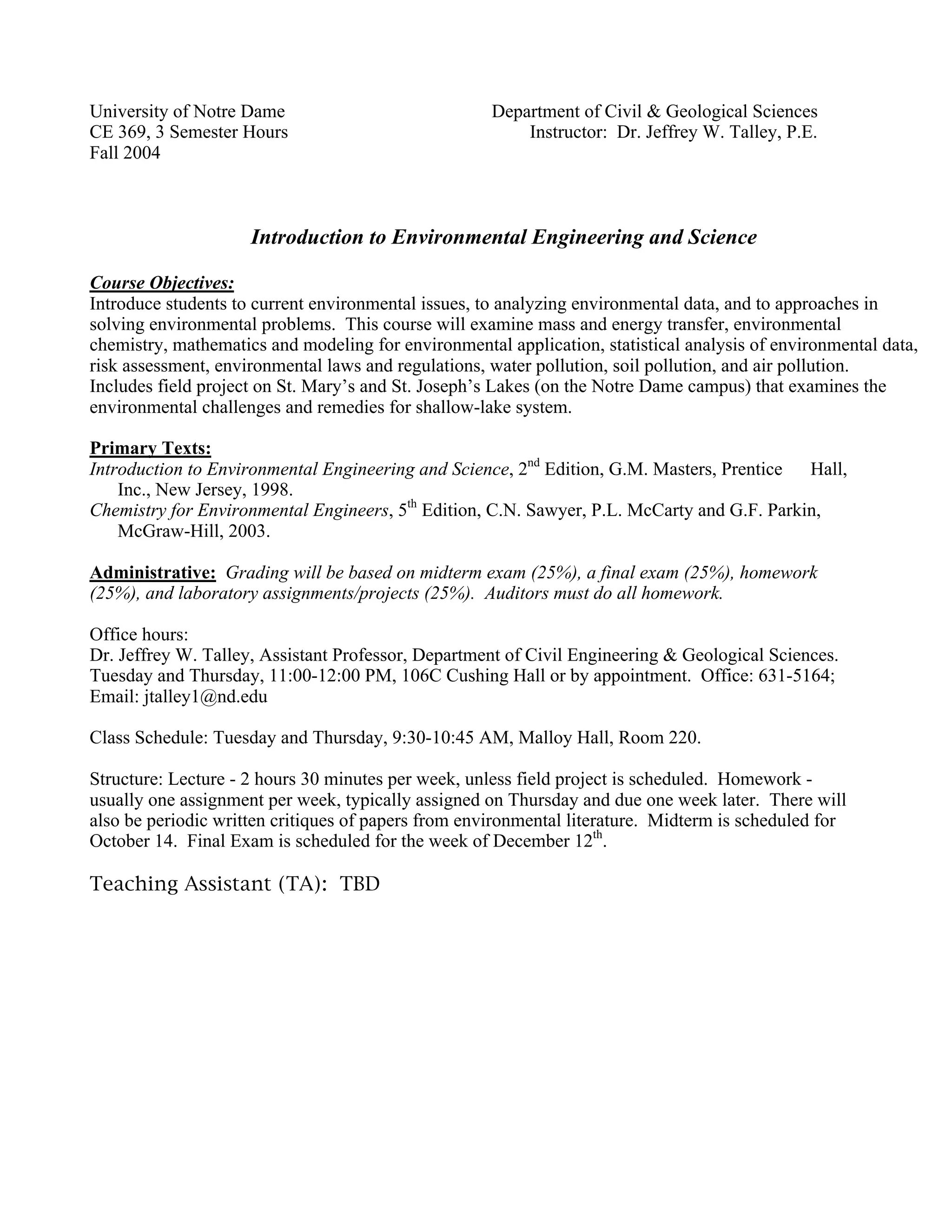
University of Notre Dame Department of Civil & Geological Sciences
CE 369, 3 Semester Hours Instructor: Dr. Jeffrey W. Talley, P.E.
Fall 2004
Introduction to Environmental Engineering and Science
Course Objectives:
Introduce students to current environmental issues, to analyzing environmental data, and to approaches in
solving environmental problems. This course will examine mass and energy transfer, environmental
chemistry, mathematics and modeling for environmental application, statistical analysis of environmental data,
risk assessment, environmental laws and regulations, water pollution, soil pollution, and air pollution.
Includes field project on St. Mary’s and St. Joseph’s Lakes (on the Notre Dame campus) that examines the
environmental challenges and remedies for shallow-lake system.
Primary Texts:
Introduction to Environmental Engineering and Science, 2nd
Edition, G.M. Masters, Prentice Hall,
Inc., New Jersey, 1998.
Chemistry for Environmental Engineers, 5th
Edition, C.N. Sawyer, P.L. McCarty and G.F. Parkin,
McGraw-Hill, 2003.
Administrative: Grading will be based on midterm exam (25%), a final exam (25%), homework
(25%), and laboratory assignments/projects (25%). Auditors must do all homework.
Office hours:
Dr. Jeffrey W. Talley, Assistant Professor, Department of Civil Engineering & Geological Sciences.
Tuesday and Thursday, 11:00-12:00 PM, 106C Cushing Hall or by appointment. Office: 631-5164;
Email: jtalley1@nd.edu
Class Schedule: Tuesday and Thursday, 9:30-10:45 AM, Malloy Hall, Room 220.
Structure: Lecture - 2 hours 30 minutes per week, unless field project is scheduled. Homework -
usually one assignment per week, typically assigned on Thursday and due one week later. There will
also be periodic written critiques of papers from environmental literature. Midterm is scheduled for
October 14. Final Exam is scheduled for the week of December 12th
.
Teaching Assistant (TA): TBD
CE 369: Introduction to Environmental Engineering and Science
Fall 2003 Course Outline
Week Topics
1. Aug. 26 Introduction
2. Aug. 28, Sep. 2 Mass and Energy Transfer
3. Sep. 4, 9 Environmental Chemistry
4. Sep. 11, 16 Laboratory 1: Study of Completely Mixed Flow
Reactor
5. Sep. 18, 23 Mathematics and Modeling for
Environmental Application
6. Sep 25 Statistical Analyses of Environmental Data
7. Sep. 30, Oct. 2 Laboratory 2: Measurement of Henry’s Law Constant for
Volatile Organics
8. Oct 7 Risk Assessment
9. Oct. 9 Environmental Laws and Regulations
10. Oct 14, 16 Review, Midterm Exam
Oct. 20-24 Mid-semester Break
11. Oct. 28, 30, Nov 4 Water Pollution
12. Nov. 6, 11 Laboratory 3: Darcy’s Law and Hydraulic
Conductivity
13. Nov. 13, 18 Soil Pollution
14. Nov. 20, 25 Laboratory 4: Phase Partitioning and
Environmental Transport
Nov. 27-Nov 30 Thanksgiving Holiday
15. Dec. 2, 4, 9 Air Pollution
16. Dec. 11-14 Study Days (Review)
17. Dec. 15 Final Examination (10:30 a.m. – 12:30 p.m.)
Final exam is comprehensive, covering the entire
course

Ce369

  • 1.
    University of NotreDame Department of Civil & Geological Sciences CE 369, 3 Semester Hours Instructor: Dr. Jeffrey W. Talley, P.E. Fall 2004 Introduction to Environmental Engineering and Science Course Objectives: Introduce students to current environmental issues, to analyzing environmental data, and to approaches in solving environmental problems. This course will examine mass and energy transfer, environmental chemistry, mathematics and modeling for environmental application, statistical analysis of environmental data, risk assessment, environmental laws and regulations, water pollution, soil pollution, and air pollution. Includes field project on St. Mary’s and St. Joseph’s Lakes (on the Notre Dame campus) that examines the environmental challenges and remedies for shallow-lake system. Primary Texts: Introduction to Environmental Engineering and Science, 2nd Edition, G.M. Masters, Prentice Hall, Inc., New Jersey, 1998. Chemistry for Environmental Engineers, 5th Edition, C.N. Sawyer, P.L. McCarty and G.F. Parkin, McGraw-Hill, 2003. Administrative: Grading will be based on midterm exam (25%), a final exam (25%), homework (25%), and laboratory assignments/projects (25%). Auditors must do all homework. Office hours: Dr. Jeffrey W. Talley, Assistant Professor, Department of Civil Engineering & Geological Sciences. Tuesday and Thursday, 11:00-12:00 PM, 106C Cushing Hall or by appointment. Office: 631-5164; Email: jtalley1@nd.edu Class Schedule: Tuesday and Thursday, 9:30-10:45 AM, Malloy Hall, Room 220. Structure: Lecture - 2 hours 30 minutes per week, unless field project is scheduled. Homework - usually one assignment per week, typically assigned on Thursday and due one week later. There will also be periodic written critiques of papers from environmental literature. Midterm is scheduled for October 14. Final Exam is scheduled for the week of December 12th . Teaching Assistant (TA): TBD
  • 2.
    CE 369: Introductionto Environmental Engineering and Science Fall 2003 Course Outline Week Topics 1. Aug. 26 Introduction 2. Aug. 28, Sep. 2 Mass and Energy Transfer 3. Sep. 4, 9 Environmental Chemistry 4. Sep. 11, 16 Laboratory 1: Study of Completely Mixed Flow Reactor 5. Sep. 18, 23 Mathematics and Modeling for Environmental Application 6. Sep 25 Statistical Analyses of Environmental Data 7. Sep. 30, Oct. 2 Laboratory 2: Measurement of Henry’s Law Constant for Volatile Organics 8. Oct 7 Risk Assessment 9. Oct. 9 Environmental Laws and Regulations 10. Oct 14, 16 Review, Midterm Exam Oct. 20-24 Mid-semester Break 11. Oct. 28, 30, Nov 4 Water Pollution 12. Nov. 6, 11 Laboratory 3: Darcy’s Law and Hydraulic Conductivity 13. Nov. 13, 18 Soil Pollution 14. Nov. 20, 25 Laboratory 4: Phase Partitioning and Environmental Transport Nov. 27-Nov 30 Thanksgiving Holiday 15. Dec. 2, 4, 9 Air Pollution 16. Dec. 11-14 Study Days (Review) 17. Dec. 15 Final Examination (10:30 a.m. – 12:30 p.m.) Final exam is comprehensive, covering the entire course