Cisco Router Throughput
Let’s know about the Cisco router throughput from the below message:
1 No Drop Rate and RFC-2544 Tests
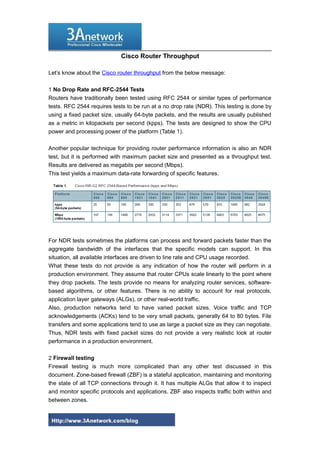
Routers have traditionally been tested using RFC 2544 or similar types of performance
tests. RFC 2544 requires tests to be run at a no drop rate (NDR). This testing is done by
using a fixed packet size, usually 64-byte packets, and the results are usually published
as a metric in kilopackets per second (kpps). The tests are designed to show the CPU
power and processing power of the platform (Table 1).
Another popular technique for providing router performance information is also an NDR
test, but it is performed with maximum packet size and presented as a throughput test.
Results are delivered as megabits per second (Mbps).
This test yields a maximum data-rate forwarding of specific features.

For NDR tests sometimes the platforms can process and forward packets faster than the
aggregate bandwidth of the interfaces that the specific models can support. In this
situation, all available interfaces are driven to line rate and CPU usage recorded.
What these tests do not provide is any indication of how the router will perform in a
production environment. They assume that router CPUs scale linearly to the point where
they drop packets. The tests provide no means for analyzing router services, softwarebased algorithms, or other features. There is no ability to account for real protocols,
application layer gateways (ALGs), or other real-world traffic.
Also, production networks tend to have varied packet sizes. Voice traffic and TCP
acknowledgements (ACKs) tend to be very small packets, generally 64 to 80 bytes. File
transfers and some applications tend to use as large a packet size as they can negotiate.
Thus, NDR tests with fixed packet sizes do not provide a very realistic look at router
performance in a production environment.
2 Firewall testing
Firewall testing is much more complicated than any other test discussed in this
document. Zone-based firewall (ZBF) is a stateful application, maintaining and monitoring
the state of all TCP connections through it. It has multiple ALGs that allow it to inspect
and monitor specific protocols and applications. ZBF also inspects traffic both within and
between zones.
1
Thus, test methodology significantly affects performance. Testing different applications
invokes specific ALGs, each of which may affect test results differently. Many test tools
can generate packets with TCP headers, but never complete the handshake and
establish state for monitoring. In some situations, the firewall may see this situation as a
denial-of-service (DoS) attack, because it would rarely be encountered in a production
network unless under attack. The use of pure User Datagram Protocol (UDP) or other
stateless traffic patterns can also produce varying results.
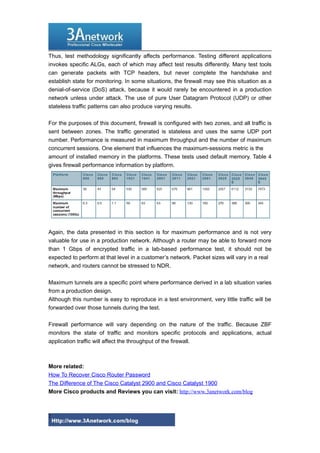
For the purposes of this document, firewall is configured with two zones, and all traffic is
sent between zones. The traffic generated is stateless and uses the same UDP port
number. Performance is measured in maximum throughput and the number of maximum
concurrent sessions. One element that influences the maximum-sessions metric is the
amount of installed memory in the platforms. These tests used default memory. Table 4
gives firewall performance information by platform.

Again, the data presented in this section is for maximum performance and is not very
valuable for use in a production network. Although a router may be able to forward more
than 1 Gbps of encrypted traffic in a lab-based performance test, it should not be
expected to perform at that level in a customer’s network. Packet sizes will vary in a real
network, and routers cannot be stressed to NDR.
Maximum tunnels are a specific point where performance derived in a lab situation varies
from a production design.
Although this number is easy to reproduce in a test environment, very little traffic will be
forwarded over those tunnels during the test.
Firewall performance will vary depending on the nature of the traffic. Because ZBF
monitors the state of traffic and monitors specific protocols and applications, actual
application traffic will affect the throughput of the firewall.

More related:
How To Recover Cisco Router Password
The Difference of The Cisco Catalyst 2900 and Cisco Catalyst 1900
More Cisco products and Reviews you can visit: http://www.3anetwork.com/blog

2
3Anetwork.com is a world leading Cisco networking products wholesaler, we wholesale
original new Cisco networking equipments, including Cisco Catalyst switches, Cisco
routers, Cisco firewalls, Cisco wireless products, Cisco modules and interface cards
products at competitive price and ship to worldwide.
Our website: http://www.3anetwork.com
Telephone: +852-3069-7733
Email: info@3Anetwork.com
Address: 23/F Lucky Plaza, 315-321 Lockhart Road, Wanchai, Hongkong

3

Cisco Router Throughput

  • 1.
    Cisco Router Throughput Let’sknow about the Cisco router throughput from the below message: 1 No Drop Rate and RFC-2544 Tests Routers have traditionally been tested using RFC 2544 or similar types of performance tests. RFC 2544 requires tests to be run at a no drop rate (NDR). This testing is done by using a fixed packet size, usually 64-byte packets, and the results are usually published as a metric in kilopackets per second (kpps). The tests are designed to show the CPU power and processing power of the platform (Table 1). Another popular technique for providing router performance information is also an NDR test, but it is performed with maximum packet size and presented as a throughput test. Results are delivered as megabits per second (Mbps). This test yields a maximum data-rate forwarding of specific features. For NDR tests sometimes the platforms can process and forward packets faster than the aggregate bandwidth of the interfaces that the specific models can support. In this situation, all available interfaces are driven to line rate and CPU usage recorded. What these tests do not provide is any indication of how the router will perform in a production environment. They assume that router CPUs scale linearly to the point where they drop packets. The tests provide no means for analyzing router services, softwarebased algorithms, or other features. There is no ability to account for real protocols, application layer gateways (ALGs), or other real-world traffic. Also, production networks tend to have varied packet sizes. Voice traffic and TCP acknowledgements (ACKs) tend to be very small packets, generally 64 to 80 bytes. File transfers and some applications tend to use as large a packet size as they can negotiate. Thus, NDR tests with fixed packet sizes do not provide a very realistic look at router performance in a production environment. 2 Firewall testing Firewall testing is much more complicated than any other test discussed in this document. Zone-based firewall (ZBF) is a stateful application, maintaining and monitoring the state of all TCP connections through it. It has multiple ALGs that allow it to inspect and monitor specific protocols and applications. ZBF also inspects traffic both within and between zones. 1
  • 2.
    Thus, test methodologysignificantly affects performance. Testing different applications invokes specific ALGs, each of which may affect test results differently. Many test tools can generate packets with TCP headers, but never complete the handshake and establish state for monitoring. In some situations, the firewall may see this situation as a denial-of-service (DoS) attack, because it would rarely be encountered in a production network unless under attack. The use of pure User Datagram Protocol (UDP) or other stateless traffic patterns can also produce varying results. For the purposes of this document, firewall is configured with two zones, and all traffic is sent between zones. The traffic generated is stateless and uses the same UDP port number. Performance is measured in maximum throughput and the number of maximum concurrent sessions. One element that influences the maximum-sessions metric is the amount of installed memory in the platforms. These tests used default memory. Table 4 gives firewall performance information by platform. Again, the data presented in this section is for maximum performance and is not very valuable for use in a production network. Although a router may be able to forward more than 1 Gbps of encrypted traffic in a lab-based performance test, it should not be expected to perform at that level in a customer’s network. Packet sizes will vary in a real network, and routers cannot be stressed to NDR. Maximum tunnels are a specific point where performance derived in a lab situation varies from a production design. Although this number is easy to reproduce in a test environment, very little traffic will be forwarded over those tunnels during the test. Firewall performance will vary depending on the nature of the traffic. Because ZBF monitors the state of traffic and monitors specific protocols and applications, actual application traffic will affect the throughput of the firewall. More related: How To Recover Cisco Router Password The Difference of The Cisco Catalyst 2900 and Cisco Catalyst 1900 More Cisco products and Reviews you can visit: http://www.3anetwork.com/blog 2
  • 3.
    3Anetwork.com is aworld leading Cisco networking products wholesaler, we wholesale original new Cisco networking equipments, including Cisco Catalyst switches, Cisco routers, Cisco firewalls, Cisco wireless products, Cisco modules and interface cards products at competitive price and ship to worldwide. Our website: http://www.3anetwork.com Telephone: +852-3069-7733 Email: info@3Anetwork.com Address: 23/F Lucky Plaza, 315-321 Lockhart Road, Wanchai, Hongkong 3