What is Informatics, and
      who’s in it?


Presented by Teri Slick
What is Informatics?

  Good question. You're inquisitive. We like that.
    Professors will tell you informatics relates information to
    digital technology.

  But what does that mean?
    It means informatics is all around us, in the ways we live,
    work and play. More than likely, you've used some form of
    informatics at some point in your work or during your
    leisure, and improving your knowledge of it will only make
    you more prepared for the ever-changing technological
    world.

  Taken from http://informatics.nku.edu/about/whatis.php
What are the possibilities?
   Imagine creating software that can recognize the limb
   movements of ballet dancers and can record their
   choreography to be replicated years from now, like a musical
   score.
   Imagine doctors and nurses having a patient's information
   on a digital tablet that contains every medical record since
   the time of the patient's birth.
   Imagine a brand-new place built especially for the College of
   Informatics, with Computer Assisted Virtual Environment
   rooms and the latest technological innovations, created from
   the ground-up to be a state-of-the-art facility designed for
   discovery.
   You won't have to imagine for long; our new building is
   scheduled to be completed in 2009, and we're excited about
   the possibilities it holds for our students and for the
   community.
Connecting the disciplines….
    Organizing fields of study at a university around Informatics is a new idea. It
    cuts "diagonally" across traditional groupings such as Business,
    Engineering, Arts, Humanities and Science. NKU is on the leading edge of
    this development, but it is not unique.
 Many fields make contributions to informatics:
   communication and media, computer science and information technology,
   and management information systems, to name a few.

 Informatics contributes to many fields:
     biology (bioinformatics and neuroinformatics), health care (health
     informatics), and law (legal informatics), to name a few.

    The foremost goal of the informatics-related programs at NKU is to graduate
    students who are savvy about information technology, who are
    accomplished communicators, and who are intellectually agile "renaissance
    people" for the information age.
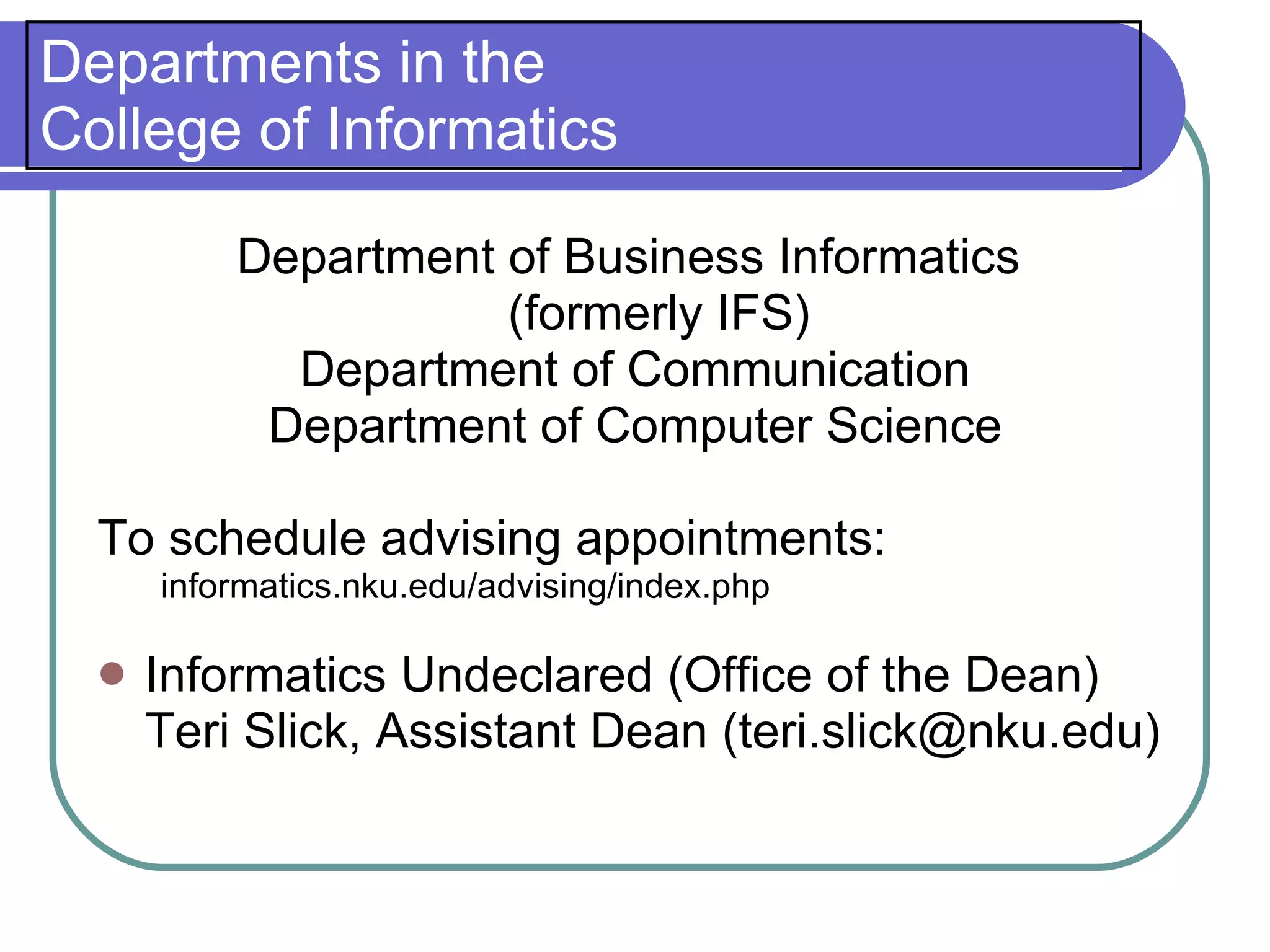
Departments in the
College of Informatics

          Department of Business Informatics
                     (formerly IFS)
            Department of Communication
           Department of Computer Science

  To schedule advising appointments:
      informatics.nku.edu/advising/index.php

     Informatics Undeclared (Office of the Dean)
      Teri Slick, Assistant Dean (teri.slick@nku.edu)
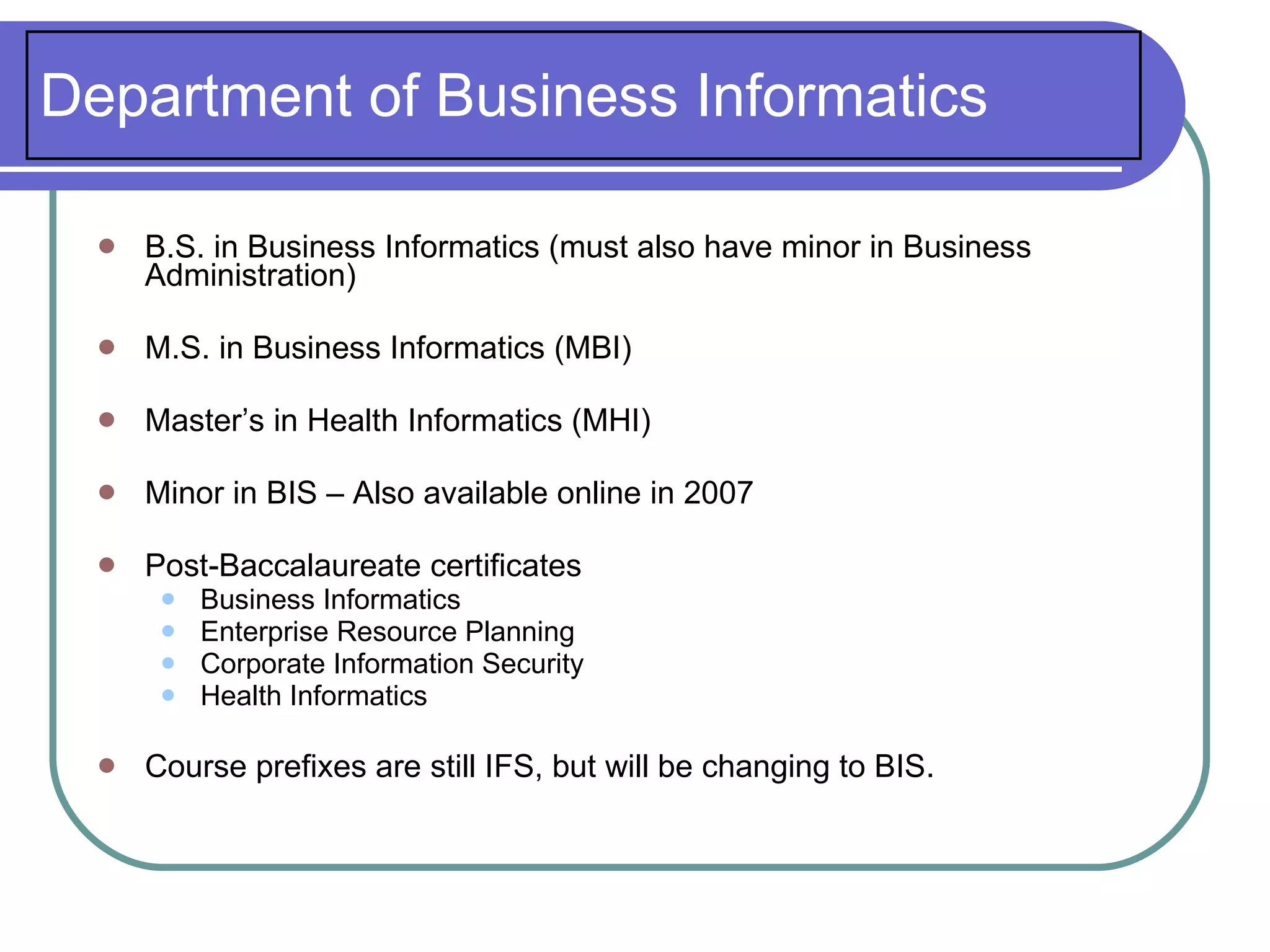
Department of Business Informatics

     B.S. in Business Informatics (must also have minor in Business
      Administration)

     M.S. in Business Informatics (MBI)

     Master’s in Health Informatics (MHI)

     Minor in BIS – Also available online in 2007

     Post-Baccalaureate certificates
          Business Informatics
          Enterprise Resource Planning
          Corporate Information Security
          Health Informatics

     Course prefixes are still IFS, but will be changing to BIS.
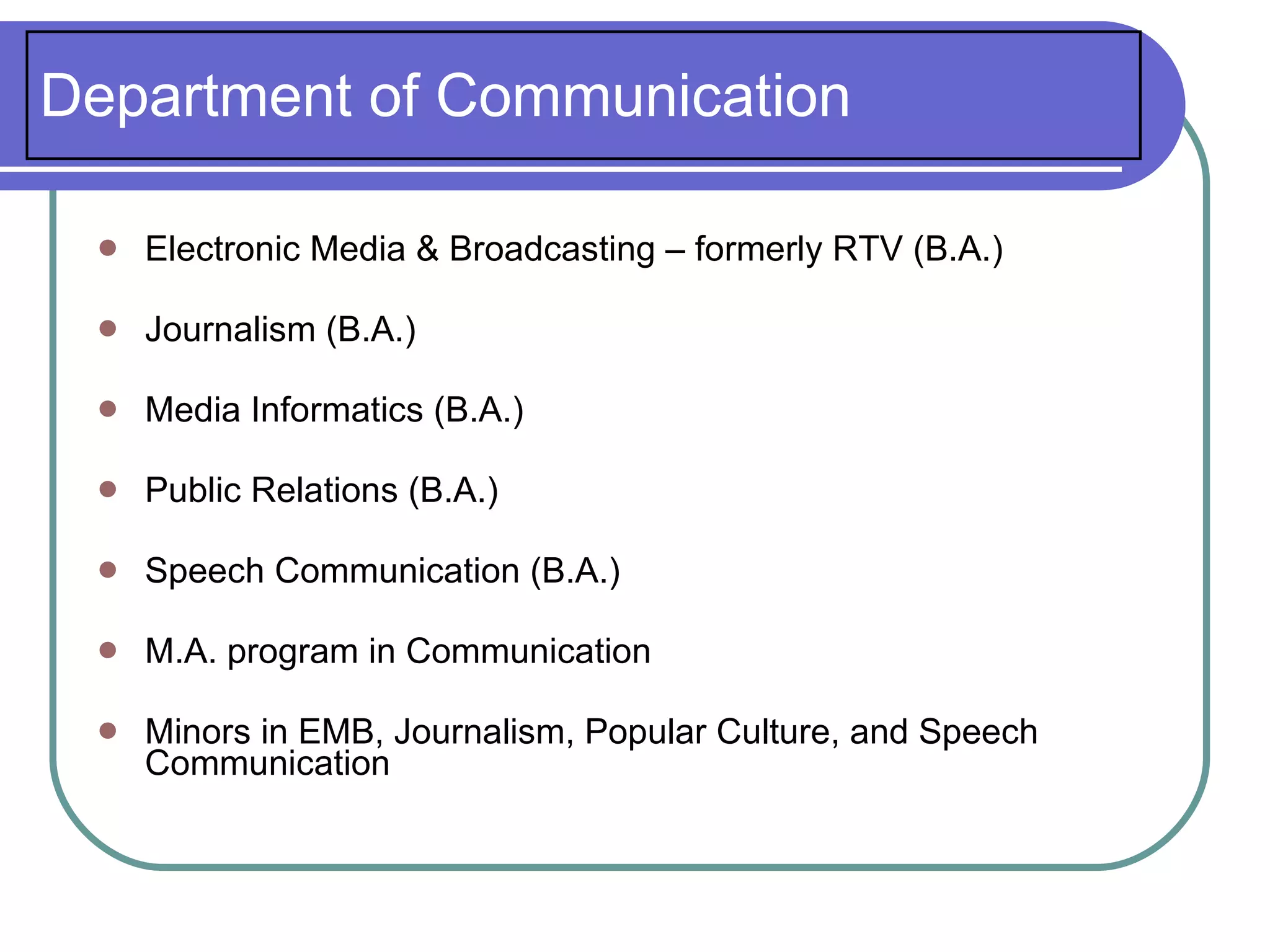
Department of Communication

    Electronic Media & Broadcasting – formerly RTV (B.A.)

    Journalism (B.A.)

    Media Informatics (B.A.)

    Public Relations (B.A.)

    Speech Communication (B.A.)

    M.A. program in Communication

    Minors in EMB, Journalism, Popular Culture, and Speech
     Communication
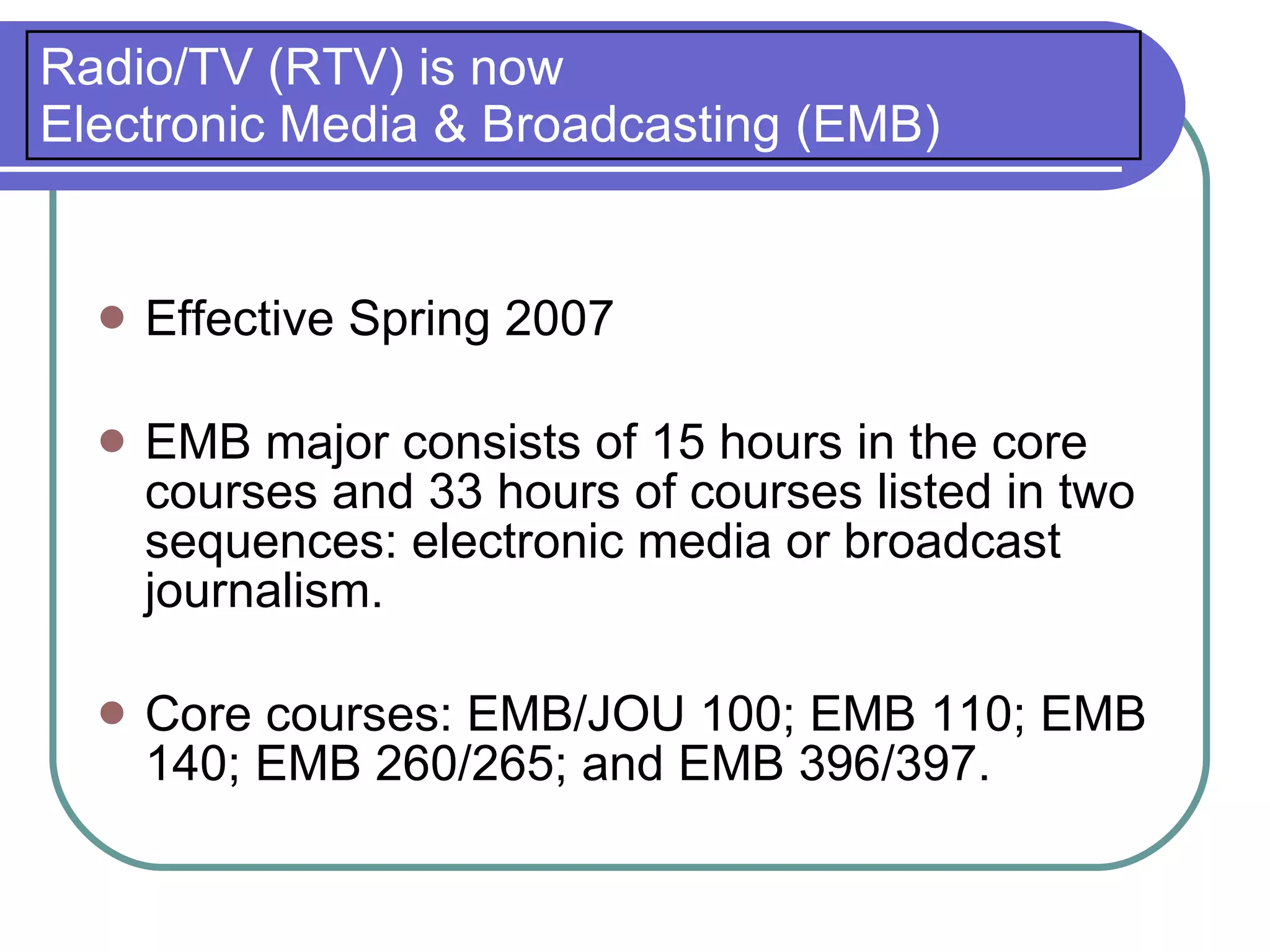
Radio/TV (RTV) is now
Electronic Media & Broadcasting (EMB)


     Effective Spring 2007

     EMB major consists of 15 hours in the core
      courses and 33 hours of courses listed in two
      sequences: electronic media or broadcast
      journalism.

     Core courses: EMB/JOU 100; EMB 110; EMB
      140; EMB 260/265; and EMB 396/397.
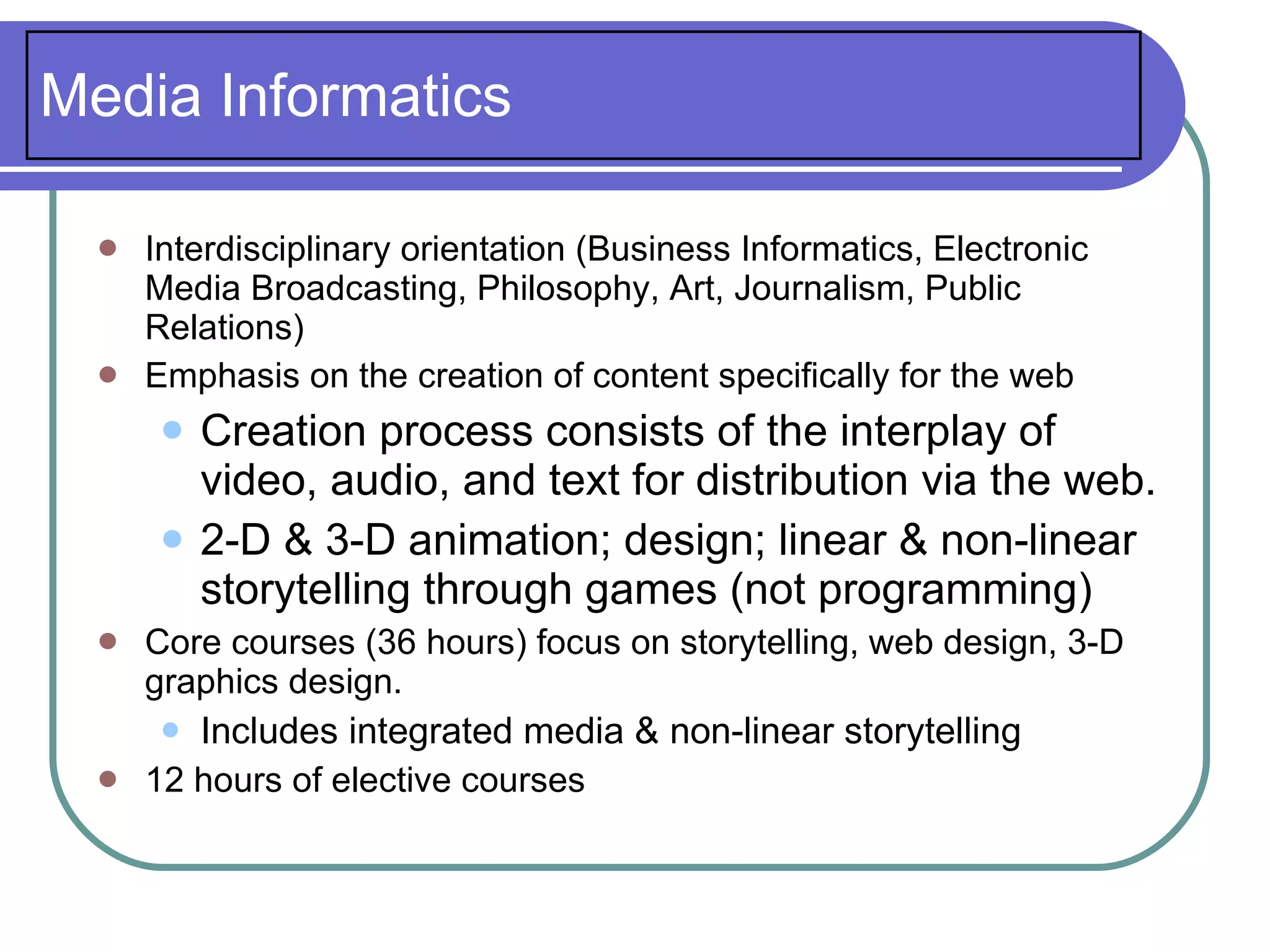
Media Informatics

     Interdisciplinary orientation (Business Informatics, Electronic
      Media Broadcasting, Philosophy, Art, Journalism, Public
      Relations)
     Emphasis on the creation of content specifically for the web
          Creation process consists of the interplay of
           video, audio, and text for distribution via the web.
          2-D & 3-D animation; design; linear & non-linear
           storytelling through games (not programming)
     Core courses (36 hours) focus on storytelling, web design, 3-D
      graphics design.
        Includes integrated media & non-linear storytelling
     12 hours of elective courses
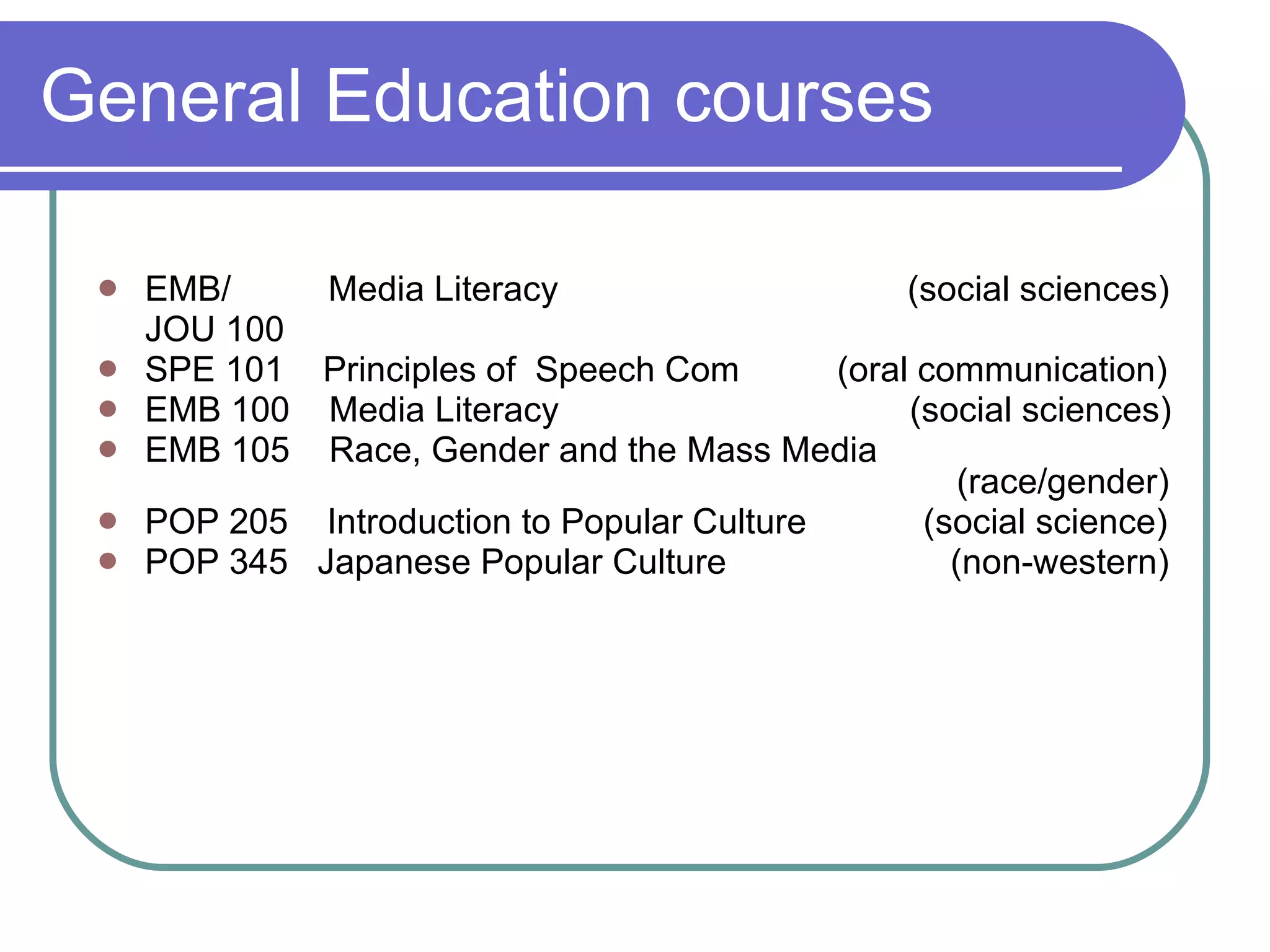
General Education courses

    EMB/     Media Literacy                      (social sciences)
     JOU 100
    SPE 101 Principles of Speech Com        (oral communication)
    EMB 100 Media Literacy                       (social sciences)
    EMB 105 Race, Gender and the Mass Media
                                                      (race/gender)
    POP 205 Introduction to Popular Culture       (social science)
    POP 345 Japanese Popular Culture                (non-western)
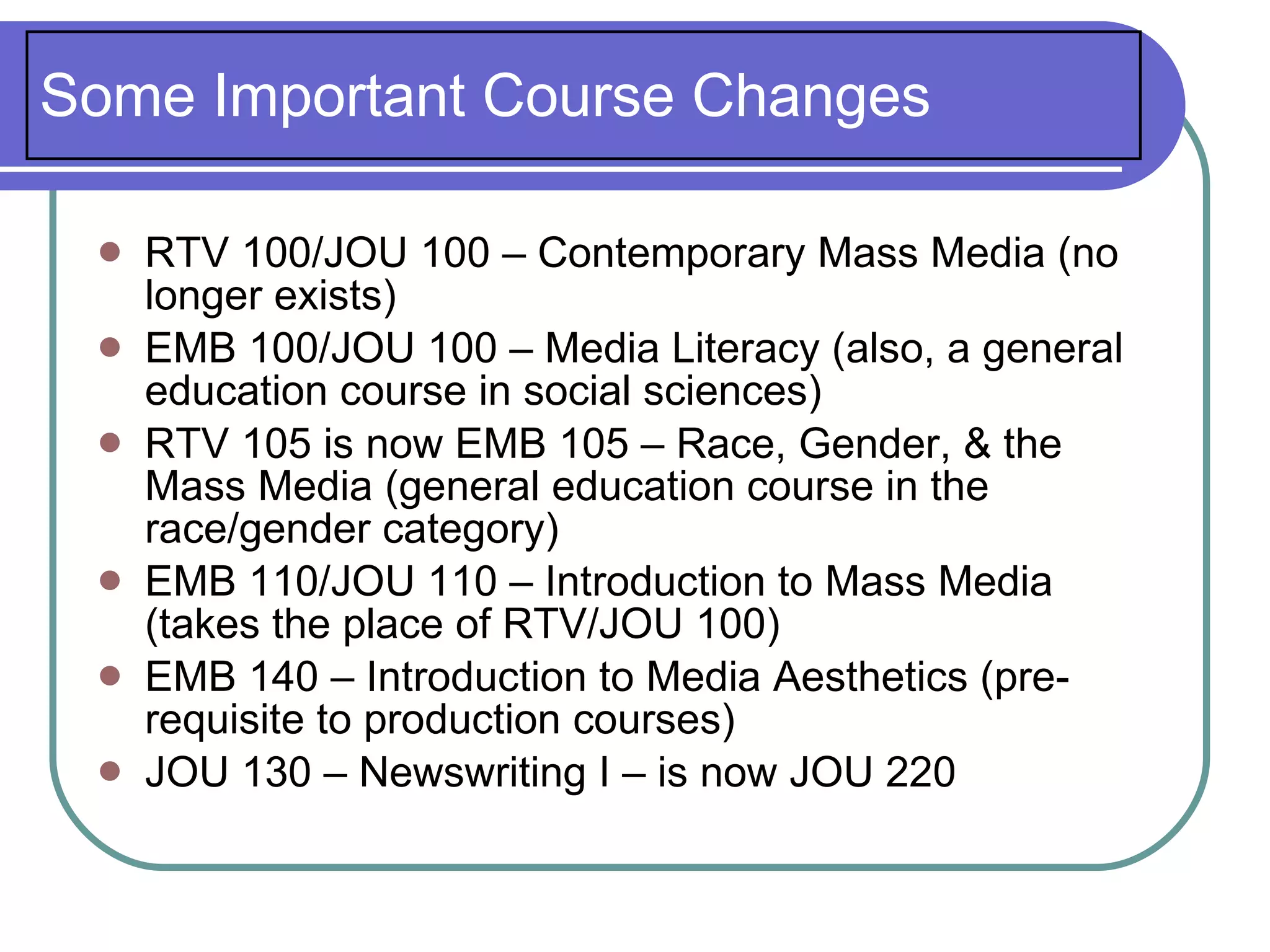
Some Important Course Changes

    RTV 100/JOU 100 – Contemporary Mass Media (no
     longer exists)
    EMB 100/JOU 100 – Media Literacy (also, a general
     education course in social sciences)
    RTV 105 is now EMB 105 – Race, Gender, & the
     Mass Media (general education course in the
     race/gender category)
    EMB 110/JOU 110 – Introduction to Mass Media
     (takes the place of RTV/JOU 100)
    EMB 140 – Introduction to Media Aesthetics (pre-
     requisite to production courses)
    JOU 130 – Newswriting I – is now JOU 220
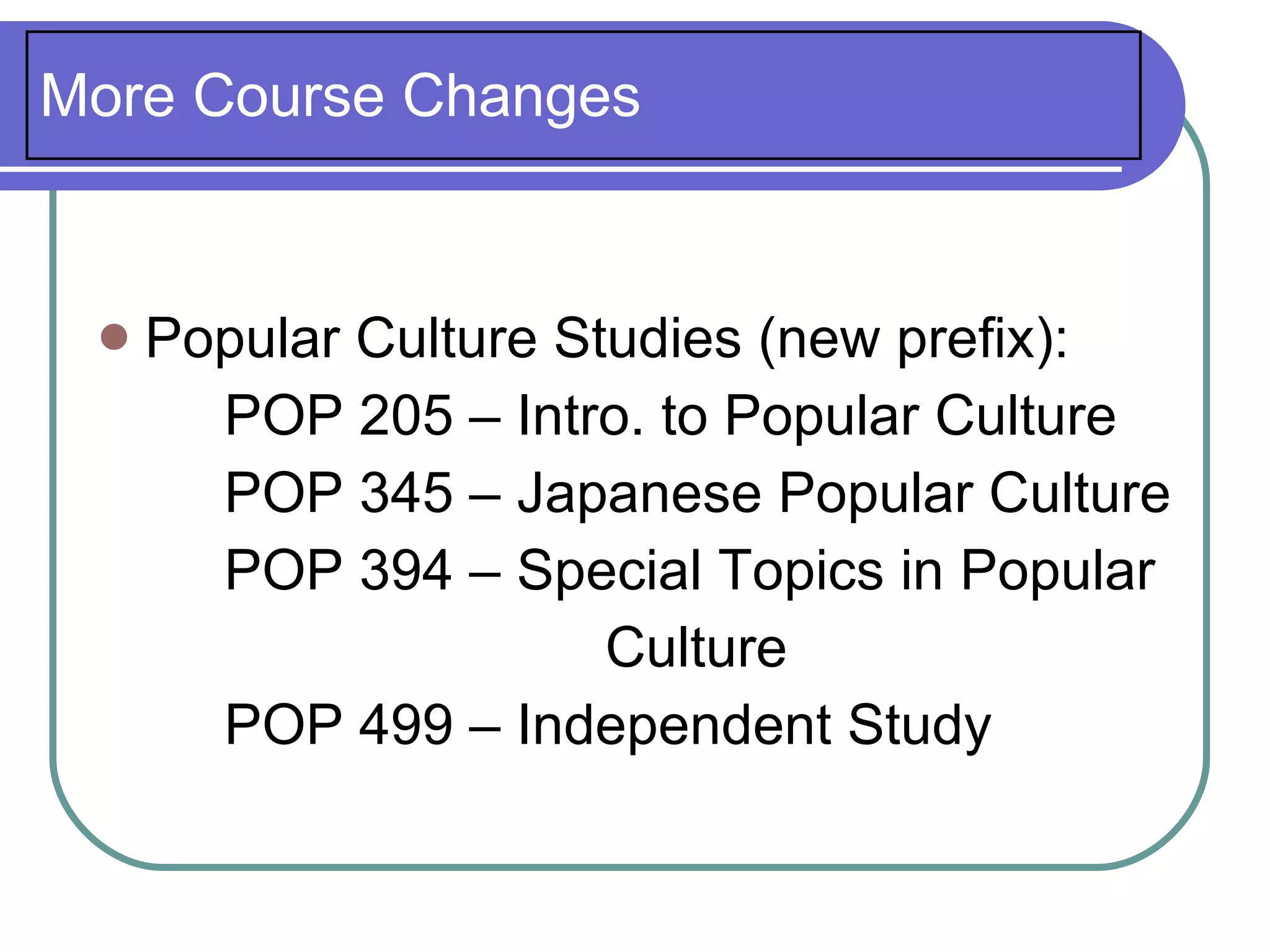
More Course Changes


    Popular Culture Studies (new prefix):
       POP 205 – Intro. to Popular Culture
       POP 345 – Japanese Popular Culture
       POP 394 – Special Topics in Popular
                       Culture
       POP 499 – Independent Study
Department of Computer Science


    Computer Information Technology (B.S.)

    Computer Science (B.S.)

    M.S. in Computer Science

    Minors in CIT, CS, Computer Forensics, and
     Information Security

    No longer accepting majors in CET (being phased out)
Informatics Undeclared

     College-specific, undeclared major code
      (not a degree program)

     Placed under the Dean’s Office (DINF)

     For students who have an interest in one
      or more of the fields within the college
Business Informatics vs. Computer Science vs. Computer Information Technology


      BIS prepares students for careers in
       business computing, and basically
       connects technology with business.
       Some applicable fields include project
       and database management, e-
       commerce, and systems analysis.
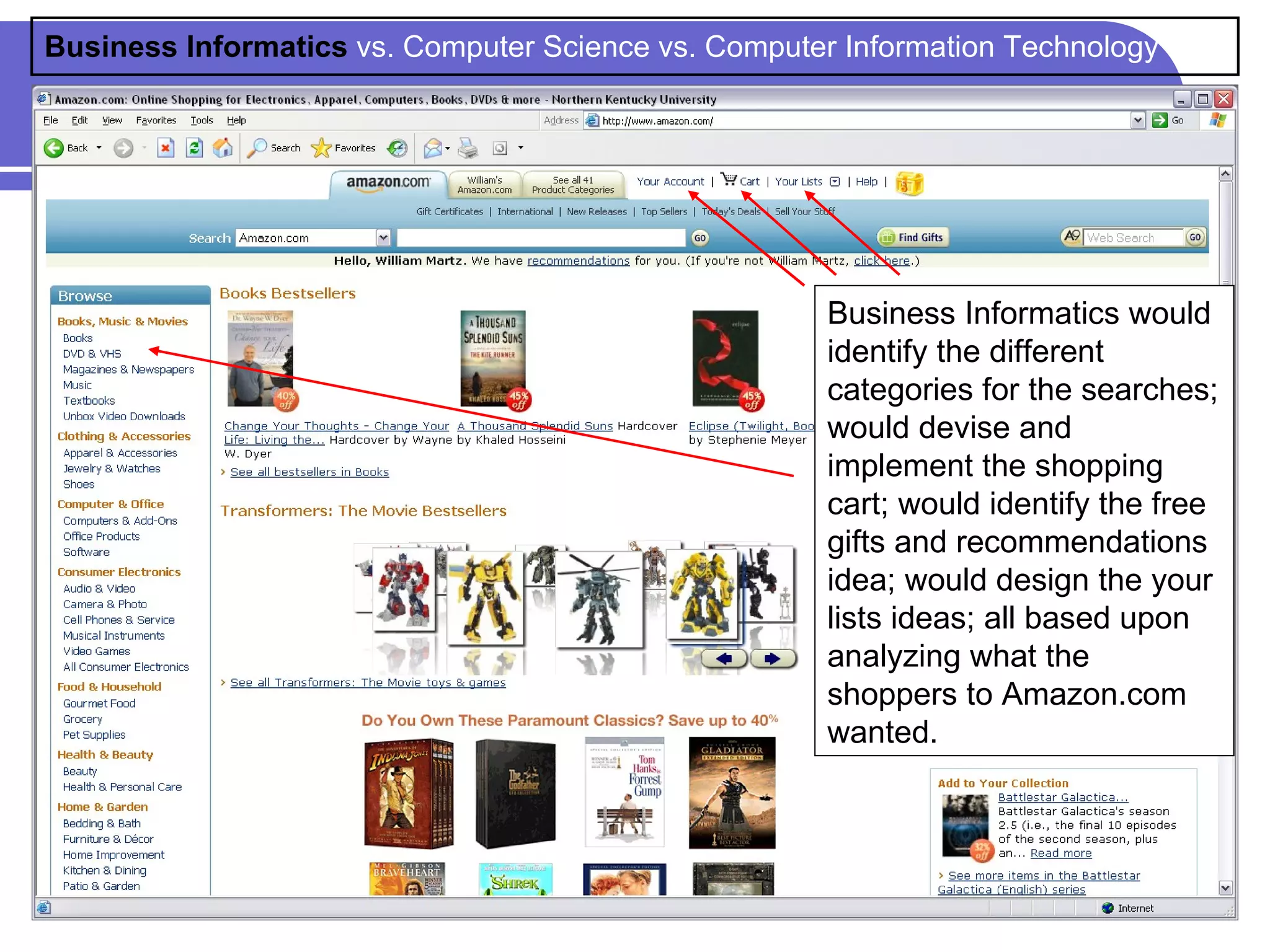
Business Informatics vs. Computer Science vs. Computer Information Technology


                                                      Business Informatics would
                                                      identify the different
                                                      categories for the searches;
                                                      would devise and
                                                      implement the shopping
                                                      cart; would identify the free
                                                      gifts and recommendations
                                                      idea; would design the your
                                                      lists ideas; all based upon
                                                      analyzing what the
                                                      shoppers to Amazon.com
                                                      wanted.
Business Informatics vs. Computer Science vs. Computer Information Technology


       CSC is an applied science with a strong
        software engineering focus. Graduates
        are prepared for careers in
        programming, software analysis, and
        computer architecture.
Business Informatics vs. Computer Science vs. Computer Information Technology


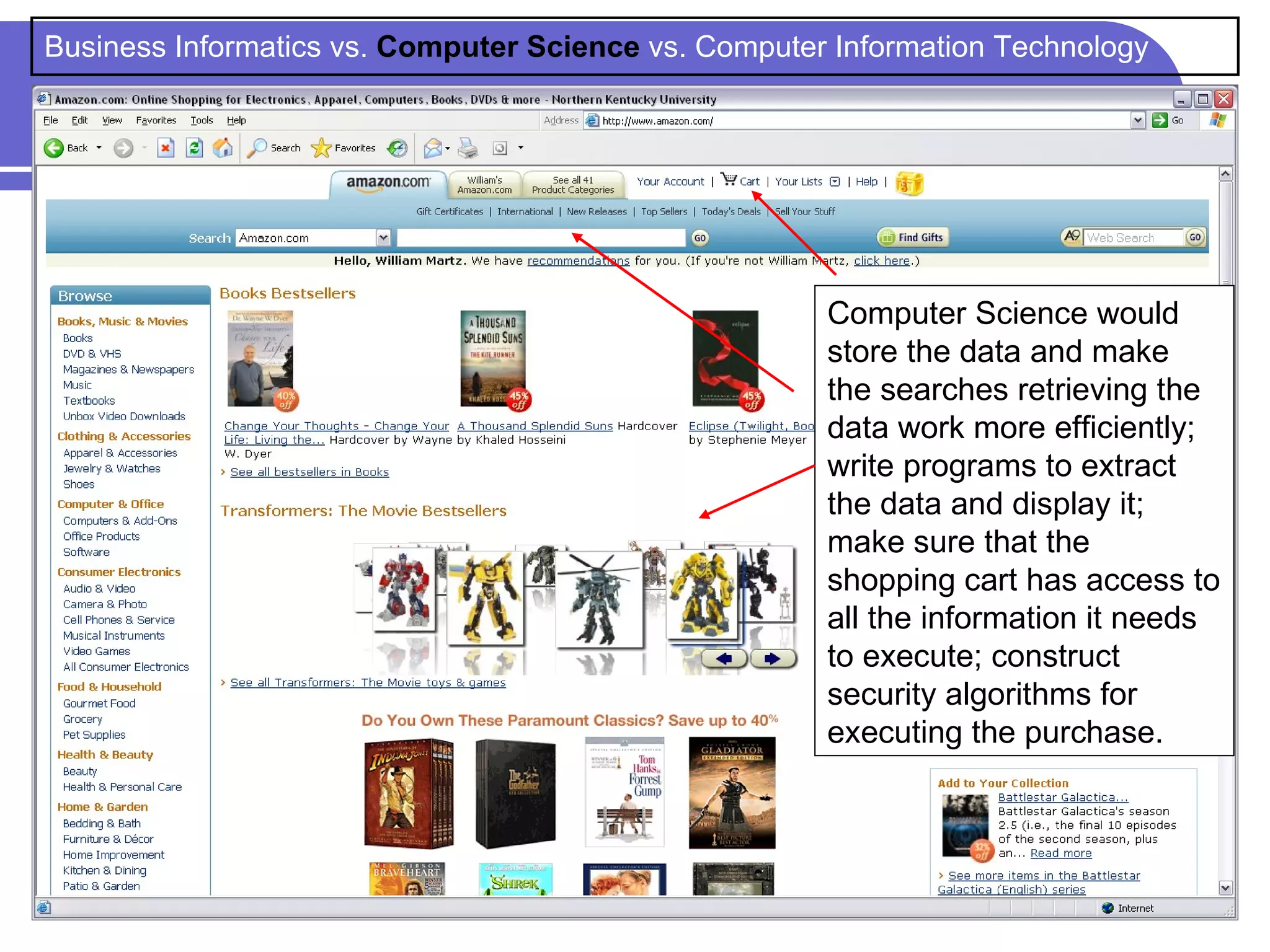
                                                      Computer Science would
                                                      store the data and make
                                                      the searches retrieving the
                                                      data work more efficiently;
                                                      write programs to extract
                                                      the data and display it;
                                                      make sure that the
                                                      shopping cart has access to
                                                      all the information it needs
                                                      to execute; construct
                                                      security algorithms for
                                                      executing the purchase.
Business Informatics vs. Computer Science vs. Computer Information Technology


       CIT provides students with a broad
        background in information technology
        and helps them to become experts in IT
        support, troubleshooting, and
        networking. Graduates become security
        technicians, Webmasters, and network
        administrators.
Business Informatics vs. Computer Science vs. Computer Information Technology


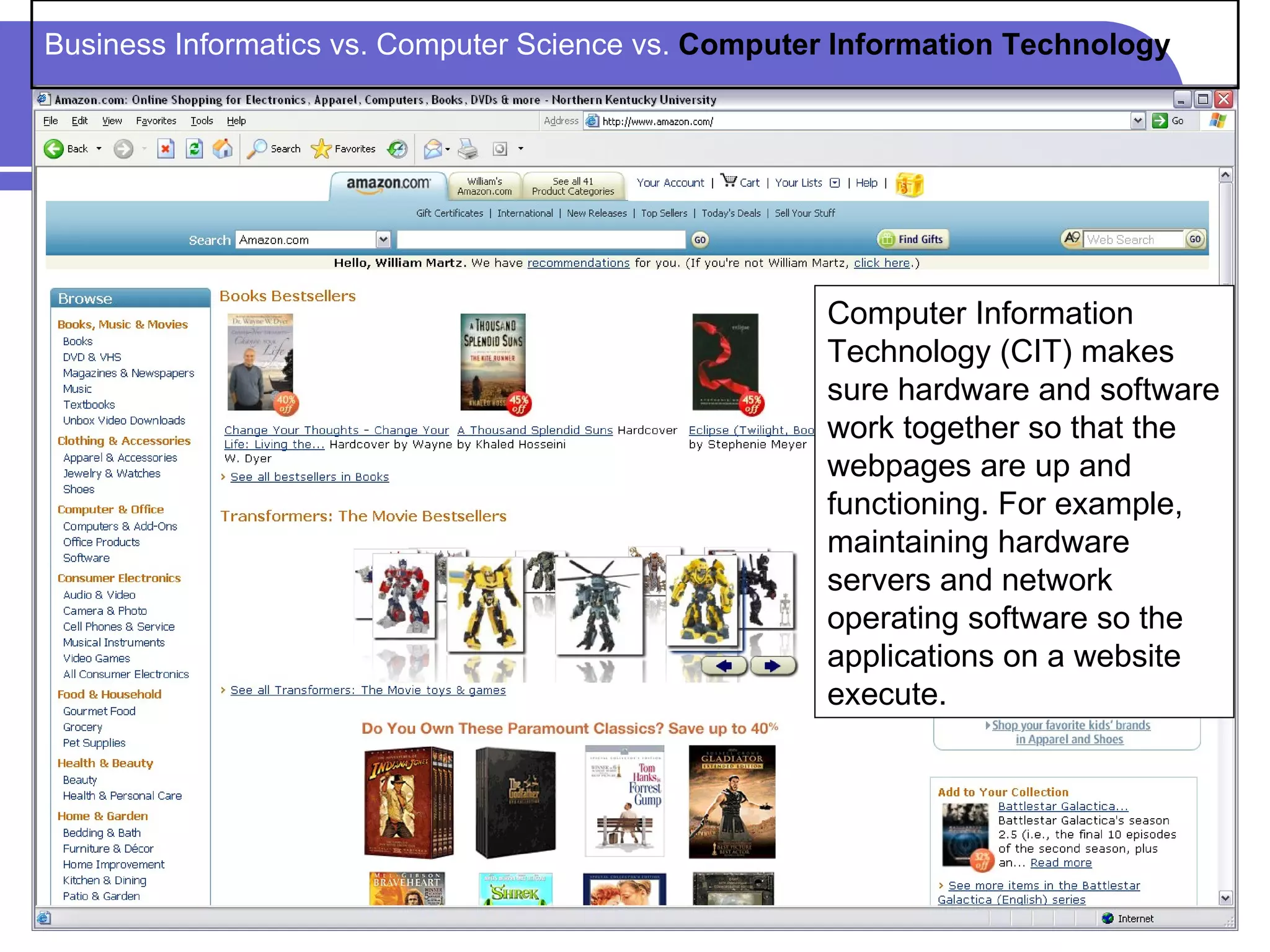
                                                     Computer Information
                                                     Technology (CIT) makes
                                                     sure hardware and software
                                                     work together so that the
                                                     webpages are up and
                                                     functioning. For example,
                                                     maintaining hardware
                                                     servers and network
                                                     operating software so the
                                                     applications on a website
                                                     execute.
New Minors in Computer Science –
Effective Fall 2007


     Computer Forensics (25 hours) –
      combines courses from CIT and Criminal
      Justice

     Information Security (25 hours) –
      combines courses from CIT and BIS/IFS
Health Informatics

     Application of information technology across the entire
      health care industry (hospitals, pharmacies, insurance
      companies, government agencies, etc.)

     Began in Fall 2007; course prefix is MHI.

     CPE approved in July 2007

     Master’s degree program housed in the Department of
      Business Informatics

     Program consists of 35 credit hours and can be
      completed in two years (full-time).
Please check out our NEW
website: informatics.nku.edu

       Questions?
       Comments?

Informatics (Recruiting) Teri Slick

  • 1.
    What is Informatics,and who’s in it? Presented by Teri Slick
  • 2.
    What is Informatics? Good question. You're inquisitive. We like that. Professors will tell you informatics relates information to digital technology. But what does that mean? It means informatics is all around us, in the ways we live, work and play. More than likely, you've used some form of informatics at some point in your work or during your leisure, and improving your knowledge of it will only make you more prepared for the ever-changing technological world. Taken from http://informatics.nku.edu/about/whatis.php
  • 3.
    What are thepossibilities? Imagine creating software that can recognize the limb movements of ballet dancers and can record their choreography to be replicated years from now, like a musical score. Imagine doctors and nurses having a patient's information on a digital tablet that contains every medical record since the time of the patient's birth. Imagine a brand-new place built especially for the College of Informatics, with Computer Assisted Virtual Environment rooms and the latest technological innovations, created from the ground-up to be a state-of-the-art facility designed for discovery. You won't have to imagine for long; our new building is scheduled to be completed in 2009, and we're excited about the possibilities it holds for our students and for the community.
  • 4.
    Connecting the disciplines…. Organizing fields of study at a university around Informatics is a new idea. It cuts "diagonally" across traditional groupings such as Business, Engineering, Arts, Humanities and Science. NKU is on the leading edge of this development, but it is not unique. Many fields make contributions to informatics: communication and media, computer science and information technology, and management information systems, to name a few. Informatics contributes to many fields: biology (bioinformatics and neuroinformatics), health care (health informatics), and law (legal informatics), to name a few. The foremost goal of the informatics-related programs at NKU is to graduate students who are savvy about information technology, who are accomplished communicators, and who are intellectually agile "renaissance people" for the information age.
  • 5.
    Departments in the Collegeof Informatics Department of Business Informatics (formerly IFS) Department of Communication Department of Computer Science To schedule advising appointments: informatics.nku.edu/advising/index.php  Informatics Undeclared (Office of the Dean) Teri Slick, Assistant Dean (teri.slick@nku.edu)
  • 6.
    Department of BusinessInformatics  B.S. in Business Informatics (must also have minor in Business Administration)  M.S. in Business Informatics (MBI)  Master’s in Health Informatics (MHI)  Minor in BIS – Also available online in 2007  Post-Baccalaureate certificates  Business Informatics  Enterprise Resource Planning  Corporate Information Security  Health Informatics  Course prefixes are still IFS, but will be changing to BIS.
  • 7.
    Department of Communication  Electronic Media & Broadcasting – formerly RTV (B.A.)  Journalism (B.A.)  Media Informatics (B.A.)  Public Relations (B.A.)  Speech Communication (B.A.)  M.A. program in Communication  Minors in EMB, Journalism, Popular Culture, and Speech Communication
  • 8.
    Radio/TV (RTV) isnow Electronic Media & Broadcasting (EMB)  Effective Spring 2007  EMB major consists of 15 hours in the core courses and 33 hours of courses listed in two sequences: electronic media or broadcast journalism.  Core courses: EMB/JOU 100; EMB 110; EMB 140; EMB 260/265; and EMB 396/397.
  • 9.
    Media Informatics  Interdisciplinary orientation (Business Informatics, Electronic Media Broadcasting, Philosophy, Art, Journalism, Public Relations)  Emphasis on the creation of content specifically for the web  Creation process consists of the interplay of video, audio, and text for distribution via the web.  2-D & 3-D animation; design; linear & non-linear storytelling through games (not programming)  Core courses (36 hours) focus on storytelling, web design, 3-D graphics design.  Includes integrated media & non-linear storytelling  12 hours of elective courses
  • 10.
    General Education courses  EMB/ Media Literacy (social sciences) JOU 100  SPE 101 Principles of Speech Com (oral communication)  EMB 100 Media Literacy (social sciences)  EMB 105 Race, Gender and the Mass Media (race/gender)  POP 205 Introduction to Popular Culture (social science)  POP 345 Japanese Popular Culture (non-western)
  • 11.
    Some Important CourseChanges  RTV 100/JOU 100 – Contemporary Mass Media (no longer exists)  EMB 100/JOU 100 – Media Literacy (also, a general education course in social sciences)  RTV 105 is now EMB 105 – Race, Gender, & the Mass Media (general education course in the race/gender category)  EMB 110/JOU 110 – Introduction to Mass Media (takes the place of RTV/JOU 100)  EMB 140 – Introduction to Media Aesthetics (pre- requisite to production courses)  JOU 130 – Newswriting I – is now JOU 220
  • 12.
    More Course Changes  Popular Culture Studies (new prefix): POP 205 – Intro. to Popular Culture POP 345 – Japanese Popular Culture POP 394 – Special Topics in Popular Culture POP 499 – Independent Study
  • 13.
    Department of ComputerScience  Computer Information Technology (B.S.)  Computer Science (B.S.)  M.S. in Computer Science  Minors in CIT, CS, Computer Forensics, and Information Security  No longer accepting majors in CET (being phased out)
  • 14.
    Informatics Undeclared  College-specific, undeclared major code (not a degree program)  Placed under the Dean’s Office (DINF)  For students who have an interest in one or more of the fields within the college
  • 15.
    Business Informatics vs.Computer Science vs. Computer Information Technology  BIS prepares students for careers in business computing, and basically connects technology with business. Some applicable fields include project and database management, e- commerce, and systems analysis.
  • 16.
    Business Informatics vs.Computer Science vs. Computer Information Technology Business Informatics would identify the different categories for the searches; would devise and implement the shopping cart; would identify the free gifts and recommendations idea; would design the your lists ideas; all based upon analyzing what the shoppers to Amazon.com wanted.
  • 17.
    Business Informatics vs.Computer Science vs. Computer Information Technology  CSC is an applied science with a strong software engineering focus. Graduates are prepared for careers in programming, software analysis, and computer architecture.
  • 18.
    Business Informatics vs.Computer Science vs. Computer Information Technology Computer Science would store the data and make the searches retrieving the data work more efficiently; write programs to extract the data and display it; make sure that the shopping cart has access to all the information it needs to execute; construct security algorithms for executing the purchase.
  • 19.
    Business Informatics vs.Computer Science vs. Computer Information Technology  CIT provides students with a broad background in information technology and helps them to become experts in IT support, troubleshooting, and networking. Graduates become security technicians, Webmasters, and network administrators.
  • 20.
    Business Informatics vs.Computer Science vs. Computer Information Technology Computer Information Technology (CIT) makes sure hardware and software work together so that the webpages are up and functioning. For example, maintaining hardware servers and network operating software so the applications on a website execute.
  • 21.
    New Minors inComputer Science – Effective Fall 2007  Computer Forensics (25 hours) – combines courses from CIT and Criminal Justice  Information Security (25 hours) – combines courses from CIT and BIS/IFS
  • 22.
    Health Informatics  Application of information technology across the entire health care industry (hospitals, pharmacies, insurance companies, government agencies, etc.)  Began in Fall 2007; course prefix is MHI.  CPE approved in July 2007  Master’s degree program housed in the Department of Business Informatics  Program consists of 35 credit hours and can be completed in two years (full-time).
  • 23.
    Please check outour NEW website: informatics.nku.edu Questions? Comments?