The Barefoot Revolution
This is the story of ordinary people who have made extraordinary things possible…
This is the story of a quaint little village in the land of drought and color….Rajasthan..
A village where the poorest of the poor lived…
A village that had been left behind and forgotten as India surged forward…..
When darkness fell virtually everything had to come to a halt – work, reading, cooking – because the village had no electricity
The people were “unemployable” and “unqualified”….  Completely dependent on the vagaries of fate….
And then came a man…..
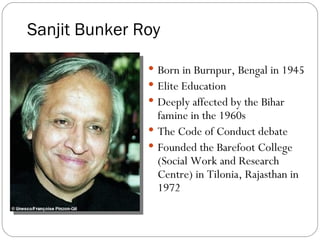
Sanjit Bunker Roy Born in Burnpur, Bengal in 1945 Elite Education Deeply affected by the Bihar famine in the 1960s The Code of Conduct debate Founded the Barefoot College (Social Work and Research Centre) in Tilonia, Rajasthan in 1972
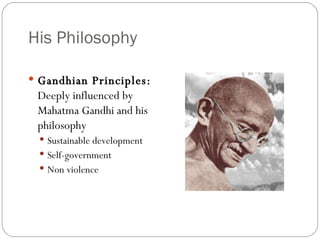
His Philosophy Gandhian Principles:  Deeply influenced by Mahatma Gandhi and his philosophy Sustainable development Self-government  Non violence
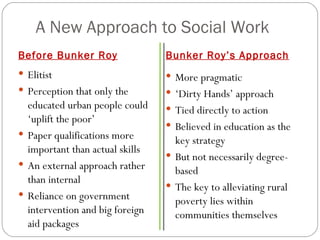
A New Approach to Social Work Before Bunker Roy Elitist Perception that only the educated urban people could ‘uplift the poor’ Paper qualifications more important than actual skills An external approach rather than internal Reliance on government intervention and big foreign aid packages  Bunker Roy’s Approach More pragmatic ‘ Dirty Hands’ approach Tied directly to action Believed in education as the key strategy But not necessarily degree-based The key to alleviating rural poverty lies within communities themselves
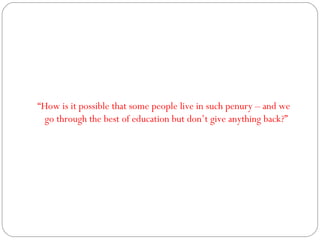
“ How is it possible that some people live in such penury – and we go through the best of education but don’t give anything back?”
GENESIS
“ To serve the basic learning needs of all requires more than a recommitment to basic education as it now exists. What is needed is an “expanded vision” that surpasses […] conventional delivery systems while building on the best in current practices” WORLD DECLARATION ON EDUCATION FOR ALL (Article 2)‏
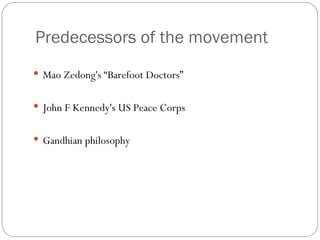
Predecessors of the movement Mao Zedong's “Barefoot Doctors” John F Kennedy's US Peace Corps Gandhian philosophy
The Beginning Started as the Social Work and Research Centre (SWRC) in Tilonia in 1972 45 acres of government land and an abandoned tuberculosis sanatorium leased at 1 Re per month! Joint venture with specialists and local villagers The ideology shift from urban specialist assistance to rural self-sufficiency
Problems that SWRC / Barefoot sought to address Lack of professionalization and rural focus Lack of accessibility Poor dissemination of information Dependency Absence of institution support
The Concept of Barefoot College Why  Barefoot College? SWRC started going by the name Barefoot College in the early ‘80’s Millions of people in India live and work barefoot! Title also used as a symbol of respect for the knowledge that the poor have
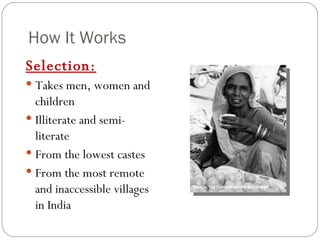
How It Works Selection: Takes men, women and children Illiterate and semi-literate From the lowest castes From the most remote and inaccessible villages in India
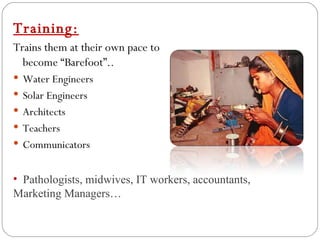
Training: Trains them at their own pace to become “Barefoot”.. Water Engineers Solar Engineers Architects Teachers Communicators Pathologists, midwives, IT workers, accountants,  Marketing Managers…
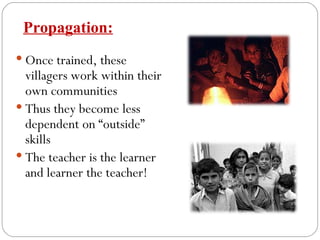
Once trained, these villagers work within their own communities Thus they become less dependent on “outside” skills The teacher is the learner and learner the teacher! Propagation:
 
Barefoot Campus and Structure The “loose” structure as a strength Definite lines of authority such as the Director and the section leader but a conscious attempt to avoid hierarchies in decision making and salaries Monthly meetings between the section leaders, the field centre coordinator and the Director Accounts Department oversees finance, supported by senior staff who are responsible for funding requests and reports The old and new campuses and the 8 field centres : greater decentralization into villages
The Barefoot Code of Conduct Live and work in close proximity with the rural community Create a space for creative and constructive personal growth - not  discriminating against caste, religion or political thinking Ensure gender equality within the organisation Have an intrinsic belief in the democratic political process and not follow  partisan political agendas or include partisan politicians on the board Judge the worth of people by their willingness and ability to learn - not by their paper qualifications
The Barefoot Code of Conduct Believe in the law of the land and have a commitment towards social justice through non-violent means  Have respect for collective, traditional knowledge, beliefs, wisdom and  practices of the community Be committed to the preservation of natural resources and not endorse  processes that destroy, exploit or abuse natural resources Use appropriate technologies that sustain the community and not encourage  technologies that deprive people of their livelihoods Set a personal example in adhering to the code of conduct
Sectors of Work Access to drinking water, groundwater management and rain water harvesting Education Medical care Women's programmes Agricultural extension Rural industry Appropriate technology Animal husbandry Communication and use of traditional media
The Barefoot Principles: A Yardstick of the success of the movement Equality: The program treats all members as equal, regardless of sex, class, education, or caste Collectivity: Collective decision-making practiced by one and all.  Self reliance: Members are helped to work together to develop the community.  Decentralization: The program is committed to local decision-making, and grassroots level.  Austerity: The staff members lead a simple life committed to generating a close community and a stimulating, creative environment.
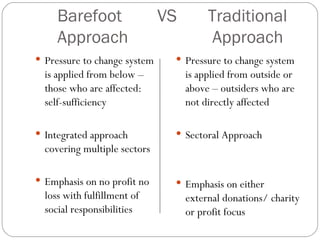
Barefoot  VS  Traditional    Approach  Approach Pressure to change system is applied from below – those who are affected: self-sufficiency Integrated approach covering multiple sectors Emphasis on no profit no loss with fulfillment of social responsibilities Pressure to change system is applied from outside or above – outsiders who are not directly affected Sectoral Approach Emphasis on either external donations/ charity or profit focus
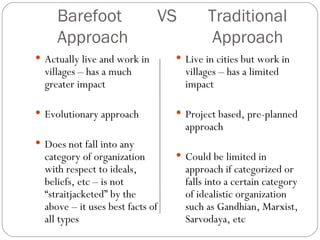
Actually live and work in villages – has a much greater impact Evolutionary approach Does not fall into any category of organization with respect to ideals, beliefs, etc – is not “straitjacketed” by the above – it uses best facts of all types Live in cities but work in villages – has a limited impact Project based, pre-planned approach Could be limited in approach if categorized or falls into a certain category of idealistic organization such as Gandhian, Marxist, Sarvodaya, etc Barefoot  VS  Traditional    Approach  Approach
DIFFERENT FACES OF A REVOLUTION
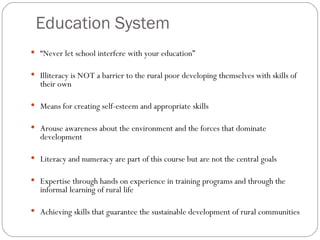
Education System  “ Never let school interfere with your education” Illiteracy is NOT a barrier to the rural poor developing themselves with skills of their own Means for creating self-esteem and appropriate skills Arouse awareness about the environment and the forces that dominate development Literacy and numeracy are part of this course but are not the central goals Expertise through hands on experience in training programs and through the informal learning of rural life Achieving skills that guarantee the sustainable development of rural communities
Bunker Roy on Education Systems… “ Encourage private initiative without commercializing education. Give private initiative more responsibility, more space, more freedom” “ In Tilonia, education and development are inextricably linked. Youth are trained to use technologies that serve their communities while children learn about environmental themes such as solar electricity, which is used in most of their schools”
Formal Education Only prepare children for government and professional employment Language Barrier Seek individual prosperity and move away from community People with the baggage of formal education can be harmful in the village as they often look down on the poor "It destroys initiative and creativity. It expects you to do everything the way they say, the way they do,"  "I advise people to get a functional education, enough reading and writing not to get tricked by the money lender and then come back to the village."
Focus on Community Opinion Assessment of community need and understanding of education. Night school teachers, day care teachers, midwives and village education committees define what rural communities need to sustain Information regarding government programmes and legal literacy Collective problem resolution – to form sustainable communities and pressure groups to influence policies A way to avoid exploitation by literate To discuss environment and development issues, every year 2500 teachers’ meetings, 600 rural parent’s meetings, and 1,250 village education meetings are called.
Means Night Schools for children Day Schools Pre-Schools Children’s Parliament Training Barefoot Teachers Training and Supervision Toy Workshop
Methodology Use of folklore, songs, puppetry and theater in classes, training and learning groups Associating with the traditional learning patterns of their environment Philosophy in which  everyone is a learner and a teacher. There is no give and take – only sharing  Although written manuals are limited, there is a sharing of information between those with traditional knowledge and those who are ‘professionals’ which has made the village a self-reliant, sustainable unit The College has helped to facilitate a revival of people’s technologies that are tried, tested and approved by communities and applied them on a wide scale to solve problems
Methodology Local staff such as the Balsevikas (women who run the day care programmes) and the night school teachers do indeed come from the villages where they work  The training sessions bring together local midwives, day care workers and night school teachers. They share education and health information for all three sectors and ensure a coherence of philosophy between the sections.  Once a mother brings in a child to the day care centre, staff attempt to build on her interest in the child’s health and education tackling issues of nutrition hearth care and women rights
Implementation Emphasis on environment  Students are taught the value of wasteland development and the destructive effect of cutting down trees for fuel and fodder Imparting educational process that refers to agriculture, animal husbandry and the daily activities that go on in a village Curriculum Language (Hindi), Arithmetic, Social Studies, Science, Geography and Environment Class 1 & 2  Idea of reading and writing Hindi Simple addition subtraction and multiplication Class 3  Letter to words and words to sentences Information on household, self government and casteism
Implementation Class 4 & 5 Geographic knowledge of district and village Socio – Political structure of the country Local fairs, festivals, traditional stories Social and Political thinkers and famous personalities Rabia, Kharif and pulse crops, fertilizers and cultivation of cereals and pulses.  Vocational Training – Carpentry, sewing, cement block making, motor winding etc. Children’s Parliament Value of recognizing good candidate on their own merit Responsibility and power More actively involved in the running of their schools An innovative step to better child-empowerment
Challenges and Innovations Infrastructure – Government day school buildings, community centers in village, teachers houses Rescheduling of schools to meet the times of rural children and teachers drawn from surrounding communities The VEC and night school teachers talk to parents who are not sending their children to school and do their best to persuade them Night school teachers are local residents who have generally completed their 8 th  grade Annual training for 15 days Continuous motivation exercises to instill a spirit of voluntarism
Statistics 60% of night school students are girls Over 3,000 drop-out children comprising 1,200 boys and 1,800 girls attend 150 night schools in 150 villages.  100 per cent attendance of children who have dropped out (of formal education)  Each night more than 4,000 children who tend cattle by day attend night classes with barefoot teachers in education centers lit by solar powered lanterns built and installed by barefoot engineers
Solar Energy: Opportunity Utilized.. Follows the combined approach to community participation through skills training and technology demystification  Solar Electronics Workshop - Located at Barefoot College, Tilonia This  centre prepares “barefoot engineers” ,men and women from poor rural backgrounds, who spend six months training here The program combines 21st century science with traditional knowledge to teach the construction, installation, and maintenance of  Home lighting systems Solar lanterns Solar Cookers All solar panels have been installed, maintained and repaired by the village people without the assistance of any paper qualified engineer.  These BSEs in turn impart the same knowledge and expertise to others.
Faces of the Movement Gulab Devi  (45) of Harmara Village in Rajasthan She is the sole bread-earner for her four children and her ailing husband  She is completely illiterate She makes electronic circuits and chargers for solar lighting panels for a living Ritma Bharti  of Bihar She underwent training with her 2yr old in tow Came back with 80 solar lanterns and lit 40 schools Now she trains others in her village
Impact..a few numbers The Barefoot College is fully solar operated, the first of its kind Solar electrifying 300 adult education centres & 900 schools 400 rural youth including women trained as barefoot solar engineers with absolutely no aid from urban professionals 574 villages and hamlets(clusters) have been covered where a total number of 12000 households have been solar electrified.  195,000 litres of kersoene saved, by replacing generators and oil lanterns with solar power.
Water Barefoot Approach consists of Ground water surveys Installation of  hand pumps by Barefoot engineers and mechanics Rainwater Harvesting Piped water systems Safe drinking water is being provided for the first time through 67 hand pumps at a height of 15,000 ft in Ladakh in Jammu and Kashmir Village barefoot engineers, who have barely passed primary school, have planned and implemented water supply schemes in 13 villages, benefiting 19,000 people
Rainwater Harvesting Involves collection of rainwater falling on existing open wells and tanks and reservoirs Community members come together and contribute labour and materials to construct these storage tanks  Such water has been tested and found to be safe for human consumption Rooftop Rainwater Harvesting Catching rainwater where it falls using the rooftops of schools and other buildings Channeling it into underground leak-proof tanks made of locally available, low-cost materials These structures are managed, controlled and owned by Village Water Communities
Impact Reduced dependence on external expertise and material More cost effective than solutions based on underground water/other sources At Rs. 2-3 /litre one can collect and store 100,000 litres of rainwater  Water availability helps in regular attendance at schools In India, around 1,000 RRWH structures have been built in 17 states, with a total storage capacity of 47 million litres serving over 220,000 children in remote rural communities  In brackish water areas 320 rural primary schools have harvested 18 million litres of rain water through traditional rain water harvesting techniques To access potable water and protect communities from water borne diseases in 78 villages in 8 states, a total of 1,374 samples were tested by barefoot water chemists
Hand Pumps Identification of sites by ground water surveys Convenience for women is given prime importance Responsibility for maintenance is in the hands of each village Training is given to village youth to be Barefoot Mechanics
Impact Community participation builds self-reliance Installation of  around 1,800 hand pumps as an environmental option to save precious ground water pumped from 150-200 ft. below the ground Over 350,000 people use these hand pumps, thereby, accessing  clean and safe drinking water. For the first time in history, safe drinking water is being provided through 67 hand pumps, at a height of 15,000 ft in Ladakh, in J&K. Hand pumps are working at temperatures of  – 40C. The government engineers said this was technically impossible to accomplish.
Communication Media Audio Visual, Puppetry , Street Theatre, Screen Printing – to communicate with the rural poor More than 2,750 barefoot communicators have been trained to produce puppet shows to communicate with semi-literate audiences on issues of health, education, human rights, casteism, discrimination, against women, environmental degradation etc. Barefoot printers run the College's silk screen printing presses. They produce posters on health, education and other social issues, announcements and pamphlets for Balmelas, Mahilamelas, and educational material for the night schools. Barefoot photographers and audiovisual technicians produce and manage slides and photographs, and over 600 audio and video cassettes The first environmental walk in the history of the State of Rajasthan was organized through 64 villages
Community Health Train Barefoot doctors, healthcare workers and upgrade skills of mid-wives Teachers and other workers are also given basic healthcare training Emphasis on preventive medicine through  Pre and post natal care Immunization Education programs  Family planning camps Emphasis on bio-chemical medicine and homeopathy because of less side effects and to reduce dependence on pharmaceutical industry Ensure consumption of clean drinking water through water testing Outpatient dispensaries conduct eye camps, cater to TB patients and general healthcare
“ Poor and Female, but Smart!” WOMEN’S GROUPS/ MAHILA SAMITI Address policy issues regarding development needs, rights and injustices Form pressure groups to struggle against injustices: eg. Min. wages Has helped in breaking the age old purdah-system and make women join the mainstream Organise awareness camps to educate on women’s rights, health, hygiene, legal literacy and build self-esteem  Discuss women’s personal problems and possible solutions
Women’s Groups Mahila Melas (Women’s fairs)‏ Bring women together Celebrate their accomplishments Encourage formation of new groups Employment Generation Trained in healthcare, hand pump mechanics and BSEs
Social Forestry, Agriculture and Animal Husbandry Social Forestry Development of wasteland with drought resistant trees, shrubs and grasses They also provide fuel, fodder and shade Scarce wood is often used as building material in the desert These programs are run by Village Communities Helps in combating desertification Has converted more than 500 hectares of desert into pasture lands Animal Husbandry Goat and sheep farmers are assisted in better animal management Work towards fodder resource development in wastelands
Social Forestry, Agriculture and Animal Husbandry` Agriculture Emphasis on growing fruit-bearing trees and vegetables Organic Farming Two field centres have land to demonstrate agriculture techniques Dairy Unit Animal Breeding Centres
Rural Industries Craft Industry The works involve Applique Block Printing Weaving Embroidery  Furniture
Crafts Barefoot College has helped them revive the art by  Assisting in improving designs and techniques Creation of marketing outlets Access to credit Marketing of the craftworks Bridgehead A fair trade organisation affiliated with OXFAM-Canada Tilonia An online store supported by a US NGO – ‘Friends of Tilonia’ Traidcraft A leading UK fair trade organisation
Impact Allow women to work in the present constraints like purdah and stay-at-home More than 300 women have supplemented their income General health awareness, family planning and participation in the local political institutions are part of their training & education which promotes their well-being The marketing channels have provided great coverage and media attention
Rural Industries Solar Supports Stands and battery boxes for the solar section Doors and Windows Emphasis on usage of metal than wood and glass Geodesic Domes (Buckminster Fuller Design)‏ Constructed with easily available scrap material as opposed to expensive wood The roof can carry much more weight of thatch More durable Can be easily dismantled and carried in a knapsack; ideal for emergency relief housing
"We keep getting these reports from the World Bank that no one reads, so we decided to put them to some use," founder Bunker Roy says.
Recycling Waste paper from the library  are recycled to make glove puppets for village theatres. Waste leaves are used in the biomass plants to produce gas for lighting, and in the pathology laboratory Fertilizers are prepared from manure which are used in organic farming
Sustainability
Funding Funding Model 30% through Government sources 40% through foreign agencies  30% through the installation of solar power packs and the sale of  handicraft items The Barefoot College has received funds from: The Government of India Plan International Hivos (Netherlands)‏ German Agro Action (Bonn)‏ The European Commission UNESCO Paris
Other Sources of Funds The Barefoot approach to solar electrification of villages has been officially endorsed by the Indian Ministry of Non-Conventional Energy Sources (MNES), and by the Planning Commission of India. For the solar electrification of villages, the Barefoot College has received funds from The Ministry of Non-Conventional Energy Source, MNES The European Union The United Nations Development Programme (5 years' support from January 2003)‏ The Indian Department of Rural Development's CAPART programme The State Governments of Sikkim, Jammu & Kashmir, and Rajasthan Money from these sources is being used to cover the capital costs of solar equipment and project running costs. The monthly contributions are used to cover the cost of repair and maintenance Money from the Ashden Award was to be used in setting up training centres for BSEs in Ladakh, and in Jammu & Kashmir
Strengths People Centric  Addresses multiple issues and sectors Use of Technology- Simple and kept in league with local demands Cost Effective – Costs are efficient and effective with only 8 percent of the costs being utilized as administrative expenditure Transformation of mindset and attitude of the people Disadvantages such as illiteracy, language barriers, lack of infrastructural facilities have been converted into advantage People at the grass root level have been made aware about their rights and duties Focus on women, gender equity within the organization
Strengths People Centric  Addresses multiple issues and sectors Simple technology – suited to local demands Cost Effective - Only 8 percent of the costs being utilized as administrative expenditure Transformation of mindset and attitude of the people: Awareness of their rights and capabilities Disadvantages such as illiteracy, language barriers, lack of infrastructural facilities have been converted into advantage Focus on women, gender equity within the organization
Strengths (cont):  Values and Ethics: Social audit workshops bring in honesty, transparency and accountability The organization lives and works in close proximity with the rural community bringing in bonding among the community members Collective decision making process Self-sufficient in terms of expertise on education and development, solar power etc. Environmentally friendly in terms of energy, water and waste management
Opportunities Opportunities for replication in other countries Great opportunity for rural women Promotion of rural artisans and small scale handicrafts Child Parliament: A better understanding of societal issues would make the Village Panchayat also stronger Promotion of sustainable technologies to other areas
Weaknesses and Threats External dependency: The project still is dependent for 70 percent of its resources from the outside world.  Problems with international replication: Passport/Visa clearance, funding issues, foreign agencies, etc. Societal pressures: Women’s status, the caste system, etc.
Replication Has few written manuals Believes in hands on experience Training for everyone Informal structure No one is an expert simply people with more experienced Volunteers can work on a number of areas Barefoot college is a process, some of its essential elements being intangible
Shiksha Karmi Education initiative to revitalize and expand primary education in remote villages in Rajasthan “ An agent of change, especially in the field of education, can work effectively only if he or she belongs to the same locality” Started with the assistance of Swedish International Development Agency(SIDA)‏ Identification of rural youth along with SWRC, village education committee ,field centre workers and the community 70% of the learning related to local environment Teachers are free to conceive their own books, songs and games to initiate the education process Use models made by the night schools
Lok Jumbish Literally means people’s movement Objective: “education for all by 2000 by people’s mobilization and participation” Universalizing primary education Joint initiative of SIDA, Government of India and Government of Rajasthan Provision for opportunity to use and upgrade the education - Improving the content and process of education Making education an instrument for women’s equality Enabling the lowest castes and poorest sections of the society to equally participate in basic education Implemented by voluntary agencies taking care of a cluster of villages
What Happened After 2000? Crisis when SIDA pulled out after the Pokharan Tests Britain stepped in with a grant aid Muslim children specially girls received formal education along with religious education Delay in switching over these schools to DPEP(District Primary Education Programme)‏ Therefore got an extension of lease
Initiation of a Start-up The Centre in Tilonia helps a person to set up a new sub-centre in the following ways: Funds are provided to  (a) visit the village/site/state to decide on the location,  (b) prepare a project proposal and rough time plan (c) identify people from the area to be trained in Tilonia  (d) meet government officials and seek their support  Funds are provided for one year to help the project take off  Eventually the sub-centre is persuaded to acquire a legal identity of its own and to adopt a name of its choice (not SWRC)‏ This has now happened for several sub-centres.
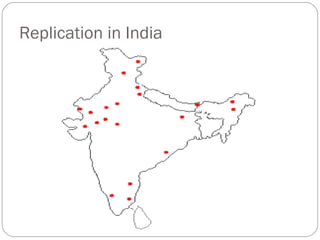
Replication in India
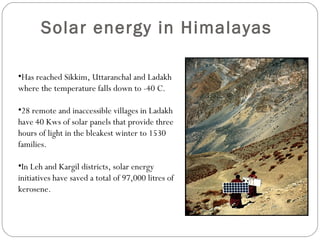
  Solar energy in Himalayas Has reached Sikkim, Uttaranchal and Ladakh where the temperature falls down to -40 C.  28 remote and inaccessible villages in Ladakh have 40 Kws of solar panels that provide three hours of light in the bleakest winter to 1530 families.  In Leh and Kargil districts, solar energy initiatives have saved a total of 97,000 litres of kerosene.
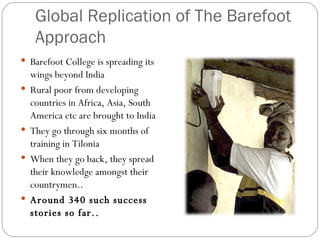
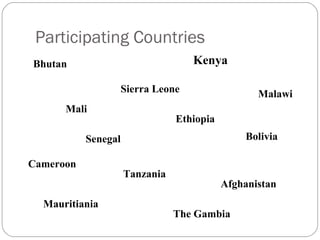
Global Replication of The Barefoot Approach Barefoot College is spreading its wings beyond India Rural poor from developing countries in Africa, Asia, South America etc are brought to India They go through six months of training in Tilonia When they go back, they spread their knowledge amongst their countrymen.. Around 340 such success stories so far..
Bhutan Afghanistan Mali Sierra   Leone Kenya Senegal Ethiopia Bolivia Cameroon The Gambia Tanzania Mauritiania Participating Countries Malawi
Sponsors: UNDP Asian Development Bank Skoll Foundation Barefoot also finances the project using the Awards it receives The course is a unique combination of modern science and age-old community wisdom Training is given in: solar engineering, rain-water harvesting, etc. Friends of Tilonia  is a US-based non-profit organization providing marketing and business development assistance to the local crafts and works using the power of Internet  Initiatives  Taken to Spread Awareness Move towards non-traditional communications channels like Internet Videos and photography Participation in international networks and meetings
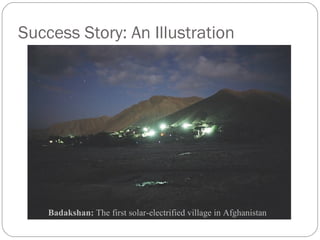
Few Success Stories… In Afghanistan Five remote Afghani villages selected 10 representatives They were trained to become Barefoot Solar Engineers in India  The BSEs, back at home, purchased and transported solar panels to solar electrify the villages for five years All for less than the cost of hiring one UN or World Bank Consultant in Kabul for one year In Gambia The women BSEs, after training, have installed solar power systems in two villages Constructed rooftop rainwater harvesting systems in five schools to provide clean drinking water  The BSEs are paid by the community to maintain these systems In Morocco Ten years ago, three sheep farmers from the village  of Agrisewal near Marrakech in Morocco came to Tilonia In six months, using only sign language, they became barefoot solar engineers Installed 100 solar units in the Himalayas in India, and then went back home.
Success Story: An Illustration Badakshan:  The first solar-electrified village in Afghanistan
Awards & Accolades Awards won by Barefoot: Alcan Prize for Sustainability‘, 2006 (The biggest prize in this category)‏ Ashden Award or ‘Green Oscars’ for Community Welfare Skoll Awards for Social  entrepreneurship ($615,000 over three years to replicate village-directed development and water supply programs), 2005 The Tyler Prize for Environmental Achievement, 2004 ESCAP (Economic and Social Commission for Asia and the Pacific) for exemplary achievement in HRD, 1996 Awards won by Bunker Roy: L-RAMP Lifetime achievement award (Lemelson Recognition and Mentoring  Programme)‏ The Aga Khan Award The World Technology Award for Social Entrepreneurship The Schwab Foundation for Social Entrepreneurs Award
“ First they ignore you, then they laugh at you, then they fight you, then you win.”

09 Barefoot

  • 1.
  • 2.
    This is thestory of ordinary people who have made extraordinary things possible…
  • 3.
    This is thestory of a quaint little village in the land of drought and color….Rajasthan..
  • 4.
    A village wherethe poorest of the poor lived…
  • 5.
    A village thathad been left behind and forgotten as India surged forward…..
  • 6.
    When darkness fellvirtually everything had to come to a halt – work, reading, cooking – because the village had no electricity
  • 7.
    The people were“unemployable” and “unqualified”…. Completely dependent on the vagaries of fate….
  • 8.
    And then camea man…..
  • 9.
    Sanjit Bunker RoyBorn in Burnpur, Bengal in 1945 Elite Education Deeply affected by the Bihar famine in the 1960s The Code of Conduct debate Founded the Barefoot College (Social Work and Research Centre) in Tilonia, Rajasthan in 1972
  • 10.
    His Philosophy GandhianPrinciples: Deeply influenced by Mahatma Gandhi and his philosophy Sustainable development Self-government Non violence
  • 11.
    A New Approachto Social Work Before Bunker Roy Elitist Perception that only the educated urban people could ‘uplift the poor’ Paper qualifications more important than actual skills An external approach rather than internal Reliance on government intervention and big foreign aid packages Bunker Roy’s Approach More pragmatic ‘ Dirty Hands’ approach Tied directly to action Believed in education as the key strategy But not necessarily degree-based The key to alleviating rural poverty lies within communities themselves
  • 12.
    “ How isit possible that some people live in such penury – and we go through the best of education but don’t give anything back?”
  • 13.
  • 14.
    “ To servethe basic learning needs of all requires more than a recommitment to basic education as it now exists. What is needed is an “expanded vision” that surpasses […] conventional delivery systems while building on the best in current practices” WORLD DECLARATION ON EDUCATION FOR ALL (Article 2)‏
  • 15.
    Predecessors of themovement Mao Zedong's “Barefoot Doctors” John F Kennedy's US Peace Corps Gandhian philosophy
  • 16.
    The Beginning Startedas the Social Work and Research Centre (SWRC) in Tilonia in 1972 45 acres of government land and an abandoned tuberculosis sanatorium leased at 1 Re per month! Joint venture with specialists and local villagers The ideology shift from urban specialist assistance to rural self-sufficiency
  • 17.
    Problems that SWRC/ Barefoot sought to address Lack of professionalization and rural focus Lack of accessibility Poor dissemination of information Dependency Absence of institution support
  • 18.
    The Concept ofBarefoot College Why Barefoot College? SWRC started going by the name Barefoot College in the early ‘80’s Millions of people in India live and work barefoot! Title also used as a symbol of respect for the knowledge that the poor have
  • 19.
    How It WorksSelection: Takes men, women and children Illiterate and semi-literate From the lowest castes From the most remote and inaccessible villages in India
  • 20.
    Training: Trains themat their own pace to become “Barefoot”.. Water Engineers Solar Engineers Architects Teachers Communicators Pathologists, midwives, IT workers, accountants, Marketing Managers…
  • 21.
    Once trained, thesevillagers work within their own communities Thus they become less dependent on “outside” skills The teacher is the learner and learner the teacher! Propagation:
  • 22.
  • 23.
    Barefoot Campus andStructure The “loose” structure as a strength Definite lines of authority such as the Director and the section leader but a conscious attempt to avoid hierarchies in decision making and salaries Monthly meetings between the section leaders, the field centre coordinator and the Director Accounts Department oversees finance, supported by senior staff who are responsible for funding requests and reports The old and new campuses and the 8 field centres : greater decentralization into villages
  • 24.
    The Barefoot Codeof Conduct Live and work in close proximity with the rural community Create a space for creative and constructive personal growth - not discriminating against caste, religion or political thinking Ensure gender equality within the organisation Have an intrinsic belief in the democratic political process and not follow partisan political agendas or include partisan politicians on the board Judge the worth of people by their willingness and ability to learn - not by their paper qualifications
  • 25.
    The Barefoot Codeof Conduct Believe in the law of the land and have a commitment towards social justice through non-violent means Have respect for collective, traditional knowledge, beliefs, wisdom and practices of the community Be committed to the preservation of natural resources and not endorse processes that destroy, exploit or abuse natural resources Use appropriate technologies that sustain the community and not encourage technologies that deprive people of their livelihoods Set a personal example in adhering to the code of conduct
  • 26.
    Sectors of WorkAccess to drinking water, groundwater management and rain water harvesting Education Medical care Women's programmes Agricultural extension Rural industry Appropriate technology Animal husbandry Communication and use of traditional media
  • 27.
    The Barefoot Principles:A Yardstick of the success of the movement Equality: The program treats all members as equal, regardless of sex, class, education, or caste Collectivity: Collective decision-making practiced by one and all. Self reliance: Members are helped to work together to develop the community. Decentralization: The program is committed to local decision-making, and grassroots level. Austerity: The staff members lead a simple life committed to generating a close community and a stimulating, creative environment.
  • 28.
    Barefoot VS Traditional Approach Approach Pressure to change system is applied from below – those who are affected: self-sufficiency Integrated approach covering multiple sectors Emphasis on no profit no loss with fulfillment of social responsibilities Pressure to change system is applied from outside or above – outsiders who are not directly affected Sectoral Approach Emphasis on either external donations/ charity or profit focus
  • 29.
    Actually live andwork in villages – has a much greater impact Evolutionary approach Does not fall into any category of organization with respect to ideals, beliefs, etc – is not “straitjacketed” by the above – it uses best facts of all types Live in cities but work in villages – has a limited impact Project based, pre-planned approach Could be limited in approach if categorized or falls into a certain category of idealistic organization such as Gandhian, Marxist, Sarvodaya, etc Barefoot VS Traditional Approach Approach
  • 30.
    DIFFERENT FACES OFA REVOLUTION
  • 31.
    Education System “ Never let school interfere with your education” Illiteracy is NOT a barrier to the rural poor developing themselves with skills of their own Means for creating self-esteem and appropriate skills Arouse awareness about the environment and the forces that dominate development Literacy and numeracy are part of this course but are not the central goals Expertise through hands on experience in training programs and through the informal learning of rural life Achieving skills that guarantee the sustainable development of rural communities
  • 32.
    Bunker Roy onEducation Systems… “ Encourage private initiative without commercializing education. Give private initiative more responsibility, more space, more freedom” “ In Tilonia, education and development are inextricably linked. Youth are trained to use technologies that serve their communities while children learn about environmental themes such as solar electricity, which is used in most of their schools”
  • 33.
    Formal Education Onlyprepare children for government and professional employment Language Barrier Seek individual prosperity and move away from community People with the baggage of formal education can be harmful in the village as they often look down on the poor "It destroys initiative and creativity. It expects you to do everything the way they say, the way they do," "I advise people to get a functional education, enough reading and writing not to get tricked by the money lender and then come back to the village."
  • 34.
    Focus on CommunityOpinion Assessment of community need and understanding of education. Night school teachers, day care teachers, midwives and village education committees define what rural communities need to sustain Information regarding government programmes and legal literacy Collective problem resolution – to form sustainable communities and pressure groups to influence policies A way to avoid exploitation by literate To discuss environment and development issues, every year 2500 teachers’ meetings, 600 rural parent’s meetings, and 1,250 village education meetings are called.
  • 35.
    Means Night Schoolsfor children Day Schools Pre-Schools Children’s Parliament Training Barefoot Teachers Training and Supervision Toy Workshop
  • 36.
    Methodology Use offolklore, songs, puppetry and theater in classes, training and learning groups Associating with the traditional learning patterns of their environment Philosophy in which everyone is a learner and a teacher. There is no give and take – only sharing Although written manuals are limited, there is a sharing of information between those with traditional knowledge and those who are ‘professionals’ which has made the village a self-reliant, sustainable unit The College has helped to facilitate a revival of people’s technologies that are tried, tested and approved by communities and applied them on a wide scale to solve problems
  • 37.
    Methodology Local staffsuch as the Balsevikas (women who run the day care programmes) and the night school teachers do indeed come from the villages where they work The training sessions bring together local midwives, day care workers and night school teachers. They share education and health information for all three sectors and ensure a coherence of philosophy between the sections. Once a mother brings in a child to the day care centre, staff attempt to build on her interest in the child’s health and education tackling issues of nutrition hearth care and women rights
  • 38.
    Implementation Emphasis onenvironment Students are taught the value of wasteland development and the destructive effect of cutting down trees for fuel and fodder Imparting educational process that refers to agriculture, animal husbandry and the daily activities that go on in a village Curriculum Language (Hindi), Arithmetic, Social Studies, Science, Geography and Environment Class 1 & 2 Idea of reading and writing Hindi Simple addition subtraction and multiplication Class 3 Letter to words and words to sentences Information on household, self government and casteism
  • 39.
    Implementation Class 4& 5 Geographic knowledge of district and village Socio – Political structure of the country Local fairs, festivals, traditional stories Social and Political thinkers and famous personalities Rabia, Kharif and pulse crops, fertilizers and cultivation of cereals and pulses. Vocational Training – Carpentry, sewing, cement block making, motor winding etc. Children’s Parliament Value of recognizing good candidate on their own merit Responsibility and power More actively involved in the running of their schools An innovative step to better child-empowerment
  • 40.
    Challenges and InnovationsInfrastructure – Government day school buildings, community centers in village, teachers houses Rescheduling of schools to meet the times of rural children and teachers drawn from surrounding communities The VEC and night school teachers talk to parents who are not sending their children to school and do their best to persuade them Night school teachers are local residents who have generally completed their 8 th grade Annual training for 15 days Continuous motivation exercises to instill a spirit of voluntarism
  • 41.
    Statistics 60% ofnight school students are girls Over 3,000 drop-out children comprising 1,200 boys and 1,800 girls attend 150 night schools in 150 villages. 100 per cent attendance of children who have dropped out (of formal education) Each night more than 4,000 children who tend cattle by day attend night classes with barefoot teachers in education centers lit by solar powered lanterns built and installed by barefoot engineers
  • 42.
    Solar Energy: OpportunityUtilized.. Follows the combined approach to community participation through skills training and technology demystification Solar Electronics Workshop - Located at Barefoot College, Tilonia This centre prepares “barefoot engineers” ,men and women from poor rural backgrounds, who spend six months training here The program combines 21st century science with traditional knowledge to teach the construction, installation, and maintenance of Home lighting systems Solar lanterns Solar Cookers All solar panels have been installed, maintained and repaired by the village people without the assistance of any paper qualified engineer. These BSEs in turn impart the same knowledge and expertise to others.
  • 43.
    Faces of theMovement Gulab Devi (45) of Harmara Village in Rajasthan She is the sole bread-earner for her four children and her ailing husband She is completely illiterate She makes electronic circuits and chargers for solar lighting panels for a living Ritma Bharti of Bihar She underwent training with her 2yr old in tow Came back with 80 solar lanterns and lit 40 schools Now she trains others in her village
  • 44.
    Impact..a few numbersThe Barefoot College is fully solar operated, the first of its kind Solar electrifying 300 adult education centres & 900 schools 400 rural youth including women trained as barefoot solar engineers with absolutely no aid from urban professionals 574 villages and hamlets(clusters) have been covered where a total number of 12000 households have been solar electrified. 195,000 litres of kersoene saved, by replacing generators and oil lanterns with solar power.
  • 45.
    Water Barefoot Approachconsists of Ground water surveys Installation of hand pumps by Barefoot engineers and mechanics Rainwater Harvesting Piped water systems Safe drinking water is being provided for the first time through 67 hand pumps at a height of 15,000 ft in Ladakh in Jammu and Kashmir Village barefoot engineers, who have barely passed primary school, have planned and implemented water supply schemes in 13 villages, benefiting 19,000 people
  • 46.
    Rainwater Harvesting Involvescollection of rainwater falling on existing open wells and tanks and reservoirs Community members come together and contribute labour and materials to construct these storage tanks Such water has been tested and found to be safe for human consumption Rooftop Rainwater Harvesting Catching rainwater where it falls using the rooftops of schools and other buildings Channeling it into underground leak-proof tanks made of locally available, low-cost materials These structures are managed, controlled and owned by Village Water Communities
  • 47.
    Impact Reduced dependenceon external expertise and material More cost effective than solutions based on underground water/other sources At Rs. 2-3 /litre one can collect and store 100,000 litres of rainwater Water availability helps in regular attendance at schools In India, around 1,000 RRWH structures have been built in 17 states, with a total storage capacity of 47 million litres serving over 220,000 children in remote rural communities In brackish water areas 320 rural primary schools have harvested 18 million litres of rain water through traditional rain water harvesting techniques To access potable water and protect communities from water borne diseases in 78 villages in 8 states, a total of 1,374 samples were tested by barefoot water chemists
  • 48.
    Hand Pumps Identificationof sites by ground water surveys Convenience for women is given prime importance Responsibility for maintenance is in the hands of each village Training is given to village youth to be Barefoot Mechanics
  • 49.
    Impact Community participationbuilds self-reliance Installation of around 1,800 hand pumps as an environmental option to save precious ground water pumped from 150-200 ft. below the ground Over 350,000 people use these hand pumps, thereby, accessing clean and safe drinking water. For the first time in history, safe drinking water is being provided through 67 hand pumps, at a height of 15,000 ft in Ladakh, in J&K. Hand pumps are working at temperatures of – 40C. The government engineers said this was technically impossible to accomplish.
  • 50.
    Communication Media AudioVisual, Puppetry , Street Theatre, Screen Printing – to communicate with the rural poor More than 2,750 barefoot communicators have been trained to produce puppet shows to communicate with semi-literate audiences on issues of health, education, human rights, casteism, discrimination, against women, environmental degradation etc. Barefoot printers run the College's silk screen printing presses. They produce posters on health, education and other social issues, announcements and pamphlets for Balmelas, Mahilamelas, and educational material for the night schools. Barefoot photographers and audiovisual technicians produce and manage slides and photographs, and over 600 audio and video cassettes The first environmental walk in the history of the State of Rajasthan was organized through 64 villages
  • 51.
    Community Health TrainBarefoot doctors, healthcare workers and upgrade skills of mid-wives Teachers and other workers are also given basic healthcare training Emphasis on preventive medicine through Pre and post natal care Immunization Education programs Family planning camps Emphasis on bio-chemical medicine and homeopathy because of less side effects and to reduce dependence on pharmaceutical industry Ensure consumption of clean drinking water through water testing Outpatient dispensaries conduct eye camps, cater to TB patients and general healthcare
  • 52.
    “ Poor andFemale, but Smart!” WOMEN’S GROUPS/ MAHILA SAMITI Address policy issues regarding development needs, rights and injustices Form pressure groups to struggle against injustices: eg. Min. wages Has helped in breaking the age old purdah-system and make women join the mainstream Organise awareness camps to educate on women’s rights, health, hygiene, legal literacy and build self-esteem Discuss women’s personal problems and possible solutions
  • 53.
    Women’s Groups MahilaMelas (Women’s fairs)‏ Bring women together Celebrate their accomplishments Encourage formation of new groups Employment Generation Trained in healthcare, hand pump mechanics and BSEs
  • 54.
    Social Forestry, Agricultureand Animal Husbandry Social Forestry Development of wasteland with drought resistant trees, shrubs and grasses They also provide fuel, fodder and shade Scarce wood is often used as building material in the desert These programs are run by Village Communities Helps in combating desertification Has converted more than 500 hectares of desert into pasture lands Animal Husbandry Goat and sheep farmers are assisted in better animal management Work towards fodder resource development in wastelands
  • 55.
    Social Forestry, Agricultureand Animal Husbandry` Agriculture Emphasis on growing fruit-bearing trees and vegetables Organic Farming Two field centres have land to demonstrate agriculture techniques Dairy Unit Animal Breeding Centres
  • 56.
    Rural Industries CraftIndustry The works involve Applique Block Printing Weaving Embroidery Furniture
  • 57.
    Crafts Barefoot Collegehas helped them revive the art by Assisting in improving designs and techniques Creation of marketing outlets Access to credit Marketing of the craftworks Bridgehead A fair trade organisation affiliated with OXFAM-Canada Tilonia An online store supported by a US NGO – ‘Friends of Tilonia’ Traidcraft A leading UK fair trade organisation
  • 58.
    Impact Allow womento work in the present constraints like purdah and stay-at-home More than 300 women have supplemented their income General health awareness, family planning and participation in the local political institutions are part of their training & education which promotes their well-being The marketing channels have provided great coverage and media attention
  • 59.
    Rural Industries SolarSupports Stands and battery boxes for the solar section Doors and Windows Emphasis on usage of metal than wood and glass Geodesic Domes (Buckminster Fuller Design)‏ Constructed with easily available scrap material as opposed to expensive wood The roof can carry much more weight of thatch More durable Can be easily dismantled and carried in a knapsack; ideal for emergency relief housing
  • 60.
    "We keep gettingthese reports from the World Bank that no one reads, so we decided to put them to some use," founder Bunker Roy says.
  • 61.
    Recycling Waste paperfrom the library are recycled to make glove puppets for village theatres. Waste leaves are used in the biomass plants to produce gas for lighting, and in the pathology laboratory Fertilizers are prepared from manure which are used in organic farming
  • 62.
  • 63.
    Funding Funding Model30% through Government sources 40% through foreign agencies 30% through the installation of solar power packs and the sale of handicraft items The Barefoot College has received funds from: The Government of India Plan International Hivos (Netherlands)‏ German Agro Action (Bonn)‏ The European Commission UNESCO Paris
  • 64.
    Other Sources ofFunds The Barefoot approach to solar electrification of villages has been officially endorsed by the Indian Ministry of Non-Conventional Energy Sources (MNES), and by the Planning Commission of India. For the solar electrification of villages, the Barefoot College has received funds from The Ministry of Non-Conventional Energy Source, MNES The European Union The United Nations Development Programme (5 years' support from January 2003)‏ The Indian Department of Rural Development's CAPART programme The State Governments of Sikkim, Jammu & Kashmir, and Rajasthan Money from these sources is being used to cover the capital costs of solar equipment and project running costs. The monthly contributions are used to cover the cost of repair and maintenance Money from the Ashden Award was to be used in setting up training centres for BSEs in Ladakh, and in Jammu & Kashmir
  • 65.
    Strengths People Centric Addresses multiple issues and sectors Use of Technology- Simple and kept in league with local demands Cost Effective – Costs are efficient and effective with only 8 percent of the costs being utilized as administrative expenditure Transformation of mindset and attitude of the people Disadvantages such as illiteracy, language barriers, lack of infrastructural facilities have been converted into advantage People at the grass root level have been made aware about their rights and duties Focus on women, gender equity within the organization
  • 66.
    Strengths People Centric Addresses multiple issues and sectors Simple technology – suited to local demands Cost Effective - Only 8 percent of the costs being utilized as administrative expenditure Transformation of mindset and attitude of the people: Awareness of their rights and capabilities Disadvantages such as illiteracy, language barriers, lack of infrastructural facilities have been converted into advantage Focus on women, gender equity within the organization
  • 67.
    Strengths (cont): Values and Ethics: Social audit workshops bring in honesty, transparency and accountability The organization lives and works in close proximity with the rural community bringing in bonding among the community members Collective decision making process Self-sufficient in terms of expertise on education and development, solar power etc. Environmentally friendly in terms of energy, water and waste management
  • 68.
    Opportunities Opportunities forreplication in other countries Great opportunity for rural women Promotion of rural artisans and small scale handicrafts Child Parliament: A better understanding of societal issues would make the Village Panchayat also stronger Promotion of sustainable technologies to other areas
  • 69.
    Weaknesses and ThreatsExternal dependency: The project still is dependent for 70 percent of its resources from the outside world. Problems with international replication: Passport/Visa clearance, funding issues, foreign agencies, etc. Societal pressures: Women’s status, the caste system, etc.
  • 70.
    Replication Has fewwritten manuals Believes in hands on experience Training for everyone Informal structure No one is an expert simply people with more experienced Volunteers can work on a number of areas Barefoot college is a process, some of its essential elements being intangible
  • 71.
    Shiksha Karmi Educationinitiative to revitalize and expand primary education in remote villages in Rajasthan “ An agent of change, especially in the field of education, can work effectively only if he or she belongs to the same locality” Started with the assistance of Swedish International Development Agency(SIDA)‏ Identification of rural youth along with SWRC, village education committee ,field centre workers and the community 70% of the learning related to local environment Teachers are free to conceive their own books, songs and games to initiate the education process Use models made by the night schools
  • 72.
    Lok Jumbish Literallymeans people’s movement Objective: “education for all by 2000 by people’s mobilization and participation” Universalizing primary education Joint initiative of SIDA, Government of India and Government of Rajasthan Provision for opportunity to use and upgrade the education - Improving the content and process of education Making education an instrument for women’s equality Enabling the lowest castes and poorest sections of the society to equally participate in basic education Implemented by voluntary agencies taking care of a cluster of villages
  • 73.
    What Happened After2000? Crisis when SIDA pulled out after the Pokharan Tests Britain stepped in with a grant aid Muslim children specially girls received formal education along with religious education Delay in switching over these schools to DPEP(District Primary Education Programme)‏ Therefore got an extension of lease
  • 74.
    Initiation of aStart-up The Centre in Tilonia helps a person to set up a new sub-centre in the following ways: Funds are provided to (a) visit the village/site/state to decide on the location, (b) prepare a project proposal and rough time plan (c) identify people from the area to be trained in Tilonia (d) meet government officials and seek their support Funds are provided for one year to help the project take off Eventually the sub-centre is persuaded to acquire a legal identity of its own and to adopt a name of its choice (not SWRC)‏ This has now happened for several sub-centres.
  • 75.
  • 76.
    Solarenergy in Himalayas Has reached Sikkim, Uttaranchal and Ladakh where the temperature falls down to -40 C. 28 remote and inaccessible villages in Ladakh have 40 Kws of solar panels that provide three hours of light in the bleakest winter to 1530 families. In Leh and Kargil districts, solar energy initiatives have saved a total of 97,000 litres of kerosene.
  • 77.
    Global Replication ofThe Barefoot Approach Barefoot College is spreading its wings beyond India Rural poor from developing countries in Africa, Asia, South America etc are brought to India They go through six months of training in Tilonia When they go back, they spread their knowledge amongst their countrymen.. Around 340 such success stories so far..
  • 78.
    Bhutan Afghanistan MaliSierra Leone Kenya Senegal Ethiopia Bolivia Cameroon The Gambia Tanzania Mauritiania Participating Countries Malawi
  • 79.
    Sponsors: UNDP AsianDevelopment Bank Skoll Foundation Barefoot also finances the project using the Awards it receives The course is a unique combination of modern science and age-old community wisdom Training is given in: solar engineering, rain-water harvesting, etc. Friends of Tilonia is a US-based non-profit organization providing marketing and business development assistance to the local crafts and works using the power of Internet Initiatives Taken to Spread Awareness Move towards non-traditional communications channels like Internet Videos and photography Participation in international networks and meetings
  • 80.
    Few Success Stories…In Afghanistan Five remote Afghani villages selected 10 representatives They were trained to become Barefoot Solar Engineers in India The BSEs, back at home, purchased and transported solar panels to solar electrify the villages for five years All for less than the cost of hiring one UN or World Bank Consultant in Kabul for one year In Gambia The women BSEs, after training, have installed solar power systems in two villages Constructed rooftop rainwater harvesting systems in five schools to provide clean drinking water The BSEs are paid by the community to maintain these systems In Morocco Ten years ago, three sheep farmers from the village of Agrisewal near Marrakech in Morocco came to Tilonia In six months, using only sign language, they became barefoot solar engineers Installed 100 solar units in the Himalayas in India, and then went back home.
  • 81.
    Success Story: AnIllustration Badakshan: The first solar-electrified village in Afghanistan
  • 82.
    Awards & AccoladesAwards won by Barefoot: Alcan Prize for Sustainability‘, 2006 (The biggest prize in this category)‏ Ashden Award or ‘Green Oscars’ for Community Welfare Skoll Awards for Social entrepreneurship ($615,000 over three years to replicate village-directed development and water supply programs), 2005 The Tyler Prize for Environmental Achievement, 2004 ESCAP (Economic and Social Commission for Asia and the Pacific) for exemplary achievement in HRD, 1996 Awards won by Bunker Roy: L-RAMP Lifetime achievement award (Lemelson Recognition and Mentoring Programme)‏ The Aga Khan Award The World Technology Award for Social Entrepreneurship The Schwab Foundation for Social Entrepreneurs Award
  • 83.
    “ First theyignore you, then they laugh at you, then they fight you, then you win.”