URBAN STUDY
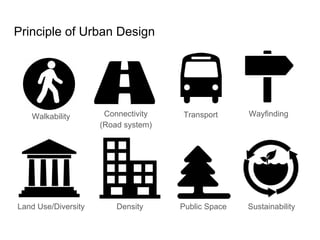
Principle of Urban Design
Public Space
Walkability Connectivity
(Road system)
Density
WayfindingTransport
Land Use/Diversity Sustainability
WALKABILITY
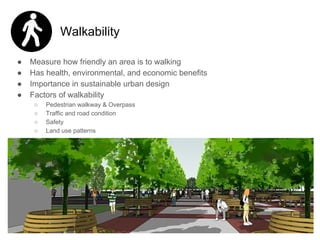
Walkability
● Measure how friendly an area is to walking
● Has health, environmental, and economic benefits
● Importance in sustainable urban design
● Factors of walkability
○ Pedestrian walkway & Overpass
○ Traffic and road condition
○ Safety
○ Land use patterns
Apple Campus, Norman Foster, California
The best way to experience
a city is through
WALKING
CONNECTIVITY
Connectivity / Road system
● Hierarchy road system
○ Hierarchy - arrangement, big to small
○ Primary (highest number of lanes), Secondary, Tertiary
(smallest number of lanes), service road
TRANSPORT
Transport
● Move people from one place to another
● Issues = Overflow of personal vehicles
○ Traffic jams
○ Insufficient parking lot
○ Threat for pedestrians
● Solution = Public Transport
○ KTM
○ LRT
○ Monorail
○ Bus
○ Taxi
● Sustainable and Healthy Solution
○ Create walkable city
○ Bicycles
WAYFINDING
Wayfinding
● Guide people through the space
○ Signage - Clearly indicate the direction
○ Landmarks - As a reference point, something outstanding in the area, e.g Main Place
○ E.g shopping malls, school, city, etc
● Important especially in emergency situation, such as in Hospital
● Contribute sense of well-being, safety and security
LAND USE / DIVERSITY
● Go to state JUPEM e.g Pulau
Pinang for our site
● Buy the map for RM 10.00
● Requires lot number, address or
landmark of the area
Land Use/Diversity
● Different category of land usage
● Jabatan Ukur dan Pemetaan
Malaysia (JUPEM)
● E.g of land usage
○ Residential
○ Commercial
○ Educational
○ Industrial
○ Institutional
○ Etc
Land Usage / Diversity
● Affects the flow of people, economy of business
● Example;
○ Industrial area will be full of factory workers
○ Commercial area will be less people at night since all shops closed at 10pm
○ Tourism area will always full of tourist especially on school holiday season
○ Residential area will be more peaceful compares to commercial area
● Affects density
DENSITY
Density
● Variety of measurement
○ Residential density - the number of dwelling/housing units in an area
○ Population density - the number of human persons in an area
○ Employment density - the number of jobs in any given area
● Influenced by the type of buildings and activities in the area
Different street in Melaka
Shibuya Crossing, Japan
High Density
Good or Bad??
PUBLIC SPACE
Public Space
● Open spaces that is accessible by public
● From a grand plaza to a green pocket in a neighbourhood
● Increase quality of life - social aspects
● Focal points or landmark, easy wayfinding
● E.g Recreational parks, plaza
Central Park, New York
KLCC Park, Kuala Lumpur
High Line, New York
Superkilen, Copenhagen
Public Swimming pool, Bucharest
SUSTAINABILITY
● Less vehicle, More Walking and Cycling
○ Reduce air and noise pollution
● More Green, less Grey
○ Vegetation
○ Supply fresh oxygen
○ Filter polluted air
● Provide healthy lifestyle
● Zero-carbon city
○ Renewable source
○ No carbon emission from vehicles
● Permeable city
○ Water can go through into the soil
○ Reduce chances of flooding
Sustainability
Air pollution in Shanghai
Designers shape the city,
The city shape the people,
Designers shape the people.
http://www.slideshare.net/shoebjafri/urban-design-principles
http://www.slideshare.net/NeoAngala/elements-of-urban-design
http://www.slideshare.net/russellowell/elements-of-urban-design-45263963
https://segd.org/what-wayfinding
https://en.wikipedia.org/wiki/Urban_density
http://www.who.int/healthy_settings/types/cities/en/
http://www.cityam.com/213160/world-health-day-2015-these-are-worlds-healthiest-cities-live
https://en.wikipedia.org/wiki/Zero-carbon_city
Reference

Urban study