Dialog Programming Overview
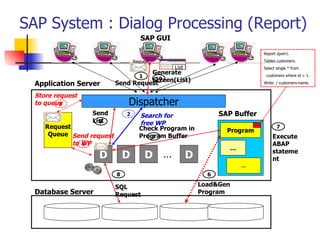
SAP System : Dialog Processing (Report)
                                      SAP GUI

                                                                              Report zpsm1.

                                   Request                                    Tables customers.
                                                List                          Select single * from
                                     Generate
                                  1   10
                                                                               customers where id = 1.
                                     Screen(List)
  Application Server       Send Request                                       Write: / customers-name.


  Store request
  to queue3                    Dispatcher
                  Send         2     Search for                  SAP Buffer
                  List
                    9                free WP
     Request                         Check Program in                                7
                                                                   Program
      Queue Send request             Program Buffer
                                         5                                        Execute
             to WP
                4                                                                 ABAP
                                                                   …
                    D          D        D …            D                          stateme
                                                                                  nt
                                                                       …

                           8                                 6

                           SQL                             Load&Gen
  Database Server          Request                         Program
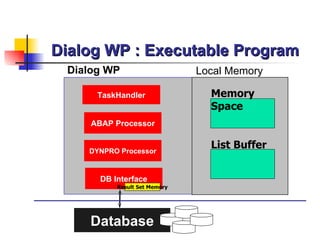
Dialog WP : Executable Program
 Dialog WP                     Local Memory

      TaskHandler                Memory
                                 Space
     ABAP Processor


    DYNPRO Processor
                                 List Buffer


       DB Interface
           Result Set Memory


    Database
Types of ABAP Report

1


                     3


                 1. Report Listing
     4           2. Drill-down Report
                 3. Control-break Report
                 4. ALV Report
SAP System : Dialog Processing (DIALOG)
                                      SAP GUI

                                                                            Program sapmzex001.

                                   Request                                  Include ….
                                                Screen                      Set screen 100.
                                     Generate Dialog
                                  1   10
                                                                            …
                                     Screen
  Application Server       Send Request

  Store request
  to queue3                    Dispatcher
                  Send         2     Search for                SAP Buffer
                  List
                    9                free WP
     Request                         Check Program in                             7
                                                                 Program
      Queue Send request             Program Buffer
                                         5                                      Execute
             to WP
                4                                                               ABAP
                                                                 …
                    D          D        D …         D                           stateme
                                                                                nt
                                                                     …

                           8                               6

                           SQL                           Load&Gen
  Database Server          Request                       Program
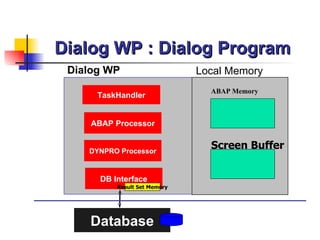
Dialog WP : Dialog Program
 Dialog WP                     Local Memory
                                 ABAP Memory
      TaskHandler


     ABAP Processor


    DYNPRO Processor
                                 Screen Buffer


       DB Interface
           Result Set Memory


    Database
Dialog Program : Transaction
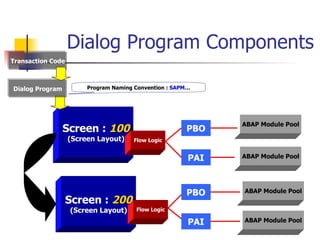
Dialog Program Components
Transaction Code


Dialog Program          Program Naming Convention : SAPM…


                                                              ABAP Module Pool
                 Screen : 100                          PBO
                   (Screen Layout)    Flow Logic


                                                        PAI   ABAP Module Pool


                                                       PBO    ABAP Module Pool
                   Screen : 200
                   (Screen Layout)     Flow Logic

                                                        PAI   ABAP Module Pool
SAP Transaction
                      DB Commit             DB Commit


   An SAP transaction consists of Dialog steps. A Dialog step
    begins when the user press Enter,activates a function by
    pressing a function key,double-clicks or chooses a function from
    a menu.It ends when the next screen is display
   In the course of a Dialog step,The PAI modules belonging to the
    current screen and the PBO modules belonging to the next
    screen
Data Transfer (Local Memory)
                            Local Memory

Screen Work Area                           ABAP Work Area
ok_code

            Screen Buffer
                                             ABAP Memory Space
                                PBO
    Element List

                                              customers

                                               id       name   city   …
  customers-id                                0000000


  customers-name
                                                 ok_code
                               PAI
Flow Logic
   Process Before Output(PBO)
       After it has processed all of the modules in the
        PBO processing block, the system copies the
        contents of the fields in the ABAP work area to
        their corresponding fields in the screen work area.

   Process After Input(PAI)
       Before it processes the first module in the PAI
        processing block, the system copies the contents
        of the fields in the screen work area to their
        corresponding fields in the ABAP work area.
OK Code Field in Screen

               OK Code Field or
                Command Field
           (ok_code in Element List)
Defining Screen (4 Steps)
   Screen Attribute
   Screen Layout
   Flow Logic                   Element
                              List(ok_code
   Element List                  field)
Flow Logic in Screen 100
PROCESS BEFORE OUTPUT.
 MODULE STATUS_0100.

PROCESS AFTER INPUT.
  MODULE USER_COMMAND_0100.
PBO in Screen 100

MODULE status_0100 OUTPUT.
 SET PF-STATUS ‘0100’.
  SET TITLEBAR ‘0100’.
ENDMODULE.
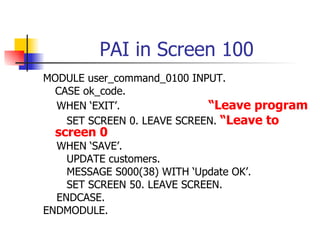
PAI in Screen 100
MODULE user_command_0100 INPUT.
  CASE ok_code.
  WHEN ‘EXIT’.               “Leave program
    SET SCREEN 0. LEAVE SCREEN. “Leave to
  screen 0
  WHEN ‘SAVE’.
    UPDATE customers.
    MESSAGE S000(38) WITH ‘Update OK’.
    SET SCREEN 50. LEAVE SCREEN.
  ENDCASE.
ENDMODULE.
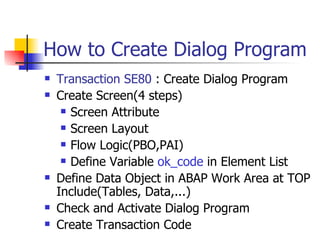
How to Create Dialog Program
   Transaction SE80 : Create Dialog Program
   Create Screen(4 steps)
      Screen Attribute

      Screen Layout

      Flow Logic(PBO,PAI)

      Define Variable ok_code in Element List

   Define Data Object in ABAP Work Area at TOP
    Include(Tables, Data,...)
   Check and Activate Dialog Program
   Create Transaction Code
Example I

               Maintain Customers Data
Screen : 100                 Screen : 200
Example I
   Create Dialog Program SAPMZEX<nn> for
    changing Customers table
      Screen 100

         Field customers-id

      Screen 200

         Field customers-id and customers-name
Example I
   Screen 100

    PROCESS BEFORE OUTPUT.
     MODULE STATUS_0100.

    PROCESS AFTER INPUT.
     MODULE USER_COMMAND_0100.
Example I
   Screen 100

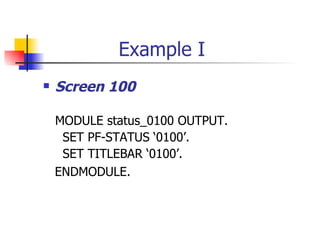
    MODULE status_0100 OUTPUT.
     SET PF-STATUS ‘0100’.
     SET TITLEBAR ‘0100’.
    ENDMODULE.
Example I
   Screen 100
    MODULE user_command_0100 INPUT.
     CASE ok_code.
      WHEN ‘BACK’.
       LEAVE PROGRAM. “leave to screen 0
      WHEN space. “if not assign Enter Key
       SELECT SINGLE * FROM customers
         WHERE id = customers-id.
       LEAVE TO SCREEN 200.
     ENDCASE.
    ENDMODULE.
Example I
   Screen 200

    PROCESS BEFORE OUTPUT.
     MODULE STATUS_0200.

    PROCESS AFTER INPUT.
     MODULE USER_COMMAND_0200.
Example I
   Screen 200

    MODULE status_0200 OUTPUT.
     SET PF-STATUS ‘0200’.
     SET TITLEBAR ‘0200’.
    ENDMODULE.
Example I
   Screen 200

MODULE user_command_0200 INPUT.
  CASE ok_code.
   WHEN ‘BACK’.
    LEAVE TO SCREEN 100. “set screen 100
   WHEN ‘SAVE’.
    UPDATE customers.
    MESSAGE S000(38) WITH ‘Update OK!’.
    LEAVE TO SCREEN 100.
  ENDCASE.
ENDMODULE.
Example I
   TOP Include
TABLES customers.
DATA ok_code TYPE sy-ucomm.
   Create Transaction Code
Transaction Code : ZEX<nn>
Exercise

Create Dialog Program : SAPMZCUST<nn>
     Transaction Code : ZCUST<nn>
Exercise : Customers Maintenance
Screen : 100             Screen : 200
Setting the Cursor Position Dynamically

PROCESS BEFORE OUTPUT.
 MODULE STATUS_0200.
 MODULE set_cursor.


MODULE set_cursor OUTPUT.
 SET CURSOR FIELD ‘CUSTOMERS-CITY’
    OFFSET 3.
ENDMODULE.
                                     Cursor Position
Avoiding the Unexpected
Processing Step of ok_code Field
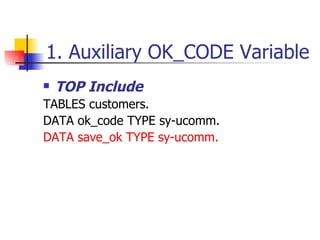
1. Auxiliary OK_CODE Variable
   TOP Include
TABLES customers.
DATA ok_code TYPE sy-ucomm.
DATA save_ok TYPE sy-ucomm.
Example I - Change
   Screen 100 : PAI
     MODULE user_command_0100 INPUT.
     save_ok = ok_code.
     CLEAR ok_code.
     CASE save_ok.
      WHEN ‘BACK’.
       LEAVE PROGRAM.
      WHEN space.
       SELECT SINGLE * FROM customers WHERE id = customers-id.
       LEAVE TO SCREEN 200.
     ENDCASE.
    ENDMODULE.
Example I - Change
    Screen 200 : PAI
     MODULE user_command_0200 INPUT.
     save_ok = ok_code.
     CLEAR ok_code.
     CASE save_ok.
      WHEN ‘BACK’.
       LEAVE TO SCREEN 100.
      WHEN space.
       LEAVE TO SCREEN 200.
      WHEN ‘SAVE’.
       UPDATE customers.
       MESSAGE s000(38) WITH ‘Update OK!’.
       LEAVE TO SCREEN 100.
     ENDCASE.
    ENDMODULE.
2. Specify the Enter Function at GUI Status
Check Enter Function
   Screen 100 : PAI
    MODULE user_command_0100 INPUT.
     CASE ok_code.
       WHEN ‘BACK’.
        LEAVE PROGRAM.
       WHEN ‘ENTE’.
        SELECT SINGLE * FROM customers
          WHERE id = customers-id.
        LEAVE TO SCREEN 200.
      ENDCASE.
    ENDMODULE.
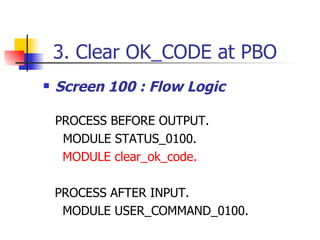
3. Clear OK_CODE at PBO
   Screen 100 : Flow Logic

    PROCESS BEFORE OUTPUT.
     MODULE STATUS_0100.
     MODULE clear_ok_code.

    PROCESS AFTER INPUT.
     MODULE USER_COMMAND_0100.
Clear OK_CODE at PBO
   Screen 100 : PBO
    MODULE status_0100 OUTPUT.
     SET PF-STATUS ‘0100’.
     SET TITLEBAR ‘0100’.
    ENDMODULE.

    MODULE clear_ok_code OUTPUT.
      CLEAR ok_code.
    ENDMODULE.
Checking User Input
Example II
Maintain Customers Data
 Check Input Data Manually
Example II
   Screen 100 : PAI
     MODULE user_command_0100 INPUT.
     ...
      WHEN SPACE.
         SELECT SINGLE * FROM customers WHERE id = customers-id.
         IF sy-subrc <> 0.
           MESSAGE S000(38) WITH ‘Customers data not found’.
           LEAVE TO SCREEN 100.
         ELSE.
           LEAVE TO SCREEN 200.
         ENDIF.
     ENDCASE.
    ENDMODULE.
Example III
Maintain Customers Data
 Check Input Data Using Field Command
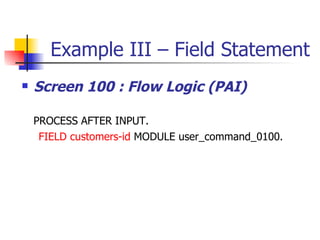
Example III – Field Statement
   Screen 100 : Flow Logic (PAI)

    PROCESS AFTER INPUT.
     FIELD customers-id MODULE user_command_0100.
Example III
   Screen 100 : PAI
     MODULE user_command_0100 INPUT.
     ...
      WHEN SPACE.
         SELECT SINGLE * FROM customers WHERE id = customers-id.
         IF sy-subrc <> 0.
           MESSAGE E000(38) WITH ‘Customers data not found’.
         ELSE.
           LEAVE TO SCREEN 200.
         ENDIF.
     ENDCASE.
    ENDMODULE.
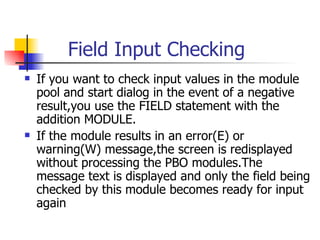
Field Input Checking
   If you want to check input values in the module
    pool and start dialog in the event of a negative
    result,you use the FIELD statement with the
    addition MODULE.
   If the module results in an error(E) or
    warning(W) message,the screen is redisplayed
    without processing the PBO modules.The
    message text is displayed and only the field being
    checked by this module becomes ready for input
    again
Field Statement With More Than 1 Field
     Screen 100 : Flow Logic (PAI)
      PROCESS AFTER INPUT.
       CHAIN.
        FIELD: customers-id,customers-custtype
              MODULE user_command_0100.
       ENDCHAIN.


PROCESS AFTER INPUT.
 CHAIN.
  FIELD customers-id MODULE user_command_0100.
  FIELD customers-custtype MODULE user_command_0100.
 ENDCHAIN.
Field Statement & Data Transport
       PROCESS AFTER INPUT.
        MODULE a.             •Transfer f3,f4
                              •Call module a
        FILED f1 MODULE b.    •Transfer f1
        FILED f2 MODULE c.    •Call module b
                              •Transfer f2
        MODULE d.             •Call module c
Screen 100                    •Call module d
  f1    f2

  f3     f4
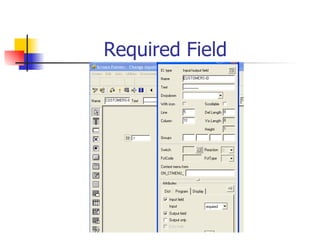
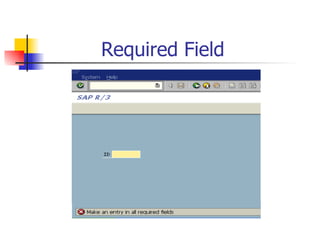
Required Field
Required Field
Required Field
At exit-command
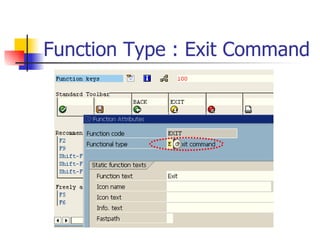
Function Type : Exit Command
At exit-command
    When user chooses a function with type
    E,the screen flow logic jumps directly to the
    following statement
        MODULE <module> AT EXIT-COMMAND
    No other screen fields are transported to the
    program except OK Code field
At exit-command
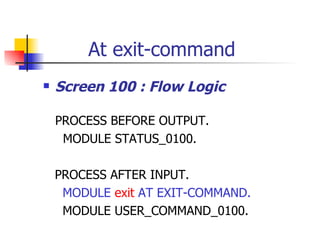
   Screen 100 : Flow Logic

    PROCESS BEFORE OUTPUT.
     MODULE STATUS_0100.

    PROCESS AFTER INPUT.
     MODULE exit AT EXIT-COMMAND.
     MODULE USER_COMMAND_0100.
At exit-command
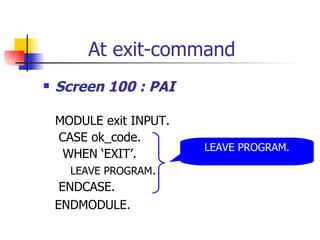
   Screen 100 : PAI

    MODULE exit INPUT.
     CASE ok_code.
                         LEAVE PROGRAM.
      WHEN ‘EXIT’.
       LEAVE PROGRAM.
     ENDCASE.
    ENDMODULE.
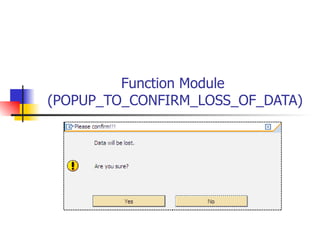
Function Module
(POPUP_TO_CONFIRM_LOSS_OF_DATA)
Example IV
Maintain Customer Data
 Popup confirmation data using function

    ‘POPUP_TO_CONFIRM_LOSS_OF_DATA’
Example IV
   TOP Include
    ...
    DATA ans.
Example IV
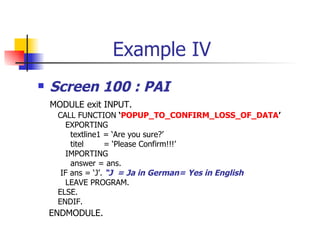
   Screen 100 : PAI
    MODULE exit INPUT.
     CALL FUNCTION ‘POPUP_TO_CONFIRM_LOSS_OF_DATA’
       EXPORTING
         textline1 = ‘Are you sure?’
         titel      = ‘Please Confirm!!!’
       IMPORTING
         answer = ans.
      IF ans = ‘J’. “J = Ja in German= Yes in English
       LEAVE PROGRAM.
     ELSE.
     ENDIF.
    ENDMODULE.
SAP Transaction : Enqueue Lock Object
SAP Transaction & DB Transaction
   Each Dialog step can contain update
    requests(INSERT,DELETE,UPDATE)
   After each Dialog step,the R/3 system
    automatically passes a database commit to the
    database system.The database system then
    distributes the update requests from the
    individual dialog steps across several database
    transactions
   A rollback in one Dialog step has no effect on
    database updates performed in previous Dialog
    steps
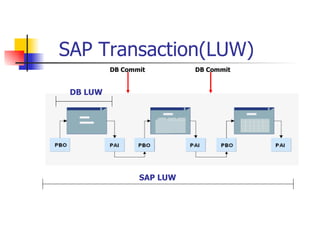
SAP Transaction(LUW)
          DB Commit        DB Commit


 DB LUW


                 SAP LUW
SAP Database Maintenance Steps
   Check data locking by calling function
    ‘ENQUEUE_<lock object>’
   Read data from Database Ex. Select single …
   Data Processing Ex. Update ...
   Release lock by calling function
    ‘DEQUEUE_<lock object>’
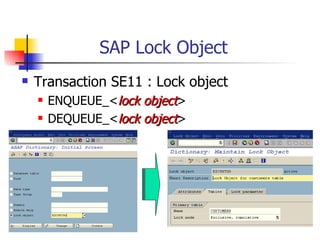
SAP Lock Object
   Transaction SE11 : Lock object
       ENQUEUE_<lock object>
       DEQUEUE_<lock object>
SAP Lock Object : Function Module
Example IV
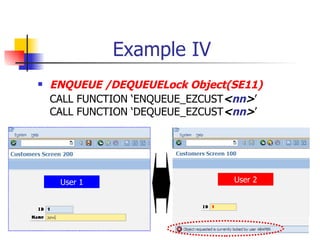
   ENQUEUE /DEQUEUELock Object(SE11)
    CALL FUNCTION ‘ENQUEUE_EZCUST<nn>’
    CALL FUNCTION ‘DEQUEUE_EZCUST<nn>’


     User 1                      User 2
Example IV (I)
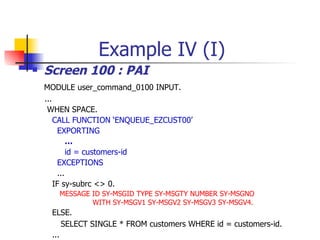
   Screen 100 : PAI
    MODULE user_command_0100 INPUT.
    ...
     WHEN SPACE.
        CALL FUNCTION ‘ENQUEUE_EZCUST00’
         EXPORTING
             …
             id = customers-id
         EXCEPTIONS
         ...
        IF sy-subrc <> 0.
       MESSAGE ID SY-MSGID TYPE SY-MSGTY NUMBER SY-MSGNO
               WITH SY-MSGV1 SY-MSGV2 SY-MSGV3 SY-MSGV4.
     ELSE.
         SELECT SINGLE * FROM customers WHERE id = customers-id.
     ...
Example IV (II)
   Screen 100 : PAI
    MODULE user_command_0100 INPUT.
    ...
     WHEN SPACE.
        CALL FUNCTION ‘ENQUEUE_EZCUST00’
          EXPORTING                      message id sy-msgid type
              id = customers-id          sy-msgty number
          ...                                       sy-msgno with sy-
        IF sy-subrc <> 0.                msgv1 sy-msgv2
            CONCATENATE ‘Data was locked by :’ sy-msgv1 INTO mess.
                                                    sy-msgv3 sy-
            MESSAGE E000(38) WITH mess. msgv4.
        ELSE.
            SELECT SINGLE * FROM customers WHERE id = customers-id.
        ...
Example IV
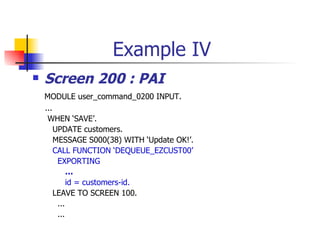
   Screen 200 : PAI
    MODULE user_command_0200 INPUT.
    ...
     WHEN ‘BACK’.
        CALL FUNCTION ‘DEQUEUE_EZCUST00’
          EXPORTING
            …
            id = customers-id.
        LEAVE TO SCREEN 100.
         …
Example IV
   Screen 200 : PAI
    MODULE user_command_0200 INPUT.
    ...
     WHEN ‘SAVE’.
        UPDATE customers.
        MESSAGE S000(38) WITH ‘Update OK!’.
        CALL FUNCTION ‘DEQUEUE_EZCUST00’
         EXPORTING
             …
             id = customers-id.
        LEAVE TO SCREEN 100.
         ...
         ...
Monitoring Enqueue Lock : SM12

08.Abap Dialog Programming Overview

  • 1.
  • 2.
    SAP System :Dialog Processing (Report) SAP GUI Report zpsm1. Request Tables customers. List Select single * from Generate 1 10 customers where id = 1. Screen(List) Application Server Send Request Write: / customers-name. Store request to queue3 Dispatcher Send 2 Search for SAP Buffer List 9 free WP Request Check Program in 7 Program Queue Send request Program Buffer 5 Execute to WP 4 ABAP … D D D … D stateme nt … 8 6 SQL Load&Gen Database Server Request Program
  • 3.
    Dialog WP :Executable Program Dialog WP Local Memory TaskHandler Memory Space ABAP Processor DYNPRO Processor List Buffer DB Interface Result Set Memory Database
  • 4.
    Types of ABAPReport 1 3 1. Report Listing 4 2. Drill-down Report 3. Control-break Report 4. ALV Report
  • 5.
    SAP System :Dialog Processing (DIALOG) SAP GUI Program sapmzex001. Request Include …. Screen Set screen 100. Generate Dialog 1 10 … Screen Application Server Send Request Store request to queue3 Dispatcher Send 2 Search for SAP Buffer List 9 free WP Request Check Program in 7 Program Queue Send request Program Buffer 5 Execute to WP 4 ABAP … D D D … D stateme nt … 8 6 SQL Load&Gen Database Server Request Program
  • 6.
    Dialog WP :Dialog Program Dialog WP Local Memory ABAP Memory TaskHandler ABAP Processor DYNPRO Processor Screen Buffer DB Interface Result Set Memory Database
  • 7.
    Dialog Program :Transaction
  • 8.
    Dialog Program Components TransactionCode Dialog Program Program Naming Convention : SAPM… ABAP Module Pool Screen : 100 PBO (Screen Layout) Flow Logic PAI ABAP Module Pool PBO ABAP Module Pool Screen : 200 (Screen Layout) Flow Logic PAI ABAP Module Pool
  • 9.
    SAP Transaction DB Commit DB Commit  An SAP transaction consists of Dialog steps. A Dialog step begins when the user press Enter,activates a function by pressing a function key,double-clicks or chooses a function from a menu.It ends when the next screen is display  In the course of a Dialog step,The PAI modules belonging to the current screen and the PBO modules belonging to the next screen
  • 10.
    Data Transfer (LocalMemory) Local Memory Screen Work Area ABAP Work Area ok_code Screen Buffer ABAP Memory Space PBO Element List customers id name city … customers-id 0000000 customers-name ok_code PAI
  • 11.
    Flow Logic  Process Before Output(PBO)  After it has processed all of the modules in the PBO processing block, the system copies the contents of the fields in the ABAP work area to their corresponding fields in the screen work area.  Process After Input(PAI)  Before it processes the first module in the PAI processing block, the system copies the contents of the fields in the screen work area to their corresponding fields in the ABAP work area.
  • 12.
    OK Code Fieldin Screen OK Code Field or Command Field (ok_code in Element List)
  • 13.
    Defining Screen (4Steps)  Screen Attribute  Screen Layout  Flow Logic Element List(ok_code  Element List field)
  • 14.
    Flow Logic inScreen 100 PROCESS BEFORE OUTPUT. MODULE STATUS_0100. PROCESS AFTER INPUT. MODULE USER_COMMAND_0100.
  • 15.
    PBO in Screen100 MODULE status_0100 OUTPUT. SET PF-STATUS ‘0100’. SET TITLEBAR ‘0100’. ENDMODULE.
  • 16.
    PAI in Screen100 MODULE user_command_0100 INPUT. CASE ok_code. WHEN ‘EXIT’. “Leave program SET SCREEN 0. LEAVE SCREEN. “Leave to screen 0 WHEN ‘SAVE’. UPDATE customers. MESSAGE S000(38) WITH ‘Update OK’. SET SCREEN 50. LEAVE SCREEN. ENDCASE. ENDMODULE.
  • 17.
    How to CreateDialog Program  Transaction SE80 : Create Dialog Program  Create Screen(4 steps)  Screen Attribute  Screen Layout  Flow Logic(PBO,PAI)  Define Variable ok_code in Element List  Define Data Object in ABAP Work Area at TOP Include(Tables, Data,...)  Check and Activate Dialog Program  Create Transaction Code
  • 18.
    Example I Maintain Customers Data Screen : 100 Screen : 200
  • 19.
    Example I  Create Dialog Program SAPMZEX<nn> for changing Customers table  Screen 100  Field customers-id  Screen 200  Field customers-id and customers-name
  • 20.
    Example I  Screen 100 PROCESS BEFORE OUTPUT. MODULE STATUS_0100. PROCESS AFTER INPUT. MODULE USER_COMMAND_0100.
  • 21.
    Example I  Screen 100 MODULE status_0100 OUTPUT. SET PF-STATUS ‘0100’. SET TITLEBAR ‘0100’. ENDMODULE.
  • 22.
    Example I  Screen 100 MODULE user_command_0100 INPUT. CASE ok_code. WHEN ‘BACK’. LEAVE PROGRAM. “leave to screen 0 WHEN space. “if not assign Enter Key SELECT SINGLE * FROM customers WHERE id = customers-id. LEAVE TO SCREEN 200. ENDCASE. ENDMODULE.
  • 23.
    Example I  Screen 200 PROCESS BEFORE OUTPUT. MODULE STATUS_0200. PROCESS AFTER INPUT. MODULE USER_COMMAND_0200.
  • 24.
    Example I  Screen 200 MODULE status_0200 OUTPUT. SET PF-STATUS ‘0200’. SET TITLEBAR ‘0200’. ENDMODULE.
  • 25.
    Example I  Screen 200 MODULE user_command_0200 INPUT. CASE ok_code. WHEN ‘BACK’. LEAVE TO SCREEN 100. “set screen 100 WHEN ‘SAVE’. UPDATE customers. MESSAGE S000(38) WITH ‘Update OK!’. LEAVE TO SCREEN 100. ENDCASE. ENDMODULE.
  • 26.
    Example I  TOP Include TABLES customers. DATA ok_code TYPE sy-ucomm.  Create Transaction Code Transaction Code : ZEX<nn>
  • 27.
    Exercise Create Dialog Program: SAPMZCUST<nn> Transaction Code : ZCUST<nn>
  • 28.
    Exercise : CustomersMaintenance Screen : 100 Screen : 200
  • 29.
    Setting the CursorPosition Dynamically PROCESS BEFORE OUTPUT. MODULE STATUS_0200. MODULE set_cursor. MODULE set_cursor OUTPUT. SET CURSOR FIELD ‘CUSTOMERS-CITY’ OFFSET 3. ENDMODULE. Cursor Position
  • 30.
  • 31.
    1. Auxiliary OK_CODEVariable  TOP Include TABLES customers. DATA ok_code TYPE sy-ucomm. DATA save_ok TYPE sy-ucomm.
  • 32.
    Example I -Change  Screen 100 : PAI MODULE user_command_0100 INPUT. save_ok = ok_code. CLEAR ok_code. CASE save_ok. WHEN ‘BACK’. LEAVE PROGRAM. WHEN space. SELECT SINGLE * FROM customers WHERE id = customers-id. LEAVE TO SCREEN 200. ENDCASE. ENDMODULE.
  • 33.
    Example I -Change  Screen 200 : PAI MODULE user_command_0200 INPUT. save_ok = ok_code. CLEAR ok_code. CASE save_ok. WHEN ‘BACK’. LEAVE TO SCREEN 100. WHEN space. LEAVE TO SCREEN 200. WHEN ‘SAVE’. UPDATE customers. MESSAGE s000(38) WITH ‘Update OK!’. LEAVE TO SCREEN 100. ENDCASE. ENDMODULE.
  • 34.
    2. Specify theEnter Function at GUI Status
  • 35.
    Check Enter Function  Screen 100 : PAI MODULE user_command_0100 INPUT. CASE ok_code. WHEN ‘BACK’. LEAVE PROGRAM. WHEN ‘ENTE’. SELECT SINGLE * FROM customers WHERE id = customers-id. LEAVE TO SCREEN 200. ENDCASE. ENDMODULE.
  • 36.
    3. Clear OK_CODEat PBO  Screen 100 : Flow Logic PROCESS BEFORE OUTPUT. MODULE STATUS_0100. MODULE clear_ok_code. PROCESS AFTER INPUT. MODULE USER_COMMAND_0100.
  • 37.
    Clear OK_CODE atPBO  Screen 100 : PBO MODULE status_0100 OUTPUT. SET PF-STATUS ‘0100’. SET TITLEBAR ‘0100’. ENDMODULE. MODULE clear_ok_code OUTPUT. CLEAR ok_code. ENDMODULE.
  • 38.
  • 39.
    Example II Maintain CustomersData  Check Input Data Manually
  • 40.
    Example II  Screen 100 : PAI MODULE user_command_0100 INPUT. ... WHEN SPACE. SELECT SINGLE * FROM customers WHERE id = customers-id. IF sy-subrc <> 0. MESSAGE S000(38) WITH ‘Customers data not found’. LEAVE TO SCREEN 100. ELSE. LEAVE TO SCREEN 200. ENDIF. ENDCASE. ENDMODULE.
  • 41.
    Example III Maintain CustomersData  Check Input Data Using Field Command
  • 42.
    Example III –Field Statement  Screen 100 : Flow Logic (PAI) PROCESS AFTER INPUT. FIELD customers-id MODULE user_command_0100.
  • 43.
    Example III  Screen 100 : PAI MODULE user_command_0100 INPUT. ... WHEN SPACE. SELECT SINGLE * FROM customers WHERE id = customers-id. IF sy-subrc <> 0. MESSAGE E000(38) WITH ‘Customers data not found’. ELSE. LEAVE TO SCREEN 200. ENDIF. ENDCASE. ENDMODULE.
  • 44.
    Field Input Checking  If you want to check input values in the module pool and start dialog in the event of a negative result,you use the FIELD statement with the addition MODULE.  If the module results in an error(E) or warning(W) message,the screen is redisplayed without processing the PBO modules.The message text is displayed and only the field being checked by this module becomes ready for input again
  • 45.
    Field Statement WithMore Than 1 Field  Screen 100 : Flow Logic (PAI) PROCESS AFTER INPUT. CHAIN. FIELD: customers-id,customers-custtype MODULE user_command_0100. ENDCHAIN. PROCESS AFTER INPUT. CHAIN. FIELD customers-id MODULE user_command_0100. FIELD customers-custtype MODULE user_command_0100. ENDCHAIN.
  • 46.
    Field Statement &Data Transport PROCESS AFTER INPUT. MODULE a. •Transfer f3,f4 •Call module a FILED f1 MODULE b. •Transfer f1 FILED f2 MODULE c. •Call module b •Transfer f2 MODULE d. •Call module c Screen 100 •Call module d f1 f2 f3 f4
  • 47.
  • 48.
  • 49.
  • 50.
  • 51.
    Function Type :Exit Command
  • 52.
    At exit-command  When user chooses a function with type E,the screen flow logic jumps directly to the following statement MODULE <module> AT EXIT-COMMAND  No other screen fields are transported to the program except OK Code field
  • 53.
    At exit-command  Screen 100 : Flow Logic PROCESS BEFORE OUTPUT. MODULE STATUS_0100. PROCESS AFTER INPUT. MODULE exit AT EXIT-COMMAND. MODULE USER_COMMAND_0100.
  • 54.
    At exit-command  Screen 100 : PAI MODULE exit INPUT. CASE ok_code. LEAVE PROGRAM. WHEN ‘EXIT’. LEAVE PROGRAM. ENDCASE. ENDMODULE.
  • 55.
  • 56.
    Example IV Maintain CustomerData  Popup confirmation data using function ‘POPUP_TO_CONFIRM_LOSS_OF_DATA’
  • 57.
    Example IV  TOP Include ... DATA ans.
  • 58.
    Example IV  Screen 100 : PAI MODULE exit INPUT. CALL FUNCTION ‘POPUP_TO_CONFIRM_LOSS_OF_DATA’ EXPORTING textline1 = ‘Are you sure?’ titel = ‘Please Confirm!!!’ IMPORTING answer = ans. IF ans = ‘J’. “J = Ja in German= Yes in English LEAVE PROGRAM. ELSE. ENDIF. ENDMODULE.
  • 59.
    SAP Transaction :Enqueue Lock Object
  • 60.
    SAP Transaction &DB Transaction  Each Dialog step can contain update requests(INSERT,DELETE,UPDATE)  After each Dialog step,the R/3 system automatically passes a database commit to the database system.The database system then distributes the update requests from the individual dialog steps across several database transactions  A rollback in one Dialog step has no effect on database updates performed in previous Dialog steps
  • 61.
    SAP Transaction(LUW) DB Commit DB Commit DB LUW SAP LUW
  • 62.
    SAP Database MaintenanceSteps  Check data locking by calling function ‘ENQUEUE_<lock object>’  Read data from Database Ex. Select single …  Data Processing Ex. Update ...  Release lock by calling function ‘DEQUEUE_<lock object>’
  • 63.
    SAP Lock Object  Transaction SE11 : Lock object  ENQUEUE_<lock object>  DEQUEUE_<lock object>
  • 64.
    SAP Lock Object: Function Module
  • 65.
    Example IV  ENQUEUE /DEQUEUELock Object(SE11) CALL FUNCTION ‘ENQUEUE_EZCUST<nn>’ CALL FUNCTION ‘DEQUEUE_EZCUST<nn>’ User 1 User 2
  • 66.
    Example IV (I)  Screen 100 : PAI MODULE user_command_0100 INPUT. ... WHEN SPACE. CALL FUNCTION ‘ENQUEUE_EZCUST00’ EXPORTING … id = customers-id EXCEPTIONS ... IF sy-subrc <> 0. MESSAGE ID SY-MSGID TYPE SY-MSGTY NUMBER SY-MSGNO WITH SY-MSGV1 SY-MSGV2 SY-MSGV3 SY-MSGV4. ELSE. SELECT SINGLE * FROM customers WHERE id = customers-id. ...
  • 67.
    Example IV (II)  Screen 100 : PAI MODULE user_command_0100 INPUT. ... WHEN SPACE. CALL FUNCTION ‘ENQUEUE_EZCUST00’ EXPORTING message id sy-msgid type id = customers-id sy-msgty number ... sy-msgno with sy- IF sy-subrc <> 0. msgv1 sy-msgv2 CONCATENATE ‘Data was locked by :’ sy-msgv1 INTO mess. sy-msgv3 sy- MESSAGE E000(38) WITH mess. msgv4. ELSE. SELECT SINGLE * FROM customers WHERE id = customers-id. ...
  • 68.
    Example IV  Screen 200 : PAI MODULE user_command_0200 INPUT. ... WHEN ‘BACK’. CALL FUNCTION ‘DEQUEUE_EZCUST00’ EXPORTING … id = customers-id. LEAVE TO SCREEN 100. …
  • 69.
    Example IV  Screen 200 : PAI MODULE user_command_0200 INPUT. ... WHEN ‘SAVE’. UPDATE customers. MESSAGE S000(38) WITH ‘Update OK!’. CALL FUNCTION ‘DEQUEUE_EZCUST00’ EXPORTING … id = customers-id. LEAVE TO SCREEN 100. ... ...
  • 70.