APPROACH TO IDENTIFYING AND
MANAGING CORONARY RISK
Eugene Braunwald, M.D.
March 6, 2004
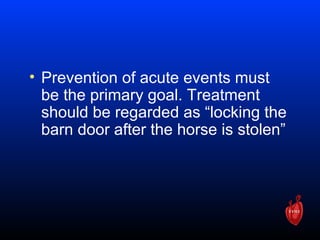
• Prevention of acute events must
be the primary goal. Treatment
should be regarded as “locking the
barn door after the horse is stolen”
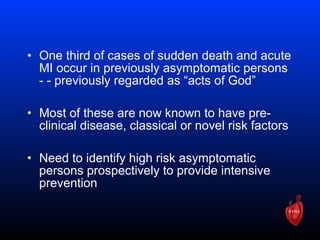
• One third of cases of sudden death and acute
MI occur in previously asymptomatic persons
- - previously regarded as “acts of God”
• Most of these are now known to have pre-
clinical disease, classical or novel risk factors
• Need to identify high risk asymptomatic
persons prospectively to provide intensive
prevention
• All patients with clinically apparent
atherosclerotic disease require
intensive global risk factor reduction
• Some have unstable placques
(“accidents about to happen”) and these
must be identified
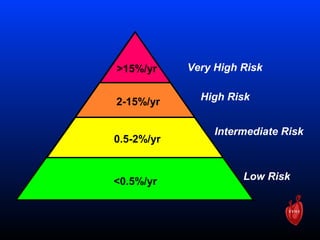
<0.5%/yr
0.5-2%/yr
2-15%/yr
>15%/yr Very High Risk
High Risk
Intermediate Risk
Low Risk
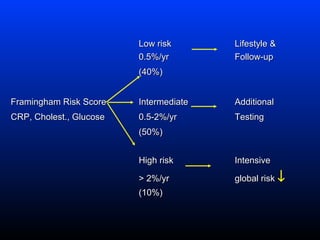
Low riskLow risk Lifestyle &Lifestyle &
0.5%/yr0.5%/yr Follow-upFollow-up
(40%)(40%)
Framingham Risk ScoreFramingham Risk Score IntermediateIntermediate AdditionalAdditional
CRP, Cholest., GlucoseCRP, Cholest., Glucose 0.5-2%/yr0.5-2%/yr TestingTesting
(50%)(50%)
High riskHigh risk IntensiveIntensive
> 2%/yr> 2%/yr global riskglobal risk ↓
(10%)(10%)
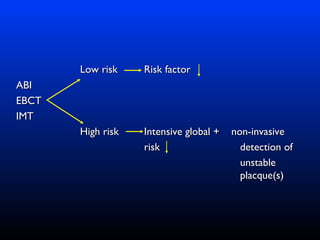
Low riskLow risk Risk factorRisk factor
ABIABI
EBCTEBCT
IMTIMT
High riskHigh risk Intensive global + non-invasiveIntensive global + non-invasive
riskrisk detection ofdetection of
unstableunstable
placque(s)placque(s)
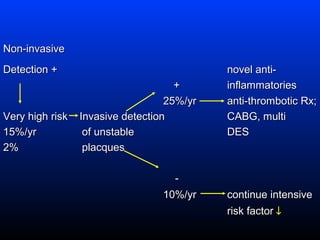
Non-invasiveNon-invasive
Detection +Detection + novel anti-novel anti-
++ inflammatoriesinflammatories
25%/yr25%/yr anti-thrombotic Rx;anti-thrombotic Rx;
Very high risk Invasive detectionVery high risk Invasive detection CABG, multiCABG, multi
15%/yr15%/yr of unstableof unstable DESDES
2%2% placquesplacques
--
10%/yr10%/yr continue intensivecontinue intensive
risk factorrisk factor ↓

Acc 04 vuln pt

  • 1.
    APPROACH TO IDENTIFYINGAND MANAGING CORONARY RISK Eugene Braunwald, M.D. March 6, 2004
  • 2.
    • Prevention ofacute events must be the primary goal. Treatment should be regarded as “locking the barn door after the horse is stolen”
  • 3.
    • One thirdof cases of sudden death and acute MI occur in previously asymptomatic persons - - previously regarded as “acts of God” • Most of these are now known to have pre- clinical disease, classical or novel risk factors • Need to identify high risk asymptomatic persons prospectively to provide intensive prevention
  • 4.
    • All patientswith clinically apparent atherosclerotic disease require intensive global risk factor reduction • Some have unstable placques (“accidents about to happen”) and these must be identified
  • 5.
    <0.5%/yr 0.5-2%/yr 2-15%/yr >15%/yr Very HighRisk High Risk Intermediate Risk Low Risk
  • 6.
    Low riskLow riskLifestyle &Lifestyle & 0.5%/yr0.5%/yr Follow-upFollow-up (40%)(40%) Framingham Risk ScoreFramingham Risk Score IntermediateIntermediate AdditionalAdditional CRP, Cholest., GlucoseCRP, Cholest., Glucose 0.5-2%/yr0.5-2%/yr TestingTesting (50%)(50%) High riskHigh risk IntensiveIntensive > 2%/yr> 2%/yr global riskglobal risk ↓ (10%)(10%)
  • 7.
    Low riskLow riskRisk factorRisk factor ABIABI EBCTEBCT IMTIMT High riskHigh risk Intensive global + non-invasiveIntensive global + non-invasive riskrisk detection ofdetection of unstableunstable placque(s)placque(s)
  • 8.
    Non-invasiveNon-invasive Detection +Detection +novel anti-novel anti- ++ inflammatoriesinflammatories 25%/yr25%/yr anti-thrombotic Rx;anti-thrombotic Rx; Very high risk Invasive detectionVery high risk Invasive detection CABG, multiCABG, multi 15%/yr15%/yr of unstableof unstable DESDES 2%2% placquesplacques -- 10%/yr10%/yr continue intensivecontinue intensive risk factorrisk factor ↓