E504
Med Oral Patol Oral Cir Bucal. 2007 Nov 1;12(7):E504-10. Oral biopsy
Oral biopsy in dental practice
Amparo Mota-Ramírez ¹, Francisco Javier Silvestre ², Juan Manuel Simó 3
(1) Degree in Dental Surgery. Diploma in Hospital Clinical-Surgical Dentistry
(2) Assistant Professor of the Department of Stomatology, Valencia University Dental School, and Head of the Stomatology Unit, Dr.
Peset University Hospital
(3) Degree in Medicine and Degree in Dental Surgery. Staff physician of the Stomatology Unit, Dr. Peset University Hospital. Valencia.
Spain
Correspondence:
Prof. F. Javier Silvestre-Donat
Sección de Pacientes Especiales
Clínica Odontológica Universitaria
Gascó Oliag 1
46010 - Valencia. Spain
E-mail: francisco.silvestre@uv.es
Received: 10-12-2006
Accepted: 3-05-2007
Mota-Ramírez A, Silvestre FJ, Simó JM. Oral biopsy in dental practice.
Med Oral Patol Oral Cir Bucal. 2007 Nov 1;12(7):E504-10.
© Medicina Oral S. L. C.I.F. B 96689336 - ISSN 1698-6946
Abstract
The conclusions drawn from the study of an oral biopsy are considered essential for the definitive diagnosis of diseases
of the oral mucosa, and for the subsequent planning of appropriate treatment.
Although the obtainment of biopsies is widely used in all medical fields, the practice is not so widespread in dental
practice - fundamentally because of a lack of awareness of the procedure among dental professionals. In this context,
it must be taken into account that the early diagnosis of invasive oral malignancy may be critical for improving the
patient prognosis.
However, in some cases the results are adversely affected by incorrect manipulation of the biopsy material. The present
study provides an update on the different biopsy sampling techniques and their application. Such familiarization in turn
will contribute to knowledge of the material and instruments required for correct biopsy performance in dentistry, as
well as of the material required for correct sample storage and transport.
Key words: Oral biopsy, oral histology, surgical technique, oral diagnosis.
Indexed in:
-Index Medicus / MEDLINE / PubMed
-EMBASE, Excerpta Medica
-SCOPUS
-Indice Médico Español
-IBECS
Article Number: 10489708
© Medicina Oral S. L. C.I.F. B 96689336 - ISSN 1698-6946
eMail: medicina@medicinaoral.com
INTRODUCTION
The word biopsy originates from the Greek terms bios
(life) and opsis (vision): vision of life. A biopsy consists of
the obtainment of tissue from a living organism with the
purpose of examining it under the microscope in order to
establish a diagnosis based on the sample (1).
The technique allows us to establish the histological char-
acteristics of suspect lesions, their differentiation, extent
or spread, and to adopt an adequate treatment strategy.
Biopsies establish evolutive control of disease processes, and
are able to document healing or relapse. In turn, the biopsy
findings are of irrefutable legal medical value (2,3).
A biopsy is indicated in application to any lip or oral
mucosal lesions following the exclusion of local irritants
(of traumatic or inflammatory origin), when the lesions in
question are seen to persist for more than two weeks, and
may be suggestive of malignancy (1,4). In general, lesions
appearing in the oral mucosa should be explored and evalu-
ated for the possible presence of local irritative factors. If
such factors are identified, they must be eliminated, after
which an observation period of approximately 15-20 days is
indicated. After this period of time, and if the lesions per-
sist, histopathological study is required to discard possible
malignancy (3). Such a study is also indicated in the case
of radiotransparent bone lesions presenting radiological
features suggestive of malignancy - even when such fea-
tures constitute casual findings in the course of a routine
radiological study.
All maxillary cysts, and particularly keratocysts, must also
be processed for histological study (1,3).
E505
Med Oral Patol Oral Cir Bucal. 2007 Nov 1;12(7):E504-10. Oral biopsy
A biopsy is also indicated in the case of bone lesions ac-
companied by pain, sensitivity alterations or other symp-
toms, and in application to bone lesions showing important
changes or rapid expansion as evidenced by successive
radiological evaluations.
A biopsy is also required of those oral mucosal surfaces
that show important and persistent color changes (becom-
ing very white, red or pigmented) or changes in appearance
(cracking, proliferation or ulceration), with deep-lying hard
masses detected upon palpation.
Likewise, evaluation is required of premalignant mucosal
lesions or states such as lichen planus or leukoplakia, in
persistent atrophic-erosive areas (4).
A biopsy is also very useful for the detection of certain sys-
temic illnesses requiring histological confirmation in order
to establish the definitive diagnosis, e.g., lupus, amyloidosis,
scleroderma, or Sjögren’s syndrome - which can be con-
firmed by an oral tissue biopsy. As an example, confirmation
of Sjögren’s syndrome requires the obtainment of a sample
of the lesser salivary glands of the lips (1,3,4).
A biopsy is also used as complement in the diagnosis of
certain disorders of infectious origin, such as lesions sug-
gestive of syphilis or tuberculosis, based on an oral sample
- though prior confirmation of the positivity of tests specific
of such disease processes is required.
Another indication for biopsy is confirmation of the diag-
nosis of blister lesions, in mucocutaneous diseases affecting
the oral mucosa, such as vulgar pemphigus or cicatricial
pemphigoid.
Benign tumors, with the exception of those of a vascular
nature, are to be removed, sending the entire sample for
histopathological study to determine the histological origin
of the lesion, after establishing a tentative diagnosis (4).
On the other hand, a biopsy is contraindicated in very
seriously ill patients, in those subjects with some systemic
disorder that may worsen, or where secondary complications
may develop (4).
Likewise, a biopsy should be avoided in the case of lesions
located in very deep regions or in areas of difficult access
where the surgical technique proves complicated or hazard-
ous, with the risk of damage to neighboring structures. In
such cases the patient should be referred to a specialist. The
same considerations apply in the case of suspected vascular
lesions such as hemangiomas, due to the risk of massive and
persistent bleeding (1,5).
Biopsy is not advised in the case of multiple neurofibromas,
due to the risk of neurosarcomatous transformation, or in
tumors of the greater salivary glands. Such biopsies must
be performed by specialized surgeons, in order to avoid
damaging nearby anatomical structures and causing the
spread of tumor cells, as this would adversely affect the
prognosis (1).
In turn, a biopsy would be needless in application to banal
irritative lesions or normal anatomical variants such as
physiological gingival pigmentation, geographic tongue,
linea alba, lingual indentations, protuberances, exostosis,
etc. (3,6).
TYPES OF BIOPSY
Depending on the characteristics of the target lesion, the
biopsy is defined as direct (located superficially, with easy
access) or indirect (when the lesion lies in depth and is cov-
ered by normally appearing mucosa or tissue)(3). However,
biopsies can also be classified according to the technique
used, the material employed, the clinical timing, the loca-
tion of the target lesion, processing of the sample, and the
purpose of the biopsy.
1) The technique employed:
Depending on the technique employed, biopsies can be clas-
sified as incisional or excisional. The incisional technique
involves the removal of a representative portion of the target
lesion and of a part of healthy tissue (3,7,8). If the lesion is
extensive, different samples should be obtained, placing each
of them in a separate and adequately identified container.
Along with the report sent to the pathologist, a schematic
representation of the lesions should be attached, specify-
ing the original location of each sample (1,3,9). Such an
approach is indicated in the case of suspected malignancy
or precancerous lesions. Likewise, such a multiple sample
biopsy should be performed when the target lesion is difficult
to remove due to its large size or complicated location. It is
also indicated for establishing the diagnosis of a systemic
disease process.
Controversy exists as to the possibility that incisional biop-
sies of malignant lesions may increase the risk of metastasis,
by disrupting the barrier preventing migration of the neo-
plastic cells and thus favoring invasion of the bloodstream
at the site of the surgical wound (10).
In certain tumors such as hemangioma or melanoma, the
biopsy should be performed with complete and extensive
resection of the lesion, in order to avoid severe bleeding or
metastatic spread, respectively (9).
An excisional biopsy in turn involves total removal of the
lesion, with slight peripheral and in-depth safety margins,
applicable to papillomas, fibromas or granulomas (4,11).
Such biopsies play a diagnostic and therapeutic role, since
complete removal of the lesion is carried out, ensuring the
inclusion of a peripheral margin of normal tissue (12).
2) The material used:
A number of cutting instruments can be used when per-
forming a biopsy: a conventional scalpel, a punch, and the
so-called B-forceps. Electroscalpels and CO2 laser scalpels
deserve separate mention, for although they are used by
some authors, their associated inconveniences make them
scantly recommendable for obtaining a biopsy sample.
The oral mucosal punch is a rapid, simple, safe and inex-
pensive technique for obtaining a representative sample of
most oral zones. The technique and usefulness are similar
to those of the skin punch. The instrument consists of a
sterile and discardable punch with a plastic handpiece and
cylindrical cutting blade. The latter may be 2, 3, 4, 5, or 6 to
8 mm in diameter, with stepwise increments of 0.25 a 0.50
mm. As a result, tissue cylinders 2 to 8 mm in diameter can
be obtained - the most widely used caliber being 4 mm.
E506
Med Oral Patol Oral Cir Bucal. 2007 Nov 1;12(7):E504-10. Oral biopsy
The punch is grasped between the index and thumb, sup-
porting the cylinder over the target lesion. If a small-diam-
eter cylinder is obtained, suturing of the residual wound is
usually not necessary, and the bleeding can be contained by
simply applying a piece of gauze or surgical dressing. The
wound heals by second intention, with good esthetic results.
In other cases, primary wound closure can be performed
with sutures.
Punches are typically made of plastic or metal. The metal
presentations can be reused, and are to be sterilized before
use. In contrast, the plastic variants are less expensive, weigh
less and are destined for single use (13,14).
The punch is able to obtain several samples at the same time,
and at different points, and generates less patient anxiety
than the conventional scalpel (15).
However, the punch is unable to remove large lesions, and
cannot be used in intensely vascularized or innervated areas.
It is likewise not applicable to deep lesions, and is limited
to epithelial or superficial mesenchymal target tissues. Cau-
tion is moreover required when using the punch to sample
lesions located over important submucosal structures such
as the mental or nasopalatine foramen. On the other hand,
the instrument is difficult to use in the region of the soft
palate, maxillary tuberosity or floor of the mouth, due to
the lack of firm tissue fixation or support, and the mobility
of the target zone (13,14).
Other instruments, such as the so-called B forceps, can also
be used to obtain a biopsy. This instrument was developed
by Bermejo (16), and facilitates, simplifies and especially
homogenizes soft tissue biopsies of the oral cavity and of
the lesser salivary glands. These forceps are equipped with
two cusps - one with a window - to allow compression of
the target tissue between them. The target zone is positioned
exposed within the window, and the compressive effect of
the cusps allows us to work in an ischemic field within the
window. Compression by the forceps causes the sectioned
portion, freed from its peripheral connective tissue attach-
ments, to propel from the window - thus allowing us to
measure the depth of the sample, with easy access to the
base in order to facilitate sectioning (16).
On the other hand, while the electroscalpel has the advan-
tage of causing no bleeding, since it cauterizes the vessels,
its main inconvenience is the induction of thermal damage.
Although similar, the laser scalpel produces less extensive
thermal damage and less postoperative pain. However, in
the same way as the electroscalpel, it is currently not advised
for obtaining oral biopsies.
3) Clinical timing of sampling:
Depending on the clinical timing of the biopsy, the proce-
dure can be classified as intraoperative or extraoperative.
An intraoperative biopsy allows a rapid histopathologi-
cal diagnosis. The sampled material is processed without
fixation, frozen with dry ice. In this sense, freezing at a
temperature of between -40ºC and -60ºC produces a tis-
sue consistency that allows sectioning with the microtome.
The quality of the preparation under such conditions is
less ideal, the analysis is more difficult, and the pathologist
faces only three diagnostic options: positive, negative or
doubtful (1,3,7).
However, the result can be received in the operating room
in a short period of time, thus allowing the surgeon to
continue with the operation as required. This procedure is
indicated when a malignant tumor is suspected, and surgery
can be planned according to the histological findings of the
intraoperative biopsy. However, the technique is not always
reliable, and in cases of doubt surgery is postponed until
conclusive results are obtained from the study of tissue
embedded in paraffin.
A very important procedure is the intraoperative examina-
tion of the margins of a resected malignant tumor, to evalu-
ate the possible existence of tumor invasion beyond these
margins. In such a case, wider resection is required (12).
On the other hand, an extraoperative biopsy requires a
longer processing time. The fixed tissue sample is processed
and embedded in paraffin, followed by the cutting and stain-
ing of thin sections. These preparations offer greater quality
than frozen samples, and histopathological evaluation is
therefore easier (1,3).
4) Sampling location:
Depending on the topography involved, the biopsy can be
obtained from the oral mucosa in its different locations
(Figure 1), the salivary glands, bone, lymph nodes, and
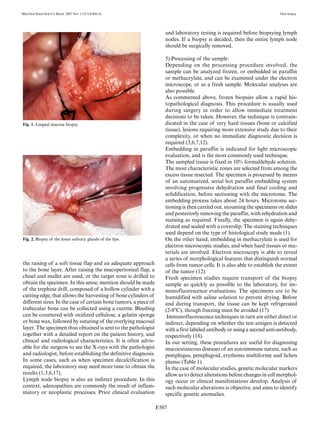
other head and neck tissues. A biopsy of the oral mucosa is
simple to perform, and is used to distinguish among differ-
ent types of lesions, in order to define adequate treatment
or conduct follow-up over time. A conventional biopsy is
usually indicated (6).
Regarding the salivary glands, it is very common and easy to
obtain a biopsy of the lesser salivary glands of the lips for
diagnosing or confirming an autoimmune condition such as
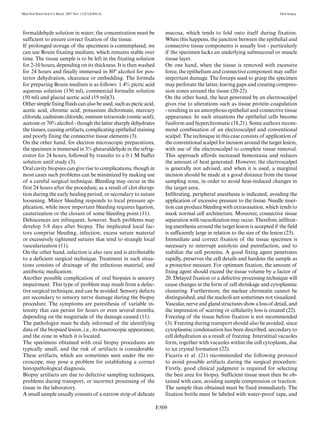
Sjögren’s syndrome (Figure 2). All the typical microscopic
characteristics of this syndrome, with the exception of the
clusters of myoepithelial cells, are usually observed in the
lesser salivary glands, and the lip glands are the most widely
used option, in view of their accessibility. Following local
anesthetic infiltration of the zone, a small incision measuring
approximately 10 mm is made in the mucosa of the lower lip;
the thickness of the sample should be sufficient to obtain
the glands without affecting the muscle layer or arteries
(1). In the case of retention cysts such as lip mucoceles, an
excisional biopsy is indicated (1,3).
On the other hand, when biopsying the greater salivary
glands, and specifically the parotid gland, fine-needle aspi-
ration biopsies (FNAB) are increasingly used, due to their
non-invasive nature. An intraoperative biopsy is also of
interest in this context, selecting the tumor target zone and
avoiding nerve structures. However, greater salivary gland
biopsies, and particularly of the parotid gland, are rarely
performed outside the context of surgery, unless the lesion
is superficial and malignancy is suspected (6).
A bone biopsy in turn constitutes an indirect technique.
These procedures are usually more difficult, and require
E507
Med Oral Patol Oral Cir Bucal. 2007 Nov 1;12(7):E504-10. Oral biopsy
16
17
Fig. 2. Biopsy of the lesser salivary glands of the lips.
Fig. 1. Lingual mucosa biopsy.
the raising of a soft tissue flap and an adequate approach
to the bone layer. After raising the mucoperiosteal flap, a
chisel and mallet are used, or the target zone is drilled to
obtain the specimen. In this sense, mention should be made
of the trephine drill, composed of a hollow cylinder with a
cutting edge, that allows the harvesting of bone cylinders of
different sizes. In the case of certain bone tumors, a piece of
trabecular bone can be collected using a curette. Bleeding
can be countered with oxidized cellulose, a gelatin sponge
or bone wax, followed by suturing of the overlying mucosal
layer. The specimen thus obtained is sent to the pathologist
together with a detailed report on the patient history, and
clinical and radiological characteristics. It is often advis-
able for the surgeon to see the X-rays with the pathologist
and radiologist, before establishing the definitive diagnosis.
In some cases, such as when specimen decalcification is
required, the laboratory may need more time to obtain the
results (1,3,6,17).
Lymph node biopsy is also an indirect procedure. In this
context, adenopathies are commonly the result of inflam-
matory or neoplastic processes. Prior clinical evaluation
and laboratory testing is required before biopsying lymph
nodes. If a biopsy is decided, then the entire lymph node
should be surgically removed.
5) Processing of the sample:
Depending on the processing procedure involved, the
sample can be analyzed frozen, or embedded in paraffin
or methacrylate, and can be examined under the electron
microscope, or as a fresh sample. Molecular analyses are
also possible.
As commented above, frozen biopsies allow a rapid his-
topathological diagnosis. This procedure is usually used
during surgery in order to allow immediate treatment
decisions to be taken. However, the technique is contrain-
dicated in the case of very hard tissues (bone or calcified
tissue), lesions requiring more extensive study due to their
complexity, or when no immediate diagnostic decision is
required (3,6,7,12).
Embedding in paraffin is indicated for light microscopic
evaluation, and is the most commonly used technique.
The sampled tissue is fixed in 10% formaldehyde solution.
The most characteristic zones are selected from among the
excess tissue resected. The specimen is processed by means
of an automatized, serial hot paraffin embedding system
involving progressive dehydration and final cooling and
solidification, before sectioning with the microtome. The
embedding process takes about 24 hours. Microtome sec-
tioning is then carried out, mounting the specimens on slides
and posteriorly removing the paraffin, with rehydration and
staining as required. Finally, the specimen is again dehy-
drated and sealed with a coverslip. The staining techniques
used depend on the type of histological study made (1).
On the other hand, embedding in methacrylate is used for
electron microscopic studies, and when hard tissues or ma-
terials are involved. Electron microscopy is able to reveal
a series of morphological features that distinguish normal
cells from tumor cells. It is also able to establish the extent
of the tumor (12).
Fresh specimen studies require transport of the biopsy
sample as quickly as possible to the laboratory, for im-
munofluorescence evaluations. The specimens are to be
humidified with saline solution to prevent drying. Before
and during transport, the tissue can be kept refrigerated
(2-8ºC), though freezing must be avoided (17).
Immunofluorescence techniques in turn are either direct or
indirect, depending on whether the test antigen is detected
with a first labeled antibody or using a second anti-antibody,
respectively (18).
In our setting, these procedures are useful for diagnosing
mucocutaneous diseases of an autoimmune nature, such as
pemphigus, pemphigoid, erythema multiforme and lichen
planus (Table 1).
In the case of molecular studies, genetic molecular markers
allow us to detect alterations before changes in cell morphol-
ogy occur or clinical manifestations develop. Analysis of
such molecular alterations is objective, and aims to identify
specific genetic anomalies.
E508
Med Oral Patol Oral Cir Bucal. 2007 Nov 1;12(7):E504-10. Oral biopsy
VULGAR PEMPHIGUS PEMPHIGOID
ERYTHEMA
MULTIFORME
LICHEN PLANUS
DIF
IgG 100% C3 40% IgM,
Fibrinogen
IgG (particularly)
C3 IgM IgA negative
Fibrinogen (particularly)
IgG 35%
IgM 30%
IIF Ab IgG 80-90% negative negative negative
LUPUS
ERYTHEMATOSUS
LINEAL IgA
DERMATOSIS
HERPETIFORM
DERMATITIS
EPIDERMOLYSIS
BULLOSA
DIF
IgG IgA IgM C3 C4
IgA
IgA
C3
IgG
C3
IIF negative negative negative negative
Table 1. Evaluation of test positivity for diagnosis via direct / indirect immunofluorescence in application to autoimmune
mucocutaneous diseases.
DIF: Direct immunofluorescence; IIF: Indirect immunofluorescence; Ig: Immunoglobulin; C: Complement fraction
The principal oral cavity carcinogens are chemical (tobacco
smoke), physical (radiation) and infectious agents (papil-
lomavirus, Candida); as mutagens, they are able to induce
structural changes in genes and chromosomes through point
mutations, deletions, insertion or rearrangements. However,
some changes of this kind can also occur spontaneously.
Such genetic alterations taking place in the context of
carcinogenesis can be used as targets for the detection of
tumor cells in clinical samples (6).
6) Purpose of the biopsy:
Biopsies can be performed for diagnostic or experimental
purposes. Thus, apart from diagnosis with a view to treat-
ment, a biopsy can yield important information for the
histopathological study of new disease entities. With this
aim in mind, studies are made in laboratory animals, and
exceptionally also in humans, with the obtainment of sam-
ples that can yield valuable information on the evolution of
a given disease process (3).
HOW TO PERFORM AN ORAL BIOPSY
The materials and instrumentation required to perform an
oral biopsy are not particularly sophisticated. The necessary
instruments are limited to those commonly employed in
surgery, such as a buccal mirror, exploratory probe, toothless
dissection forceps, mosquito forceps, scalpel handpiece and
number 15 blade, syringe for anesthesia, pressure forceps,
scissors, periostotome, separators, needle carriers and su-
ture mounted needles. For bone biopsies we can use gubia
forceps, a chisel and mallet, a motor-driven handpiece with
drills, and curettes.
As to the required material, an ejector, gauze, sterile gloves
and a plastic or glass bottle containing 10% formalin solu-
tion is advised (3).
As with any surgical procedure, a biopsy requires due
sterilization of the instrumentation and disinfection of the
surgical field.
Most target lesions are found in soft tissues such as the
tongue, cheek mucosa or lips, or in more adhered regions
such as the palate and gums. Anaesthesia with a vasocon-
strictor to minimize bleeding should not be applied in the
actual biopsy target zone but rather at a certain distance, to
avoid alterations. Thus, injection should be performed with
a separation of 3-4 mm, and at the four cardinal reference
points (top, bottom, left and right).
Traction suture or tissue forceps are to be used to fix the
tissue to be removed. Traction sutures offer the advantage
of orienting at least one lesion surface for the pathologist.
Surgery is moreover facilitated, and compression or destruc-
tion of the specimen (as tends to occur when using puncture
or cutting instruments) is avoided (8).
The specimen should be obtained by means of a clean
and deep cut, taking care in extraction to avoid tearing or
compression, as this could cause alterations. In excisional
biopsies, the lesion is to be palpated carefully, determining
its depth, and the incisions should slightly exceed the total
depth of the lesion. In incisional biopsies, any depth within
the lesion allowing the obtainment of sufficient material for
study is considered acceptable. The incision should include a
significant portion of the suspect tissue, though also a part
of adjacent normal tissue (19).
The wound margins are subjected to debridement, with
control of bleeding, and the lips of the wound are joined
with suture. When a sample of gingival tissue or palate is
obtained, and closure of the incision proves difficult, it can
be left to heal by second intention. Oxidized and regenerated
cellulose can be applied, together with gauze impregnated
with tranexamic acid, to avoid bleeding (8).
After obtaining the sample, washing with physiological
saline is indicated, followed by fixation. Sample process-
ing begins once the specimen has been obtained, with the
purpose of allowing tissue study under magnification. The
steps comprise fixation, cutting into fragments or blocks,
embedding, sectioning, staining and examination. The most
common procedure is staining with hematoxylin-eosin, fol-
lowed by examination under the light microscope (1).
Light microscopic studies generally involve the use of 10%
E509
Med Oral Patol Oral Cir Bucal. 2007 Nov 1;12(7):E504-10. Oral biopsy
formaldehyde solution in water; the concentration must be
sufficient to ensure correct fixation of the tissue.
If prolonged storage of the specimens is contemplated, we
can use Bouin fixating medium, which remains stable over
time. The tissue sample is to be left in the fixating solution
for 2-10 hours, depending on its thickness. It is then washed
for 24 hours and finally immersed in 80º alcohol for pos-
terior dehydration, clearance or embedding. The formula
for preparing Bouin medium is as follows: 1.4% picric acid
aqueous solution (150 ml), commercial formalin solution
(50 ml) and glacial acetic acid (19 ml)(3).
Other simple fixing fluids can also be used, such as picric acid,
acetic acid, chromic acid, potassium dichromate, mercury
chloride, cadmium chloride, osmium tetraoxide (osmic acid),
acetone or 70% alcohol - though the latter sharply dehydrates
the tissues, causing artifacts, complicating epithelial staining
and poorly fixing the connective tissue elements (3).
On the other hand, for electron microscopic preparations,
the specimen is immersed in 3% glutaraldehyde in the refrig-
erator for 24 hours, followed by transfer to a 0.1 M buffer
solution until study (3).
Oral cavity biopsies can give rise to complications, though in
most cases such problems can be minimized by making use
of a careful surgical technique. Bleeding may occur in the
first 24 hours after the procedure, as a result of clot disrup-
tion during the early healing period, or secondary to suture
loosening. Minor bleeding responds to local pressure ap-
plication, while more important bleeding requires ligation,
cauterization or the closure of some bleeding point (11).
Dehiscences are infrequent, however. Such problems may
develop 5-8 days after biopsy. The implicated local fac-
tors comprise bleeding, infection, excess suture material
or excessively tightened sutures that tend to strangle local
vascularization (11).
On the other hand, infection is also rare and is attributable
to a deficient surgical technique. Treatment in such situa-
tions consists of drainage of the infectious material, and
antibiotic medication.
Another possible complication of oral biopsies is sensory
impairment. This type of problem may result from a defec-
tive surgical technique, and can be avoided. Sensory defects
are secondary to sensory nerve damage during the biopsy
procedure. The symptoms are paresthesia of variable in-
tensity that can persist for hours or even several months,
depending on the magnitude of the damage caused (11).
The pathologist must be duly informed of the identifying
data of the biopsied lesion, i.e., its macroscopic appearance,
and the zone in which it is located.
The specimens obtained with oral biopsy procedures are
typically small, and the risk of artifacts is considerable.
These artifacts, which are sometimes seen under the mi-
croscope, may pose a problem for establishing a correct
histopathological diagnosis.
Biopsy artifacts are due to defective sampling techniques,
problems during transport, or incorrect processing of the
tissue in the laboratory.
A small sample usually consists of a narrow strip of delicate
mucosa, which tends to fold onto itself during fixation.
When this happens, the junction between the epithelial and
connective tissue components is usually lost - particularly
if the specimen lacks an underlying submucosal or muscle
tissue layer.
On one hand, when the tissue is removed with excessive
force, the epithelium and connective component may suffer
important damage. The forceps used to grasp the specimen
may perforate the latter, leaving gaps and creating compres-
sion zones around the tissue (20-22).
On the other hand, the heat generated by an electroscalpel
gives rise to alterations such as tissue protein coagulation
- resulting in an amorphous epithelial and connective tissue
appearance. In such situations the epithelial cells become
fusiform and hyperchromatic (18,21). Some authors recom-
mend combination of an electroscalpel and conventional
scalpel. The technique in this case consists of application of
the conventional scalpel for incision around the target lesion,
with use of the electroscalpel to complete tissue removal.
This approach affords increased hemostasia and reduces
the amount of heat generated. However, the electroscalpel
is generally not advised, and when it is used, a marginal
incision should be made at a good distance from the tissue
sampling zone, in order to avoid heat-induced changes in
the target area.
Infiltrating, peripheral anesthesia is indicated, avoiding the
application of excessive pressure to the tissue. Needle inser-
tion can produce bleeding with extravasation, which tends to
mask normal cell architecture. Moreover, connective tissue
separation with vacuolization may occur. Therefore, infiltrat-
ing anesthesia around the target lesion is accepted if the field
is sufficiently large in relation to the size of the lesion (23).
Immediate and correct fixation of the tissue specimen is
necessary to interrupt autolysis and putrefaction, and to
stabilize the cell proteins. A good fixing agent penetrates
rapidly, preserves the cell details and hardens the sample as
a protective measure. For optimum fixation, the amount of
fixing agent should exceed the tissue volume by a factor of
20. Delayed fixation or a defective processing technique will
cause changes in the form of cell shrinkage and cytoplasmic
clustering. Furthermore, the nuclear chromatin cannot be
distinguished, and the nucleoli are sometimes not visualized.
Vascular,nerveandglandstructuresshowalossof detail,and
the impression of scarring or cellularity loss is created (22).
Freezing of the tissue before fixation is not recommended
(3). Freezing during transport should also be avoided, since
cytoplasmic condensation has been described, secondary to
cell dehydration as a result of freezing. Interstitial vacuoles
form, together with vacuoles within the cell cytoplasm, due
to ice crystal formation (22).
Ficarra et al. (21) recommended the following protocol
to avoid possible artifacts during the surgical procedure:
Firstly, good clinical judgment is required for selecting
the best area for biopsy. Sufficient tissue must then be ob-
tained with care, avoiding sample compression or traction.
The sample thus obtained must be fixed immediately. The
fixation bottle must be labeled with water-proof tape, and
E510
Med Oral Patol Oral Cir Bucal. 2007 Nov 1;12(7):E504-10. Oral biopsy
12. Pifarré S. Patología quirúrgica oral y maxillofacial. Barcelona: Jims;
1993. p. 235-98.
13. Lynch DP, Morris LF. The oral mucosal punch biopsy: indications and
technique. J Am Dent Assoc. 1990 Jul;121(1):145-9.
14. López-Jornet MP. La biopsia en odontoestomatología. Descripción de
la técnica mediante la utilización del punch. Revista Europea de Odonto-
Estomatología 1994;3:147-50.
15. Eisen D. The oral mucosal punch biopsy. A report of 140 cases. Arch
Dermatol. 1992 Jun;128(6):815-7.
16. Bermejo-Fenoll A, Lopez-Jornet P. Instrument for biopsy of oral lesions:
an improved chalazion forceps. Dermatol Surg. 2006 Dec;32(12):1493-5.
17. Laskin DM. Cirugía bucal y maxilofacial. Buenos Aires: Panamericana;
1987. p. 529, 593-5.
18. Bagán JV. Enfermedades ampollares de la cavidad oral. In: Bagan JV,
Ceballos A, Bermejo A, Aguirre JM, Peñarrocha M (eds). Medicina Oral.
Barcelona: ed Masson; 1995. p. 220-6, 227-40.
19. Keszler A. Biopsies: practical standards for correct technic. Rev Asoc
Odontol Argent. 1988 Jun;76(3):100.
20. Lolli R, Venezia A, Bellardini M, De Nisi S, Demuro G. Technical
artifacts in biopsy of the oral cavity. I. Clinical and histopathologic aspects.
Minerva Stomatol. 1989 Jan;38(1):37-45.
21. Ficarra G, McClintock B, Hansen LS. Artefacts created during oral
biopsy procedures. J Craniomaxillofac Surg. 1987 Feb;15(1):34-7.
22. Margarone JE, Natiella JR, Vaughan CD. Artifacts in oral biopsy
specimens. J Oral Maxillofac Surg. 1985 Mar;43(3):163-72.
23. Kearns HP, McCartan BE, Lamey PJ. Patients’ pain experience fol-
lowing oral mucosal biopsy under local anaesthesia. Br Dent J. 2001 Jan
13;190(1):33-5.
24. Potter TJ, Summerlin DJ, Campbell JH. Oral malignancies associated
with negative transepithelial brush biopsy. J Oral Maxillofac Surg. 2003
Jun;61(6):674-7.
using a pencil for writing. Each specimen is to be placed in
a separate bottle or container, with due identification of the
different zones involved.
Posteriorly, the pathology laboratory will issue a report,
identifying the material and providing details (macroscopic
identification), a description of the study made, the final
histopathological diagnosis, and other comments (3).
The pathologist thus may prepare the report in three dif-
ferent ways: certainty diagnosis, incompatibility diagnosis,
or orientative diagnosis.
The certainty diagnosis is a true histopathological diagnosis.
This diagnosis is stated when the findings are pathogno-
monic of a given type of lesion. If possible, tumor disease
should specify tumor extension to the resection margins,
including depth and infiltration, and the histological ma-
lignancy grade.
On the other hand, a diagnostic incompatibility report
is issued when no lesions typical of a given disease entity
have been observed. In these situations we must check that
sampling and processing have been correct in both amount
and location. In some cases there may be a previous test
yielding a negative diagnosis, and the biopsy specimen in
these cases serves to check the possible presence of positive
lesions (24).
In contrast, the diagnosis in some cases is merely orientative
and must be interpreted in close correlation to the clinical
data and the findings of other complementary tests. In such
cases the diagnosis is said to be compatible or suggestive of
a concrete disease entity.
Finally, in some cases the pathologist is unable to draw any
conclusions, and the resulting report is of a merely descrip-
tive nature (1,3,7).
REFERENCES
1. García-Peñín A. Biopsia en Cirugía Bucal. In: Donado M (eds). Cirugía
Bucal: patología y técnica. Madrid: Masson; 1990.p.119-31.
2. Sabater-Recolons M, Viñals-Iglesias H. Las biopsias en medicina oral.
Rev Europea Odontoestomatol 1997;3:175-82..
3. García-Peñín A, Carrillo-Baracaldo JS, Martínez-González JM, Sada-
García-Lomas JM. La biopsia en Estomatología. Rev Actual Estomatol
Esp 1987;47:49-52, 55-8, 61-2.
4. Gandolfo S, Carbone M, Carrozzo M, Scamuzzi S. Biopsy technics
in oral oncology: excisional or incisional biopsy? A critical review of the
literature and the authors’personal contribution. Minerva Stomatol. 1993
Mar;42(3):69-75.
5. Brown RS, Bottomley WK, Abramovitch K, Langlais RP. Immediate
biopsy versus a therapeutic trial in the diagnosis and treatment of vesicu-
lobullous/vesiculoerosive oral lesions. Opposing viewpoints presented. Oral
Surg Oral Med Oral Pathol. 1992 Jun;73(6):694-7.
6. García-Núñez JA, Esparza-Gómez G, Cerero-Lapiedra R. Medios diag-
nósticos en medicina bucal. In: Bascones A (eds). Tratado de odontología.
Tomo III. Madrid: Smithkline Beecham 1999. p. 2993-8.
7. Peñarrocha M, Brotons A. Biopsias. In: Peñarrocha M (eds). Cirugía
Bucal. Valencia: Promolibro; 2000. p. 87-97.
8. Waite DE. Técnica de biopsia. In: Waite DE (eds). Tratado de cirugía
bucal práctica. México: CECSA; 1984. p. 211-9.
9. Bramley PA, Smith CJ. Oral cancer and precancer: establishing a diag-
nosis. Br Dent J. 1990 Feb 10;168(3):103-7.
10. Shklar G. The effect of manipulation and incision on experimental car-
cinoma of hamster buccal pouch. Cancer Res. 1968 Nov;28(11):2180-2.
11. Harahap M. How to biopsy oral lesions. J Dermatol Surg Oncol. 1989
Oct;15(10):1077-80.

07

  • 1.
    E504 Med Oral PatolOral Cir Bucal. 2007 Nov 1;12(7):E504-10. Oral biopsy Oral biopsy in dental practice Amparo Mota-Ramírez ¹, Francisco Javier Silvestre ², Juan Manuel Simó 3 (1) Degree in Dental Surgery. Diploma in Hospital Clinical-Surgical Dentistry (2) Assistant Professor of the Department of Stomatology, Valencia University Dental School, and Head of the Stomatology Unit, Dr. Peset University Hospital (3) Degree in Medicine and Degree in Dental Surgery. Staff physician of the Stomatology Unit, Dr. Peset University Hospital. Valencia. Spain Correspondence: Prof. F. Javier Silvestre-Donat Sección de Pacientes Especiales Clínica Odontológica Universitaria Gascó Oliag 1 46010 - Valencia. Spain E-mail: francisco.silvestre@uv.es Received: 10-12-2006 Accepted: 3-05-2007 Mota-Ramírez A, Silvestre FJ, Simó JM. Oral biopsy in dental practice. Med Oral Patol Oral Cir Bucal. 2007 Nov 1;12(7):E504-10. © Medicina Oral S. L. C.I.F. B 96689336 - ISSN 1698-6946 Abstract The conclusions drawn from the study of an oral biopsy are considered essential for the definitive diagnosis of diseases of the oral mucosa, and for the subsequent planning of appropriate treatment. Although the obtainment of biopsies is widely used in all medical fields, the practice is not so widespread in dental practice - fundamentally because of a lack of awareness of the procedure among dental professionals. In this context, it must be taken into account that the early diagnosis of invasive oral malignancy may be critical for improving the patient prognosis. However, in some cases the results are adversely affected by incorrect manipulation of the biopsy material. The present study provides an update on the different biopsy sampling techniques and their application. Such familiarization in turn will contribute to knowledge of the material and instruments required for correct biopsy performance in dentistry, as well as of the material required for correct sample storage and transport. Key words: Oral biopsy, oral histology, surgical technique, oral diagnosis. Indexed in: -Index Medicus / MEDLINE / PubMed -EMBASE, Excerpta Medica -SCOPUS -Indice Médico Español -IBECS Article Number: 10489708 © Medicina Oral S. L. C.I.F. B 96689336 - ISSN 1698-6946 eMail: medicina@medicinaoral.com INTRODUCTION The word biopsy originates from the Greek terms bios (life) and opsis (vision): vision of life. A biopsy consists of the obtainment of tissue from a living organism with the purpose of examining it under the microscope in order to establish a diagnosis based on the sample (1). The technique allows us to establish the histological char- acteristics of suspect lesions, their differentiation, extent or spread, and to adopt an adequate treatment strategy. Biopsies establish evolutive control of disease processes, and are able to document healing or relapse. In turn, the biopsy findings are of irrefutable legal medical value (2,3). A biopsy is indicated in application to any lip or oral mucosal lesions following the exclusion of local irritants (of traumatic or inflammatory origin), when the lesions in question are seen to persist for more than two weeks, and may be suggestive of malignancy (1,4). In general, lesions appearing in the oral mucosa should be explored and evalu- ated for the possible presence of local irritative factors. If such factors are identified, they must be eliminated, after which an observation period of approximately 15-20 days is indicated. After this period of time, and if the lesions per- sist, histopathological study is required to discard possible malignancy (3). Such a study is also indicated in the case of radiotransparent bone lesions presenting radiological features suggestive of malignancy - even when such fea- tures constitute casual findings in the course of a routine radiological study. All maxillary cysts, and particularly keratocysts, must also be processed for histological study (1,3).
  • 2.
    E505 Med Oral PatolOral Cir Bucal. 2007 Nov 1;12(7):E504-10. Oral biopsy A biopsy is also indicated in the case of bone lesions ac- companied by pain, sensitivity alterations or other symp- toms, and in application to bone lesions showing important changes or rapid expansion as evidenced by successive radiological evaluations. A biopsy is also required of those oral mucosal surfaces that show important and persistent color changes (becom- ing very white, red or pigmented) or changes in appearance (cracking, proliferation or ulceration), with deep-lying hard masses detected upon palpation. Likewise, evaluation is required of premalignant mucosal lesions or states such as lichen planus or leukoplakia, in persistent atrophic-erosive areas (4). A biopsy is also very useful for the detection of certain sys- temic illnesses requiring histological confirmation in order to establish the definitive diagnosis, e.g., lupus, amyloidosis, scleroderma, or Sjögren’s syndrome - which can be con- firmed by an oral tissue biopsy. As an example, confirmation of Sjögren’s syndrome requires the obtainment of a sample of the lesser salivary glands of the lips (1,3,4). A biopsy is also used as complement in the diagnosis of certain disorders of infectious origin, such as lesions sug- gestive of syphilis or tuberculosis, based on an oral sample - though prior confirmation of the positivity of tests specific of such disease processes is required. Another indication for biopsy is confirmation of the diag- nosis of blister lesions, in mucocutaneous diseases affecting the oral mucosa, such as vulgar pemphigus or cicatricial pemphigoid. Benign tumors, with the exception of those of a vascular nature, are to be removed, sending the entire sample for histopathological study to determine the histological origin of the lesion, after establishing a tentative diagnosis (4). On the other hand, a biopsy is contraindicated in very seriously ill patients, in those subjects with some systemic disorder that may worsen, or where secondary complications may develop (4). Likewise, a biopsy should be avoided in the case of lesions located in very deep regions or in areas of difficult access where the surgical technique proves complicated or hazard- ous, with the risk of damage to neighboring structures. In such cases the patient should be referred to a specialist. The same considerations apply in the case of suspected vascular lesions such as hemangiomas, due to the risk of massive and persistent bleeding (1,5). Biopsy is not advised in the case of multiple neurofibromas, due to the risk of neurosarcomatous transformation, or in tumors of the greater salivary glands. Such biopsies must be performed by specialized surgeons, in order to avoid damaging nearby anatomical structures and causing the spread of tumor cells, as this would adversely affect the prognosis (1). In turn, a biopsy would be needless in application to banal irritative lesions or normal anatomical variants such as physiological gingival pigmentation, geographic tongue, linea alba, lingual indentations, protuberances, exostosis, etc. (3,6). TYPES OF BIOPSY Depending on the characteristics of the target lesion, the biopsy is defined as direct (located superficially, with easy access) or indirect (when the lesion lies in depth and is cov- ered by normally appearing mucosa or tissue)(3). However, biopsies can also be classified according to the technique used, the material employed, the clinical timing, the loca- tion of the target lesion, processing of the sample, and the purpose of the biopsy. 1) The technique employed: Depending on the technique employed, biopsies can be clas- sified as incisional or excisional. The incisional technique involves the removal of a representative portion of the target lesion and of a part of healthy tissue (3,7,8). If the lesion is extensive, different samples should be obtained, placing each of them in a separate and adequately identified container. Along with the report sent to the pathologist, a schematic representation of the lesions should be attached, specify- ing the original location of each sample (1,3,9). Such an approach is indicated in the case of suspected malignancy or precancerous lesions. Likewise, such a multiple sample biopsy should be performed when the target lesion is difficult to remove due to its large size or complicated location. It is also indicated for establishing the diagnosis of a systemic disease process. Controversy exists as to the possibility that incisional biop- sies of malignant lesions may increase the risk of metastasis, by disrupting the barrier preventing migration of the neo- plastic cells and thus favoring invasion of the bloodstream at the site of the surgical wound (10). In certain tumors such as hemangioma or melanoma, the biopsy should be performed with complete and extensive resection of the lesion, in order to avoid severe bleeding or metastatic spread, respectively (9). An excisional biopsy in turn involves total removal of the lesion, with slight peripheral and in-depth safety margins, applicable to papillomas, fibromas or granulomas (4,11). Such biopsies play a diagnostic and therapeutic role, since complete removal of the lesion is carried out, ensuring the inclusion of a peripheral margin of normal tissue (12). 2) The material used: A number of cutting instruments can be used when per- forming a biopsy: a conventional scalpel, a punch, and the so-called B-forceps. Electroscalpels and CO2 laser scalpels deserve separate mention, for although they are used by some authors, their associated inconveniences make them scantly recommendable for obtaining a biopsy sample. The oral mucosal punch is a rapid, simple, safe and inex- pensive technique for obtaining a representative sample of most oral zones. The technique and usefulness are similar to those of the skin punch. The instrument consists of a sterile and discardable punch with a plastic handpiece and cylindrical cutting blade. The latter may be 2, 3, 4, 5, or 6 to 8 mm in diameter, with stepwise increments of 0.25 a 0.50 mm. As a result, tissue cylinders 2 to 8 mm in diameter can be obtained - the most widely used caliber being 4 mm.
  • 3.
    E506 Med Oral PatolOral Cir Bucal. 2007 Nov 1;12(7):E504-10. Oral biopsy The punch is grasped between the index and thumb, sup- porting the cylinder over the target lesion. If a small-diam- eter cylinder is obtained, suturing of the residual wound is usually not necessary, and the bleeding can be contained by simply applying a piece of gauze or surgical dressing. The wound heals by second intention, with good esthetic results. In other cases, primary wound closure can be performed with sutures. Punches are typically made of plastic or metal. The metal presentations can be reused, and are to be sterilized before use. In contrast, the plastic variants are less expensive, weigh less and are destined for single use (13,14). The punch is able to obtain several samples at the same time, and at different points, and generates less patient anxiety than the conventional scalpel (15). However, the punch is unable to remove large lesions, and cannot be used in intensely vascularized or innervated areas. It is likewise not applicable to deep lesions, and is limited to epithelial or superficial mesenchymal target tissues. Cau- tion is moreover required when using the punch to sample lesions located over important submucosal structures such as the mental or nasopalatine foramen. On the other hand, the instrument is difficult to use in the region of the soft palate, maxillary tuberosity or floor of the mouth, due to the lack of firm tissue fixation or support, and the mobility of the target zone (13,14). Other instruments, such as the so-called B forceps, can also be used to obtain a biopsy. This instrument was developed by Bermejo (16), and facilitates, simplifies and especially homogenizes soft tissue biopsies of the oral cavity and of the lesser salivary glands. These forceps are equipped with two cusps - one with a window - to allow compression of the target tissue between them. The target zone is positioned exposed within the window, and the compressive effect of the cusps allows us to work in an ischemic field within the window. Compression by the forceps causes the sectioned portion, freed from its peripheral connective tissue attach- ments, to propel from the window - thus allowing us to measure the depth of the sample, with easy access to the base in order to facilitate sectioning (16). On the other hand, while the electroscalpel has the advan- tage of causing no bleeding, since it cauterizes the vessels, its main inconvenience is the induction of thermal damage. Although similar, the laser scalpel produces less extensive thermal damage and less postoperative pain. However, in the same way as the electroscalpel, it is currently not advised for obtaining oral biopsies. 3) Clinical timing of sampling: Depending on the clinical timing of the biopsy, the proce- dure can be classified as intraoperative or extraoperative. An intraoperative biopsy allows a rapid histopathologi- cal diagnosis. The sampled material is processed without fixation, frozen with dry ice. In this sense, freezing at a temperature of between -40ºC and -60ºC produces a tis- sue consistency that allows sectioning with the microtome. The quality of the preparation under such conditions is less ideal, the analysis is more difficult, and the pathologist faces only three diagnostic options: positive, negative or doubtful (1,3,7). However, the result can be received in the operating room in a short period of time, thus allowing the surgeon to continue with the operation as required. This procedure is indicated when a malignant tumor is suspected, and surgery can be planned according to the histological findings of the intraoperative biopsy. However, the technique is not always reliable, and in cases of doubt surgery is postponed until conclusive results are obtained from the study of tissue embedded in paraffin. A very important procedure is the intraoperative examina- tion of the margins of a resected malignant tumor, to evalu- ate the possible existence of tumor invasion beyond these margins. In such a case, wider resection is required (12). On the other hand, an extraoperative biopsy requires a longer processing time. The fixed tissue sample is processed and embedded in paraffin, followed by the cutting and stain- ing of thin sections. These preparations offer greater quality than frozen samples, and histopathological evaluation is therefore easier (1,3). 4) Sampling location: Depending on the topography involved, the biopsy can be obtained from the oral mucosa in its different locations (Figure 1), the salivary glands, bone, lymph nodes, and other head and neck tissues. A biopsy of the oral mucosa is simple to perform, and is used to distinguish among differ- ent types of lesions, in order to define adequate treatment or conduct follow-up over time. A conventional biopsy is usually indicated (6). Regarding the salivary glands, it is very common and easy to obtain a biopsy of the lesser salivary glands of the lips for diagnosing or confirming an autoimmune condition such as Sjögren’s syndrome (Figure 2). All the typical microscopic characteristics of this syndrome, with the exception of the clusters of myoepithelial cells, are usually observed in the lesser salivary glands, and the lip glands are the most widely used option, in view of their accessibility. Following local anesthetic infiltration of the zone, a small incision measuring approximately 10 mm is made in the mucosa of the lower lip; the thickness of the sample should be sufficient to obtain the glands without affecting the muscle layer or arteries (1). In the case of retention cysts such as lip mucoceles, an excisional biopsy is indicated (1,3). On the other hand, when biopsying the greater salivary glands, and specifically the parotid gland, fine-needle aspi- ration biopsies (FNAB) are increasingly used, due to their non-invasive nature. An intraoperative biopsy is also of interest in this context, selecting the tumor target zone and avoiding nerve structures. However, greater salivary gland biopsies, and particularly of the parotid gland, are rarely performed outside the context of surgery, unless the lesion is superficial and malignancy is suspected (6). A bone biopsy in turn constitutes an indirect technique. These procedures are usually more difficult, and require
  • 4.
    E507 Med Oral PatolOral Cir Bucal. 2007 Nov 1;12(7):E504-10. Oral biopsy 16 17 Fig. 2. Biopsy of the lesser salivary glands of the lips. Fig. 1. Lingual mucosa biopsy. the raising of a soft tissue flap and an adequate approach to the bone layer. After raising the mucoperiosteal flap, a chisel and mallet are used, or the target zone is drilled to obtain the specimen. In this sense, mention should be made of the trephine drill, composed of a hollow cylinder with a cutting edge, that allows the harvesting of bone cylinders of different sizes. In the case of certain bone tumors, a piece of trabecular bone can be collected using a curette. Bleeding can be countered with oxidized cellulose, a gelatin sponge or bone wax, followed by suturing of the overlying mucosal layer. The specimen thus obtained is sent to the pathologist together with a detailed report on the patient history, and clinical and radiological characteristics. It is often advis- able for the surgeon to see the X-rays with the pathologist and radiologist, before establishing the definitive diagnosis. In some cases, such as when specimen decalcification is required, the laboratory may need more time to obtain the results (1,3,6,17). Lymph node biopsy is also an indirect procedure. In this context, adenopathies are commonly the result of inflam- matory or neoplastic processes. Prior clinical evaluation and laboratory testing is required before biopsying lymph nodes. If a biopsy is decided, then the entire lymph node should be surgically removed. 5) Processing of the sample: Depending on the processing procedure involved, the sample can be analyzed frozen, or embedded in paraffin or methacrylate, and can be examined under the electron microscope, or as a fresh sample. Molecular analyses are also possible. As commented above, frozen biopsies allow a rapid his- topathological diagnosis. This procedure is usually used during surgery in order to allow immediate treatment decisions to be taken. However, the technique is contrain- dicated in the case of very hard tissues (bone or calcified tissue), lesions requiring more extensive study due to their complexity, or when no immediate diagnostic decision is required (3,6,7,12). Embedding in paraffin is indicated for light microscopic evaluation, and is the most commonly used technique. The sampled tissue is fixed in 10% formaldehyde solution. The most characteristic zones are selected from among the excess tissue resected. The specimen is processed by means of an automatized, serial hot paraffin embedding system involving progressive dehydration and final cooling and solidification, before sectioning with the microtome. The embedding process takes about 24 hours. Microtome sec- tioning is then carried out, mounting the specimens on slides and posteriorly removing the paraffin, with rehydration and staining as required. Finally, the specimen is again dehy- drated and sealed with a coverslip. The staining techniques used depend on the type of histological study made (1). On the other hand, embedding in methacrylate is used for electron microscopic studies, and when hard tissues or ma- terials are involved. Electron microscopy is able to reveal a series of morphological features that distinguish normal cells from tumor cells. It is also able to establish the extent of the tumor (12). Fresh specimen studies require transport of the biopsy sample as quickly as possible to the laboratory, for im- munofluorescence evaluations. The specimens are to be humidified with saline solution to prevent drying. Before and during transport, the tissue can be kept refrigerated (2-8ºC), though freezing must be avoided (17). Immunofluorescence techniques in turn are either direct or indirect, depending on whether the test antigen is detected with a first labeled antibody or using a second anti-antibody, respectively (18). In our setting, these procedures are useful for diagnosing mucocutaneous diseases of an autoimmune nature, such as pemphigus, pemphigoid, erythema multiforme and lichen planus (Table 1). In the case of molecular studies, genetic molecular markers allow us to detect alterations before changes in cell morphol- ogy occur or clinical manifestations develop. Analysis of such molecular alterations is objective, and aims to identify specific genetic anomalies.
  • 5.
    E508 Med Oral PatolOral Cir Bucal. 2007 Nov 1;12(7):E504-10. Oral biopsy VULGAR PEMPHIGUS PEMPHIGOID ERYTHEMA MULTIFORME LICHEN PLANUS DIF IgG 100% C3 40% IgM, Fibrinogen IgG (particularly) C3 IgM IgA negative Fibrinogen (particularly) IgG 35% IgM 30% IIF Ab IgG 80-90% negative negative negative LUPUS ERYTHEMATOSUS LINEAL IgA DERMATOSIS HERPETIFORM DERMATITIS EPIDERMOLYSIS BULLOSA DIF IgG IgA IgM C3 C4 IgA IgA C3 IgG C3 IIF negative negative negative negative Table 1. Evaluation of test positivity for diagnosis via direct / indirect immunofluorescence in application to autoimmune mucocutaneous diseases. DIF: Direct immunofluorescence; IIF: Indirect immunofluorescence; Ig: Immunoglobulin; C: Complement fraction The principal oral cavity carcinogens are chemical (tobacco smoke), physical (radiation) and infectious agents (papil- lomavirus, Candida); as mutagens, they are able to induce structural changes in genes and chromosomes through point mutations, deletions, insertion or rearrangements. However, some changes of this kind can also occur spontaneously. Such genetic alterations taking place in the context of carcinogenesis can be used as targets for the detection of tumor cells in clinical samples (6). 6) Purpose of the biopsy: Biopsies can be performed for diagnostic or experimental purposes. Thus, apart from diagnosis with a view to treat- ment, a biopsy can yield important information for the histopathological study of new disease entities. With this aim in mind, studies are made in laboratory animals, and exceptionally also in humans, with the obtainment of sam- ples that can yield valuable information on the evolution of a given disease process (3). HOW TO PERFORM AN ORAL BIOPSY The materials and instrumentation required to perform an oral biopsy are not particularly sophisticated. The necessary instruments are limited to those commonly employed in surgery, such as a buccal mirror, exploratory probe, toothless dissection forceps, mosquito forceps, scalpel handpiece and number 15 blade, syringe for anesthesia, pressure forceps, scissors, periostotome, separators, needle carriers and su- ture mounted needles. For bone biopsies we can use gubia forceps, a chisel and mallet, a motor-driven handpiece with drills, and curettes. As to the required material, an ejector, gauze, sterile gloves and a plastic or glass bottle containing 10% formalin solu- tion is advised (3). As with any surgical procedure, a biopsy requires due sterilization of the instrumentation and disinfection of the surgical field. Most target lesions are found in soft tissues such as the tongue, cheek mucosa or lips, or in more adhered regions such as the palate and gums. Anaesthesia with a vasocon- strictor to minimize bleeding should not be applied in the actual biopsy target zone but rather at a certain distance, to avoid alterations. Thus, injection should be performed with a separation of 3-4 mm, and at the four cardinal reference points (top, bottom, left and right). Traction suture or tissue forceps are to be used to fix the tissue to be removed. Traction sutures offer the advantage of orienting at least one lesion surface for the pathologist. Surgery is moreover facilitated, and compression or destruc- tion of the specimen (as tends to occur when using puncture or cutting instruments) is avoided (8). The specimen should be obtained by means of a clean and deep cut, taking care in extraction to avoid tearing or compression, as this could cause alterations. In excisional biopsies, the lesion is to be palpated carefully, determining its depth, and the incisions should slightly exceed the total depth of the lesion. In incisional biopsies, any depth within the lesion allowing the obtainment of sufficient material for study is considered acceptable. The incision should include a significant portion of the suspect tissue, though also a part of adjacent normal tissue (19). The wound margins are subjected to debridement, with control of bleeding, and the lips of the wound are joined with suture. When a sample of gingival tissue or palate is obtained, and closure of the incision proves difficult, it can be left to heal by second intention. Oxidized and regenerated cellulose can be applied, together with gauze impregnated with tranexamic acid, to avoid bleeding (8). After obtaining the sample, washing with physiological saline is indicated, followed by fixation. Sample process- ing begins once the specimen has been obtained, with the purpose of allowing tissue study under magnification. The steps comprise fixation, cutting into fragments or blocks, embedding, sectioning, staining and examination. The most common procedure is staining with hematoxylin-eosin, fol- lowed by examination under the light microscope (1). Light microscopic studies generally involve the use of 10%
  • 6.
    E509 Med Oral PatolOral Cir Bucal. 2007 Nov 1;12(7):E504-10. Oral biopsy formaldehyde solution in water; the concentration must be sufficient to ensure correct fixation of the tissue. If prolonged storage of the specimens is contemplated, we can use Bouin fixating medium, which remains stable over time. The tissue sample is to be left in the fixating solution for 2-10 hours, depending on its thickness. It is then washed for 24 hours and finally immersed in 80º alcohol for pos- terior dehydration, clearance or embedding. The formula for preparing Bouin medium is as follows: 1.4% picric acid aqueous solution (150 ml), commercial formalin solution (50 ml) and glacial acetic acid (19 ml)(3). Other simple fixing fluids can also be used, such as picric acid, acetic acid, chromic acid, potassium dichromate, mercury chloride, cadmium chloride, osmium tetraoxide (osmic acid), acetone or 70% alcohol - though the latter sharply dehydrates the tissues, causing artifacts, complicating epithelial staining and poorly fixing the connective tissue elements (3). On the other hand, for electron microscopic preparations, the specimen is immersed in 3% glutaraldehyde in the refrig- erator for 24 hours, followed by transfer to a 0.1 M buffer solution until study (3). Oral cavity biopsies can give rise to complications, though in most cases such problems can be minimized by making use of a careful surgical technique. Bleeding may occur in the first 24 hours after the procedure, as a result of clot disrup- tion during the early healing period, or secondary to suture loosening. Minor bleeding responds to local pressure ap- plication, while more important bleeding requires ligation, cauterization or the closure of some bleeding point (11). Dehiscences are infrequent, however. Such problems may develop 5-8 days after biopsy. The implicated local fac- tors comprise bleeding, infection, excess suture material or excessively tightened sutures that tend to strangle local vascularization (11). On the other hand, infection is also rare and is attributable to a deficient surgical technique. Treatment in such situa- tions consists of drainage of the infectious material, and antibiotic medication. Another possible complication of oral biopsies is sensory impairment. This type of problem may result from a defec- tive surgical technique, and can be avoided. Sensory defects are secondary to sensory nerve damage during the biopsy procedure. The symptoms are paresthesia of variable in- tensity that can persist for hours or even several months, depending on the magnitude of the damage caused (11). The pathologist must be duly informed of the identifying data of the biopsied lesion, i.e., its macroscopic appearance, and the zone in which it is located. The specimens obtained with oral biopsy procedures are typically small, and the risk of artifacts is considerable. These artifacts, which are sometimes seen under the mi- croscope, may pose a problem for establishing a correct histopathological diagnosis. Biopsy artifacts are due to defective sampling techniques, problems during transport, or incorrect processing of the tissue in the laboratory. A small sample usually consists of a narrow strip of delicate mucosa, which tends to fold onto itself during fixation. When this happens, the junction between the epithelial and connective tissue components is usually lost - particularly if the specimen lacks an underlying submucosal or muscle tissue layer. On one hand, when the tissue is removed with excessive force, the epithelium and connective component may suffer important damage. The forceps used to grasp the specimen may perforate the latter, leaving gaps and creating compres- sion zones around the tissue (20-22). On the other hand, the heat generated by an electroscalpel gives rise to alterations such as tissue protein coagulation - resulting in an amorphous epithelial and connective tissue appearance. In such situations the epithelial cells become fusiform and hyperchromatic (18,21). Some authors recom- mend combination of an electroscalpel and conventional scalpel. The technique in this case consists of application of the conventional scalpel for incision around the target lesion, with use of the electroscalpel to complete tissue removal. This approach affords increased hemostasia and reduces the amount of heat generated. However, the electroscalpel is generally not advised, and when it is used, a marginal incision should be made at a good distance from the tissue sampling zone, in order to avoid heat-induced changes in the target area. Infiltrating, peripheral anesthesia is indicated, avoiding the application of excessive pressure to the tissue. Needle inser- tion can produce bleeding with extravasation, which tends to mask normal cell architecture. Moreover, connective tissue separation with vacuolization may occur. Therefore, infiltrat- ing anesthesia around the target lesion is accepted if the field is sufficiently large in relation to the size of the lesion (23). Immediate and correct fixation of the tissue specimen is necessary to interrupt autolysis and putrefaction, and to stabilize the cell proteins. A good fixing agent penetrates rapidly, preserves the cell details and hardens the sample as a protective measure. For optimum fixation, the amount of fixing agent should exceed the tissue volume by a factor of 20. Delayed fixation or a defective processing technique will cause changes in the form of cell shrinkage and cytoplasmic clustering. Furthermore, the nuclear chromatin cannot be distinguished, and the nucleoli are sometimes not visualized. Vascular,nerveandglandstructuresshowalossof detail,and the impression of scarring or cellularity loss is created (22). Freezing of the tissue before fixation is not recommended (3). Freezing during transport should also be avoided, since cytoplasmic condensation has been described, secondary to cell dehydration as a result of freezing. Interstitial vacuoles form, together with vacuoles within the cell cytoplasm, due to ice crystal formation (22). Ficarra et al. (21) recommended the following protocol to avoid possible artifacts during the surgical procedure: Firstly, good clinical judgment is required for selecting the best area for biopsy. Sufficient tissue must then be ob- tained with care, avoiding sample compression or traction. The sample thus obtained must be fixed immediately. The fixation bottle must be labeled with water-proof tape, and
  • 7.
    E510 Med Oral PatolOral Cir Bucal. 2007 Nov 1;12(7):E504-10. Oral biopsy 12. Pifarré S. Patología quirúrgica oral y maxillofacial. Barcelona: Jims; 1993. p. 235-98. 13. Lynch DP, Morris LF. The oral mucosal punch biopsy: indications and technique. J Am Dent Assoc. 1990 Jul;121(1):145-9. 14. López-Jornet MP. La biopsia en odontoestomatología. Descripción de la técnica mediante la utilización del punch. Revista Europea de Odonto- Estomatología 1994;3:147-50. 15. Eisen D. The oral mucosal punch biopsy. A report of 140 cases. Arch Dermatol. 1992 Jun;128(6):815-7. 16. Bermejo-Fenoll A, Lopez-Jornet P. Instrument for biopsy of oral lesions: an improved chalazion forceps. Dermatol Surg. 2006 Dec;32(12):1493-5. 17. Laskin DM. Cirugía bucal y maxilofacial. Buenos Aires: Panamericana; 1987. p. 529, 593-5. 18. Bagán JV. Enfermedades ampollares de la cavidad oral. In: Bagan JV, Ceballos A, Bermejo A, Aguirre JM, Peñarrocha M (eds). Medicina Oral. Barcelona: ed Masson; 1995. p. 220-6, 227-40. 19. Keszler A. Biopsies: practical standards for correct technic. Rev Asoc Odontol Argent. 1988 Jun;76(3):100. 20. Lolli R, Venezia A, Bellardini M, De Nisi S, Demuro G. Technical artifacts in biopsy of the oral cavity. I. Clinical and histopathologic aspects. Minerva Stomatol. 1989 Jan;38(1):37-45. 21. Ficarra G, McClintock B, Hansen LS. Artefacts created during oral biopsy procedures. J Craniomaxillofac Surg. 1987 Feb;15(1):34-7. 22. Margarone JE, Natiella JR, Vaughan CD. Artifacts in oral biopsy specimens. J Oral Maxillofac Surg. 1985 Mar;43(3):163-72. 23. Kearns HP, McCartan BE, Lamey PJ. Patients’ pain experience fol- lowing oral mucosal biopsy under local anaesthesia. Br Dent J. 2001 Jan 13;190(1):33-5. 24. Potter TJ, Summerlin DJ, Campbell JH. Oral malignancies associated with negative transepithelial brush biopsy. J Oral Maxillofac Surg. 2003 Jun;61(6):674-7. using a pencil for writing. Each specimen is to be placed in a separate bottle or container, with due identification of the different zones involved. Posteriorly, the pathology laboratory will issue a report, identifying the material and providing details (macroscopic identification), a description of the study made, the final histopathological diagnosis, and other comments (3). The pathologist thus may prepare the report in three dif- ferent ways: certainty diagnosis, incompatibility diagnosis, or orientative diagnosis. The certainty diagnosis is a true histopathological diagnosis. This diagnosis is stated when the findings are pathogno- monic of a given type of lesion. If possible, tumor disease should specify tumor extension to the resection margins, including depth and infiltration, and the histological ma- lignancy grade. On the other hand, a diagnostic incompatibility report is issued when no lesions typical of a given disease entity have been observed. In these situations we must check that sampling and processing have been correct in both amount and location. In some cases there may be a previous test yielding a negative diagnosis, and the biopsy specimen in these cases serves to check the possible presence of positive lesions (24). In contrast, the diagnosis in some cases is merely orientative and must be interpreted in close correlation to the clinical data and the findings of other complementary tests. In such cases the diagnosis is said to be compatible or suggestive of a concrete disease entity. Finally, in some cases the pathologist is unable to draw any conclusions, and the resulting report is of a merely descrip- tive nature (1,3,7). REFERENCES 1. García-Peñín A. Biopsia en Cirugía Bucal. In: Donado M (eds). Cirugía Bucal: patología y técnica. Madrid: Masson; 1990.p.119-31. 2. Sabater-Recolons M, Viñals-Iglesias H. Las biopsias en medicina oral. Rev Europea Odontoestomatol 1997;3:175-82.. 3. García-Peñín A, Carrillo-Baracaldo JS, Martínez-González JM, Sada- García-Lomas JM. La biopsia en Estomatología. Rev Actual Estomatol Esp 1987;47:49-52, 55-8, 61-2. 4. Gandolfo S, Carbone M, Carrozzo M, Scamuzzi S. Biopsy technics in oral oncology: excisional or incisional biopsy? A critical review of the literature and the authors’personal contribution. Minerva Stomatol. 1993 Mar;42(3):69-75. 5. Brown RS, Bottomley WK, Abramovitch K, Langlais RP. Immediate biopsy versus a therapeutic trial in the diagnosis and treatment of vesicu- lobullous/vesiculoerosive oral lesions. Opposing viewpoints presented. Oral Surg Oral Med Oral Pathol. 1992 Jun;73(6):694-7. 6. García-Núñez JA, Esparza-Gómez G, Cerero-Lapiedra R. Medios diag- nósticos en medicina bucal. In: Bascones A (eds). Tratado de odontología. Tomo III. Madrid: Smithkline Beecham 1999. p. 2993-8. 7. Peñarrocha M, Brotons A. Biopsias. In: Peñarrocha M (eds). Cirugía Bucal. Valencia: Promolibro; 2000. p. 87-97. 8. Waite DE. Técnica de biopsia. In: Waite DE (eds). Tratado de cirugía bucal práctica. México: CECSA; 1984. p. 211-9. 9. Bramley PA, Smith CJ. Oral cancer and precancer: establishing a diag- nosis. Br Dent J. 1990 Feb 10;168(3):103-7. 10. Shklar G. The effect of manipulation and incision on experimental car- cinoma of hamster buccal pouch. Cancer Res. 1968 Nov;28(11):2180-2. 11. Harahap M. How to biopsy oral lesions. J Dermatol Surg Oncol. 1989 Oct;15(10):1077-80.