Powered by TCPDF (www.tcpdf.org)
The Skeletal System: Bone Tissue
Principles of Anatomy and Physiology
Bones are complex organs that contain many elements
including blood vessels, nerves, cartiladge and specialized
bone cells.
The entire framework of the body is made up of bones and
their cartilages, which constitute the skeletal system.
Bone
Powered by TCPDF (www.tcpdf.org)
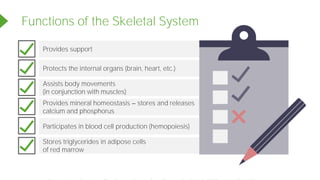
Provides support
Protects the internal organs (brain, heart, etc.)
Assists body movements
(in conjunction with muscles)
Provides mineral homeostasis stores and releases
calcium and phosphorus
Participates in blood cell production (hemopoiesis)
Functions of the Skeletal System
Stores triglycerides in adipose cells
of red marrow
Powered by TCPDF (www.tcpdf.org)
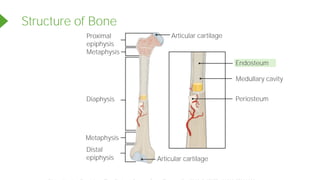
Structure of Bone
Metaphysis
Diaphysis
Metaphysis
Distal
epiphysis
Proximal
epiphysis
Articular cartilage
Articular cartilage
Periosteum
Medullary cavity
Endosteum
Powered by TCPDF (www.tcpdf.org)
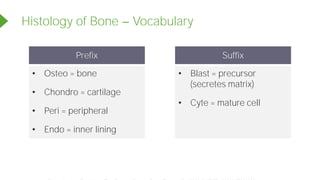
Histology of Bone Vocabulary
Prefix Suffix
• Blast = precursor
(secretes matrix)
• Cyte = mature cell
• Osteo = bone
• Chondro = cartilage
• Peri = peripheral
• Endo = inner lining
Powered by TCPDF (www.tcpdf.org)
Bone contains an abundant extracellular
matrix that surrounds widely separated cells.
Histology of Bone
Powered by TCPDF (www.tcpdf.org)
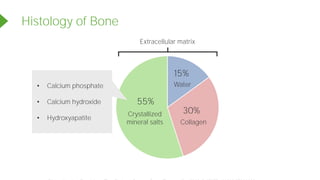
Histology of Bone
15%
55%
Crystallized
mineral salts
Water
• Calcium phosphate
• Calcium hydroxide
• Hydroxyapatite
30%
Collagen
Extracellular matrix
Powered by TCPDF (www.tcpdf.org)
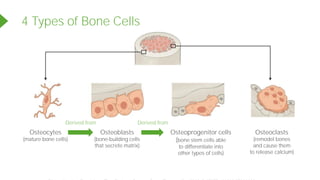
4 Types of Bone Cells
Osteocytes
(mature bone cells)
Osteoblasts
(bone-building cells
that secrete matrix)
Osteoclasts
(remodel bones
and cause them
to release calcium)
Osteoprogenitor cells
(bone stem cells able
to differentiate into
other types of cells)
Derived from Derived from
Powered by TCPDF (www.tcpdf.org)
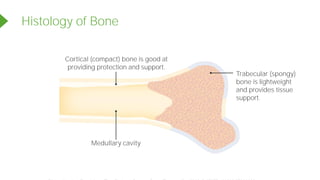
Histology of Bone
Trabecular (spongy)
bone is lightweight
and provides tissue
support.
Cortical (compact) bone is good at
providing protection and support.
Medullary cavity
Powered by TCPDF (www.tcpdf.org)
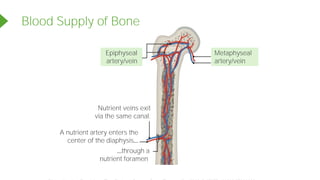
Blood Supply of Bone
Epiphyseal
artery/vein
Metaphyseal
artery/vein
Nutrient veins exit
via the same canal.
A nutrient artery enters the
center of the diaphysis
through a
nutrient foramen
Powered by TCPDF (www.tcpdf.org)
Ossification (osteogenesis) is the process of
bone formation.
Bone Formation
Powered by TCPDF (www.tcpdf.org)
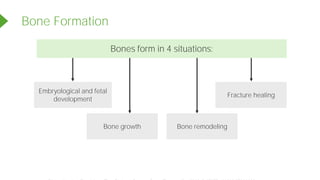
Bone Formation
Embryological and fetal
development
Bone growth
Fracture healing
Bone remodeling
Bones form in 4 situations:
Powered by TCPDF (www.tcpdf.org)
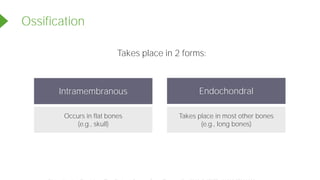
Ossification
Intramembranous
Takes place in 2 forms:
Endochondral
Occurs in flat bones
(e.g., skull)
Takes place in most other bones
(e.g., long bones)
Powered by TCPDF (www.tcpdf.org)
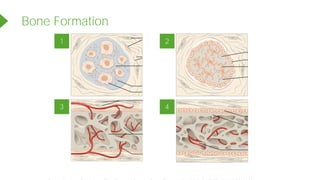
Bone Formation
1 2
4
3
Powered by TCPDF (www.tcpdf.org)
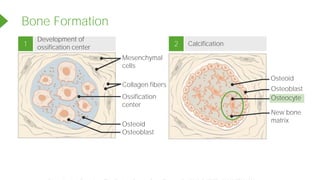
Bone Formation
Osteoid
Mesenchymal
cells
Ossification
center
Osteoid
1 2
Osteoblast
Osteoblast
New bone
matrix
Osteocyte
Collagen fibers
Development of
ossification center
Calcification
Powered by TCPDF (www.tcpdf.org)
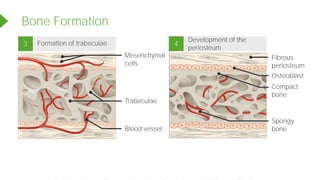
Bone Formation
3 4
Fibrous
periosteum
Osteoblast
Compact
bone
Spongy
bone
Mesenchymal
cells
Trabeculae
Blood vessel
Development of the
periosteum
Formation of trabeculae
Powered by TCPDF (www.tcpdf.org)
Endochondral ossification replaces
cartilage with bone in the developing
embryo and fetus.
Bone Formation
Powered by TCPDF (www.tcpdf.org)
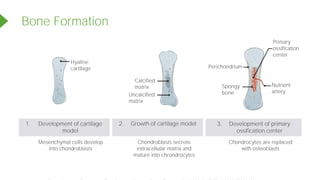
Bone Formation
Hyaline
cartilage
Calcified
matrix
Uncalcified
matrix
Primary
ossification
center
Nutrient
artery
Spongy
bone
Perichondrium
1. Development of cartilage
model
2. Growth of cartilage model 3. Development of primary
ossification center
Mesenchymal cells develop
into chondroblasts
Chondroblasts secrete
extracellular matrix and
mature into chrondrocytes
Chondrocytes are replaced
with osteoblasts
Powered by TCPDF (www.tcpdf.org)
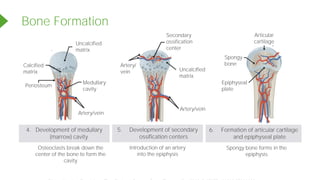
Bone Formation
5. Development of secondary
ossification centers
6. Formation of articular cartilage
and epiphyseal plate
Osteoclasts break down the
center of the bone to form the
cavity
Introduction of an artery
into the epiphysis
Spongy bone forms in the
epiphysis
Uncalcified
matrix
Medullary
cavity
Periosteum
Calcified
matrix Uncalcified
matrix
Secondary
ossification
center
Articular
cartilage
Spongy
bone
Epiphyseal
plate
Artery/
vein
Artery/vein
4. Development of medullary
(marrow) cavity
Artery/vein
Powered by TCPDF (www.tcpdf.org)
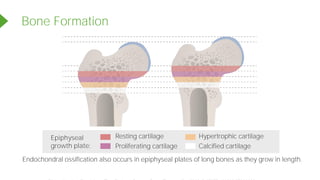
Endochondral ossification also occurs in epiphyseal plates of long bones as they grow in length.
Bone Formation
Resting cartilage
Proliferating cartilage
Hypertrophic cartilage
Calcified cartilage
Epiphyseal
growth plate:
Powered by TCPDF (www.tcpdf.org)
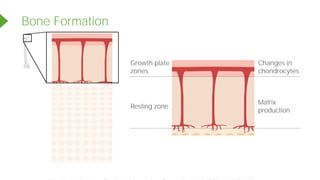
Bone Formation
<<<<<
Growth plate
zones
Changes in
chondrocytes
Matrix
production
Resting zone
Powered by TCPDF (www.tcpdf.org)
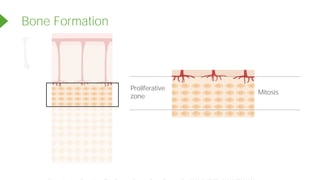
Bone Formation
<<<<<
Mitosis
Proliferative
zone
Powered by TCPDF (www.tcpdf.org)
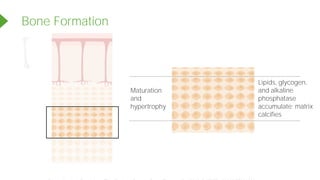
Bone Formation
<<<<<
Lipids, glycogen,
and alkaline
phosphatase
accumulate; matrix
calcifies
Maturation
and
hypertrophy
Powered by TCPDF (www.tcpdf.org)
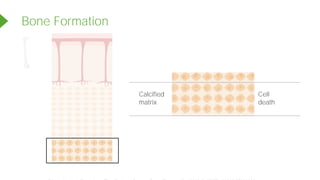
Bone Formation
<<<<<
Cell
death
Calcified
matrix
Powered by TCPDF (www.tcpdf.org)
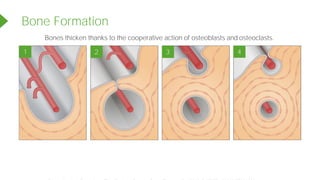
Bones thicken thanks to the cooperative action of osteoblasts and osteoclasts.
Bone Formation
1 2 3 4
Powered by TCPDF (www.tcpdf.org)
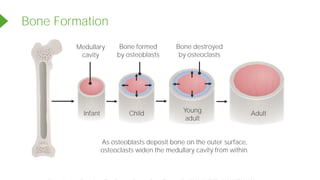
As osteoblasts deposit bone on the outer surface,
osteoclasts widen the medullary cavity from within.
Bone Formation
Infant Child Young
adult
Adult
Bone formed
by osteoblasts
Bone destroyed
by osteoclasts
Medullary
cavity
Powered by TCPDF (www.tcpdf.org)
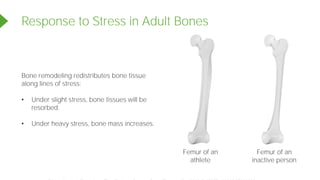
Response to Stress in Adult Bones
Bone remodeling redistributes bone tissue
along lines of stress:
• Under slight stress, bone tissues will be
resorbed.
• Under heavy stress, bone mass increases.
Femur of an
inactive person
Femur of an
athlete
Powered by TCPDF (www.tcpdf.org)
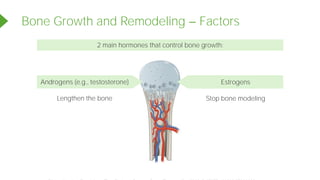
Bone Growth and Remodeling Factors
Androgens (e.g., testosterone)
2 main hormones that control bone growth:
Estrogens
Lengthen the bone Stop bone modeling
Powered by TCPDF (www.tcpdf.org)
A fracture is a break in a bone. Many different
types of fractures may occur.
Fracture
Powered by TCPDF (www.tcpdf.org)
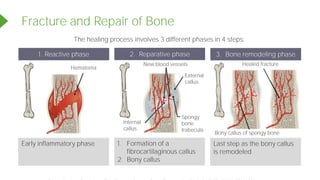
The healing process involves 3 different phases in 4 steps:
Fracture and Repair of Bone
Healed fracture
1. Reactive phase 2. Reparative phase 3. Bone remodeling phase
Early inflammatory phase 1. Formation of a
fibrocartilaginous callus
2. Bony callus
Last step as the bony callus
is remodeled
Bony callus of spongy bone
Hematoma
New blood vessels
External
callus
Spongy
bone
trabecula
Internal
callus
Powered by TCPDF (www.tcpdf.org)
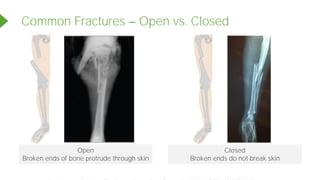
Common Fractures Open vs. Closed
Open
Broken ends of bone protrude through skin
Closed
Broken ends do not break skin
Powered by TCPDF (www.tcpdf.org)
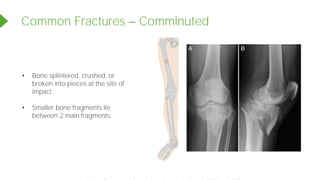
Common Fractures Comminuted
• Bone splintered, crushed, or
broken into pieces at the site of
impact
• Smaller bone fragments lie
between 2 main fragments
Powered by TCPDF (www.tcpdf.org)
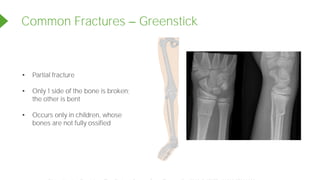
Common Fractures Greenstick
• Partial fracture
• Only 1 side of the bone is broken;
the other is bent
• Occurs only in children, whose
bones are not fully ossified
Powered by TCPDF (www.tcpdf.org)
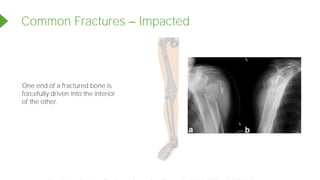
Common Fractures Impacted
One end of a fractured bone is
forcefully driven into the interior
of the other.
Powered by TCPDF (www.tcpdf.org)
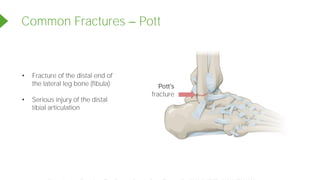
Common Fractures Pott
• Fracture of the distal end of
the lateral leg bone (fibula)
• Serious injury of the distal
tibial articulation
fracture
Powered by TCPDF (www.tcpdf.org)
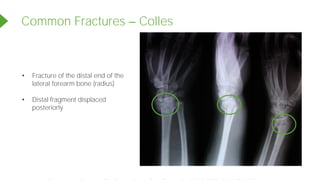
Common Fractures Colles
• Fracture of the distal end of the
lateral forearm bone (radius)
• Distal fragment displaced
posteriorly
Powered by TCPDF (www.tcpdf.org)
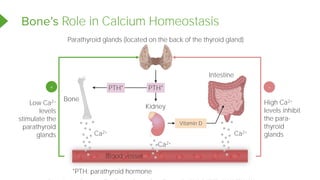
Role in Calcium Homeostasis
Parathyroid glands (located on the back of the thyroid gland)
Intestine
Bone
Kidney
Blood vessel
Ca2+
Ca2+
Ca2+
PTH*
Vitamin D
PTH*
+
Low Ca2+
levels
stimulate the
parathyroid
glands
-
High Ca2+
levels inhibit
the para-
thyroid
glands
*PTH: parathyroid hormone
Powered by TCPDF (www.tcpdf.org)
In a Nutshell
✓ The skeletal system includes all of the
bones of the body.
✓ The functions of the skeletal system are to:
provide support, protect internal organs,
assist in body movements, help establish
mineral homeostasis, produce red blood
cells, and store triglycerides.
✓ Bone tissue contains 4 cell types:
osteocytes, osteoblasts, osteoclast, and
osteoprogenitor cells.
Powered by TCPDF (www.tcpdf.org)
In a Nutshell
✓ There are 2 types of bone formation:
intramembranous and endochondral
ossification.
✓ Homeostatic imbalance in the skeletal
system can include bone fracture and
certain diseases, such as osteoporosis.
Powered by TCPDF (www.tcpdf.org)

05 The Skeletal System - Bone Tissue (1).pdf

  • 1.
    Powered by TCPDF(www.tcpdf.org) The Skeletal System: Bone Tissue Principles of Anatomy and Physiology
  • 2.
    Bones are complexorgans that contain many elements including blood vessels, nerves, cartiladge and specialized bone cells. The entire framework of the body is made up of bones and their cartilages, which constitute the skeletal system. Bone Powered by TCPDF (www.tcpdf.org)
  • 3.
    Provides support Protects theinternal organs (brain, heart, etc.) Assists body movements (in conjunction with muscles) Provides mineral homeostasis stores and releases calcium and phosphorus Participates in blood cell production (hemopoiesis) Functions of the Skeletal System Stores triglycerides in adipose cells of red marrow Powered by TCPDF (www.tcpdf.org)
  • 4.
    Structure of Bone Metaphysis Diaphysis Metaphysis Distal epiphysis Proximal epiphysis Articularcartilage Articular cartilage Periosteum Medullary cavity Endosteum Powered by TCPDF (www.tcpdf.org)
  • 5.
    Histology of BoneVocabulary Prefix Suffix • Blast = precursor (secretes matrix) • Cyte = mature cell • Osteo = bone • Chondro = cartilage • Peri = peripheral • Endo = inner lining Powered by TCPDF (www.tcpdf.org)
  • 6.
    Bone contains anabundant extracellular matrix that surrounds widely separated cells. Histology of Bone Powered by TCPDF (www.tcpdf.org)
  • 7.
    Histology of Bone 15% 55% Crystallized mineralsalts Water • Calcium phosphate • Calcium hydroxide • Hydroxyapatite 30% Collagen Extracellular matrix Powered by TCPDF (www.tcpdf.org)
  • 8.
    4 Types ofBone Cells Osteocytes (mature bone cells) Osteoblasts (bone-building cells that secrete matrix) Osteoclasts (remodel bones and cause them to release calcium) Osteoprogenitor cells (bone stem cells able to differentiate into other types of cells) Derived from Derived from Powered by TCPDF (www.tcpdf.org)
  • 9.
    Histology of Bone Trabecular(spongy) bone is lightweight and provides tissue support. Cortical (compact) bone is good at providing protection and support. Medullary cavity Powered by TCPDF (www.tcpdf.org)
  • 10.
    Blood Supply ofBone Epiphyseal artery/vein Metaphyseal artery/vein Nutrient veins exit via the same canal. A nutrient artery enters the center of the diaphysis through a nutrient foramen Powered by TCPDF (www.tcpdf.org)
  • 11.
    Ossification (osteogenesis) isthe process of bone formation. Bone Formation Powered by TCPDF (www.tcpdf.org)
  • 12.
    Bone Formation Embryological andfetal development Bone growth Fracture healing Bone remodeling Bones form in 4 situations: Powered by TCPDF (www.tcpdf.org)
  • 13.
    Ossification Intramembranous Takes place in2 forms: Endochondral Occurs in flat bones (e.g., skull) Takes place in most other bones (e.g., long bones) Powered by TCPDF (www.tcpdf.org)
  • 14.
    Bone Formation 1 2 4 3 Poweredby TCPDF (www.tcpdf.org)
  • 15.
    Bone Formation Osteoid Mesenchymal cells Ossification center Osteoid 1 2 Osteoblast Osteoblast Newbone matrix Osteocyte Collagen fibers Development of ossification center Calcification Powered by TCPDF (www.tcpdf.org)
  • 16.
    Bone Formation 3 4 Fibrous periosteum Osteoblast Compact bone Spongy bone Mesenchymal cells Trabeculae Bloodvessel Development of the periosteum Formation of trabeculae Powered by TCPDF (www.tcpdf.org)
  • 17.
    Endochondral ossification replaces cartilagewith bone in the developing embryo and fetus. Bone Formation Powered by TCPDF (www.tcpdf.org)
  • 18.
    Bone Formation Hyaline cartilage Calcified matrix Uncalcified matrix Primary ossification center Nutrient artery Spongy bone Perichondrium 1. Developmentof cartilage model 2. Growth of cartilage model 3. Development of primary ossification center Mesenchymal cells develop into chondroblasts Chondroblasts secrete extracellular matrix and mature into chrondrocytes Chondrocytes are replaced with osteoblasts Powered by TCPDF (www.tcpdf.org)
  • 19.
    Bone Formation 5. Developmentof secondary ossification centers 6. Formation of articular cartilage and epiphyseal plate Osteoclasts break down the center of the bone to form the cavity Introduction of an artery into the epiphysis Spongy bone forms in the epiphysis Uncalcified matrix Medullary cavity Periosteum Calcified matrix Uncalcified matrix Secondary ossification center Articular cartilage Spongy bone Epiphyseal plate Artery/ vein Artery/vein 4. Development of medullary (marrow) cavity Artery/vein Powered by TCPDF (www.tcpdf.org)
  • 20.
    Endochondral ossification alsooccurs in epiphyseal plates of long bones as they grow in length. Bone Formation Resting cartilage Proliferating cartilage Hypertrophic cartilage Calcified cartilage Epiphyseal growth plate: Powered by TCPDF (www.tcpdf.org)
  • 21.
    Bone Formation <<<<< Growth plate zones Changesin chondrocytes Matrix production Resting zone Powered by TCPDF (www.tcpdf.org)
  • 22.
  • 23.
    Bone Formation <<<<< Lipids, glycogen, andalkaline phosphatase accumulate; matrix calcifies Maturation and hypertrophy Powered by TCPDF (www.tcpdf.org)
  • 24.
  • 25.
    Bones thicken thanksto the cooperative action of osteoblasts and osteoclasts. Bone Formation 1 2 3 4 Powered by TCPDF (www.tcpdf.org)
  • 26.
    As osteoblasts depositbone on the outer surface, osteoclasts widen the medullary cavity from within. Bone Formation Infant Child Young adult Adult Bone formed by osteoblasts Bone destroyed by osteoclasts Medullary cavity Powered by TCPDF (www.tcpdf.org)
  • 27.
    Response to Stressin Adult Bones Bone remodeling redistributes bone tissue along lines of stress: • Under slight stress, bone tissues will be resorbed. • Under heavy stress, bone mass increases. Femur of an inactive person Femur of an athlete Powered by TCPDF (www.tcpdf.org)
  • 28.
    Bone Growth andRemodeling Factors Androgens (e.g., testosterone) 2 main hormones that control bone growth: Estrogens Lengthen the bone Stop bone modeling Powered by TCPDF (www.tcpdf.org)
  • 29.
    A fracture isa break in a bone. Many different types of fractures may occur. Fracture Powered by TCPDF (www.tcpdf.org)
  • 30.
    The healing processinvolves 3 different phases in 4 steps: Fracture and Repair of Bone Healed fracture 1. Reactive phase 2. Reparative phase 3. Bone remodeling phase Early inflammatory phase 1. Formation of a fibrocartilaginous callus 2. Bony callus Last step as the bony callus is remodeled Bony callus of spongy bone Hematoma New blood vessels External callus Spongy bone trabecula Internal callus Powered by TCPDF (www.tcpdf.org)
  • 31.
    Common Fractures Openvs. Closed Open Broken ends of bone protrude through skin Closed Broken ends do not break skin Powered by TCPDF (www.tcpdf.org)
  • 32.
    Common Fractures Comminuted •Bone splintered, crushed, or broken into pieces at the site of impact • Smaller bone fragments lie between 2 main fragments Powered by TCPDF (www.tcpdf.org)
  • 33.
    Common Fractures Greenstick •Partial fracture • Only 1 side of the bone is broken; the other is bent • Occurs only in children, whose bones are not fully ossified Powered by TCPDF (www.tcpdf.org)
  • 34.
    Common Fractures Impacted Oneend of a fractured bone is forcefully driven into the interior of the other. Powered by TCPDF (www.tcpdf.org)
  • 35.
    Common Fractures Pott •Fracture of the distal end of the lateral leg bone (fibula) • Serious injury of the distal tibial articulation fracture Powered by TCPDF (www.tcpdf.org)
  • 36.
    Common Fractures Colles •Fracture of the distal end of the lateral forearm bone (radius) • Distal fragment displaced posteriorly Powered by TCPDF (www.tcpdf.org)
  • 37.
    Role in CalciumHomeostasis Parathyroid glands (located on the back of the thyroid gland) Intestine Bone Kidney Blood vessel Ca2+ Ca2+ Ca2+ PTH* Vitamin D PTH* + Low Ca2+ levels stimulate the parathyroid glands - High Ca2+ levels inhibit the para- thyroid glands *PTH: parathyroid hormone Powered by TCPDF (www.tcpdf.org)
  • 38.
    In a Nutshell ✓The skeletal system includes all of the bones of the body. ✓ The functions of the skeletal system are to: provide support, protect internal organs, assist in body movements, help establish mineral homeostasis, produce red blood cells, and store triglycerides. ✓ Bone tissue contains 4 cell types: osteocytes, osteoblasts, osteoclast, and osteoprogenitor cells. Powered by TCPDF (www.tcpdf.org)
  • 39.
    In a Nutshell ✓There are 2 types of bone formation: intramembranous and endochondral ossification. ✓ Homeostatic imbalance in the skeletal system can include bone fracture and certain diseases, such as osteoporosis. Powered by TCPDF (www.tcpdf.org)
  • 40.
    Powered by TCPDF(www.tcpdf.org) Powered by TCPDF (www.tcpdf.org)