Use Case  загварчлал Сем №4
Хичээлийн агуулга Use Case  гэж юу вэ  ? Use Case -үүдийн ашиг тус Use Case  загварын хөгжүүлэлт System -систем Actor -оролцогч Use Case Use Case -ийн холбоосууд Example: TVRS Use Cases Use Case Modeling
What is a Use Case? Ivar Jacobson  гэдэг хүн  1994  онд үүсгэсэн. Use case  нь систем дэхь үйлдлүүдийн дараалал юм.  Use case- ийн гол үйлдэл нь системийн оролцогчид хийх зүйлийнх нь үр дүнг тодорхой болгож үзүүлэх.  Систем ЮУ хийдэг гэдгийг оролцогчын төсөөллөөр тодорхойлдог.  Use Case Model  бол обьект хандалтат загварчилгааны техник БИШ. Use Case Modeling
Benefits of Use Cases Хэрэглэгчийн төсөөллөөс гарсан үйл ажиллагааны шаардлагуудыг цуглуулна.  Систем юу хийх вэ гэдгийн ойлгомжтой тайлбарыг өгдөг.  Системийн тестүүдийг хийх нөхцөлүүдийг  Систем дэхь үйлдлүүд болон классуудыг функционал шаардлагуудаас алхам бүрээр гаргах боломжыг олгоно. Use Case Modeling
UML Use Case Diagrams A Use Case  загвар нь нэг эсвэл олон  Use case  диаграммуудаар   энэ нь  UML -ээр  (Unified Modeling Language)  илэрхийлэгддэг. UCD  нь 4 гол элементтэй : System -   тодорхойлогдсон Actors - систем хэнтэй харилцах  use-case -үүд ,  эсвэл үйлчилгээнүүд –   систем хэрхэн гүйцэтгэгдэх relationships   – дээрх элементүүдийн хамаарлууд Use Case Modeling
System Use case  загварчилалын нэг алхам нь  системийн хүрээ хязгаарыг  тодорхойлсон байх ёстой. Системийн хүрээнд ач холбогдолгүй зүйлийг тодорхойлох шаардлагагүй. Аль даалгаварууд нь автоматаар, аль нь гараар гүйцэтгэгдэх вэ  ? Ямар даалгаварууд нь өөр системүүдээр гүйцэтгэгдэх вэ  ? Бүх шийдлийг системийн хүрээ хязгаарт оруулан хангана.  Өссөн хувилбараар Use Case Modeling
System (cont.) UCD- д системийг тэгш өнцөгтөөр харуулна.  Тэгш өнцөгтийн дотор талын дээр системийн нэрийг харуулдаг. Use Case Modeling Traffic Violations Report System
Actor Хэн нэг эсвэл ямар нэг юм системтэй харьцана ( мэдээлэл солилцоно ) . Оролцогч дүрүүд нь системтэй яаж харилцан үйлдэл хийхийг харуулна.  Жишээ нь : Цагдаагийн ажилтан –  өгөгдөл оруулна Ахлах ажилтан –  өөрчлөлт хийнэ / өгөгдөл устгана   Менежер – Статистик мэдээ харна Нэг хэрэглэгч магадгүй нэгээс олон дүрийг гүйцэтгэнэ. Use Case Modeling
Actor ( үргэлж .) Оролцогчид нь зорилгуудтай : Замын зөрчлийг нэмэх Замын зөрчлийг үзэх Оролцогч нь заавал хүн байх албагүй. Магадгүй өөр гадны систем, тэр нь хөгжигдсэн системтэй холбогдоно. Оролцогч нь дүртэй холбоотой нэрлэгдэнэ. Use Case Modeling
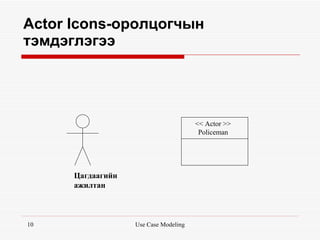
Actor Icons -оролцогчын тэмдэглэгээ  Use Case Modeling Цагдаагийн  ажилтан << Actor >> Policeman
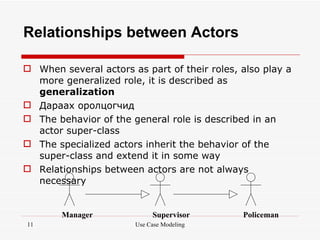
Relationships between Actors When several actors as part of their roles, also play a more generalized role, it is described as  generalization Дараах оролцогчид  The behavior of the general role is described in an actor super-class   The specialized actors inherit the behavior of the super-class and extend it in some way Relationships between actors are not always necessary Use Case Modeling Policeman Supervisor Manager
Use Case Represent a complete behavior as perceived by an actor A use case satisfies an actor’s goal Always initiated by an actor A use case is complete Don’t divide a use case into smaller use cases that implement each other (functional decomposition) Use Case Modeling
Use Case Description The scenarios of a use case are normally described textually A simple and consistent specification about how the actors and the system interact Use case description template Describe at the level of user intentions and system responses Free of technology and mechanism details, especially those related to user interface Use Case Modeling
UC Description Template Name Name of use case, usually close to the user’s goal Forward traceability (unique) Actors Goal description Reference to requirements Backward traceability Pre-conditions The necessary conditions before the use case can be performed Could be other Use Cases as well Description A description of the basic or normal course that should be taken by the system if the system should perform as intended Use Case Modeling
UC Description Template (cont.) Post-conditions The state of the system after the use case is performed The value delivered to the actor Distinguishes between variations and exceptions Variations Expected condition causing the branch Description of the alternative course or name of the  extending  Use Case Exceptions Unexpected condition causing the branch (conflicts with post-condition) Description of the alternative course Use Case Modeling
Use Case (cont.) Use Case Icon An ellipsis containing the name of the Use Case Placed inside the boundaries of the modeled system Connected to at least one actor with a communication association Except for specialized / extending use cases. Use Case Modeling Add Traffic Violation Traffic Violations Report system Policeman
Use Case Relationships Generalization : A generalized Use Case describes the common of other specialized Use Cases. Inclusion:  A Use Case is a part of another Use Case. Extension:  A Use Case may extend another Use Case. Use Case Modeling
Generalization Relationships Used when a number of Use Cases all have some subtasks in common, but each one has something different about it  The generalized and specialized use cases share the same goal A specialized Use Case may capture an alternative scenario of the generalized Use Case The Specialized use case may interact with new actors.  The Specialized use case may add pre-conditions and post-conditions (AND semantics). Use Case Modeling Specialized Generalized
Include Relationship In older versions: “uses”  When a number of Use Cases have common behavior, which can be modeled in a single use case  X << includes >> Y indicates that the process of doing X always involves doing Y at least once The included Use Case must be complete X must satisfy the pre-conditions of Y before including it Not necessarily preserves the pre or post conditions. Use Case Modeling << include >> X Y
Extend Relationship Serves as extension point to another Use Case The extended Use Case must explicitly declare its extension points The extension conditions of the extended Use Case are part of the pre-conditions (AND semantics) Use Case Modeling << extend >> (9: OffendersDB replies) New Offender Add T.R . (9: OffendersDB replies)
Recommended Workflow Identify actors (and their relationships if necessary) For each actor identified and until no new UC is discovered do Find all the goals of the actor Decide on the main course of success for each goal Create a Use Case for each of the goals New actors/goals may be discovered Validate/correct existing Use Cases Draw the Use Case diagram Simplify model by repeating the process incase the produced diagram is too complex Use Case Modeling
Example:  TVRS Use Cases
TVRS Use Case Model Use Case Modeling Remove T.V Lookup T.V Replace Offender New Offender Edit T.V. (8) Add T.V. (9) Policeman Supervisor Traffic Violations Report System <<extend>> <<extend>> <<include>> OffendersDB PolicemenDB
TVRS - Remove TV Name: Remove Traffic Violation Actors: Supervisor, OffendersDB. Goal: Remove an existing Traffic Violation References to requirements: 1.2.3, 1.3.2.4, … Pre-conditions: Normal Course of “Lookup Traffic Violation” UC is completed, and the details of an existing Traffic Violation are displayed Description: Supervisor calls for deletion of the chosen Traffic Violation TVRS prompts Supervisor for confirmation Use Case Modeling External System
TVRS - Remove TV Supervisor confirms TVRS requests OffendersDB to delete the Traffic Violation from the offender’s record OffendersDB approves that the Traffic Violation has been deleted TVRS allows Supervisor to look up a new Traffic Violation as described in the “Lookup Traffic Violation” UC Post-conditions:  Removed Traffic Violation is no longer stored in the TVRS. Traffic Violation is removed from the offender’s record in the OffendersDB &quot;Lookup Traffic Violation&quot; form is displayed Use Case Modeling
TVRS - Remove TV Exceptions: 3a: Supervisor cancels: 3a1: TVRS Continues to item 6 without removing the Traffic Violation 5a: Traffic Violation is not removed from the OffendersDB 5a1: TVRS displays an error message describing the failure 5a2: TVRS continues to item  6 without clearing chosen Traffic Violation details, and without deleting the Traffic Violation Use Case Modeling Goal is not fulfilled
TVRS - Add TV Name: Add Traffic Violation Actors: Policeman, PolicemenDB, OffendersDB,  Traffic Violation. Goal: Add a new Traffic Violation to OffendersDB. References to requirements: … Pre-conditions: Pliceman tries to add Traffic Violation. Description: Policeman calls for addition of a new Traffic Violation TVRS displays an empty Traffic Violation Details form Policeman enters violation details and calls for saving the new Traffic Violation Use Case Modeling TVRS The Traffic Violation Management window is displayed 1.  Policeman presses “Add” button (With planted mistakes)
TVRS - Add TV TVRS prompts Policeman for confirmation. Policeman confirms 6. PolocemenDB is asked whether or not the policeman is known 7. PolicemenDB replies that the policeman is known 8. TVRS asks the OffendersDB whether or not the offender is known 9.   OffendersDB replies that the offender is known … Use Case Modeling TVRS asks PolicemenDB Always? Always! (With planted mistakes) [Extenstion Point]
TVRS - Add TV Post-conditions: New Traffic Violation is stored in the TVRS TVRS displays an empty Traffic Violation Details form Variations: 5a: Policeman cancels   5a1: TVRS shows error message and closes Traffic Violation    Management window.  5a1: TVRS continues to item 2 without clearing the traffic violation details entered by Policeman 9a: OffendersDB replies that the offender is not known. Described in Use Case “New Offender” 7a: Policeman is not stored in the PolicemenDB 7a1: TVRS displays an error message 7a2: TVRS continues to item 2 without clearing Traffic Violation details entered by Policeman ... Use Case Modeling Goal may be fulfilled (With planted mistakes)
TVRS - Add TV Exceptions: 3a: Policeman cancels addition of the new Traffic Violation 3a1: TVRS continues to item 2 without clearing    the traffic violation details entered by      Policeman 3a1: TVRS displays the &quot;Traffic Violation    Management&quot; window without adding the    Traffic Violation … Use Case Modeling Use Case terminated (With planted mistakes)
TVRS – New Offender Name: New Offender [extends “Add Traffic Violaton” ] Actors: Goal:  References to requirements: … Pre-conditions: Offender is not stored in the OffendersDB Use Case Modeling
TVRS – New Offender Description: 9a: OffendersDB replies that the offender is not known. [Add Traffic Violation] 9b: TVRS displays an empty “Offender Details form” 9c: Policeman enters offender details and calls for saving the new details 9d: TVRS prompts Policeman for confirmation 9e: Policeman confirms 9f: TVRS requests OffendersDB to store the new offender 9g: OffendersDB replies that offender was stored successfully Post-conditions: New Offender is stored in the offenders DB ... Use Case Modeling
Rational Rose™ Use Case Modeling

05 use-case-modeling-1mon

  • 1.
    Use Case загварчлал Сем №4
  • 2.
    Хичээлийн агуулга UseCase гэж юу вэ ? Use Case -үүдийн ашиг тус Use Case загварын хөгжүүлэлт System -систем Actor -оролцогч Use Case Use Case -ийн холбоосууд Example: TVRS Use Cases Use Case Modeling
  • 3.
    What is aUse Case? Ivar Jacobson гэдэг хүн 1994 онд үүсгэсэн. Use case нь систем дэхь үйлдлүүдийн дараалал юм. Use case- ийн гол үйлдэл нь системийн оролцогчид хийх зүйлийнх нь үр дүнг тодорхой болгож үзүүлэх. Систем ЮУ хийдэг гэдгийг оролцогчын төсөөллөөр тодорхойлдог. Use Case Model бол обьект хандалтат загварчилгааны техник БИШ. Use Case Modeling
  • 4.
    Benefits of UseCases Хэрэглэгчийн төсөөллөөс гарсан үйл ажиллагааны шаардлагуудыг цуглуулна. Систем юу хийх вэ гэдгийн ойлгомжтой тайлбарыг өгдөг. Системийн тестүүдийг хийх нөхцөлүүдийг Систем дэхь үйлдлүүд болон классуудыг функционал шаардлагуудаас алхам бүрээр гаргах боломжыг олгоно. Use Case Modeling
  • 5.
    UML Use CaseDiagrams A Use Case загвар нь нэг эсвэл олон Use case диаграммуудаар энэ нь UML -ээр (Unified Modeling Language) илэрхийлэгддэг. UCD нь 4 гол элементтэй : System - тодорхойлогдсон Actors - систем хэнтэй харилцах use-case -үүд , эсвэл үйлчилгээнүүд – систем хэрхэн гүйцэтгэгдэх relationships – дээрх элементүүдийн хамаарлууд Use Case Modeling
  • 6.
    System Use case загварчилалын нэг алхам нь системийн хүрээ хязгаарыг тодорхойлсон байх ёстой. Системийн хүрээнд ач холбогдолгүй зүйлийг тодорхойлох шаардлагагүй. Аль даалгаварууд нь автоматаар, аль нь гараар гүйцэтгэгдэх вэ ? Ямар даалгаварууд нь өөр системүүдээр гүйцэтгэгдэх вэ ? Бүх шийдлийг системийн хүрээ хязгаарт оруулан хангана. Өссөн хувилбараар Use Case Modeling
  • 7.
    System (cont.) UCD-д системийг тэгш өнцөгтөөр харуулна. Тэгш өнцөгтийн дотор талын дээр системийн нэрийг харуулдаг. Use Case Modeling Traffic Violations Report System
  • 8.
    Actor Хэн нэгэсвэл ямар нэг юм системтэй харьцана ( мэдээлэл солилцоно ) . Оролцогч дүрүүд нь системтэй яаж харилцан үйлдэл хийхийг харуулна. Жишээ нь : Цагдаагийн ажилтан – өгөгдөл оруулна Ахлах ажилтан – өөрчлөлт хийнэ / өгөгдөл устгана Менежер – Статистик мэдээ харна Нэг хэрэглэгч магадгүй нэгээс олон дүрийг гүйцэтгэнэ. Use Case Modeling
  • 9.
    Actor ( үргэлж.) Оролцогчид нь зорилгуудтай : Замын зөрчлийг нэмэх Замын зөрчлийг үзэх Оролцогч нь заавал хүн байх албагүй. Магадгүй өөр гадны систем, тэр нь хөгжигдсэн системтэй холбогдоно. Оролцогч нь дүртэй холбоотой нэрлэгдэнэ. Use Case Modeling
  • 10.
    Actor Icons -оролцогчынтэмдэглэгээ Use Case Modeling Цагдаагийн ажилтан << Actor >> Policeman
  • 11.
    Relationships between ActorsWhen several actors as part of their roles, also play a more generalized role, it is described as generalization Дараах оролцогчид The behavior of the general role is described in an actor super-class The specialized actors inherit the behavior of the super-class and extend it in some way Relationships between actors are not always necessary Use Case Modeling Policeman Supervisor Manager
  • 12.
    Use Case Representa complete behavior as perceived by an actor A use case satisfies an actor’s goal Always initiated by an actor A use case is complete Don’t divide a use case into smaller use cases that implement each other (functional decomposition) Use Case Modeling
  • 13.
    Use Case DescriptionThe scenarios of a use case are normally described textually A simple and consistent specification about how the actors and the system interact Use case description template Describe at the level of user intentions and system responses Free of technology and mechanism details, especially those related to user interface Use Case Modeling
  • 14.
    UC Description TemplateName Name of use case, usually close to the user’s goal Forward traceability (unique) Actors Goal description Reference to requirements Backward traceability Pre-conditions The necessary conditions before the use case can be performed Could be other Use Cases as well Description A description of the basic or normal course that should be taken by the system if the system should perform as intended Use Case Modeling
  • 15.
    UC Description Template(cont.) Post-conditions The state of the system after the use case is performed The value delivered to the actor Distinguishes between variations and exceptions Variations Expected condition causing the branch Description of the alternative course or name of the extending Use Case Exceptions Unexpected condition causing the branch (conflicts with post-condition) Description of the alternative course Use Case Modeling
  • 16.
    Use Case (cont.)Use Case Icon An ellipsis containing the name of the Use Case Placed inside the boundaries of the modeled system Connected to at least one actor with a communication association Except for specialized / extending use cases. Use Case Modeling Add Traffic Violation Traffic Violations Report system Policeman
  • 17.
    Use Case RelationshipsGeneralization : A generalized Use Case describes the common of other specialized Use Cases. Inclusion: A Use Case is a part of another Use Case. Extension: A Use Case may extend another Use Case. Use Case Modeling
  • 18.
    Generalization Relationships Usedwhen a number of Use Cases all have some subtasks in common, but each one has something different about it The generalized and specialized use cases share the same goal A specialized Use Case may capture an alternative scenario of the generalized Use Case The Specialized use case may interact with new actors. The Specialized use case may add pre-conditions and post-conditions (AND semantics). Use Case Modeling Specialized Generalized
  • 19.
    Include Relationship Inolder versions: “uses” When a number of Use Cases have common behavior, which can be modeled in a single use case X << includes >> Y indicates that the process of doing X always involves doing Y at least once The included Use Case must be complete X must satisfy the pre-conditions of Y before including it Not necessarily preserves the pre or post conditions. Use Case Modeling << include >> X Y
  • 20.
    Extend Relationship Servesas extension point to another Use Case The extended Use Case must explicitly declare its extension points The extension conditions of the extended Use Case are part of the pre-conditions (AND semantics) Use Case Modeling << extend >> (9: OffendersDB replies) New Offender Add T.R . (9: OffendersDB replies)
  • 21.
    Recommended Workflow Identifyactors (and their relationships if necessary) For each actor identified and until no new UC is discovered do Find all the goals of the actor Decide on the main course of success for each goal Create a Use Case for each of the goals New actors/goals may be discovered Validate/correct existing Use Cases Draw the Use Case diagram Simplify model by repeating the process incase the produced diagram is too complex Use Case Modeling
  • 22.
    Example: TVRSUse Cases
  • 23.
    TVRS Use CaseModel Use Case Modeling Remove T.V Lookup T.V Replace Offender New Offender Edit T.V. (8) Add T.V. (9) Policeman Supervisor Traffic Violations Report System <<extend>> <<extend>> <<include>> OffendersDB PolicemenDB
  • 24.
    TVRS - RemoveTV Name: Remove Traffic Violation Actors: Supervisor, OffendersDB. Goal: Remove an existing Traffic Violation References to requirements: 1.2.3, 1.3.2.4, … Pre-conditions: Normal Course of “Lookup Traffic Violation” UC is completed, and the details of an existing Traffic Violation are displayed Description: Supervisor calls for deletion of the chosen Traffic Violation TVRS prompts Supervisor for confirmation Use Case Modeling External System
  • 25.
    TVRS - RemoveTV Supervisor confirms TVRS requests OffendersDB to delete the Traffic Violation from the offender’s record OffendersDB approves that the Traffic Violation has been deleted TVRS allows Supervisor to look up a new Traffic Violation as described in the “Lookup Traffic Violation” UC Post-conditions: Removed Traffic Violation is no longer stored in the TVRS. Traffic Violation is removed from the offender’s record in the OffendersDB &quot;Lookup Traffic Violation&quot; form is displayed Use Case Modeling
  • 26.
    TVRS - RemoveTV Exceptions: 3a: Supervisor cancels: 3a1: TVRS Continues to item 6 without removing the Traffic Violation 5a: Traffic Violation is not removed from the OffendersDB 5a1: TVRS displays an error message describing the failure 5a2: TVRS continues to item 6 without clearing chosen Traffic Violation details, and without deleting the Traffic Violation Use Case Modeling Goal is not fulfilled
  • 27.
    TVRS - AddTV Name: Add Traffic Violation Actors: Policeman, PolicemenDB, OffendersDB, Traffic Violation. Goal: Add a new Traffic Violation to OffendersDB. References to requirements: … Pre-conditions: Pliceman tries to add Traffic Violation. Description: Policeman calls for addition of a new Traffic Violation TVRS displays an empty Traffic Violation Details form Policeman enters violation details and calls for saving the new Traffic Violation Use Case Modeling TVRS The Traffic Violation Management window is displayed 1. Policeman presses “Add” button (With planted mistakes)
  • 28.
    TVRS - AddTV TVRS prompts Policeman for confirmation. Policeman confirms 6. PolocemenDB is asked whether or not the policeman is known 7. PolicemenDB replies that the policeman is known 8. TVRS asks the OffendersDB whether or not the offender is known 9. OffendersDB replies that the offender is known … Use Case Modeling TVRS asks PolicemenDB Always? Always! (With planted mistakes) [Extenstion Point]
  • 29.
    TVRS - AddTV Post-conditions: New Traffic Violation is stored in the TVRS TVRS displays an empty Traffic Violation Details form Variations: 5a: Policeman cancels 5a1: TVRS shows error message and closes Traffic Violation Management window. 5a1: TVRS continues to item 2 without clearing the traffic violation details entered by Policeman 9a: OffendersDB replies that the offender is not known. Described in Use Case “New Offender” 7a: Policeman is not stored in the PolicemenDB 7a1: TVRS displays an error message 7a2: TVRS continues to item 2 without clearing Traffic Violation details entered by Policeman ... Use Case Modeling Goal may be fulfilled (With planted mistakes)
  • 30.
    TVRS - AddTV Exceptions: 3a: Policeman cancels addition of the new Traffic Violation 3a1: TVRS continues to item 2 without clearing the traffic violation details entered by Policeman 3a1: TVRS displays the &quot;Traffic Violation Management&quot; window without adding the Traffic Violation … Use Case Modeling Use Case terminated (With planted mistakes)
  • 31.
    TVRS – NewOffender Name: New Offender [extends “Add Traffic Violaton” ] Actors: Goal: References to requirements: … Pre-conditions: Offender is not stored in the OffendersDB Use Case Modeling
  • 32.
    TVRS – NewOffender Description: 9a: OffendersDB replies that the offender is not known. [Add Traffic Violation] 9b: TVRS displays an empty “Offender Details form” 9c: Policeman enters offender details and calls for saving the new details 9d: TVRS prompts Policeman for confirmation 9e: Policeman confirms 9f: TVRS requests OffendersDB to store the new offender 9g: OffendersDB replies that offender was stored successfully Post-conditions: New Offender is stored in the offenders DB ... Use Case Modeling
  • 33.
    Rational Rose™ UseCase Modeling