Servicio Nacional de Aprendizaje - SENA. Reservados todos los derechos 2012.
TECNÓlOGO EN GESTIÓN LOGÍSTICA
LOGISTICS STRATEGY
Important!
You need the topics of this reading for the de-
velopment of English Activity No. 1, which is
about the blog you have to realize in this guide.
Each company has purposes or reasons
for its existence. The mission permits
to know the purposes of the company
and its direction. It creates the strate-
gies to get to the end of its mission.
Mission
According to Heizer and Render (2009),
economic success is the result of iden-
tifying missions to satisfy a customer’s
needs and wants. Mission statements
provide horizons and focus on con-
cepts to follow in the company proces-
ses.To establish a company, strategy is
required to have a well- defined mis-
sion. If a company establishes the com-
pany rationales,the functional areas can
support the company. Functional areas
are Marketing, Finance/accounting, and
production/operations. There are also
missions for each function to support
the firm’s overall mission.
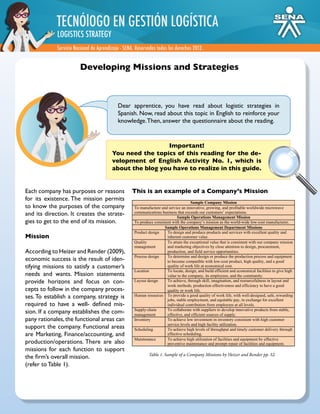
(refer to Table 1).
This is an example of a Company’s Mission
Dear apprentice, you have read about logistic strategies in
Spanish. Now, read about this topic in English to reinforce your
knowledge.Then, answer the questionnaire about the reading.
Developing Missions and Strategies
Sample Company Mission
To manufacture and service an innovative, growing, and profitable worldwide microwave
communications business that exceeds our customers’ expectations.
Sample Operations Management Mission
To produce consistent with the company’s mission as the world-wide low-cost manufacturer.
Sample Operations Management Department Missions
Product design To design and produce products and services with excellent quality and
inherent customer value.
Quality
management
To attain the exceptional value that is consistent with our company mission
and marketing objectives by close attention to design, procurement,
production, and field service opportunities.
Process design To determine and design or produce the production process and equipment
to become compatible with low-cost product, high quality, and a good
quality of work life at economical cost.
Location To locate, design, and build efficient and economical facilities to give high
value to the company, its employees, and the community.
Layout design To achieve, through skill, imagination, and resourcefulness in layout and
work methods, production effectiveness and efficiency to have a good
quality or work life.
Human resources To provide a good quality of work life, with well-designed, safe, rewarding
jobs, stable employment, and equitable pay, in exchange for excellent
individual contribution from employees at all levels.
Supply-chain
management
To collaborate with suppliers to develop innovative products from stable,
effective, and efficient sources of supply.
Inventory To achieve low investment in inventory consistent with high customer
service levels and high facility utilization.
Scheduling To achieve high levels of throughput and timely customer delivery through
effective scheduling.
Maintenance To achieve high utilization of facilities and equipment by effective
preventive maintenance and prompt repair of facilities and equipment.
	
  
Table 1. Sample of a Company Missions by Heizer and Render pp. 32.
Servicio Nacional de Aprendizaje - SENA. Reservados todos los derechos 2012.
TECNÓlOGO EN GESTIÓN LOGÍSTICA
LOGISTICS STRATEGY
Martin Murray (s/f)
says that each com-
pany creates a logistics
strategy to define the
service levels accor-
ding to logistics orga-
nization and effective
costs. Strategy is an
organization’s action
plan to achieve the
mission because supply chains constantly change and
evolve to develop a variety of “logistics strategies for
specific product lines, specific countries or specific
customers”.
According to the author, the implementation of a Lo-
gistics Strategy in a company permits “to identify the
impact of imminent changes in the supply chain and
make organizational or functional changes to ensure
service levels” in the corporation.These strategies ex-
ploit opportunities and strengths, neutralize threats,
and avoid weaknesses.
Murray expresses that “a company can start to de-
velop a logistics strategy by looking at four distinct
levels of their logistics organization”.
Strategic: the company needs to check its “objecti-
ves and strategic supply chain decisions” to see its
procedures and how they contribute to develop the
company’s targets.
Structural:the logistics strategy needs to examine the
logistics company organization “such as the optimum
number of warehouses and distribution centers” or
products to “be produced at a specific manufacturing
plant”.
Functional:the company checks“separate functions in
the logistics organization to achieve functional exce-
llence” in the whole organization.
Implementation: each logistics strategy requires “to
be implemented across the organization”. It is neces-
sary to create a plan to implement, develop and es-
tablish an information system, introduce new policies
and procedures to develop a management plan into the
company.
Elements to examine when developing a
Logistics Strategy
As reported by Murray, when a company constructs
a logistics strategy, it also needs to define the service
levels to evaluate in order to check its effectiveness in
cost benefits and the ways to achieve the results.The
author presents an example of some component areas
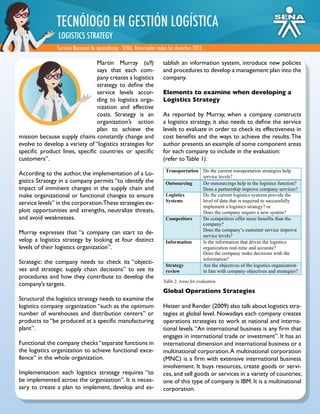
for each company to include in the evaluation:
(refer to Table 1).
Global Operations Strategies
Heizer and Render (2009) also talk about logistics stra-
tegies at global level. Nowadays each company creates
operations strategies to work at national and interna-
tional levels.“An international business is any firm that
engages in international trade or investment”. It has an
international dimension and international business or a
multinational corporation.A multinational corporation
(MNC) is a firm with extensive international business
involvement. It buys resources, create goods or servi-
ces, and sell goods or services in a variety of countries;
one of this type of company is IBM. It is a multinational
corporation.
Transportation Do the current transportation strategies help
service levels?
Outsourcing Do outsourcings help in the logistics function?
Does a partnership improve company services?
Logistics
Systems
Do the current logistics systems provide the
level of data that is required to successfully
implement a logistics strategy? or
Does the company require a new system?
Competitors Do competitors offer more benefits than the
company?
Does the company’s customer service improve
service levels?
Information Is the information that drives the logistics
organization real-time and accurate?
Does the company make decisions with the
information?
Strategy
review
Are the objectives of the logistics organization
in line with company objectives and strategies?
	
  
Table 2. Areas for evaluation
Servicio Nacional de Aprendizaje - SENA. Reservados todos los derechos 2012.
TECNÓlOGO EN GESTIÓN LOGÍSTICA
LOGISTICS STRATEGY
As reported by the authors, operation managers of
international and multinational companies focus on
global opportunities with four international opera-
tion strategies: international, multidomestic, global and
transnational.
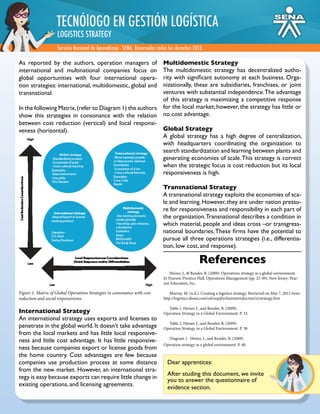
In the following Matrix,(refer to Diagram 1) the authors
show this strategies in consonance with the relation
between cost reduction (vertical) and local responsi-
veness (horizontal).
International Strategy
An international strategy uses exports and licenses to
penetrate in the global world. It doesn’t take advantage
from the local markets and has little local responsive-
ness and little cost advantage. It has little responsive-
ness because companies export or license goods from
the home country. Cost advantages are few because
companies use production process at some distance
from the new market. However, an international stra-
tegy is easy because exports can require little change in
existing operations, and licensing agreements.
Figure 1. Matrix of Global Operations Strategies in consonance with cost
reduction and social responsivenes
Multidomestic Strategy
The multidomestic strategy has decentralized autho-
rity with significant autonomy at each business. Orga-
nizationally, these are subsidiaries, franchises, or joint
ventures with substantial independence.The advantage
of this strategy is maximizing a competitive response
for the local market; however, the strategy has little or
no cost advantage.
Global Strategy
A global strategy has a high degree of centralization,
with headquarters coordinating the organization to
search standardization and learning between plants and
generating economies of scale.This strategy is correct
when the strategic focus is cost reduction but its local
responsiveness is high.
Transnational Strategy
A transnational strategy exploits the economies of sca-
le and learning.However,they are under nation pressu-
re for responsiveness and responsibility in each part of
the organization.Transnational describes a condition in
which material, people and ideas cross –or transgress-
national boundaries.These firms have the potential to
pursue all three operations strategies (i.e., differentia-
tion, low cost, and response).
References
Heizer, J., & Render, B. (2009). Operations strategy in a global environment.
In Pearson Prentice Hall, Operations Management (pp. 25-49). New Jersey: Pear-
son Education, Inc.
Murray, M. (n.d.). Creating a logistics strategy. Retrieved on May 7, 2012 from
http://logistics.about.com/od/supplychainintroduction/a/strategy.htm
Table 1. Heizer, J., and Render, B. (2009).
Operation Strategy in a Global Environment. P. 32.
Table 2. Heizer, J., and Render, B. (2009).
Operation Strategy in a Global Environment. P. 38.
Diagram 1. Heizer, J., and Render, B. (2009).
Operation strategy in a global environment. P. 40.
Dear apprentices:
After studing this document, we invite
you to answer the questionnaire of
evidence section.

05 logistics strategy

  • 1.
    Servicio Nacional deAprendizaje - SENA. Reservados todos los derechos 2012. TECNÓlOGO EN GESTIÓN LOGÍSTICA LOGISTICS STRATEGY Important! You need the topics of this reading for the de- velopment of English Activity No. 1, which is about the blog you have to realize in this guide. Each company has purposes or reasons for its existence. The mission permits to know the purposes of the company and its direction. It creates the strate- gies to get to the end of its mission. Mission According to Heizer and Render (2009), economic success is the result of iden- tifying missions to satisfy a customer’s needs and wants. Mission statements provide horizons and focus on con- cepts to follow in the company proces- ses.To establish a company, strategy is required to have a well- defined mis- sion. If a company establishes the com- pany rationales,the functional areas can support the company. Functional areas are Marketing, Finance/accounting, and production/operations. There are also missions for each function to support the firm’s overall mission. (refer to Table 1). This is an example of a Company’s Mission Dear apprentice, you have read about logistic strategies in Spanish. Now, read about this topic in English to reinforce your knowledge.Then, answer the questionnaire about the reading. Developing Missions and Strategies Sample Company Mission To manufacture and service an innovative, growing, and profitable worldwide microwave communications business that exceeds our customers’ expectations. Sample Operations Management Mission To produce consistent with the company’s mission as the world-wide low-cost manufacturer. Sample Operations Management Department Missions Product design To design and produce products and services with excellent quality and inherent customer value. Quality management To attain the exceptional value that is consistent with our company mission and marketing objectives by close attention to design, procurement, production, and field service opportunities. Process design To determine and design or produce the production process and equipment to become compatible with low-cost product, high quality, and a good quality of work life at economical cost. Location To locate, design, and build efficient and economical facilities to give high value to the company, its employees, and the community. Layout design To achieve, through skill, imagination, and resourcefulness in layout and work methods, production effectiveness and efficiency to have a good quality or work life. Human resources To provide a good quality of work life, with well-designed, safe, rewarding jobs, stable employment, and equitable pay, in exchange for excellent individual contribution from employees at all levels. Supply-chain management To collaborate with suppliers to develop innovative products from stable, effective, and efficient sources of supply. Inventory To achieve low investment in inventory consistent with high customer service levels and high facility utilization. Scheduling To achieve high levels of throughput and timely customer delivery through effective scheduling. Maintenance To achieve high utilization of facilities and equipment by effective preventive maintenance and prompt repair of facilities and equipment.   Table 1. Sample of a Company Missions by Heizer and Render pp. 32.
  • 2.
    Servicio Nacional deAprendizaje - SENA. Reservados todos los derechos 2012. TECNÓlOGO EN GESTIÓN LOGÍSTICA LOGISTICS STRATEGY Martin Murray (s/f) says that each com- pany creates a logistics strategy to define the service levels accor- ding to logistics orga- nization and effective costs. Strategy is an organization’s action plan to achieve the mission because supply chains constantly change and evolve to develop a variety of “logistics strategies for specific product lines, specific countries or specific customers”. According to the author, the implementation of a Lo- gistics Strategy in a company permits “to identify the impact of imminent changes in the supply chain and make organizational or functional changes to ensure service levels” in the corporation.These strategies ex- ploit opportunities and strengths, neutralize threats, and avoid weaknesses. Murray expresses that “a company can start to de- velop a logistics strategy by looking at four distinct levels of their logistics organization”. Strategic: the company needs to check its “objecti- ves and strategic supply chain decisions” to see its procedures and how they contribute to develop the company’s targets. Structural:the logistics strategy needs to examine the logistics company organization “such as the optimum number of warehouses and distribution centers” or products to “be produced at a specific manufacturing plant”. Functional:the company checks“separate functions in the logistics organization to achieve functional exce- llence” in the whole organization. Implementation: each logistics strategy requires “to be implemented across the organization”. It is neces- sary to create a plan to implement, develop and es- tablish an information system, introduce new policies and procedures to develop a management plan into the company. Elements to examine when developing a Logistics Strategy As reported by Murray, when a company constructs a logistics strategy, it also needs to define the service levels to evaluate in order to check its effectiveness in cost benefits and the ways to achieve the results.The author presents an example of some component areas for each company to include in the evaluation: (refer to Table 1). Global Operations Strategies Heizer and Render (2009) also talk about logistics stra- tegies at global level. Nowadays each company creates operations strategies to work at national and interna- tional levels.“An international business is any firm that engages in international trade or investment”. It has an international dimension and international business or a multinational corporation.A multinational corporation (MNC) is a firm with extensive international business involvement. It buys resources, create goods or servi- ces, and sell goods or services in a variety of countries; one of this type of company is IBM. It is a multinational corporation. Transportation Do the current transportation strategies help service levels? Outsourcing Do outsourcings help in the logistics function? Does a partnership improve company services? Logistics Systems Do the current logistics systems provide the level of data that is required to successfully implement a logistics strategy? or Does the company require a new system? Competitors Do competitors offer more benefits than the company? Does the company’s customer service improve service levels? Information Is the information that drives the logistics organization real-time and accurate? Does the company make decisions with the information? Strategy review Are the objectives of the logistics organization in line with company objectives and strategies?   Table 2. Areas for evaluation
  • 3.
    Servicio Nacional deAprendizaje - SENA. Reservados todos los derechos 2012. TECNÓlOGO EN GESTIÓN LOGÍSTICA LOGISTICS STRATEGY As reported by the authors, operation managers of international and multinational companies focus on global opportunities with four international opera- tion strategies: international, multidomestic, global and transnational. In the following Matrix,(refer to Diagram 1) the authors show this strategies in consonance with the relation between cost reduction (vertical) and local responsi- veness (horizontal). International Strategy An international strategy uses exports and licenses to penetrate in the global world. It doesn’t take advantage from the local markets and has little local responsive- ness and little cost advantage. It has little responsive- ness because companies export or license goods from the home country. Cost advantages are few because companies use production process at some distance from the new market. However, an international stra- tegy is easy because exports can require little change in existing operations, and licensing agreements. Figure 1. Matrix of Global Operations Strategies in consonance with cost reduction and social responsivenes Multidomestic Strategy The multidomestic strategy has decentralized autho- rity with significant autonomy at each business. Orga- nizationally, these are subsidiaries, franchises, or joint ventures with substantial independence.The advantage of this strategy is maximizing a competitive response for the local market; however, the strategy has little or no cost advantage. Global Strategy A global strategy has a high degree of centralization, with headquarters coordinating the organization to search standardization and learning between plants and generating economies of scale.This strategy is correct when the strategic focus is cost reduction but its local responsiveness is high. Transnational Strategy A transnational strategy exploits the economies of sca- le and learning.However,they are under nation pressu- re for responsiveness and responsibility in each part of the organization.Transnational describes a condition in which material, people and ideas cross –or transgress- national boundaries.These firms have the potential to pursue all three operations strategies (i.e., differentia- tion, low cost, and response). References Heizer, J., & Render, B. (2009). Operations strategy in a global environment. In Pearson Prentice Hall, Operations Management (pp. 25-49). New Jersey: Pear- son Education, Inc. Murray, M. (n.d.). Creating a logistics strategy. Retrieved on May 7, 2012 from http://logistics.about.com/od/supplychainintroduction/a/strategy.htm Table 1. Heizer, J., and Render, B. (2009). Operation Strategy in a Global Environment. P. 32. Table 2. Heizer, J., and Render, B. (2009). Operation Strategy in a Global Environment. P. 38. Diagram 1. Heizer, J., and Render, B. (2009). Operation strategy in a global environment. P. 40. Dear apprentices: After studing this document, we invite you to answer the questionnaire of evidence section.