Global Trade
The Global Environment And operation strategy
 We have identified six reasons why domestic business operations decide to change to
some form of international operation. They are:
1. Reduce cost (labor, taxes, tariffs)
2. Improve the supply chain
3. Provide better goods and services
4. Learn to improve operations
5. Understand the market
6. Attract and retain global talent
 Reduce cost- many international seek to take advantage of tangible opportunities to
reduce their cost.
 Improve the supply chain- The supply chain can often be improved by locating facilities
in countries where unique resources are available. These resources may be expertise,
labor, or raw materials.
 Provide better goods and services- Although the characteristics of goods and services
can be objective and measurable they can be subjective and less measurable.
 Learn to improve operations- Learning does not take place in isolation. Firms serve
themselves and their customer well when they remain open to the free flow of ideas.
 Understand the market – Because international operations require interaction with
foreign customers, suppliers, and other competitive businesses, international firms
inevitably learn about opportunities of new products and services.
 Attract and retain global talent – Global organization can attract and retain better
employees by offering more employment opportunities.
Cultural and ethical issues
 While there are great forces driving firms toward globalization, many challenges
remain. One of these challenges is reconciling differences in social and cultural
behavior. With issues ranging form bribery, to child labor, to the environment,
managers sometimes do not know how to respond when operating in a different
culture.
Developing mission and strategy
 An effective operation managements effort must have a mission so it knows where it is
going and a strategy so it knows how to get there. This is the case for domestic
organization, as well as a large international organization.
Mission
 Provide boundaries and focus for organizations and the concept around which the
firm can rally. The mission states the rationale for the organization’s existence.
Strategy
 Is an organization’s action plan to achieve the mission. Each area has strategy for
achieving its mission and for helping the organization reach the overall mission. These
strategies exploit opportunities and strengths neutralize threats and avoid
weaknesses.
 Firms achieve mission in three conceptual ways
1. Differentiation (better)
2. Cost leadership (Cheaper)
3. Response (More responsive)
4. Operation Strategy in global environment
Operation Strategy in global environment
 • Strategies –Plans for achieving organizational goals
 • Mission – The reason for existence for an organization
 • Mission Statement – Answers the question ―What business are we in?‖
 • Goals – Provide detail and scope of mission
 • Tactics – The methods and actions taken to accomplish strategies
Operation Strategy in global environment
GLOBAL OPERATIONS STRATEGY OPTIONS:
 1.International Strategy: International strategy uses export and licenses to penetrate
the global arena. This strategy is least advantageous, with little local responsiveness,
as we are exporting the product from home country and little cost advantage as we
are using existing production process at some distance from the new market.
However,this strategy is always easiest, as export requires little change in existing
operations.
 2.Multidomestic strategy: This strategy has decentralized authority, with substantial
autonomy at each business. Organizationally, these are franchises, subsidiaries and
joint ventures with substantial independence. Advantage with this strategy is
maximizing competitive response to the local market.
Key success Factors and Core Competencies
 Because no firm does everything exceptionally well, a successful strategy requires
determining the firm’s critical success factors and core competencies. Key Success
Factors ( KSFs) are those activities that are necessary for a firm to achieve its goals. Key
success factors can be so significant that a firm must get them right to survive in the
industry. Core competency are set if unique skills, talents, and capabilities that a firm
does at a world class standard. They allow a firm to set itself apart and develop a
competitive advantage. The idea is to build KSFs and core competency that provide a

competitive advantage and support a successful strategy and mission. A core
competency may be a subset of KSFs or a combination of KSFs.
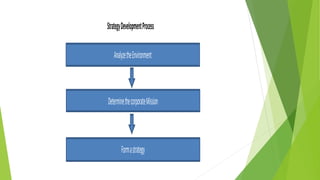
StrategyDevelopmentProcess
Formastrategy
DeterminethecorporateMission
AnalyzetheEnvironment
 3.Global strategy: Global strategy has high degree of centralization, with headquarters
coordinating organization to seek out standardization and learning between plants,
thus generating economies of scale.
 4.Transnational strategy: A transnational strategy exploits the economies of scale and
learning, as well as pressure for local responsiveness, by recognizing that the core
competence does not reside in home country but can exist anywhere in the
organization. In transnational organizations, the material, people as well as ideas cross
national boundaries.
Global Trade.pptx
Global Trade.pptx
Global Trade.pptx
Global Trade.pptx
Global Trade.pptx
Global Trade.pptx
Global Trade.pptx
Global Trade.pptx
Global Trade.pptx
Global Trade.pptx
Global Trade.pptx
Global Trade.pptx
Global Trade.pptx
Global Trade.pptx

Global Trade.pptx

  • 1.
  • 2.
    The Global EnvironmentAnd operation strategy  We have identified six reasons why domestic business operations decide to change to some form of international operation. They are: 1. Reduce cost (labor, taxes, tariffs) 2. Improve the supply chain 3. Provide better goods and services 4. Learn to improve operations 5. Understand the market 6. Attract and retain global talent
  • 3.
     Reduce cost-many international seek to take advantage of tangible opportunities to reduce their cost.  Improve the supply chain- The supply chain can often be improved by locating facilities in countries where unique resources are available. These resources may be expertise, labor, or raw materials.  Provide better goods and services- Although the characteristics of goods and services can be objective and measurable they can be subjective and less measurable.  Learn to improve operations- Learning does not take place in isolation. Firms serve themselves and their customer well when they remain open to the free flow of ideas.
  • 4.
     Understand themarket – Because international operations require interaction with foreign customers, suppliers, and other competitive businesses, international firms inevitably learn about opportunities of new products and services.  Attract and retain global talent – Global organization can attract and retain better employees by offering more employment opportunities.
  • 5.
    Cultural and ethicalissues  While there are great forces driving firms toward globalization, many challenges remain. One of these challenges is reconciling differences in social and cultural behavior. With issues ranging form bribery, to child labor, to the environment, managers sometimes do not know how to respond when operating in a different culture.
  • 6.
    Developing mission andstrategy  An effective operation managements effort must have a mission so it knows where it is going and a strategy so it knows how to get there. This is the case for domestic organization, as well as a large international organization.
  • 7.
    Mission  Provide boundariesand focus for organizations and the concept around which the firm can rally. The mission states the rationale for the organization’s existence.
  • 8.
    Strategy  Is anorganization’s action plan to achieve the mission. Each area has strategy for achieving its mission and for helping the organization reach the overall mission. These strategies exploit opportunities and strengths neutralize threats and avoid weaknesses.  Firms achieve mission in three conceptual ways 1. Differentiation (better) 2. Cost leadership (Cheaper) 3. Response (More responsive) 4. Operation Strategy in global environment
  • 9.
    Operation Strategy inglobal environment  • Strategies –Plans for achieving organizational goals  • Mission – The reason for existence for an organization  • Mission Statement – Answers the question ―What business are we in?‖  • Goals – Provide detail and scope of mission  • Tactics – The methods and actions taken to accomplish strategies
  • 10.
    Operation Strategy inglobal environment GLOBAL OPERATIONS STRATEGY OPTIONS:  1.International Strategy: International strategy uses export and licenses to penetrate the global arena. This strategy is least advantageous, with little local responsiveness, as we are exporting the product from home country and little cost advantage as we are using existing production process at some distance from the new market. However,this strategy is always easiest, as export requires little change in existing operations.
  • 11.
     2.Multidomestic strategy:This strategy has decentralized authority, with substantial autonomy at each business. Organizationally, these are franchises, subsidiaries and joint ventures with substantial independence. Advantage with this strategy is maximizing competitive response to the local market.
  • 12.
    Key success Factorsand Core Competencies  Because no firm does everything exceptionally well, a successful strategy requires determining the firm’s critical success factors and core competencies. Key Success Factors ( KSFs) are those activities that are necessary for a firm to achieve its goals. Key success factors can be so significant that a firm must get them right to survive in the industry. Core competency are set if unique skills, talents, and capabilities that a firm does at a world class standard. They allow a firm to set itself apart and develop a competitive advantage. The idea is to build KSFs and core competency that provide a competitive advantage and support a successful strategy and mission. A core competency may be a subset of KSFs or a combination of KSFs.
  • 13.
  • 14.
     3.Global strategy:Global strategy has high degree of centralization, with headquarters coordinating organization to seek out standardization and learning between plants, thus generating economies of scale.
  • 15.
     4.Transnational strategy:A transnational strategy exploits the economies of scale and learning, as well as pressure for local responsiveness, by recognizing that the core competence does not reside in home country but can exist anywhere in the organization. In transnational organizations, the material, people as well as ideas cross national boundaries.