What Do Anthros Do?

 One way to describe anthropology is to
describe some things anthropologists do.

Traditionally, the things they do have been
      divided into:

   PHYSICAL ANTHROPOLOGY
                     and
   CULTURAL ANTHROPOLOGY
Physical
           Anthropometry
 Osteology
                  Primatology

           Human Genetics
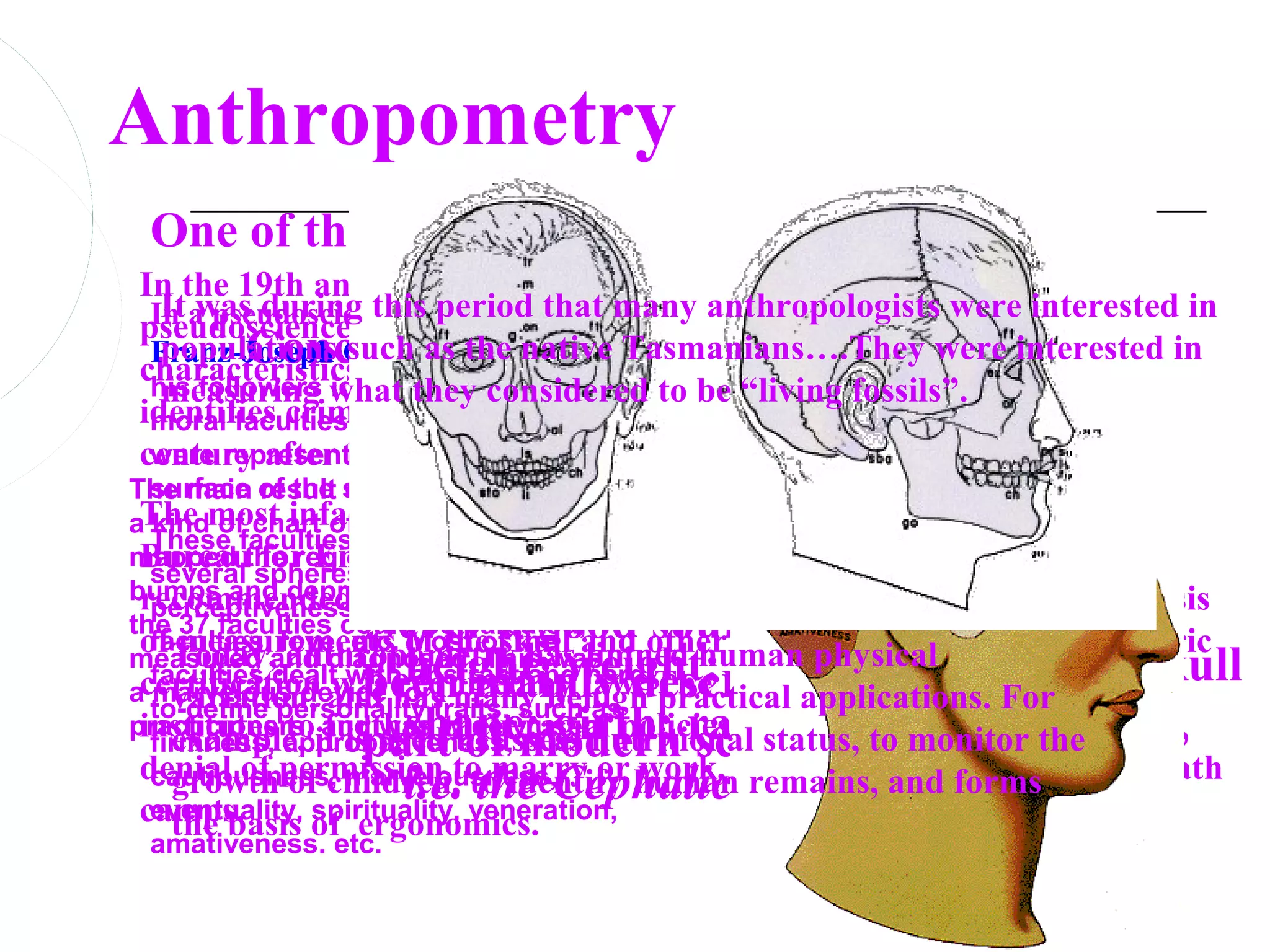
Anthropometry
 One of the earliest specialties
In the 19th and early 20th centuries, anthropometry was a
 In a pseudoscience called phrenology, anthropologists were interested in
  It was during this period that many
pseudoscience used mainly to classify potential criminals by facial
characteristics. For example, empirical
 Franz-Joseph Gall (1758 withand
         Concerned -1828) the work of Eugene Vidocq, which
  populations such as the native Tasmanians….They were interested in
 his followers what they considered to be “living fossils”.
  measuring identified 37 mental and
identifies criminals by facial characteristics, aspects nearly a
 moral faculties which they thought of many is still used
                  description
century after its introduction in France.
                  of the human physical
 were represented in the exterior
The main of the skull.
  surface result of Gall's theory was
aThe most infamous use which
  kind of chart of the skull, of anthropometry was by the Nazis, whose
                condition…..
  These faculties were divided into
mapped the regions where the on Population Policy and Racial Welfare
 Bureau spheres: intellectual,
           for Enlightenment
  several
bumps and depressions related to of Aryans and non-Aryans on the basis
 recommended the classification
  perceptiveness, mental energy, moral
                Never a good source of theory…has
the 37 faculties could be palpated,
 of Today, love, etc. of the skull and other physical features. Craniometric
     measurements Most of the limned human physical
  faculties,
             anthropometry has
                been mainly descriptive…important skull
                  height; weight; skin pigmentation;
measured and diagnosed. This was
  faculties dealt with abstract and law. The Nazis set up certification
                                      hard-
acertification and has manyby
    variation, was required benign practical applications. For
  marvelous device for
  to-define personality traits, such as
                part of modern ratios ofof ergonomics.
                  shape; girth; science measurements,
practicioners, and was widelyracial policies. Not measuring up meant
 institutes approbativeness, used.
    example, further their
             to
  firmness, it is used to assess nutritional status, to monitor the
 denial of permission to marry or humanand for many it meant the death
    growth of children, to identify work, remains, and forms
                  i.e. the Cephalic Index.
  cautiousness, marvelousness,
 camps.
  eventuality, spirituality, veneration,
    the basis of ergonomics.
  amativeness. etc.
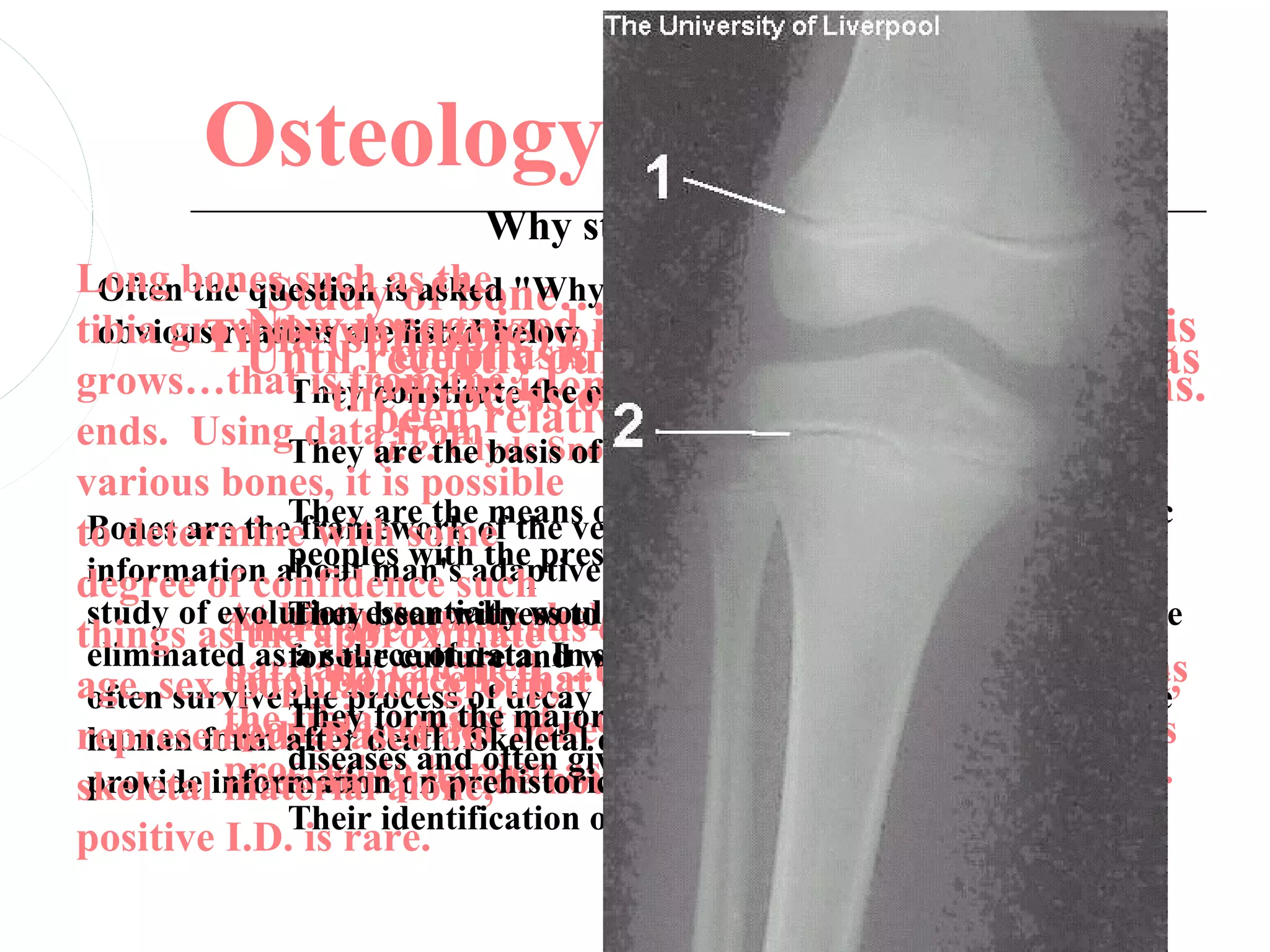
Osteology
                              Why study bones?
Long bones such isofthe "Why study bones?" A few of with
  Often the question as bone….in anthropology the more
             Study asked
         Tibia areemphasis inknowledge of osteology has
            Now recognized prevention of osteoporosis
tibia grow the(shinbone) provides a model to illustrate
  obvious reasons way a tree
                        listed below.
            Untilfrom the our primates
                     recently on
grows…that isthe process of bonefor the study of fossil man.
               They and in identification of human remains.
                     constitute the evidence development:
ends. UsingThey been relatively ignored in prehistory.
                data from basis of racial Forensic Anthropology)
                     (i.e.the
                     are Clyde Snow and classification
various bones, it is possible
 Bones are theThey are the means of biological comparison of prehistoric
to determineframework of the vertebrate body and thus contain much
                 with some present living descendents.
               peoples withadaptive mechanisms to his environment. The
 information about man'ssuch  the
degree of confidence
 study of evolution essentially would be impossible if bones were evidence
          At birth,bear witness toof bonevery smallthus give
          There are two kinds burial patterns and and only
               They human skeleton is
things as theaapproximate Inworld viewcells….essentially hard,
 eliminated as for the calcified….the skull of theotheris studied.
          partially culture and summary,oneanswer bones such as
                 source of data.               the people that bones
age, sex,outer bone cellsdecay overlap and another, and for the
 often survive the process of that and provide the main evidence a soft,
           population group,
represented. Based onoften a cartilaginous model,of death.
          the They death.the major whose of information on ancient
               tibia consist of
          spongy form Skeletal source also develop along stressand
 human form after interior boneevidence cellshas the potential to
          proceed to and
               diseases harden give clues as to the causes
          lines and provide as calcification proceeds with age.
skeletal material on prehistoric customs marrow.
 provide informationalone, housing forand diseases.
               Their identification often helps solve forensic cases.
positive I.D. is rare.
Primatology
       Study of Primates
        Before the 1930’s knowledge of free ranging
        primates was riddled with “sea stories.”
         Early studies included:
Clarence Ray Carpenter’s studies of Howler Monkeys on Barrio Colorado
 Harold island in the Panama of the Zone.
        Bingham’s studies Canal Mountain Gorilla.


    These were essentially studies in comparative psychology
    that employed anthropological field techniques….These
    studies were interrupted by WWII.
Primatology
 Among these were: of free ranging primates
 After the war studies
 were resumed with renewed vigor.
Jane Goodall’s studies among the Chimpanzees
        of the Gombe Stream Preserve in NE Tanzania.
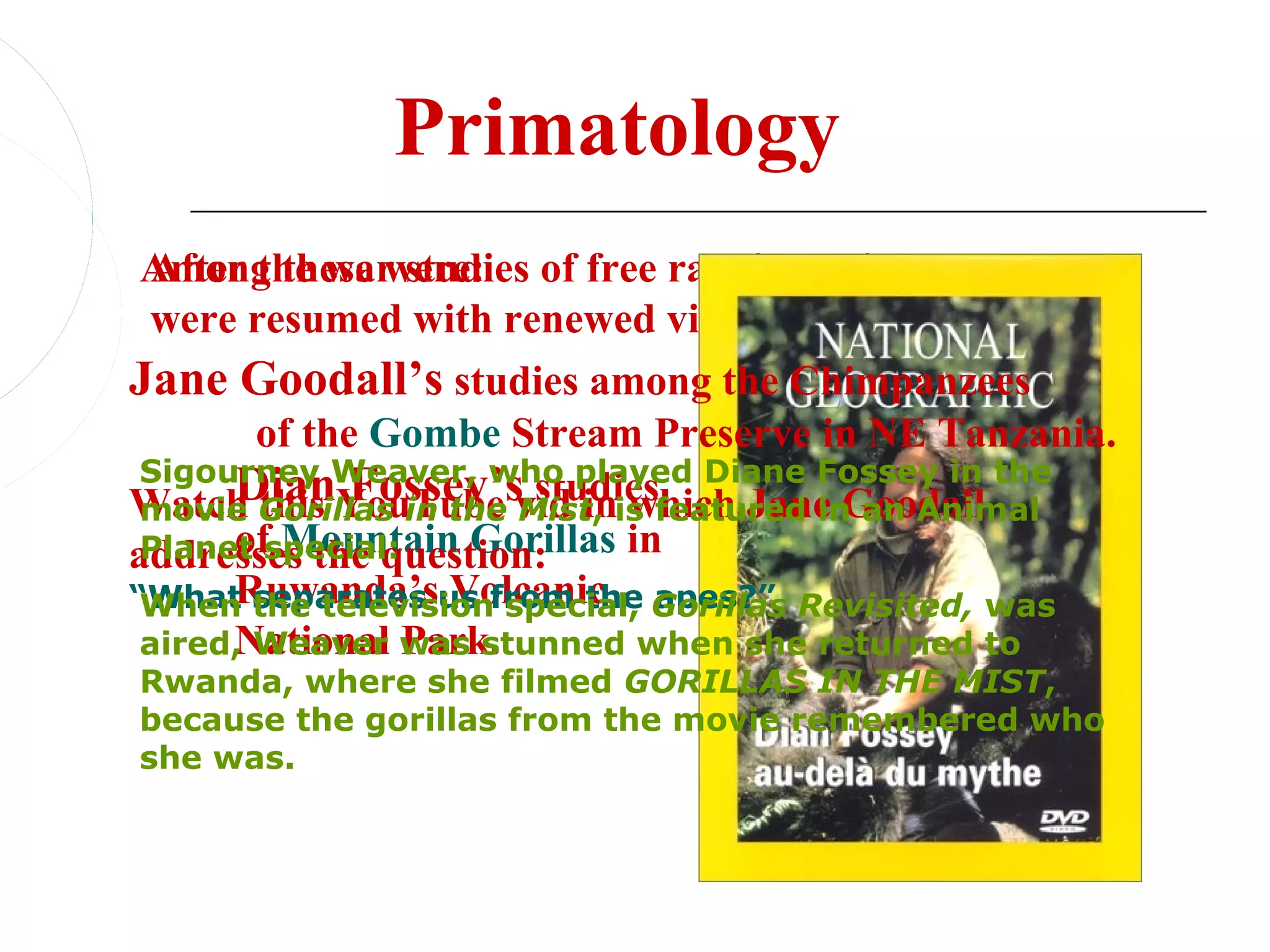
 Sigourney Weaver, who played Diane Fossey in the
      Dian Fossey’s studies
Watch Gorillas in the vid inis featured in an Animal
 movie this YouTube Mist, which Jane Goodall
      of Mountain Gorillas in
 Planet special:
addresses the question:
      Ruwanda’s Volcanic
“What separates us from the Gorillas Revisited, was
 When the television special, apes?”
      National Park.
 aired, Weaver was stunned when she returned to
Rwanda, where she filmed GORILLAS IN THE MIST,
because the gorillas from the movie remembered who
she was.
Human Genetics
Basic Biology

    Two types of cells:
        body (somatic) cells
    and sex cells (gametes)
         Human body cells have 23 pairs of
         chromosomes (diploid cells). Human sex
         cells have half of each pair (haploid cells).
Human Genetics
Basic Biology


              When male and female
              gametes are combined, the
         The term GENOTYPE refers to normally
              result, a zygote, the actual
         genetic composition of the person while
              develops into a human
         the way a person develops with
              being through interaction
         interaction with the environment is called
         the PHENOTYPE.
              with the environment.
Human Genetics
aka Population Genetics (Microevolution)

  Species
      Largest set of individuals who can mate
      with one another with genetically viable
      offspring as a result.
Human Genetics
aka Population Genetics (Microevolution)

   Population        (Mendelian population;
                     breeding population)


       Set of individuals who mate with one
       another more often than with others.
Human Genetics
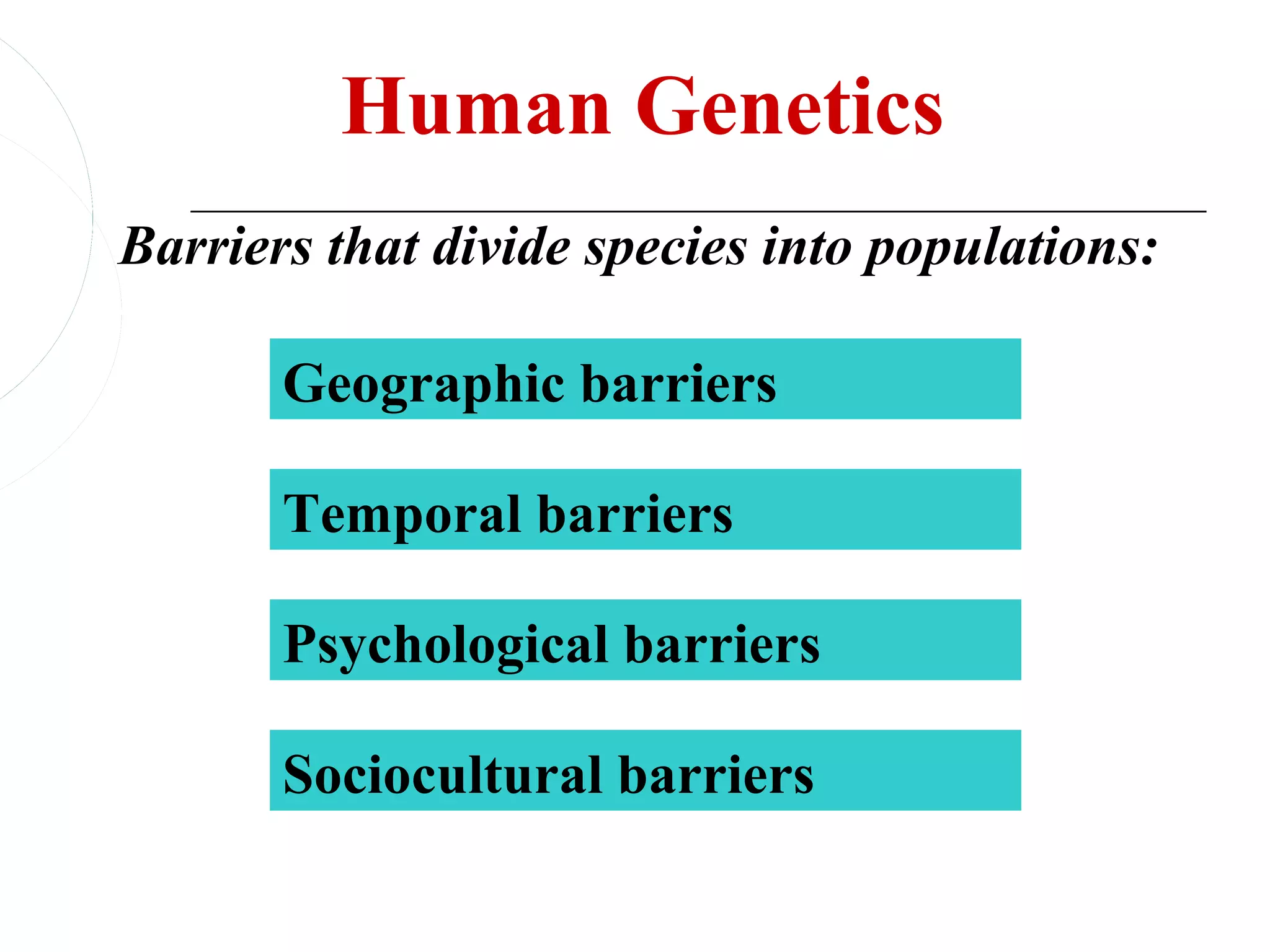
Barriers that divide species into populations:

       Geographic barriers

       Temporal barriers

       Psychological barriers

       Sociocultural barriers
Human Genetics

The total genetic material of a population is
     the Gene Pool of that population.


Evolution is operationally defined as change
in the composition of a gene pool.
Human Genetics
Processes that effect changes in composition of gene pools:

          Genetic Drift/Sewell Wright Effect
          (founder’s principle is related)

          Natural Selection
          (i.e. H.B.D. Kettlewell’s pepperback moth study)

          Mutation
          Cross breeding
EvoDevo (Evolutionary Development
         A number of problems in macroevolution that have not
been successfully addressed by microevolution are now being
addressed by molecular geneticists in the field of
evolutionary development (EvoDevo).
    EvoDevo demonstrates that evolution alters
         The field of “EvoDevo”, looking at development from
    developmental processes (genes and gene networks)
an evolutionary standpoint, has provided a great deal of
    to create new and novel structures from the old gene
information in recent years particularly inthe jaw to
    networks (such as bone structures of regard
development to the ossicles of structures. The discovery of a
    deviating of complex body the middle ear).
set Wikipedia:genes, referred to as the homeotic genes, has
     of control http://
allowed scientists to understand how complex body plans are
    en.wikipedia.org/wiki/Evolutionary_developmental_biology
initially laid out in embryonic stages. The homeotic genes are
a suite of genes found in animals that determine the axes of
embryos, then control how embryos are divided into
segments, and initiate the development of appropriate body
parts in each segment. This system is interesting because it
answers so many developmental questions and also because
it provides a reasonable method for development of radically
different body plans.

04whatdo

  • 1.
    What Do AnthrosDo? One way to describe anthropology is to describe some things anthropologists do. Traditionally, the things they do have been divided into: PHYSICAL ANTHROPOLOGY and CULTURAL ANTHROPOLOGY
  • 2.
    Physical Anthropometry Osteology Primatology Human Genetics
  • 3.
    Anthropometry One ofthe earliest specialties In the 19th and early 20th centuries, anthropometry was a In a pseudoscience called phrenology, anthropologists were interested in It was during this period that many pseudoscience used mainly to classify potential criminals by facial characteristics. For example, empirical Franz-Joseph Gall (1758 withand Concerned -1828) the work of Eugene Vidocq, which populations such as the native Tasmanians….They were interested in his followers what they considered to be “living fossils”. measuring identified 37 mental and identifies criminals by facial characteristics, aspects nearly a moral faculties which they thought of many is still used description century after its introduction in France. of the human physical were represented in the exterior The main of the skull. surface result of Gall's theory was aThe most infamous use which kind of chart of the skull, of anthropometry was by the Nazis, whose condition….. These faculties were divided into mapped the regions where the on Population Policy and Racial Welfare Bureau spheres: intellectual, for Enlightenment several bumps and depressions related to of Aryans and non-Aryans on the basis recommended the classification perceptiveness, mental energy, moral Never a good source of theory…has the 37 faculties could be palpated, of Today, love, etc. of the skull and other physical features. Craniometric measurements Most of the limned human physical faculties, anthropometry has been mainly descriptive…important skull height; weight; skin pigmentation; measured and diagnosed. This was faculties dealt with abstract and law. The Nazis set up certification hard- acertification and has manyby variation, was required benign practical applications. For marvelous device for to-define personality traits, such as part of modern ratios ofof ergonomics. shape; girth; science measurements, practicioners, and was widelyracial policies. Not measuring up meant institutes approbativeness, used. example, further their to firmness, it is used to assess nutritional status, to monitor the denial of permission to marry or humanand for many it meant the death growth of children, to identify work, remains, and forms i.e. the Cephalic Index. cautiousness, marvelousness, camps. eventuality, spirituality, veneration, the basis of ergonomics. amativeness. etc.
  • 4.
    Osteology Why study bones? Long bones such isofthe "Why study bones?" A few of with Often the question as bone….in anthropology the more Study asked Tibia areemphasis inknowledge of osteology has Now recognized prevention of osteoporosis tibia grow the(shinbone) provides a model to illustrate obvious reasons way a tree listed below. Untilfrom the our primates recently on grows…that isthe process of bonefor the study of fossil man. They and in identification of human remains. constitute the evidence development: ends. UsingThey been relatively ignored in prehistory. data from basis of racial Forensic Anthropology) (i.e.the are Clyde Snow and classification various bones, it is possible Bones are theThey are the means of biological comparison of prehistoric to determineframework of the vertebrate body and thus contain much with some present living descendents. peoples withadaptive mechanisms to his environment. The information about man'ssuch the degree of confidence study of evolution essentially would be impossible if bones were evidence At birth,bear witness toof bonevery smallthus give There are two kinds burial patterns and and only They human skeleton is things as theaapproximate Inworld viewcells….essentially hard, eliminated as for the calcified….the skull of theotheris studied. partially culture and summary,oneanswer bones such as source of data. the people that bones age, sex,outer bone cellsdecay overlap and another, and for the often survive the process of that and provide the main evidence a soft, population group, represented. Based onoften a cartilaginous model,of death. the They death.the major whose of information on ancient tibia consist of spongy form Skeletal source also develop along stressand human form after interior boneevidence cellshas the potential to proceed to and diseases harden give clues as to the causes lines and provide as calcification proceeds with age. skeletal material on prehistoric customs marrow. provide informationalone, housing forand diseases. Their identification often helps solve forensic cases. positive I.D. is rare.
  • 5.
    Primatology Study of Primates Before the 1930’s knowledge of free ranging primates was riddled with “sea stories.” Early studies included: Clarence Ray Carpenter’s studies of Howler Monkeys on Barrio Colorado Harold island in the Panama of the Zone. Bingham’s studies Canal Mountain Gorilla. These were essentially studies in comparative psychology that employed anthropological field techniques….These studies were interrupted by WWII.
  • 6.
    Primatology Among thesewere: of free ranging primates After the war studies were resumed with renewed vigor. Jane Goodall’s studies among the Chimpanzees of the Gombe Stream Preserve in NE Tanzania. Sigourney Weaver, who played Diane Fossey in the Dian Fossey’s studies Watch Gorillas in the vid inis featured in an Animal movie this YouTube Mist, which Jane Goodall of Mountain Gorillas in Planet special: addresses the question: Ruwanda’s Volcanic “What separates us from the Gorillas Revisited, was When the television special, apes?” National Park. aired, Weaver was stunned when she returned to Rwanda, where she filmed GORILLAS IN THE MIST, because the gorillas from the movie remembered who she was.
  • 7.
    Human Genetics Basic Biology Two types of cells: body (somatic) cells and sex cells (gametes) Human body cells have 23 pairs of chromosomes (diploid cells). Human sex cells have half of each pair (haploid cells).
  • 8.
    Human Genetics Basic Biology When male and female gametes are combined, the The term GENOTYPE refers to normally result, a zygote, the actual genetic composition of the person while develops into a human the way a person develops with being through interaction interaction with the environment is called the PHENOTYPE. with the environment.
  • 9.
    Human Genetics aka PopulationGenetics (Microevolution) Species Largest set of individuals who can mate with one another with genetically viable offspring as a result.
  • 10.
    Human Genetics aka PopulationGenetics (Microevolution) Population (Mendelian population; breeding population) Set of individuals who mate with one another more often than with others.
  • 11.
    Human Genetics Barriers thatdivide species into populations: Geographic barriers Temporal barriers Psychological barriers Sociocultural barriers
  • 12.
    Human Genetics The totalgenetic material of a population is the Gene Pool of that population. Evolution is operationally defined as change in the composition of a gene pool.
  • 13.
    Human Genetics Processes thateffect changes in composition of gene pools: Genetic Drift/Sewell Wright Effect (founder’s principle is related) Natural Selection (i.e. H.B.D. Kettlewell’s pepperback moth study) Mutation Cross breeding
  • 14.
    EvoDevo (Evolutionary Development A number of problems in macroevolution that have not been successfully addressed by microevolution are now being addressed by molecular geneticists in the field of evolutionary development (EvoDevo). EvoDevo demonstrates that evolution alters The field of “EvoDevo”, looking at development from developmental processes (genes and gene networks) an evolutionary standpoint, has provided a great deal of to create new and novel structures from the old gene information in recent years particularly inthe jaw to networks (such as bone structures of regard development to the ossicles of structures. The discovery of a deviating of complex body the middle ear). set Wikipedia:genes, referred to as the homeotic genes, has of control http:// allowed scientists to understand how complex body plans are en.wikipedia.org/wiki/Evolutionary_developmental_biology initially laid out in embryonic stages. The homeotic genes are a suite of genes found in animals that determine the axes of embryos, then control how embryos are divided into segments, and initiate the development of appropriate body parts in each segment. This system is interesting because it answers so many developmental questions and also because it provides a reasonable method for development of radically different body plans.