IT2032PA
Content Management
   System (CMS)
 Nitec in Social Media & Web Technology
Mashup and Streaming Protocols
In this chapter, you will learn:
  o Define what is a streaming protocol
  o Describe the different type of streaming protocol
    use on the Internet
  o Outline the protocol issues
  o Identify the difference between portals and
    mashup
Streaming Protocol
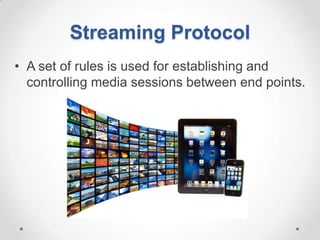
• A set of rules is used for establishing and
  controlling media sessions between end points.
Streaming Media Protocol
• RTSP Protocol
  is the default protocol for streaming Windows Media.
  o Also used for streaming by:
     • RealMedia/RealVideo/RealAudio,
     • QuickTime video
Streaming Media Protocol
• MMS Protocol
  is used for streaming Windows Media only.
  o RTSP using UDP is called RTSPU
  o RTSP using TCP is called RTSPT
  o MMS using UDP is called MMSU
  o MMS using TCP is called MMST
Streaming Media Protocol
• PNM Protocol
  used for RealMedia/RealVideo/RealAudio
  streaming only.
Streaming Media Protocol
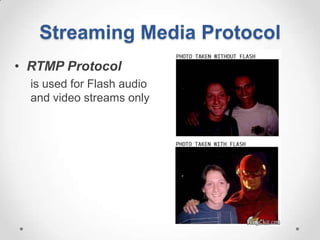
• RTMP Protocol
  is used for Flash audio
  and video streams only
Streaming Media Protocol
• HTTP Streaming
  HTTP streaming is a mechanism for sending data
  from a Web server to a Web browser in response to
  an event.


HTTP protocol usually uses port 80 or 8080.
Streaming Media Protocol
• MMS - Microsoft Media Services
  Microsoft's streaming server uses the Microsoft
  Media Services (MMS) protocol (also called NetShow
  Services) to transfer unicast data.


Note:
  o If WMP cannot negotiate a good connection using MMS over
    UDP, it will resort to MMS over TCP


         The default port for MMS is 1755
Streaming Media Protocol
• RTSP - Real Time Streaming Protocol
  o use in streaming media systems which allows a
    client to remotely control a streaming media server
  o issuing VCR-like commands such as "play" and
    "pause",
  o allowing time-based access to files on a server
Note:
  o RTSP servers use RealNetworks's proprietary RDT as
    the transport protocol


         The default port for RTSP is 554
Streaming Media Protocol
• PNM/PNA -
  o The first version of RealAudio
  o RealNetworks later switched to the IETF
    standardized RTSP
  o allowing time-based access to files on a server
Note:
  o RTSP servers use RealNetworks's proprietary RDT as
    the transport protocol


        The default port for RTSP is 554
Streaming Media Protocol
• RTMP - Real Time Messaging Protocol -
  o Proprietary protocol developed by Adobe Systems
  o Stream audio and video to Adobe Flash Player


Note:
  o RTMPE - secure RTMP protocol. Uses
    encryption.


        The default port for RTMP is 1935
Protocol Issues
• User Datagram Protocol (UDP) –
  o send the media stream as a series of small packets.
  o simple and efficient
  o no mechanism to guarantee delivery
  o up to the receiving application to detect loss /
    corruption and recover data using error correction
    techniques
  o data is lost = stream may suffer a dropout
Protocol Issues
• Another Approach –
  o HTTP adaptive bitrate streaming
    • files are very small, so that they can be compared to the
      streaming of packets
Protocol Issues
• Transmission Control Protocol (TCP) –
  o guarantee correct delivery of each bit in the
    media stream
  o accomplish this with a system of timeouts and
    retries
  o makes them more complex to implement
  o data loss = media stream stalls while the protocol
    handlers detect the loss and retransmit the
    missing data
Protocol Issues
• Unicast Protocol –
  send a separate copy of the media stream from the
  server to each recipient
  o norm for most Internet connections
  o does not scale well when many users want to view
    the same video
Protocol Issues
• Multicast Protocol –
  developed to reduce the data replication and
  consequent server/network loads
  o send a single stream from the source to a group of
    recipients.
  o loss of video on demand functionality (downside).
  o But can be solved by elements such as
     • caching servers
     • digital set-top boxes
     • buffered media players
Protocol Issues
• IP Protocol –
  sends a single media stream to a group of recipients
  on a computer network
  o used to manage delivery of multicast streams to the
    groups of recipients on a LAN
  o Challenge is routers and firewalls between LANs
    must allow the passage of packets to m’cast groups
  o Protocol Independent Multicast (Org has control)
     • can be used to deliver stream content to multiple Local
       Area Network segments
Protocol Issues
• Peer-to-Peer (P2P) Protocol –
  arrange for prerecorded streams to be sent between
  computers
  o prevents the server and its network connections
    from becoming a bottleneck
  o raises technical, performance, quality, and business
    issues
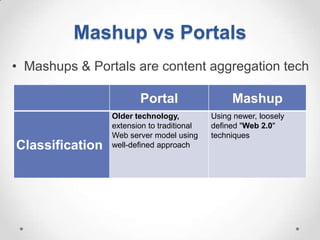
Mashup vs Portals
• Mashups & Portals are content aggregation tech

                        Portal                   Mashup
                 Older technology,          Using newer, loosely
                 extension to traditional   defined "Web 2.0"
                 Web server model using     techniques
Classification   well-defined approach
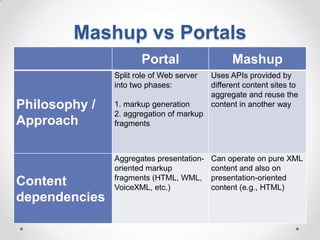
Mashup vs Portals
                      Portal                    Mashup
               Split role of Web server   Uses APIs provided by
               into two phases:           different content sites to
                                          aggregate and reuse the
Philosophy /   1. markup generation       content in another way
               2. aggregation of markup
Approach       fragments


               Aggregates presentation-   Can operate on pure XML
               oriented markup            content and also on
               fragments (HTML, WML,      presentation-oriented
Content        VoiceXML, etc.)            content (e.g., HTML)
dependencies
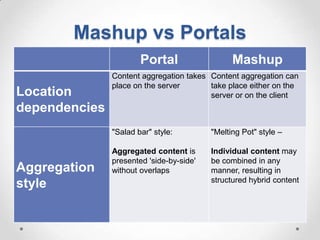
Mashup vs Portals
                       Portal                   Mashup
               Content aggregation takes Content aggregation can
               place on the server       take place either on the
Location                                 server or on the client
dependencies
               "Salad bar" style:         "Melting Pot" style –

               Aggregated content is      Individual content may
               presented 'side-by-side'   be combined in any
Aggregation    without overlaps           manner, resulting in
                                          structured hybrid content
style
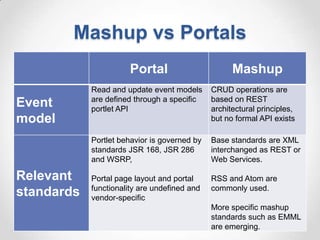
Mashup vs Portals
                       Portal                       Mashup
            Read and update event models      CRUD operations are
            are defined through a specific    based on REST
Event       portlet API                       architectural principles,
model                                         but no formal API exists

            Portlet behavior is governed by   Base standards are XML
            standards JSR 168, JSR 286        interchanged as REST or
            and WSRP,                         Web Services.

Relevant    Portal page layout and portal     RSS and Atom are
            functionality are undefined and   commonly used.
standards   vendor-specific
                                              More specific mashup
                                              standards such as EMML
                                              are emerging.
Portals
• Portals are older technology
  o designed as an extension to traditional dynamic Web
    applications

  Split into two phases
  o generation of markup "fragments" – portlet
     - hosted locally on the portal server or remotely
  o aggregation of the fragments into pages
Portals
• Portals are older technology
  o defines a complete event model covering reads and
    updates
  o Portal technology is about server-side, presentation-
    tier aggregation
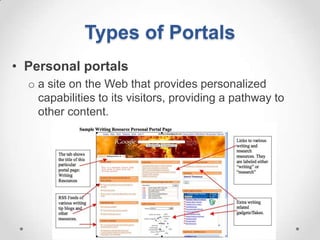
Types of Portals
• Personal portals
  o a site on the Web that provides personalized
    capabilities to its visitors, providing a pathway to
    other content.
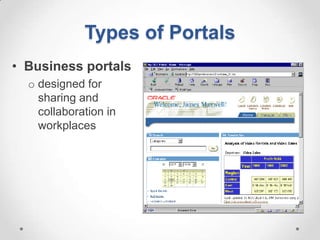
Types of Portals
• Business portals
  o designed for
    sharing and
    collaboration in
    workplaces
Types of Portals
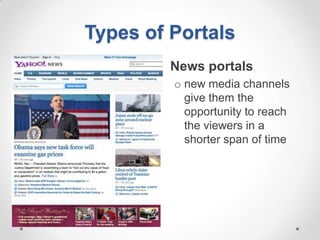
       • News portals
         o new media channels
           give them the
           opportunity to reach
           the viewers in a
           shorter span of time
Types of Portals
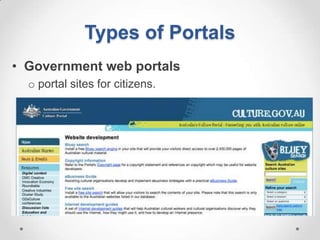
• Government web portals
  o portal sites for citizens.
Types of Portals
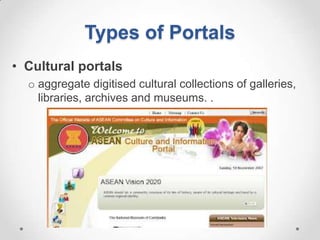
• Cultural portals
  o aggregate digitised cultural collections of galleries,
    libraries, archives and museums. .
Types of Portals
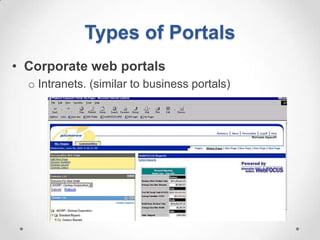
• Corporate web portals
  o Intranets. (similar to business portals)
Types of Portals
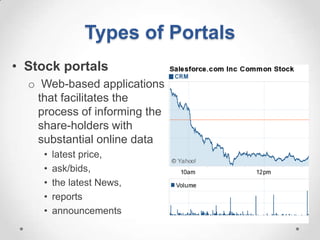
• Stock portals
  o Web-based applications
   that facilitates the
   process of informing the
   share-holders with
   substantial online data
    •   latest price,
    •   ask/bids,
    •   the latest News,
    •   reports
    •   announcements
Types of Portals
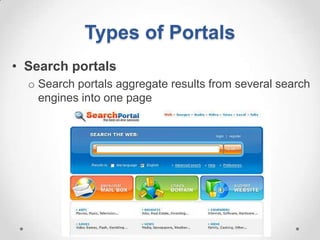
• Search portals
  o Search portals aggregate results from several search
    engines into one page
Types of Portals
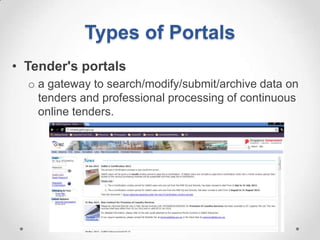
• Tender's portals
  o a gateway to search/modify/submit/archive data on
    tenders and professional processing of continuous
    online tenders.
Types of Portals
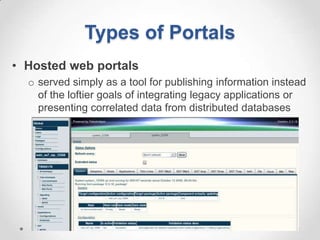
• Hosted web portals
  o served simply as a tool for publishing information instead
    of the loftier goals of integrating legacy applications or
    presenting correlated data from distributed databases
Types of Portals
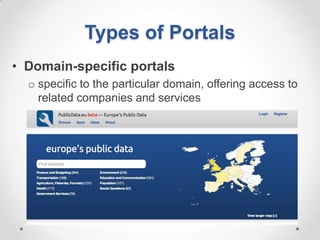
• Domain-specific portals
  o specific to the particular domain, offering access to
    related companies and services

04.m3 cms streaming-protocol

  • 1.
    IT2032PA Content Management System (CMS) Nitec in Social Media & Web Technology
  • 2.
    Mashup and StreamingProtocols In this chapter, you will learn: o Define what is a streaming protocol o Describe the different type of streaming protocol use on the Internet o Outline the protocol issues o Identify the difference between portals and mashup
  • 3.
    Streaming Protocol • Aset of rules is used for establishing and controlling media sessions between end points.
  • 4.
    Streaming Media Protocol •RTSP Protocol is the default protocol for streaming Windows Media. o Also used for streaming by: • RealMedia/RealVideo/RealAudio, • QuickTime video
  • 5.
    Streaming Media Protocol •MMS Protocol is used for streaming Windows Media only. o RTSP using UDP is called RTSPU o RTSP using TCP is called RTSPT o MMS using UDP is called MMSU o MMS using TCP is called MMST
  • 6.
    Streaming Media Protocol •PNM Protocol used for RealMedia/RealVideo/RealAudio streaming only.
  • 7.
    Streaming Media Protocol •RTMP Protocol is used for Flash audio and video streams only
  • 8.
    Streaming Media Protocol •HTTP Streaming HTTP streaming is a mechanism for sending data from a Web server to a Web browser in response to an event. HTTP protocol usually uses port 80 or 8080.
  • 9.
    Streaming Media Protocol •MMS - Microsoft Media Services Microsoft's streaming server uses the Microsoft Media Services (MMS) protocol (also called NetShow Services) to transfer unicast data. Note: o If WMP cannot negotiate a good connection using MMS over UDP, it will resort to MMS over TCP The default port for MMS is 1755
  • 10.
    Streaming Media Protocol •RTSP - Real Time Streaming Protocol o use in streaming media systems which allows a client to remotely control a streaming media server o issuing VCR-like commands such as "play" and "pause", o allowing time-based access to files on a server Note: o RTSP servers use RealNetworks's proprietary RDT as the transport protocol The default port for RTSP is 554
  • 11.
    Streaming Media Protocol •PNM/PNA - o The first version of RealAudio o RealNetworks later switched to the IETF standardized RTSP o allowing time-based access to files on a server Note: o RTSP servers use RealNetworks's proprietary RDT as the transport protocol The default port for RTSP is 554
  • 12.
    Streaming Media Protocol •RTMP - Real Time Messaging Protocol - o Proprietary protocol developed by Adobe Systems o Stream audio and video to Adobe Flash Player Note: o RTMPE - secure RTMP protocol. Uses encryption. The default port for RTMP is 1935
  • 13.
    Protocol Issues • UserDatagram Protocol (UDP) – o send the media stream as a series of small packets. o simple and efficient o no mechanism to guarantee delivery o up to the receiving application to detect loss / corruption and recover data using error correction techniques o data is lost = stream may suffer a dropout
  • 14.
    Protocol Issues • AnotherApproach – o HTTP adaptive bitrate streaming • files are very small, so that they can be compared to the streaming of packets
  • 15.
    Protocol Issues • TransmissionControl Protocol (TCP) – o guarantee correct delivery of each bit in the media stream o accomplish this with a system of timeouts and retries o makes them more complex to implement o data loss = media stream stalls while the protocol handlers detect the loss and retransmit the missing data
  • 16.
    Protocol Issues • UnicastProtocol – send a separate copy of the media stream from the server to each recipient o norm for most Internet connections o does not scale well when many users want to view the same video
  • 17.
    Protocol Issues • MulticastProtocol – developed to reduce the data replication and consequent server/network loads o send a single stream from the source to a group of recipients. o loss of video on demand functionality (downside). o But can be solved by elements such as • caching servers • digital set-top boxes • buffered media players
  • 18.
    Protocol Issues • IPProtocol – sends a single media stream to a group of recipients on a computer network o used to manage delivery of multicast streams to the groups of recipients on a LAN o Challenge is routers and firewalls between LANs must allow the passage of packets to m’cast groups o Protocol Independent Multicast (Org has control) • can be used to deliver stream content to multiple Local Area Network segments
  • 19.
    Protocol Issues • Peer-to-Peer(P2P) Protocol – arrange for prerecorded streams to be sent between computers o prevents the server and its network connections from becoming a bottleneck o raises technical, performance, quality, and business issues
  • 20.
    Mashup vs Portals •Mashups & Portals are content aggregation tech Portal Mashup Older technology, Using newer, loosely extension to traditional defined "Web 2.0" Web server model using techniques Classification well-defined approach
  • 21.
    Mashup vs Portals Portal Mashup Split role of Web server Uses APIs provided by into two phases: different content sites to aggregate and reuse the Philosophy / 1. markup generation content in another way 2. aggregation of markup Approach fragments Aggregates presentation- Can operate on pure XML oriented markup content and also on fragments (HTML, WML, presentation-oriented Content VoiceXML, etc.) content (e.g., HTML) dependencies
  • 22.
    Mashup vs Portals Portal Mashup Content aggregation takes Content aggregation can place on the server take place either on the Location server or on the client dependencies "Salad bar" style: "Melting Pot" style – Aggregated content is Individual content may presented 'side-by-side' be combined in any Aggregation without overlaps manner, resulting in structured hybrid content style
  • 23.
    Mashup vs Portals Portal Mashup Read and update event models CRUD operations are are defined through a specific based on REST Event portlet API architectural principles, model but no formal API exists Portlet behavior is governed by Base standards are XML standards JSR 168, JSR 286 interchanged as REST or and WSRP, Web Services. Relevant Portal page layout and portal RSS and Atom are functionality are undefined and commonly used. standards vendor-specific More specific mashup standards such as EMML are emerging.
  • 24.
    Portals • Portals areolder technology o designed as an extension to traditional dynamic Web applications Split into two phases o generation of markup "fragments" – portlet - hosted locally on the portal server or remotely o aggregation of the fragments into pages
  • 25.
    Portals • Portals areolder technology o defines a complete event model covering reads and updates o Portal technology is about server-side, presentation- tier aggregation
  • 26.
    Types of Portals •Personal portals o a site on the Web that provides personalized capabilities to its visitors, providing a pathway to other content.
  • 27.
    Types of Portals •Business portals o designed for sharing and collaboration in workplaces
  • 28.
    Types of Portals • News portals o new media channels give them the opportunity to reach the viewers in a shorter span of time
  • 29.
    Types of Portals •Government web portals o portal sites for citizens.
  • 30.
    Types of Portals •Cultural portals o aggregate digitised cultural collections of galleries, libraries, archives and museums. .
  • 31.
    Types of Portals •Corporate web portals o Intranets. (similar to business portals)
  • 32.
    Types of Portals •Stock portals o Web-based applications that facilitates the process of informing the share-holders with substantial online data • latest price, • ask/bids, • the latest News, • reports • announcements
  • 33.
    Types of Portals •Search portals o Search portals aggregate results from several search engines into one page
  • 34.
    Types of Portals •Tender's portals o a gateway to search/modify/submit/archive data on tenders and professional processing of continuous online tenders.
  • 35.
    Types of Portals •Hosted web portals o served simply as a tool for publishing information instead of the loftier goals of integrating legacy applications or presenting correlated data from distributed databases
  • 36.
    Types of Portals •Domain-specific portals o specific to the particular domain, offering access to related companies and services