Enterprise Portals


Gate to the Gold
`whoami`
•  SensePost
  –  Specialist Security firm based in
     Pretoria
  –  Customers all over the globe
  –  Talks / Papers / Books
•  ian@sensepost.com
  –  Associate security analyst
  –  I break stuff and write reports about
     breaking stuff
•  Why this talk?
EP Vendors
•  IBM WebSphere Portal
•  SAP NetWeaver Portal
•  Oracle Portal Products (PlumTree,
   BEA, SUN, ∞)
•  OpenText Portal (Formerly Vignette)
•  JBoss Portal
•  Microsoft SharePoint Server
•  Apache Jetspeed, Interwoven
   TeamPortal, …, ∞
EP Overview
•  Frequent on intranets.
•  Also frequent on the Internet… :)
•  Framework for integrating
   information, people and processes**
•  Consolidate and summarise diverse
   sources of information
•  Provide customisable home-page for
   registered users

**
EP Overview
•  Popular platform for deployment of
   applications due to framework and
   built-in functionality
•  Provide SDK’s for customisation and
   deployment of custom applications
•  Support pluggable components
   called portlets
•  Generally J2EE-based, but there are
   some alternate platforms (i.e.: .NET,
   PHP, ∞)
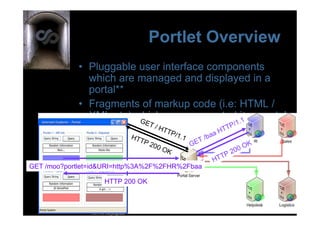
Portlet Overview
            •  Pluggable user interface components
               which are managed and displayed in a
               portal**
            •  Fragments of markup code (i.e: HTML /
               XML etc) which are aggregated in a portal
               page**
            •  Adhere to various standards
                   –  WSRP (web services for remote portlets)
                   –  Java Portlet Specification
GET /moo?portlet=id&URI=http%3A%2F%2FHR%2Fbaa
                   •  JSR168
                   HTTP 200 OK
                   •  JSR268
                   •  Proprietary
             **
Functionality++
•  User Registration
•  Portals are generally designed to
   share information – provide
   functionality for searching
   documents, users, ..., ∞
•  Workflow components
•  Messaging / Social networking
•  Configuration and administrative
   components
Common Shortcomings
•  Generally cater for multiple portal
   applications
  –  May expose intranet applications to the
     Internet
•  Frequently allow registration for
   public users – Functionality++
•  Due to complex installation of J2EE
   application servers and lazy
   sys-admins, frequently run with
   elevated privileges
Common Shortcomings
•  Diverse log-in capabilities
  –  LDAP, XML, Database, ..., ∞, * == SSO
•  Developers of custom applications
   deployed on portal platforms
   frequently have not considered the
   underlying functionality of the
   platform
•  Custom error pages defined for
   platform
•  Complexity++
Breaking Out
•  Custom applications frequently
   exploit functionality of portal
   framework but don’t allow users
   direct access to framework
   functions…
•  … or do they ?
Breaking Out
•  Direct object access
•  Google is your friend… :>
•  Forcing errors to display generic
   portal error messages
•  Accessing site-registration
•  HTML source comments and
   JavaScript
•  Once we can break out of the
   custom application, we expose the
   full functionality of the portal…
Finding Portals
•  Google Hacks (nods at Johnny
   Long…)
•  site:, insite:, inurl:, …, ∞
•  Demo…
  –  site:za
  –  inurl:/portal/site
  –  inurl:/template.REGISTER
Abusing Portlets
•  Original Advisory pertaining to IBM
   WebSphere
     –  WebSphere – 2006/01/24 – EPAM Systems
•    Port Scanning
•    Accessing protected resources
•    Attacks at third parties
•    Blended Attack Scenarios
     –  Denial Of Service
     –  Brute-Force
     –  Attacks against other protocols
PortletSuite.tgz
•  PortletScan.py
  –  Scan for open ports by abusing portlets
•  Pikto.py
  –  Scan for common virtual directory
     names and web server
     misconfigurations
•  PorProx.py
  –  Provides proxy server functionality
     tunnelling HTTP requests through
     remote portlets
PortletSuite.tgz
•  http://www.sensepost.com/blog
•  Demo…
  –  Breaking out
  –  Portlet-scanning
  –  Pikto
  –  Accessing protected resources
  –  PortletProx
Questions ?


ian@sensepost.com

Enterprise portals, gate to the gold

  • 1.
  • 2.
    `whoami` •  SensePost –  Specialist Security firm based in Pretoria –  Customers all over the globe –  Talks / Papers / Books •  ian@sensepost.com –  Associate security analyst –  I break stuff and write reports about breaking stuff •  Why this talk?
  • 3.
    EP Vendors •  IBMWebSphere Portal •  SAP NetWeaver Portal •  Oracle Portal Products (PlumTree, BEA, SUN, ∞) •  OpenText Portal (Formerly Vignette) •  JBoss Portal •  Microsoft SharePoint Server •  Apache Jetspeed, Interwoven TeamPortal, …, ∞
  • 4.
    EP Overview •  Frequenton intranets. •  Also frequent on the Internet… :) •  Framework for integrating information, people and processes** •  Consolidate and summarise diverse sources of information •  Provide customisable home-page for registered users **
  • 5.
    EP Overview •  Popularplatform for deployment of applications due to framework and built-in functionality •  Provide SDK’s for customisation and deployment of custom applications •  Support pluggable components called portlets •  Generally J2EE-based, but there are some alternate platforms (i.e.: .NET, PHP, ∞)
  • 6.
    Portlet Overview •  Pluggable user interface components which are managed and displayed in a portal** •  Fragments of markup code (i.e: HTML / XML etc) which are aggregated in a portal page** •  Adhere to various standards –  WSRP (web services for remote portlets) –  Java Portlet Specification GET /moo?portlet=id&URI=http%3A%2F%2FHR%2Fbaa •  JSR168 HTTP 200 OK •  JSR268 •  Proprietary **
  • 7.
    Functionality++ •  User Registration • Portals are generally designed to share information – provide functionality for searching documents, users, ..., ∞ •  Workflow components •  Messaging / Social networking •  Configuration and administrative components
  • 8.
    Common Shortcomings •  Generallycater for multiple portal applications –  May expose intranet applications to the Internet •  Frequently allow registration for public users – Functionality++ •  Due to complex installation of J2EE application servers and lazy sys-admins, frequently run with elevated privileges
  • 9.
    Common Shortcomings •  Diverselog-in capabilities –  LDAP, XML, Database, ..., ∞, * == SSO •  Developers of custom applications deployed on portal platforms frequently have not considered the underlying functionality of the platform •  Custom error pages defined for platform •  Complexity++
  • 10.
    Breaking Out •  Customapplications frequently exploit functionality of portal framework but don’t allow users direct access to framework functions… •  … or do they ?
  • 11.
    Breaking Out •  Directobject access •  Google is your friend… :> •  Forcing errors to display generic portal error messages •  Accessing site-registration •  HTML source comments and JavaScript •  Once we can break out of the custom application, we expose the full functionality of the portal…
  • 12.
    Finding Portals •  GoogleHacks (nods at Johnny Long…) •  site:, insite:, inurl:, …, ∞ •  Demo… –  site:za –  inurl:/portal/site –  inurl:/template.REGISTER
  • 13.
    Abusing Portlets •  OriginalAdvisory pertaining to IBM WebSphere –  WebSphere – 2006/01/24 – EPAM Systems •  Port Scanning •  Accessing protected resources •  Attacks at third parties •  Blended Attack Scenarios –  Denial Of Service –  Brute-Force –  Attacks against other protocols
  • 14.
    PortletSuite.tgz •  PortletScan.py –  Scan for open ports by abusing portlets •  Pikto.py –  Scan for common virtual directory names and web server misconfigurations •  PorProx.py –  Provides proxy server functionality tunnelling HTTP requests through remote portlets
  • 15.
    PortletSuite.tgz •  http://www.sensepost.com/blog •  Demo… –  Breaking out –  Portlet-scanning –  Pikto –  Accessing protected resources –  PortletProx
  • 16.