SOFTWARE TESTING
(EQUIVALENCE CLASS PARTITIONING)
Engr. Sajid Saleem
2
OUTLINE
 Equivalence Classes
 Testing By Contract
 Defensive testing
 Types of Equivalence Classes
 Continuous Equivalence Class
 Discrete Equivalence Class
 Single Selection Equivalence Class
 Multiple Selection Equivalence Class
 Testing Valid vs Invalid Data
 Applicability and Limitations
 Examples
 Grocery Store
 Banking Problem
 Next Date Problem
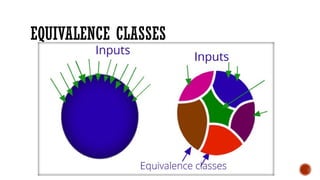
EQUIVALENCE CLASSES
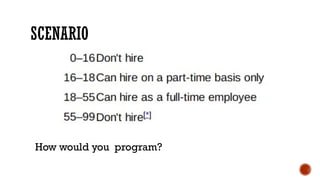
SCENARIO
How would you program?
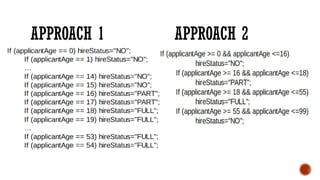
APPROACH 1 APPROACH 2
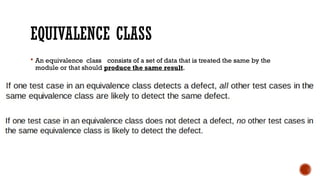
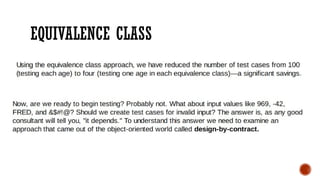
EQUIVALENCE CLASS
 An equivalence class consists of a set of data that is treated the same by the
module or that should produce the same result.
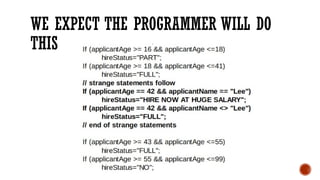
WE EXPECT THE PROGRAMMER WILL DO
THIS
EQUIVALENCE CLASS
DESIGN BY CONTRACT : OOP APPROACH
 In the design-by-contract approach, modules (called "methods" in the object-
oriented paradigm, but "module" is a more generic term) are defined in terms of
pre-conditions and post-conditions.
 Post-conditions define what a module promises to do (compute a value, open a file,
print a
 report, update a database record, change the state of the system, etc.).
 Pre-conditions define what that module requires so that it can meet its post-
conditions.
 For example, if we had a module called openFile, what does it promise to do? Open
a file.What would legitimate preconditions of openFile be? First, the file must exist;
second, we must provide the name (or other identifying information) of the file;
third, the file must be "openable," that is, it cannot already be exclusively opened
by another process; fourth, we must have access rights to the file; and so on.
 Pre-conditions and postconditions establish a contract between a module and
others that invoke it.
TESTING BY CONTRACT
 Testing-by-contract is based on the design-by-contract philosophy.
 Its approach is to create test cases only for the situations in which the pre-conditions
are met.
 For example, we would not test the openFile module when the file did not exist.
 The reason is simple. If the file does not exist, openFile does not promise to work.
 If there is no claim that it will work under a specific condition, there is no need to test
under that condition.
 At this point testers usually protest.
 Yes, they agree, the module does not claim to work in that case, but what if the
preconditions are violated during production? What does the system do?
 Do we get a misspelled word on the screen or a smoking crater where our company
used to be?
DEFENSIVE DESIGN
 A different approach to design is defensive design.
 In this case the module is designed to accept any input.
 If the normal preconditions are met, the module will achieve its normal postconditions.
 If the normal pre-conditions are not met, the module will notify the caller by returning an
error code or throwing an exception (depending on the programming language used).
This notification is actually another one of the module's postconditions.
 Based on this approach we could define defensive testing: an approach that tests
under both normal and abnormal pre-conditions.
TYPES OF EQUIVALENCE CLASSES
 Different types of input require different types of equivalence classes.
 Let's consider four possibilities.
 Continuous Equivalence Class
 Discrete Equivalence Class
 Single Selection Equivalence Class
 Multiple Selection Equivalence Class
 Let's assume a defensive testing philosophy of testing both valid and invalid
input.
 Testing invalid inputs is often a great source of defects.
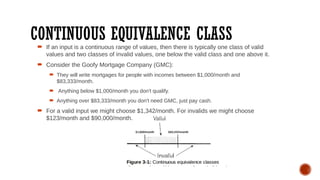
CONTINUOUS EQUIVALENCE CLASS
 If an input is a continuous range of values, then there is typically one class of valid
values and two classes of invalid values, one below the valid class and one above it.
 Consider the Goofy Mortgage Company (GMC):
 They will write mortgages for people with incomes between $1,000/month and
$83,333/month.
 Anything below $1,000/month you don't qualify.
 Anything over $83,333/month you don't need GMC, just pay cash.
 For a valid input we might choose $1,342/month. For invalids we might choose
$123/month and $90,000/month.
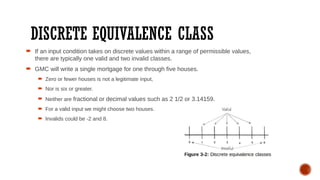
DISCRETE EQUIVALENCE CLASS
 If an input condition takes on discrete values within a range of permissible values,
there are typically one valid and two invalid classes.
 GMC will write a single mortgage for one through five houses.
 Zero or fewer houses is not a legitimate input,
 Nor is six or greater.
 Neither are fractional or decimal values such as 2 1/2 or 3.14159.
 For a valid input we might choose two houses.
 Invalids could be -2 and 8.
SINGLE SELECTION EQUIVALENCE CLASS
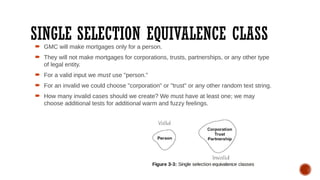
 GMC will make mortgages only for a person.
 They will not make mortgages for corporations, trusts, partnerships, or any other type
of legal entity.
 For a valid input we must use "person."
 For an invalid we could choose "corporation" or "trust" or any other random text string.
 How many invalid cases should we create? We must have at least one; we may
choose additional tests for additional warm and fuzzy feelings.
MULTIPLE SELECTION EQUIVALENCE CLASS
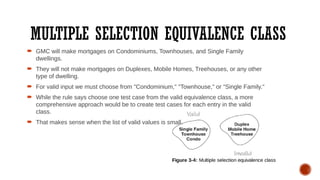
 GMC will make mortgages on Condominiums, Townhouses, and Single Family
dwellings.
 They will not make mortgages on Duplexes, Mobile Homes, Treehouses, or any other
type of dwelling.
 For valid input we must choose from "Condominium," "Townhouse," or "Single Family."
 While the rule says choose one test case from the valid equivalence class, a more
comprehensive approach would be to create test cases for each entry in the valid
class.
 That makes sense when the list of valid values is small.
TESTING VALID DATA
 Now, rarely will we have the time to create individual tests for every separate
equivalence class of every input value that enters our system.
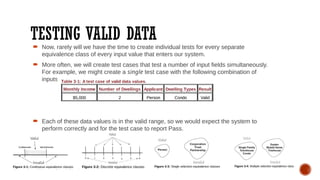
 More often, we will create test cases that test a number of input fields simultaneously.
For example, we might create a single test case with the following combination of
inputs:
 Each of these data values is in the valid range, so we would expect the system to
perform correctly and for the test case to report Pass.
TESTING INVALID DATA
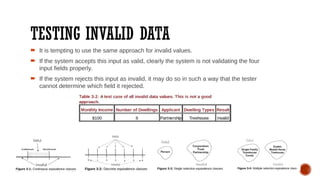
 It is tempting to use the same approach for invalid values.
 If the system accepts this input as valid, clearly the system is not validating the four
input fields properly.
 If the system rejects this input as invalid, it may do so in such a way that the tester
cannot determine which field it rejected.
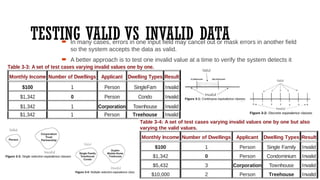
TESTING VALID VS INVALID DATA
 In many cases, errors in one input field may cancel out or mask errors in another field
so the system accepts the data as valid.
 A better approach is to test one invalid value at a time to verify the system detects it
correctly.
TESTING VALID VS INVALID DATA (CONTD.)
 Another approach to using equivalence classes is to examine the outputs rather than
the inputs.
 Divide the outputs into equivalence classes, then determine what input values would
cause those outputs.
 This has the advantage of guiding the tester to examine, and thus test, every different
kind of output.
 But this approach can be deceiving. ??????
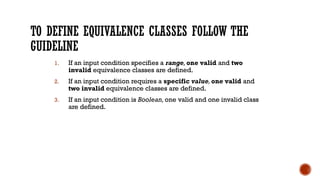
TO DEFINE EQUIVALENCE CLASSES FOLLOW THE
GUIDELINE
1. If an input condition specifies a range,one valid and two
invalid equivalence classes are defined.
2. If an input condition requires a specific value,one valid and
two invalid equivalence classes are defined.
3. If an input condition is Boolean, one valid and one invalid class
are defined.
TEST CASES FOR INPUT BOX ACCEPTING NUMBERS
BETWEEN 1 AND 1000 USING EQUIVALENCE PARTITIONING
 One input data class with all valid inputs. Pick a single value from range 1 to 1000
 Input data class with all values below lower limit. I.e. any value below 1, as a invalid
input data test case
 Input data with any value greater than 1000 to represent third invalid input class.
APPLICABILITY AND LIMITATIONS
 Equivalence class testing can significantly reduce the number of test cases
that must be created and executed.
 It is most suited to systems in which much of the input data takes on values
within ranges or within sets.
 It makes the assumption that data in the same equivalence class is, in fact,
processed in the same way by the system.
 The simplest way to validate this assumption is to ask the programmer about
their implementation.
 Equivalence class testing is equally applicable at the unit, integration, system,
and acceptance test levels.
 All it requires are inputs or outputs that can be partitioned based on the
system’s requirements.
TEST CASE OF GROCERY STORE
APPLICATION
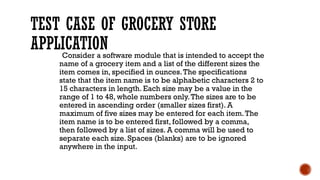
Consider a software module that is intended to accept the
name of a grocery item and a list of the different sizes the
item comes in, specified in ounces.The specifications
state that the item name is to be alphabetic characters 2 to
15 characters in length. Each size may be a value in the
range of 1 to 48, whole numbers only.The sizes are to be
entered in ascending order (smaller sizes first). A
maximum of five sizes may be entered for each item.The
item name is to be entered first, followed by a comma,
then followed by a list of sizes. A comma will be used to
separate each size. Spaces (blanks) are to be ignored
anywhere in the input.
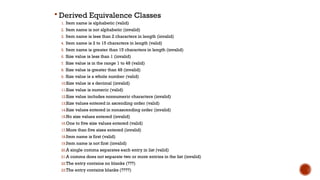
 Derived Equivalence Classes
1. Item name is alphabetic (valid)
2. Item name is not alphabetic (invalid)
3. Item name is less than 2 characters in length (invalid)
4. Item name is 2 to 15 characters in length (valid)
5. Item name is greater than 15 characters in length (invalid)
6. Size value is less than 1 (invalid)
7. Size value is in the range 1 to 48 (valid)
8. Size value is greater than 48 (invalid)
9. Size value is a whole number (valid)
10.Size value is a decimal (invalid)
11.Size value is numeric (valid)
12.Size value includes nonnumeric characters (invalid)
13.Size values entered in ascending order (valid)
14.Size values entered in nonascending order (invalid)
15.No size values entered (invalid)
16.One to five size values entered (valid)
17.More than five sizes entered (invalid)
18.Item name is first (valid)
19.Item name is not first (invalid)
20.A single comma separates each entry in list (valid)
21.A comma does not separate two or more entries in the list (invalid)
22.The entry contains no blanks (???)
23.The entry contains blanks (????)
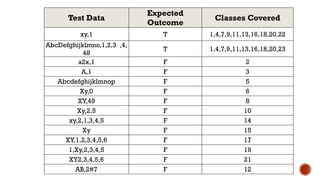
Test Data
Expected
Outcome
Classes Covered
xy,1 T 1,4,7,9,11,13,16,18,20,22
AbcDefghijklmno,1,2,3 ,4,
48
T 1,4,7,9,11,13,16,18,20,23
a2x,1 F 2
A,1 F 3
Abcdefghijklmnop F 5
Xy,0 F 6
XY,49 F 8
Xy,2.5 F 10
xy,2,1,3,4,5 F 14
Xy F 15
XY,1,2,3,4,5,6 F 17
1,Xy,2,3,4,5 F 19
XY2,3,4,5,6 F 21
AB,2#7 F 12
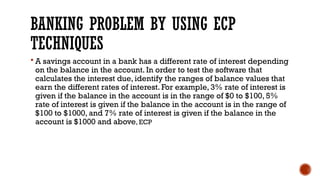
BANKING PROBLEM BY USING ECP
TECHNIQUES
 A savings account in a bank has a different rate of interest depending
on the balance in the account. In order to test the software that
calculates the interest due, identify the ranges of balance values that
earn the different rates of interest. For example, 3% rate of interest is
given if the balance in the account is in the range of $0 to $100, 5%
rate of interest is given if the balance in the account is in the range of
$100 to $1000, and 7% rate of interest is given if the balance in the
account is $1000 and above, ECP
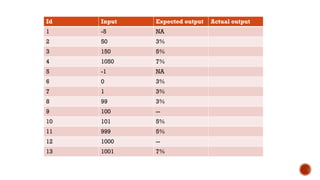
Id Input Expected output Actual output
1 -5 NA
2 50 3%
3 150 5%
4 1050 7%
5 -1 NA
6 0 3%
7 1 3%
8 99 3%
9 100 --
10 101 5%
11 999 5%
12 1000 --
13 1001 7%
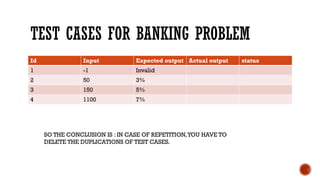
TEST CASES FOR BANKING PROBLEM
Id Input Expected output Actual output status
1 -1 Invalid
2 50 3%
3 150 5%
4 1100 7%
SO THE CONCLUSION IS : IN CASE OF REPETITION,YOU HAVE TO
DELETE THE DUPLICATIONS OF TEST CASES.
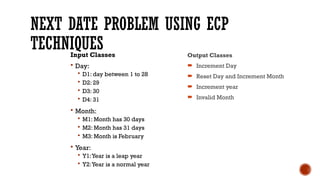
NEXT DATE PROBLEM USING ECP
TECHNIQUES
Input Classes
 Day:
 D1: day between 1 to 28
 D2: 29
 D3: 30
 D4: 31
 Month:
 M1: Month has 30 days
 M2: Month has 31 days
 M3: Month is February
 Year:
 Y1:Year is a leap year
 Y2:Year is a normal year
Output Classes
 Increment Day
 Reset Day and Increment Month
 Increment year
 Invalid Month
NEXT DATE PROBLEM USING ECP
TECHNIQUES
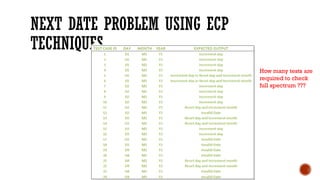
How many tests are
required to check
full spectrum ???
NEXT DATE PROBLEM USING ECP
TECHNIQUES
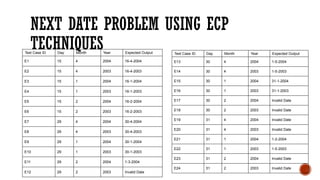
Test Case ID Day Month Year Expected Output
E1 15 4 2004 16-4-2004
E2 15 4 2003 16-4-2003
E3 15 1 2004 16-1-2004
E4 15 1 2003 16-1-2003
E5 15 2 2004 16-2-2004
E6 15 2 2003 16-2-2003
E7 29 4 2004 30-4-2004
E8 29 4 2003 30-4-2003
E9 29 1 2004 30-1-2004
E10 29 1 2003 30-1-2003
E11 29 2 2004 1-3-2004
E12 29 2 2003 Invalid Date
Test Case ID Day Month Year Expected Output
E13 30 4 2004 1-5-2004
E14 30 4 2003 1-5-2003
E15 30 1 2004 31-1-2004
E16 30 1 2003 31-1-2003
E17 30 2 2004 Invalid Date
E18 30 2 2003 Invalid Date
E19 31 4 2004 Invalid Date
E20 31 4 2003 Invalid Date
E21 31 1 2004 1-2-2004
E22 31 1 2003 1-5-2003
E23 31 2 2004 Invalid Date
E24 31 2 2003 Invalid Date
THANK YOU

04 Equivalence Class Partitioning_Done.pptx

  • 1.
    SOFTWARE TESTING (EQUIVALENCE CLASSPARTITIONING) Engr. Sajid Saleem
  • 2.
    2 OUTLINE  Equivalence Classes Testing By Contract  Defensive testing  Types of Equivalence Classes  Continuous Equivalence Class  Discrete Equivalence Class  Single Selection Equivalence Class  Multiple Selection Equivalence Class  Testing Valid vs Invalid Data  Applicability and Limitations  Examples  Grocery Store  Banking Problem  Next Date Problem
  • 3.
  • 4.
  • 5.
  • 6.
    EQUIVALENCE CLASS  Anequivalence class consists of a set of data that is treated the same by the module or that should produce the same result.
  • 7.
    WE EXPECT THEPROGRAMMER WILL DO THIS
  • 8.
  • 9.
    DESIGN BY CONTRACT: OOP APPROACH  In the design-by-contract approach, modules (called "methods" in the object- oriented paradigm, but "module" is a more generic term) are defined in terms of pre-conditions and post-conditions.  Post-conditions define what a module promises to do (compute a value, open a file, print a  report, update a database record, change the state of the system, etc.).  Pre-conditions define what that module requires so that it can meet its post- conditions.  For example, if we had a module called openFile, what does it promise to do? Open a file.What would legitimate preconditions of openFile be? First, the file must exist; second, we must provide the name (or other identifying information) of the file; third, the file must be "openable," that is, it cannot already be exclusively opened by another process; fourth, we must have access rights to the file; and so on.  Pre-conditions and postconditions establish a contract between a module and others that invoke it.
  • 10.
    TESTING BY CONTRACT Testing-by-contract is based on the design-by-contract philosophy.  Its approach is to create test cases only for the situations in which the pre-conditions are met.  For example, we would not test the openFile module when the file did not exist.  The reason is simple. If the file does not exist, openFile does not promise to work.  If there is no claim that it will work under a specific condition, there is no need to test under that condition.  At this point testers usually protest.  Yes, they agree, the module does not claim to work in that case, but what if the preconditions are violated during production? What does the system do?  Do we get a misspelled word on the screen or a smoking crater where our company used to be?
  • 11.
    DEFENSIVE DESIGN  Adifferent approach to design is defensive design.  In this case the module is designed to accept any input.  If the normal preconditions are met, the module will achieve its normal postconditions.  If the normal pre-conditions are not met, the module will notify the caller by returning an error code or throwing an exception (depending on the programming language used). This notification is actually another one of the module's postconditions.  Based on this approach we could define defensive testing: an approach that tests under both normal and abnormal pre-conditions.
  • 12.
    TYPES OF EQUIVALENCECLASSES  Different types of input require different types of equivalence classes.  Let's consider four possibilities.  Continuous Equivalence Class  Discrete Equivalence Class  Single Selection Equivalence Class  Multiple Selection Equivalence Class  Let's assume a defensive testing philosophy of testing both valid and invalid input.  Testing invalid inputs is often a great source of defects.
  • 13.
    CONTINUOUS EQUIVALENCE CLASS If an input is a continuous range of values, then there is typically one class of valid values and two classes of invalid values, one below the valid class and one above it.  Consider the Goofy Mortgage Company (GMC):  They will write mortgages for people with incomes between $1,000/month and $83,333/month.  Anything below $1,000/month you don't qualify.  Anything over $83,333/month you don't need GMC, just pay cash.  For a valid input we might choose $1,342/month. For invalids we might choose $123/month and $90,000/month.
  • 14.
    DISCRETE EQUIVALENCE CLASS If an input condition takes on discrete values within a range of permissible values, there are typically one valid and two invalid classes.  GMC will write a single mortgage for one through five houses.  Zero or fewer houses is not a legitimate input,  Nor is six or greater.  Neither are fractional or decimal values such as 2 1/2 or 3.14159.  For a valid input we might choose two houses.  Invalids could be -2 and 8.
  • 15.
    SINGLE SELECTION EQUIVALENCECLASS  GMC will make mortgages only for a person.  They will not make mortgages for corporations, trusts, partnerships, or any other type of legal entity.  For a valid input we must use "person."  For an invalid we could choose "corporation" or "trust" or any other random text string.  How many invalid cases should we create? We must have at least one; we may choose additional tests for additional warm and fuzzy feelings.
  • 16.
    MULTIPLE SELECTION EQUIVALENCECLASS  GMC will make mortgages on Condominiums, Townhouses, and Single Family dwellings.  They will not make mortgages on Duplexes, Mobile Homes, Treehouses, or any other type of dwelling.  For valid input we must choose from "Condominium," "Townhouse," or "Single Family."  While the rule says choose one test case from the valid equivalence class, a more comprehensive approach would be to create test cases for each entry in the valid class.  That makes sense when the list of valid values is small.
  • 17.
    TESTING VALID DATA Now, rarely will we have the time to create individual tests for every separate equivalence class of every input value that enters our system.  More often, we will create test cases that test a number of input fields simultaneously. For example, we might create a single test case with the following combination of inputs:  Each of these data values is in the valid range, so we would expect the system to perform correctly and for the test case to report Pass.
  • 18.
    TESTING INVALID DATA It is tempting to use the same approach for invalid values.  If the system accepts this input as valid, clearly the system is not validating the four input fields properly.  If the system rejects this input as invalid, it may do so in such a way that the tester cannot determine which field it rejected.
  • 19.
    TESTING VALID VSINVALID DATA  In many cases, errors in one input field may cancel out or mask errors in another field so the system accepts the data as valid.  A better approach is to test one invalid value at a time to verify the system detects it correctly.
  • 20.
    TESTING VALID VSINVALID DATA (CONTD.)  Another approach to using equivalence classes is to examine the outputs rather than the inputs.  Divide the outputs into equivalence classes, then determine what input values would cause those outputs.  This has the advantage of guiding the tester to examine, and thus test, every different kind of output.  But this approach can be deceiving. ??????
  • 21.
    TO DEFINE EQUIVALENCECLASSES FOLLOW THE GUIDELINE 1. If an input condition specifies a range,one valid and two invalid equivalence classes are defined. 2. If an input condition requires a specific value,one valid and two invalid equivalence classes are defined. 3. If an input condition is Boolean, one valid and one invalid class are defined.
  • 22.
    TEST CASES FORINPUT BOX ACCEPTING NUMBERS BETWEEN 1 AND 1000 USING EQUIVALENCE PARTITIONING  One input data class with all valid inputs. Pick a single value from range 1 to 1000  Input data class with all values below lower limit. I.e. any value below 1, as a invalid input data test case  Input data with any value greater than 1000 to represent third invalid input class.
  • 23.
    APPLICABILITY AND LIMITATIONS Equivalence class testing can significantly reduce the number of test cases that must be created and executed.  It is most suited to systems in which much of the input data takes on values within ranges or within sets.  It makes the assumption that data in the same equivalence class is, in fact, processed in the same way by the system.  The simplest way to validate this assumption is to ask the programmer about their implementation.  Equivalence class testing is equally applicable at the unit, integration, system, and acceptance test levels.  All it requires are inputs or outputs that can be partitioned based on the system’s requirements.
  • 24.
    TEST CASE OFGROCERY STORE APPLICATION Consider a software module that is intended to accept the name of a grocery item and a list of the different sizes the item comes in, specified in ounces.The specifications state that the item name is to be alphabetic characters 2 to 15 characters in length. Each size may be a value in the range of 1 to 48, whole numbers only.The sizes are to be entered in ascending order (smaller sizes first). A maximum of five sizes may be entered for each item.The item name is to be entered first, followed by a comma, then followed by a list of sizes. A comma will be used to separate each size. Spaces (blanks) are to be ignored anywhere in the input.
  • 25.
     Derived EquivalenceClasses 1. Item name is alphabetic (valid) 2. Item name is not alphabetic (invalid) 3. Item name is less than 2 characters in length (invalid) 4. Item name is 2 to 15 characters in length (valid) 5. Item name is greater than 15 characters in length (invalid) 6. Size value is less than 1 (invalid) 7. Size value is in the range 1 to 48 (valid) 8. Size value is greater than 48 (invalid) 9. Size value is a whole number (valid) 10.Size value is a decimal (invalid) 11.Size value is numeric (valid) 12.Size value includes nonnumeric characters (invalid) 13.Size values entered in ascending order (valid) 14.Size values entered in nonascending order (invalid) 15.No size values entered (invalid) 16.One to five size values entered (valid) 17.More than five sizes entered (invalid) 18.Item name is first (valid) 19.Item name is not first (invalid) 20.A single comma separates each entry in list (valid) 21.A comma does not separate two or more entries in the list (invalid) 22.The entry contains no blanks (???) 23.The entry contains blanks (????)
  • 26.
    Test Data Expected Outcome Classes Covered xy,1T 1,4,7,9,11,13,16,18,20,22 AbcDefghijklmno,1,2,3 ,4, 48 T 1,4,7,9,11,13,16,18,20,23 a2x,1 F 2 A,1 F 3 Abcdefghijklmnop F 5 Xy,0 F 6 XY,49 F 8 Xy,2.5 F 10 xy,2,1,3,4,5 F 14 Xy F 15 XY,1,2,3,4,5,6 F 17 1,Xy,2,3,4,5 F 19 XY2,3,4,5,6 F 21 AB,2#7 F 12
  • 27.
    BANKING PROBLEM BYUSING ECP TECHNIQUES  A savings account in a bank has a different rate of interest depending on the balance in the account. In order to test the software that calculates the interest due, identify the ranges of balance values that earn the different rates of interest. For example, 3% rate of interest is given if the balance in the account is in the range of $0 to $100, 5% rate of interest is given if the balance in the account is in the range of $100 to $1000, and 7% rate of interest is given if the balance in the account is $1000 and above, ECP
  • 28.
    Id Input Expectedoutput Actual output 1 -5 NA 2 50 3% 3 150 5% 4 1050 7% 5 -1 NA 6 0 3% 7 1 3% 8 99 3% 9 100 -- 10 101 5% 11 999 5% 12 1000 -- 13 1001 7%
  • 29.
    TEST CASES FORBANKING PROBLEM Id Input Expected output Actual output status 1 -1 Invalid 2 50 3% 3 150 5% 4 1100 7% SO THE CONCLUSION IS : IN CASE OF REPETITION,YOU HAVE TO DELETE THE DUPLICATIONS OF TEST CASES.
  • 30.
    NEXT DATE PROBLEMUSING ECP TECHNIQUES Input Classes  Day:  D1: day between 1 to 28  D2: 29  D3: 30  D4: 31  Month:  M1: Month has 30 days  M2: Month has 31 days  M3: Month is February  Year:  Y1:Year is a leap year  Y2:Year is a normal year Output Classes  Increment Day  Reset Day and Increment Month  Increment year  Invalid Month
  • 31.
    NEXT DATE PROBLEMUSING ECP TECHNIQUES How many tests are required to check full spectrum ???
  • 32.
    NEXT DATE PROBLEMUSING ECP TECHNIQUES Test Case ID Day Month Year Expected Output E1 15 4 2004 16-4-2004 E2 15 4 2003 16-4-2003 E3 15 1 2004 16-1-2004 E4 15 1 2003 16-1-2003 E5 15 2 2004 16-2-2004 E6 15 2 2003 16-2-2003 E7 29 4 2004 30-4-2004 E8 29 4 2003 30-4-2003 E9 29 1 2004 30-1-2004 E10 29 1 2003 30-1-2003 E11 29 2 2004 1-3-2004 E12 29 2 2003 Invalid Date Test Case ID Day Month Year Expected Output E13 30 4 2004 1-5-2004 E14 30 4 2003 1-5-2003 E15 30 1 2004 31-1-2004 E16 30 1 2003 31-1-2003 E17 30 2 2004 Invalid Date E18 30 2 2003 Invalid Date E19 31 4 2004 Invalid Date E20 31 4 2003 Invalid Date E21 31 1 2004 1-2-2004 E22 31 1 2003 1-5-2003 E23 31 2 2004 Invalid Date E24 31 2 2003 Invalid Date
  • 33.