1
Basic Of GSM
Which is needed
IN Drive Test
Written By
PAWAN KUMAR
RF ENGINEER
2
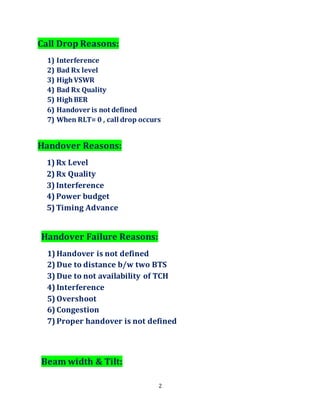
Call Drop Reasons:
1) Interference
2) Bad Rx level
3) HighVSWR
4) Bad Rx Quality
5) HighBER
6) Handover is not defined
7) When RLT= 0 , call drop occurs
Handover Reasons:
1) Rx Level
2) Rx Quality
3) Interference
4) Power budget
5) Timing Advance
Handover Failure Reasons:
1) Handover is not defined
2) Due to distance b/w two BTS
3) Due to not availability of TCH
4) Interference
5) Overshoot
6) Congestion
7) Proper handover is not defined
Beam width & Tilt:
3
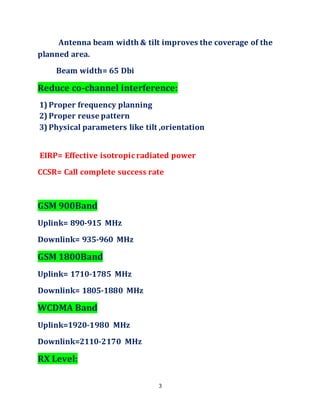
Antenna beam width & tilt improves the coverage of the
planned area.
Beam width= 65 Dbi
Reduce co-channel interference:
1) Proper frequency planning
2) Proper reuse pattern
3) Physical parameters like tilt ,orientation
EIRP= Effective isotropicradiated power
CCSR= Call complete success rate
GSM 900Band
Uplink= 890-915 MHz
Downlink= 935-960 MHz
GSM 1800Band
Uplink= 1710-1785 MHz
Downlink= 1805-1880 MHz
WCDMA Band
Uplink=1920-1980 MHz
Downlink=2110-2170 MHz
RX Level:
4
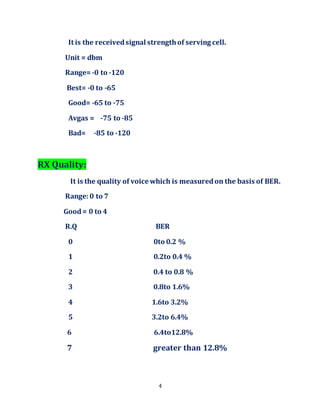
It is the receivedsignal strengthof serving cell.
Unit = dbm
Range=-0 to -120
Best= -0 to -65
Good= -65 to -75
Avgas = -75 to -85
Bad= -85 to -120
RX Quality:
It is the quality of voice which is measuredon the basis of BER.
Range:0 to 7
Good= 0 to 4
R.Q BER
0 0to 0.2 %
1 0.2to 0.4 %
2 0.4 to 0.8 %
3 0.8to 1.6%
4 1.6to 3.2%
5 3.2to 6.4%
6 6.4to12.8%
7 greater than 12.8%
5
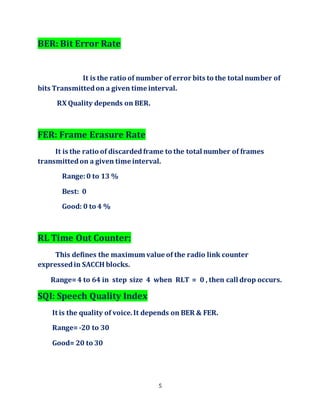
BER: Bit Error Rate
It is the ratio of number of error bits to the total number of
bits Transmittedon a given time interval.
RX Quality depends on BER.
FER: Frame Erasure Rate
It is the ratio of discardedframe to the total number of frames
transmittedon a given time interval.
Range:0 to 13 %
Best: 0
Good: 0 to 4 %
RL Time Out Counter:
This defines the maximum value of the radio link counter
expressedin SACCH blocks.
Range=4 to 64 in step size 4 when RLT = 0 , then call drop occurs.
SQI: Speech Quality Index
It is the quality of voice.It depends on BER & FER.
Range=-20 to 30
Good= 20 to 30
6
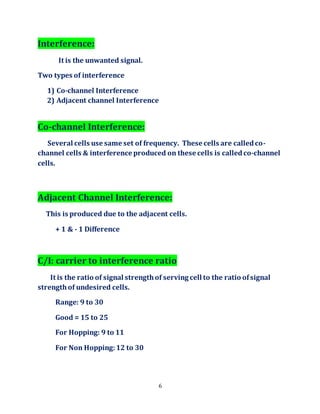
Interference:
It is the unwanted signal.
Two types of interference
1) Co-channel Interference
2) Adjacent channel Interference
Co-channel Interference:
Several cells use same set of frequency. These cells are calledco-
channel cells & interference produced on these cells is calledco-channel
cells.
Adjacent Channel Interference:
This is produced due to the adjacent cells.
+ 1 & - 1 Difference
C/I: carrier to interference ratio
It is the ratio of signal strengthof serving cell to the ratio ofsignal
strengthof undesired cells.
Range: 9 to 30
Good = 15 to 25
For Hopping: 9 to 11
For Non Hopping:12 to 30
7
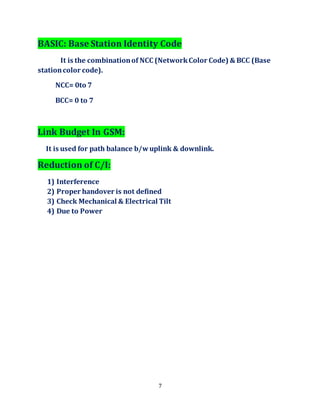
BASIC: Base Station Identity Code
It is the combinationof NCC (NetworkColor Code) & BCC (Base
stationcolor code).
NCC= 0to 7
BCC= 0 to 7
Link Budget In GSM:
It is used for path balance b/wuplink & downlink.
Reduction of C/I:
1) Interference
2) Proper handover is not defined
3) Check Mechanical & Electrical Tilt
4) Due to Power
8
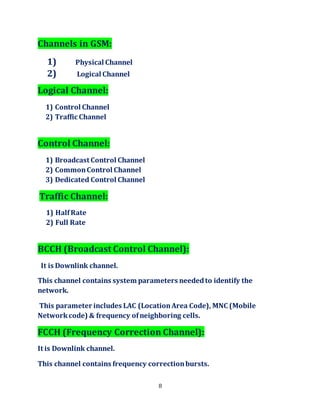
Channels in GSM:
1) Physical Channel
2) Logical Channel
Logical Channel:
1) Control Channel
2) Traffic Channel
Control Channel:
1) Broadcast Control Channel
2) CommonControl Channel
3) Dedicated Control Channel
Traffic Channel:
1) HalfRate
2) Full Rate
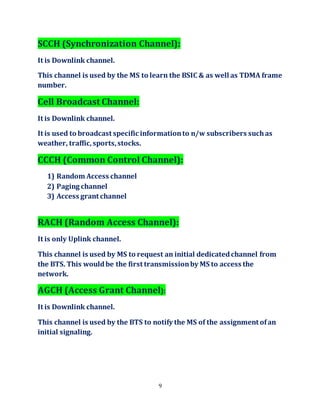
BCCH (Broadcast Control Channel):
It is Downlink channel.
This channel contains system parameters neededto identify the
network.
This parameter includes LAC (LocationArea Code), MNC (Mobile
Networkcode) & frequency ofneighboring cells.
FCCH (Frequency Correction Channel):
It is Downlink channel.
This channel contains frequency correctionbursts.
9
SCCH (Synchronization Channel):
It is Downlink channel.
This channel is used by the MS to learn the BSIC & as well as TDMA frame
number.
Cell Broadcast Channel:
It is Downlink channel.
It is used to broadcast specific informationto n/w subscribers suchas
weather, traffic,sports,stocks.
CCCH (Common Control Channel):
1) Random Access channel
2) Paging channel
3) Access grant channel
RACH (Random Access Channel):
It is only Uplink channel.
This channel is used by MS to request an initial dedicatedchannel from
the BTS. This wouldbe the first transmissionby MS to access the
network.
AGCH (Access Grant Channel):
It is Downlink channel.
This channel is used by the BTS to notify the MS of the assignment ofan
initial signaling.
10
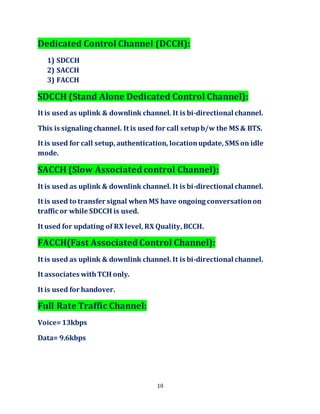
Dedicated Control Channel (DCCH):
1) SDCCH
2) SACCH
3) FACCH
SDCCH (Stand Alone Dedicated Control Channel):
It is used as uplink & downlink channel. It is bi-directional channel.
This is signaling channel. It is used for call setupb/w the MS & BTS.
It is used for call setup, authentication, locationupdate, SMS on idle
mode.
SACCH (Slow Associated control Channel):
It is used as uplink & downlink channel. It is bi-directional channel.
It is used to transfer signal when MS have ongoing conversationon
traffic or while SDCCH is used.
It used for updating of RX level, RX Quality, BCCH.
FACCH(Fast Associated Control Channel):
It is used as uplink & downlink channel. It is bi-directional channel.
It associates withTCH only.
It is used for handover.
Full Rate Traffic Channel:
Voice=13kbps
Data= 9.6kbps
11
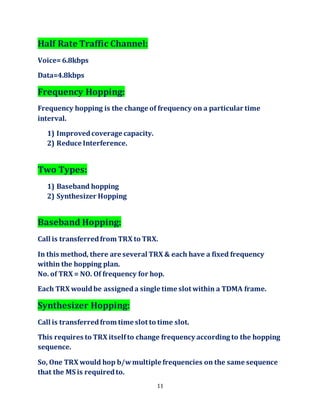
Half Rate Traffic Channel:
Voice=6.8kbps
Data=4.8kbps
Frequency Hopping:
Frequency hopping is the change of frequency on a particular time
interval.
1) Improvedcoverage capacity.
2) Reduce Interference.
Two Types:
1) Baseband hopping
2) Synthesizer Hopping
Baseband Hopping:
Call is transferredfrom TRX to TRX.
In this method, there are several TRX & each have a fixed frequency
within the hopping plan.
No. of TRX = NO. Of frequency for hop.
Each TRX wouldbe assigneda single time slot within a TDMA frame.
Synthesizer Hopping:
Call is transferredfrom time slot to time slot.
This requires to TRX itselfto change frequency according to the hopping
sequence.
So, One TRX would hop b/wmultiple frequencies on the same sequence
that the MS is requiredto.
12
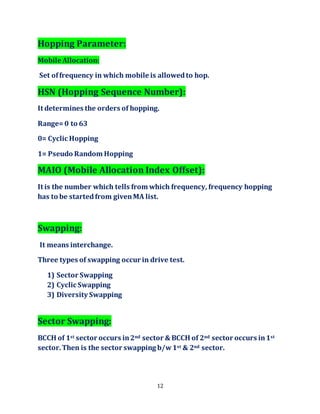
Hopping Parameter:
Mobile Allocation:
Set offrequency in which mobile is allowedto hop.
HSN (Hopping Sequence Number):
It determines the orders of hopping.
Range=0 to 63
0= Cyclic Hopping
1= Pseudo Random Hopping
MAIO (Mobile Allocation Index Offset):
It is the number which tells from which frequency, frequency hopping
has to be startedfrom givenMA list.
Swapping:
It means interchange.
Three types of swapping occur in drive test.
1) Sector Swapping
2) Cyclic Swapping
3) Diversity Swapping
Sector Swapping:
BCCH of 1st sector occurs in2nd sector & BCCH of 2nd sector occurs in1st
sector.Then is the sector swapping b/w1st & 2nd sector.
13
Cyclic Swapping:
BCCH of all sectors are interchangedi.e
1-2
2-3
3-1
DiversitySwapping:
It occurs due to interchange of TX/RX cable.
Handover:
Handover is a process in which call is transferredfrom one cell to
another cell without disconnecting the call.
There are two types of handover.
1) Intracell handover: B/Wtwo sectors ofsame BTS.
2) Inter cell handover: B/Wtwo different BTS.
Tilt:
1) Mechanical Tilt
2) Electrical Tilt
Mechanical Tilt:
Mechanical Tilt is used for horizontal direction.It is used to increase the
coverage.There shouldbe less mechanical tilt in the city; eg.-2, if we will
give 2 METthen we will get good coverage.
If we will give 4 or 5 MET in the city than back lob will get produced
which will affect the back sites.In the rural area MET is given to get
coverage for a long distance.
14
Electrical Tilt:
Electrical tilt is used for vertical direction. It is usedto spread the
coverage.We can use 4 or 5 electrical tilt in the city.
15
WCDMA OR 3G
Wide band code divisionmultiple access
Frequency Band: 2100
UPLINK:1920 to 1980 MHz
DOWNLINK:2110 to 2170 MHz
Duplex Scheme:
Frequency divisionduplex (FDD)
Time division duplex (TDD)
Channel Spacing: 5 MHz
25 times the channel spacing of GSM (200 KHz)
Codes Used In WCDMA:
1) Channelization Code
2) Scrambling Code
Channelization Code:
Downlink: Separates different users within a cell.
Uplink: Separates physical channel of one user.
Scrambling Code:
Downlink: Separate cells in same carrier frequency.
Uplink: Separate users.
The commonpilot channel (CPICH) is broadcast from every cell.It
carries no information& can be thought as a “Beacon” constantly
transmitting the scrambling code of the cell.
16
WCDMA cells are identifies by their SC.
It’s like a BCCH in GSM.
RSCP: Receivedsignal code power.
It is the signal strengthafter spreading. It is the receivedpower of a
particular CPICH.
Range: -30 to -120
Good: -50 to -75
RSSI: Receivedsignal strengthindicator.It is the signal strengthbefore
spreading.
Range: -30 to -140
Good: -60 to -90
EC/Io: It is the ratio of energy per chip to the total noise spectral
density.
Range: 0 to -13
Good: 0 to -7
Handover Types:
1) Softer Handover
2) Soft Handover
3) HardHandover
4) I- RATE Handover
Softer Handover: Handover occur b/w two sectors ofsame Node B
(BTS)
Soft Handover: Handover occur b/w two different Node B (BTS).
17
Hard Handover: Handover occur b/w different RNC.
I-RAT Handover: Handover occur b/w two different band, or
handover occur b/w3G to GSM.
18
19
20
21
22
23
24
25

Basic of gsm by pawan

  • 1.
    1 Basic Of GSM Whichis needed IN Drive Test Written By PAWAN KUMAR RF ENGINEER
  • 2.
    2 Call Drop Reasons: 1)Interference 2) Bad Rx level 3) HighVSWR 4) Bad Rx Quality 5) HighBER 6) Handover is not defined 7) When RLT= 0 , call drop occurs Handover Reasons: 1) Rx Level 2) Rx Quality 3) Interference 4) Power budget 5) Timing Advance Handover Failure Reasons: 1) Handover is not defined 2) Due to distance b/w two BTS 3) Due to not availability of TCH 4) Interference 5) Overshoot 6) Congestion 7) Proper handover is not defined Beam width & Tilt:
  • 3.
    3 Antenna beam width& tilt improves the coverage of the planned area. Beam width= 65 Dbi Reduce co-channel interference: 1) Proper frequency planning 2) Proper reuse pattern 3) Physical parameters like tilt ,orientation EIRP= Effective isotropicradiated power CCSR= Call complete success rate GSM 900Band Uplink= 890-915 MHz Downlink= 935-960 MHz GSM 1800Band Uplink= 1710-1785 MHz Downlink= 1805-1880 MHz WCDMA Band Uplink=1920-1980 MHz Downlink=2110-2170 MHz RX Level:
  • 4.
    4 It is thereceivedsignal strengthof serving cell. Unit = dbm Range=-0 to -120 Best= -0 to -65 Good= -65 to -75 Avgas = -75 to -85 Bad= -85 to -120 RX Quality: It is the quality of voice which is measuredon the basis of BER. Range:0 to 7 Good= 0 to 4 R.Q BER 0 0to 0.2 % 1 0.2to 0.4 % 2 0.4 to 0.8 % 3 0.8to 1.6% 4 1.6to 3.2% 5 3.2to 6.4% 6 6.4to12.8% 7 greater than 12.8%
  • 5.
    5 BER: Bit ErrorRate It is the ratio of number of error bits to the total number of bits Transmittedon a given time interval. RX Quality depends on BER. FER: Frame Erasure Rate It is the ratio of discardedframe to the total number of frames transmittedon a given time interval. Range:0 to 13 % Best: 0 Good: 0 to 4 % RL Time Out Counter: This defines the maximum value of the radio link counter expressedin SACCH blocks. Range=4 to 64 in step size 4 when RLT = 0 , then call drop occurs. SQI: Speech Quality Index It is the quality of voice.It depends on BER & FER. Range=-20 to 30 Good= 20 to 30
  • 6.
    6 Interference: It is theunwanted signal. Two types of interference 1) Co-channel Interference 2) Adjacent channel Interference Co-channel Interference: Several cells use same set of frequency. These cells are calledco- channel cells & interference produced on these cells is calledco-channel cells. Adjacent Channel Interference: This is produced due to the adjacent cells. + 1 & - 1 Difference C/I: carrier to interference ratio It is the ratio of signal strengthof serving cell to the ratio ofsignal strengthof undesired cells. Range: 9 to 30 Good = 15 to 25 For Hopping: 9 to 11 For Non Hopping:12 to 30
  • 7.
    7 BASIC: Base StationIdentity Code It is the combinationof NCC (NetworkColor Code) & BCC (Base stationcolor code). NCC= 0to 7 BCC= 0 to 7 Link Budget In GSM: It is used for path balance b/wuplink & downlink. Reduction of C/I: 1) Interference 2) Proper handover is not defined 3) Check Mechanical & Electrical Tilt 4) Due to Power
  • 8.
    8 Channels in GSM: 1)Physical Channel 2) Logical Channel Logical Channel: 1) Control Channel 2) Traffic Channel Control Channel: 1) Broadcast Control Channel 2) CommonControl Channel 3) Dedicated Control Channel Traffic Channel: 1) HalfRate 2) Full Rate BCCH (Broadcast Control Channel): It is Downlink channel. This channel contains system parameters neededto identify the network. This parameter includes LAC (LocationArea Code), MNC (Mobile Networkcode) & frequency ofneighboring cells. FCCH (Frequency Correction Channel): It is Downlink channel. This channel contains frequency correctionbursts.
  • 9.
    9 SCCH (Synchronization Channel): Itis Downlink channel. This channel is used by the MS to learn the BSIC & as well as TDMA frame number. Cell Broadcast Channel: It is Downlink channel. It is used to broadcast specific informationto n/w subscribers suchas weather, traffic,sports,stocks. CCCH (Common Control Channel): 1) Random Access channel 2) Paging channel 3) Access grant channel RACH (Random Access Channel): It is only Uplink channel. This channel is used by MS to request an initial dedicatedchannel from the BTS. This wouldbe the first transmissionby MS to access the network. AGCH (Access Grant Channel): It is Downlink channel. This channel is used by the BTS to notify the MS of the assignment ofan initial signaling.
  • 10.
    10 Dedicated Control Channel(DCCH): 1) SDCCH 2) SACCH 3) FACCH SDCCH (Stand Alone Dedicated Control Channel): It is used as uplink & downlink channel. It is bi-directional channel. This is signaling channel. It is used for call setupb/w the MS & BTS. It is used for call setup, authentication, locationupdate, SMS on idle mode. SACCH (Slow Associated control Channel): It is used as uplink & downlink channel. It is bi-directional channel. It is used to transfer signal when MS have ongoing conversationon traffic or while SDCCH is used. It used for updating of RX level, RX Quality, BCCH. FACCH(Fast Associated Control Channel): It is used as uplink & downlink channel. It is bi-directional channel. It associates withTCH only. It is used for handover. Full Rate Traffic Channel: Voice=13kbps Data= 9.6kbps
  • 11.
    11 Half Rate TrafficChannel: Voice=6.8kbps Data=4.8kbps Frequency Hopping: Frequency hopping is the change of frequency on a particular time interval. 1) Improvedcoverage capacity. 2) Reduce Interference. Two Types: 1) Baseband hopping 2) Synthesizer Hopping Baseband Hopping: Call is transferredfrom TRX to TRX. In this method, there are several TRX & each have a fixed frequency within the hopping plan. No. of TRX = NO. Of frequency for hop. Each TRX wouldbe assigneda single time slot within a TDMA frame. Synthesizer Hopping: Call is transferredfrom time slot to time slot. This requires to TRX itselfto change frequency according to the hopping sequence. So, One TRX would hop b/wmultiple frequencies on the same sequence that the MS is requiredto.
  • 12.
    12 Hopping Parameter: Mobile Allocation: Setoffrequency in which mobile is allowedto hop. HSN (Hopping Sequence Number): It determines the orders of hopping. Range=0 to 63 0= Cyclic Hopping 1= Pseudo Random Hopping MAIO (Mobile Allocation Index Offset): It is the number which tells from which frequency, frequency hopping has to be startedfrom givenMA list. Swapping: It means interchange. Three types of swapping occur in drive test. 1) Sector Swapping 2) Cyclic Swapping 3) Diversity Swapping Sector Swapping: BCCH of 1st sector occurs in2nd sector & BCCH of 2nd sector occurs in1st sector.Then is the sector swapping b/w1st & 2nd sector.
  • 13.
    13 Cyclic Swapping: BCCH ofall sectors are interchangedi.e 1-2 2-3 3-1 DiversitySwapping: It occurs due to interchange of TX/RX cable. Handover: Handover is a process in which call is transferredfrom one cell to another cell without disconnecting the call. There are two types of handover. 1) Intracell handover: B/Wtwo sectors ofsame BTS. 2) Inter cell handover: B/Wtwo different BTS. Tilt: 1) Mechanical Tilt 2) Electrical Tilt Mechanical Tilt: Mechanical Tilt is used for horizontal direction.It is used to increase the coverage.There shouldbe less mechanical tilt in the city; eg.-2, if we will give 2 METthen we will get good coverage. If we will give 4 or 5 MET in the city than back lob will get produced which will affect the back sites.In the rural area MET is given to get coverage for a long distance.
  • 14.
    14 Electrical Tilt: Electrical tiltis used for vertical direction. It is usedto spread the coverage.We can use 4 or 5 electrical tilt in the city.
  • 15.
    15 WCDMA OR 3G Wideband code divisionmultiple access Frequency Band: 2100 UPLINK:1920 to 1980 MHz DOWNLINK:2110 to 2170 MHz Duplex Scheme: Frequency divisionduplex (FDD) Time division duplex (TDD) Channel Spacing: 5 MHz 25 times the channel spacing of GSM (200 KHz) Codes Used In WCDMA: 1) Channelization Code 2) Scrambling Code Channelization Code: Downlink: Separates different users within a cell. Uplink: Separates physical channel of one user. Scrambling Code: Downlink: Separate cells in same carrier frequency. Uplink: Separate users. The commonpilot channel (CPICH) is broadcast from every cell.It carries no information& can be thought as a “Beacon” constantly transmitting the scrambling code of the cell.
  • 16.
    16 WCDMA cells areidentifies by their SC. It’s like a BCCH in GSM. RSCP: Receivedsignal code power. It is the signal strengthafter spreading. It is the receivedpower of a particular CPICH. Range: -30 to -120 Good: -50 to -75 RSSI: Receivedsignal strengthindicator.It is the signal strengthbefore spreading. Range: -30 to -140 Good: -60 to -90 EC/Io: It is the ratio of energy per chip to the total noise spectral density. Range: 0 to -13 Good: 0 to -7 Handover Types: 1) Softer Handover 2) Soft Handover 3) HardHandover 4) I- RATE Handover Softer Handover: Handover occur b/w two sectors ofsame Node B (BTS) Soft Handover: Handover occur b/w two different Node B (BTS).
  • 17.
    17 Hard Handover: Handoveroccur b/w different RNC. I-RAT Handover: Handover occur b/w two different band, or handover occur b/w3G to GSM.
  • 18.
  • 19.
  • 20.
  • 21.
  • 22.
  • 23.
  • 24.
  • 25.