HUMAN RESOURCE
MANAGEMENT-PROJECT
SUCCESS
helpdesk@construction-productivity.co.uk
htt://www.construction-productivity.co.uk
HUMAN RESOURCE MANAGEMENT-
PROJECT SUCCESS
HRM is rapidly being
recognized as an important
factor in improving the
chances of the project success
(in terms of productivity).
HUMAN RESOURCE MANAGEMENT-
PROJECT SUCCESS
Human resources is one of the most
crucial elements of construction
productivity.
Some researchers believe that HRM
is a marginal variable for project
success!
Some other believe it is crucial factor
for project success.
HUMAN RESOURCE MANAGEMENT-
PROJECT SUCCESS
Some of the critical factors for construction
productivity improvement are:
 Project mission;
 Project manager’s effectiveness;
 Project schedule;
 Client involvement;
 Technical issues;
HUMAN RESOURCE MANAGEMENT-
PROJECT SUCCESS
 Project monitoring;
 Communication and feedback;
 Trouble shooting;
 Personnel recruitment method;
 Personnel training;
 Personal motivational issue;
 Management support at all time.
HUMAN RESOURCE MANAGEMENT-
PROJECT SUCCESS
 Helpdesk divides productivity factors into:
Pre-construction Activities (1)
 Client brief
 Project objectives
 Specification
 Design/build-ability
 Contractual arrangement
 Planning
 Scheduling
 Estimating
HUMAN RESOURCE MANAGEMENT-
PROJECT SUCCESS
Site /Project & Manager Characteristics
(2 &3)
Experience/capability
Leadership style
Authority/influence
Goal commitment
Involvement
HUMAN RESOURCE MANAGEMENT-
PROJECT SUCCESS
Management System (4)
Planning
Communication
Controlling
Co-ordinating
HUMAN RESOURCE MANAGEMENT-
PROJECT SUCCESS
Resource Management(5)
 Labour selection
 Labour control
 Material selection
 Material handling
 Plant
 Waste on site
 Delay and Disruption on site
HUMAN RESOURCE MANAGEMENT-
PROJECT SUCCESS
Labour Characteristics (6)
Subcontracting labour
Direct labour
Motivating Factors (7)
Hygiene Factors
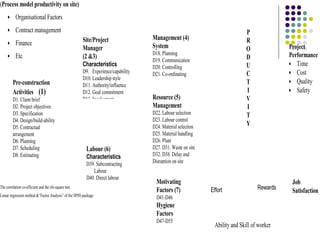
(Process model productivity on site)
• Organisational Factors
• Contract management
• Finance
• Etc
The correlation co-efficient and the chi-square test.
Linear regression method &“Factor Analysis” of the SPSS package
Pre-construction
Activities (1)
D1. Client brief
D2. Project objectives
D3. Specification
D4. Design/build-ability
D5. Contractual
arrangement
D6. Planning
D7. Scheduling
D8. Estimating
Site/Project
Manager
(2 &3)
Characteristics
D9. Experience/capability
D10. Leadership style
D11. Authority/influence
D12. Goal commitment
D13. Involvement
Labour (6)
Characteristics
D39. Subcontracting
Labour
D40. Direct labour
Management (4)
System
D18. Planning
D19. Communication
D20. Controlling
D21. Co-ordinating
Resource (5)
Management
D22. Labour selection
D23. Labour control
D24. Material selection
D25. Material handling
D26. Plant
D27. D31. Waste on site
D32. D38. Delay and
Disruption on site
Motivating
Factors (7)
D41-D46
Hygiene
Factors
D47-D55
P
R
O
D
U
C
T
I
V
I
T
Y
Project
Performance
• Time
• Cost
• Quality
• Safety
Job
SatisfactionEffort Rewards
Ability and Skill of worker
HUMAN RESOURCE MANAGEMENT-
PROJECT SUCCESS
Historically, projects are managed
as technical system.
There is a shift towards behavioural
system.
Project managers effectiveness is
related to project goals.
 (Time-Cost-Quality).
HUMAN RESOURCE MANAGEMENT-
PROJECT SUCCESS
The concept of gaol model
This concept suggest that
effectiveness is related to project
goal.
Project effectiveness and efficiency
brings project success.
HUMAN RESOURCE MANAGEMENT-
PROJECT SUCCESS
Project success
 From project manger’s point of
view.
 Client point of view.
 The end user’s point of view.
 Should be based on achieving
project’s objectives.
HUMAN RESOURCE MANAGEMENT-
PROJECT SUCCESS
 These are KPIs.
 The most successful organizations
mange their human resources
differently.
 Less productive organization not
have a sound HR policy.
HUMAN RESOURCE MANAGEMENT-
PROJECT SUCCESS
In the past project success was defined as:
 The level of satisfaction expressed by at
least one of the three main players. They
are:
1. Sponsor’s view
2. Project manager’s view
3. Sponsor as project manager’s view
 Today customers view is also considered
to be very important.
*
HUMAN RESOURCE MANAGEMENT-
PROJECT SUCCESS
 Productivity helpdesk derived productivity
model.
 Including the Freeman and Beale model can
improve the productivity on site and at the
head office.
HUMAN RESOURCE MANAGEMENT-
PROJECT SUCCESS
 Project manger should devote a
significant amount of time in managing
human resources.
 Regular training for workforce will
increase the level of productivity.
 Major project failures are related to
manpower.
HUMAN RESOURCE MANAGEMENT-
PROJECT SUCCESS
HR failure is related to factors such as:
1. Training;
2. Non qualified staff;
3. Management experience;
4. Shortage of skilled workers;
5. Lack of multi trade workforce.
HUMAN RESOURCE MANAGEMENT-
PROJECT SUCCESS
 Project manager’s training is
considered to be one of the most
important influential factor.
 project manager must be a team
builder.
 They must be able to form/create
an effective team.
HUMAN RESOURCE MANAGEMENT-
PROJECT SUCCESS
 To motivate their team
successfully.
 The key project success/high
productivity can be achieved by
having:
1. well qualified
2. motivated personnel.
Between hard and soft HRM
 During the recession 2008, organizations
have tended to shed labour as part of a
survival strategy.
 More skilled workers are kept for a longer
period of time.
 Domestic and global competition, shifted the
desired outcomes in the management of
employment relationship (people oriented) to
task oriented.
Between hard and soft HRM
 There are two broad approaches towards
HRM.
 ‘soft’
 ‘hard’ HRM
 The ‘soft’ approach to HRM is particularly
associated with the Harvard school.
 The ‘soft’ approach describes that employees
are the greatest asset.
 Hence they are the key to organizational
success.
 It is the workforce themselves who are
adding value to the organization.
Between hard and soft HRM
 A well looked after workforce are more
committed.
 Also, more creative than ignored workforce.
 Human resource should be managed carefully
and professionally.
 Reliable and good workforce should receive
appropriate training and development.
 Good workers should be rewarded to reflect their
value.
Between hard and soft HRM
 The ‘hard; approach is associated with
Michigan school.
 The ‘hard’ approach puts the main emphasis
on strategic business objectives.
 It handles its human resources like any other
factors of production.
 In ‘hard’ approach the main motive is to make
workforce work harder.
 It must be used as flexibly as possible.
Between hard and soft HRM
The world ‘people’ is substituted
for ‘employee’ in the ‘hard’
approach.
The ‘hard’ approach is historically
associated with scientific
management.
‘soft’ approach and ‘hard’
approach are not contradictory.
Between hard and soft HRM
They both want high productivity.
their emphasis are not the same.
British researchers view has been
characterized by scepticism about
the coherence of ‘soft’ and ‘hard’
approach.
Between hard and soft HRM
Limited development of
managers and workforce is
harmful to the construction
industry.
This industry is interesting in term
of HRM as each project has
different contracting arrangement.
Between hard and soft HRM
Projects carry uncertainty in a
constant changing environment.
There is less scope for improving
HRM.
Or innovative work methods.
Larger companies take HRM and
innovation seriously.
Between hard and soft HRM
The economic pressure often
determine HRM strategies.
Smaller construction firms with
irregular flow of work do not have
HRM policy.
They have experienced significant
pressure over the past two years.
Between hard and soft HRM
Reduced the core workforce and
adopted a more Felixable
approach in working arrangement.
The growth in self-employment
during booms had a significant
increase and has started to decline
in 2008 during the recent
recession.

033 human resource management

  • 1.
  • 2.
    HUMAN RESOURCE MANAGEMENT- PROJECTSUCCESS HRM is rapidly being recognized as an important factor in improving the chances of the project success (in terms of productivity).
  • 3.
    HUMAN RESOURCE MANAGEMENT- PROJECTSUCCESS Human resources is one of the most crucial elements of construction productivity. Some researchers believe that HRM is a marginal variable for project success! Some other believe it is crucial factor for project success.
  • 4.
    HUMAN RESOURCE MANAGEMENT- PROJECTSUCCESS Some of the critical factors for construction productivity improvement are:  Project mission;  Project manager’s effectiveness;  Project schedule;  Client involvement;  Technical issues;
  • 5.
    HUMAN RESOURCE MANAGEMENT- PROJECTSUCCESS  Project monitoring;  Communication and feedback;  Trouble shooting;  Personnel recruitment method;  Personnel training;  Personal motivational issue;  Management support at all time.
  • 6.
    HUMAN RESOURCE MANAGEMENT- PROJECTSUCCESS  Helpdesk divides productivity factors into: Pre-construction Activities (1)  Client brief  Project objectives  Specification  Design/build-ability  Contractual arrangement  Planning  Scheduling  Estimating
  • 7.
    HUMAN RESOURCE MANAGEMENT- PROJECTSUCCESS Site /Project & Manager Characteristics (2 &3) Experience/capability Leadership style Authority/influence Goal commitment Involvement
  • 8.
    HUMAN RESOURCE MANAGEMENT- PROJECTSUCCESS Management System (4) Planning Communication Controlling Co-ordinating
  • 9.
    HUMAN RESOURCE MANAGEMENT- PROJECTSUCCESS Resource Management(5)  Labour selection  Labour control  Material selection  Material handling  Plant  Waste on site  Delay and Disruption on site
  • 10.
    HUMAN RESOURCE MANAGEMENT- PROJECTSUCCESS Labour Characteristics (6) Subcontracting labour Direct labour Motivating Factors (7) Hygiene Factors
  • 11.
    (Process model productivityon site) • Organisational Factors • Contract management • Finance • Etc The correlation co-efficient and the chi-square test. Linear regression method &“Factor Analysis” of the SPSS package Pre-construction Activities (1) D1. Client brief D2. Project objectives D3. Specification D4. Design/build-ability D5. Contractual arrangement D6. Planning D7. Scheduling D8. Estimating Site/Project Manager (2 &3) Characteristics D9. Experience/capability D10. Leadership style D11. Authority/influence D12. Goal commitment D13. Involvement Labour (6) Characteristics D39. Subcontracting Labour D40. Direct labour Management (4) System D18. Planning D19. Communication D20. Controlling D21. Co-ordinating Resource (5) Management D22. Labour selection D23. Labour control D24. Material selection D25. Material handling D26. Plant D27. D31. Waste on site D32. D38. Delay and Disruption on site Motivating Factors (7) D41-D46 Hygiene Factors D47-D55 P R O D U C T I V I T Y Project Performance • Time • Cost • Quality • Safety Job SatisfactionEffort Rewards Ability and Skill of worker
  • 12.
    HUMAN RESOURCE MANAGEMENT- PROJECTSUCCESS Historically, projects are managed as technical system. There is a shift towards behavioural system. Project managers effectiveness is related to project goals.  (Time-Cost-Quality).
  • 13.
    HUMAN RESOURCE MANAGEMENT- PROJECTSUCCESS The concept of gaol model This concept suggest that effectiveness is related to project goal. Project effectiveness and efficiency brings project success.
  • 14.
    HUMAN RESOURCE MANAGEMENT- PROJECTSUCCESS Project success  From project manger’s point of view.  Client point of view.  The end user’s point of view.  Should be based on achieving project’s objectives.
  • 15.
    HUMAN RESOURCE MANAGEMENT- PROJECTSUCCESS  These are KPIs.  The most successful organizations mange their human resources differently.  Less productive organization not have a sound HR policy.
  • 16.
    HUMAN RESOURCE MANAGEMENT- PROJECTSUCCESS In the past project success was defined as:  The level of satisfaction expressed by at least one of the three main players. They are: 1. Sponsor’s view 2. Project manager’s view 3. Sponsor as project manager’s view  Today customers view is also considered to be very important.
  • 17.
  • 18.
    HUMAN RESOURCE MANAGEMENT- PROJECTSUCCESS  Productivity helpdesk derived productivity model.  Including the Freeman and Beale model can improve the productivity on site and at the head office.
  • 19.
    HUMAN RESOURCE MANAGEMENT- PROJECTSUCCESS  Project manger should devote a significant amount of time in managing human resources.  Regular training for workforce will increase the level of productivity.  Major project failures are related to manpower.
  • 20.
    HUMAN RESOURCE MANAGEMENT- PROJECTSUCCESS HR failure is related to factors such as: 1. Training; 2. Non qualified staff; 3. Management experience; 4. Shortage of skilled workers; 5. Lack of multi trade workforce.
  • 21.
    HUMAN RESOURCE MANAGEMENT- PROJECTSUCCESS  Project manager’s training is considered to be one of the most important influential factor.  project manager must be a team builder.  They must be able to form/create an effective team.
  • 22.
    HUMAN RESOURCE MANAGEMENT- PROJECTSUCCESS  To motivate their team successfully.  The key project success/high productivity can be achieved by having: 1. well qualified 2. motivated personnel.
  • 24.
    Between hard andsoft HRM  During the recession 2008, organizations have tended to shed labour as part of a survival strategy.  More skilled workers are kept for a longer period of time.  Domestic and global competition, shifted the desired outcomes in the management of employment relationship (people oriented) to task oriented.
  • 25.
    Between hard andsoft HRM  There are two broad approaches towards HRM.  ‘soft’  ‘hard’ HRM  The ‘soft’ approach to HRM is particularly associated with the Harvard school.  The ‘soft’ approach describes that employees are the greatest asset.  Hence they are the key to organizational success.  It is the workforce themselves who are adding value to the organization.
  • 26.
    Between hard andsoft HRM  A well looked after workforce are more committed.  Also, more creative than ignored workforce.  Human resource should be managed carefully and professionally.  Reliable and good workforce should receive appropriate training and development.  Good workers should be rewarded to reflect their value.
  • 27.
    Between hard andsoft HRM  The ‘hard; approach is associated with Michigan school.  The ‘hard’ approach puts the main emphasis on strategic business objectives.  It handles its human resources like any other factors of production.  In ‘hard’ approach the main motive is to make workforce work harder.  It must be used as flexibly as possible.
  • 28.
    Between hard andsoft HRM The world ‘people’ is substituted for ‘employee’ in the ‘hard’ approach. The ‘hard’ approach is historically associated with scientific management. ‘soft’ approach and ‘hard’ approach are not contradictory.
  • 29.
    Between hard andsoft HRM They both want high productivity. their emphasis are not the same. British researchers view has been characterized by scepticism about the coherence of ‘soft’ and ‘hard’ approach.
  • 30.
    Between hard andsoft HRM Limited development of managers and workforce is harmful to the construction industry. This industry is interesting in term of HRM as each project has different contracting arrangement.
  • 31.
    Between hard andsoft HRM Projects carry uncertainty in a constant changing environment. There is less scope for improving HRM. Or innovative work methods. Larger companies take HRM and innovation seriously.
  • 32.
    Between hard andsoft HRM The economic pressure often determine HRM strategies. Smaller construction firms with irregular flow of work do not have HRM policy. They have experienced significant pressure over the past two years.
  • 33.
    Between hard andsoft HRM Reduced the core workforce and adopted a more Felixable approach in working arrangement. The growth in self-employment during booms had a significant increase and has started to decline in 2008 during the recent recession.