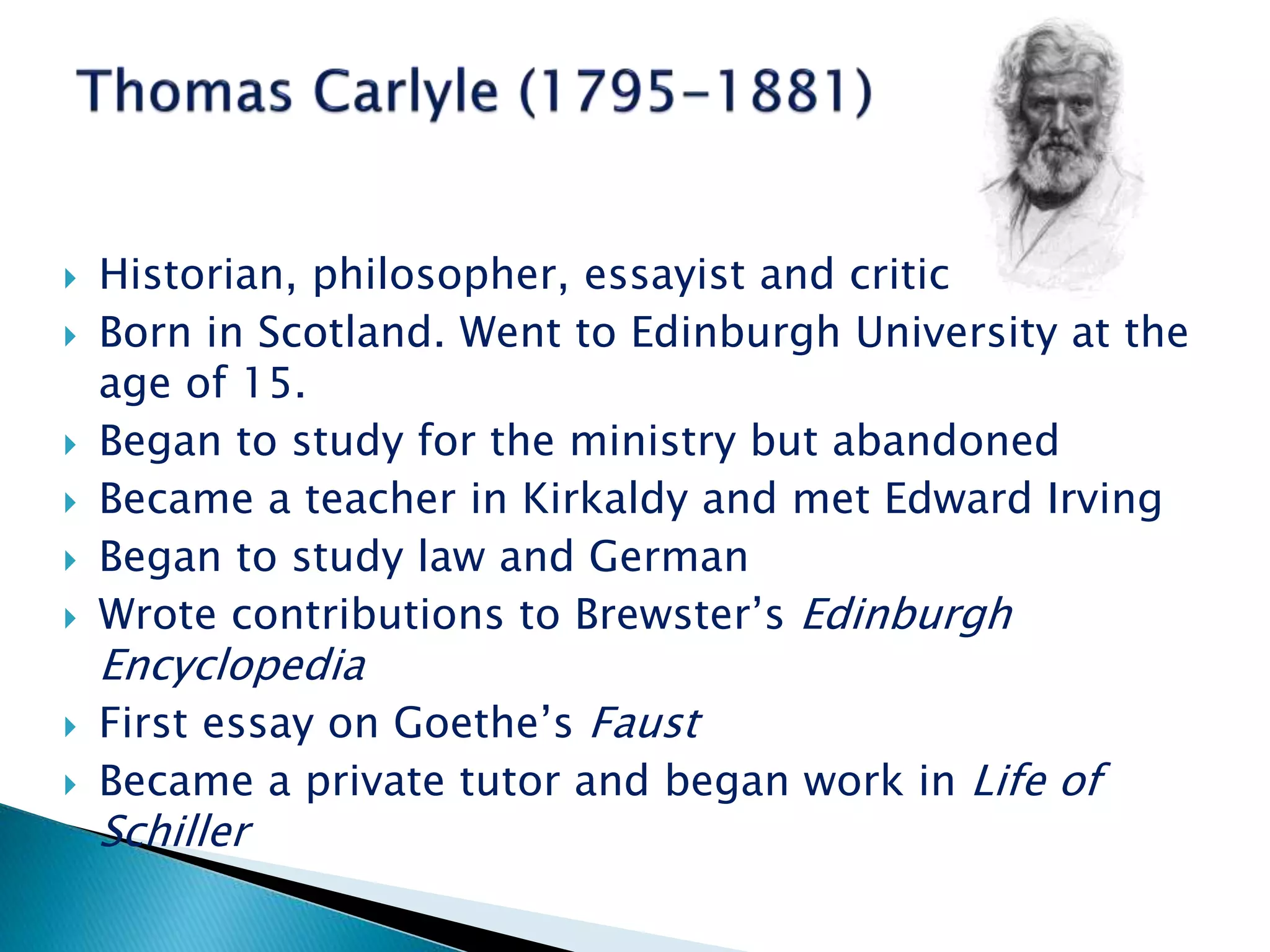
 Historian, philosopher, essayist and critic
 Born in Scotland. Went to Edinburgh University at the
age of 15.
 Began to study for the ministry but abandoned
 Became a teacher in Kirkaldy and met Edward Irving
 Began to study law and German
 Wrote contributions to Brewster’s Edinburgh
Encyclopedia
 First essay on Goethe’s Faust
 Became a private tutor and began work in Life of
Schiller
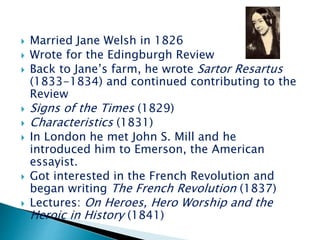
 Married Jane Welsh in 1826
 Wrote for the Edingburgh Review
 Back to Jane’s farm, he wrote Sartor Resartus
(1833-1834) and continued contributing to the
Review
 Signs of the Times (1829)
 Characteristics (1831)
 In London he met John S. Mill and he
introduced him to Emerson, the American
essayist.
 Got interested in the French Revolution and
began writing The French Revolution (1837)
 Lectures: On Heroes, Hero Worship and the
Heroic in History (1841)
 Chartism (1840)
 Past and Present (1843):the proper regulation of
society depended upon the leadership of a strong
man of genius.
 Oliver Cromwell’s Letters and Speeches (1845),
consolidated literary figure.
 He took 14 years to write his most ambitious work:
The History of Frederick the Great (1858-1865)
 Lord Rector of the University of Edinburgh (1866)
 Regular letters to The Times
 Refused Disraeli’s offer to secure him an honour in
England.
 Almost buried in Westminster Abbey but finally
honoured in Scotland.
 Literary considerations:
◦ In his life he enjoyed a reputation in contrast to his
present neglect
◦ To his contemporaries, he was the leading thinker
of his day
◦ There are few Victorians whose work does not
reflect his ideas (if only to reject them)
 Ruskin’s social writing and Dickens’s mature novels
◦ Affirmation of moral values in an age of profound
change: Carlyle responded to Victorian uneasiness
not with a philosophical system or political
programm, but with a list of values to which people
could adhere: work, duty and self-abnegation.
◦ In an age of mass movements and mass democracy,
he insisted on the importance of the individual, the
private life of service by the ordinary man and the
public life heroism by the leader.
◦ From his earlier lectures on heroism until his last
great work about the biography of Frederick the
Great, he searched for a satisfactory model of the
hero. At first, his theory inspired his
contemporaries but then, with the more liberal and
more democratic tendencies of the day, he was very
isolated.
◦ In Characteristics: human society resembles a living
creature (youth, maturity and senescence)
◦ Present as an era of ill-health, crisis. Illustrated in
metaphors of abnormal state of affairs (clothing
and varnishing figures)
◦ “things are growing disobedient to man” and causing
disruption (similar to Th. Hobbes’s “man is a wolf to
man”)
◦ In Past and Present: evokes Medieval society and
religion
◦ He thought that the methods used by historians were
not sufficiently ingenious to bring before the reader
the essential significance of historical events.
◦ His technique: casual selection of circumstancial
details + biographical sketches
◦ He did not pay homage to the idea of the “men of
letters”, but for him, Samuel Johnson was an
exception, as he was against chaos and idleness, and
defended prudence.
◦ Religion:
 influenced by Calvinistic theology?
 Faith? : more a theism without Christianity
 John S. Mill: for Carlyle “everything is right and good
according to the laws of the universe”
 Thought he had been elected to call the sinners and the
righteous to repentance
 He wrote political essays, historiography, philosophical satires
and fiction: he often blurred the boundaries between literary
genres.
 Individualist: modern technical civilisation and the gradual loss
of individual freedom.
 Criticised both the feudal and capitalist systems in Sartor
Resartus, Chartism, Past and Present and his latter-day
pamphlets.
 “Condition of England Question”: first used by Carlyle in
Chartism (1839); debates about the spiritual and material
foundations of England; great effect on a number of writers of
fiction in the Victorian era and after.
 He was concerned with the “two nations theme”,
the rich and the poor.
◦ Similar to other novelists, particularly Benjamin
Disraeli, Elizabeth Gaskell and Charles Dickens
(reducing the gap between the “two nations”)
 He contributed to the awakening of social
conscience among the reading public and
understood well the social and political
importance of literature.
 He attacked the growing materialism of Victorian
society
 In his attacks on the wealthy, he anticipated
some of the ideas of the condition-of England
novels and he also inspired social reformers,
such as John Ruskin and William Morris.
 In Chartism (1839)
◦ he expressed his sympathy for the poor and the
industrial class in England
◦ He argued for the need of a more profound reform.
◦ He noticed a discrepancy between a new form of
economic activity called “industrialism”, which
promised general welfare, and a dramatic
degradation in the living conditions of the urban
poor.
◦ The effect of it could be a revolution if government
did not improve the living conditions of the
labouring classes.
◦ A cure for this disease is, according to Carlyle, a
”real” aristocracy” which can lead the working class
through the vicissitudes of modern history.
◦ He looked for a new type of “unclassed” aristocracy
because he was critical about both an idle landowning
aristocracy and a working aristocracy submerged in
Mammonism, who instead of being “captains of
industry”, are “a gang of industrial buccaneers and
pirates.”
 "Mammon”:
 Aramaic word for "riches”
 Demon who represents the sin of avarice (Bible)
 “The proper name of the devil of covetousness”
(OED)
 One of Satan's cohorts in Paradise Lost (John
Milton, 1667)
 Materialism and idolatry of wealth (Victorian
times)
“England is full of wealth, of multifarious
produce, supply for human want in every kind,
yet England is dying of inanition.”
“Touch it not, ye workers, ye master-workers,
ye master-idlers, none of you can touch it, no
man of you shall be the better for it; this is
enchanted fruit!”
"We, with our Mammon-Gospel, have come to
strange conclusions. . . . Verily Mammon-
worship is a melancholy creed."
 It opens with a visit to a workhouse
 Written as a response to the economic crisis
which began in the early 1840’s.
 Further analysis of the condition of England
question.
 Carlyle opposed the medieval past and the
turbulent Victorian present of the 1830s and
1840s.
 A time of worship of money, exploitation, low
wages, poverty, unemployment and riots =>
it would bring England to self-destruction.
Book I.
Chapter I: Midas
“The condition of England on which many
pamphlets are now in the course of
publication, and many thoughts unpublished
are going on in every reflective head, is justly
regarded as one of the most omnious, and
withal one of the strangest, ever seen in the
world”
-prophetic language
-despite England’s abundant resources, the poor classes are
living in deprivation.
“To the 'Millo-cracy' so-called, to the Working
Aristocracy, steeped too deep in mere ignoble
Mammonism, and as yet all unconscious of its
noble destinies, as yet but an irrational or
semirational giant, struggling to awake some
soul in itself,--the world will have much to
say, reproachfully, reprovingly, admonishingly.
But to the Idle Aristocracy, what will the world
have to say? Things painful and not pleasant!
 His solution: a spiritual rebirth of both the individual
and society.
 The two sections of the book show the contrasting
visions of the past and the present.
 His idealised vision of the past is based on the
chronicle of the English monk, Jocelyn of Brakelond
(fl. 1200), who described the life of the abbot Samson
and his monks of St. Edmund’s monastery. Carlyle
shows the organisation of life and work of the
medieval monks as an authentic idyll, whereas he
finds contemporary life increasingly unbearable due
to the lack of true leadership.
 He argues that a new “Aristocracy of Talent” should
take the lead in the country, and the English people
must themselves choose true heroes and not sham-
heroes or quacks.
 Book 4: three practical suggestions for the
improvement of social conditions in England.
◦ Introduction of legal hygienic measures
◦ Improvement of education
◦ Promotion of emigration.
(the first two were soon adopted but the third
affected mainly the Irish and Scottish people, and,
in a smaller degree, the English population)

03. Thomas Carlyle (1795-1881).pptx

  • 1.
     Historian, philosopher,essayist and critic  Born in Scotland. Went to Edinburgh University at the age of 15.  Began to study for the ministry but abandoned  Became a teacher in Kirkaldy and met Edward Irving  Began to study law and German  Wrote contributions to Brewster’s Edinburgh Encyclopedia  First essay on Goethe’s Faust  Became a private tutor and began work in Life of Schiller
  • 2.
     Married JaneWelsh in 1826  Wrote for the Edingburgh Review  Back to Jane’s farm, he wrote Sartor Resartus (1833-1834) and continued contributing to the Review  Signs of the Times (1829)  Characteristics (1831)  In London he met John S. Mill and he introduced him to Emerson, the American essayist.  Got interested in the French Revolution and began writing The French Revolution (1837)  Lectures: On Heroes, Hero Worship and the Heroic in History (1841)
  • 3.
     Chartism (1840) Past and Present (1843):the proper regulation of society depended upon the leadership of a strong man of genius.  Oliver Cromwell’s Letters and Speeches (1845), consolidated literary figure.  He took 14 years to write his most ambitious work: The History of Frederick the Great (1858-1865)  Lord Rector of the University of Edinburgh (1866)  Regular letters to The Times  Refused Disraeli’s offer to secure him an honour in England.  Almost buried in Westminster Abbey but finally honoured in Scotland.
  • 4.
     Literary considerations: ◦In his life he enjoyed a reputation in contrast to his present neglect ◦ To his contemporaries, he was the leading thinker of his day ◦ There are few Victorians whose work does not reflect his ideas (if only to reject them)  Ruskin’s social writing and Dickens’s mature novels ◦ Affirmation of moral values in an age of profound change: Carlyle responded to Victorian uneasiness not with a philosophical system or political programm, but with a list of values to which people could adhere: work, duty and self-abnegation.
  • 5.
    ◦ In anage of mass movements and mass democracy, he insisted on the importance of the individual, the private life of service by the ordinary man and the public life heroism by the leader. ◦ From his earlier lectures on heroism until his last great work about the biography of Frederick the Great, he searched for a satisfactory model of the hero. At first, his theory inspired his contemporaries but then, with the more liberal and more democratic tendencies of the day, he was very isolated. ◦ In Characteristics: human society resembles a living creature (youth, maturity and senescence) ◦ Present as an era of ill-health, crisis. Illustrated in metaphors of abnormal state of affairs (clothing and varnishing figures)
  • 6.
    ◦ “things aregrowing disobedient to man” and causing disruption (similar to Th. Hobbes’s “man is a wolf to man”) ◦ In Past and Present: evokes Medieval society and religion ◦ He thought that the methods used by historians were not sufficiently ingenious to bring before the reader the essential significance of historical events. ◦ His technique: casual selection of circumstancial details + biographical sketches ◦ He did not pay homage to the idea of the “men of letters”, but for him, Samuel Johnson was an exception, as he was against chaos and idleness, and defended prudence.
  • 7.
    ◦ Religion:  influencedby Calvinistic theology?  Faith? : more a theism without Christianity  John S. Mill: for Carlyle “everything is right and good according to the laws of the universe”  Thought he had been elected to call the sinners and the righteous to repentance  He wrote political essays, historiography, philosophical satires and fiction: he often blurred the boundaries between literary genres.  Individualist: modern technical civilisation and the gradual loss of individual freedom.  Criticised both the feudal and capitalist systems in Sartor Resartus, Chartism, Past and Present and his latter-day pamphlets.  “Condition of England Question”: first used by Carlyle in Chartism (1839); debates about the spiritual and material foundations of England; great effect on a number of writers of fiction in the Victorian era and after.
  • 8.
     He wasconcerned with the “two nations theme”, the rich and the poor. ◦ Similar to other novelists, particularly Benjamin Disraeli, Elizabeth Gaskell and Charles Dickens (reducing the gap between the “two nations”)  He contributed to the awakening of social conscience among the reading public and understood well the social and political importance of literature.  He attacked the growing materialism of Victorian society  In his attacks on the wealthy, he anticipated some of the ideas of the condition-of England novels and he also inspired social reformers, such as John Ruskin and William Morris.
  • 9.
     In Chartism(1839) ◦ he expressed his sympathy for the poor and the industrial class in England ◦ He argued for the need of a more profound reform. ◦ He noticed a discrepancy between a new form of economic activity called “industrialism”, which promised general welfare, and a dramatic degradation in the living conditions of the urban poor. ◦ The effect of it could be a revolution if government did not improve the living conditions of the labouring classes. ◦ A cure for this disease is, according to Carlyle, a ”real” aristocracy” which can lead the working class through the vicissitudes of modern history.
  • 10.
    ◦ He lookedfor a new type of “unclassed” aristocracy because he was critical about both an idle landowning aristocracy and a working aristocracy submerged in Mammonism, who instead of being “captains of industry”, are “a gang of industrial buccaneers and pirates.”  "Mammon”:  Aramaic word for "riches”  Demon who represents the sin of avarice (Bible)  “The proper name of the devil of covetousness” (OED)  One of Satan's cohorts in Paradise Lost (John Milton, 1667)  Materialism and idolatry of wealth (Victorian times)
  • 11.
    “England is fullof wealth, of multifarious produce, supply for human want in every kind, yet England is dying of inanition.” “Touch it not, ye workers, ye master-workers, ye master-idlers, none of you can touch it, no man of you shall be the better for it; this is enchanted fruit!” "We, with our Mammon-Gospel, have come to strange conclusions. . . . Verily Mammon- worship is a melancholy creed."
  • 12.
     It openswith a visit to a workhouse  Written as a response to the economic crisis which began in the early 1840’s.  Further analysis of the condition of England question.  Carlyle opposed the medieval past and the turbulent Victorian present of the 1830s and 1840s.  A time of worship of money, exploitation, low wages, poverty, unemployment and riots => it would bring England to self-destruction.
  • 13.
    Book I. Chapter I:Midas “The condition of England on which many pamphlets are now in the course of publication, and many thoughts unpublished are going on in every reflective head, is justly regarded as one of the most omnious, and withal one of the strangest, ever seen in the world” -prophetic language -despite England’s abundant resources, the poor classes are living in deprivation.
  • 14.
    “To the 'Millo-cracy'so-called, to the Working Aristocracy, steeped too deep in mere ignoble Mammonism, and as yet all unconscious of its noble destinies, as yet but an irrational or semirational giant, struggling to awake some soul in itself,--the world will have much to say, reproachfully, reprovingly, admonishingly. But to the Idle Aristocracy, what will the world have to say? Things painful and not pleasant!
  • 15.
     His solution:a spiritual rebirth of both the individual and society.  The two sections of the book show the contrasting visions of the past and the present.  His idealised vision of the past is based on the chronicle of the English monk, Jocelyn of Brakelond (fl. 1200), who described the life of the abbot Samson and his monks of St. Edmund’s monastery. Carlyle shows the organisation of life and work of the medieval monks as an authentic idyll, whereas he finds contemporary life increasingly unbearable due to the lack of true leadership.  He argues that a new “Aristocracy of Talent” should take the lead in the country, and the English people must themselves choose true heroes and not sham- heroes or quacks.
  • 16.
     Book 4:three practical suggestions for the improvement of social conditions in England. ◦ Introduction of legal hygienic measures ◦ Improvement of education ◦ Promotion of emigration. (the first two were soon adopted but the third affected mainly the Irish and Scottish people, and, in a smaller degree, the English population)