SW010205 – SOCIAL WORK
RESEARCH AND STATISTICS
Kesiyamol Mathew, MSW
Asst. Professor
Department of Social Work
Marian Academy of Management Studies,
Kothamangalam, Ernakulam
Agenda
1) Basic elements of scientific method
2) Concept
3) Conceptual and operational definition
4) Assumptions
5) Hypothesis
6) Law
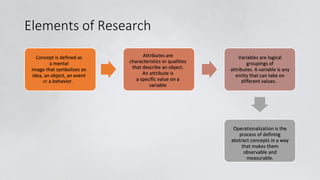
Elements of Research
Concept is defined as
a mental
image that symbolizes an
idea, an object, an event
or a behavior.
Attributes are
characteristics or qualities
that describe an object.
An attribute is
a specific value on a
variable
Variables are logical
groupings of
attributes. A variable is any
entity that can take on
different values.
Operationalization is the
process of defining
abstract concepts in a way
that makes them
observable and
measurable.
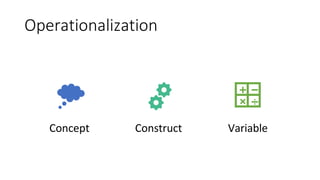
Operationalization
Concept Construct Variable
How do you Operationalize
• Interactions in the class
• Duration of interaction
• No of times you spoke
• Extend of contribution
• No of Ideas you proposed
• Duration of class
Hypothesis
A hypothesis is a specific
statement of prediction.
The statement that postulates
the relationship between the
independent and dependent
variable is called the hypothesis.
Thus hypotheses are tentative statements that predict what we
expect to find about the way our variable co-vary together.
A good hypothesis is:
Clear and specific
It should have more that one possible out come.
Hypotheses should be testable
Should state the relationship between the
variables.
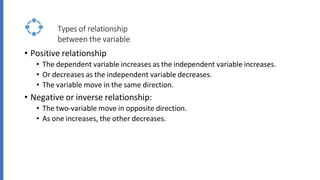
Types of relationship
between the variable
• Positive relationship
• The dependent variable increases as the independent variable increases.
• Or decreases as the independent variable decreases.
• The variable move in the same direction.
• Negative or inverse relationship:
• The two-variable move in opposite direction.
• As one increases, the other decreases.
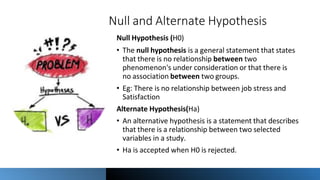
Null and Alternate Hypothesis
Null Hypothesis (H0)
• The null hypothesis is a general statement that states
that there is no relationship between two
phenomenon's under consideration or that there is
no association between two groups.
• Eg: There is no relationship between job stress and
Satisfaction
Alternate Hypothesis(Ha)
• An alternative hypothesis is a statement that describes
that there is a relationship between two selected
variables in a study.
• Ha is accepted when H0 is rejected.
Type 1 and 2 errors
• Type – 1 error is a false-positive finding, while
• It occurs if the researcher rejects a correct null
hypothesis in the population.
• i.e., incorrect rejection of the null hypothesis.
• Type –2 error is also known as a false negative.
• It occurs if a researcher fails to reject a null
hypothesis that is actually false hypothesis.
Type 1 and 2
errors
Theory /conceptual framework
While the theoretical framework
is the theory on which the study
is based, the conceptual
framework is the
operationalization of the theory.
It is the researcher’s own
position on the problem and
gives direction to the study.
It may be an adaptation of a
model used in a previous study,
with modifications to suit the
inquiry.
The indicators we will use to
determine the attribute we
observe about a particular
variable.

RESEARCH: Conceptualization, Operationalization, Assumptions, Hypothesis.

  • 1.
    SW010205 – SOCIALWORK RESEARCH AND STATISTICS Kesiyamol Mathew, MSW Asst. Professor Department of Social Work Marian Academy of Management Studies, Kothamangalam, Ernakulam
  • 2.
    Agenda 1) Basic elementsof scientific method 2) Concept 3) Conceptual and operational definition 4) Assumptions 5) Hypothesis 6) Law
  • 3.
    Elements of Research Conceptis defined as a mental image that symbolizes an idea, an object, an event or a behavior. Attributes are characteristics or qualities that describe an object. An attribute is a specific value on a variable Variables are logical groupings of attributes. A variable is any entity that can take on different values. Operationalization is the process of defining abstract concepts in a way that makes them observable and measurable.
  • 4.
  • 5.
    How do youOperationalize • Interactions in the class • Duration of interaction • No of times you spoke • Extend of contribution • No of Ideas you proposed • Duration of class
  • 7.
    Hypothesis A hypothesis isa specific statement of prediction. The statement that postulates the relationship between the independent and dependent variable is called the hypothesis.
  • 8.
    Thus hypotheses aretentative statements that predict what we expect to find about the way our variable co-vary together. A good hypothesis is: Clear and specific It should have more that one possible out come. Hypotheses should be testable Should state the relationship between the variables.
  • 9.
    Types of relationship betweenthe variable • Positive relationship • The dependent variable increases as the independent variable increases. • Or decreases as the independent variable decreases. • The variable move in the same direction. • Negative or inverse relationship: • The two-variable move in opposite direction. • As one increases, the other decreases.
  • 10.
    Null and AlternateHypothesis Null Hypothesis (H0) • The null hypothesis is a general statement that states that there is no relationship between two phenomenon's under consideration or that there is no association between two groups. • Eg: There is no relationship between job stress and Satisfaction Alternate Hypothesis(Ha) • An alternative hypothesis is a statement that describes that there is a relationship between two selected variables in a study. • Ha is accepted when H0 is rejected.
  • 11.
    Type 1 and2 errors • Type – 1 error is a false-positive finding, while • It occurs if the researcher rejects a correct null hypothesis in the population. • i.e., incorrect rejection of the null hypothesis. • Type –2 error is also known as a false negative. • It occurs if a researcher fails to reject a null hypothesis that is actually false hypothesis.
  • 12.
    Type 1 and2 errors
  • 13.
    Theory /conceptual framework Whilethe theoretical framework is the theory on which the study is based, the conceptual framework is the operationalization of the theory. It is the researcher’s own position on the problem and gives direction to the study. It may be an adaptation of a model used in a previous study, with modifications to suit the inquiry. The indicators we will use to determine the attribute we observe about a particular variable.