Metabolic Network and MitochondrialMetabolic Network and Mitochondrial
EvolutionEvolution
MotivationMotivation
An important goal in biology is to uncover the
fundamental design principles that provide the
common underlying structure and function in all
cells and microorganisms. The development of
huge databases have improved our ability to
identify the design principles that integrate these
interactions into a complex system.
The concept of modularity assumes that cellular
functionality can be seamlessly partitioned into a
collection of modules. Each module is a discrete
entity of several elementary components and
performs an identifiable task, separable from the
functions of other modules . Spatially and
chemically isolated molecular machines or protein
complexes (such as ribosomes and flagella) are
prominent examples of such functional units, but
more extended modules, such as those achieving
their isolation through the initial binding of a
signaling molecule, are also apparent.
The endosymbiont theory explains the origins of
organelles such as mitochondria and chloroplasts
in eukaryotic cells. The theory proposes that
chloroplasts and mitochondria evolved from
certain types of bacteria that prokaryotic cells
engulfed through endophagocytosis. These cells
and the bacteria trapped inside then entered a
symbiotic relationship, a close cooperation between
different types of organisms over an extended time.
Researchers in molecular and evolutionary
biology no longer question this theory, as it has
numerous proofs from cellular and genetic
point of view. But the mechanisms are still
being worked out. In this program, I want to
take a global picture of the topological structure
of metabolic networks and modularity hoping
that it may give some hint to the design
principle of this process.
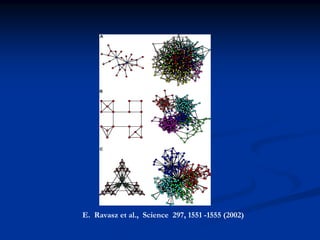
E. Ravasz et al., Science 297, 1551 -1555 (2002)
TTools and Databasesools and Databases
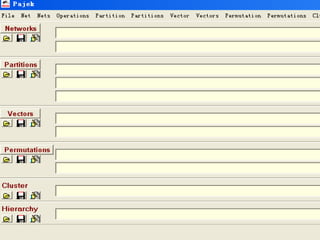
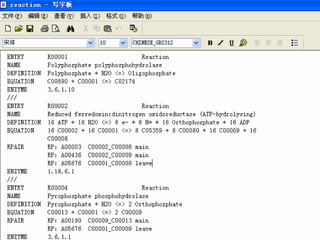
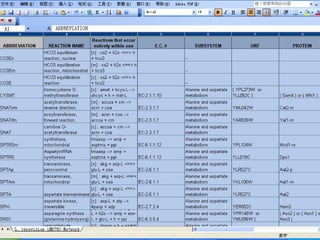
Pajek
Kegg
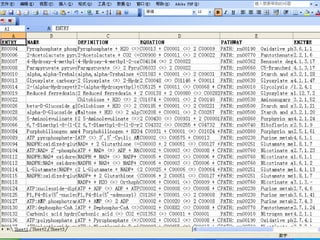
Yeast mitochondria reactions
http://gcrg.ucsd.edu/what.htm
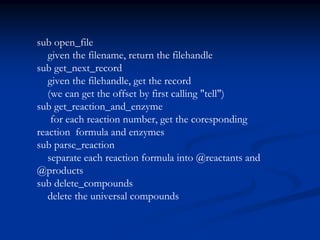
sub open_file
given the filename, return the filehandle
sub get_next_record
given the filehandle, get the record
(we can get the offset by first calling "tell")
sub get_reaction_and_enzyme
for each reaction number, get the coresponding
reaction formula and enzymes
sub parse_reaction
separate each reaction formula into @reactants and
@products
sub delete_compounds
delete the universal compounds
Correlate the enzymes by the compound relationships
Use Simulated Annealing to analyze the modular structure of the
networks
Compare the modular structure of mitochondria and other
species
And more…
Unfinished Work
Next is the PPT of my presentation which is
mainly my digest of Matin Nowak’s book
Evolutionary Dynamics. This presentation was
given two weeks ago in the course of System
Theory conducted by Prof.Andreas Dress at
Partner Institute of Computer Biology,
Chinese Academy of Life Science.
Evolutionary DynamicsEvolutionary Dynamics
Yu Yiming
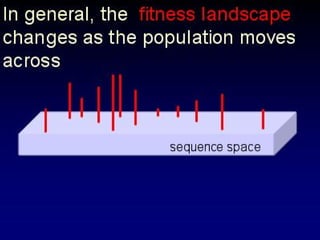
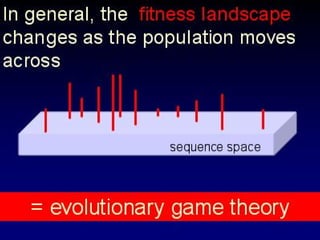
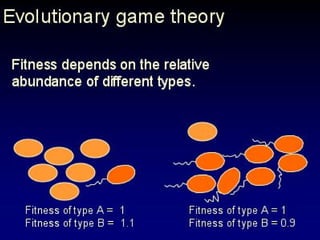
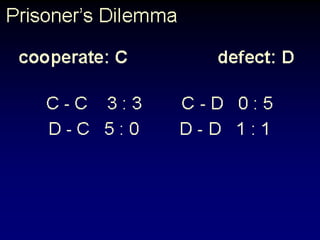
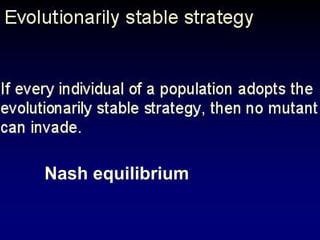
Nash equilibrium
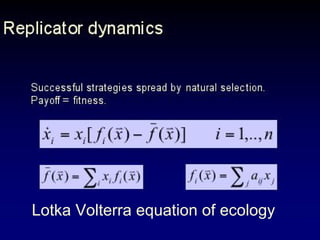
Lotka Volterra equation of ecology
Evolutionary Dynamics
Evolutionary Dynamics of
Biological Games
VirtualLabs in evolutionary
game theory
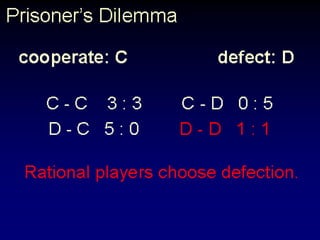
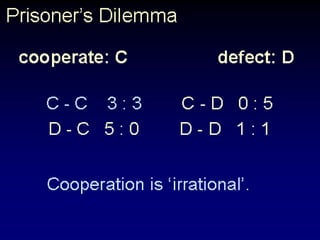
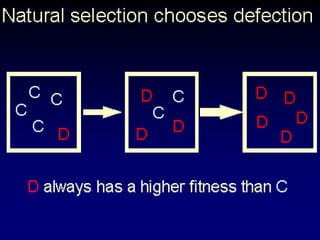
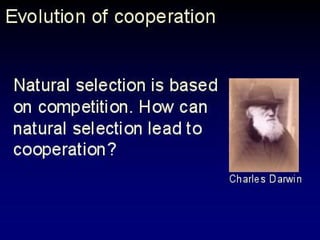
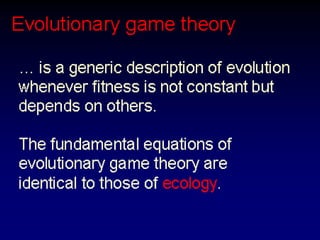
evolutionary game theory presentation

evolutionary game theory presentation

  • 1.
    Metabolic Network andMitochondrialMetabolic Network and Mitochondrial EvolutionEvolution
  • 2.
    MotivationMotivation An important goalin biology is to uncover the fundamental design principles that provide the common underlying structure and function in all cells and microorganisms. The development of huge databases have improved our ability to identify the design principles that integrate these interactions into a complex system.
  • 3.
    The concept ofmodularity assumes that cellular functionality can be seamlessly partitioned into a collection of modules. Each module is a discrete entity of several elementary components and performs an identifiable task, separable from the functions of other modules . Spatially and chemically isolated molecular machines or protein complexes (such as ribosomes and flagella) are prominent examples of such functional units, but more extended modules, such as those achieving their isolation through the initial binding of a signaling molecule, are also apparent.
  • 4.
    The endosymbiont theoryexplains the origins of organelles such as mitochondria and chloroplasts in eukaryotic cells. The theory proposes that chloroplasts and mitochondria evolved from certain types of bacteria that prokaryotic cells engulfed through endophagocytosis. These cells and the bacteria trapped inside then entered a symbiotic relationship, a close cooperation between different types of organisms over an extended time.
  • 5.
    Researchers in molecularand evolutionary biology no longer question this theory, as it has numerous proofs from cellular and genetic point of view. But the mechanisms are still being worked out. In this program, I want to take a global picture of the topological structure of metabolic networks and modularity hoping that it may give some hint to the design principle of this process.
  • 6.
    E. Ravasz etal., Science 297, 1551 -1555 (2002)
  • 7.
    TTools and Databasesoolsand Databases Pajek Kegg Yeast mitochondria reactions http://gcrg.ucsd.edu/what.htm
  • 11.
    sub open_file given thefilename, return the filehandle sub get_next_record given the filehandle, get the record (we can get the offset by first calling "tell") sub get_reaction_and_enzyme for each reaction number, get the coresponding reaction formula and enzymes sub parse_reaction separate each reaction formula into @reactants and @products sub delete_compounds delete the universal compounds
  • 13.
    Correlate the enzymesby the compound relationships Use Simulated Annealing to analyze the modular structure of the networks Compare the modular structure of mitochondria and other species And more… Unfinished Work
  • 14.
    Next is thePPT of my presentation which is mainly my digest of Matin Nowak’s book Evolutionary Dynamics. This presentation was given two weeks ago in the course of System Theory conducted by Prof.Andreas Dress at Partner Institute of Computer Biology, Chinese Academy of Life Science.
  • 15.
  • 54.
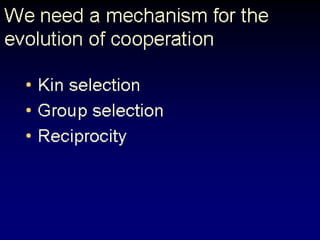
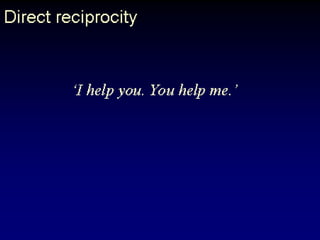
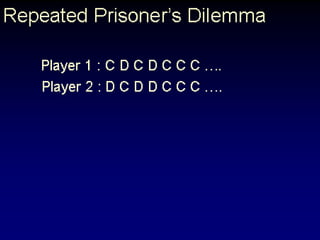
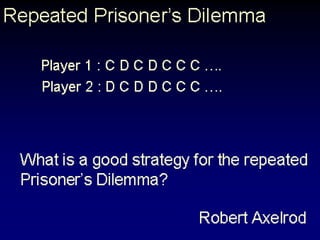
  • 56.
  • 64.
    Evolutionary Dynamics Evolutionary Dynamicsof Biological Games VirtualLabs in evolutionary game theory