Philosophy of Religion
reason, faith, belief and doubt
George Matthews
Spring 2015
Perspectives on Religion
! From inside: what religious beliefs or practices should I
adhere to as someone aware of the mystery of life and
death?
Perspectives on Religion
! From inside: what religious beliefs or practices should I
adhere to as someone aware of the mystery of life and
death?
! From outside: how can we understand religion as
disinterested observers?
Perspectives on Religion
! From inside: what religious beliefs or practices should I
adhere to as someone aware of the mystery of life and
death?
! From outside: how can we understand religion as
disinterested observers?
religious studies: what are the practices, beliefs and
histories of various religions?
Perspectives on Religion
! From inside: what religious beliefs or practices should I
adhere to as someone aware of the mystery of life and
death?
! From outside: how can we understand religion as
disinterested observers?
religious studies: what are the practices, beliefs and
histories of various religions?
sociology: how do religions work as institutions
expressing shared values and how do they relate to other
social institutions?
Perspectives on Religion
! From inside: what religious beliefs or practices should I
adhere to as someone aware of the mystery of life and
death?
! From outside: how can we understand religion as
disinterested observers?
religious studies: what are the practices, beliefs and
histories of various religions?
sociology: how do religions work as institutions
expressing shared values and how do they relate to other
social institutions?
psychology: what is going on in the mind when people
have religious beliefs or engage in religious practices?
Perspectives on Religion
! From inside: what religious beliefs or practices should I
adhere to as someone aware of the mystery of life and
death?
! From outside: how can we understand religion as
disinterested observers?
religious studies: what are the practices, beliefs and
histories of various religions?
sociology: how do religions work as institutions
expressing shared values and how do they relate to other
social institutions?
psychology: what is going on in the mind when people
have religious beliefs or engage in religious practices?
philosophy: can religious thinking be rationally justified?
What philosophers ask about religion
metaphysical questions
What philosophers ask about religion
1. Does God exist? If so in what sense – as separate
from nature, identical with nature, or in some other
way?
metaphysical questions
What philosophers ask about religion
1. Does God exist? If so in what sense – as separate
from nature, identical with nature, or in some other
way?
2. Do any “spiritual things” such as gods, souls,
disembodied spirits, demons or ghosts exist or is the
universe and everything in it purely material stuff?
metaphysical questions
What philosophers ask about religion
1. Does God exist? If so in what sense – as separate
from nature, identical with nature, or in some other
way?
2. Do any “spiritual things” such as gods, souls,
disembodied spirits, demons or ghosts exist or is the
universe and everything in it purely material stuff?
3. What does the existence of evil in the world imply
about the existence or non-existence of God?
metaphysical questions
What philosophers ask about religion
epistemological questions
What philosophers ask about religion
1. What evidence might establish the existence of a
God?
epistemological questions
What philosophers ask about religion
1. What evidence might establish the existence of a
God?
2. What is the relation between reason and faith in
general and what does this tell us about religion?
epistemological questions
What philosophers ask about religion
1. What evidence might establish the existence of a
God?
2. What is the relation between reason and faith in
general and what does this tell us about religion?
3. Does religious experience warrant religious belief?
epistemological questions
What philosophers ask about religion
1. What evidence might establish the existence of a
God?
2. What is the relation between reason and faith in
general and what does this tell us about religion?
3. Does religious experience warrant religious belief?
4. Are religious explanations of natural phenomena in
competition with scientific explanations?
epistemological questions
What philosophers ask about religion
value-theory questions
What philosophers ask about religion
1. Are religious beliefs or institutions necessary for social
order?
value-theory questions
What philosophers ask about religion
1. Are religious beliefs or institutions necessary for social
order?
2. Can we have morality without religion?
value-theory questions
What philosophers ask about religion
1. Are religious beliefs or institutions necessary for social
order?
2. Can we have morality without religion?
3. Is religion a purely private matter or should it play a
public role in modern societies?
value-theory questions
Varieties of Religious Belief
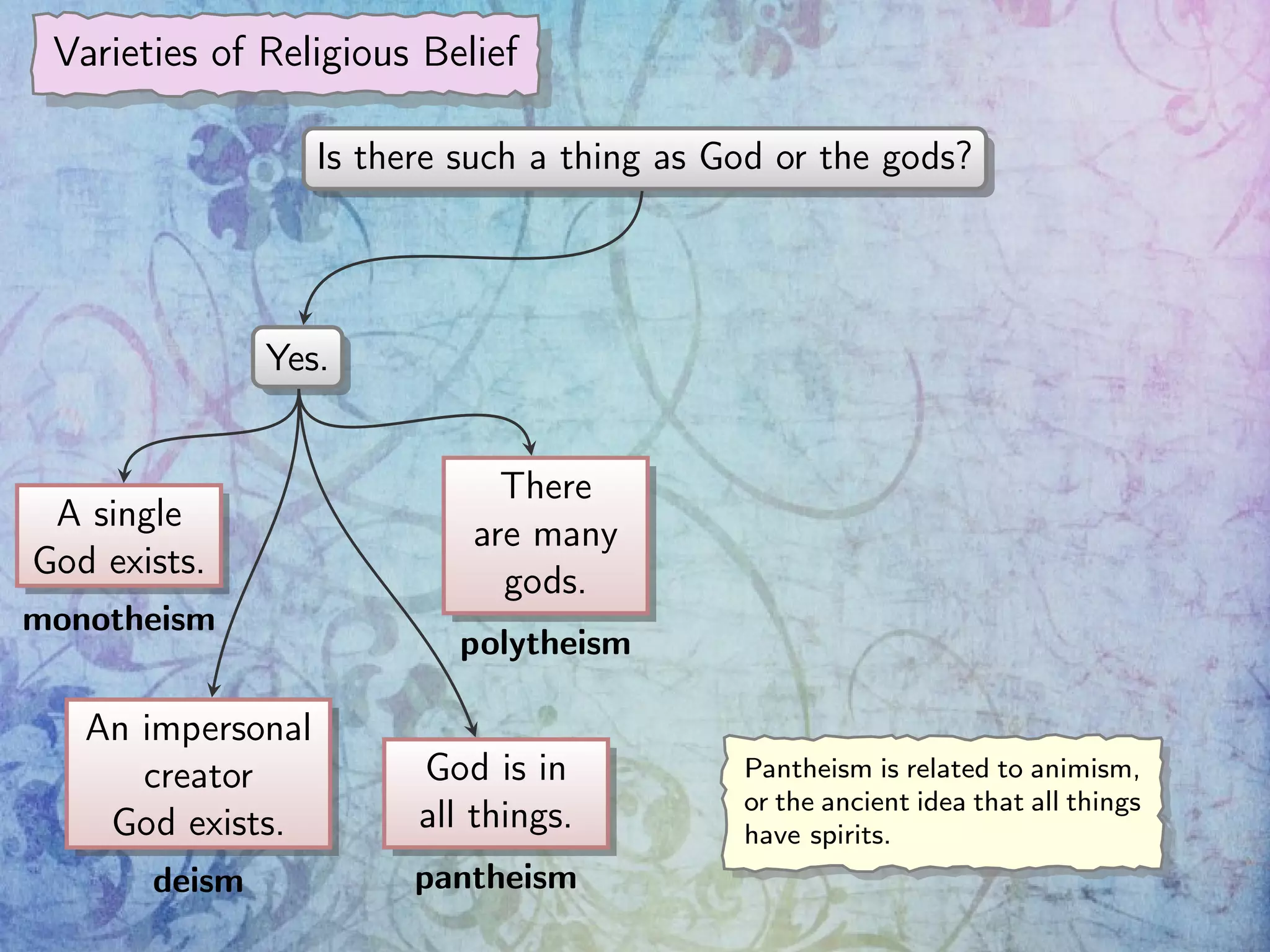
Is there such a thing as God or the gods?
Varieties of Religious Belief
Is there such a thing as God or the gods?
Yes.
This general answer defines what
it means to be THEIST.
Varieties of Religious Belief
Is there such a thing as God or the gods?
Yes.
A single
God exists.
monotheism
This is what we often think
of when we think of religion –
the idea that there is one all-
powerful God, an idea common
to Judaism, Christianity and
Islam.
Varieties of Religious Belief
Is there such a thing as God or the gods?
Yes.
A single
God exists.
monotheism
There
are many
gods.
polytheism
Historically monotheism grew out of
polytheism. Polytheism is alive and
well in India in the form of Hinduism.
Varieties of Religious Belief
Is there such a thing as God or the gods?
Yes.
A single
God exists.
monotheism
There
are many
gods.
polytheism
An impersonal
creator
God exists.
deism
Deism was popular during
the Enlightenment and many
founders of the American
Republic were deists.
Varieties of Religious Belief
Is there such a thing as God or the gods?
Yes.
A single
God exists.
monotheism
There
are many
gods.
polytheism
An impersonal
creator
God exists.
deism
God is in
all things.
pantheism
Pantheism is related to animism,
or the ancient idea that all things
have spirits.
Varieties of Religious Belief
Is there such a thing as God or the gods?
Yes.
A single
God exists.
monotheism
There
are many
gods.
polytheism
An impersonal
creator
God exists.
deism
God is in
all things.
pantheism
No.
God does
not exist.
atheism
You might think that a negative
conclusion like this cannot be
proved, but the argument from
evil tries to do so.
Varieties of Religious Belief
Is there such a thing as God or the gods?
Yes.
A single
God exists.
monotheism
There
are many
gods.
polytheism
An impersonal
creator
God exists.
deism
God is in
all things.
pantheism
No.
God does
not exist.
atheism
Maybe.
We don’t or
can’t know if
God exists.
agnosticism
Is this the most reasonable position to
take, or are there strong arguments in
favor of or against belief? Buddhism
might be considered an agnostic
religion.
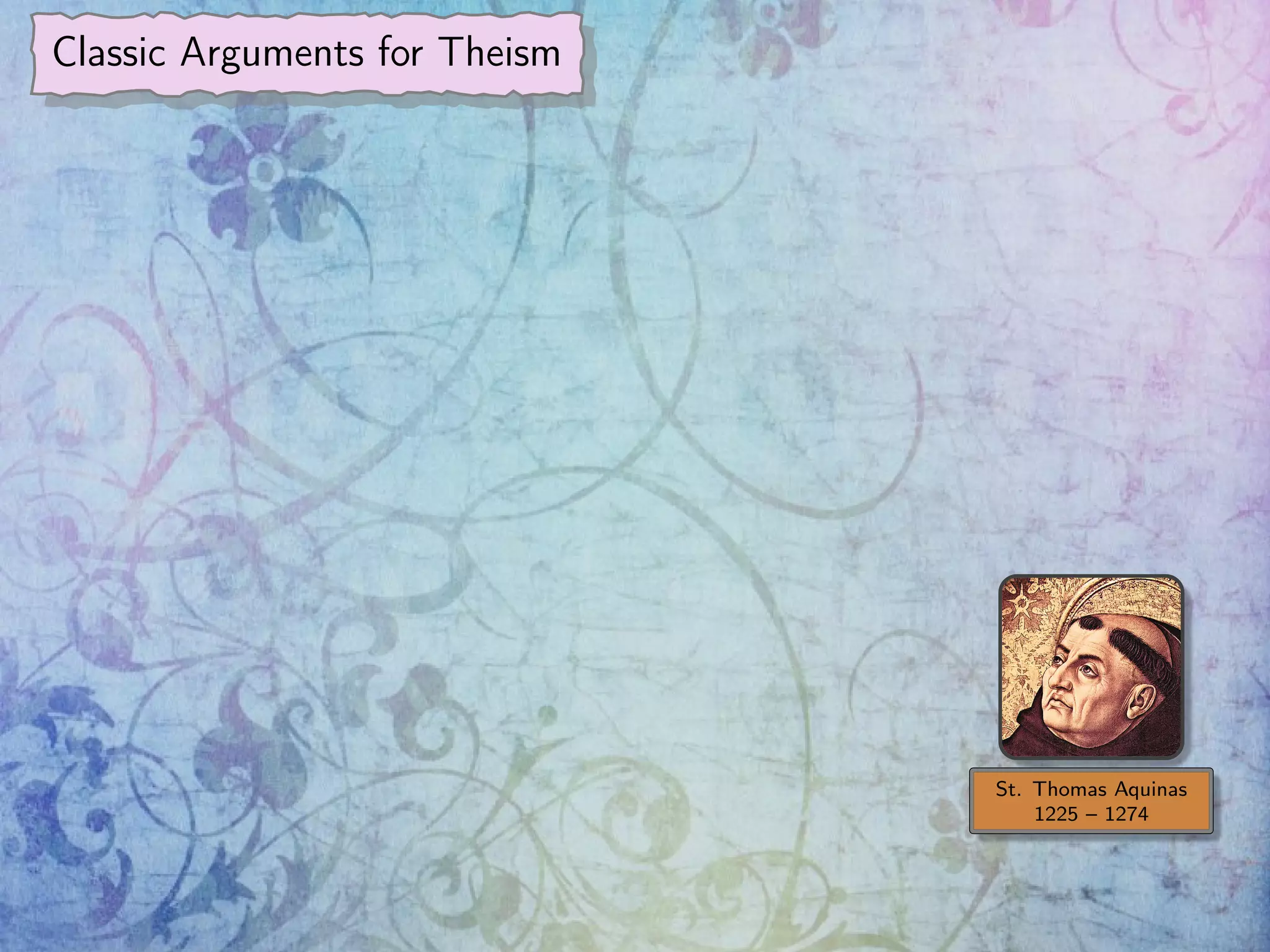
Classic Arguments for Theism
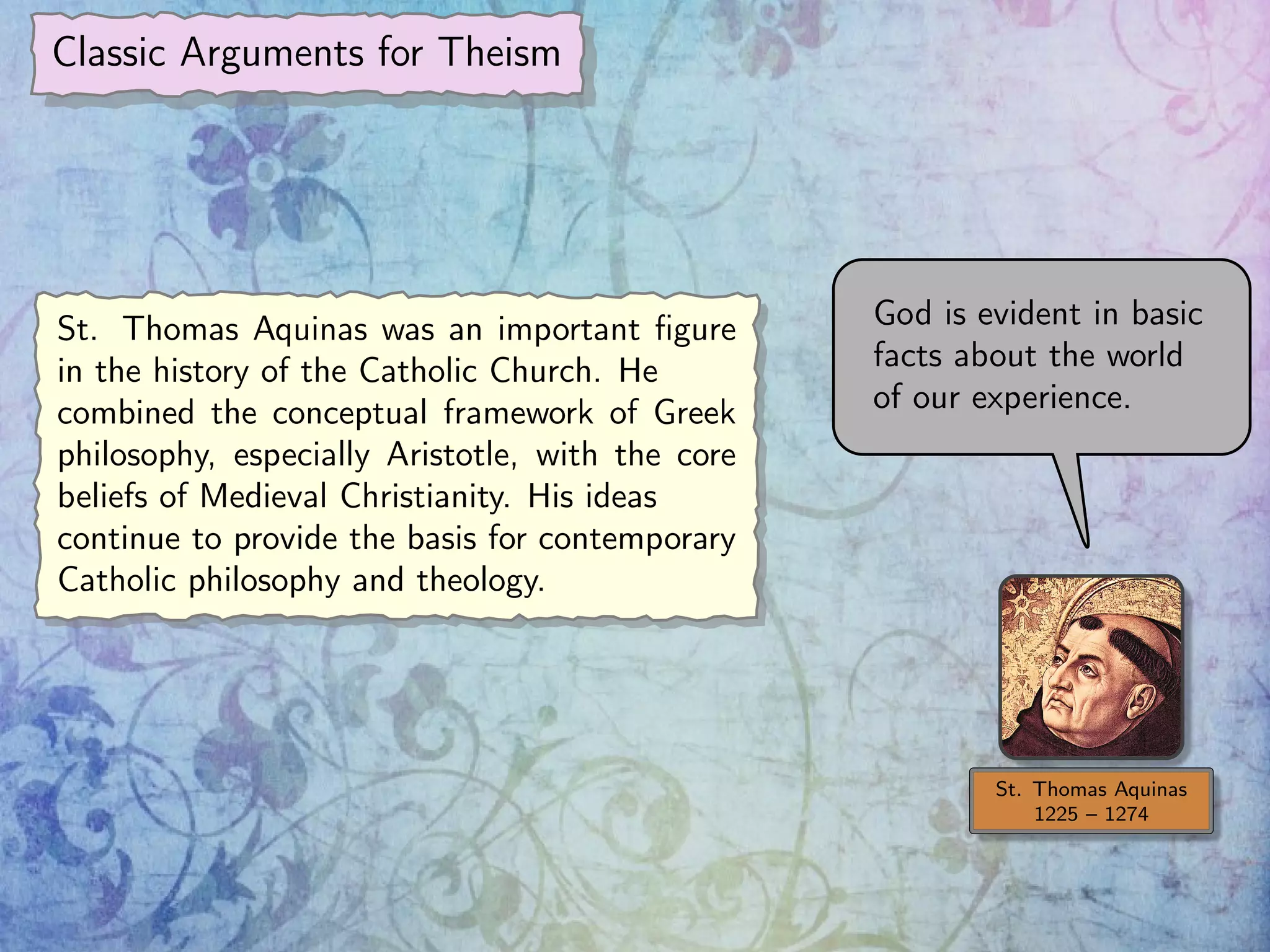
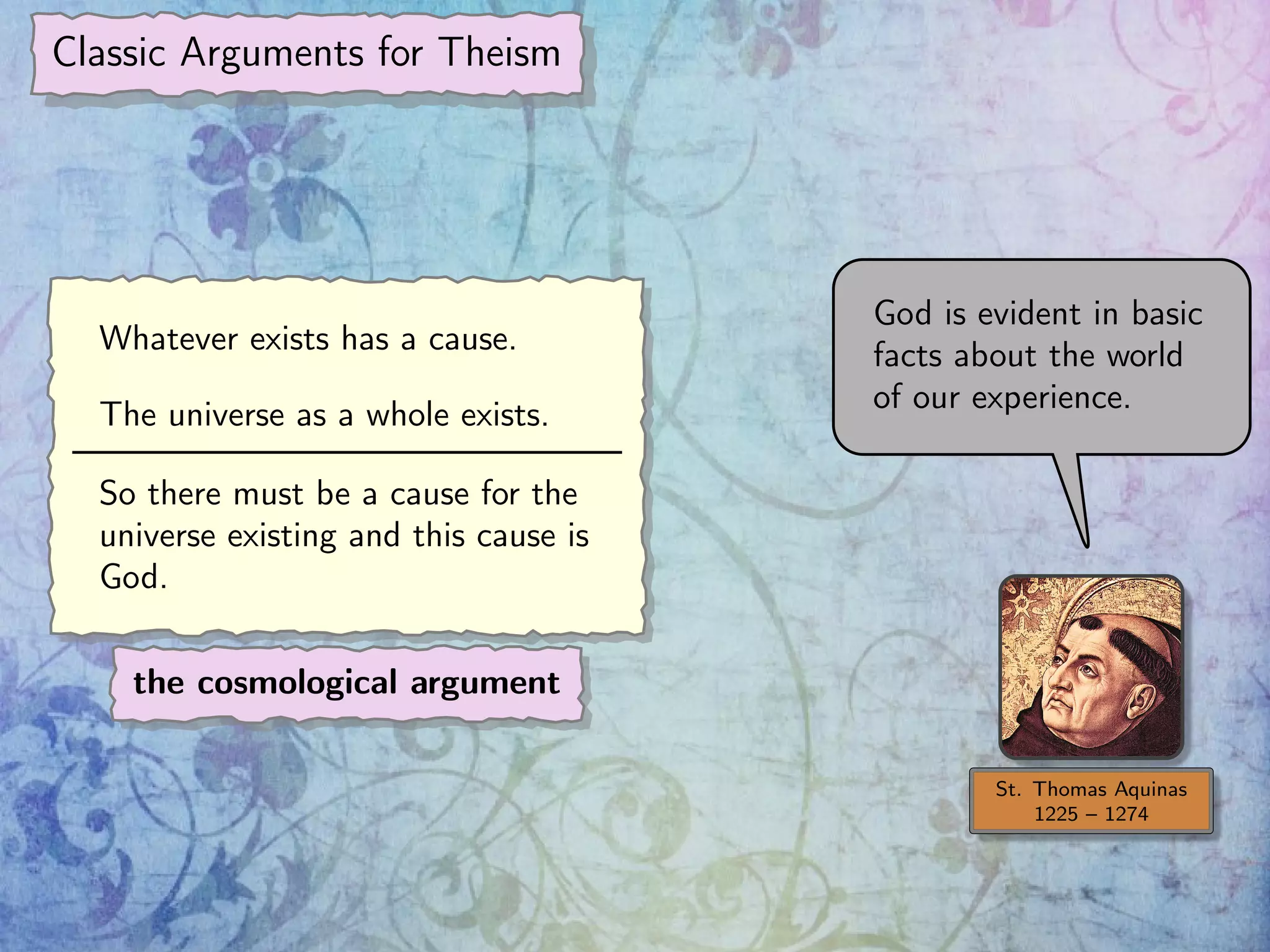
St. Thomas Aquinas
1225 – 1274
Classic Arguments for Theism
St. Thomas Aquinas
1225 – 1274
God is evident in basic
facts about the world
of our experience.
Classic Arguments for Theism
St. Thomas Aquinas
1225 – 1274
God is evident in basic
facts about the world
of our experience.
St. Thomas Aquinas was an important figure
in the history of the Catholic Church. He
combined the conceptual framework of Greek
philosophy, especially Aristotle, with the core
beliefs of Medieval Christianity. His ideas
continue to provide the basis for contemporary
Catholic philosophy and theology.
Classic Arguments for Theism
St. Thomas Aquinas
1225 – 1274
God is evident in basic
facts about the world
of our experience.
Whatever exists has a cause.
The universe as a whole exists.
So there must be a cause for the
universe existing and this cause is
God.
the cosmological argument
Classic Arguments for Theism
Whatever exists has a cause.
The universe as a whole exists.
So there must be a cause for the
universe existing and this cause is
God.
the cosmological argument
This argument is VALID, but is it
SOUND? Are the premises true?
Classic Arguments for Theism
Whatever exists has a cause.
The universe as a whole exists.
So there must be a cause for the
universe existing and this cause is
God.
the cosmological argument
Does everything have to have a
cause?
Classic Arguments for Theism
Whatever exists has a cause.
The universe as a whole exists.
So there must be a cause for the
universe existing and this cause is
God.
the cosmological argument
According to quantum physics
maybe not since some things can
just happen.
Classic Arguments for Theism
Whatever exists has a cause.
The universe as a whole exists.
So there must be a cause for the
universe existing and this cause is
God.
the cosmological argument
Is there any reason why the universe
could not have existed forever?
Classic Arguments for Theism
Whatever exists has a cause.
The universe as a whole exists.
So there must be a cause for the
universe existing and this cause is
God.
the cosmological argument
Even given that the universe has a
cause, why must this cause be God?
Classic Arguments for Theism
William Paley
c. 1743 – 1805
Classic Arguments for Theism
William Paley
c. 1743 – 1805
The work of God
is evident in the
complexity of the
natural world.
Classic Arguments for Theism
William Paley
c. 1743 – 1805
The work of God
is evident in the
complexity of the
natural world.
William Paley was an influential
English Protestant minister of the
18th Century. His arguments are
still popular among contemporary
“creationists” and backers of
“intelligent design theory.”
Classic Arguments for Theism
William Paley
c. 1743 – 1805
The work of God
is evident in the
complexity of the
natural world.
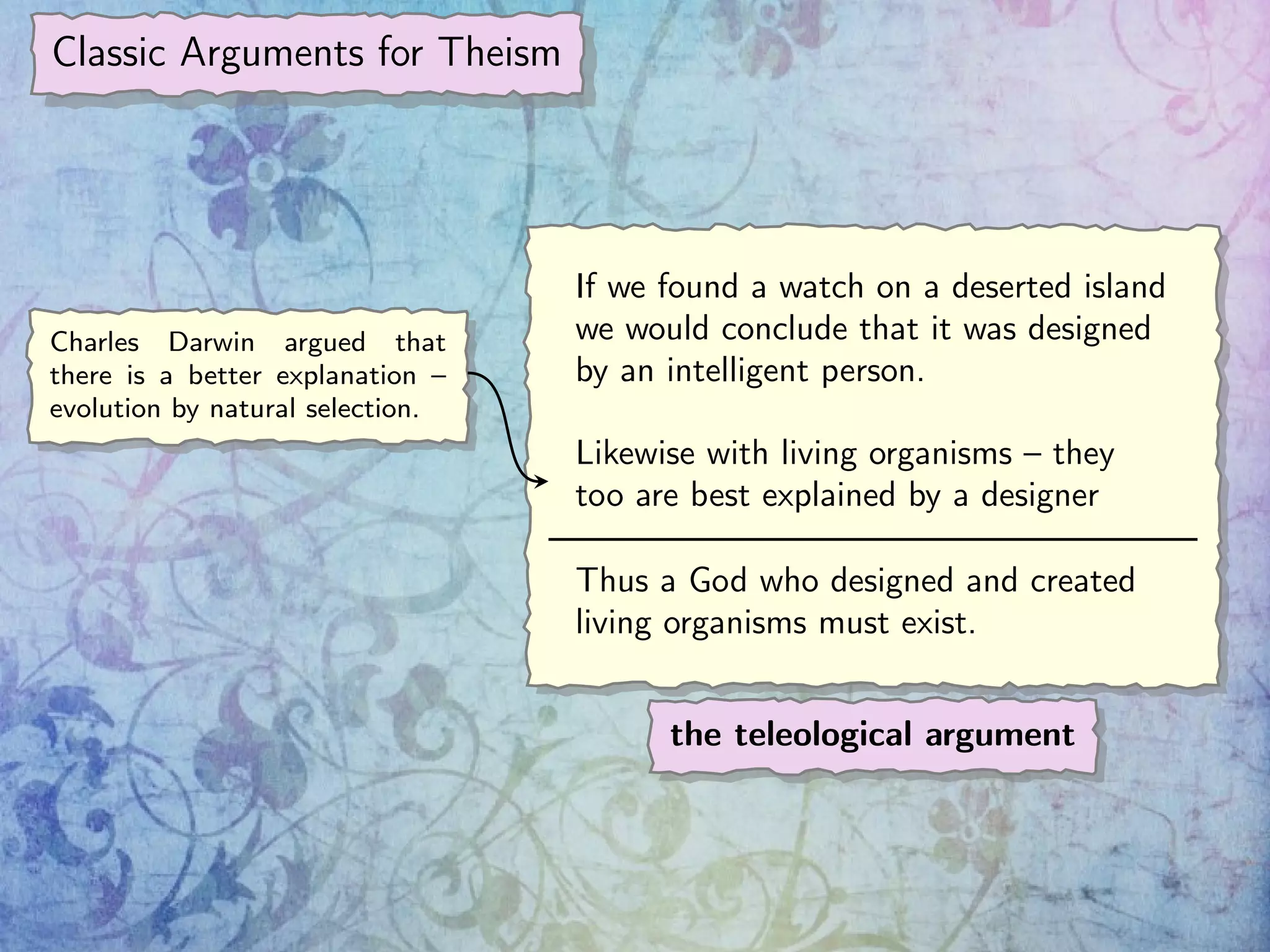
If we found a watch on a deserted island
we would conclude that it was designed
by an intelligent person.
Likewise with living organisms – they
too are best explained by a designer
Thus a God who designed and created
living organisms must exist.
the teleological argument
Classic Arguments for Theism
If we found a watch on a deserted island
we would conclude that it was designed
by an intelligent person.
Likewise with living organisms – they
too are best explained by a designer
Thus a God who designed and created
living organisms must exist.
the teleological argument
This is an “argument to the
best explanation” which claims
that the best explanation for
the complexity of living things is
that there is a God who created
them.
Classic Arguments for Theism
If we found a watch on a deserted island
we would conclude that it was designed
by an intelligent person.
Likewise with living organisms – they
too are best explained by a designer
Thus a God who designed and created
living organisms must exist.
the teleological argument
To see whether this is true we
need to know whether there are
other workable explanations.
Classic Arguments for Theism
If we found a watch on a deserted island
we would conclude that it was designed
by an intelligent person.
Likewise with living organisms – they
too are best explained by a designer
Thus a God who designed and created
living organisms must exist.
the teleological argument
Charles Darwin argued that
there is a better explanation –
evolution by natural selection.
Classic Arguments for Theism
St. Anselm
c. 1033 – 1101
Classic Arguments for Theism
St. Anselm
c. 1033 – 1101
Reason alone can
convince us to
believe that God
exists.
Classic Arguments for Theism
St. Anselm
c. 1033 – 1101
Reason alone can
convince us to
believe that God
exists.
Anselm of Canterbury was born in France
but ascended through the ranks of the
Medieval Church to become Archbishop
of Canterbury, the head of the Church in
England. His philosophical work was an
early attempt to systematize Church
doctrine and establish it on a rational
basis.
Classic Arguments for Theism
St. Anselm
c. 1033 – 1101
Reason alone can
convince us to
believe that God
exists.
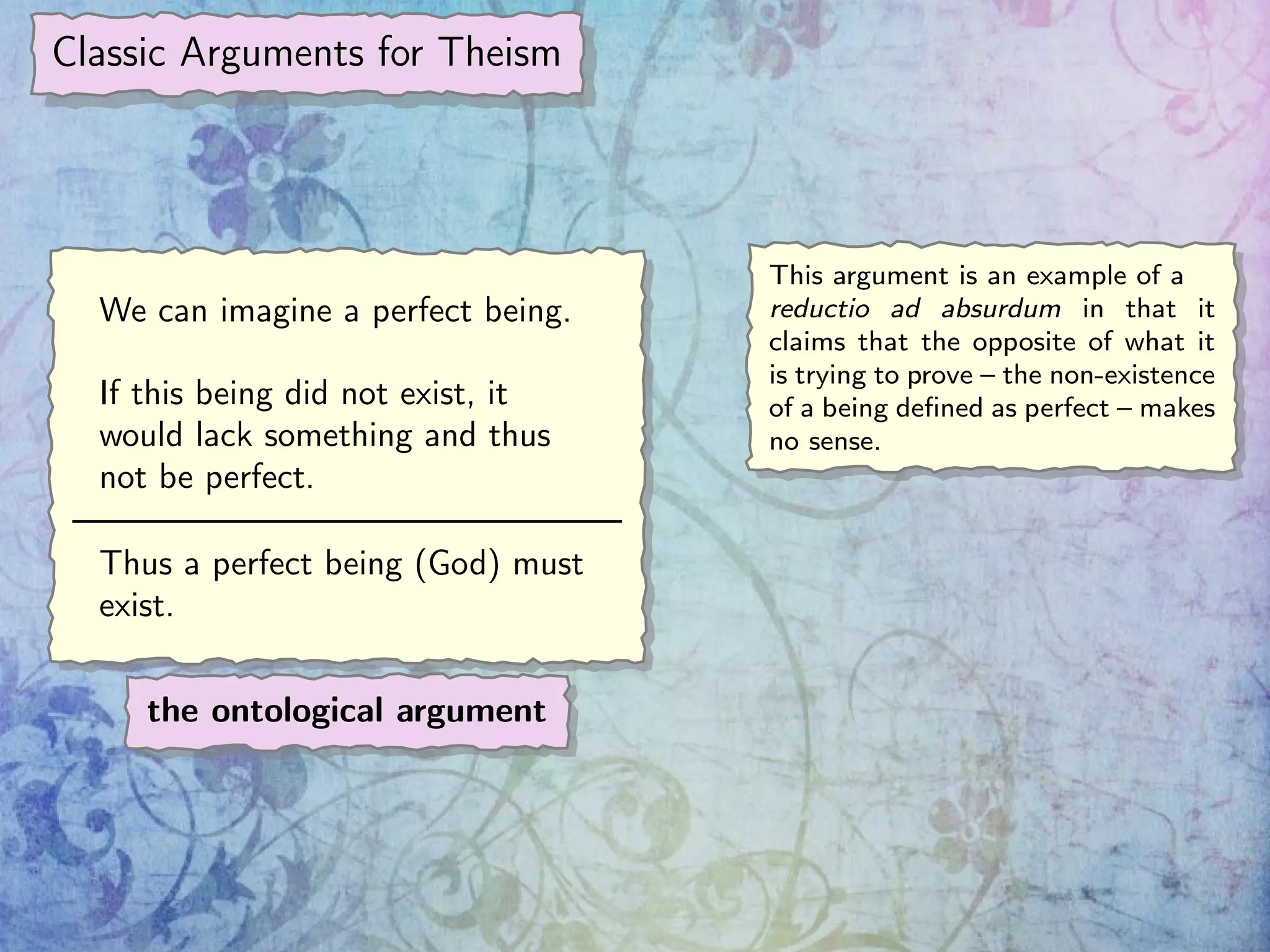
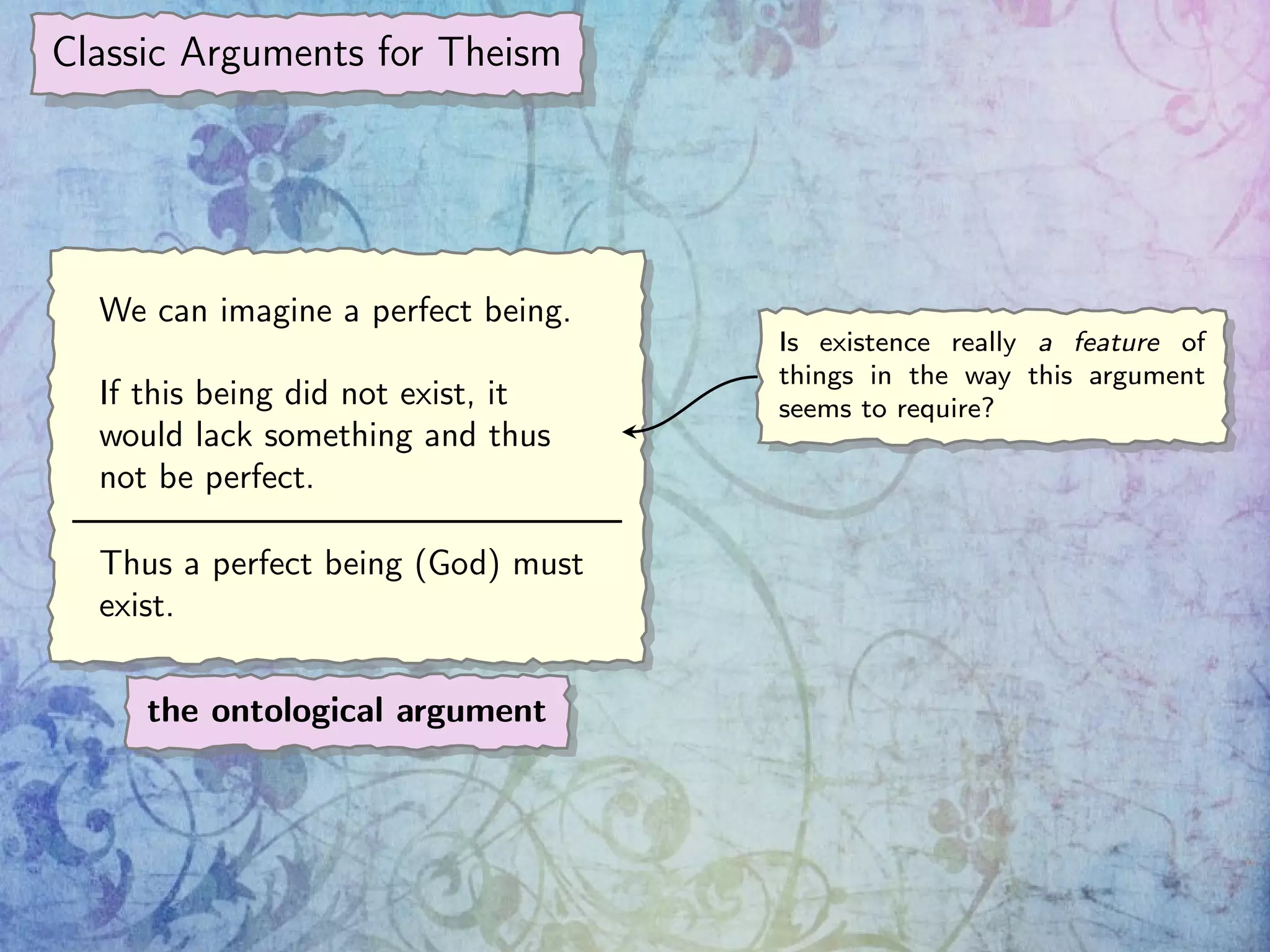
We can imagine a perfect being.
If this being did not exist, it
would lack something and thus
not be perfect.
Thus a perfect being (God) must
exist.
the ontological argument
Classic Arguments for Theism
We can imagine a perfect being.
If this being did not exist, it
would lack something and thus
not be perfect.
Thus a perfect being (God) must
exist.
the ontological argument
This argument is an example of a
reductio ad absurdum in that it
claims that the opposite of what it
is trying to prove – the non-existence
of a being defined as perfect – makes
no sense.
Classic Arguments for Theism
We can imagine a perfect being.
If this being did not exist, it
would lack something and thus
not be perfect.
Thus a perfect being (God) must
exist.
the ontological argument
This argument seems to be cheating –
can we really conclude anything about
reality based just on our definition of
the concept “perfect being?”
Classic Arguments for Theism
We can imagine a perfect being.
If this being did not exist, it
would lack something and thus
not be perfect.
Thus a perfect being (God) must
exist.
the ontological argument
Is existence really a feature of
things in the way this argument
seems to require?
Classic Arguments for Theism
We can imagine a perfect being.
If this being did not exist, it
would lack something and thus
not be perfect.
Thus a perfect being (God) must
exist.
the ontological argument
What does this very abstract idea of
a perfect being have to do with the
God of religion?
An Argument for Atheism
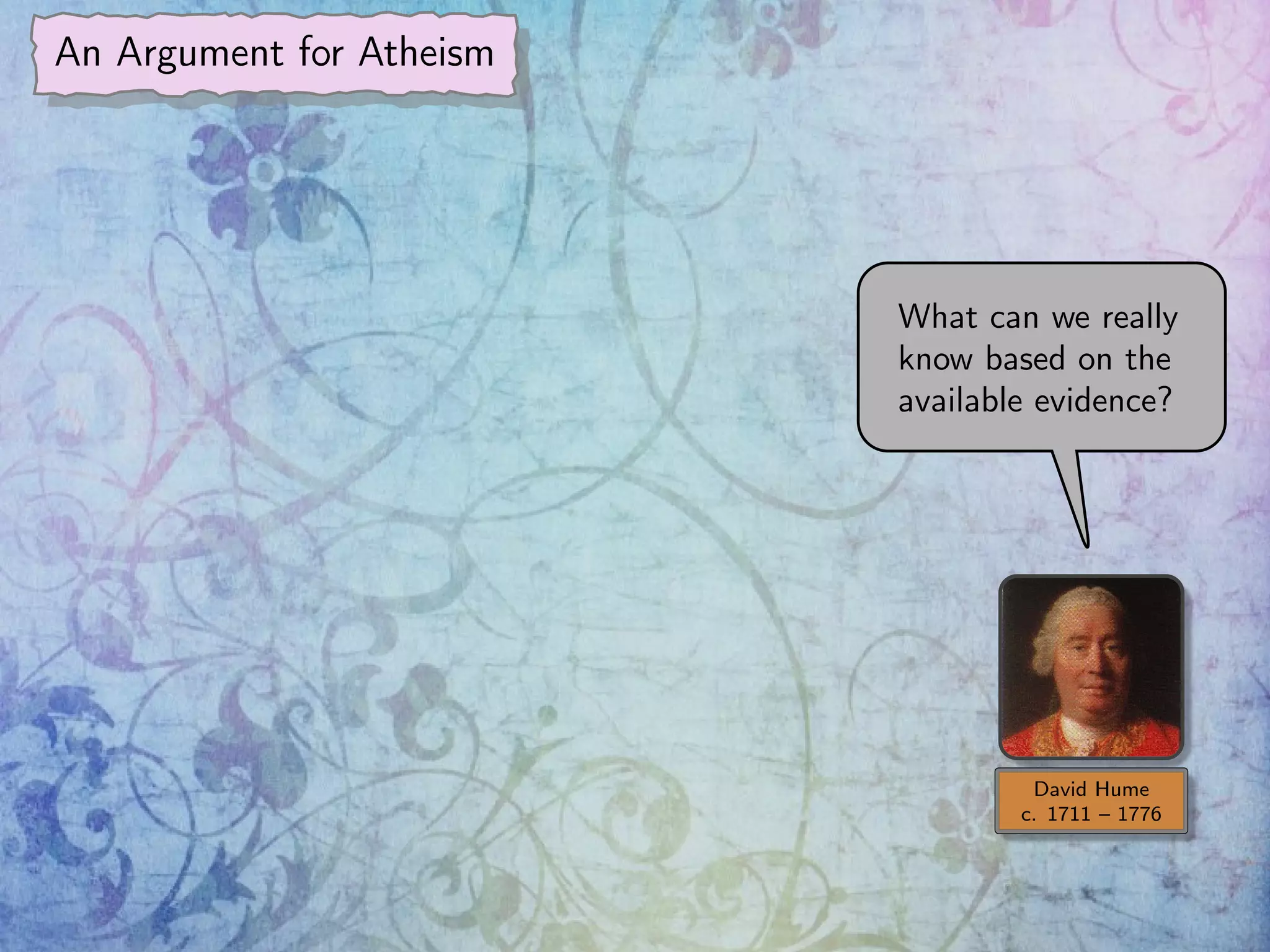
David Hume
c. 1711 – 1776
An Argument for Atheism
David Hume
c. 1711 – 1776
What can we really
know based on the
available evidence?
An Argument for Atheism
David Hume
c. 1711 – 1776
What can we really
know based on the
available evidence?
David Hume was a major figure in the
Scottish Enlightenment. He sought to
apply the scientific method to the study
of human knowledge. This often led him
to skeptical conclusions about how much
we really can claim to know. He is now
recognized as a pioneer in cognitive
psychology as well being an influential
philosopher.
An Argument for Atheism
David Hume
c. 1711 – 1776
What can we really
know based on the
available evidence?
If there is an all-powerful, all-
knowing and all-good God, then
evil should not exist.
But there clearly is evil in the
world.
This gives us a strong reason to
doubt the existence of such a
God.
the argument from evil
An Argument for Atheism
If there is an all-powerful, all-
knowing and all-good God, then
evil should not exist.
But there clearly is evil in the
world.
This gives us a strong reason to
doubt the existence of such a
God.
the argument from evil
This argument is VALID, but is it
SOUND? Are the premises true?
An Argument for Atheism
If there is an all-powerful, all-
knowing and all-good God, then
evil should not exist.
But there clearly is evil in the
world.
This gives us a strong reason to
doubt the existence of such a
God.
the argument from evil
The existence of evil could be explained
away if God either couldn’t do anything
about it, did not know or did not care
to stop it.
An Argument for Atheism
If there is an all-powerful, all-
knowing and all-good God, then
evil should not exist.
But there clearly is evil in the
world.
This gives us a strong reason to
doubt the existence of such a
God.
the argument from evil
The fact of undeserved evil, such
as childhood disease, presents a big
challenge to the theist.
An Argument for Atheism
If there is an all-powerful, all-
knowing and all-good God, then
evil should not exist.
But there clearly is evil in the
world.
This gives us a strong reason to
doubt the existence of such a
God.
the argument from evil
The theist must respond by showing
that there is a good reason for evil
in the world.
An Argument for Atheism
If there is an all-powerful, all-
knowing and all-good God, then
evil should not exist.
But there clearly is evil in the
world.
This gives us a strong reason to
doubt the existence of such a
God.
the argument from evil
The most popular defense of God is
the appeal to free will - God made us
free to choose good or evil and this
requires evil in the world.
An Alternate Argument for Theism
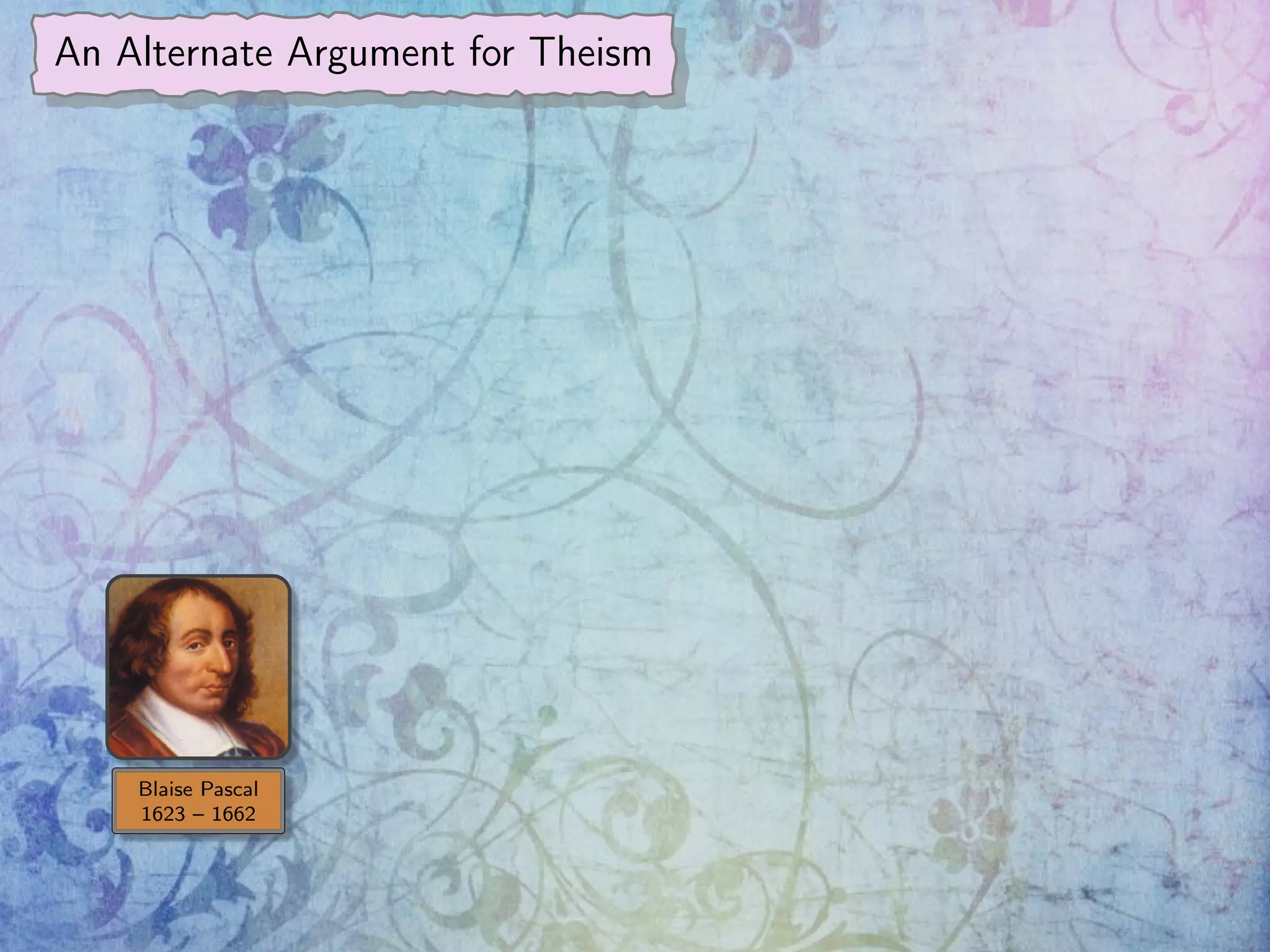
Blaise Pascal
1623 – 1662
An Alternate Argument for Theism
Blaise Pascal
1623 – 1662
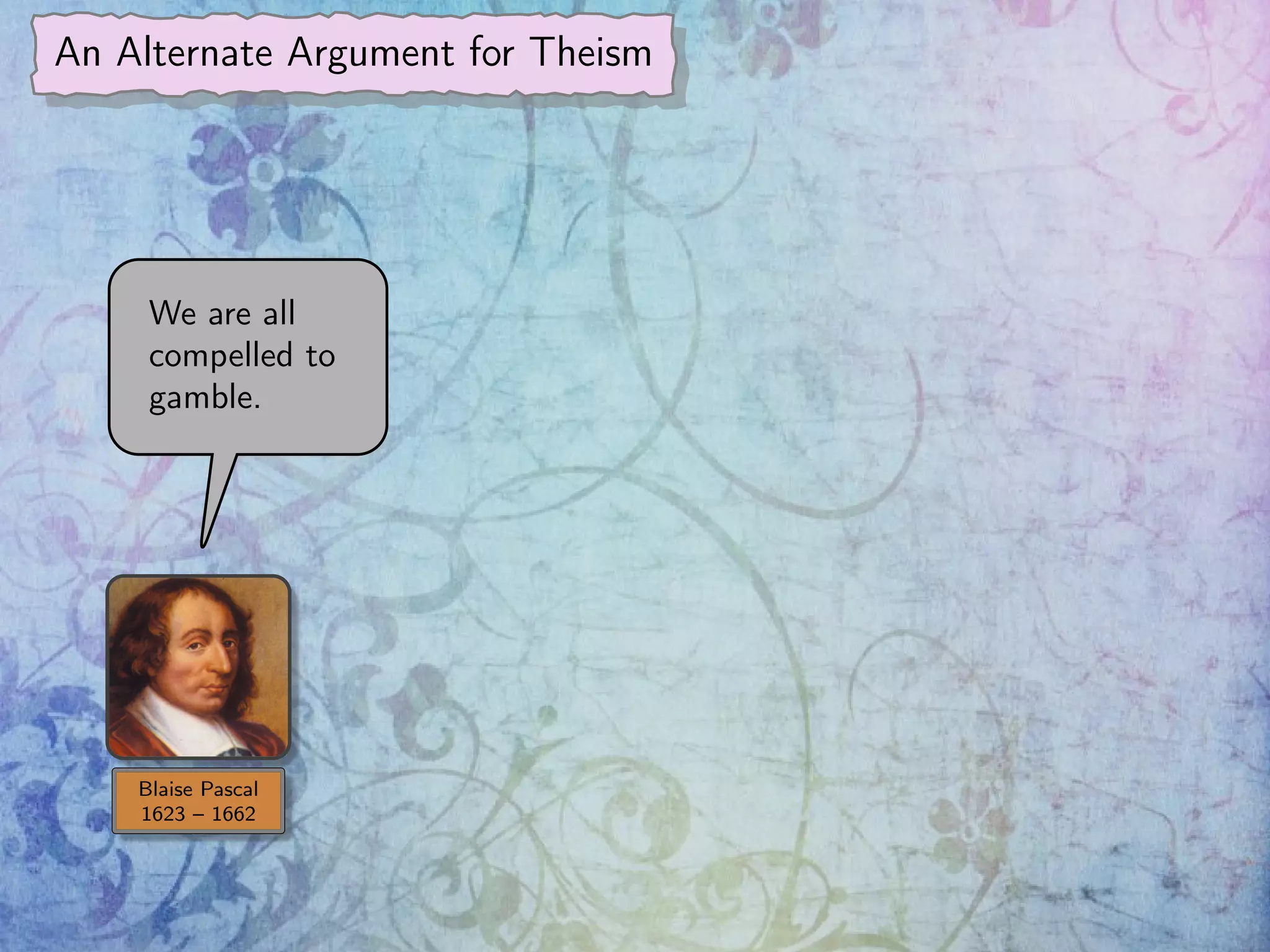
We are all
compelled to
gamble.
An Alternate Argument for Theism
Blaise Pascal
1623 – 1662
We are all
compelled to
gamble.
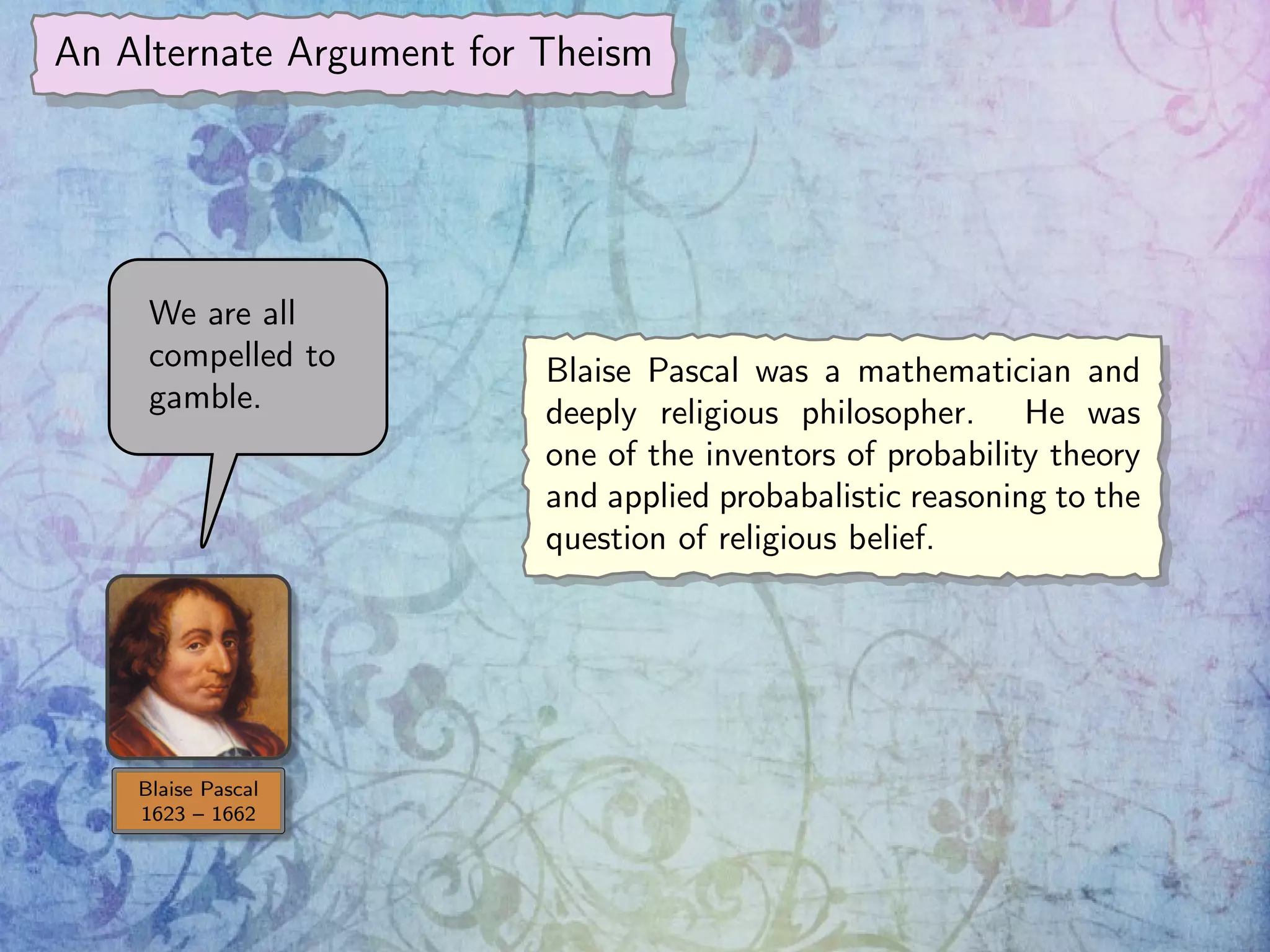
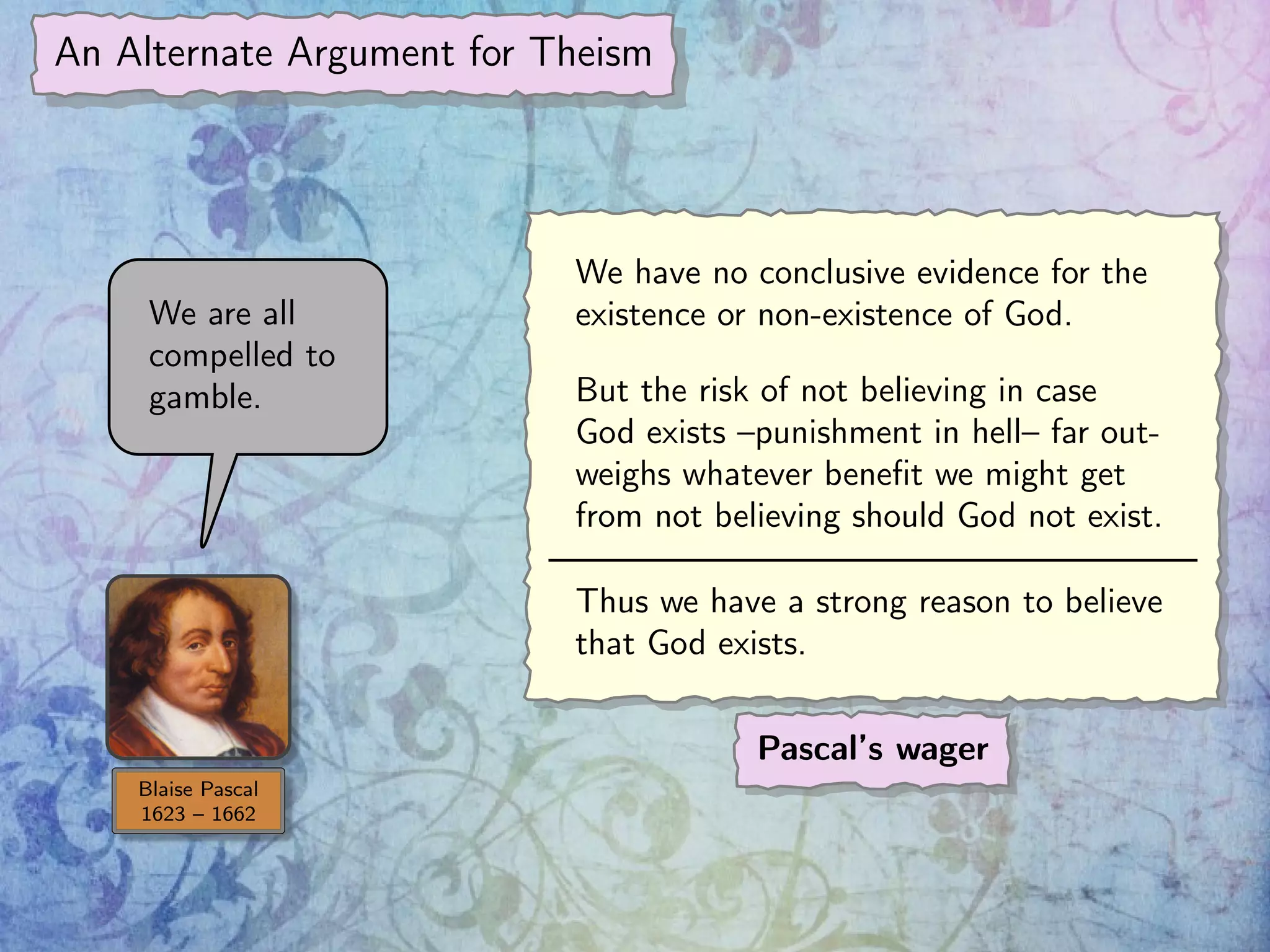
Blaise Pascal was a mathematician and
deeply religious philosopher. He was
one of the inventors of probability theory
and applied probabalistic reasoning to the
question of religious belief.
An Alternate Argument for Theism
Blaise Pascal
1623 – 1662
We are all
compelled to
gamble.
We have no conclusive evidence for the
existence or non-existence of God.
But the risk of not believing in case
God exists –punishment in hell– far out-
weighs whatever benefit we might get
from not believing should God not exist.
Thus we have a strong reason to believe
that God exists.
Pascal’s wager
An Alternate Argument for Theism
We have no conclusive evidence for the
existence or non-existence of God.
But the risk of not believing in case
God exists –punishment in hell– far out-
weighs whatever benefit we might get
from not believing should God not exist.
Thus we have a strong reason to believe
that God exists.
Pascal’s wager
This argument is a practical
argument which looks at the
potential payoffs of belief as
opposed to unbelief.
An Alternate Argument for Theism
We have no conclusive evidence for the
existence or non-existence of God.
But the risk of not believing in case
God exists –punishment in hell– far out-
weighs whatever benefit we might get
from not believing should God not exist.
Thus we have a strong reason to believe
that God exists.
Pascal’s wager
Given the difficulties presented
by the other arguments, this
seems correct.
An Alternate Argument for Theism
We have no conclusive evidence for the
existence or non-existence of God.
But the risk of not believing in case
God exists –punishment in hell– far out-
weighs whatever benefit we might get
from not believing should God not exist.
Thus we have a strong reason to believe
that God exists.
Pascal’s wager
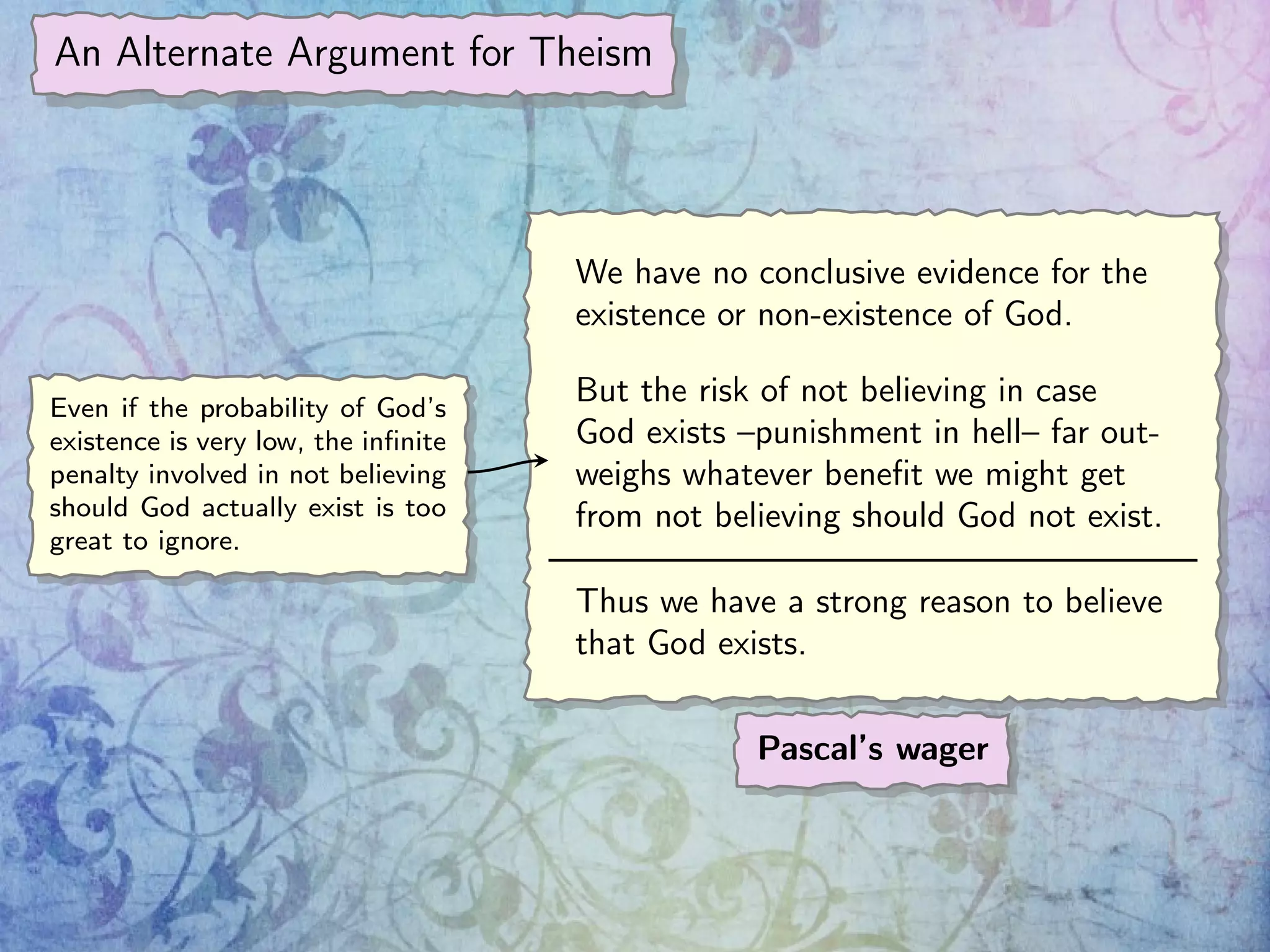
Even if the probability of God’s
existence is very low, the infinite
penalty involved in not believing
should God actually exist is too
great to ignore.
An Alternate Argument for Theism
We have no conclusive evidence for the
existence or non-existence of God.
But the risk of not believing in case
God exists –punishment in hell– far out-
weighs whatever benefit we might get
from not believing should God not exist.
Thus we have a strong reason to believe
that God exists.
Pascal’s wager
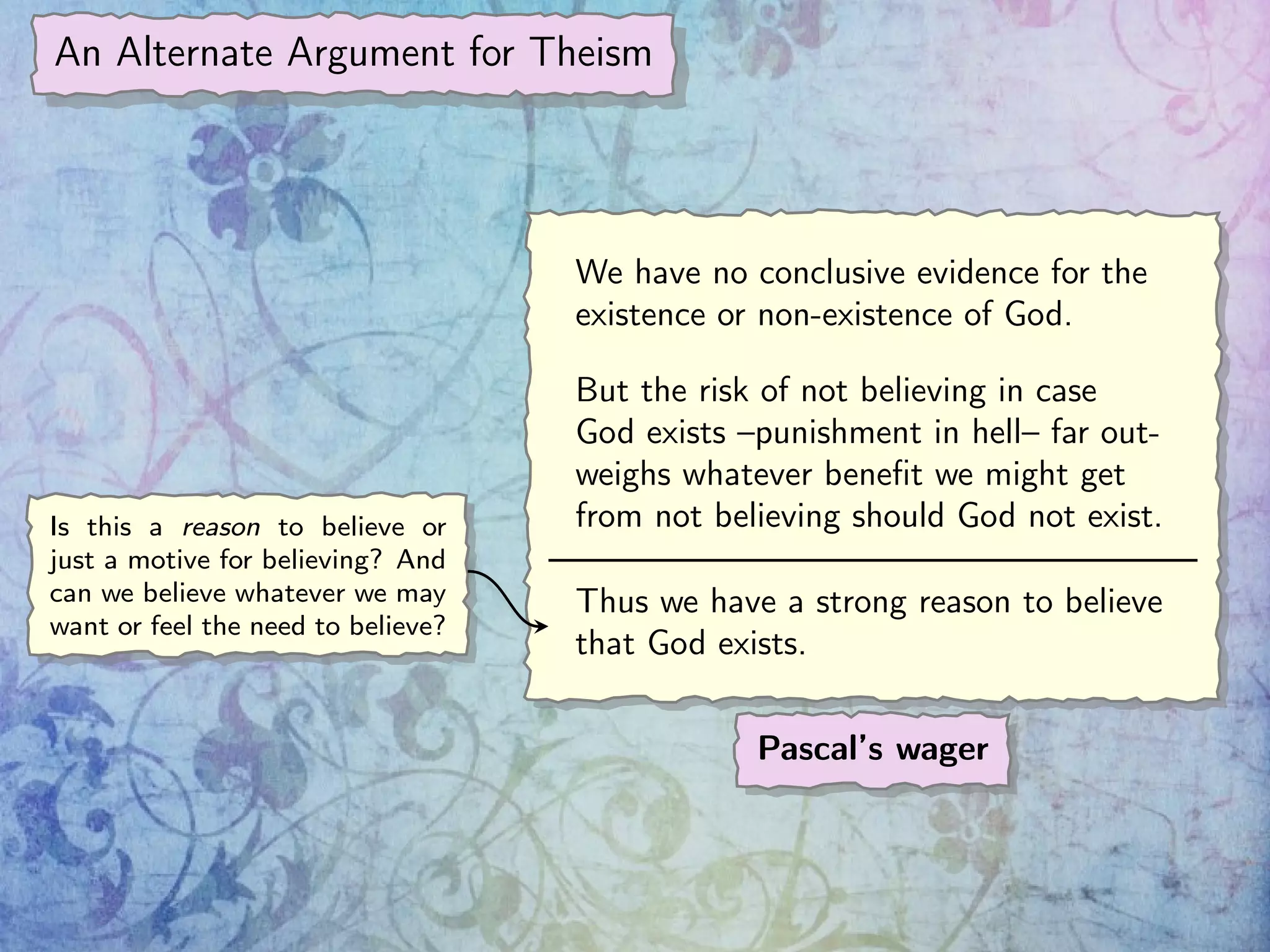
Is this a reason to believe or
just a motive for believing? And
can we believe whatever we may
want or feel the need to believe?
The Buddhist Perspective
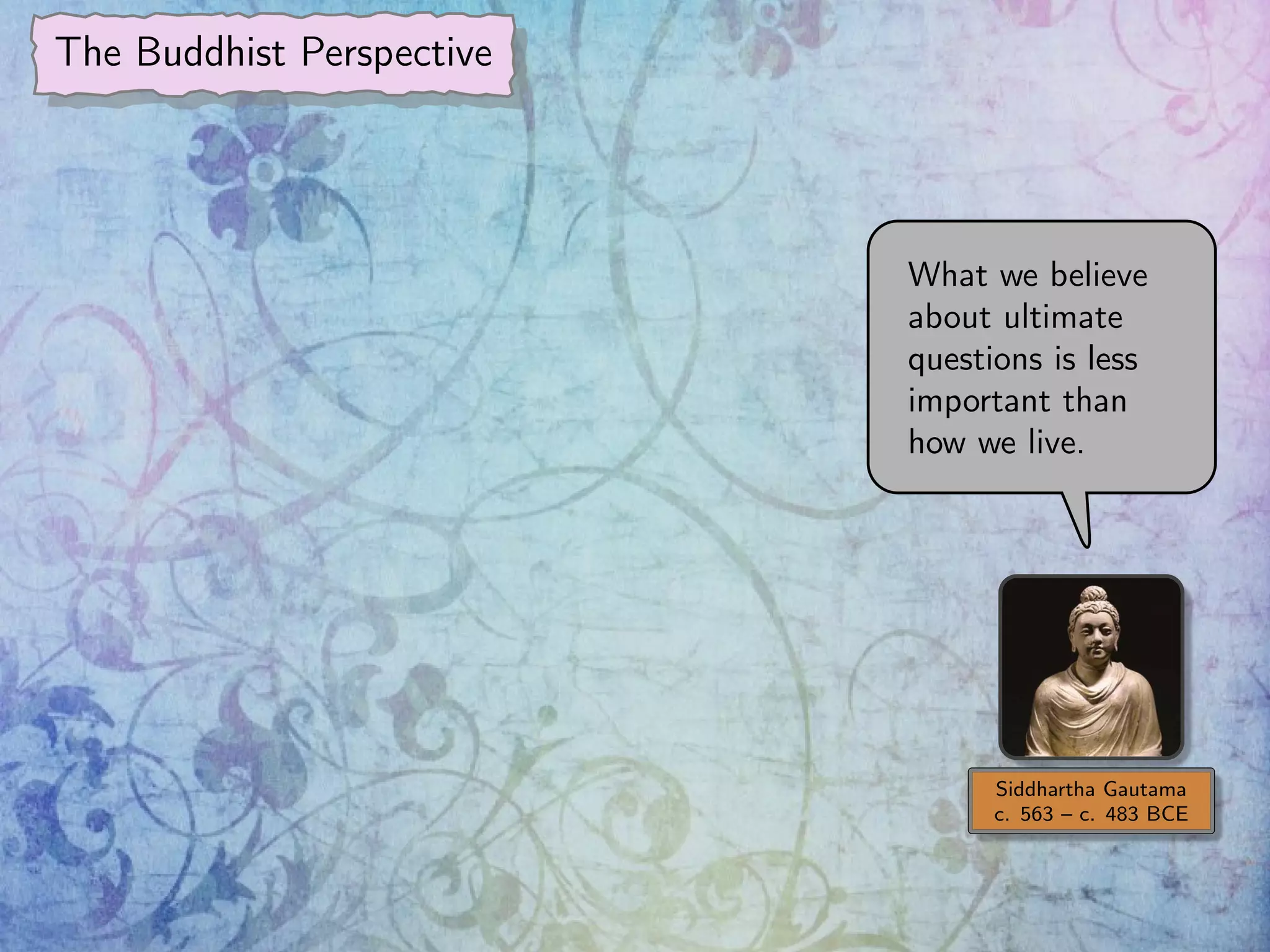
Siddhartha Gautama
c. 563 – c. 483 BCE
The Buddhist Perspective
Siddhartha Gautama
c. 563 – c. 483 BCE
What we believe
about ultimate
questions is less
important than
how we live.
The Buddhist Perspective
Siddhartha Gautama
c. 563 – c. 483 BCE
What we believe
about ultimate
questions is less
important than
how we live.
Siddhartha Guatama, “the Buddha,” was
an Indian prince who left a comfortable
life to seek a solution to the human
predicament. He claimed to find one in
a way of life emphasizing self-knowledge,
ethical action and contemplation of the
impermanent nature of things.
The Buddhist Perspective
Siddhartha Gautama
c. 563 – c. 483 BCE
What we believe
about ultimate
questions is less
important than
how we live.
Arguing about the nature of God, the
soul, life after death is like arguing about
the details of the arrow after having been
shot with one.
It is far more important to pull the arrow
out than worry about who shot it and
from how far away.
The same is true of religious practice –
it is intended to overcome suffering not
answer ultimate questions.
the parable of the arrow
The Buddhist Perspective
Arguing about the nature of God, the
soul, life after death is like arguing about
the details of the arrow after having been
shot with one.
It is far more important to pull the arrow
out than worry about who shot it and
from how far away.
The same is true of religious practice –
it is intended to overcome suffering not
answer ultimate questions.
the parable of the arrow
Buddhism is often considered to be
a religion, but it is non-theistic in
that it holds that God or the gods
are not relevant for resolving the
difficulties with being human.
The Buddhist Perspective
Arguing about the nature of God, the
soul, life after death is like arguing about
the details of the arrow after having been
shot with one.
It is far more important to pull the arrow
out than worry about who shot it and
from how far away.
The same is true of religious practice –
it is intended to overcome suffering not
answer ultimate questions.
the parable of the arrow
Metaphysical questions may be
interesting, but perhaps they are
besides the point.
The Buddhist Perspective
Arguing about the nature of God, the
soul, life after death is like arguing about
the details of the arrow after having been
shot with one.
It is far more important to pull the arrow
out than worry about who shot it and
from how far away.
The same is true of religious practice –
it is intended to overcome suffering not
answer ultimate questions.
the parable of the arrow
Human beings seek to get to the
root of the difficulties of living and
dying. Religion is one response to
this.
The Buddhist Perspective
Arguing about the nature of God, the
soul, life after death is like arguing about
the details of the arrow after having been
shot with one.
It is far more important to pull the arrow
out than worry about who shot it and
from how far away.
The same is true of religious practice –
it is intended to overcome suffering not
answer ultimate questions.
the parable of the arrow
In spite of its lack of concern for
religious belief, Buddhism shares
with other religions a sense of the
sacredness and mystery of life.

02 religion

  • 1.
    Philosophy of Religion reason,faith, belief and doubt George Matthews Spring 2015
  • 2.
  • 3.
  • 4.
    Perspectives on Religion !From inside: what religious beliefs or practices should I adhere to as someone aware of the mystery of life and death?
  • 5.
    Perspectives on Religion !From inside: what religious beliefs or practices should I adhere to as someone aware of the mystery of life and death? ! From outside: how can we understand religion as disinterested observers?
  • 6.
    Perspectives on Religion !From inside: what religious beliefs or practices should I adhere to as someone aware of the mystery of life and death? ! From outside: how can we understand religion as disinterested observers? religious studies: what are the practices, beliefs and histories of various religions?
  • 7.
    Perspectives on Religion !From inside: what religious beliefs or practices should I adhere to as someone aware of the mystery of life and death? ! From outside: how can we understand religion as disinterested observers? religious studies: what are the practices, beliefs and histories of various religions? sociology: how do religions work as institutions expressing shared values and how do they relate to other social institutions?
  • 8.
    Perspectives on Religion !From inside: what religious beliefs or practices should I adhere to as someone aware of the mystery of life and death? ! From outside: how can we understand religion as disinterested observers? religious studies: what are the practices, beliefs and histories of various religions? sociology: how do religions work as institutions expressing shared values and how do they relate to other social institutions? psychology: what is going on in the mind when people have religious beliefs or engage in religious practices?
  • 9.
    Perspectives on Religion !From inside: what religious beliefs or practices should I adhere to as someone aware of the mystery of life and death? ! From outside: how can we understand religion as disinterested observers? religious studies: what are the practices, beliefs and histories of various religions? sociology: how do religions work as institutions expressing shared values and how do they relate to other social institutions? psychology: what is going on in the mind when people have religious beliefs or engage in religious practices? philosophy: can religious thinking be rationally justified?
  • 10.
    What philosophers askabout religion
  • 11.
    What philosophers askabout religion metaphysical questions
  • 12.
    What philosophers askabout religion 1. Does God exist? If so in what sense – as separate from nature, identical with nature, or in some other way? metaphysical questions
  • 13.
    What philosophers askabout religion 1. Does God exist? If so in what sense – as separate from nature, identical with nature, or in some other way? 2. Do any “spiritual things” such as gods, souls, disembodied spirits, demons or ghosts exist or is the universe and everything in it purely material stuff? metaphysical questions
  • 14.
    What philosophers askabout religion 1. Does God exist? If so in what sense – as separate from nature, identical with nature, or in some other way? 2. Do any “spiritual things” such as gods, souls, disembodied spirits, demons or ghosts exist or is the universe and everything in it purely material stuff? 3. What does the existence of evil in the world imply about the existence or non-existence of God? metaphysical questions
  • 15.
    What philosophers askabout religion epistemological questions
  • 16.
    What philosophers askabout religion 1. What evidence might establish the existence of a God? epistemological questions
  • 17.
    What philosophers askabout religion 1. What evidence might establish the existence of a God? 2. What is the relation between reason and faith in general and what does this tell us about religion? epistemological questions
  • 18.
    What philosophers askabout religion 1. What evidence might establish the existence of a God? 2. What is the relation between reason and faith in general and what does this tell us about religion? 3. Does religious experience warrant religious belief? epistemological questions
  • 19.
    What philosophers askabout religion 1. What evidence might establish the existence of a God? 2. What is the relation between reason and faith in general and what does this tell us about religion? 3. Does religious experience warrant religious belief? 4. Are religious explanations of natural phenomena in competition with scientific explanations? epistemological questions
  • 20.
    What philosophers askabout religion value-theory questions
  • 21.
    What philosophers askabout religion 1. Are religious beliefs or institutions necessary for social order? value-theory questions
  • 22.
    What philosophers askabout religion 1. Are religious beliefs or institutions necessary for social order? 2. Can we have morality without religion? value-theory questions
  • 23.
    What philosophers askabout religion 1. Are religious beliefs or institutions necessary for social order? 2. Can we have morality without religion? 3. Is religion a purely private matter or should it play a public role in modern societies? value-theory questions
  • 24.
  • 25.
    Varieties of ReligiousBelief Is there such a thing as God or the gods?
  • 26.
    Varieties of ReligiousBelief Is there such a thing as God or the gods? Yes. This general answer defines what it means to be THEIST.
  • 27.
    Varieties of ReligiousBelief Is there such a thing as God or the gods? Yes. A single God exists. monotheism This is what we often think of when we think of religion – the idea that there is one all- powerful God, an idea common to Judaism, Christianity and Islam.
  • 28.
    Varieties of ReligiousBelief Is there such a thing as God or the gods? Yes. A single God exists. monotheism There are many gods. polytheism Historically monotheism grew out of polytheism. Polytheism is alive and well in India in the form of Hinduism.
  • 29.
    Varieties of ReligiousBelief Is there such a thing as God or the gods? Yes. A single God exists. monotheism There are many gods. polytheism An impersonal creator God exists. deism Deism was popular during the Enlightenment and many founders of the American Republic were deists.
  • 30.
    Varieties of ReligiousBelief Is there such a thing as God or the gods? Yes. A single God exists. monotheism There are many gods. polytheism An impersonal creator God exists. deism God is in all things. pantheism Pantheism is related to animism, or the ancient idea that all things have spirits.
  • 31.
    Varieties of ReligiousBelief Is there such a thing as God or the gods? Yes. A single God exists. monotheism There are many gods. polytheism An impersonal creator God exists. deism God is in all things. pantheism No. God does not exist. atheism You might think that a negative conclusion like this cannot be proved, but the argument from evil tries to do so.
  • 32.
    Varieties of ReligiousBelief Is there such a thing as God or the gods? Yes. A single God exists. monotheism There are many gods. polytheism An impersonal creator God exists. deism God is in all things. pantheism No. God does not exist. atheism Maybe. We don’t or can’t know if God exists. agnosticism Is this the most reasonable position to take, or are there strong arguments in favor of or against belief? Buddhism might be considered an agnostic religion.
  • 33.
  • 34.
    Classic Arguments forTheism St. Thomas Aquinas 1225 – 1274
  • 35.
    Classic Arguments forTheism St. Thomas Aquinas 1225 – 1274 God is evident in basic facts about the world of our experience.
  • 36.
    Classic Arguments forTheism St. Thomas Aquinas 1225 – 1274 God is evident in basic facts about the world of our experience. St. Thomas Aquinas was an important figure in the history of the Catholic Church. He combined the conceptual framework of Greek philosophy, especially Aristotle, with the core beliefs of Medieval Christianity. His ideas continue to provide the basis for contemporary Catholic philosophy and theology.
  • 37.
    Classic Arguments forTheism St. Thomas Aquinas 1225 – 1274 God is evident in basic facts about the world of our experience. Whatever exists has a cause. The universe as a whole exists. So there must be a cause for the universe existing and this cause is God. the cosmological argument
  • 38.
    Classic Arguments forTheism Whatever exists has a cause. The universe as a whole exists. So there must be a cause for the universe existing and this cause is God. the cosmological argument This argument is VALID, but is it SOUND? Are the premises true?
  • 39.
    Classic Arguments forTheism Whatever exists has a cause. The universe as a whole exists. So there must be a cause for the universe existing and this cause is God. the cosmological argument Does everything have to have a cause?
  • 40.
    Classic Arguments forTheism Whatever exists has a cause. The universe as a whole exists. So there must be a cause for the universe existing and this cause is God. the cosmological argument According to quantum physics maybe not since some things can just happen.
  • 41.
    Classic Arguments forTheism Whatever exists has a cause. The universe as a whole exists. So there must be a cause for the universe existing and this cause is God. the cosmological argument Is there any reason why the universe could not have existed forever?
  • 42.
    Classic Arguments forTheism Whatever exists has a cause. The universe as a whole exists. So there must be a cause for the universe existing and this cause is God. the cosmological argument Even given that the universe has a cause, why must this cause be God?
  • 43.
  • 44.
    Classic Arguments forTheism William Paley c. 1743 – 1805
  • 45.
    Classic Arguments forTheism William Paley c. 1743 – 1805 The work of God is evident in the complexity of the natural world.
  • 46.
    Classic Arguments forTheism William Paley c. 1743 – 1805 The work of God is evident in the complexity of the natural world. William Paley was an influential English Protestant minister of the 18th Century. His arguments are still popular among contemporary “creationists” and backers of “intelligent design theory.”
  • 47.
    Classic Arguments forTheism William Paley c. 1743 – 1805 The work of God is evident in the complexity of the natural world. If we found a watch on a deserted island we would conclude that it was designed by an intelligent person. Likewise with living organisms – they too are best explained by a designer Thus a God who designed and created living organisms must exist. the teleological argument
  • 48.
    Classic Arguments forTheism If we found a watch on a deserted island we would conclude that it was designed by an intelligent person. Likewise with living organisms – they too are best explained by a designer Thus a God who designed and created living organisms must exist. the teleological argument This is an “argument to the best explanation” which claims that the best explanation for the complexity of living things is that there is a God who created them.
  • 49.
    Classic Arguments forTheism If we found a watch on a deserted island we would conclude that it was designed by an intelligent person. Likewise with living organisms – they too are best explained by a designer Thus a God who designed and created living organisms must exist. the teleological argument To see whether this is true we need to know whether there are other workable explanations.
  • 50.
    Classic Arguments forTheism If we found a watch on a deserted island we would conclude that it was designed by an intelligent person. Likewise with living organisms – they too are best explained by a designer Thus a God who designed and created living organisms must exist. the teleological argument Charles Darwin argued that there is a better explanation – evolution by natural selection.
  • 51.
  • 52.
    Classic Arguments forTheism St. Anselm c. 1033 – 1101
  • 53.
    Classic Arguments forTheism St. Anselm c. 1033 – 1101 Reason alone can convince us to believe that God exists.
  • 54.
    Classic Arguments forTheism St. Anselm c. 1033 – 1101 Reason alone can convince us to believe that God exists. Anselm of Canterbury was born in France but ascended through the ranks of the Medieval Church to become Archbishop of Canterbury, the head of the Church in England. His philosophical work was an early attempt to systematize Church doctrine and establish it on a rational basis.
  • 55.
    Classic Arguments forTheism St. Anselm c. 1033 – 1101 Reason alone can convince us to believe that God exists. We can imagine a perfect being. If this being did not exist, it would lack something and thus not be perfect. Thus a perfect being (God) must exist. the ontological argument
  • 56.
    Classic Arguments forTheism We can imagine a perfect being. If this being did not exist, it would lack something and thus not be perfect. Thus a perfect being (God) must exist. the ontological argument This argument is an example of a reductio ad absurdum in that it claims that the opposite of what it is trying to prove – the non-existence of a being defined as perfect – makes no sense.
  • 57.
    Classic Arguments forTheism We can imagine a perfect being. If this being did not exist, it would lack something and thus not be perfect. Thus a perfect being (God) must exist. the ontological argument This argument seems to be cheating – can we really conclude anything about reality based just on our definition of the concept “perfect being?”
  • 58.
    Classic Arguments forTheism We can imagine a perfect being. If this being did not exist, it would lack something and thus not be perfect. Thus a perfect being (God) must exist. the ontological argument Is existence really a feature of things in the way this argument seems to require?
  • 59.
    Classic Arguments forTheism We can imagine a perfect being. If this being did not exist, it would lack something and thus not be perfect. Thus a perfect being (God) must exist. the ontological argument What does this very abstract idea of a perfect being have to do with the God of religion?
  • 60.
  • 61.
    An Argument forAtheism David Hume c. 1711 – 1776
  • 62.
    An Argument forAtheism David Hume c. 1711 – 1776 What can we really know based on the available evidence?
  • 63.
    An Argument forAtheism David Hume c. 1711 – 1776 What can we really know based on the available evidence? David Hume was a major figure in the Scottish Enlightenment. He sought to apply the scientific method to the study of human knowledge. This often led him to skeptical conclusions about how much we really can claim to know. He is now recognized as a pioneer in cognitive psychology as well being an influential philosopher.
  • 64.
    An Argument forAtheism David Hume c. 1711 – 1776 What can we really know based on the available evidence? If there is an all-powerful, all- knowing and all-good God, then evil should not exist. But there clearly is evil in the world. This gives us a strong reason to doubt the existence of such a God. the argument from evil
  • 65.
    An Argument forAtheism If there is an all-powerful, all- knowing and all-good God, then evil should not exist. But there clearly is evil in the world. This gives us a strong reason to doubt the existence of such a God. the argument from evil This argument is VALID, but is it SOUND? Are the premises true?
  • 66.
    An Argument forAtheism If there is an all-powerful, all- knowing and all-good God, then evil should not exist. But there clearly is evil in the world. This gives us a strong reason to doubt the existence of such a God. the argument from evil The existence of evil could be explained away if God either couldn’t do anything about it, did not know or did not care to stop it.
  • 67.
    An Argument forAtheism If there is an all-powerful, all- knowing and all-good God, then evil should not exist. But there clearly is evil in the world. This gives us a strong reason to doubt the existence of such a God. the argument from evil The fact of undeserved evil, such as childhood disease, presents a big challenge to the theist.
  • 68.
    An Argument forAtheism If there is an all-powerful, all- knowing and all-good God, then evil should not exist. But there clearly is evil in the world. This gives us a strong reason to doubt the existence of such a God. the argument from evil The theist must respond by showing that there is a good reason for evil in the world.
  • 69.
    An Argument forAtheism If there is an all-powerful, all- knowing and all-good God, then evil should not exist. But there clearly is evil in the world. This gives us a strong reason to doubt the existence of such a God. the argument from evil The most popular defense of God is the appeal to free will - God made us free to choose good or evil and this requires evil in the world.
  • 70.
  • 71.
    An Alternate Argumentfor Theism Blaise Pascal 1623 – 1662
  • 72.
    An Alternate Argumentfor Theism Blaise Pascal 1623 – 1662 We are all compelled to gamble.
  • 73.
    An Alternate Argumentfor Theism Blaise Pascal 1623 – 1662 We are all compelled to gamble. Blaise Pascal was a mathematician and deeply religious philosopher. He was one of the inventors of probability theory and applied probabalistic reasoning to the question of religious belief.
  • 74.
    An Alternate Argumentfor Theism Blaise Pascal 1623 – 1662 We are all compelled to gamble. We have no conclusive evidence for the existence or non-existence of God. But the risk of not believing in case God exists –punishment in hell– far out- weighs whatever benefit we might get from not believing should God not exist. Thus we have a strong reason to believe that God exists. Pascal’s wager
  • 75.
    An Alternate Argumentfor Theism We have no conclusive evidence for the existence or non-existence of God. But the risk of not believing in case God exists –punishment in hell– far out- weighs whatever benefit we might get from not believing should God not exist. Thus we have a strong reason to believe that God exists. Pascal’s wager This argument is a practical argument which looks at the potential payoffs of belief as opposed to unbelief.
  • 76.
    An Alternate Argumentfor Theism We have no conclusive evidence for the existence or non-existence of God. But the risk of not believing in case God exists –punishment in hell– far out- weighs whatever benefit we might get from not believing should God not exist. Thus we have a strong reason to believe that God exists. Pascal’s wager Given the difficulties presented by the other arguments, this seems correct.
  • 77.
    An Alternate Argumentfor Theism We have no conclusive evidence for the existence or non-existence of God. But the risk of not believing in case God exists –punishment in hell– far out- weighs whatever benefit we might get from not believing should God not exist. Thus we have a strong reason to believe that God exists. Pascal’s wager Even if the probability of God’s existence is very low, the infinite penalty involved in not believing should God actually exist is too great to ignore.
  • 78.
    An Alternate Argumentfor Theism We have no conclusive evidence for the existence or non-existence of God. But the risk of not believing in case God exists –punishment in hell– far out- weighs whatever benefit we might get from not believing should God not exist. Thus we have a strong reason to believe that God exists. Pascal’s wager Is this a reason to believe or just a motive for believing? And can we believe whatever we may want or feel the need to believe?
  • 79.
  • 80.
    The Buddhist Perspective SiddharthaGautama c. 563 – c. 483 BCE
  • 81.
    The Buddhist Perspective SiddharthaGautama c. 563 – c. 483 BCE What we believe about ultimate questions is less important than how we live.
  • 82.
    The Buddhist Perspective SiddharthaGautama c. 563 – c. 483 BCE What we believe about ultimate questions is less important than how we live. Siddhartha Guatama, “the Buddha,” was an Indian prince who left a comfortable life to seek a solution to the human predicament. He claimed to find one in a way of life emphasizing self-knowledge, ethical action and contemplation of the impermanent nature of things.
  • 83.
    The Buddhist Perspective SiddharthaGautama c. 563 – c. 483 BCE What we believe about ultimate questions is less important than how we live. Arguing about the nature of God, the soul, life after death is like arguing about the details of the arrow after having been shot with one. It is far more important to pull the arrow out than worry about who shot it and from how far away. The same is true of religious practice – it is intended to overcome suffering not answer ultimate questions. the parable of the arrow
  • 84.
    The Buddhist Perspective Arguingabout the nature of God, the soul, life after death is like arguing about the details of the arrow after having been shot with one. It is far more important to pull the arrow out than worry about who shot it and from how far away. The same is true of religious practice – it is intended to overcome suffering not answer ultimate questions. the parable of the arrow Buddhism is often considered to be a religion, but it is non-theistic in that it holds that God or the gods are not relevant for resolving the difficulties with being human.
  • 85.
    The Buddhist Perspective Arguingabout the nature of God, the soul, life after death is like arguing about the details of the arrow after having been shot with one. It is far more important to pull the arrow out than worry about who shot it and from how far away. The same is true of religious practice – it is intended to overcome suffering not answer ultimate questions. the parable of the arrow Metaphysical questions may be interesting, but perhaps they are besides the point.
  • 86.
    The Buddhist Perspective Arguingabout the nature of God, the soul, life after death is like arguing about the details of the arrow after having been shot with one. It is far more important to pull the arrow out than worry about who shot it and from how far away. The same is true of religious practice – it is intended to overcome suffering not answer ultimate questions. the parable of the arrow Human beings seek to get to the root of the difficulties of living and dying. Religion is one response to this.
  • 87.
    The Buddhist Perspective Arguingabout the nature of God, the soul, life after death is like arguing about the details of the arrow after having been shot with one. It is far more important to pull the arrow out than worry about who shot it and from how far away. The same is true of religious practice – it is intended to overcome suffering not answer ultimate questions. the parable of the arrow In spite of its lack of concern for religious belief, Buddhism shares with other religions a sense of the sacredness and mystery of life.