Unit 2: Religion and Belief
Systems
Unit in Brief
● Concepts of Religion (important terms and
definitions)
● Major Religions
● Religion and Human Interaction
○ Expansion/Conversion
○ Conflicts between/within faiths
○ Impact on Culture
○ Secularism
● Animism
● Hinduism
● Buddhism
● Sikhism
● Confucianism
● Taoism
● Judaism
● Christianity
● Islam
Concepts of
Religion
Unit 2: Religions and Belief Systems
Warm-up
With a partner…
1. Define monotheism and polytheism. Give an example of
each from a civilization we have learned about this year
2. Define theocracy
Important Terms
● Theism
● Religion
● Deity/Deities
● Atheism
● Nontheism
● Agnosticism
● Deism
● Secularism
What is Religion?
● A religion is a set of values,
morals, rules, and/or traditions
that accompany the supernatural
or divine
● To date, there are around 4,200
different religions practiced
around the world
Largest World
Religions
Christianity
2.1 billion
Islam
1.3 billion
Hinduism
900 million
Buddhism
376 million
Sikhism
23 million
Judaism
14 million
What is religion?
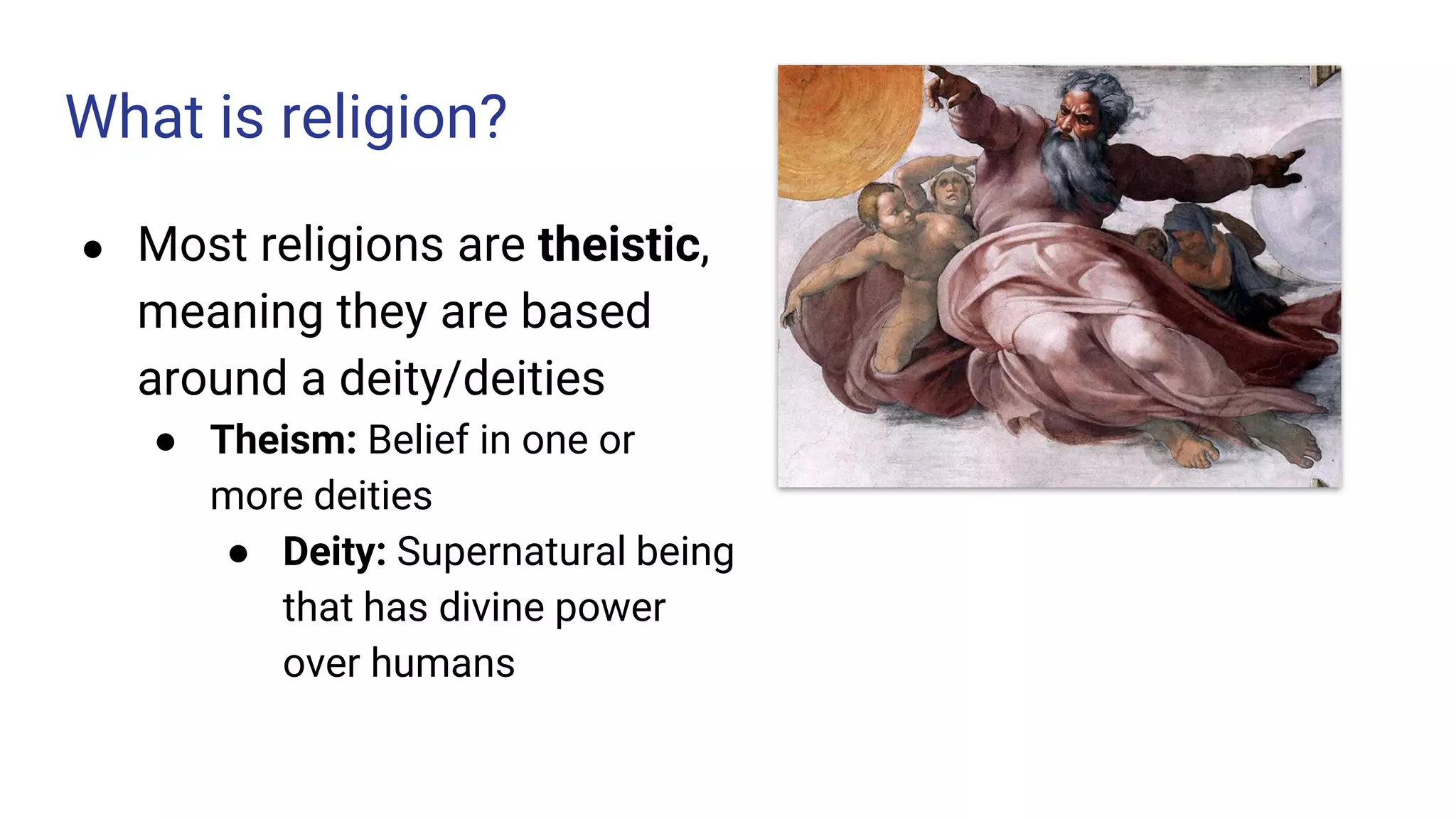
● Most religions are theistic,
meaning they are based
around a deity/deities
● Theism: Belief in one or
more deities
● Deity: Supernatural being
that has divine power
over humans
What is religion?
● Theism and religion often work together, but do
not have to
● There is such a thing as a non-theistic religion
○ Non-theism: Apathy or silence towards the subject of deities
○ Supernaturality is still at play, just not in the form of a deity
What is religion?
● Deities are responsible for
natural occurrences and laws
● Not all religions believe in direct
involvement from deities
○ Deism: A religion that
believes God created the
universe and allowed it to
evolve on its own
This analogy is a common way to describe the beliefs of deism:
If you are walking down a beach and happen across a watch, your
immediate assumption would be that someone created it—it’s far too
complex for nature to have randomly created it. The universe is like
the watch—it’s far too complex to have been created by accident.
Human beings are so fragile, and so complicated, that someone had
to have created them.
The watch is the universe and everything in it, and the watchmaker is
God.
With a partner...
What are the purposes of a religion? Brainstorm some
different reasons about why human beings have religion
Purposes of Religion
● Religion is typically used for three main things:
○ Explaining natural events and phenomena
○ Providing a set of ethics and morals
○ Eschatology
Natural Events and Phenomena
Moral and Ethical Rules
Eschatology (ultimate destiny of humanity)
What areas of the world appear to be the most religious? Why
might some countries be more religious than others?
Atheism vs. Agnosticism
● Atheism is the total lack of belief in deities or the
supernatural
○ Usually cites lack of evidence
○ Atheism is different than non-theism, because non-theists
still believe in the supernatural
Atheism vs. Agnosticism
Agnosticism and atheism are not the same
● Gnosis is knowledge of spiritual mysteries (God’s existence, the future, God’s
will)
● Agnosticism: The idea that the existence of a deity/deities is unknowable
○ Has nothing to do with whether a deity exists or not
● So…
○ An agnostic Christian still believes in God, but doesn’t believe his existence can be proven
○ Becomes a matter of faith
Secularism
● Secularism: separating religious affairs from non-religious affairs
Example: Teachers or other public school officials cannot force students to pray
(separation of church and state)
Example: Freedom of religion in the 1st Amendment; the U.S. gov’t cannot impose
religion on its people nor can it infringe on its people’s religions
Philosophy
 A religion with deities and the supernatural is a theistic religion
 A religion with the supernatural but no deities is a non-theistic religion
 But what is a religion called that has neither deities nor supernatural
occurrences?
○ A religion with no supernatural element whatsoever is no longer a religion but
instead a philosophy
● Philosophy: a set of values, morality, rules and/or traditions with no
accompanying supernatural belief in a divine being or force
Religion can be as
simple or complicated
as people make it
For example…
Concepts of Religion.pdf

Concepts of Religion.pdf

  • 1.
    Unit 2: Religionand Belief Systems
  • 2.
    Unit in Brief ●Concepts of Religion (important terms and definitions) ● Major Religions ● Religion and Human Interaction ○ Expansion/Conversion ○ Conflicts between/within faiths ○ Impact on Culture ○ Secularism ● Animism ● Hinduism ● Buddhism ● Sikhism ● Confucianism ● Taoism ● Judaism ● Christianity ● Islam
  • 3.
    Concepts of Religion Unit 2:Religions and Belief Systems
  • 4.
    Warm-up With a partner… 1.Define monotheism and polytheism. Give an example of each from a civilization we have learned about this year 2. Define theocracy
  • 5.
    Important Terms ● Theism ●Religion ● Deity/Deities ● Atheism ● Nontheism ● Agnosticism ● Deism ● Secularism
  • 6.
    What is Religion? ●A religion is a set of values, morals, rules, and/or traditions that accompany the supernatural or divine ● To date, there are around 4,200 different religions practiced around the world
  • 7.
    Largest World Religions Christianity 2.1 billion Islam 1.3billion Hinduism 900 million Buddhism 376 million Sikhism 23 million Judaism 14 million
  • 8.
    What is religion? ●Most religions are theistic, meaning they are based around a deity/deities ● Theism: Belief in one or more deities ● Deity: Supernatural being that has divine power over humans
  • 14.
    What is religion? ●Theism and religion often work together, but do not have to ● There is such a thing as a non-theistic religion ○ Non-theism: Apathy or silence towards the subject of deities ○ Supernaturality is still at play, just not in the form of a deity
  • 18.
    What is religion? ●Deities are responsible for natural occurrences and laws ● Not all religions believe in direct involvement from deities ○ Deism: A religion that believes God created the universe and allowed it to evolve on its own
  • 19.
    This analogy isa common way to describe the beliefs of deism: If you are walking down a beach and happen across a watch, your immediate assumption would be that someone created it—it’s far too complex for nature to have randomly created it. The universe is like the watch—it’s far too complex to have been created by accident. Human beings are so fragile, and so complicated, that someone had to have created them. The watch is the universe and everything in it, and the watchmaker is God.
  • 20.
    With a partner... Whatare the purposes of a religion? Brainstorm some different reasons about why human beings have religion
  • 21.
    Purposes of Religion ●Religion is typically used for three main things: ○ Explaining natural events and phenomena ○ Providing a set of ethics and morals ○ Eschatology
  • 22.
  • 23.
  • 24.
  • 25.
    What areas ofthe world appear to be the most religious? Why might some countries be more religious than others?
  • 26.
    Atheism vs. Agnosticism ●Atheism is the total lack of belief in deities or the supernatural ○ Usually cites lack of evidence ○ Atheism is different than non-theism, because non-theists still believe in the supernatural
  • 27.
    Atheism vs. Agnosticism Agnosticismand atheism are not the same ● Gnosis is knowledge of spiritual mysteries (God’s existence, the future, God’s will) ● Agnosticism: The idea that the existence of a deity/deities is unknowable ○ Has nothing to do with whether a deity exists or not ● So… ○ An agnostic Christian still believes in God, but doesn’t believe his existence can be proven ○ Becomes a matter of faith
  • 28.
    Secularism ● Secularism: separatingreligious affairs from non-religious affairs Example: Teachers or other public school officials cannot force students to pray (separation of church and state) Example: Freedom of religion in the 1st Amendment; the U.S. gov’t cannot impose religion on its people nor can it infringe on its people’s religions
  • 29.
    Philosophy  A religionwith deities and the supernatural is a theistic religion  A religion with the supernatural but no deities is a non-theistic religion  But what is a religion called that has neither deities nor supernatural occurrences? ○ A religion with no supernatural element whatsoever is no longer a religion but instead a philosophy ● Philosophy: a set of values, morality, rules and/or traditions with no accompanying supernatural belief in a divine being or force
  • 30.
    Religion can beas simple or complicated as people make it For example…