Writing Your Résumé
ART 287
Your Résumé
• Itemizes the reasons why a prospective
employer should hire you
• Establishes your professional knowledge
• Provides overview of your background
• Sets forth your goals and highlights
your accomplishments
Your Résumé
• Organization is very important
• Decide on format:
Chronological
Functional
Combination
Chronological Résumé
• Most widely used format.
• Lists work experience as history in reverse-date
form, followed by job titles and responsibilities
• Pros: easy for employers to see experience;
good for accomplished designers with
strong work history.
• Cons: focuses on what you’ve done, rather than
what you can do. Not necessarily best for
designers just beginning their careers.
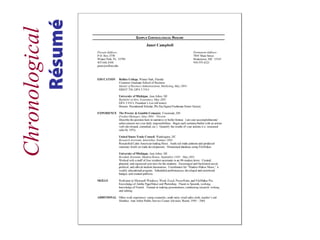
Chronological
Résumé
Functional Résumé
• Describes skills and talents, organized according
to areas of specialization.
• Not as popular as chronological résumé.
• Pros: good for those who have employment
“gaps” or little “real world” experience. Can
effectively show your skills in job-related areas.
• Cons: more difficult to write; more difficult for
prospective employers to determine your
contributions to previous employers.
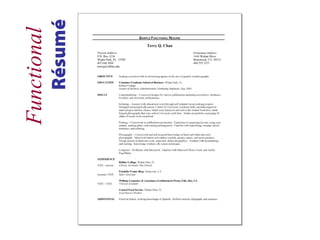
Functional
Résumé
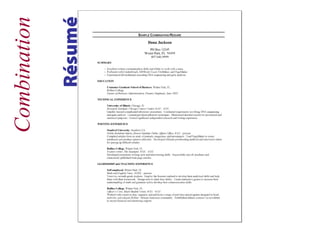
Combination Résumé
• Organizes employment history based on skills
utilized in the job
• Not as popular as chronological résumé.
• Pros: good for those who have diverse job
experiences, or those seeking new career paths.
• Cons: more difficult to write and organize;
more difficult for prospective employers to
determine your contributions to previous
employers.
Combination
Résumé
Your Résumé
• Once you’ve decided on the format,
be sure to include the following
parts of the résumé.
• Focus first on carefully crafting the
language of the résumé. After the writing
is refined, then design the layout.
1) Contact Information
Be sure to include:
• Name, address
• Phone numbers (home and cell)
• Email and web site
• Important for the potential employer to
reach you, and for you to respond fast.
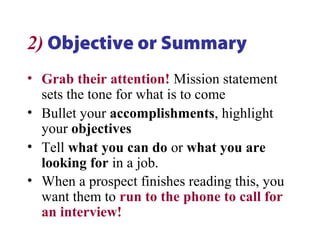
2) Objective or Summary
• Grab their attention! Mission statement
sets the tone for what is to come
• Bullet your accomplishments, highlight
your objectives
• Tell what you can do or what you are
looking for in a job.
• When a prospect finishes reading this, you
want them to run to the phone to call for
an interview!
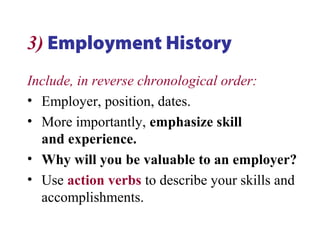
3) Employment History
Include, in reverse chronological order:
• Employer, position, dates.
• More importantly, emphasize skill
and experience.
• Why will you be valuable to an employer?
• Use action verbs to describe your skills and
accomplishments.
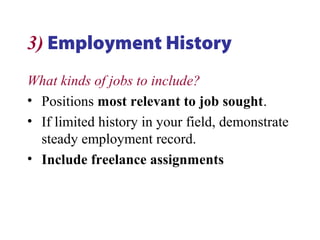
3) Employment History
What kinds of jobs to include?
• Positions most relevant to job sought.
• If limited history in your field, demonstrate
steady employment record.
• Include freelance assignments
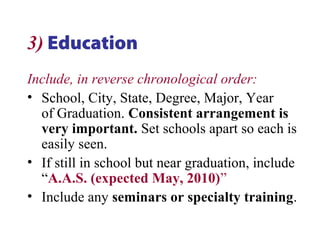
3) Education
Include, in reverse chronological order:
• School, City, State, Degree, Major, Year
of Graduation. Consistent arrangement is
very important. Set schools apart so each is
easily seen.
• If still in school but near graduation, include
“A.A.S. (expected May, 2010)”
• Include any seminars or specialty training.
4) Honors & Certifications
• What special skills set you apart from
everyone else?
• Design awards?
• Academic awards?
• Give details if reader won’t know meaning
of award.
5) Professional Affiliations
• Belong to any professional organizations?
• Students can join Advertising Federation,
the American Institute of Graphic Arts.
Check online for membership requirements
and fees.
6) Additional Information
• Hobbies, interests, clubs.
• Employers like to see well-rounded
individuals with other interests.
• Non-work activities can demonstrate
leadership skills.
6) References
• References furnished on request
• Have a separate sheet ready (matching your
résumé) that includes three references
(names with reliable, accurate contact info).
• Always secure permission to use someone
as a reference, and make sure they will
available and will give you a good
reference!
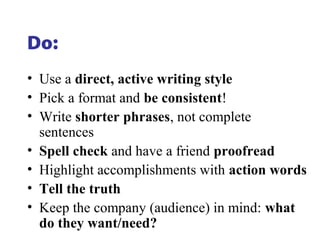
Do:
• Use a direct, active writing style
• Pick a format and be consistent!
• Write shorter phrases, not complete
sentences
• Spell check and have a friend proofread
• Highlight accomplishments with action words
• Tell the truth
• Keep the company (audience) in mind: what
do they want/need?
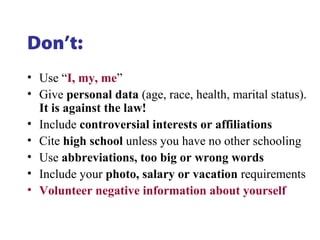
Don’t:
• Use “I, my, me”
• Give personal data (age, race, health, marital status).
It is against the law!
• Include controversial interests or affiliations
• Cite high school unless you have no other schooling
• Use abbreviations, too big or wrong words
• Include your photo, salary or vacation requirements
• Volunteer negative information about yourself

2 write résumé

  • 1.
  • 2.
    Your Résumé • Itemizesthe reasons why a prospective employer should hire you • Establishes your professional knowledge • Provides overview of your background • Sets forth your goals and highlights your accomplishments
  • 3.
    Your Résumé • Organizationis very important • Decide on format: Chronological Functional Combination
  • 4.
    Chronological Résumé • Mostwidely used format. • Lists work experience as history in reverse-date form, followed by job titles and responsibilities • Pros: easy for employers to see experience; good for accomplished designers with strong work history. • Cons: focuses on what you’ve done, rather than what you can do. Not necessarily best for designers just beginning their careers.
  • 5.
  • 6.
    Functional Résumé • Describesskills and talents, organized according to areas of specialization. • Not as popular as chronological résumé. • Pros: good for those who have employment “gaps” or little “real world” experience. Can effectively show your skills in job-related areas. • Cons: more difficult to write; more difficult for prospective employers to determine your contributions to previous employers.
  • 7.
  • 8.
    Combination Résumé • Organizesemployment history based on skills utilized in the job • Not as popular as chronological résumé. • Pros: good for those who have diverse job experiences, or those seeking new career paths. • Cons: more difficult to write and organize; more difficult for prospective employers to determine your contributions to previous employers.
  • 9.
  • 10.
    Your Résumé • Onceyou’ve decided on the format, be sure to include the following parts of the résumé. • Focus first on carefully crafting the language of the résumé. After the writing is refined, then design the layout.
  • 11.
    1) Contact Information Besure to include: • Name, address • Phone numbers (home and cell) • Email and web site • Important for the potential employer to reach you, and for you to respond fast.
  • 12.
    2) Objective orSummary • Grab their attention! Mission statement sets the tone for what is to come • Bullet your accomplishments, highlight your objectives • Tell what you can do or what you are looking for in a job. • When a prospect finishes reading this, you want them to run to the phone to call for an interview!
  • 13.
    3) Employment History Include,in reverse chronological order: • Employer, position, dates. • More importantly, emphasize skill and experience. • Why will you be valuable to an employer? • Use action verbs to describe your skills and accomplishments.
  • 14.
    3) Employment History Whatkinds of jobs to include? • Positions most relevant to job sought. • If limited history in your field, demonstrate steady employment record. • Include freelance assignments
  • 15.
    3) Education Include, inreverse chronological order: • School, City, State, Degree, Major, Year of Graduation. Consistent arrangement is very important. Set schools apart so each is easily seen. • If still in school but near graduation, include “A.A.S. (expected May, 2010)” • Include any seminars or specialty training.
  • 16.
    4) Honors &Certifications • What special skills set you apart from everyone else? • Design awards? • Academic awards? • Give details if reader won’t know meaning of award.
  • 17.
    5) Professional Affiliations •Belong to any professional organizations? • Students can join Advertising Federation, the American Institute of Graphic Arts. Check online for membership requirements and fees.
  • 18.
    6) Additional Information •Hobbies, interests, clubs. • Employers like to see well-rounded individuals with other interests. • Non-work activities can demonstrate leadership skills.
  • 19.
    6) References • Referencesfurnished on request • Have a separate sheet ready (matching your résumé) that includes three references (names with reliable, accurate contact info). • Always secure permission to use someone as a reference, and make sure they will available and will give you a good reference!
  • 20.
    Do: • Use adirect, active writing style • Pick a format and be consistent! • Write shorter phrases, not complete sentences • Spell check and have a friend proofread • Highlight accomplishments with action words • Tell the truth • Keep the company (audience) in mind: what do they want/need?
  • 21.
    Don’t: • Use “I,my, me” • Give personal data (age, race, health, marital status). It is against the law! • Include controversial interests or affiliations • Cite high school unless you have no other schooling • Use abbreviations, too big or wrong words • Include your photo, salary or vacation requirements • Volunteer negative information about yourself