1
Alström syndrome and PBI-4050:
A case-study of the challenges and
barriers facing patients, physicians
and industry in developing new
treatments for rare diseases
The regulatory - clinical development
perspective
Dr. Owen J. Vaughan
Senior Director, Regulatory Affairs
Prometic Pharma SMT Ltd.
CRDN (Cambridge, UK) – October 20, 2017
© Prometic Life Sciences Inc 2017
Alström syndrome – Overview
Key Eligibility Criteria
Alström syndrome 1 (ALMS1) - A rare autosomal recessive
disease (mutations in a large gene located on chromosome 2p13-
identified in 2002). Alström syndrome is a fibrotic multi-organ
disease with gradual unfolding of phenotypes.
Characterized by childhood onset obesity, extreme insulin
resistance, type 2 diabetes mellitus (T2DM), dyslipidaemia,
hypertension and multi-organ fibrosis.
Other features include retinal cone-rod dystrophy, hearing loss,
short stature, cardiomyopathy progressive cardiac, pulmonary,
hepatic, and renal dysfunction.
Complex, varied clinical picture. Limited natural history data.
Leads to delays in diagnosis. Reduced life expectancy.
Clinical challenges to develop treatment strategies and need for
specialised multi-disciplinary clinics.
Subject recruitment is a major challenge for clinical trials.
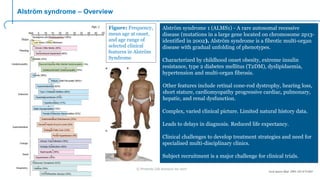
Figure: Frequency,
mean age at onset,
and age range of
selected clinical
features in Alström
Syndrome
Arch Intern Med. 2005;165:675-683
© Prometic Life Sciences Inc 2017
Alström syndrome and PBI-4050 - Example of ‘matching’ drug development with a
rare (orphan) disease
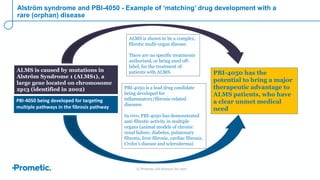
ALMS is shown to be a complex,
fibrotic multi-organ disease.
There are no specific treatments
authorised, or being used off-
label, for the treatment of
patients with ALMS.ALMS is caused by mutations in
Alström Syndrome 1 (ALMS1), a
large gene located on chromosome
2p13 (identified in 2002)
PBI-4050 has the
potential to bring a major
therapeutic advantage to
ALMS patients, who have
a clear unmet medical
need
PBI-4050 being developed for targeting
multiple pathways in the fibrosis pathway
PBI-4050 is a lead drug candidate
being developed for
inflammatory/fibrosis-related
diseases.
In vivo, PBI-4050 has demonstrated
anti-fibrotic activity in multiple
organs (animal models of chronic
renal failure, diabetes, pulmonary
fibrosis, liver fibrosis, cardiac fibrosis,
Crohn’s disease and scleroderma)
© Prometic Life Sciences Inc 2017
Alström Syndrome and PBI-4050 - Development of first proof-of-concept (PoC) study
Key challenge is capability to
engage appropriate stakeholders
(clinical experts, industry etc.)
The heterogenous and varied
clinical variability, limited natural
history data are key areas for
development.
A key challenge going forward is
the acceptability of clinical
endpoints.
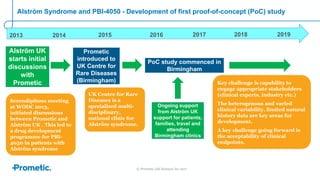
2013 2014 2015 2016 2017 2018
Serendipitous meeting
at WODC 2013,
initiated discussions
between Prometic and
Alström UK . This led to
a drug development
programme for PBI-
4050 in patients with
Alström syndrome
Alström UK
starts initial
discussions
with
Prometic
Prometic
introduced to
UK Centre for
Rare Diseases
(Birmingham)
PoC study commenced in
Birmingham
Ongoing support
from Alström UK
support for patients,
families, travel and
attending
Birmingham clinics
2019
UK Centre for Rare
Diseases is a
specialised multi-
disciplinary,
national clinic for
Alström syndrome.
© Prometic Life Sciences Inc 2017
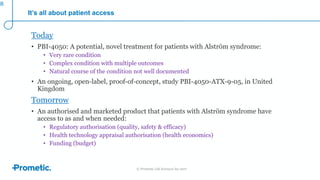
Today
• PBI-4050: A potential, novel treatment for patients with Alström syndrome:
• Very rare condition
• Complex condition with multiple outcomes
• Natural course of the condition not well documented
• An ongoing, open-label, proof-of-concept, study PBI-4050-ATX-9-05, in United
Kingdom
Tomorrow
• An authorised and marketed product that patients with Alström syndrome have
access to as and when needed:
• Regulatory authorisation (quality, safety & efficacy)
• Health technology appraisal authorisation (health economics)
• Funding (budget)
8
It’s all about patient access
© Prometic Life Sciences Inc 2017
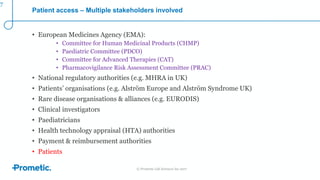
Patient access – Multiple stakeholders involved
• European Medicines Agency (EMA):
• Committee for Human Medicinal Products (CHMP)
• Paediatric Committee (PDCO)
• Committee for Advanced Therapies (CAT)
• Pharmacovigilance Risk Assessment Committee (PRAC)
• National regulatory authorities (e.g. MHRA in UK)
• Patients’ organisations (e.g. Alström Europe and Alström Syndrome UK)
• Rare disease organisations & alliances (e.g. EURODIS)
• Clinical investigators
• Paediatricians
• Health technology appraisal (HTA) authorities
• Payment & reimbursement authorities
• Patients
7
© Prometic Life Sciences Inc 2017
8
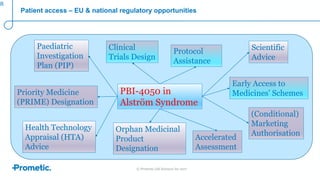
Patient access – EU & national regulatory opportunities
PBI-4050 in
Alström Syndrome
Paediatric
Investigation
Plan (PIP)
Scientific
Advice
(Conditional)
Marketing
Authorisation
Health Technology
Appraisal (HTA)
Advice
Orphan Medicinal
Product
Designation
Accelerated
Assessment
Early Access to
Medicines’ Schemes
Clinical
Trials Design
Priority Medicine
(PRIME) Designation
Protocol
Assistance
© Prometic Life Sciences Inc 2017
9
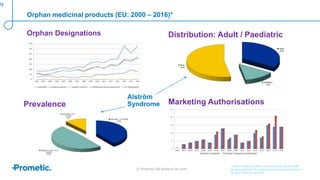
Distribution: Adult / Paediatric
Prevalence Marketing Authorisations
Orphan Designations
Orphan medicinal products (EU: 2000 – 2016)*
* Figures Taken from EMA Annual report on the use of the
special contribution for orphan medicinal products (January
25, 2017; EMA/40172/2017)
Alström
Syndrome
© Prometic Life Sciences Inc 2017
10
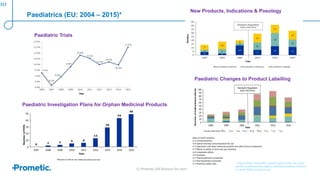
Paediatrics (EU: 2004 – 2015)*
Paediatric Trials
New Products, Indications & Posology
Paediatric Investigation Plans for Orphan Medicinal Products
Paediatric Changes to Product Labelling
* Figures Taken from EMA Annual report on the use of the
special contribution for orphan medicinal products (October
27, 2016; EMA/231225/2015)
© Prometic Life Sciences Inc 2017
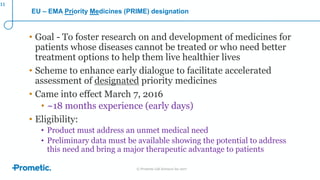
EU – EMA Priority Medicines (PRIME) designation
• Goal - To foster research on and development of medicines for
patients whose diseases cannot be treated or who need better
treatment options to help them live healthier lives
• Scheme to enhance early dialogue to facilitate accelerated
assessment of designated priority medicines
• Came into effect March 7, 2016
• ~18 months experience (early days)
• Eligibility:
• Product must address an unmet medical need
• Preliminary data must be available showing the potential to address
this need and bring a major therapeutic advantage to patients
11
© Prometic Life Sciences Inc 2017
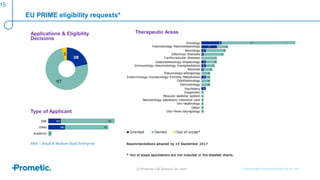
15
EU PRIME eligibility requests*
* Figures Taken from EMA Website Oct 16,, 2017
Applications & Eligibility
Decisions
Type of Applicant
Therapeutic Areas
SME = Small & Medium Sized Enterprise
© Prometic Life Sciences Inc 2017
Benefits of EU PRIME designation
Once a candidate has been selected for PRIME, the EMA:
• Appoints a Rapporteur from the CHMP (or CAT) to provide continuous support
and help to build knowledge ahead of marketing authorisation application;
• Organises a kick-off meeting with the CHMP (or CAT) Rapporteur and a
multidisciplinary group of experts from relevant EMA scientific committees and
working parties;
• Issues guidance on a company’s overall development plan and regulatory
strategy;
• Offers a dedicated EMA contact person;
• Provides scientific advice at key development milestones, involving additional
stakeholders as needed – e.g. health technology assessment bodies and patients.
Medicines eligible for PRIME are also potentially eligible for accelerated
assessment at the time of application for a marketing authorisations
14
© Prometic Life Sciences Inc 2017
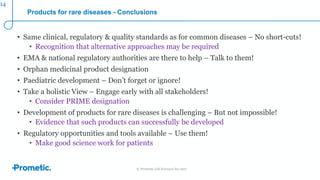
Products for rare diseases - Conclusions
• Same clinical, regulatory & quality standards as for common diseases – No short-cuts!
• Recognition that alternative approaches may be required
• EMA & national regulatory authorities are there to help – Talk to them!
• Orphan medicinal product designation
• Paediatric development – Don’t forget or ignore!
• Take a holistic View – Engage early with all stakeholders!
• Consider PRIME designation
• Development of products for rare diseases is challenging – But not impossible!
• Evidence that such products can successfully be developed
• Regulatory opportunities and tools available – Use them!
• Make good science work for patients
14
© Prometic Life Sciences Inc 2017 15
Thank you

Owen Vaughan prometics crdn summit 2017

  • 1.
  • 2.
    Alström syndrome andPBI-4050: A case-study of the challenges and barriers facing patients, physicians and industry in developing new treatments for rare diseases The regulatory - clinical development perspective Dr. Owen J. Vaughan Senior Director, Regulatory Affairs Prometic Pharma SMT Ltd. CRDN (Cambridge, UK) – October 20, 2017
  • 3.
    © Prometic LifeSciences Inc 2017 Alström syndrome – Overview Key Eligibility Criteria Alström syndrome 1 (ALMS1) - A rare autosomal recessive disease (mutations in a large gene located on chromosome 2p13- identified in 2002). Alström syndrome is a fibrotic multi-organ disease with gradual unfolding of phenotypes. Characterized by childhood onset obesity, extreme insulin resistance, type 2 diabetes mellitus (T2DM), dyslipidaemia, hypertension and multi-organ fibrosis. Other features include retinal cone-rod dystrophy, hearing loss, short stature, cardiomyopathy progressive cardiac, pulmonary, hepatic, and renal dysfunction. Complex, varied clinical picture. Limited natural history data. Leads to delays in diagnosis. Reduced life expectancy. Clinical challenges to develop treatment strategies and need for specialised multi-disciplinary clinics. Subject recruitment is a major challenge for clinical trials. Figure: Frequency, mean age at onset, and age range of selected clinical features in Alström Syndrome Arch Intern Med. 2005;165:675-683
  • 4.
    © Prometic LifeSciences Inc 2017 Alström syndrome and PBI-4050 - Example of ‘matching’ drug development with a rare (orphan) disease ALMS is shown to be a complex, fibrotic multi-organ disease. There are no specific treatments authorised, or being used off- label, for the treatment of patients with ALMS.ALMS is caused by mutations in Alström Syndrome 1 (ALMS1), a large gene located on chromosome 2p13 (identified in 2002) PBI-4050 has the potential to bring a major therapeutic advantage to ALMS patients, who have a clear unmet medical need PBI-4050 being developed for targeting multiple pathways in the fibrosis pathway PBI-4050 is a lead drug candidate being developed for inflammatory/fibrosis-related diseases. In vivo, PBI-4050 has demonstrated anti-fibrotic activity in multiple organs (animal models of chronic renal failure, diabetes, pulmonary fibrosis, liver fibrosis, cardiac fibrosis, Crohn’s disease and scleroderma)
  • 5.
    © Prometic LifeSciences Inc 2017 Alström Syndrome and PBI-4050 - Development of first proof-of-concept (PoC) study Key challenge is capability to engage appropriate stakeholders (clinical experts, industry etc.) The heterogenous and varied clinical variability, limited natural history data are key areas for development. A key challenge going forward is the acceptability of clinical endpoints. 2013 2014 2015 2016 2017 2018 Serendipitous meeting at WODC 2013, initiated discussions between Prometic and Alström UK . This led to a drug development programme for PBI- 4050 in patients with Alström syndrome Alström UK starts initial discussions with Prometic Prometic introduced to UK Centre for Rare Diseases (Birmingham) PoC study commenced in Birmingham Ongoing support from Alström UK support for patients, families, travel and attending Birmingham clinics 2019 UK Centre for Rare Diseases is a specialised multi- disciplinary, national clinic for Alström syndrome.
  • 6.
    © Prometic LifeSciences Inc 2017 Today • PBI-4050: A potential, novel treatment for patients with Alström syndrome: • Very rare condition • Complex condition with multiple outcomes • Natural course of the condition not well documented • An ongoing, open-label, proof-of-concept, study PBI-4050-ATX-9-05, in United Kingdom Tomorrow • An authorised and marketed product that patients with Alström syndrome have access to as and when needed: • Regulatory authorisation (quality, safety & efficacy) • Health technology appraisal authorisation (health economics) • Funding (budget) 8 It’s all about patient access
  • 7.
    © Prometic LifeSciences Inc 2017 Patient access – Multiple stakeholders involved • European Medicines Agency (EMA): • Committee for Human Medicinal Products (CHMP) • Paediatric Committee (PDCO) • Committee for Advanced Therapies (CAT) • Pharmacovigilance Risk Assessment Committee (PRAC) • National regulatory authorities (e.g. MHRA in UK) • Patients’ organisations (e.g. Alström Europe and Alström Syndrome UK) • Rare disease organisations & alliances (e.g. EURODIS) • Clinical investigators • Paediatricians • Health technology appraisal (HTA) authorities • Payment & reimbursement authorities • Patients 7
  • 8.
    © Prometic LifeSciences Inc 2017 8 Patient access – EU & national regulatory opportunities PBI-4050 in Alström Syndrome Paediatric Investigation Plan (PIP) Scientific Advice (Conditional) Marketing Authorisation Health Technology Appraisal (HTA) Advice Orphan Medicinal Product Designation Accelerated Assessment Early Access to Medicines’ Schemes Clinical Trials Design Priority Medicine (PRIME) Designation Protocol Assistance
  • 9.
    © Prometic LifeSciences Inc 2017 9 Distribution: Adult / Paediatric Prevalence Marketing Authorisations Orphan Designations Orphan medicinal products (EU: 2000 – 2016)* * Figures Taken from EMA Annual report on the use of the special contribution for orphan medicinal products (January 25, 2017; EMA/40172/2017) Alström Syndrome
  • 10.
    © Prometic LifeSciences Inc 2017 10 Paediatrics (EU: 2004 – 2015)* Paediatric Trials New Products, Indications & Posology Paediatric Investigation Plans for Orphan Medicinal Products Paediatric Changes to Product Labelling * Figures Taken from EMA Annual report on the use of the special contribution for orphan medicinal products (October 27, 2016; EMA/231225/2015)
  • 11.
    © Prometic LifeSciences Inc 2017 EU – EMA Priority Medicines (PRIME) designation • Goal - To foster research on and development of medicines for patients whose diseases cannot be treated or who need better treatment options to help them live healthier lives • Scheme to enhance early dialogue to facilitate accelerated assessment of designated priority medicines • Came into effect March 7, 2016 • ~18 months experience (early days) • Eligibility: • Product must address an unmet medical need • Preliminary data must be available showing the potential to address this need and bring a major therapeutic advantage to patients 11
  • 12.
    © Prometic LifeSciences Inc 2017 15 EU PRIME eligibility requests* * Figures Taken from EMA Website Oct 16,, 2017 Applications & Eligibility Decisions Type of Applicant Therapeutic Areas SME = Small & Medium Sized Enterprise
  • 13.
    © Prometic LifeSciences Inc 2017 Benefits of EU PRIME designation Once a candidate has been selected for PRIME, the EMA: • Appoints a Rapporteur from the CHMP (or CAT) to provide continuous support and help to build knowledge ahead of marketing authorisation application; • Organises a kick-off meeting with the CHMP (or CAT) Rapporteur and a multidisciplinary group of experts from relevant EMA scientific committees and working parties; • Issues guidance on a company’s overall development plan and regulatory strategy; • Offers a dedicated EMA contact person; • Provides scientific advice at key development milestones, involving additional stakeholders as needed – e.g. health technology assessment bodies and patients. Medicines eligible for PRIME are also potentially eligible for accelerated assessment at the time of application for a marketing authorisations 14
  • 14.
    © Prometic LifeSciences Inc 2017 Products for rare diseases - Conclusions • Same clinical, regulatory & quality standards as for common diseases – No short-cuts! • Recognition that alternative approaches may be required • EMA & national regulatory authorities are there to help – Talk to them! • Orphan medicinal product designation • Paediatric development – Don’t forget or ignore! • Take a holistic View – Engage early with all stakeholders! • Consider PRIME designation • Development of products for rare diseases is challenging – But not impossible! • Evidence that such products can successfully be developed • Regulatory opportunities and tools available – Use them! • Make good science work for patients 14
  • 15.
    © Prometic LifeSciences Inc 2017 15 Thank you